
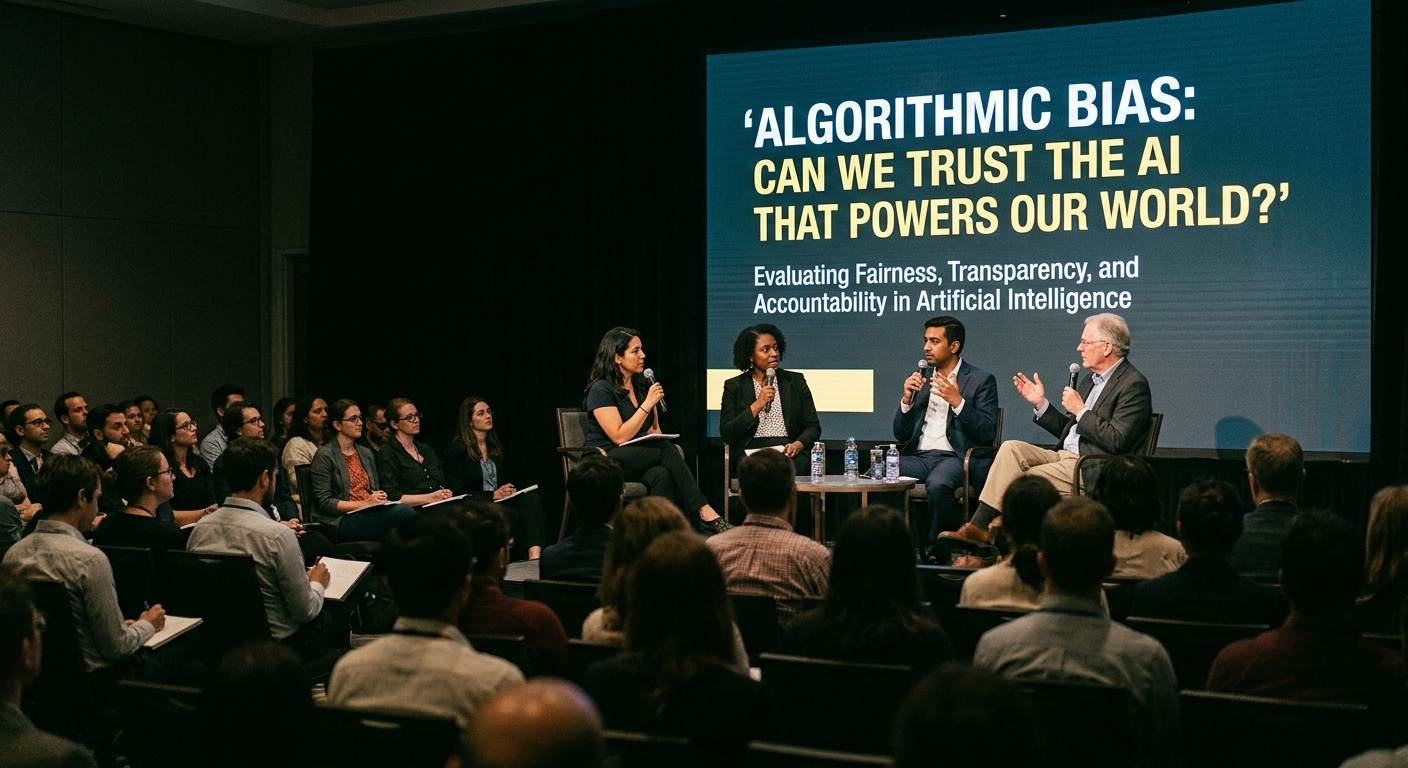
A Comprehensive Thesis on Artificial Intelligence, Bias, Fairness, Accountability, and Human Trust
Abstract
Artificial intelligence has moved from research laboratories into everyday life. Algorithms increasingly influence what people see online, how information is organized, how businesses identify potential customers, how institutions allocate resources, and how organizations make predictions and recommendations. AI can improve efficiency, discover patterns in enormous datasets, support scientific research, personalize education, and assist professionals in complex tasks. Yet the same systems can reproduce or amplify patterns of discrimination and inequality.
This problem is commonly described as algorithmic bias: systematic patterns in an AI system’s outputs that produce unfair or undesirable differences between people or groups. Bias can originate in historical data, sampling decisions, labels, measurement methods, model architecture, optimization objectives, deployment environments, human decisions, or feedback loops. It is therefore misleading to think of bias as merely a programming error that can always be removed by changing a line of code.
The central question is consequently not simply, “Is AI biased?” but rather: Under what conditions can humans reasonably trust an AI system?
Trustworthy AI requires more than high accuracy. It requires appropriate data, rigorous testing, fairness assessment, transparency, security, privacy protection, accountability, human oversight, monitoring after deployment, and mechanisms through which affected people can challenge harmful decisions. UNESCO’s global AI ethics framework emphasizes human rights, dignity, fairness, non-discrimination, transparency, accountability, and human oversight as fundamental principles for responsible AI.
This thesis examines the anatomy of algorithmic bias, its sources, manifestations across society, technical and institutional remedies, limitations of current approaches, and the conditions necessary for responsible deployment of AI.
1. Introduction
Artificial intelligence is increasingly becoming part of the infrastructure of modern society.
Search engines rank information. Recommendation systems select content. Fraud-detection systems identify unusual transactions. Language models generate text. Computer-vision systems interpret images. Predictive systems estimate future events. Automated systems assist organizations in deciding where attention and resources should be directed.
The increasing importance of AI creates an important societal question:
Can decisions produced or influenced by machines be trusted simply because they are computational?
The answer is no.
A computer does not automatically transform imperfect human information into perfectly objective knowledge. An AI system learns from data, objectives, measurements, assumptions and feedback. If these components contain systematic distortions, the resulting system may reproduce them.
UNESCO explicitly recognizes that AI can embed and amplify existing biases and potentially contribute to discrimination, inequality and exclusion. Its Recommendation on the Ethics of Artificial Intelligence places fairness, non-discrimination, transparency, accountability and human oversight among its core principles.
Algorithmic bias therefore represents one of the central challenges of the AI era.
2. Understanding Algorithms
An algorithm is a structured procedure for solving a problem or transforming inputs into outputs.
A simple algorithm might calculate an average:
[
Average = \frac{\sum x_i}{n}
]
Modern AI systems can be vastly more complicated. A machine-learning model may contain millions or billions of adjustable parameters and learn statistical relationships from enormous datasets.
A simplified AI pipeline can be represented as:
Data → Preparation → Model → Training → Evaluation → Deployment → Feedback
Bias can potentially enter at every stage.
For example:
- the data may not represent the population;
- labels may reflect human prejudice;
- measurements may be inaccurate;
- the objective function may prioritize the wrong outcome;
- evaluation data may differ from real-world conditions;
- deployment may affect different groups differently;
- users may generate feedback that reinforces the original model’s behavior.
Consequently, algorithmic fairness is not simply a property of the mathematical model.
It is a property of the larger socio-technical system.
3. What Is Algorithmic Bias?
Algorithmic bias refers broadly to systematic patterns in automated or AI-assisted decisions that create unfair, inaccurate, or undesirable outcomes.
Bias does not necessarily mean that a programmer deliberately discriminated against someone.
It can emerge unintentionally.
Consider a hypothetical hiring model trained primarily on historical hiring decisions. If historical decisions favored one group because of institutional practices, the model may discover correlations associated with those decisions and reproduce them.
The model may therefore appear mathematically consistent while still producing socially problematic outcomes.
This leads to an important distinction:
Statistical consistency is not the same as social fairness.
A model can be:
- technically sophisticated;
- highly predictive;
- computationally efficient;
- statistically stable;
and still be inappropriate for a particular social application.
4. The Anatomy of Algorithmic Bias
Algorithmic bias can be divided into several interconnected categories.
4.1 Historical Bias
Historical bias occurs when the underlying data reflects inequalities or patterns from the past.
Suppose an organization has historically provided opportunities unevenly among different populations.
A machine-learning system trained on those historical outcomes may learn the pattern.
The AI is not necessarily “inventing” the bias.
It is learning history.
This creates an important philosophical problem:
If the past is unequal, should an AI system reproduce the past accurately?
In many applications, the answer should be no.
Prediction and justice are different objectives.
4.2 Sampling Bias
Sampling bias occurs when the training dataset does not adequately represent the population in which the system will operate.
Imagine an image-recognition model trained primarily on one demographic group.
Its average accuracy might appear impressive, while performance for underrepresented groups may be substantially worse.
This demonstrates why aggregate accuracy can be misleading.
A model’s overall performance might be:
[
Accuracy_{overall}=95%
]
while performance varies significantly across groups.
Therefore, responsible evaluation should examine:
[
Performance_{group1}, Performance_{group2}, …, Performance_{groupn}
]
rather than relying exclusively on one overall score.
5. Measurement Bias
AI systems often depend on measurements that are imperfect representations of the phenomenon researchers actually care about.
For example:
Target concept: ability to perform a job.
Measured variables: historical performance scores, educational credentials, interview ratings and employment history.
These variables are not identical to ability.
They are proxies.
If the proxies are systematically influenced by social or institutional factors, an AI model can inherit those distortions.
This is known as a measurement problem.
The deeper question is therefore:
What exactly are we measuring, and does the measurement genuinely represent the outcome we claim to predict?
6. Label Bias
Supervised machine learning frequently requires labels.
A dataset might contain examples such as:
Input → Label
The problem is that labels are often created by people or institutions.
Human judgment is not automatically neutral.
Two people can interpret the same case differently.
A historical classification may itself have been influenced by:
- incomplete information;
- institutional practices;
- cultural assumptions;
- inconsistent standards;
- socioeconomic conditions;
- human error.
Consequently:
Biased labels → biased training signal → biased model behavior
7. Selection Bias
Selection bias occurs when the data available to an AI system is systematically different from the population it is supposed to represent.
This is especially important when AI systems learn from historical records.
Data often exists because someone previously decided to collect it.
That means:
What gets recorded can be as important as what actually happened.
An absence of data does not necessarily mean an absence of the underlying phenomenon.
8. Proxy Variables
One of the most difficult problems in algorithmic fairness is the existence of proxy variables.
A system may not explicitly use a sensitive attribute, yet another variable may contain information correlated with it.
For example, a model might exclude a particular demographic attribute while using geographic, economic, educational or behavioral variables that correlate strongly with demographic characteristics.
Simply deleting one column therefore does not automatically eliminate bias.
This illustrates an important principle:
Fairness cannot always be achieved by deleting sensitive attributes from the dataset.
9. Model Bias
Bias can also arise from the model itself.
Machine-learning systems optimize objectives.
For example:
[
\min_{\theta} L(\theta)
]
where:
- (\theta) represents model parameters;
- (L) represents a loss function.
If the system is optimized exclusively for predictive accuracy, it may select a solution that maximizes average accuracy without adequately considering differences in outcomes across groups.
This creates a fundamental engineering challenge:
What should the model optimize?
Possible objectives include:
- accuracy;
- reliability;
- fairness;
- safety;
- privacy;
- efficiency;
- robustness;
- interpretability.
These objectives can sometimes conflict.
10. Bias in Generative AI
Generative AI introduces another dimension.
Large language models and other generative systems learn statistical relationships from enormous collections of information.
Their outputs can therefore reflect patterns present in training material.
Potential problems include:
- stereotypical associations;
- uneven representation;
- cultural assumptions;
- linguistic imbalances;
- misinformation;
- inappropriate generalizations;
- unequal performance across languages and populations.
The issue is particularly important because generative AI produces new content rather than simply selecting an existing record.
The system can transform patterns from its training distribution into new outputs.
Therefore, the problem is not simply:
“What information did the model memorize?”
It is also:
“What relationships did the model learn?”
11. Language Bias
AI does not operate equally well across every language.
Large quantities of digital information exist in some languages, while many others have considerably less digitized material.
This creates an imbalance in training resources.
A model may therefore demonstrate:
- stronger performance in high-resource languages;
- weaker performance in low-resource languages;
- different cultural interpretations;
- reduced linguistic nuance;
- poorer translation quality.
For multilingual societies, this becomes a major issue.
An AI system that works extremely well in one language but poorly in another can unintentionally create a technological inequality.
12. Cultural Bias
AI systems operate within cultural environments.
Concepts such as:
- family;
- education;
- success;
- leadership;
- beauty;
- authority;
- work;
- community;
- communication;
can vary across societies.
A model trained predominantly on one cultural environment may incorrectly treat one cultural pattern as universal.
UNESCO’s AI ethics framework specifically emphasizes diversity, inclusion, cultural diversity, multilingualism and participation.
13. Gender Bias
Gender bias is one of the well-known forms of algorithmic bias.
It can arise from:
- historical stereotypes;
- unequal representation;
- biased language;
- image datasets;
- occupational stereotypes;
- unequal participation in technical fields.
UNESCO provides examples of gender bias in search and AI systems and emphasizes minimizing stereotypical representations in algorithms, datasets and decision-making systems.
The broader lesson is that AI can reflect the social environment from which its information originates.
14. Racial and Ethnic Bias
AI systems can also produce unequal outcomes across racial or ethnic populations when training data, measurements, institutional processes or deployment environments contain systematic differences.
This can be especially serious when AI is used in high-impact environments.
The appropriate response is not merely to ask whether a model “uses race.”
Instead, developers should investigate:
- which variables influence predictions;
- whether proxy variables exist;
- whether error rates differ;
- whether data coverage differs;
- whether historical processes generated biased labels;
- whether deployment affects communities differently.
15. Economic and Class Bias
AI can also reproduce socioeconomic inequalities.
People with greater access to:
- high-quality education;
- digital services;
- financial resources;
- reliable connectivity;
- advanced devices;
may generate richer digital footprints.
Systems trained on such information can therefore perform differently for people whose lives are less represented digitally.
This creates a potential cycle:
Digital inequality → unequal data → unequal AI performance → greater digital inequality
Breaking this cycle requires deliberate intervention.
16. Geographic Bias
AI models may perform differently across countries, regions, cities and rural communities.
Geographic bias can result from:
- uneven data collection;
- language differences;
- infrastructure differences;
- socioeconomic variation;
- climate variation;
- cultural differences;
- different regulatory environments.
A model designed in one country cannot automatically be assumed to perform equally well everywhere.
17. Algorithmic Bias in Healthcare
Healthcare is an especially sensitive field because AI outputs can influence important decisions.
Potential sources of bias include:
- unequal medical datasets;
- differences in access to healthcare;
- incomplete records;
- historical treatment differences;
- demographic underrepresentation;
- differences in disease presentation;
- unequal availability of medical technology.
A healthcare AI model should therefore be evaluated not merely for overall accuracy but also for clinically meaningful performance across relevant populations.
The principle should be:
AI should assist healthcare professionals, not eliminate professional responsibility.
UNESCO’s framework emphasizes human oversight and ultimate human responsibility for AI systems.
18. Algorithmic Bias in Education
AI is increasingly capable of supporting:
- tutoring;
- assessment;
- personalized learning;
- educational recommendations;
- language learning;
- administrative processes.
But educational AI can inherit biases from historical achievement data.
A predictive system might interpret past educational outcomes as evidence of future potential without adequately considering differences in opportunity, resources or learning environments.
The danger is creating a self-reinforcing cycle:
Past inequality → biased prediction → reduced opportunity → future inequality
Responsible educational AI must therefore distinguish between prediction of historical outcomes and promotion of educational opportunity.
19. Algorithmic Bias in Employment
AI-assisted recruitment can process thousands of applications.
This can be useful.
But automated recruitment systems may inherit biases from:
- historical hiring;
- educational requirements;
- employment gaps;
- language patterns;
- professional networks;
- historical performance assessments.
A key principle is:
Efficiency does not justify discrimination.
An organization should be able to explain what a recruitment system is measuring, why the variables matter, and how the system is tested for unequal outcomes.
20. Algorithmic Bias in Finance
Financial institutions use algorithms for:
- fraud detection;
- credit assessment;
- risk management;
- customer segmentation;
- transaction monitoring.
Financial models can produce unequal outcomes when their input variables reflect historical socioeconomic inequalities.
The challenge is balancing:
Risk management + accuracy + fairness + privacy + explainability
A model that is highly accurate but systematically disadvantages particular groups may still be inappropriate.
21. Algorithmic Bias in Search and Recommendation Systems
Search engines and recommendation systems determine what information people encounter.
These systems often optimize for objectives such as:
- relevance;
- engagement;
- predicted interest;
- popularity;
- personalization.
But what receives attention can influence public perception.
UNESCO notes that search and recommendation systems can reproduce societal biases because algorithms operate on data shaped by human behavior and preferences.
This creates an important distinction:
Information ranking is not merely technical.
It can influence:
- knowledge;
- culture;
- public discourse;
- political understanding;
- social attitudes.
22. Feedback Loops
One of the most important mechanisms behind algorithmic bias is the feedback loop.
Consider:
Model prediction → human response → new data → model retraining → stronger prediction
Suppose a recommendation system repeatedly promotes a particular category of content.
Users interact with it.
The system interprets that interaction as evidence of user preference.
It then recommends more of the same.
The model has now influenced the data used to justify its future decisions.
This is sometimes called a self-reinforcing feedback loop.
It means that AI systems are not always passive observers.
They can actively shape the environment from which their future data is generated.
23. Automation Bias
Humans can also become biased toward AI.
This phenomenon can be described as automation bias: people may place excessive confidence in automated recommendations simply because they appear computational or objective.
A person may think:
“The computer calculated it, therefore it must be correct.”
That assumption is dangerous.
AI systems can:
- make errors;
- misunderstand context;
- encounter unfamiliar situations;
- inherit biased data;
- produce confident but incorrect outputs.
Human oversight is therefore not merely a ceremonial approval step.
It must be meaningful.
24. The Problem of Explainability
A major challenge in AI is explaining how complex models reach particular outputs.
A simple model may be relatively easy to interpret.
A large neural network may be much more difficult to understand.
This produces a tension between:
Performance ↔ Interpretability
However, explainability should not be treated as an absolute requirement in exactly the same form for every application.
A low-risk recommendation system may tolerate a different level of explanation than a high-impact system.
UNESCO emphasizes that transparency and explainability should be appropriate to context and balanced with other considerations such as privacy, safety and security.
25. Fairness Is Not One Single Mathematical Concept
One of the most difficult discoveries in AI fairness research is that fairness can have multiple definitions.
Possible concepts include:
Equal accuracy
Different groups should receive similar predictive accuracy.
Equal error rates
False-positive and false-negative rates should be considered across groups.
Equal opportunity
People with equivalent relevant qualifications should have comparable opportunities.
Demographic parity
Selection outcomes may be required to have specified statistical relationships across groups.
Individual fairness
Similar individuals should receive similar treatment.
These concepts do not always produce the same result.
Therefore, organizations must determine:
What does fairness mean for this particular application?
26. Why Perfect Fairness Is Difficult
There is no universal mathematical definition of fairness that solves every social problem.
Different fairness objectives can conflict.
For example, suppose two populations have different underlying statistical characteristics.
Optimizing one fairness metric may make another metric worse.
Therefore, responsible AI requires more than choosing a mathematical fairness score.
It requires:
Technical analysis + ethical reasoning + legal requirements + stakeholder participation
27. Bias Detection
Bias detection should occur throughout the AI lifecycle.
A responsible process may include:
Stage 1 — Dataset assessment
Ask:
- Who is represented?
- Who is missing?
- How were the data collected?
- What historical processes created them?
Stage 2 — Data-quality assessment
Check:
- missing values;
- incorrect labels;
- duplicates;
- measurement errors;
- inconsistent categories.
Stage 3 — Model testing
Evaluate:
- overall accuracy;
- subgroup performance;
- error rates;
- calibration;
- robustness.
Stage 4 — Human evaluation
Ask whether outputs make sense within the actual social context.
Stage 5 — Deployment monitoring
Continue evaluating the system after launch.
28. Bias Auditing
AI auditing is increasingly important.
A useful audit can examine:
Data → Model → Output → Impact → Governance
An audit should ask:
- What purpose does the system serve?
- What data does it use?
- Who designed it?
- Who is affected?
- What assumptions were made?
- What errors occur?
- Are errors distributed equally?
- Can people challenge decisions?
- Who is accountable?
- What happens when the system fails?
UNESCO’s framework supports auditability, traceability, impact assessment and due diligence as important components of responsible AI.
29. Data Governance
High-quality AI begins with responsible data governance.
Important principles include:
- lawful data collection;
- appropriate consent where applicable;
- privacy protection;
- data quality;
- representativeness;
- documentation;
- provenance;
- secure storage;
- controlled access;
- appropriate retention.
The phrase “garbage in, garbage out” remains relevant, but modern AI requires a more sophisticated version:
Biased, incomplete or poorly understood data can produce unreliable or unfair AI systems.
30. Human Oversight
Human oversight should exist throughout the AI lifecycle.
It includes:
Before deployment → During deployment → After deployment
Humans should be able to:
- evaluate the system;
- question outputs;
- investigate anomalies;
- intervene when necessary;
- suspend the system;
- correct errors;
- provide remedies.
UNESCO explicitly identifies human oversight and human determination as core principles of responsible AI.
31. Accountability
One of the most important questions is:
Who is responsible when an AI system causes harm?
Possible actors include:
- developers;
- data providers;
- system owners;
- vendors;
- deployers;
- managers;
- professional users;
- regulators.
Responsibility should not disappear simply because a machine participated in the decision.
A useful governance principle is:
[
AI\ decision \neq absence\ of\ human\ responsibility
]
32. Transparency
Transparency means that important information about an AI system should be available to appropriate stakeholders.
This can include:
- purpose;
- capabilities;
- limitations;
- training-data characteristics;
- evaluation results;
- known risks;
- responsible organization;
- human review procedures.
Transparency does not necessarily mean publishing every line of source code.
It means providing enough meaningful information for people to understand and evaluate the system appropriately.
33. Documentation
AI systems should be documented throughout their lifecycle.
Documentation may include:
Dataset documentation
- origin;
- composition;
- collection method;
- limitations.
Model documentation
- architecture;
- intended purpose;
- limitations;
- evaluation results.
Deployment documentation
- operating environment;
- users;
- risks;
- monitoring procedures.
Documentation creates institutional memory.
Without it, organizations may forget why particular design decisions were made.
34. Independent Testing
AI developers should not always be the only people evaluating their systems.
Independent testing can provide another layer of scrutiny.
Possible evaluators include:
- internal audit teams;
- external auditors;
- academic researchers;
- regulators;
- domain experts;
- civil-society organizations.
Independence can help identify risks that development teams may overlook.
35. Red-Teaming
Red-teaming involves deliberately testing systems under challenging conditions.
For fairness, this can include searching for:
- unequal performance;
- stereotypical responses;
- unexpected failure modes;
- harmful correlations;
- vulnerable populations;
- unusual contexts.
The purpose is not to prove that a system is perfect.
It is to discover where it fails.
36. Human-Centered AI
A trustworthy AI system should be designed around human needs rather than technological capability alone.
The design process should ask:
Who benefits?
Who might be harmed?
Who is excluded?
Who controls the system?
Who can appeal its decisions?
Who is responsible for correcting mistakes?
This changes AI development from:
“Can we build it?”
to:
“Should we build it, and under what conditions?”
37. The Role of Regulation
Technical controls alone cannot solve every AI problem.
Governments can establish requirements for:
- transparency;
- accountability;
- privacy;
- discrimination;
- safety;
- impact assessments;
- documentation;
- human oversight.
UNESCO’s Recommendation provides a global ethical framework applicable across its 194 Member States and emphasizes practical governance alongside ethical principles.
Different jurisdictions may implement these principles differently, but the broader trend is clear: AI governance is becoming an institutional responsibility rather than merely a software-development issue.
38. AI Governance as a Lifecycle
A mature AI governance system should cover:
1. Problem definition
Determine whether AI is appropriate.
2. Data acquisition
Evaluate legality, quality and representation.
3. Model development
Build and test the system.
4. Validation
Evaluate accuracy, fairness, security and robustness.
5. Deployment
Introduce appropriate human controls.
6. Monitoring
Observe real-world performance.
7. Incident management
Respond to failures.
8. Review
Determine whether the system should continue operating.
9. Retirement
Safely discontinue obsolete or harmful systems.
This lifecycle approach is much stronger than evaluating an AI model only once before deployment.
39. Can We Trust AI?
The answer should not be simply yes or no.
AI should be trusted conditionally.
A useful model is:
[
Trust = f(Accuracy, Fairness, Transparency, Safety, Privacy, Accountability, Human\ Oversight)
]
A system should earn trust through evidence.
Trustworthy AI should demonstrate:
- technical reliability;
- appropriate accuracy;
- fairness appropriate to its context;
- transparency;
- privacy protection;
- security;
- robustness;
- human oversight;
- accountability;
- continuous monitoring.
Trust should therefore be earned, measured and continuously reassessed.
40. A Trust Ladder for AI
AI systems can be conceptually divided into levels of trust.
Level 1 — Experimental
The system is being researched and should not be relied upon for consequential decisions.
Level 2 — Assisted
AI provides recommendations while humans remain responsible.
Level 3 — Controlled Operational
AI operates in defined environments with monitoring and intervention mechanisms.
Level 4 — High Assurance
The system has undergone extensive validation, auditing and continuous monitoring.
Level 5 — Societally Critical
AI participates in highly consequential infrastructure and therefore requires the strongest governance, transparency and oversight.
The higher the potential harm, the stronger the evidence required before deployment.
41. The Principle of Proportionality
Not every AI system requires the same level of governance.
A recommendation system suggesting a movie does not carry the same risk as an AI system supporting a high-impact institutional decision.
Therefore:
[
Governance\ Requirements \propto Potential\ Harm
]
This is a practical principle.
The greater the possible consequences, the greater the need for:
- testing;
- documentation;
- human oversight;
- transparency;
- auditing;
- accountability.
42. The Importance of Context
An AI model cannot be judged only in a laboratory.
Suppose a model performs extremely well on a test dataset.
That does not guarantee that it will perform equally well in:
- different countries;
- different languages;
- different economic environments;
- different demographic populations;
- different institutions;
- changing conditions.
The deployment environment is part of the system.
Therefore:
AI evaluation must reflect the environment in which AI will actually be used.
43. Algorithmic Bias in Developing Economies
Algorithmic fairness is particularly important for developing economies.
Countries may face:
- limited datasets;
- language diversity;
- rural connectivity gaps;
- unequal digital access;
- limited AI expertise;
- dependence on foreign technologies;
- limited computing infrastructure.
If AI systems are developed elsewhere and simply imported, local populations may not be adequately represented.
This creates a technological sovereignty question:
Who decides what data represents a population?
Local researchers, institutions and communities should have meaningful participation in AI development and evaluation.
UNESCO emphasizes inclusive access, multilingualism, cultural diversity and participation in AI systems.
44. Africa and Algorithmic Fairness
African societies contain enormous linguistic, cultural, geographic and socioeconomic diversity.
This creates both a challenge and an opportunity.
AI development for Africa should consider:
- African languages;
- local datasets;
- rural communities;
- local cultural contexts;
- different educational environments;
- local economic structures;
- accessibility;
- digital infrastructure.
A system that works well in a wealthy urban environment cannot automatically be assumed to work equally well in rural communities.
African AI development therefore needs both technological capability and local knowledge.
45. The Digital Divide and AI
AI can either reduce or increase inequality.
Positive scenario
AI provides:
- affordable education;
- translation;
- agricultural information;
- healthcare assistance;
- business tools;
- scientific support.
Negative scenario
AI becomes concentrated among organizations and populations with superior:
- computing resources;
- connectivity;
- data;
- education;
- financial capital.
The result could be:
AI divide → economic divide → knowledge divide → technological divide
Responsible AI policy must therefore address access as well as fairness.
46. The Role of Education
AI literacy is becoming essential.
People should understand:
- what AI is;
- what algorithms do;
- how training data works;
- why models can be biased;
- why AI can make mistakes;
- how to evaluate AI-generated information;
- when human judgment is required.
UNESCO explicitly identifies awareness and AI literacy as important principles in responsible AI governance.
An educated population is better positioned to question automated systems rather than blindly accepting them.
47. AI Literacy as a Democratic Skill
AI literacy should not be limited to computer scientists.
It is increasingly relevant to:
- students;
- teachers;
- business leaders;
- government officials;
- journalists;
- lawyers;
- healthcare professionals;
- engineers;
- citizens.
If algorithms influence society, citizens need enough understanding to ask meaningful questions about them.
48. The Economics of Algorithmic Bias
Bias has economic consequences.
Unfair AI can produce:
- inefficient hiring;
- lost opportunities;
- inaccurate risk assessment;
- unequal access to services;
- reputational damage;
- legal costs;
- reduced trust;
- market distortions.
Therefore, fairness should not be viewed solely as an ethical expense.
Responsible AI can also be economically rational because reliable systems reduce costly errors.
49. Bias and Innovation
Some organizations may fear that fairness requirements slow innovation.
A better perspective is:
Responsible innovation = innovation + risk management
Technology that produces unacceptable harms may eventually face:
- public resistance;
- legal restrictions;
- loss of customers;
- reputational damage;
- expensive redesign.
Building fairness into development early can therefore reduce future costs.
50. The AI Supply Chain
AI bias can originate beyond the organization deploying the final system.
The modern AI supply chain can include:
Data provider → Dataset creator → Model developer → Infrastructure provider → Application developer → Organization → End user
Each participant can influence the final outcome.
Therefore, AI accountability should extend across the supply chain.
51. Foundation Models and Shared Bias
Foundation models introduce another challenge because one model may support thousands of applications.
If a foundation model contains systematic weaknesses, those weaknesses can potentially propagate into many downstream systems.
This creates a multiplier effect:
One model → many applications → many users
Consequently, evaluation of foundation models has implications far beyond a single software product.
52. The Environmental Dimension
AI governance also involves environmental sustainability.
Large-scale AI systems require:
- electricity;
- computing infrastructure;
- cooling;
- data centers;
- hardware;
- network infrastructure.
A responsible AI framework therefore needs to consider not only social fairness but also environmental consequences.
UNESCO includes environmental sustainability among the core values of its AI ethics framework.
53. Privacy and Fairness
Privacy and fairness can sometimes conflict.
For example, evaluating whether performance differs across demographic groups may require information about those groups.
But collecting sensitive information can create privacy concerns.
This demonstrates why AI governance cannot optimize one ethical principle in isolation.
Responsible systems must balance:
Privacy + fairness + transparency + safety + accountability
54. Why Removing Bias Completely May Be Impossible
Human societies are complex.
Data is incomplete.
Fairness has multiple definitions.
Values differ.
Therefore, eliminating every possible form of bias may not be realistic.
The more practical objective is:
Identify, measure, reduce, monitor and govern harmful bias.
This changes the goal from perfect neutrality to responsible control of known risks.
55. A Framework for Building Less Biased AI
A comprehensive framework can be summarized as:
STEP 1 — Define the purpose
Why is AI being used?
STEP 2 — Identify affected groups
Who could benefit?
Who could be harmed?
STEP 3 — Examine the data
Where did the data originate?
STEP 4 — Identify potential bias
Which historical or measurement processes may distort the data?
STEP 5 — Define fairness
What does fair treatment mean for this application?
STEP 6 — Build the model
Optimize for appropriate technical and social objectives.
STEP 7 — Test extensively
Evaluate performance across relevant conditions and groups.
STEP 8 — Conduct human review
Have domain experts examine results.
STEP 9 — Deploy cautiously
Use appropriate safeguards.
STEP 10 — Monitor continuously
Watch for changes and unexpected outcomes.
STEP 11 — Provide appeals
Allow affected people to challenge important decisions.
STEP 12 — Correct or retire
Modify, suspend or discontinue systems that cannot be made sufficiently safe and fair.
56. A Governance Architecture for Trustworthy AI
A mature organization can establish six governance layers.
Layer 1 — Data Governance
Controls data quality, provenance, privacy and representation.
Layer 2 — Model Governance
Controls development, testing and validation.
Layer 3 — Fairness Governance
Measures and addresses unequal outcomes.
Layer 4 — Human Governance
Defines human responsibility and intervention.
Layer 5 — Legal and Ethical Governance
Ensures compliance and alignment with human rights.
Layer 6 — Continuous Monitoring
Tracks real-world performance after deployment.
Together:
Data → Model → Fairness → Human Oversight → Governance → Monitoring
57. The Role of Governments
Governments have several responsibilities.
They can:
- establish legal frameworks;
- protect fundamental rights;
- require appropriate transparency;
- establish independent oversight;
- encourage responsible innovation;
- fund research;
- support AI education;
- protect vulnerable communities;
- encourage international cooperation.
But government regulation should also avoid unnecessarily preventing beneficial innovation.
The objective should be:
Enable useful AI while controlling unacceptable risks.
58. The Role of Companies
Companies developing or deploying AI should treat fairness as an engineering and governance responsibility.
They should establish:
- responsible AI policies;
- technical testing;
- documentation;
- incident reporting;
- human oversight;
- independent review;
- employee training;
- monitoring systems.
AI ethics should not exist only in corporate statements.
It should be incorporated into engineering processes.
59. The Role of Researchers
Researchers can contribute by developing:
- better fairness metrics;
- improved datasets;
- explainability methods;
- bias-detection techniques;
- robustness testing;
- privacy-preserving methods;
- multilingual models;
- culturally diverse datasets.
Interdisciplinary research is especially important because algorithmic bias is simultaneously a:
computer science + statistics + social science + ethics + law + governance
problem.
60. The Role of Citizens
Citizens should not be expected to understand every technical detail of AI.
But they should have fundamental rights when automated systems significantly affect them.
These may include appropriate:
- information;
- explanation;
- human review;
- correction;
- complaint mechanisms;
- protection against unlawful discrimination.
The principle is simple:
People should not become powerless merely because a machine participated in a decision.
61. The Central Trust Equation
A useful conceptual model is:
[
Trustworthy\ AI =
Technical\ Reliability
+
Fairness
+
Transparency
+
Privacy
+
Security
+
Accountability
+
Human\ Oversight
]
However, this should not be interpreted as literal arithmetic.
Rather, it demonstrates that trust is multidimensional.
Excellent performance in one dimension cannot automatically compensate for catastrophic failure in another.
62. The Difference Between Trust and Blind Faith
Trust does not mean believing an AI system without questioning it.
Healthy technological trust means:
“We have evidence that this system is appropriate for this purpose, within these limits, under these safeguards.”
Blind faith means:
“The machine said it, so it must be true.”
The first is responsible.
The second is dangerous.
63. A New Social Contract for AI
The rise of AI requires a new relationship between:
Humans ↔ Algorithms ↔ Institutions
Humans create AI.
Institutions deploy AI.
AI influences humans.
Humans then generate new data.
That data can influence future AI.
The relationship is therefore circular.
A responsible social contract should establish:
- human dignity;
- fairness;
- accountability;
- transparency;
- privacy;
- safety;
- inclusion;
- democratic oversight.
64. The Future of Algorithmic Bias
The problem will not disappear as AI becomes more advanced.
In some ways, it may become more complicated.
Future AI systems may become:
- more autonomous;
- multimodal;
- personalized;
- embedded into physical infrastructure;
- integrated into organizations;
- capable of interacting with other AI systems.
This makes continuous governance increasingly important.
The objective should not be to create a mythical “perfectly unbiased machine.”
The objective should be to create systems that:
- recognize uncertainty;
- expose limitations;
- minimize harmful discrimination;
- remain subject to human oversight;
- can be audited;
- can be corrected;
- can be stopped when necessary.
65. Ten Principles for Trustworthy AI
Principle 1 — Purpose
AI should have a clearly defined legitimate purpose.
Principle 2 — Proportionality
The technology should be appropriate to the problem.
Principle 3 — Quality Data
Training and operational data should be sufficiently reliable and representative.
Principle 4 — Fairness
Potentially harmful unequal outcomes should be identified and reduced.
Principle 5 — Transparency
Users and affected stakeholders should receive meaningful information.
Principle 6 — Accountability
Responsible people and institutions must be identifiable.
Principle 7 — Human Oversight
Humans must retain meaningful responsibility.
Principle 8 — Privacy
Personal information should be appropriately protected.
Principle 9 — Continuous Monitoring
AI should be evaluated after deployment, not only before it.
Principle 10 — Remedy
People affected by consequential AI decisions should have appropriate mechanisms to challenge and correct errors.
These principles closely reflect the human-rights-centered approach promoted by UNESCO, including fairness, non-discrimination, transparency, accountability and human oversight.
66. Research Questions for Future Study
Future research should investigate:
- How can fairness be measured across cultures?
- How should AI systems handle conflicting fairness objectives?
- How can low-resource languages receive better AI representation?
- How can bias be detected without compromising privacy?
- How should foundation models be audited?
- How should organizations monitor AI after deployment?
- Who should be legally responsible for AI failures?
- How can citizens effectively challenge automated decisions?
- How can developing economies participate in AI governance?
- Can AI systems be designed to detect their own uncertainty and potential bias?
67. Recommended Institutional AI Audit Model
Organizations adopting AI can establish an AI Trust and Fairness Board responsible for:
Before deployment
- risk assessment;
- data assessment;
- fairness testing;
- privacy assessment;
- security testing;
- documentation.
During deployment
- performance monitoring;
- incident tracking;
- human oversight;
- user feedback.
After deployment
- independent audits;
- periodic reassessment;
- model updates;
- retirement decisions.
This transforms responsible AI from a one-time technical exercise into an institutional process.
68. Major Lessons
Several major conclusions emerge from the study of algorithmic bias.
Lesson 1
AI is not automatically objective because it is mathematical.
Lesson 2
Bias can originate in data, people, institutions and deployment environments.
Lesson 3
Removing one sensitive variable does not necessarily eliminate bias.
Lesson 4
Accuracy alone is insufficient for high-impact AI.
Lesson 5
Fairness requires a clearly defined context.
Lesson 6
Human oversight must be meaningful.
Lesson 7
AI systems require continuous monitoring.
Lesson 8
Transparency and documentation are essential for accountability.
Lesson 9
AI literacy is increasingly important for society.
Lesson 10
Trust should be earned through evidence rather than assumed because a system is automated.
69. Conclusion
Algorithmic bias represents one of the defining challenges of the artificial-intelligence age.
AI systems can deliver enormous benefits. They can accelerate scientific discovery, improve access to information, assist professionals, support education, increase productivity and help organizations process complex information.
But AI is not separate from society.
It learns from human-generated information, operates within human institutions and influences human behavior. Consequently, the strengths and weaknesses of society can become embedded in technological systems.
The question “Can we trust AI?” therefore has no universal yes-or-no answer.
The better question is:
“Has this particular AI system earned trust for this particular purpose under appropriate conditions?”
That trust must be based on evidence.
A trustworthy AI system should be technically reliable, appropriately tested, reasonably fair, transparent enough for its context, secure, privacy-conscious, accountable and subject to meaningful human oversight.
UNESCO’s global AI ethics framework reinforces this approach by placing human rights and human dignity at the center while emphasizing fairness, non-discrimination, transparency, accountability, safety, privacy, sustainability and human oversight.
The ultimate objective should therefore not be to build machines that society blindly trusts.
It should be to build AI systems that deserve carefully earned trust.
The future of artificial intelligence will not be determined solely by how intelligent machines become.
It will also be determined by how responsibly humanity chooses to design, govern, evaluate and use them.
Selected Reference Frameworks
- UNESCO, Recommendation on the Ethics of Artificial Intelligence, adopted in 2021. The framework establishes human rights and dignity, diversity and inclusion, transparency, accountability, human oversight, sustainability and fairness/non-discrimination as central principles.
- UNESCO, Ethics of Artificial Intelligence — global guidance and governance resources concerning responsible AI development and deployment.
- UNESCO, Ethical Impact Assessment — an approach for assessing whether AI systems align with human rights, human dignity, fairness, inclusion and related ethical objectives.
- UNESCO, Examples of AI Ethical Dilemmas — illustrative cases involving biased AI and algorithmic decision-making.
Final Thesis Statement
Artificial intelligence should not be trusted because it is artificial, intelligent, automated or mathematically sophisticated. It should be trusted only to the extent that humans can demonstrate that it is appropriate, reliable, fair, transparent, accountable and safely governed for the task it has been given.





Be First to Comment