
Introduction
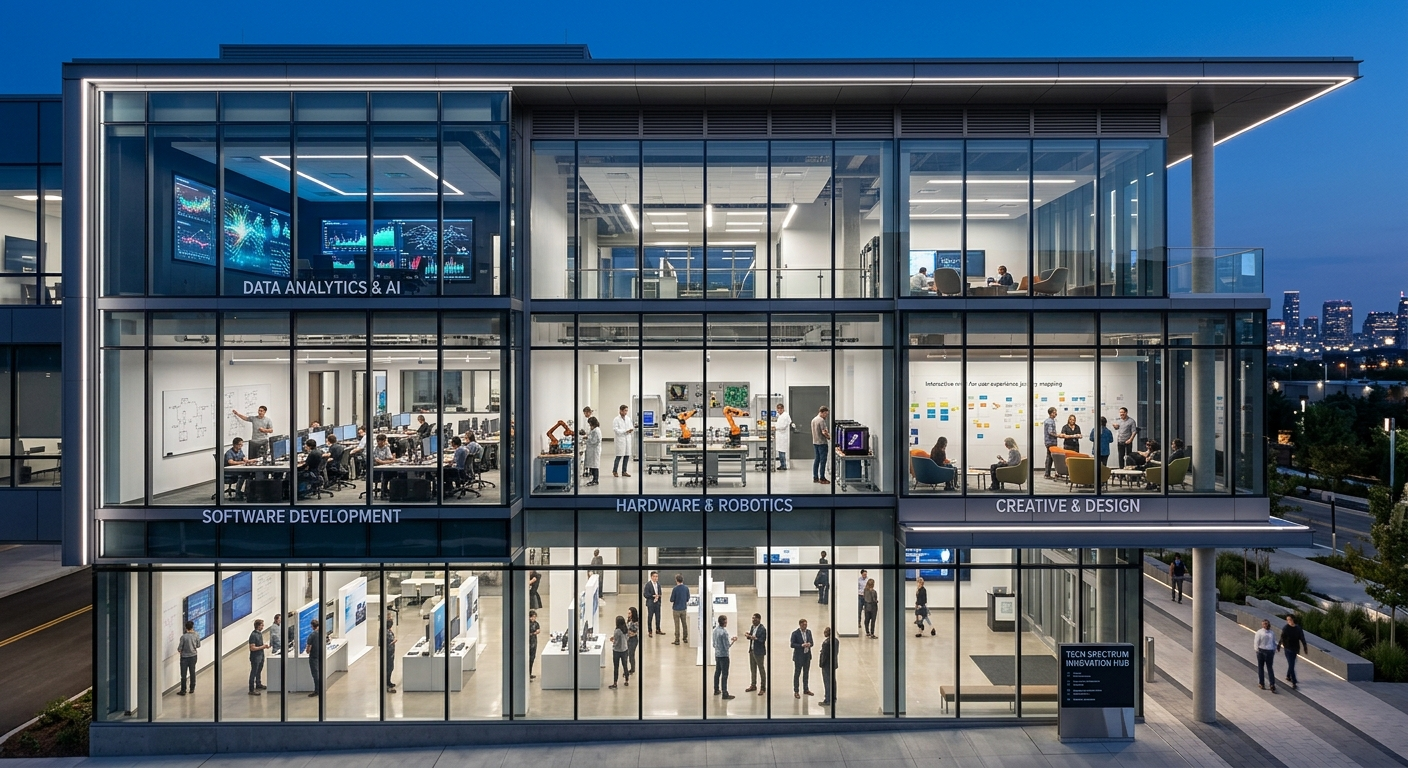
Technology is no longer a collection of separate inventions. It has evolved into an interconnected spectrum of computing, communications, artificial intelligence, robotics, biotechnology, energy systems, advanced materials, cybersecurity, and digital infrastructure. Each technology occupies a particular position in this spectrum, but the most important developments increasingly occur between technologies, where one capability strengthens another.
The modern technology spectrum can therefore be understood as a layered ecosystem. At its foundation are energy, semiconductors, computing hardware, networks, and data. Above these foundations sit cloud computing, artificial intelligence, software, cybersecurity, and digital platforms. At the physical edge are Internet of Things (IoT) devices, robotics, autonomous systems, smart infrastructure, vehicles, and industrial machinery. Beyond today’s mainstream systems are emerging areas such as quantum computing, synthetic biology, advanced materials, neuromorphic computing, space technology, and physical AI.
This convergence is becoming increasingly visible in 2026. The World Economic Forum’s 2026 emerging-technology assessment identifies technologies spanning energy, materials, health and computing, while emphasizing that many are moving from laboratory research toward practical deployment.
The result is a technological landscape in which the boundaries between computing, engineering, biology, communications, and physical machines are becoming increasingly blurred.
1. What Is the Technology Spectrum?
The technology spectrum is a conceptual way of viewing the complete range of technologies available to humanity—from fundamental physical components to sophisticated systems capable of sensing, reasoning, communicating, and acting.
It can be represented broadly as:
Energy → Materials → Semiconductors → Computing → Networks → Data → AI → Applications → Physical Systems → Intelligent Ecosystems
Each layer depends on the layers beneath it.
For example:
- AI requires computing hardware.
- Computing hardware requires semiconductors.
- Semiconductors depend on advanced materials and manufacturing.
- Cloud AI requires telecommunications and data centers.
- IoT requires sensors, processors and networks.
- Robotics combines AI, software, electronics, sensors, motors and mechanical engineering.
- Autonomous systems require AI, sensing, connectivity, computing and energy.
Consequently, no single technology exists in isolation.
2. The Foundation: Energy
Every digital technology ultimately depends on energy.
Data centers, smartphones, satellites, telecommunications networks, factories, electric vehicles and robots all require reliable power.
The growing importance of AI has made this relationship particularly visible. AI infrastructure requires large quantities of computing capacity, which translates into substantial electricity, cooling and grid requirements. IEEE’s 2026 technology predictions specifically identify data-center energy management and power-system innovation as important consequences of increasing AI demand.
The energy layer includes:
- Solar power
- Wind power
- Hydroelectricity
- Nuclear energy
- Batteries
- Energy storage
- Smart grids
- Power electronics
- Distributed energy systems
- Advanced energy technologies
An important emerging concept is everything-to-grid energy, in which buildings, vehicles and other distributed assets can potentially store and return electricity to the grid. The World Economic Forum lists this among its 2026 emerging technologies.
The future technology ecosystem will therefore increasingly be an interaction between digital intelligence and physical energy infrastructure.
3. Materials: The Physical Building Blocks
Before a computer can process information, engineers need materials from which to construct it.
Materials science provides the physical foundation for:
- Semiconductor wafers
- Batteries
- Optical fibers
- Solar cells
- Displays
- Sensors
- Magnets
- Aircraft
- Robots
- Medical devices
- Construction systems
Materials engineering increasingly involves designing materials for particular technological functions rather than simply selecting naturally available materials.
Examples include:
- Semiconductor materials
- Carbon-based materials
- Advanced ceramics
- Composite materials
- Battery materials
- Nanomaterials
- Metamaterials
- Smart materials
The relationship between materials science and computing is particularly important because improvements in materials can enable new generations of processors, memory, sensors and energy systems.
4. Semiconductors: The Engine of Digital Technology
The semiconductor industry occupies one of the most strategically important positions in the technology spectrum.
Modern semiconductors provide the computational machinery inside:
- Smartphones
- Computers
- Servers
- Cars
- Industrial machines
- Telecommunications equipment
- Medical equipment
- Satellites
- IoT devices
A modern chip can contain billions of transistors.
Different semiconductor components specialize in different functions:
CPU → General-purpose computation
GPU → Parallel computation and AI workloads
NPU/AI accelerator → Machine-learning inference
Memory → Data storage close to computation
Network processor → Communications
Microcontroller → Embedded control
As AI becomes increasingly important, specialized computing hardware is becoming a central part of the technology spectrum. Research organizations are also tracking growing investment in hardware designed specifically to accelerate AI training and inference.
5. Computing: From Machines to Intelligence
Computing has progressed through several major stages.
Mechanical computation
Early calculating machines used mechanical components to perform arithmetic.
Electronic computing
Vacuum tubes and later transistors enabled much faster electronic computation.
Integrated circuits
Thousands and eventually millions of electronic components could be placed on a single chip.
Microprocessors
Computing became compact enough to enter personal computers and eventually billions of embedded devices.
Parallel computing
Multiple processing units began working simultaneously on large problems.
Cloud computing
Computing resources became accessible through large remote data centers.
Accelerated computing
GPUs and specialized accelerators dramatically increased the ability to process AI and scientific workloads.
Intelligent computing
Modern systems increasingly combine computing with machine learning, allowing computers to recognize patterns, generate content, predict outcomes and make decisions.
6. Cloud Computing: The Global Digital Infrastructure
Cloud computing transformed computing from something organizations primarily purchased and operated themselves into something they could access as an on-demand service.
The cloud provides:
- Compute
- Storage
- Databases
- Networking
- AI services
- Security tools
- Developer platforms
- Data analytics
Large cloud data centers have become critical infrastructure for modern digital economies.
However, the technology spectrum is moving beyond an exclusively cloud-centered architecture.
Increasingly, computing is divided among:
Cloud → Edge → Device
The cloud provides enormous computational capacity.
The edge provides lower latency.
The device can process information locally.
This distributed model is especially important for autonomous vehicles, industrial systems, robotics, smart cities and IoT.
7. Connectivity: The Nervous System of Technology
Networks connect technological components together.
The connectivity spectrum includes:
- Fiber-optic networks
- Ethernet
- Wi-Fi
- Bluetooth
- 4G
- 5G
- Emerging 6G research
- Satellite communications
- Internet infrastructure
- Submarine cables
Connectivity effectively becomes the nervous system of the digital economy.
A sensor may generate information, a wireless network may transport it, cloud infrastructure may process it, AI may interpret it, and an actuator may respond.
That creates a complete information loop:
Sense → Connect → Compute → Understand → Decide → Act
This loop is one of the defining characteristics of modern technology.
8. The Internet of Things
The Internet of Things extends computing into the physical environment.
Instead of computers existing primarily as separate machines, computational capabilities become embedded into:
- Buildings
- Vehicles
- Farms
- Factories
- Energy systems
- Appliances
- Infrastructure
- Medical equipment
- Environmental monitoring systems
An IoT architecture commonly contains:
Sensors → Connectivity → Data Platform → Analytics/AI → Action
Sensors transform physical conditions into digital information.
Examples include sensors measuring:
- Temperature
- Pressure
- Humidity
- Motion
- Location
- Vibration
- Light
- Sound
- Electrical conditions
IoT therefore acts as a bridge between the physical world and digital world.
9. Artificial Intelligence: The Intelligence Layer
Artificial intelligence has become one of the most influential technologies in the modern spectrum.
Traditional software follows explicit instructions.
AI systems can instead learn patterns from data and use those patterns to generate predictions, classifications, recommendations or actions.
Important AI categories include:
- Machine learning
- Deep learning
- Computer vision
- Natural-language processing
- Generative AI
- Multimodal AI
- Reinforcement learning
- Agentic AI
- Physical AI
AI is increasingly moving from purely digital environments into the physical world. Forrester’s 2026 emerging-technology analysis highlights physical AI, humanoid robots and agentic software as important areas of development.
10. Generative AI
Generative AI represents an important transformation in computing because systems can create new outputs rather than merely classify existing information.
Generative systems can work with:
- Text
- Images
- Audio
- Video
- Code
- Scientific information
- Structured data
Large AI models are increasingly becoming general-purpose interfaces to computing.
Instead of requiring a user to understand every underlying software command, natural language can become an interface for interacting with complex systems.
This does not eliminate conventional software. Rather, it adds a new intelligence layer above it.
11. Agentic AI
The next stage is increasingly moving from AI that answers toward AI that performs tasks.
An agentic system may be designed to:
- Understand an objective.
- Break the objective into tasks.
- Gather information.
- Use software tools.
- Evaluate intermediate results.
- Adjust its plan.
- Produce an outcome.
This represents a movement from:
Prompt → Response
toward:
Goal → Planning → Tools → Execution → Evaluation → Outcome
The technology remains subject to important limitations, including reliability, security, permissions, evaluation and human oversight.
12. Robotics: Intelligence Enters the Physical World
Robotics combines software with physical machinery.
A robot typically requires:
- Sensors
- Computing
- Control systems
- Motors or actuators
- Mechanical structures
- Software
- Communication
- Power
AI dramatically expands what robots can potentially do.
Computer vision allows robots to interpret environments.
Machine learning allows them to improve recognition and control.
Advanced tactile sensing can give robots information about pressure, contact and movement. Recent work on electronic skin illustrates the direction of development toward robots with increasingly sophisticated touch capabilities.
The combination of AI and robotics is sometimes described as physical AI.
13. Autonomous Systems
Autonomous technology extends robotics and AI into systems capable of operating with reduced direct human control.
Examples include:
- Autonomous industrial equipment
- Warehouse robots
- Agricultural machines
- Autonomous vehicles
- Drones
- Space systems
- Intelligent infrastructure
Autonomy depends upon a chain of capabilities:
Perception → Localization → Understanding → Planning → Control
The challenge is not merely making a machine intelligent. It must also make reliable decisions in an unpredictable physical environment.
14. Biotechnology and Synthetic Biology
The technology spectrum is expanding beyond silicon.
Biotechnology applies engineering principles to biological systems.
Synthetic biology takes this further by enabling researchers to design or modify biological systems for particular purposes.
Potential applications include:
- Medicine
- Agriculture
- Food production
- Industrial biotechnology
- Environmental applications
- Biological manufacturing
AI is increasingly becoming a tool for biological discovery.
The World Economic Forum’s 2026 technology analysis highlights AI-assisted scientific discovery as an important pattern, including applications involving drug candidates, biological pathways and personalized medicine.
This creates a new convergence:
AI + Biology + Computing + Laboratory Automation
15. Quantum Computing
Quantum computing represents a fundamentally different computational paradigm.
Classical computers use bits.
Quantum computers use quantum bits, or qubits.
Qubits exploit quantum phenomena such as:
- Superposition
- Entanglement
- Quantum interference
Quantum computers are not simply faster replacements for ordinary computers. Their potential advantage arises for particular classes of problems.
Potential areas include:
- Molecular simulation
- Materials science
- Optimization
- Cryptography
- Scientific computing
However, broad commercial value remains uncertain and significant engineering challenges remain. Forrester’s 2026 assessment places quantum computing in a longer-term category for enterprise impact.
16. Quantum-Safe Security
Quantum computing also creates a security challenge.
Some existing cryptographic systems could eventually become vulnerable to sufficiently capable quantum computers.
This has stimulated development of post-quantum cryptography.
Lattice-based cryptography is one important approach receiving attention because of its potential resistance to both conventional and quantum attacks. The World Economic Forum identifies lattice-based cryptography as one of its 2026 emerging technologies.
This demonstrates an important principle:
A new technology often creates both new capabilities and new risks.
17. Cybersecurity: The Protective Layer
As technological systems become more connected, cybersecurity becomes increasingly fundamental.
Cybersecurity protects:
- Devices
- Networks
- Applications
- Data
- Identity
- Cloud infrastructure
- Industrial systems
- AI systems
Modern cybersecurity increasingly incorporates AI itself.
AI can help detect:
- Unusual behavior
- Suspicious network activity
- Malware patterns
- Account anomalies
- Fraud indicators
But AI can also introduce new security challenges, making security a continuous technological contest between defense and attack.
18. Blockchain and Distributed Systems
Blockchain introduced another approach to organizing digital information.
Instead of relying entirely on one central database, blockchain systems can distribute records across participating nodes and use cryptographic mechanisms to maintain consistency.
Potential applications include:
- Digital assets
- Supply-chain records
- Decentralized applications
- Identity systems
- Digital certificates
Blockchain should not be viewed as a replacement for all databases. Its value depends heavily on the particular problem being solved.
19. Extended Reality
Extended reality includes:
- Virtual reality
- Augmented reality
- Mixed reality
These technologies alter the relationship between humans and digital information.
Instead of interacting with information only through a conventional screen, users can experience digital objects within spatial environments.
Potential applications include:
- Education
- Engineering
- Design
- Training
- Healthcare
- Entertainment
- Industrial maintenance
The combination of XR and AI could eventually allow systems to understand both the user and the surrounding environment.
20. Digital Twins
A digital twin is a digital representation of a physical object, machine, building or system.
For example:
Physical factory → Sensors → Data → Digital model → Simulation → Optimization
Digital twins can help organizations understand how physical systems behave without repeatedly experimenting on the real system.
Applications include:
- Manufacturing
- Energy
- Transportation
- Buildings
- Infrastructure
- Agriculture
- Aerospace
Digital twins become particularly powerful when combined with AI and IoT.
21. Smart Cities
Smart cities represent the convergence of many technologies.
A modern smart-city ecosystem can combine:
- IoT
- AI
- Telecommunications
- Cloud computing
- Edge computing
- Digital twins
- Smart energy
- Intelligent transportation
- Environmental monitoring
The objective is not simply to add technology to cities.
The larger objective is to make infrastructure:
More efficient → More responsive → More sustainable → More resilient
22. Smart Agriculture
Agriculture is another area where the technology spectrum becomes highly visible.
A modern digital farm may combine:
- Soil sensors
- Weather stations
- Satellite imagery
- Drones
- AI
- Automated irrigation
- GPS
- Robotics
- Agricultural machinery
- Cloud platforms
The resulting system can move agriculture toward precision management.
Instead of treating an entire field identically, data can help identify differences in:
- Soil conditions
- Water requirements
- Crop development
- Disease risk
- Nutrient requirements
This illustrates how technology can transform a traditional physical industry into a data-driven system.
23. Healthcare Technology
Healthcare increasingly combines biology with digital technology.
The spectrum includes:
Medical sensors → Wearables → Data platforms → AI → Medical decision support → Personalized treatment
Emerging systems may analyze large quantities of biological and clinical information.
AI can assist with:
- Medical imaging
- Drug discovery
- Pattern recognition
- Patient monitoring
- Research
- Clinical decision support
The greatest potential comes from combining computational intelligence with human expertise rather than assuming technology can replace professional judgment.
24. Space Technology
Space technology is another frontier of the spectrum.
Modern space systems increasingly combine:
- Advanced materials
- Semiconductors
- AI
- Robotics
- Satellite communications
- Sensors
- Autonomous navigation
- High-performance computing
Satellite systems are also becoming increasingly integrated with terrestrial communications.
IEEE’s 2026 predictions identify satellite direct-to-device communications as an important development that could expand connectivity to previously underserved locations.
The technology spectrum therefore extends beyond Earth.
25. World Models and Physical Intelligence
One of the more important emerging ideas is the development of AI systems that model the physical world.
Traditional language models primarily learn relationships among tokens and language.
World models attempt to learn aspects of how environments behave.
The World Economic Forum identifies world models as an emerging technology, describing systems that combine information such as video, sensor data and text to build representations of real-world behavior.
This could become important for:
- Robotics
- Autonomous vehicles
- Industrial automation
- Simulation
- Climate modelling
- Physical planning
The broader direction is clear:
AI is moving from understanding information toward understanding environments.
26. Neuromorphic Computing
Another emerging direction is neuromorphic computing.
Neuromorphic systems attempt to borrow principles from biological nervous systems to develop more efficient computational architectures.
Potential advantages include:
- Low-power processing
- Event-driven computation
- Efficient sensor processing
- Real-time AI inference
This could become particularly useful for edge devices where conventional high-performance computing is constrained by power and thermal limitations.
27. The Convergence of Technologies
The most important feature of today’s technology spectrum is not any single technology.
It is convergence.
Consider an autonomous agricultural machine.
It may require:
- Semiconductors
- Batteries
- GPS
- Sensors
- Computer vision
- AI
- Robotics
- Wireless connectivity
- Edge computing
- Cloud computing
- Cybersecurity
No single technology creates the system.
The system emerges from the combination.
This can be expressed as:
Hardware + Software + Data + Connectivity + AI + Energy + Human Expertise = Intelligent System
28. The Technology Stack of the Future
A useful way to understand the spectrum is through a technology stack.
Layer 1 — Energy
Power generation, storage and distribution.
Layer 2 — Materials
The physical substances from which technology is constructed.
Layer 3 — Semiconductors
Transistors, processors, memory and accelerators.
Layer 4 — Computing
CPUs, GPUs, specialized accelerators and quantum systems.
Layer 5 — Connectivity
Fiber, cellular, Wi-Fi, satellites and future networks.
Layer 6 — Data
Collection, storage, processing and governance.
Layer 7 — Artificial Intelligence
Machine learning, generative AI, agents and physical AI.
Layer 8 — Applications
Software platforms and specialized services.
Layer 9 — Physical Systems
Robots, vehicles, machines, buildings and infrastructure.
Layer 10 — Intelligent Ecosystems
Connected systems that continuously sense, compute, learn and act.
This final layer represents the direction toward which much of modern technology is moving.
29. From Digital Technology to Physical Technology
For decades, much of the digital revolution occurred inside computers.
Now the boundary is moving outward.
AI is increasingly entering:
- Cars
- Robots
- Factories
- Homes
- Farms
- Hospitals
- Energy networks
- Warehouses
- Satellites
Forrester’s 2026 research describes this as a movement of AI beyond software into physical environments.
This transition is historically significant because it connects digital intelligence with physical action.
30. The Human Dimension
Technology is ultimately created for human purposes.
The technology spectrum raises important questions about:
- Employment
- Education
- Privacy
- Security
- Inequality
- Digital access
- Human autonomy
- Accountability
- Environmental sustainability
The Stanford Emerging Technology Review’s 2026 edition emphasizes that rapid advances across AI, biotechnology, quantum technologies, robotics, semiconductors, energy, materials and space create both opportunities and significant policy questions.
Therefore, technological progress cannot be measured solely by processing speed or market value.
It must also be evaluated by its effect on people and society.
31. The Digital Divide
Technology does not automatically benefit everyone equally.
Access depends on:
- Electricity
- Internet connectivity
- Devices
- Affordability
- Digital literacy
- Education
- Infrastructure
- Local skills
- Policy
For developing economies, the challenge is therefore not simply adopting the newest technology.
It is building the underlying infrastructure that makes advanced technology useful.
For Africa in particular, technology development must be connected to practical priorities such as:
- Reliable electricity
- Broadband
- Data centers
- Education
- Agriculture
- Healthcare
- Manufacturing
- Financial inclusion
- Public services
32. Technology and Sustainability
Technology can both consume resources and help conserve them.
AI data centers consume energy.
Manufacturing requires raw materials.
Electronic devices create waste.
Yet technology can also improve:
- Energy efficiency
- Water management
- Agricultural productivity
- Renewable-energy integration
- Transportation efficiency
- Environmental monitoring
The critical question is therefore not whether technology is automatically sustainable.
The question is:
How can technology produce greater value while reducing resource consumption and environmental impact?
33. The Emerging Technology Frontier
The technology frontier is expanding simultaneously in multiple directions.
According to the World Economic Forum’s 2026 analysis, emerging areas include technologies associated with energy systems, lithium extraction, scientific discovery, world models and quantum-safe cryptography, among others.
Stanford’s 2026 review similarly surveys frontier areas including AI, biotechnology, cryptography and computer security, energy, materials science, neuroscience, quantum technologies, robotics, semiconductors and space.
This demonstrates that the future is unlikely to be dominated by one technological field.
Instead, it will emerge from interactions among many fields.
34. The Technology Spectrum as an Innovation Cycle
Technology can also be viewed as a continuous cycle:
Scientific discovery
↓
Engineering
↓
Prototype
↓
Manufacturing
↓
Software integration
↓
Commercialization
↓
Mass adoption
↓
Infrastructure transformation
↓
New scientific questions
The cycle then begins again.
For example, better semiconductor manufacturing enables better AI accelerators; better AI enables better scientific research; scientific research can produce new materials; new materials can enable better semiconductors.
Technology therefore forms a self-reinforcing innovation ecosystem.
35. The Future: From Smart Devices to Intelligent Environments
The next major technological transformation may not be defined by individual smart devices.
Instead, intelligence may become embedded throughout environments.
Imagine an ecosystem containing:
- Intelligent buildings
- Connected vehicles
- Smart energy systems
- AI assistants
- Autonomous robots
- Environmental sensors
- Digital twins
- Intelligent infrastructure
These systems could communicate and coordinate.
The result would be a transition from:
Smart Device
to
Smart System
to
Smart Environment
to potentially
Intelligent Ecosystem.
36. A Unified View of the Technology Spectrum
The entire technology landscape can be summarized as a progression:
| Level | Core Technology | Primary Function |
|---|---|---|
| 1 | Energy | Provides power |
| 2 | Materials | Provides physical foundations |
| 3 | Semiconductors | Provides electronic control |
| 4 | Computing | Processes information |
| 5 | Networks | Moves information |
| 6 | Data | Represents knowledge |
| 7 | AI | Interprets and generates intelligence |
| 8 | Software | Delivers functionality |
| 9 | Robotics/IoT | Connects intelligence to the physical world |
| 10 | Autonomous systems | Enables independent operation |
| 11 | Digital ecosystems | Coordinates multiple systems |
| 12 | Frontier technologies | Expands technological possibility |
This structure illustrates why modern innovation increasingly depends on interdisciplinary knowledge.
Conclusion
A Glimpse into the Tech Spectrum reveals that technology is much larger than computers, smartphones or artificial intelligence. It is an enormous interconnected system extending from energy and materials to semiconductors, computation, communications, data, AI, robotics, biotechnology, quantum technologies and space systems.
The most consequential development is the convergence of these domains.
AI provides intelligence.
IoT provides sensing.
Networks provide communication.
Cloud and edge computing provide computational infrastructure.
Robotics provides physical action.
Semiconductors provide electronic capability.
Energy provides power.
Materials provide physical foundations.
Cybersecurity provides protection.
Human knowledge provides direction.
The emerging technology landscape is therefore best understood not as a collection of isolated inventions but as a spectrum of interconnected capabilities.
The technology frontier is moving from computers that process information toward environments that can sense, understand, predict, communicate and act. Current research increasingly reflects this transition: AI is moving into physical systems, world models are being developed to represent real environments, quantum technologies are advancing, and emerging energy and materials technologies are moving toward practical deployment.
The central lesson is simple:
The future of technology will not belong to one technology. It will belong to the connections between technologies.
Understanding that spectrum—and understanding how its layers interact—is therefore essential for anyone seeking to understand the technological transformation of the twenty-first century.


Be First to Comment