
Introduction
Modern business is no longer defined simply by selling a product at a higher price than its production cost. Technology, globalization, artificial intelligence, digital platforms, changing consumer expectations, sustainability pressures, supply-chain disruptions, and rapidly evolving competition have transformed the way organizations create and capture value.
A business model explains how an organization creates value, delivers that value to customers and stakeholders, and captures sufficient value to remain viable. Contemporary research commonly examines business models through these dimensions of value creation, delivery, and capture.
Strategic thinking provides the intellectual framework for deciding where to compete, how to compete, what capabilities to build, what customers to serve, and what the organization should deliberately avoid doing. Strategy is therefore more than having ambitious goals: it involves making choices and creating a distinctive position supported by a coherent set of activities.
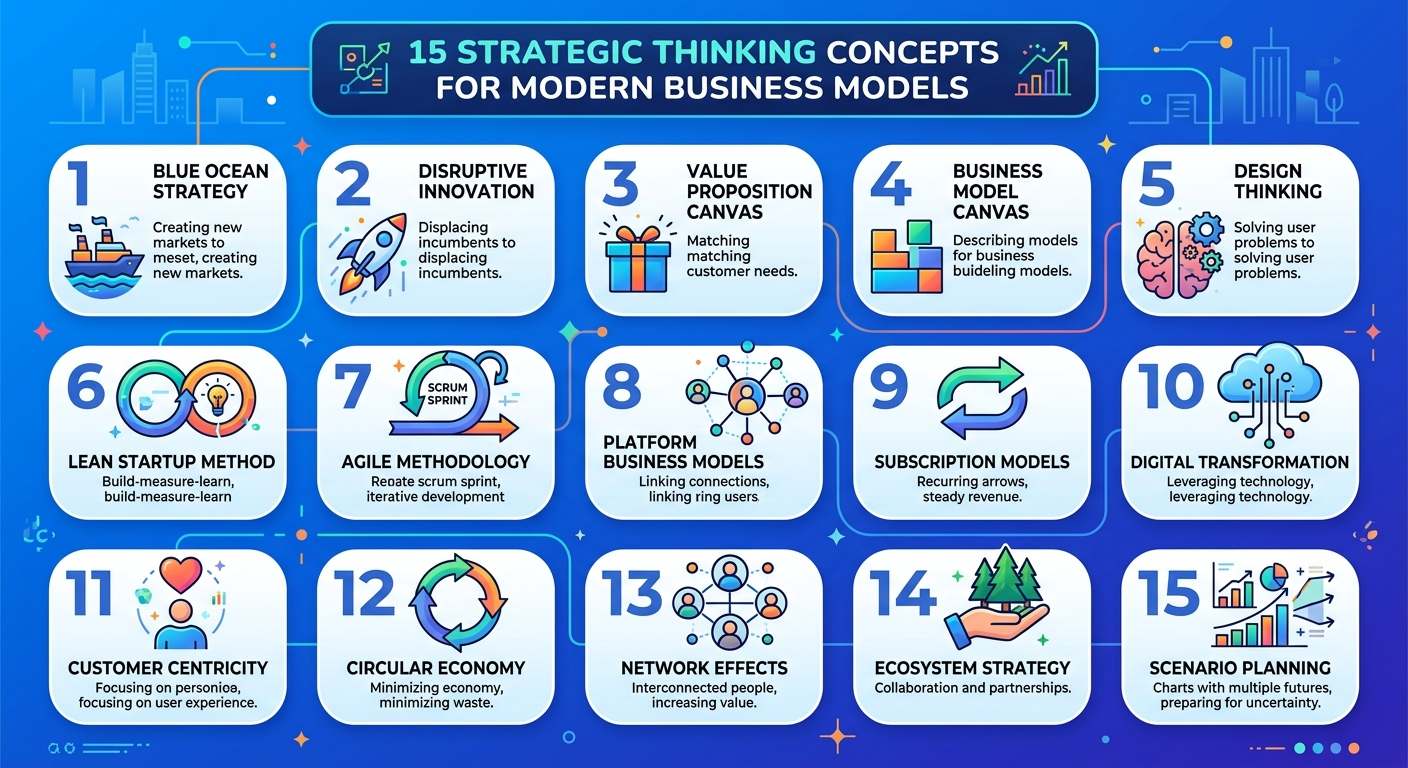
This article presents 15 strategic thinking concepts that can help entrepreneurs, executives, managers, policymakers, and students understand modern business models.
1. Value Proposition Thinking
The first strategic question is:
Why should a customer choose this organization rather than an alternative?
A value proposition describes the meaningful benefit offered to a particular customer group.
A strong value proposition may involve:
- lower cost;
- better quality;
- greater convenience;
- faster delivery;
- superior reliability;
- personalization;
- accessibility;
- technological innovation;
- reduced risk;
- improved customer experience; or
- social or environmental benefits.
The important point is that businesses should not begin by asking only, “What can we sell?”
They should ask:
“What important problem can we solve?”
Business-model innovation frequently occurs when companies change their value proposition, supply chain, target customers, revenue model, or operating configuration.
Strategic lesson
A product is not automatically valuable simply because it contains advanced technology. Technology becomes strategically valuable when it solves a meaningful problem better, faster, cheaper, or differently.
2. Customer-Centric Strategic Thinking
Modern strategy begins with understanding the customer.
Organizations should investigate:
- Who is the customer?
- What problem does the customer experience?
- What does the customer currently use?
- What does the customer dislike about existing solutions?
- What does the customer value most?
- What are customers willing to pay for?
- How are customer expectations changing?
Customer-centric strategy does not mean blindly giving customers everything they request. Strategic management requires deciding which customer needs the organization can serve profitably and sustainably.
Customer segmentation
A market can be divided according to:
- demographics;
- geography;
- income;
- business size;
- behavior;
- purchasing frequency;
- technological sophistication;
- industry;
- urgency of need; and
- willingness to pay.
A business model becomes stronger when its value proposition, distribution system, pricing structure, and capabilities are aligned with a clearly defined customer segment.
3. Competitive Positioning
A business should understand its position relative to competitors.
Competition is not simply about being “better.” Strategic positioning involves creating a distinctive and valuable position supported by activities that fit together.
A company can potentially compete through:
Cost leadership
Produce and deliver at a structurally lower cost.
Differentiation
Provide characteristics customers perceive as distinctive and valuable.
Focus
Concentrate resources on a specific market segment or specialized problem.
Strategic uniqueness
Create a combination of activities that competitors find difficult to reproduce.
The important principle is that strategic positioning requires choice.
A company that attempts to serve everyone, provide everything, and compete simultaneously on every dimension can lose strategic clarity.
4. Business Model Architecture
A business model can be understood as an interconnected architecture rather than a collection of isolated departments.
A useful conceptual structure is:
Value Creation → Value Delivery → Value Capture
Value creation
What value does the organization create?
Value delivery
How does that value reach customers?
Value capture
How does the organization generate revenue, profit, or other sustainable benefits?
Modern business-model research also emphasizes the importance of partners and wider ecosystems.
For example, a digital company may depend on:
- cloud infrastructure;
- payment systems;
- software developers;
- data providers;
- telecommunications networks;
- logistics companies;
- regulators;
- customers; and
- strategic partners.
Therefore, strategic thinking must examine the entire business architecture.
5. Competitive Advantage
Competitive advantage exists when an organization can create superior value or achieve a favorable economic position through capabilities and activities that competitors cannot easily replicate.
Potential sources include:
- technology;
- intellectual property;
- brand reputation;
- distribution;
- customer relationships;
- data;
- specialized knowledge;
- economies of scale;
- network effects;
- operational excellence;
- organizational culture; and
- unique partnerships.
However, an advantage should not be considered permanent.
Technology can become standardized. Customers can change. Competitors can imitate. Regulations can change. New entrants can introduce entirely different business models.
Consequently:
Competitive advantage must be renewed rather than merely protected.
6. Strategic Trade-Offs
One of the most important strategic-thinking concepts is the willingness to choose what not to do.
Organizations have limited:
- money;
- people;
- management attention;
- technology;
- time;
- production capacity; and
- organizational energy.
Therefore, pursuing every opportunity is impossible.
A strategic decision may involve choosing:
- one market instead of another;
- premium customers instead of mass-market customers;
- specialization instead of diversification;
- quality instead of lowest price;
- long-term investment instead of short-term profit.
Strategic trade-offs create focus.
Without trade-offs, strategic plans can become wish lists rather than strategies.
7. Systems Thinking
Modern businesses operate as systems.
A company may be affected by:
Customers → Suppliers → Employees → Technology → Finance → Regulation → Infrastructure → Competitors → Society
Changing one element can affect many others.
For example, adopting a new technology may require:
- new equipment;
- employee training;
- cybersecurity improvements;
- software integration;
- new suppliers;
- revised processes;
- new customer support;
- regulatory compliance; and
- additional capital.
Therefore, strategic thinkers avoid examining decisions in isolation.
Systems-thinking question
Instead of asking:
“Will this project work?”
ask:
“How will this project affect the entire business system?”
8. Ecosystem Strategy
Modern companies increasingly operate within ecosystems rather than completely independent value chains.
An ecosystem may contain:
- producers;
- technology providers;
- customers;
- distributors;
- developers;
- financial institutions;
- governments;
- infrastructure providers; and
- complementary businesses.
Research on innovation ecosystems emphasizes the need to understand how different actors interact to create and capture value.
For example, a smartphone ecosystem involves far more than the manufacturer. It can include operating-system developers, application developers, semiconductor companies, telecommunications operators, cloud providers, accessory manufacturers, retailers, and users.
Strategic question
Can the organization create greater value by building an ecosystem rather than operating alone?
9. Platform Thinking
A platform business attempts to facilitate interactions among multiple groups.
Examples include conceptual categories such as:
- buyer–seller platforms;
- developer–user platforms;
- advertiser–consumer platforms;
- producer–consumer platforms;
- service-provider–customer platforms.
The strategic advantage of platforms can emerge from network effects.
As more participants join, the platform may become more useful to other participants.
However, platforms also face major challenges:
- governance;
- trust;
- cybersecurity;
- quality control;
- regulation;
- user acquisition;
- monetization; and
- maintaining participation.
Platform strategy therefore requires thinking about both sides—or multiple sides—of the market.
10. Innovation and Business Model Innovation
Innovation should not be limited to inventing new products.
Organizations can innovate in:
- products;
- services;
- processes;
- distribution;
- pricing;
- customer relationships;
- supply chains;
- partnerships;
- revenue models; and
- entire business architectures.
Business-model innovation can involve fundamentally changing how value is proposed, created, delivered, or captured. Research has increasingly treated business-model innovation as a systemic and dynamic process rather than a one-time event.
Example
A traditional company may sell equipment once.
An alternative model could involve:
Equipment + software + maintenance + analytics + subscription services.
The product has not necessarily disappeared, but the economic model surrounding it has changed.
11. Dynamic Capabilities
A successful business must be capable of responding to change.
Dynamic capabilities involve the organizational ability to:
- sense changes;
- seize opportunities; and
- transform resources and operations.
This is especially important in technology-intensive industries.
For example, an organization might notice that artificial intelligence is changing customer expectations.
It could then:
Sense: identify the technological shift.
Seize: develop an AI-enabled product.
Transform: restructure employees, technology, data systems, and processes around the new model.
Research has connected dynamic capabilities with value-proposition innovation and disruptive innovation activities.
12. Scenario Thinking
The future is uncertain.
Strategic organizations should therefore avoid planning around only one predicted future.
Instead, they can develop several scenarios:
Scenario A — Stable growth
Markets expand gradually.
Scenario B — Technological disruption
A new technology changes industry economics.
Scenario C — Economic downturn
Demand and investment decline.
Scenario D — Regulatory transformation
Government introduces major new rules.
Scenario E — Supply-chain disruption
Critical inputs become expensive or unavailable.
The purpose of scenario planning is not to predict the future perfectly.
Its purpose is to ask:
“If this happens, are we prepared?”
13. Data-Driven Strategic Thinking
Modern organizations generate enormous quantities of data.
Strategic data can include:
- customer behavior;
- sales;
- inventory;
- financial performance;
- production;
- website activity;
- supply-chain performance;
- operational efficiency;
- customer support;
- market trends.
But data alone does not create strategy.
The organization must transform:
Data → Information → Insight → Decision → Action → Learning
The strategic objective is therefore not simply to collect more data.
It is to make better decisions using relevant evidence.
Artificial intelligence can increasingly assist with forecasting, pattern recognition, customer analysis, operational optimization, and strategic experimentation. Nevertheless, human judgment remains important because strategic decisions frequently involve uncertainty, ethics, trade-offs, and objectives that cannot be reduced to historical data.
14. Financial and Economic Model Thinking
A business model must eventually make economic sense.
A strategic idea should therefore be examined through:
- revenue;
- variable costs;
- fixed costs;
- gross margin;
- operating expenses;
- capital requirements;
- cash flow;
- customer acquisition cost;
- customer lifetime value;
- pricing;
- break-even point;
- return on investment; and
- scalability.
A company can have millions of users and still have an unsustainable business model.
Therefore, strategic thinkers distinguish between:
Growth and profitable, sustainable growth.
Example
If acquiring one customer costs R500 but the expected contribution from that customer is only R200, rapid customer growth could actually increase losses.
The strategic objective is therefore not merely:
“Acquire more customers.”
It becomes:
“Acquire valuable customers through an economically sustainable model.”
15. Long-Term Strategic Thinking
The final concept is the ability to think beyond immediate results.
Organizations must balance:
Short-term performance ↔ Long-term capability
Short-term decisions may improve quarterly results while weakening:
- research and development;
- employee capability;
- infrastructure;
- customer trust;
- technology;
- brand reputation; or
- organizational resilience.
Long-term strategic thinking asks:
- What will this industry look like in five years?
- Which technologies could transform it?
- Which capabilities should we build today?
- What could make our existing business obsolete?
- Which partnerships should we develop?
- What should we stop doing?
- What new business models might emerge?
Recent research continues to emphasize the difficulty of translating strategic intent into adaptable business-model structures, particularly in dynamic and innovation-driven environments.
Integrating the 15 Concepts
These concepts should not be treated as fifteen independent theories.
They form an interconnected strategic system.
| Strategic concept | Central question |
|---|---|
| 1. Value proposition | What valuable problem do we solve? |
| 2. Customer-centric thinking | Who exactly are we serving? |
| 3. Competitive positioning | How will we compete? |
| 4. Business-model architecture | How does the whole model work? |
| 5. Competitive advantage | Why can we win sustainably? |
| 6. Trade-offs | What will we deliberately not do? |
| 7. Systems thinking | How do decisions affect the wider organization? |
| 8. Ecosystem strategy | Which external actors create additional value? |
| 9. Platform thinking | Can we connect multiple groups? |
| 10. Business-model innovation | Can we redesign how value is created and captured? |
| 11. Dynamic capabilities | How quickly can we adapt? |
| 12. Scenario thinking | What if the future develops differently? |
| 13. Data-driven thinking | What does evidence tell us? |
| 14. Economic thinking | Can the model create sustainable returns? |
| 15. Long-term thinking | What capabilities will matter in the future? |
A Strategic Thinking Framework for Entrepreneurs
A practical sequence can be constructed from the fifteen concepts:
Step 1 — Identify the problem
Determine the customer or societal problem.
Step 2 — Define the customer
Identify the people or organizations experiencing the problem.
Step 3 — Design the value proposition
Develop a compelling solution.
Step 4 — Study competition
Determine existing alternatives.
Step 5 — Select a strategic position
Decide how the organization will compete.
Step 6 — Design the business model
Determine how value will be created, delivered, and captured.
Step 7 — Identify capabilities
Determine the technology, people, capital, knowledge, and infrastructure required.
Step 8 — Build partnerships
Identify organizations that can strengthen the model.
Step 9 — Establish economic logic
Determine whether the model can generate sustainable financial returns.
Step 10 — Experiment
Test assumptions before committing excessive resources.
Step 11 — Measure
Track financial, operational, customer, and strategic indicators.
Step 12 — Adapt
Change the model when evidence shows that assumptions are wrong.
This reflects a broader understanding of business-model innovation as an ongoing process rather than a single strategic event.
Strategic Thinking in the Age of Artificial Intelligence
Artificial intelligence is changing the strategic landscape because it can influence virtually every component of a business model.
AI can affect:
Customer acquisition
AI can help organizations understand customer behavior and personalize communication.
Product development
AI can accelerate research, design, testing, and prototyping.
Operations
AI can support forecasting, scheduling, quality control, and optimization.
Customer service
AI can assist with information retrieval and routine customer interactions.
Management
AI can help analyze large quantities of information for decision support.
New business models
AI can enable entirely new products and services.
The strategic question, however, should not simply be:
“How can we use AI?”
A better question is:
“How does AI change the economics and architecture of our business model?”
This distinction is critical.
Using AI merely as an additional tool may improve efficiency. Rebuilding a business model around AI-enabled capabilities can potentially change the basis of competition itself.
Strategic Thinking and Sustainability
Modern strategy increasingly has to consider environmental and social consequences alongside financial performance.
A sustainable business model can ask:
- Can resources be used more efficiently?
- Can waste be reduced?
- Can products be repaired or reused?
- Can energy consumption be reduced?
- Can supply chains become more transparent?
- Can employees and communities benefit?
- Can environmental risks be incorporated into strategic planning?
Business-model research increasingly considers value capture in broader stakeholder terms rather than viewing profit as the only relevant outcome.
This creates the possibility of moving from a narrow model of:
Profit → Shareholders
toward a broader strategic perspective involving:
Economic Value + Customer Value + Employee Value + Social Value + Environmental Value
Common Strategic Thinking Mistakes
1. Confusing ambition with strategy
“Become the biggest company” is an ambition, not a strategy.
2. Copying competitors
Imitation can create parity rather than advantage.
3. Ignoring economics
Revenue growth without sustainable economics can destroy value.
4. Focusing exclusively on technology
Technology must connect to customer value and business economics.
5. Trying to serve everyone
Broad markets can sometimes create opportunities, but lack of focus can weaken positioning.
6. Refusing to change
A successful existing model can eventually become a strategic constraint.
7. Changing everything simultaneously
Transformation without prioritization can overwhelm an organization.
8. Ignoring ecosystems
Suppliers, partners, regulators, infrastructure providers, and complementary businesses can determine whether a business model succeeds.
9. Measuring only financial results
Strategic health also requires indicators for customers, operations, innovation, people, risk, and resilience.
10. Thinking only about today
A business optimized entirely for today’s environment can become poorly prepared for tomorrow.
The Strategic Thinking Equation
A useful conceptual equation is:
Strategic Success = Customer Value × Distinctive Position × Capabilities × Economic Viability × Adaptability
If any major component approaches zero, the overall model can become weak.
For example:
Excellent product × weak distribution = weak business
Strong technology × no customer need = weak business
Large market × poor economics = weak business
Strong current position × inability to adapt = vulnerable business
Therefore, strategic thinking is fundamentally about alignment.
Conclusion
The modern business model is not simply a mechanism for selling products and collecting revenue. It is an integrated system through which an organization identifies opportunities, creates value, serves customers, coordinates resources, works with partners, competes, generates economic returns, and adapts to change.
The 15 strategic thinking concepts provide a comprehensive framework:
- Value proposition
- Customer-centric thinking
- Competitive positioning
- Business-model architecture
- Competitive advantage
- Strategic trade-offs
- Systems thinking
- Ecosystem strategy
- Platform thinking
- Business-model innovation
- Dynamic capabilities
- Scenario thinking
- Data-driven decision-making
- Economic model thinking
- Long-term strategic thinking
Together, these concepts move management from simply asking “What should we sell?” toward much deeper questions:
Who should we serve?
What value should we create?
How should we deliver it?
How should we capture value?
Why should customers choose us?
What capabilities will competitors struggle to reproduce?
Which partnerships can strengthen our ecosystem?
How might technology change the rules of competition?
What should we stop doing?
How will our business model survive and evolve as the world changes?
Ultimately, strategic thinking is the discipline of connecting vision, choices, resources, capabilities, customers, technology, economics, and adaptation into a coherent business system. Business-model innovation research increasingly supports this systemic perspective, emphasizing that successful innovation can require coordinated changes across value propositions, operations, resources, partners, and the broader ecosystem.
The strongest modern organizations therefore do not merely build products. They build strategic systems capable of continuously creating, delivering, capturing, and renewing value.
Selected References
- Harvard Business School, Institute for Strategy and Competitiveness — strategic positioning, uniqueness, trade-offs, and competitive advantage.
- Boston Consulting Group — business-model innovation and competitive advantage.
- Journal of Business Research — research on the evolution of innovative value propositions and business models.
- Journal of Management and Governance — systematic review of business-model innovation processes.
- Journal of Cleaner Production — business-model innovation and ecosystems for sustainable development.
- Long Range Planning — strategy, business models, and tactics.
- Journal of Business Strategy (2026) — integration of business strategies into adaptable business models.






Be First to Comment