
A Comprehensive Scientific, Economic, Technological and Social Thesis
Abstract
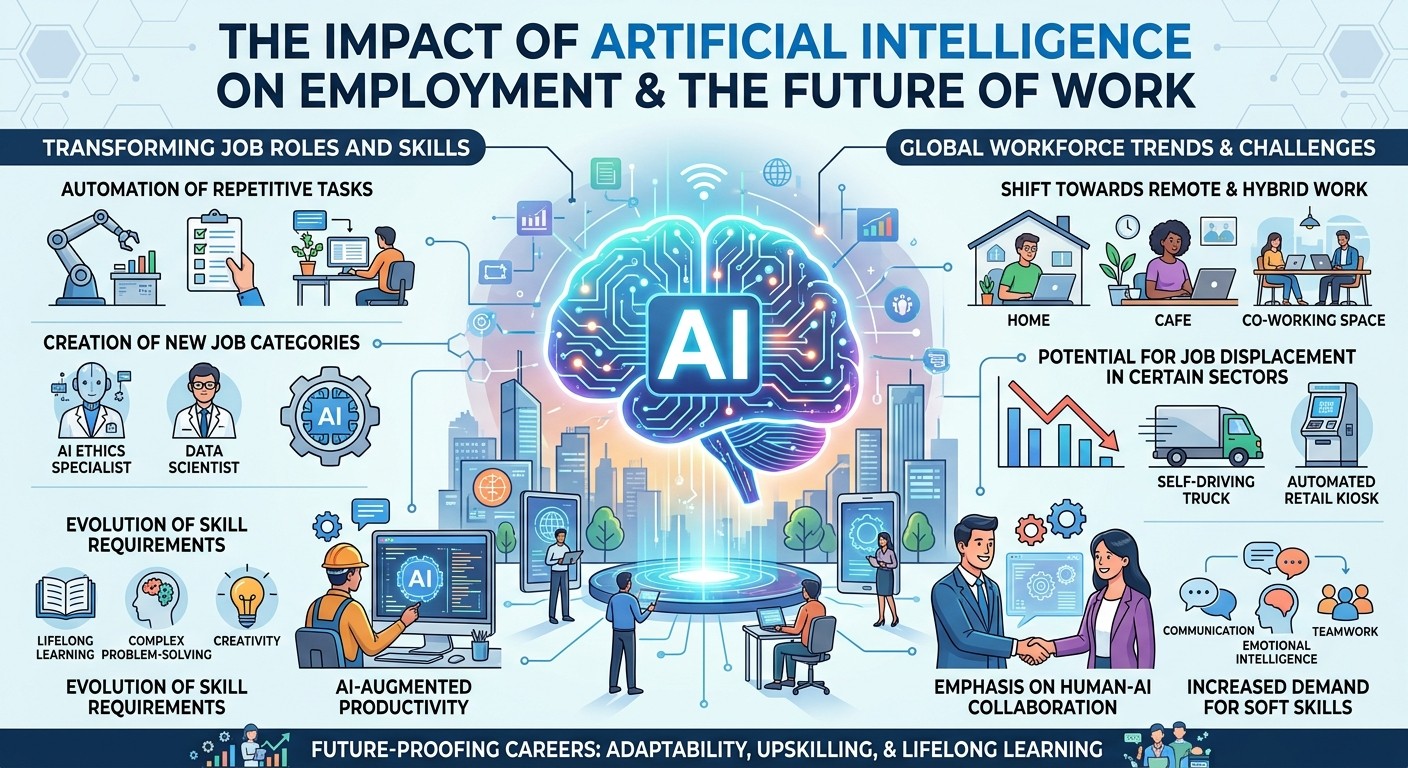
Artificial Intelligence (AI) is becoming one of the most consequential general-purpose technologies in modern economic history. Like electricity, telecommunications, computers and the internet before it, AI is not simply creating a new industrial sector; it is changing how existing industries operate, how organisations make decisions, how workers perform tasks, how businesses produce goods and services, and how societies understand employment itself.
The central question is therefore not simply whether AI will “take people’s jobs.” A more useful question is: Which tasks will AI automate, which tasks will AI augment, which new occupations will emerge, and how will human labour be reorganised around increasingly capable machines?
Current research indicates that AI has both displacement and augmentation effects. The OECD reports that AI can improve productivity and working conditions while also creating risks involving automation, inequality, privacy, discrimination and loss of worker autonomy. Its research also estimates that occupations at high risk of automation represent roughly 28% of employment across OECD countries.
The International Labour Organization’s 2025 update similarly emphasises occupational exposure rather than assuming that exposure automatically means complete job elimination. Generative AI is more likely in many occupations to transform the tasks performed by workers than to eliminate entire occupations immediately.
The future of work will therefore depend on the interaction between AI capability, business investment, education, worker adaptation, government policy, economic growth, demographic change and the creation of new forms of employment.
1. Introduction
Work is one of the fundamental organising systems of human civilisation.
Human beings have always developed technologies that change how work is performed. Stone tools increased physical capability. Agriculture transformed hunting and gathering societies. The steam engine mechanised physical production. Electricity reorganised factories and cities. The telephone accelerated communication. Computers automated calculation and information processing. The internet connected billions of people and created a global digital economy.
Artificial Intelligence represents another major transition.
The difference is that AI increasingly operates on activities traditionally associated with human cognition:
- reading;
- writing;
- translation;
- classification;
- prediction;
- image recognition;
- speech recognition;
- programming;
- research;
- data analysis;
- planning;
- decision support;
- pattern recognition;
- content generation;
- customer interaction;
- document processing.
Consequently, AI affects not only manual labour but also professional and knowledge-based occupations.
The transformation is already visible. OECD research finds that workers frequently report improved performance when using AI, while also reporting concerns about work intensity, data collection and inequality.
The future labour market will therefore not be divided simply into “humans versus machines.” A more realistic model is:
Human + AI + automation + robotics + data + organisations = future production system.
2. Understanding Artificial Intelligence
Artificial Intelligence is a broad field involving computational systems capable of performing tasks associated with human intelligence.
Major AI technologies include:
- Machine learning
- Deep learning
- Natural-language processing
- Computer vision
- Speech recognition
- Generative AI
- Reinforcement learning
- Predictive analytics
- Recommendation systems
- Autonomous systems
- AI agents
- Multimodal AI
The development of large language models has particularly accelerated the transformation of knowledge work.
An AI system can potentially receive:
Input → interpretation → reasoning/prediction → generation → action
This creates a new technological layer between humans and information.
3. From Automation of Machines to Automation of Intelligence
Earlier industrial automation primarily targeted physical activities.
For example:
Human → machine → physical output
Modern AI introduces another pathway:
Human → AI → information processing → decision/output
This changes the economic significance of automation.
A traditional machine might manufacture a component faster than a human worker.
An AI system can potentially:
- analyse thousands of documents;
- summarise information;
- generate reports;
- identify patterns;
- write software;
- translate languages;
- analyse images;
- answer questions;
- assist with research;
- support business decisions.
Therefore, AI extends automation from the physical world into parts of the cognitive economy.
4. Job Exposure Is Not the Same as Job Elimination
One of the most important distinctions in the AI-employment debate is between occupational exposure and complete job replacement.
An occupation consists of many tasks.
For example, an accountant may perform:
- data entry;
- reconciliation;
- financial analysis;
- communication;
- regulatory interpretation;
- auditing;
- strategic advice;
- client interaction.
AI may automate some of these activities while assisting with others.
The accountant therefore does not necessarily disappear.
Instead:
Old occupation = human performs most tasks
may become:
New occupation = human performs selected high-value tasks + AI performs selected automated tasks.
This task-based interpretation is central to understanding the future of employment.
The ILO’s 2025 analysis uses detailed task-level assessment and distinguishes different degrees of generative-AI exposure rather than treating all exposed occupations as automatically disappearing.
5. The Four Possible Effects of AI on Jobs
AI can influence employment through four major mechanisms.
5.1 Automation
AI performs tasks previously performed by humans.
Example:
Human data-entry worker → automated document-processing system
5.2 Augmentation
AI assists a human worker.
Example:
Doctor + AI diagnostic support → enhanced medical decision-making
The human remains responsible for important decisions while AI provides analytical assistance.
5.3 Creation
AI creates new occupations and industries.
Examples include:
- AI engineers;
- AI safety specialists;
- data engineers;
- AI product managers;
- AI governance specialists;
- model evaluators;
- AI trainers;
- robotics engineers;
- AI infrastructure specialists.
5.4 Transformation
An existing occupation survives but changes substantially.
For example:
Traditional software developer
may evolve into:
software engineer + AI systems architect + AI-agent supervisor + security specialist.
This transformation effect may become one of the dominant characteristics of the future labour market.
6. The Productivity Effect
One of the strongest economic arguments for AI is productivity improvement.
Suppose a worker previously required eight hours to complete a task.
If AI reduces the required time to four hours, several outcomes are possible.
Scenario A: Employment reduction
The company produces the same output with fewer workers.
Scenario B: Output expansion
The company doubles production while retaining workers.
Scenario C: Higher-value work
Workers spend the saved time performing more complex activities.
Scenario D: Lower prices
Higher productivity reduces production costs, potentially increasing consumer demand.
Scenario E: New businesses
Lower production costs make previously uneconomic products and services viable.
Therefore:
AI productivity ≠ automatic unemployment.
The final employment outcome depends on what businesses, consumers and governments do with the productivity gains.
OECD research similarly identifies productivity enhancement as one of AI’s major potential benefits.
7. The Productivity–Employment Relationship
A useful economic model is:
AI → productivity increase → lower unit costs → lower prices / higher profits → higher demand / investment → potential employment creation
But another pathway exists:
AI → automation → fewer labour hours required → reduced employment in particular tasks
Both mechanisms can operate simultaneously.
Consequently, the effect of AI must be evaluated at several levels:
Task → occupation → company → industry → economy → society
A technology can destroy jobs within one occupation while creating substantially more economic activity elsewhere.
8. Occupations Most Exposed to Generative AI
Generative AI has particularly strong implications for occupations involving digital information.
Potentially exposed areas include:
- administrative work;
- customer support;
- basic content production;
- translation;
- routine programming;
- document preparation;
- data analysis;
- bookkeeping;
- research assistance;
- marketing;
- financial analysis;
- legal document preparation.
However, exposure varies enormously within each occupation.
The OECD notes that occupations highly exposed to AI include areas such as programming, budget analysis and administrative assistance, while the skills required by workers are changing as AI becomes integrated into these occupations.
9. Occupations Less Easily Automated
AI faces greater difficulty where work requires combinations of:
- physical presence;
- unpredictable environments;
- complex interpersonal interaction;
- physical dexterity;
- accountability;
- empathy;
- leadership;
- negotiation;
- trust;
- contextual judgement.
Examples may include:
- many construction occupations;
- skilled maintenance;
- emergency response;
- nursing;
- caregiving;
- certain agricultural activities;
- plumbing;
- electrical installation;
- specialised technicians;
- leadership roles;
- complex interpersonal services.
However, “less easily automated” does not mean “unaffected by AI.”
AI can still assist these workers through:
- scheduling;
- diagnostics;
- training;
- logistics;
- documentation;
- safety monitoring;
- equipment maintenance.
10. The Rise of the AI-Augmented Worker
One of the most important future concepts is the AI-augmented worker.
The worker of the future may not compete directly with AI.
Instead, the worker may operate through AI.
The production model becomes:
Human intelligence + machine intelligence + organisational intelligence
For example:
Architect + AI
can produce and evaluate many design alternatives.
Engineer + AI
can analyse complex engineering data.
Teacher + AI
can personalise educational material.
Doctor + AI
can analyse medical information.
Lawyer + AI
can rapidly examine large document collections.
Programmer + AI
can generate and test software components.
AI therefore becomes a form of cognitive infrastructure.
11. AI and the Transformation of Management
AI is also changing management.
Traditional management relies heavily on:
- meetings;
- reports;
- supervisors;
- spreadsheets;
- manual performance monitoring.
AI can introduce:
- automated dashboards;
- predictive analytics;
- workflow optimisation;
- algorithmic scheduling;
- automated reporting;
- workforce forecasting;
- performance analytics.
This creates opportunities but also risks.
The OECD identifies algorithmic management as an important emerging issue because software can partially or fully automate tasks traditionally performed by managers.
The challenge is ensuring that algorithmic management does not become an opaque system that unfairly controls workers.
12. AI Agents and the Next Stage of Automation
Generative AI initially focused heavily on producing information.
The next major development is increasingly agentic AI.
An AI agent can potentially:
- receive a goal;
- break the goal into tasks;
- access authorised tools;
- retrieve information;
- generate outputs;
- evaluate results;
- continue working through multiple steps.
This changes the automation equation.
Traditional software:
Human gives instructions → software performs predefined operation
AI agent:
Human gives objective → AI determines a sequence of actions within defined constraints
This could substantially increase automation of complex digital workflows.
13. The Future Digital Organisation
A future organisation may contain several layers:
Layer 1 — Human leadership
Strategy, ethics, accountability and major decisions.
Layer 2 — AI management systems
Planning, analysis and coordination.
Layer 3 — AI agents
Execution of digital workflows.
Layer 4 — Enterprise software
Finance, HR, logistics, sales and operations.
Layer 5 — Robotics
Physical-world execution.
Layer 6 — Infrastructure
Cloud computing, data centres, networks, electricity and semiconductor systems.
The resulting organisation becomes a human-machine production ecosystem.
14. AI and the Changing Skills Economy
The most important employment consequence may not be mass unemployment but changing skill requirements.
Workers increasingly need:
Digital literacy
Understanding computers, software, networks and digital systems.
AI literacy
Understanding what AI can and cannot do.
Data literacy
Understanding data, statistics and evidence.
Critical thinking
Evaluating AI-generated information.
Communication
Giving effective instructions and communicating results.
Domain expertise
Knowing the industry in which AI is being applied.
Human skills
Leadership, collaboration, judgement and interpersonal communication.
OECD research indicates that many workers exposed to AI will not necessarily need specialist AI-development skills; instead, AI can change the tasks they perform and the broader skill mix required.
15. The Emergence of the AI Generalist
A new category of worker is emerging:
the AI-enabled generalist.
This worker may combine:
- business knowledge;
- technology;
- AI tools;
- research;
- communication;
- data analysis;
- problem-solving.
Such workers can become highly productive because they can move between multiple disciplines.
The future may therefore reward people who can connect different areas of knowledge.
16. The Importance of Human Skills
Paradoxically, greater automation can increase the value of certain human capabilities.
These include:
- creativity;
- empathy;
- leadership;
- trust;
- ethical reasoning;
- negotiation;
- entrepreneurship;
- collaboration;
- cultural understanding;
- responsibility.
AI can generate an answer.
But society still needs people to determine:
Should this answer be used?
That distinction is fundamental.
17. AI and Education
Education is likely to undergo profound transformation.
Traditional education often follows:
Teacher → textbook → student → examination
AI enables:
Student → AI tutor → personalised explanation → practice → feedback → teacher supervision
This could provide students with personalised learning support.
However, education must avoid creating dependence on automated answers.
The objective should be:
AI-assisted learning, not AI-dependent thinking.
Students still need foundational knowledge because meaningful use of AI requires the ability to evaluate its output.
18. AI and Higher Education
Universities are likely to change in several ways.
AI can support:
- research;
- literature analysis;
- simulation;
- programming;
- data analysis;
- scientific modelling;
- tutoring;
- administration.
At the same time, universities will need to reconsider:
- examinations;
- assignments;
- academic integrity;
- assessment;
- curriculum design;
- professional preparation.
The university of the future may increasingly teach students how to work with intelligent systems rather than merely how to memorise information.
19. AI and Entrepreneurship
AI dramatically lowers the cost of starting certain businesses.
A small team can use AI for:
- market research;
- accounting support;
- customer service;
- website development;
- software development;
- marketing;
- translation;
- business analysis;
- documentation.
This creates the possibility of micro-enterprises with global reach.
A future entrepreneur may operate a business with:
1–5 humans + multiple AI systems + cloud infrastructure.
This does not guarantee success, but it changes the minimum scale required to launch certain enterprises.
20. The Small Business Revolution
Large corporations have traditionally possessed advantages in:
- capital;
- personnel;
- research;
- technology;
- administration.
AI can reduce some of these advantages.
A small company may gain access to sophisticated capabilities through cloud AI services.
This can democratise access to:
- analysis;
- software;
- design;
- marketing;
- translation;
- customer support.
The result could be a more distributed entrepreneurial economy.
21. AI and Globalisation
AI reduces some forms of geographical friction.
A worker can potentially provide digital services internationally from almost anywhere with adequate:
- electricity;
- internet connectivity;
- computing access;
- education;
- payment infrastructure.
This creates opportunities for developing economies.
However, it also creates stronger competition.
A worker is increasingly competing not only with people in the same city or country but potentially with workers and AI-enabled firms worldwide.
22. AI and Developing Economies
Developing countries face a dual challenge.
They can benefit from AI through:
- improved productivity;
- education;
- healthcare;
- agriculture;
- financial inclusion;
- government services;
- business automation.
But they can also face:
- digital inequality;
- infrastructure shortages;
- limited AI skills;
- job displacement;
- dependence on foreign technology;
- concentration of AI infrastructure in wealthy economies.
The objective should therefore be AI inclusion rather than AI dependence.
23. Africa and the Future of Work
Africa has a particularly important opportunity.
The continent has:
- a young population;
- expanding mobile connectivity;
- rapidly developing digital economies;
- major infrastructure needs;
- large agricultural sectors;
- growing financial technology ecosystems.
AI could assist with:
- agriculture;
- education;
- healthcare;
- logistics;
- financial services;
- public administration;
- manufacturing;
- energy management.
But AI development requires investment in:
electricity + telecommunications + cloud infrastructure + data centres + education + skills + research.
Without these foundations, AI adoption remains limited.
24. South Africa and AI Employment
South Africa has an opportunity to become a regional AI hub.
Potential areas include:
- financial technology;
- mining technology;
- telecommunications;
- healthcare;
- agriculture;
- logistics;
- cybersecurity;
- public services;
- manufacturing;
- energy systems.
However, the country must address:
- digital skills;
- electricity reliability;
- broadband access;
- education quality;
- unemployment;
- inequality;
- SME technology adoption.
AI policy therefore cannot be separated from broader economic development.
25. AI and Youth Employment
Youth employment is one of the most important questions in the AI transition.
Young people entering the labour market traditionally gain experience through junior positions.
If AI automates many entry-level digital tasks, companies may need fewer traditional junior workers.
This creates a potential experience paradox:
Young workers need jobs to gain experience, but AI may reduce some of the jobs traditionally used to acquire that experience.
Recent ILO findings highlight the vulnerability of young workers to labour-market disruption, with particularly significant exposure in some occupational groups.
This makes apprenticeships, internships, practical education and entrepreneurship increasingly important.
26. AI and Inequality
AI can produce both equality and inequality.
Equalising effect
AI provides sophisticated tools to people who previously lacked access to experts.
Unequal effect
Workers with better education, infrastructure and AI skills may capture a disproportionate share of productivity gains.
Therefore:
AI access ≠ AI equality.
A country can provide AI tools while still maintaining large economic inequalities.
27. The AI Productivity Divide
A new economic divide may emerge:
AI-enabled workers
Workers who can effectively integrate AI into their workflows.
AI-excluded workers
Workers who lack access, skills, training or organisational support.
The difference in productivity between the two groups could become substantial.
This makes AI literacy a potential component of future economic citizenship.
28. AI and Wages
The effect of AI on wages will vary.
Workers whose productivity increases substantially may become more valuable.
Workers performing highly automatable tasks may experience weaker demand.
Workers possessing complementary skills may benefit.
Therefore, wage outcomes depend on:
AI exposure + skill scarcity + productivity + bargaining power + labour demand + institutional policy.
AI does not automatically determine wages.
The economic institutions surrounding AI matter greatly.
29. AI and the Four-Day Workweek
One long-term possibility is that productivity improvements could reduce working time.
Historically, technological productivity has sometimes allowed societies to produce more while reducing required labour time.
If AI substantially increases productivity, societies could theoretically choose:
- higher output;
- higher wages;
- shorter working hours;
- greater leisure;
- expanded public services.
But this is a political and economic choice.
Productivity gains do not automatically become leisure.
30. AI and the Concept of Employment
The traditional employment relationship is:
Human sells labour time → organisation pays wages.
AI introduces a different model:
Human provides judgement + AI provides computational labour → organisation pays for outcomes.
This could shift economic thinking from:
hours worked
toward:
value produced.
Such a transition would have major implications for compensation, taxation and labour law.
31. New AI-Related Occupations
AI is already creating demand for specialised roles.
Potential occupations include:
- machine-learning engineer;
- AI researcher;
- data scientist;
- AI product manager;
- AI infrastructure engineer;
- AI safety specialist;
- AI governance professional;
- model evaluator;
- AI auditor;
- robotics engineer;
- AI security specialist;
- data engineer;
- automation architect;
- AI implementation consultant.
Many future occupations cannot yet be predicted precisely.
This is a recurring characteristic of technological revolutions: new industries often create jobs that previous generations could not have imagined.
32. The Semiconductor Employment Chain
AI employment extends far beyond software.
The AI economy depends on:
semiconductor research → chip design → EDA → fabrication → advanced packaging → memory → servers → data centres → networking → cloud platforms → AI models → applications → end users.
Therefore AI creates employment throughout a massive industrial ecosystem.
33. The Data-Centre Economy
AI requires enormous computational infrastructure.
This creates demand for:
- electrical engineers;
- mechanical engineers;
- cooling specialists;
- network engineers;
- cybersecurity specialists;
- construction workers;
- facilities managers;
- power engineers;
- semiconductor professionals;
- cloud engineers.
Thus, AI’s employment effects include both digital and physical infrastructure.
34. AI and Robotics
The next major stage occurs when AI becomes integrated with physical machines.
The combination becomes:
AI + robotics + sensors + connectivity + energy
This can transform:
- manufacturing;
- warehouses;
- agriculture;
- logistics;
- construction;
- healthcare;
- inspection;
- mining.
The employment debate will therefore increasingly involve both cognitive automation and physical automation.
35. AI and the Future Factory
The future factory could contain:
Sensors → industrial network → data platform → AI models → AI agents → robots → human supervisors
Humans may increasingly move from repetitive production toward:
- system supervision;
- maintenance;
- engineering;
- quality control;
- optimisation;
- safety;
- strategic decision-making.
36. AI and Healthcare Employment
Healthcare illustrates augmentation particularly well.
AI can support:
- medical imaging;
- administrative processing;
- patient scheduling;
- medical research;
- clinical decision support;
- drug discovery;
- monitoring.
But healthcare involves trust, ethics, physical care and responsibility.
Consequently, AI is likely to transform healthcare professions rather than simply eliminate them.
37. AI and Agriculture
Agriculture can benefit from:
- satellite imagery;
- crop monitoring;
- predictive analytics;
- weather forecasting;
- irrigation optimisation;
- pest detection;
- automated machinery.
The future farm could combine:
farmer + sensors + satellite data + AI + automated equipment.
This could increase productivity while changing the skills required of agricultural workers.
38. AI and Financial Services
Financial institutions are major AI users.
AI can assist with:
- fraud detection;
- risk analysis;
- customer service;
- document processing;
- financial forecasting;
- compliance;
- market analysis.
This may reduce demand for some routine administrative activities while increasing demand for technology, risk, governance and analytical expertise.
39. AI and Government Employment
Governments are among the largest employers in many economies.
AI could automate:
- document processing;
- administrative workflows;
- citizen enquiries;
- data analysis;
- scheduling;
- service delivery.
However, government also requires:
- public accountability;
- legal judgement;
- policy-making;
- democratic oversight.
AI should therefore support government officials rather than become an unaccountable replacement for public institutions.
40. AI and the Future of the Office
The traditional office may become increasingly automated.
Instead of:
Email → meeting → spreadsheet → report → meeting
the workflow may become:
AI agent → data retrieval → analysis → draft → human review → decision
The worker’s role shifts toward:
verification + judgement + decision-making + relationship management.
41. The Decline of Routine Knowledge Work
The first major disruption may occur in repetitive information processing.
Examples include:
- copying information;
- formatting documents;
- basic summarisation;
- routine correspondence;
- repetitive reporting;
- basic classification.
These activities are particularly compatible with digital automation.
This does not mean the occupations disappear overnight.
It means the number of human hours required per unit of output may decline.
42. The Rise of High-Value Knowledge Work
As routine work becomes automated, human workers may increasingly concentrate on:
- strategy;
- innovation;
- complex problem-solving;
- scientific research;
- leadership;
- entrepreneurship;
- interpersonal relationships.
The economic challenge is ensuring that displaced workers can successfully transition toward these higher-value activities.
43. Reskilling and Upskilling
The most important labour-market response is continuous learning.
Reskilling
Learning a substantially different occupation.
Upskilling
Improving capabilities within an existing occupation.
AI literacy
Learning how to use and evaluate AI.
Domain-AI integration
Learning how AI applies to a particular profession.
The future worker may need to learn continuously throughout an entire career.
44. The New Education Model
A future education system should combine:
Foundational knowledge
Digital literacy
AI literacy
Critical thinking
Practical experience
Human skills
Lifelong learning
This model is more resilient than education based exclusively on memorisation.
45. Corporate Responsibility
Companies adopting AI should not view workers solely as costs to be eliminated.
Responsible adoption should involve:
- identifying tasks affected;
- consulting workers;
- assessing risks;
- providing training;
- redesigning jobs;
- measuring productivity;
- monitoring worker wellbeing;
- protecting privacy;
- maintaining human accountability.
OECD research indicates that worker training and consultation are associated with better outcomes when AI is introduced into workplaces.
46. Government Responsibility
Governments have several responsibilities.
Education
Build AI-ready education systems.
Infrastructure
Expand broadband, electricity and computing infrastructure.
Labour policy
Protect workers during technological transitions.
Social protection
Support people experiencing displacement.
Competition
Prevent excessive concentration of AI economic power.
Privacy
Protect worker and citizen data.
Transparency
Require appropriate explanations and accountability for consequential automated decisions.
47. AI Governance
AI governance should answer fundamental questions:
- Who is responsible when an AI system makes an error?
- How should worker data be protected?
- How should automated employment decisions be audited?
- How should discrimination be detected?
- When must a human remain involved?
- What decisions should never be fully automated?
- How should workers challenge automated decisions?
The OECD identifies privacy, discrimination, transparency, accountability and worker autonomy as important dimensions of responsible AI deployment.
48. The Risk of Algorithmic Management
Algorithmic management can improve efficiency.
However, excessive automation of management can create problems.
Workers may feel that:
- every action is monitored;
- performance is reduced to numerical scores;
- automated systems determine schedules;
- decisions are difficult to challenge;
- managers rely excessively on algorithms.
Technology should therefore remain subordinate to sound organisational governance.
49. AI and Worker Surveillance
AI can analyse:
- productivity;
- communications;
- workflow;
- attendance;
- performance patterns.
This can help organisations identify inefficiencies.
But unrestricted surveillance can undermine:
- privacy;
- trust;
- dignity;
- autonomy.
The future workplace therefore requires a balance between organisational efficiency and human rights.
50. The Psychological Dimension
Work provides more than income.
It can provide:
- identity;
- purpose;
- social interaction;
- status;
- routine;
- personal development.
Consequently, large-scale labour displacement would have social consequences beyond economics.
A successful AI transition must therefore consider the meaning of work itself.
51. The Economic Concentration Problem
AI systems can require enormous:
- computing power;
- capital;
- data;
- semiconductor capacity;
- engineering talent.
This can favour large companies.
If AI capabilities become concentrated among a small number of corporations, economic power may also become concentrated.
Competition policy will therefore become increasingly important.
52. AI and the Distribution of Wealth
AI creates a fundamental distribution question:
Who owns the machines that produce the additional value?
Possible beneficiaries include:
- technology companies;
- investors;
- entrepreneurs;
- workers;
- consumers;
- governments.
If productivity gains flow primarily to capital owners, inequality could increase.
If productivity gains are broadly distributed through wages, lower prices, public services and new employment, AI could contribute to broad prosperity.
53. Universal Basic Income and Other Responses
AI-driven automation has revived discussion around policies such as:
- universal basic income;
- negative income tax;
- wage subsidies;
- stronger unemployment insurance;
- universal basic services;
- public employment;
- lifelong-learning accounts.
These are policy choices rather than technological necessities.
Different societies may choose different approaches.
54. The Future Labour Contract
The traditional social contract may evolve from:
education → employment → retirement
toward:
education → employment → continuous retraining → multiple careers → lifelong learning → flexible retirement
People may increasingly have several occupations during their working lives.
55. AI and the End of the “One Career” Model
Historically, many people could expect a relatively stable occupation.
AI may make occupational change more frequent.
A person might move through:
education → analyst → AI-enabled analyst → automation specialist → manager → entrepreneur
The ability to learn may therefore become more important than mastery of one fixed tool.
56. Human Comparative Advantage
Humans retain important advantages.
These include:
- consciousness;
- social relationships;
- moral responsibility;
- physical presence;
- lived experience;
- cultural understanding;
- leadership;
- trust;
- responsibility for consequences.
AI may become extraordinarily capable, but society still requires human institutions and human accountability.
57. The Future of Human–AI Collaboration
The most likely medium-term model is neither:
Human only
nor:
AI only
but:
Human + AI collaboration.
The most productive organisations may therefore be those that design workflows around complementary strengths.
AI:
speed + scale + pattern processing + generation
Human:
judgement + responsibility + context + values + relationships
58. A New Productivity Equation
A conceptual model for the future workplace is:
Productivity = Human capability × AI capability × Data quality × Infrastructure × Organisational design
If any component is weak, the overall system suffers.
A powerful AI model cannot compensate for:
- poor data;
- weak management;
- inadequate infrastructure;
- untrained workers;
- unclear objectives.
59. The AI Employment Transition Model
The transition can be represented as:
Stage 1 — Manual work
Human performs task.
↓
Stage 2 — Computer-assisted work
Human + software.
↓
Stage 3 — AI-assisted work
Human + AI.
↓
Stage 4 — AI-agent workflow
Human supervises AI agents.
↓
Stage 5 — Autonomous production systems
AI + robotics + infrastructure perform increasingly complex workflows.
↓
Stage 6 — Human strategic oversight
Humans concentrate increasingly on objectives, governance, innovation and societal decisions.
This progression will occur at different speeds across industries.
60. What Jobs Will Remain?
The better question is not:
“Which jobs will survive?”
but:
“Which human contributions remain valuable?”
Likely enduring categories include work requiring:
- trust;
- responsibility;
- complex physical interaction;
- interpersonal relationships;
- leadership;
- judgement;
- creativity;
- strategic thinking;
- ethical decision-making;
- accountability.
61. What Jobs Will Change the Most?
Jobs are particularly vulnerable to transformation when they contain large numbers of:
- repetitive digital tasks;
- predictable information processing;
- structured classification;
- standardised document production;
- routine communication;
- repetitive analysis.
These jobs may not disappear completely.
Instead, their human labour content may decline.
62. The AI Employment Paradox
AI produces a paradox:
The better AI becomes at automating tasks, the more valuable uniquely human complementary capabilities may become.
But simultaneously:
The better AI becomes, the more occupations may become economically viable with fewer workers.
Both statements can be true.
That is why AI’s labour-market impact cannot be summarised as simply “AI creates jobs” or “AI destroys jobs.”
63. A 2030 Workplace Scenario
By 2030, many workplaces may have:
- AI assistants;
- AI search;
- AI document systems;
- AI coding systems;
- AI analytics;
- automated customer support;
- AI scheduling;
- enterprise AI agents;
- robotic systems;
- automated compliance.
Workers may interact with several specialised AI systems during a normal working day.
64. A 2040 Workplace Scenario
By the 2040s, AI systems may increasingly coordinate complex workflows involving both digital and physical systems.
A business could potentially have:
Human leadership
↓
AI strategic systems
↓
AI agents
↓
Enterprise software
↓
Robotics
↓
Physical infrastructure
This could dramatically change organisational structures.
65. A 2050 and Beyond Perspective
The long-term future is much harder to predict.
AI capability, robotics, quantum computing, biotechnology, advanced materials and energy technologies could converge.
The resulting economy may have production systems that are dramatically more automated than today’s.
The central societal challenge would then shift from:
How do we produce enough?
toward:
How do we distribute productivity, purpose, opportunity and power fairly?
66. The Ultimate Question: What Is Work For?
For thousands of years, humans have worked largely because survival required labour.
Technology progressively reduced the amount of human labour required for certain forms of production.
AI could accelerate this trend.
This raises a civilisation-scale question:
If machines can perform an increasing proportion of economically necessary tasks, what should humans choose to do?
Possible answers include:
- scientific discovery;
- creativity;
- education;
- exploration;
- caregiving;
- entrepreneurship;
- community development;
- environmental restoration;
- cultural production;
- governance;
- personal development.
67. Recommendations for Workers
Workers should develop five categories of capability:
1. Foundational knowledge
Strong literacy, numeracy and domain knowledge.
2. Digital capability
Ability to operate modern digital systems.
3. AI capability
Ability to use and evaluate AI tools.
4. Human capability
Communication, leadership, collaboration and judgement.
5. Learning capability
Ability to continuously acquire new skills.
The most resilient worker may not be the person who knows one AI tool best.
It may be the person who can continually learn how to use new tools to solve real problems.
68. Recommendations for Businesses
Businesses should:
- Map tasks rather than simply eliminate occupations.
- Identify opportunities for augmentation.
- Train employees.
- Establish AI governance.
- Protect sensitive information.
- Audit automated decisions.
- Measure productivity realistically.
- Consult workers.
- Redesign jobs.
- Invest in human capabilities.
The objective should be:
AI-enabled productivity + sustainable employment + responsible innovation.
69. Recommendations for Governments
Governments should:
- Expand digital infrastructure.
- Improve education.
- Establish AI literacy programmes.
- Support reskilling.
- Encourage responsible AI adoption.
- Strengthen labour-market data.
- Protect worker privacy.
- Prevent discriminatory automation.
- Encourage competition.
- Support entrepreneurship.
- Expand social protection where necessary.
- Develop national AI strategies.
- Invest in research.
- Encourage domestic AI infrastructure.
- Prepare public-sector workers for AI.
70. Recommendations for Developing Countries
Developing economies should not attempt to copy every technology strategy used by wealthy nations.
They should identify areas where AI can produce the greatest developmental benefit.
Priority sectors could include:
Education → Healthcare → Agriculture → Government → Finance → Manufacturing → Energy → Logistics
AI development should be integrated with infrastructure development.
A country cannot build an AI economy without:
electricity + connectivity + computing + education + institutions.
71. A Framework for an AI-Ready Workforce
An AI-ready workforce can be represented as:
Basic Education
↓
Digital Literacy
↓
AI Literacy
↓
Professional Skills
↓
AI-Enhanced Professional Skills
↓
Continuous Learning
↓
Innovation and Entrepreneurship
This creates a workforce capable of adapting rather than merely reacting to technological change.
72. Measuring the Success of AI
AI success should not be measured only by:
number of jobs eliminated.
A broader measurement framework should include:
- productivity;
- employment;
- wages;
- job quality;
- working hours;
- worker satisfaction;
- innovation;
- business formation;
- economic growth;
- inequality;
- safety;
- inclusion.
The objective should be human prosperity, not automation for its own sake.
73. Central Thesis
The central thesis of this study is:
Artificial Intelligence will not simply replace human employment; it will restructure the architecture of work itself.
Some tasks will disappear.
Some occupations will shrink.
Some occupations will expand.
New occupations will emerge.
Most importantly, many existing jobs will be redesigned around collaboration between humans and intelligent machines.
The decisive factor will therefore not be AI capability alone.
It will be society’s ability to manage the transition.
74. Conclusion
Artificial Intelligence represents a major transformation in the history of work.
The steam engine transformed physical production.
Electricity transformed industrial organisation.
Computers transformed information processing.
The internet transformed communication and commerce.
AI is transforming cognitive work, decision-making and knowledge production.
Current evidence suggests that AI can simultaneously increase productivity, improve some aspects of work and create significant risks of automation and inequality. OECD research stresses the need for skills, worker consultation and appropriate governance, while ILO research shows that exposure to generative AI varies significantly across occupations and tasks.
The future therefore should not be framed as:
Humans versus AI.
A more productive framework is:
Humans with AI versus humans without AI.
But even this is incomplete.
The real challenge is to build an economy in which:
AI increases productivity,
workers acquire new capabilities,
businesses create new opportunities,
governments protect fundamental rights,
education continuously adapts,
and
the benefits of technological progress are broadly shared.
The future of work will ultimately be determined not only by what artificial intelligence can do, but by what humanity chooses to do with artificial intelligence.
75. Final Conceptual Framework
The entire AI-employment transition can be summarised as:
ARTIFICIAL INTELLIGENCE
↓
AUTOMATION + AUGMENTATION
↓
TASK TRANSFORMATION
↓
OCCUPATIONAL TRANSFORMATION
↓
BUSINESS TRANSFORMATION
↓
INDUSTRIAL TRANSFORMATION
↓
LABOUR-MARKET TRANSFORMATION
↓
SKILLS TRANSFORMATION
↓
EDUCATION TRANSFORMATION
↓
ECONOMIC TRANSFORMATION
↓
SOCIAL TRANSFORMATION
↓
NEW DEFINITION OF WORK
The fundamental objective of the AI era should therefore be neither to preserve every existing job unchanged nor to automate everything possible.
It should be to construct a future in which technological intelligence expands human capability, raises productivity, creates meaningful opportunities, and contributes to a more prosperous and inclusive society.

Be First to Comment