
Abstract
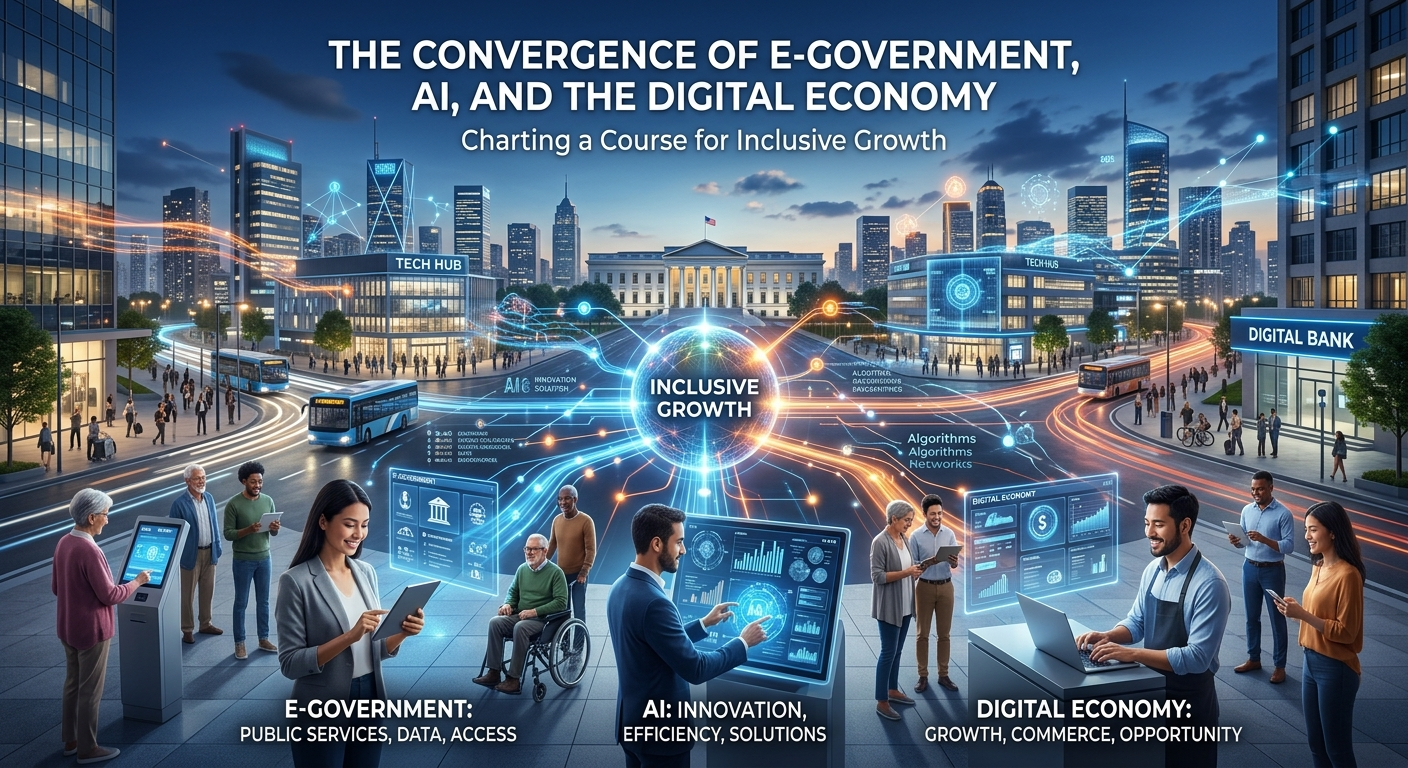
The convergence of e-government, artificial intelligence (AI), digital infrastructure, digital public services, and the digital economy represents one of the most consequential transformations in modern governance and economic development. Governments are increasingly moving from paper-based administration toward integrated digital platforms capable of delivering public services, managing information, collecting revenue, supporting businesses, monitoring infrastructure, and interacting continuously with citizens.
Artificial intelligence adds another layer to this transformation. Whereas traditional e-government primarily digitizes existing government processes, AI can analyze enormous quantities of information, identify patterns, automate selected tasks, support decision-making, personalize public services, detect anomalies, and help governments anticipate emerging problems. At the same time, the digital economy creates new markets, enterprises, occupations, financial systems, and forms of economic participation.
The United Nations’ 2024 E-Government Survey, covering all 193 UN Member States, reports substantial global progress in digital government while emphasizing continuing disparities between countries and communities. The proportion of the world’s population considered to be lagging in digital-government development fell from 45.0% in 2022 to 22.4% in 2024. Nevertheless, Africa and several developing-country groupings remain below the global average.
The central challenge, therefore, is not simply to digitize government. It is to construct an inclusive digital civilization in which technology improves institutional capacity, economic opportunity, public services, accountability, and human welfare without creating a new technological divide.
1. Introduction
Government has always depended upon information.
Ancient administrations recorded populations, land, taxation, trade, military resources, agriculture, and public works. Modern states expanded this information infrastructure through paper records, telecommunications, computers, databases, and eventually the Internet.
The emergence of e-government represents the next major stage.
Instead of requiring citizens to physically visit government offices, digital government allows many interactions to occur through websites, mobile applications, digital identity systems, electronic payments, online licensing platforms, electronic tax systems, digital health services, education portals, and other interconnected systems.
The transformation is now entering another phase.
Artificial intelligence is turning digital government from a system that merely stores and moves information into a system that can increasingly interpret information and assist with decisions.
This produces a powerful convergence:
Digital infrastructure → E-government → Data → AI → Digital economy → Inclusive growth
The relationship is circular.
Better digital infrastructure enables better government services.
Better government services generate better-quality administrative data.
Better data can support AI.
AI can improve government efficiency and public services.
Improved public services can reduce transaction costs for businesses and citizens.
Lower transaction costs can stimulate entrepreneurship and economic activity.
A stronger digital economy can subsequently provide governments with additional resources, technologies, skills, and innovation.
2. Understanding the Three Pillars
2.1 E-Government
E-government refers broadly to the use of digital technologies by public institutions to provide services, communicate with citizens, manage administration, and improve government operations.
Examples include:
- online tax filing;
- electronic business registration;
- digital identity;
- online permits;
- electronic procurement;
- digital land records;
- online education services;
- digital health records;
- electronic court services;
- municipal service portals;
- social-protection platforms;
- online payment systems;
- government open-data platforms.
The fundamental objective is to make government more accessible, efficient, transparent, responsive, and accountable.
3. From E-Government to Digital Government
There is an important distinction between e-government and digital government.
E-government often begins by placing existing government services online.
For example:
Paper application → online application.
Digital government goes further.
It redesigns the underlying process:
Citizen need → digital identity → shared government data → automated eligibility assessment → service delivery → digital payment → continuous monitoring.
The second model is not simply a digital version of the first.
It represents government process transformation.
The UN’s 2024 Digital Government Model Framework emphasizes the importance of integrated digital-government development rather than treating individual digital services as isolated projects.
4. Artificial Intelligence as the Intelligence Layer
Artificial intelligence can be understood as an additional intelligence layer above digital infrastructure and government information systems.
Traditional computer systems generally follow predefined instructions.
AI systems can additionally:
- classify information;
- detect patterns;
- summarize documents;
- translate languages;
- identify anomalies;
- forecast trends;
- assist with research;
- recognize speech;
- analyze images;
- support decision-making;
- generate text and other content.
This does not mean that AI should replace government officials.
Instead, the most useful model is generally:
Human authority + digital infrastructure + data + AI assistance
Human institutions remain responsible for laws, rights, accountability, public policy, and consequential decisions.
5. The Architecture of AI-Enabled Government
A future-oriented digital government can be represented as a technological stack.
Layer 1 — Physical Infrastructure
- electricity;
- telecommunications;
- fibre;
- mobile networks;
- satellites;
- data centres;
- cloud infrastructure.
Layer 2 — Digital Connectivity
- broadband;
- 4G/5G;
- Internet exchange infrastructure;
- government networks;
- secure communications.
Layer 3 — Digital Identity
- citizen identity;
- authentication;
- electronic signatures;
- organizational identities.
Layer 4 — Digital Public Infrastructure
- payment systems;
- identity platforms;
- data-exchange systems;
- registries;
- authentication services.
Layer 5 — Government Data
- population data;
- tax information;
- health information;
- education records;
- land records;
- business registries;
- infrastructure data.
Layer 6 — Applications
- tax portals;
- licensing systems;
- health platforms;
- education systems;
- municipal applications;
- social services.
Layer 7 — Artificial Intelligence
- machine learning;
- natural-language processing;
- computer vision;
- predictive analytics;
- generative AI;
- AI agents.
Layer 8 — Human Governance
- legislation;
- public administration;
- courts;
- oversight;
- ethics;
- democratic accountability.
This final layer is crucial.
Technology can process information, but society must determine what government should do and what rights citizens possess.
6. Digital Identity as the Front Door of Government
One of the most important components of digital government is digital identity.
A robust digital identity system can allow an individual to establish who they are when accessing multiple public services.
A citizen might theoretically use one trusted identity to access:
Identity → Tax → Health → Education → Social protection → Licensing → Municipal services
This can eliminate repeated paperwork and reduce administrative duplication.
However, identity systems must be designed with strong safeguards.
Important principles include:
- privacy;
- security;
- proportionality;
- accessibility;
- transparency;
- authentication;
- correction mechanisms;
- independent oversight.
Digital identity should be an instrument for inclusion rather than a mechanism that prevents vulnerable people from accessing government.
7. Government Data: The Raw Material of Digital Administration
AI depends heavily upon data.
Government possesses enormous quantities of information because public institutions interact with citizens and organizations across virtually every major sector.
Government datasets may include:
- demographic information;
- economic statistics;
- geographical information;
- environmental measurements;
- transportation data;
- public-health statistics;
- educational information;
- infrastructure records;
- business registrations;
- public expenditure data.
However, having data is not the same as having usable data.
Data must be:
Accurate + accessible + secure + interoperable + appropriately governed
Poor-quality data can produce poor AI results.
This creates an important principle:
AI cannot compensate indefinitely for weak information foundations.
8. AI Applications in Government
8.1 Public Service Assistants
AI assistants can help citizens navigate complicated government systems.
For example:
Citizen question → AI interprets request → identifies relevant service → explains requirements → directs citizen to application → tracks status.
This can be especially valuable where government procedures are complicated.
8.2 Tax Administration
AI can assist tax authorities by:
- identifying unusual patterns;
- detecting inconsistencies;
- improving taxpayer communication;
- forecasting revenue;
- assisting auditors;
- reducing administrative workload.
The objective should be improved compliance and service—not arbitrary automated punishment.
8.3 Healthcare
AI can assist health systems with:
- medical-image analysis;
- disease surveillance;
- resource planning;
- hospital scheduling;
- supply-chain management;
- epidemiological modelling.
Human medical professionals remain essential for diagnosis, treatment, and patient care.
8.4 Education
AI can support:
- personalized learning;
- teacher assistance;
- translation;
- educational content;
- administrative management;
- learning analytics.
The goal should be to expand educational opportunity rather than simply automate teachers.
8.5 Agriculture
Governments can combine satellite information, weather data, agricultural statistics, and AI to support:
- crop monitoring;
- drought assessment;
- food-security planning;
- agricultural extension;
- irrigation management;
- disaster preparedness.
This is particularly important for developing economies where agriculture remains economically significant.
9. AI and Public Infrastructure
AI can transform infrastructure management.
A modern government could theoretically operate an integrated infrastructure intelligence platform connecting:
- roads;
- bridges;
- water systems;
- electricity;
- public transport;
- telecommunications;
- waste management;
- environmental monitoring.
Sensors and databases provide information.
AI analyzes the information.
Government engineers make decisions.
For example:
Sensor → Data → AI anomaly detection → Engineer inspection → Maintenance decision
This can move governments from reactive maintenance toward predictive infrastructure management.
10. AI and Disaster Management
Digital government can also become a major component of national resilience.
AI can combine:
- weather information;
- satellite imagery;
- geological information;
- historical disaster records;
- population data;
- infrastructure maps.
The system can help authorities identify areas requiring attention.
The broader architecture becomes:
Observation → Data collection → AI analysis → Risk assessment → Government decision → Public warning → Emergency response → Recovery
This connects digital government directly to public safety and disaster resilience.
11. The Digital Economy
The digital economy extends far beyond online shopping.
It includes:
- telecommunications;
- cloud computing;
- software;
- fintech;
- digital payments;
- e-commerce;
- artificial intelligence;
- cybersecurity;
- data services;
- online education;
- digital media;
- platform businesses;
- digital professional services.
The government itself becomes part of this ecosystem.
Government can function simultaneously as:
Regulator + customer + infrastructure provider + data producer + service provider + market participant
12. Government as a Digital-Economy Catalyst
A capable government can accelerate the digital economy by providing the foundations that individual companies cannot efficiently build alone.
These include:
- broadband;
- digital identity;
- payment infrastructure;
- cybersecurity standards;
- data protection;
- digital skills;
- electronic procurement;
- innovation policy;
- startup support;
- research institutions.
The World Bank’s 2025 Digital Progress and Trends Report identifies four foundational areas as particularly important for inclusive AI development: connectivity, compute, context/data, and competency/skills.
These four areas provide a useful framework for developing economies.
13. Digital Public Infrastructure
Digital public infrastructure can be understood as foundational digital systems that enable large-scale participation in the digital economy.
Major components may include:
- digital identity;
- digital payments;
- trusted data exchange;
- interoperable registries;
- authentication;
- electronic signatures.
The importance of interoperability cannot be overstated.
If government departments operate completely isolated systems, citizens may repeatedly provide the same information.
If properly governed systems can communicate securely, government becomes more efficient.
14. The Citizen Experience
The ultimate measure of digital government should not be the number of government websites.
It should be:
How much easier has government become for an ordinary person to use?
Consider a citizen attempting to establish a small business.
A fragmented system might require:
- visit government office;
- complete paper form;
- obtain separate certificate;
- visit tax office;
- open another application;
- make a separate payment;
- wait for several departments.
An integrated system could potentially provide:
Digital identity → Business registration → Tax registration → Licensing → Payment → Certificate
The technological achievement is therefore not the website itself.
It is the elimination of unnecessary institutional friction.
15. Digital Inclusion
The greatest danger of digital transformation is that it can create a new divide between people who can participate digitally and those who cannot.
The UN reports that approximately 1.89 billion people remain on the disadvantaged side of the digital divide, emphasizing the importance of inclusive policies, affordable access, digital literacy, accessible platforms, and attention to marginalized groups.
Digital inclusion requires more than Internet coverage.
It requires:
- affordable connectivity;
- affordable devices;
- electricity;
- digital literacy;
- accessible interfaces;
- local-language services;
- disability accessibility;
- public digital-access points;
- support for people with limited technological skills.
16. Africa and the Digital Transformation Challenge
Africa possesses enormous opportunities for digital transformation because many economies can adopt modern technologies without carrying the full burden of legacy systems.
This creates the possibility of digital leapfrogging.
Examples include:
- mobile financial services;
- digital payments;
- mobile government services;
- cloud computing;
- digital identity;
- AI-enabled agriculture;
- telemedicine;
- online education.
However, major obstacles remain.
These include:
- inadequate connectivity;
- electricity constraints;
- limited computing infrastructure;
- shortage of advanced technical skills;
- cybersecurity risks;
- fragmented markets;
- limited financing;
- regulatory differences;
- affordability barriers.
The UN’s 2024 assessment specifically notes that African countries, on average, remain below the global e-government-development level, reinforcing the need for targeted investment and institutional capacity-building.
17. South Africa as a Digital-Government Case
South Africa has several important foundations for digital transformation:
- sophisticated financial institutions;
- extensive telecommunications infrastructure;
- major technology companies;
- universities;
- financial-technology ecosystems;
- large urban digital markets;
- established government databases.
However, digital transformation must address disparities between highly connected urban communities and underserved areas.
The objective should therefore be a national architecture in which digital government works for:
large cities + small towns + rural communities
Digital transformation should not become synonymous with urban transformation.
18. The AI Divide
A new technological divide is emerging beyond the traditional digital divide.
The traditional digital divide concerns:
Who has Internet access?
The AI divide asks:
Who has access to advanced computing, data, AI expertise, AI models, and AI-enabled economic opportunities?
The World Bank’s 2025 report highlights substantial global differences in AI innovation, computing infrastructure, startup funding, data, connectivity, and skills.
Developing countries therefore need strategies that prevent AI from becoming concentrated exclusively in already wealthy economies.
19. Skills for the Digital Economy
Digital transformation ultimately depends upon people.
Important skills include:
Basic digital literacy
- computer use;
- smartphones;
- Internet navigation;
- online safety.
Intermediate skills
- spreadsheets;
- databases;
- digital communications;
- e-commerce;
- digital administration.
Advanced skills
- programming;
- cloud computing;
- cybersecurity;
- AI;
- data science;
- semiconductor technology;
- robotics.
Strategic skills
- technology management;
- digital policy;
- entrepreneurship;
- innovation;
- systems architecture.
A country cannot build a sustainable AI economy merely by purchasing computers.
It must develop human capability.
20. Cybersecurity
The more government becomes digital, the more cybersecurity becomes a national-security and public-service requirement.
Potential threats include:
- data theft;
- identity fraud;
- ransomware;
- service disruption;
- unauthorized access;
- misinformation;
- supply-chain vulnerabilities.
Therefore:
Digital government = digital services + digital security
Security must be designed into systems from the beginning rather than added after deployment.
21. Privacy and Data Governance
Government data can be extremely sensitive.
AI systems can potentially combine information from many sources and produce new insights about individuals and communities.
Consequently, digital government requires:
- data-protection legislation;
- access controls;
- encryption;
- audit trails;
- retention rules;
- transparency;
- independent oversight;
- mechanisms for correcting inaccurate information.
The principle should be:
Collect what is necessary, protect what is collected, and use information for legitimate purposes.
22. Algorithmic Fairness
AI systems can reproduce biases present in their training data.
A government AI system could therefore produce unfair results if:
- historical data are biased;
- particular communities are underrepresented;
- data are incomplete;
- algorithms are poorly evaluated.
High-impact government AI should therefore undergo rigorous:
- testing;
- auditing;
- documentation;
- monitoring;
- human review.
AI should assist public administration without eliminating due process.
23. Transparency and Explainability
Citizens should be able to understand when important government decisions involve automated systems.
This raises fundamental questions:
- What system made the recommendation?
- What data were used?
- Can a citizen challenge the outcome?
- Who is legally responsible?
- Was a human involved?
- How is the system audited?
The answer should not simply be:
“The algorithm decided.”
Government remains accountable for decisions made using government technology.
24. The Digital Economy and Small Businesses
Small and medium enterprises can benefit enormously from digital transformation.
Digital platforms can reduce barriers to:
- market access;
- payments;
- accounting;
- logistics;
- advertising;
- customer communication;
- procurement;
- financing.
A small business in a rural community can potentially reach customers far beyond its immediate geographic market.
This transforms the economic geography of entrepreneurship.
25. Digital Payments
Digital payments are another critical bridge between government and the digital economy.
They can support:
- tax collection;
- social transfers;
- business transactions;
- salaries;
- public procurement;
- utility payments.
When combined with appropriate identity and financial infrastructure, digital payments can substantially reduce transaction friction.
However, financial inclusion must remain central.
People who lack bank accounts, digital skills, devices, or reliable connectivity should not automatically be excluded.
26. Smart Cities
The convergence becomes particularly visible at the city level.
A smart city can combine:
Sensors + telecommunications + cloud + databases + AI + municipal government
Applications include:
- traffic management;
- water monitoring;
- electricity management;
- waste collection;
- public transport;
- environmental monitoring;
- emergency coordination.
The objective should not be to make cities technologically complicated.
It should be to make them more livable, efficient, resilient, and inclusive.
27. The Future Government Operating Model
The traditional model resembles:
Citizen → Government Department
The emerging model increasingly resembles:
Citizen → Digital Identity → Unified Platform → Multiple Government Services
Behind the platform:
Government databases → Interoperability → Cloud/compute → AI → Human officials → Public institutions
This resembles an operating system for government.
The government of the future may increasingly function as a networked digital institution rather than a collection of isolated departments.
28. AI Agents and Government
The next stage after AI assistants may involve AI agents capable of coordinating multiple steps in administrative processes.
For example:
Citizen request
↓
AI understands request
↓
Identifies relevant government services
↓
Checks available information
↓
Requests missing information
↓
Coordinates departmental systems
↓
Prepares documentation
↓
Human official reviews consequential decisions
↓
Service completed
The critical distinction is that automation should have boundaries.
Low-risk administrative tasks may be highly automated.
High-impact decisions involving rights, benefits, legal status, health, or significant financial consequences require stronger human oversight.
29. Digital Government and Economic Productivity
Digital government can increase productivity by reducing transaction costs.
Consider the cumulative cost of:
- travelling to offices;
- waiting in queues;
- repeatedly entering information;
- processing paper;
- correcting administrative errors;
- transferring physical documents;
- manually verifying information.
Digitization can reduce many of these costs.
At national scale, relatively small reductions in administrative friction can produce significant economic benefits.
30. Government Procurement and Innovation
Governments are among the world’s largest purchasers of goods and services.
Digital procurement platforms can improve:
- transparency;
- competition;
- supplier access;
- auditing;
- efficiency;
- expenditure tracking.
Open and well-designed procurement systems can also help smaller technology companies participate in government markets.
This turns public procurement into a potential innovation policy instrument.
31. Open Government Data
Government generates enormous amounts of non-sensitive information.
Publishing appropriate datasets can enable:
- research;
- journalism;
- startups;
- universities;
- civic organizations;
- developers.
A transport dataset, for example, can enable private developers to build mobility applications.
Thus:
Government data → public infrastructure → private innovation → economic activity
Open data must nevertheless respect privacy, security, confidentiality, and legal requirements.
32. Digital Democracy
Digital government can also change citizen participation.
Citizens can potentially:
- submit public comments;
- monitor government projects;
- access legislation;
- track public spending;
- participate in consultations;
- report infrastructure problems.
This can strengthen the relationship between citizens and institutions.
However, digital participation must not become a substitute for democratic institutions.
Technology should strengthen democracy rather than merely automate communication.
33. Environmental Sustainability
Digital government can contribute to environmental management through:
- satellite monitoring;
- environmental sensors;
- AI analysis;
- energy-management systems;
- climate modelling;
- digital permitting;
- electronic records.
AI can help governments process complex environmental information faster.
At the same time, digital infrastructure itself consumes electricity and resources.
Therefore, digital transformation must consider:
computing efficiency + renewable energy + responsible hardware lifecycle + electronic-waste management
34. The Economics of Digital Infrastructure
A digital economy requires physical foundations.
Behind an apparently simple mobile application may exist:
Electricity → fibre → mobile tower → router → data centre → server → storage → database → software → AI model → application → smartphone
This illustrates a crucial principle:
The digital economy is physically constructed.
Cloud computing is not literally weightless.
It depends upon:
- buildings;
- electrical grids;
- cooling;
- fibre;
- semiconductor chips;
- servers;
- storage systems;
- physical security.
Consequently, digital transformation is simultaneously an IT strategy, infrastructure strategy, energy strategy, education strategy, and economic strategy.
35. Public-Private Partnerships
Governments cannot build every component of the digital economy themselves.
Private companies may provide:
- cloud services;
- telecommunications;
- software;
- cybersecurity;
- data-centre capacity;
- fintech;
- AI services.
Governments provide:
- regulation;
- public infrastructure;
- standards;
- public services;
- policy;
- oversight.
Successful digital transformation therefore requires carefully designed public-private partnerships.
36. Regional Digital Integration
Digital economies become more powerful when markets can connect across borders.
Regional integration can involve:
- interoperable payment systems;
- digital identity recognition;
- data standards;
- cross-border e-commerce;
- cybersecurity cooperation;
- telecommunications;
- digital taxation;
- common technology standards.
For Africa, regional digital integration could help create larger markets for African technology companies.
37. Building an Inclusive Digital-Economy Strategy
A national strategy can be organized around ten pillars:
Pillar 1 — Connectivity
Affordable, reliable Internet.
Pillar 2 — Electricity
Reliable power for digital infrastructure.
Pillar 3 — Digital Identity
Trusted identity and authentication.
Pillar 4 — Digital Public Infrastructure
Payments, registries, data exchange, and shared platforms.
Pillar 5 — Government Digitization
Transformation of public services.
Pillar 6 — Artificial Intelligence
Responsible deployment of AI.
Pillar 7 — Human Capital
Digital and technical education.
Pillar 8 — Cybersecurity
Protection of systems and citizens.
Pillar 9 — Digital Entrepreneurship
Support for startups and SMEs.
Pillar 10 — Inclusion
Ensuring vulnerable communities participate.
38. A Step-by-Step National Implementation Roadmap
Phase 1 — Establish the Foundations
Develop:
- broadband;
- electricity;
- government networks;
- cloud infrastructure;
- cybersecurity capability.
Phase 2 — Establish Digital Identity
Create secure and accessible identity mechanisms.
Phase 3 — Digitize Core Registries
Modernize:
- population;
- business;
- tax;
- land;
- education;
- health;
- social-protection databases.
Phase 4 — Build Interoperability
Enable appropriately governed government systems to exchange information securely.
Phase 5 — Create Unified Citizen Platforms
Move from dozens of isolated portals toward coherent service ecosystems.
Phase 6 — Introduce AI
Begin with lower-risk applications:
- document processing;
- translation;
- search;
- service navigation;
- administrative assistance;
- forecasting.
Phase 7 — Expand AI Carefully
Introduce more sophisticated applications with stronger evaluation and human oversight.
Phase 8 — Build the Digital Economy
Support:
- startups;
- SMEs;
- e-commerce;
- fintech;
- software;
- AI;
- cloud;
- cybersecurity.
Phase 9 — Measure Inclusion
Track whether rural communities, low-income households, women, young people, older persons, and people with disabilities can participate.
Phase 10 — Continuous Improvement
Digital government should never be considered finished.
Technology, citizen expectations, cybersecurity threats, and economic conditions continuously change.
39. Measuring Success
A national digital transformation programme should measure more than the number of websites created.
Important indicators include:
Access
- Internet coverage;
- affordability;
- device availability.
Government
- percentage of services available digitally;
- processing time;
- administrative cost;
- citizen satisfaction.
Economy
- digital-business creation;
- e-commerce activity;
- technology employment;
- startup formation.
AI
- AI adoption;
- AI skills;
- computing capacity;
- responsible-AI assessments.
Inclusion
- rural participation;
- accessibility;
- gender participation;
- digital literacy.
Security
- cybersecurity incidents;
- response times;
- system resilience.
40. Major Risks
Digital transformation also creates risks.
40.1 Digital Exclusion
People without connectivity can be excluded.
40.2 Cybersecurity
More connected systems create more potential attack surfaces.
40.3 Privacy
Large-scale data integration can threaten individual privacy if poorly governed.
40.4 Algorithmic Bias
AI can reproduce or amplify existing inequalities.
40.5 Automation Risk
Some occupations may change substantially.
40.6 Concentration of Technology
Advanced AI infrastructure may become concentrated in a small number of countries and corporations.
40.7 Vendor Dependence
Governments can become overly dependent on external technology suppliers.
40.8 Digital Monopolies
A small number of platforms may acquire excessive economic power.
These risks mean that digital transformation requires institutions as much as technology.
41. The Human Principle
The ultimate purpose of digital government is not technology.
It is human development.
A successful system should make it easier for a person to:
- obtain an identity;
- register a business;
- access education;
- receive healthcare;
- pay taxes;
- obtain permits;
- access social services;
- communicate with government;
- participate economically.
Technology is therefore the means.
Human welfare is the objective.
42. The Convergence Model
The entire transformation can be summarized as:
Physical Infrastructure
↓
Connectivity
↓
Digital Identity
↓
Digital Public Infrastructure
↓
Government Data
↓
Interoperability
↓
Cloud + Computing
↓
Artificial Intelligence
↓
Digital Public Services
↓
Digital Businesses
↓
Innovation + Productivity
↓
Employment + Economic Opportunity
↓
Inclusive Growth
But the model requires a parallel governance foundation:
Law + Privacy + Cybersecurity + Ethics + Human Rights + Accountability
Without this foundation, technological advancement can generate new risks.
43. Conclusion
The convergence of e-government, artificial intelligence, and the digital economy represents far more than the modernization of government websites.
It is a transformation of the relationship between:
state + citizen + business + information + technology + economy
The first generation of e-government digitized paperwork.
The second generation integrated government services.
The emerging generation adds artificial intelligence, interoperable digital infrastructure, automation, advanced analytics, and intelligent interfaces.
The objective should be a government that is:
faster, more accessible, more transparent, more responsive, more secure, more efficient, and more inclusive.
The digital economy then extends these capabilities into society, creating new opportunities for entrepreneurs, workers, researchers, educators, farmers, businesses, and communities.
However, technological progress alone does not guarantee inclusive growth.
The World Bank’s current analysis emphasizes that connectivity, computing capacity, relevant data, and skills are fundamental prerequisites for countries seeking to participate meaningfully in AI-driven development.
Similarly, the United Nations emphasizes that digital transformation must address infrastructure, digital literacy, cybersecurity, privacy, inclusive design, human capital, and the digital divide.
The strategic objective for governments should therefore be clear:
Build digital systems that do not merely make government more technological, but make society more capable of participating in economic, educational, civic, and technological progress.
The ultimate destination is not an automated government.
It is a human-centred digital society in which technology expands opportunity rather than concentrating it.
44. Final Strategic Framework
The convergence can ultimately be represented by seven interconnected systems:
1. DIGITAL GOVERNMENT
Public services, administration, regulation and citizen interaction.
2. DIGITAL PUBLIC INFRASTRUCTURE
Identity, payments, registries and trusted data exchange.
3. ARTIFICIAL INTELLIGENCE
Prediction, analysis, automation and decision support.
4. DIGITAL ECONOMY
Businesses, platforms, fintech, e-commerce and technology industries.
5. DIGITAL INFRASTRUCTURE
Networks, cloud, data centres, computing and electricity.
6. HUMAN CAPITAL
Education, digital literacy, STEM, entrepreneurship and lifelong learning.
7. TRUSTED GOVERNANCE
Privacy, cybersecurity, ethics, law, transparency and accountability.
When these seven systems reinforce one another, digital transformation can become a powerful engine of productivity, institutional effectiveness, innovation and inclusive economic growth.
The central lesson is therefore simple:
The future of government is not merely electronic. It is interconnected, data-driven, increasingly intelligent, and economically integrated—but it must remain fundamentally human-centred.
Selected Research Foundation
The United Nations E-Government Survey 2024 provides the principal international framework for assessing digital government across all 193 UN Member States and includes a dedicated addendum examining AI and digital government.
The World Bank Digital Progress and Trends Report 2025 provides a complementary perspective on the foundations required for inclusive AI adoption, particularly connectivity, compute, context/data, and competency/skills.



Be First to Comment