
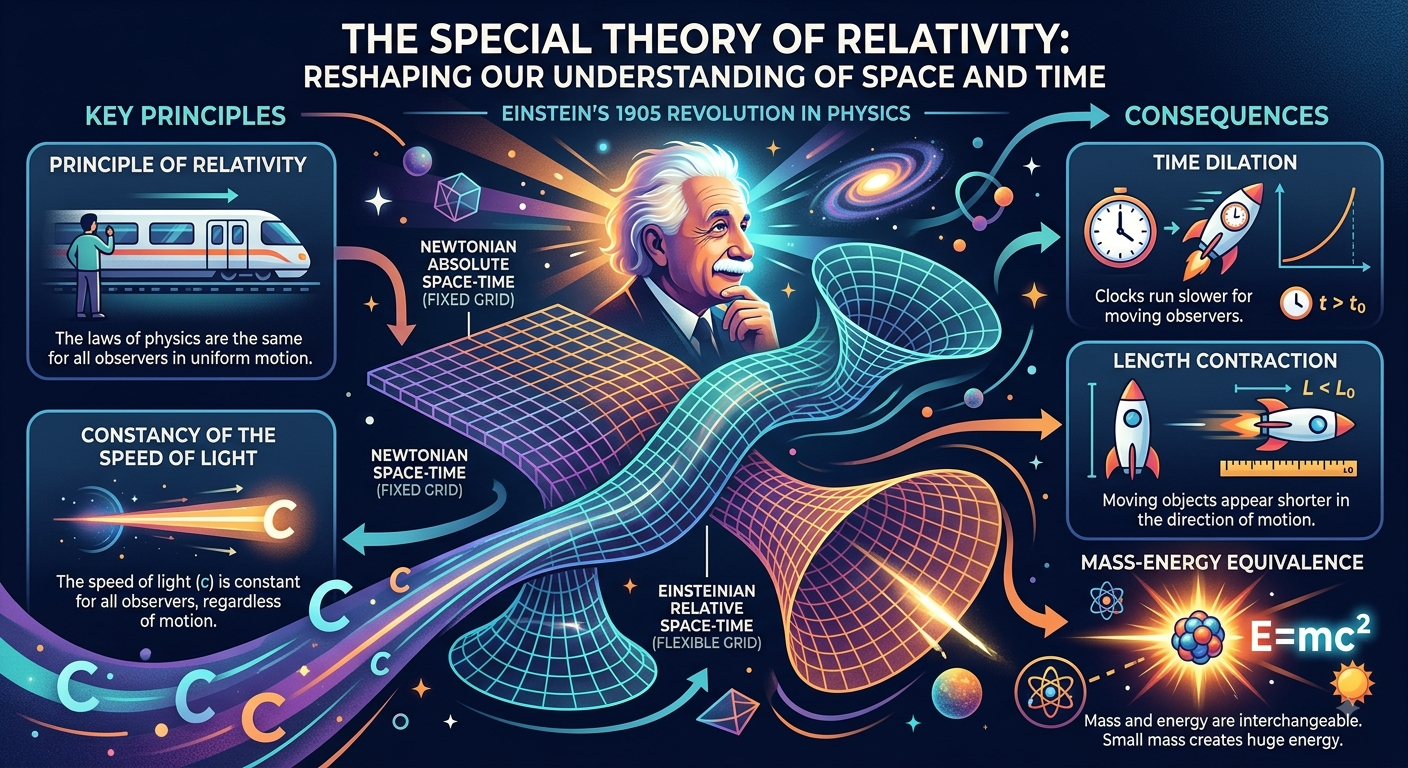
A Comprehensive Scientific and Technological Thesis
Abstract
The Special Theory of Relativity, published by Albert Einstein in 1905, transformed the scientific understanding of space, time, motion, matter, energy, and causality. Its central insight was that measurements of space and time are not absolute quantities shared identically by all observers. Instead, they depend upon the relative motion of the observer, while the laws of physics—and particularly the speed of light in vacuum—remain invariant between inertial reference frames.
Special relativity replaced the classical Galilean description of space and time with a unified four-dimensional structure known as spacetime. From two foundational postulates, Einstein derived consequences that appeared profoundly counterintuitive from the perspective of everyday experience: time dilation, length contraction, relativity of simultaneity, relativistic velocity addition, relativistic momentum, mass-energy equivalence, and the invariant spacetime interval.
The theory is not merely a philosophical description of the Universe. It is a working technological framework. Relativistic physics is fundamental to particle accelerators, high-energy physics, precision timing, satellite navigation, accelerator-based research, electromagnetic theory, astrophysics, cosmology, radiation physics, and modern atomic-clock technology. GPS and other global navigation satellite systems require relativistic corrections to achieve their intended precision.
This thesis examines the historical crisis that preceded Einstein’s 1905 formulation, develops the mathematical structure of special relativity, explains its experimental foundations, and follows its influence from fundamental physics into contemporary technology.
Keywords: special relativity, Einstein, spacetime, Lorentz transformation, time dilation, length contraction, simultaneity, relativistic momentum, mass-energy equivalence, (E=mc^2), particle physics, GPS, atomic clocks, astrophysics.
Chapter 1 — Introduction
1.1 The problem of absolute space and time
Before relativity, classical mechanics was dominated by the Newtonian conception that space and time existed as universal backgrounds.
In Newtonian physics:
- time flowed identically for all observers;
- spatial distances were independent of the observer’s motion;
- simultaneous events were simultaneous for everyone;
- velocities combined according to ordinary addition;
- the laws of mechanics were naturally expressed using Galilean transformations.
For ordinary speeds, this framework works extraordinarily well.
If a train moves at (50\ \text{km/h}) and a passenger walks forward at (5\ \text{km/h}), a stationary observer approximately measures the passenger’s speed as (55\ \text{km/h}).
Classical mechanics therefore suggests:
[
u’ = u-v
]
where (u) is the object’s velocity in one reference frame and (v) is the relative velocity between the frames.
The problem arose when physicists attempted to combine this framework with Maxwell’s theory of electromagnetism.
Chapter 2 — Historical Origins
2.1 Newtonian mechanics
Isaac Newton’s mechanics provided a remarkably successful description of terrestrial and celestial motion.
Its mathematical framework assumed an absolute temporal order:
[
t’=t
]
and Galilean spatial transformation:
[
x’=x-vt
]
These equations implicitly assume that time is universal.
2.2 Maxwell’s electromagnetic theory
During the nineteenth century, James Clerk Maxwell unified electricity, magnetism, and optics into electromagnetic theory.
The resulting equations implied electromagnetic waves propagating through vacuum at a characteristic speed:
[
c \approx 299,792,458\ \text{m/s}
]
This raised a fundamental question:
Relative to what is the speed of light measured?
The prevailing nineteenth-century idea was the hypothetical luminiferous ether, imagined as a medium through which electromagnetic waves propagated.
2.3 The Michelson-Morley experiment
The Michelson-Morley experiment attempted to detect Earth’s motion through the supposed ether.
The expected effect was not observed at the predicted level.
This result contributed to a growing crisis in classical interpretations of electromagnetism and motion.
2.4 Lorentz and the transformation problem
Hendrik Lorentz developed mathematical transformations that preserved the form of Maxwell’s equations between inertial reference frames.
The Lorentz transformation ultimately became one of the mathematical foundations of special relativity.
The deeper conceptual interpretation, however, came from Einstein.
Chapter 3 — Einstein’s 1905 Revolution
3.1 Einstein’s 1905 paper
In 1905 Einstein published his paper on the electrodynamics of moving bodies.
Rather than treating the apparent conflict between mechanics and electromagnetism as a problem requiring an ether, Einstein questioned the underlying assumptions about space and time.
The revolutionary move was to make the laws of physics—and especially the propagation of light—compatible by changing the transformation rules for space and time.
3.2 The two postulates
Special relativity rests on two fundamental principles.
Postulate 1 — Principle of relativity
The laws of physics have the same form in all inertial reference frames.
No inertial observer can determine through a purely local experiment that they are in a state of uniform motion.
Postulate 2 — Invariance of the speed of light
The speed of light in vacuum has the same value for all inertial observers, independent of the motion of the source or observer.
Thus:
[
c=299,792,458\ \text{m/s}
]
This is not simply a statement that light usually travels at this speed. It is a statement about the structure of spacetime itself.
Chapter 4 — Reference Frames and Events
4.1 Inertial reference frames
An inertial reference frame is one in which a free object moves at constant velocity unless acted upon by an external influence.
Special relativity primarily concerns relationships between such frames.
4.2 Events
An event is something that occurs at a particular position and time.
An event can be represented as:
[
(ct,x,y,z)
]
The inclusion of (ct) allows time to be expressed in distance units.
This leads naturally to four-dimensional spacetime.
4.3 Spacetime
Instead of treating space and time as completely independent entities, relativity treats them as interconnected components of one geometric structure.
A useful conceptual representation is:
[
\text{Spacetime}=(ct,x,y,z)
]
This was developed mathematically into the spacetime framework associated with Hermann Minkowski.
Chapter 5 — The Lorentz Transformation
Consider two inertial reference frames:
- (S)
- (S’)
where (S’) moves with velocity (v) relative to (S) along the (x)-axis.
Define:
[
\gamma=\frac{1}{\sqrt{1-\frac{v^2}{c^2}}}
]
The Lorentz transformation is:
[
x’=\gamma(x-vt)
]
[
t’=\gamma\left(t-\frac{vx}{c^2}\right)
]
with:
[
y’=y
]
[
z’=z
]
The inverse transformation is:
[
x=\gamma(x’+vt’)
]
[
t=\gamma\left(t’+\frac{vx’}{c^2}\right)
]
The crucial feature is that space and time transform together.
The transformation preserves the spacetime interval:
[
c^2\Delta t^2-\Delta x^2-\Delta y^2-\Delta z^2
]
This invariant replaces the Newtonian idea that spatial distance and time separately possess universal values.
NIST’s technical literature describes the Lorentz transformation as arising naturally from relativity together with the invariance of the light cone and emphasizes that space and time become unified into four-dimensional spacetime.
Chapter 6 — Time Dilation
6.1 The moving clock
One of the most famous predictions of special relativity is time dilation.
If a clock moves relative to an observer, the observer measures the moving clock as running more slowly.
The relationship is:
[
\Delta t=\gamma\Delta\tau
]
where:
- (\Delta\tau) = proper time measured by the clock traveling with the process;
- (\Delta t) = elapsed time measured by another inertial observer;
- (\gamma) = Lorentz factor.
Since:
[
\gamma>1
]
for any nonzero velocity,
[
\Delta t>\Delta\tau
]
6.2 Why everyday clocks appear unaffected
At ordinary speeds,
[
\frac{v}{c}\ll1
]
so:
[
\gamma\approx1
]
The relativistic effect therefore becomes significant only at velocities approaching the speed of light or when clocks can measure extremely small differences.
Modern precision timing experiments demonstrate that relativity is not merely a theoretical curiosity. ESA notes that accelerator experiments provide extremely precise tests of special-relativistic time dilation, while satellite clocks experience both special- and general-relativistic effects.
Chapter 7 — Length Contraction
A moving object is measured to be shorter along its direction of motion.
The relationship is:
[
L=\frac{L_0}{\gamma}
]
where:
- (L_0) is the object’s proper length;
- (L) is its measured length in a frame where the object is moving.
This does not mean that an observer riding with the object sees the object physically crushed.
Instead, different observers assign different spatial measurements because they disagree about which distant events occur simultaneously.
Length contraction and relativity of simultaneity are therefore deeply connected.
Chapter 8 — Relativity of Simultaneity
Newtonian physics assumes that if two events occur simultaneously for one observer, they are simultaneous for every observer.
Special relativity rejects this assumption.
From:
[
t’=\gamma\left(t-\frac{vx}{c^2}\right)
]
we see that time depends not only on (t), but also on spatial position (x).
Therefore two events separated in space can be simultaneous in one reference frame but occur at different times in another.
This is one of the most profound consequences of Einstein’s theory.
8.1 The conceptual transformation
Classical physics:
[
\text{Universal time}
]
Special relativity:
[
\text{Observer-dependent time + invariant spacetime structure}
]
The theory therefore does not say that “everything is relative.”
Rather, it identifies specific quantities that depend on reference frame and other quantities that remain invariant.
Chapter 9 — The Relativistic Velocity Transformation
Classical velocity addition fails at relativistic speeds.
Instead of:
[
u’=u-v
]
special relativity gives:
[
u’=\frac{u-v}{1-\frac{uv}{c^2}}
]
This equation ensures that if:
[
u=c
]
then:
[
u’=c
]
for any inertial observer moving at a physically allowed subluminal velocity.
The speed of light therefore acts as an invariant limiting speed for objects with nonzero rest mass.
Chapter 10 — Causality and the Light Cone
The invariance of the speed of light creates a causal structure.
For an event, light can propagate outward at (c), forming a light cone.
Events can be classified as:
- timelike separated;
- lightlike separated;
- spacelike separated.
For timelike-separated events, causal influence can travel from one to the other at a speed below or equal to (c).
For spacelike-separated events, no ordinary causal signal traveling at or below (c) can connect them.
This preserves the fundamental principle of causality within special relativity.
Chapter 11 — Relativistic Momentum
Classical momentum is:
[
p=mv
]
At relativistic velocities, the correct expression becomes:
[
p=\gamma mv
]
As (v\rightarrow c):
[
\gamma\rightarrow\infty
]
and therefore the momentum required to accelerate an object with nonzero rest mass toward (c) grows without bound.
This explains why massive objects cannot be accelerated to the speed of light using ordinary acceleration processes.
The theory thus establishes a fundamental limit:
[
v<c
]
for massive particles.
Chapter 12 — Relativistic Energy
The total relativistic energy is:
[
E=\gamma mc^2
]
The rest energy is:
[
E_0=mc^2
]
The kinetic energy is:
[
K=(\gamma-1)mc^2
]
The famous equation:
[
\boxed{E=mc^2}
]
therefore represents the energy associated with the rest mass of an object.
It does not simply mean that “mass turns into energy.” More precisely, mass contributes to the invariant energy content of a physical system, and energy and momentum form a unified relativistic description.
Chapter 13 — The Energy-Momentum Relationship
A more general relationship is:
[
E^2=p^2c^2+m^2c^4
]
For a particle at rest:
[
p=0
]
so:
[
E=mc^2
]
For a massless particle:
[
m=0
]
therefore:
[
E=pc
]
This relationship is fundamental to particle physics.
It allows physicists to determine particle properties from measured energy and momentum.
Chapter 14 — Experimental Verification
Special relativity has been tested through many independent experimental approaches.
14.1 Particle accelerators
Accelerated particles routinely reach velocities extremely close to (c).
Their measured:
- energies,
- momenta,
- lifetimes,
- trajectories,
- radiation patterns
agree with relativistic predictions.
CERN experiments explicitly exploit relativistic time dilation and length contraction when investigating high-energy particle processes.
14.2 Unstable particles
Some unstable particles have very short lifetimes in their rest frames.
When moving at relativistic velocities, their observed lifetimes are extended by the Lorentz factor.
This is a direct manifestation of time dilation.
14.3 Atomic clocks
Modern atomic clocks can detect extremely small differences in elapsed time.
This has transformed relativity from a theory tested primarily through high-speed particles into a framework relevant to precision metrology.
14.4 Electromagnetism
Special relativity provides a deeper explanation of the relationship between electric and magnetic fields.
Electric and magnetic fields can be understood as different components of a relativistic electromagnetic field.
Consequently:
[
\mathbf{E}\quad\text{and}\quad\mathbf{B}
]
are not completely independent phenomena.
Their measured values depend partly upon the observer’s state of motion.
Chapter 15 — Relativity and Particle Physics
Special relativity forms the kinematic foundation of modern high-energy physics.
Particle physics requires simultaneous treatment of:
- quantum mechanics;
- special relativity;
- fields;
- conservation laws;
- particle interactions.
This ultimately leads to relativistic quantum field theory.
15.1 Particle creation and annihilation
Because energy and mass are connected, sufficient energy can produce massive particles under appropriate physical conditions.
Likewise, particle-antiparticle systems can transform their energy into other forms while conserving the relevant quantities.
15.2 Accelerator physics
Particle accelerators rely upon relativistic equations to calculate:
- beam momentum;
- particle energy;
- collision energies;
- magnetic bending;
- radiation;
- particle lifetimes.
Without relativistic mechanics, modern accelerator design would be fundamentally incorrect.
Chapter 16 — Special Relativity and GPS
The Global Positioning System is one of the clearest examples of relativity becoming an engineering requirement.
GPS satellites carry extremely precise clocks.
Their clocks experience:
- special-relativistic time dilation because satellites move relative to Earth;
- general-relativistic gravitational effects because the satellites occupy a different gravitational potential.
Therefore satellite navigation cannot simply assume Newtonian absolute time.
NIST documentation specifically identifies relativistic corrections in GPS timing and describes corrections associated with satellite motion and signal propagation.
NIST also describes GPS as an important worldwide time-transfer system.
ESA likewise explains that relativistic effects are essential to GNSS operation and future high-precision navigation systems.
GPS conceptual architecture
                  SATELLITE
              ┌───────────────┐
              │ Atomic Clock  │
              │ Orbit Motion  │
              └───────┬───────┘
                      │
                Relativistic
                  corrections
                      │
                      ▼
               Radio timing signal
                      │
                      ▼
              ┌───────────────┐
              │ GPS Receiver  │
              └───────┬───────┘
                      │
                      ▼
              Position + precise time
Relativity therefore becomes part of the computational infrastructure underlying navigation.
Chapter 17 — Relativity and Nuclear Technology
Mass-energy equivalence is fundamental to understanding nuclear processes.
Atomic nuclei have different binding energies depending on their configuration.
The difference between the total mass of separated constituents and the mass of a bound system corresponds to energy according to:
[
E=\Delta mc^2
]
The equation therefore provides the conversion factor between mass difference and energy.
Applications include scientific understanding of:
- nuclear binding energy;
- radioactive transformations;
- nuclear reactions;
- stellar energy generation;
- nuclear-energy systems;
- particle interactions.
This thesis treats these applications from a scientific and technological perspective rather than providing instructions for constructing weapons.
Chapter 18 — Relativity and Astrophysics
Although special relativity describes physics in inertial frames without gravity, it is indispensable throughout astrophysics.
18.1 Relativistic jets
Some astronomical objects produce jets of matter moving at velocities extremely close to (c).
Relativistic effects influence:
- observed brightness;
- apparent velocity;
- Doppler shifts;
- beaming;
- observed variability.
18.2 High-energy cosmic rays
Cosmic rays can possess enormous energies.
Their interactions with matter and radiation require relativistic energy-momentum relationships.
18.3 Neutron stars
Matter inside compact stars can reach extreme densities and energies where relativistic physics becomes essential.
A complete treatment of their gravitational structure requires general relativity, but special relativity remains embedded in the local physics.
Chapter 19 — Relativistic Doppler Effect
Motion changes the observed frequency of electromagnetic radiation.
For motion directly along the line of sight, relativistic Doppler relationships can be expressed through the Lorentz factor and velocity parameter:
[
\beta=\frac{v}{c}
]
For a source moving away from an observer, the observed frequency decreases; for an approaching source, it increases.
This phenomenon is essential to interpreting astronomical observations.
It helps scientists determine:
- stellar velocities;
- galaxy motions;
- relativistic jets;
- high-energy astrophysical processes.
Chapter 20 — Relativistic Aberration
Relativity also changes the apparent direction from which light arrives when an observer moves relative to the source.
This phenomenon is called relativistic aberration.
At ordinary speeds it is negligible.
At speeds approaching (c), however, radiation becomes increasingly concentrated into the forward direction.
This effect is important in relativistic astrophysics and accelerator physics.
Chapter 21 — From Special to General Relativity
Special relativity describes physics in the absence of gravitational curvature.
Einstein subsequently recognized that gravity itself needed to be incorporated into the relativistic description.
This led to the General Theory of Relativity in 1915.
The conceptual progression is:
Newtonian Mechanics
       │
       ▼
Maxwell Electromagnetism
       │
       ▼
Lorentz Transformation
       │
       ▼
Einstein Special Relativity
       │
       ├── Space + Time → Spacetime
       │
       ├── E = mc²
       │
       └── Relativistic Mechanics
       │
       ▼
Einstein General Relativity
       │
       ▼
Curved Spacetime + Gravity
Special relativity therefore forms one of the foundations upon which general relativity was constructed.
Chapter 22 — Special Relativity and Modern Timekeeping
Modern science increasingly depends on extremely precise time.
Applications include:
- atomic clocks;
- telecommunications;
- satellite navigation;
- scientific instrumentation;
- frequency standards;
- astronomical observations;
- distributed computer networks;
- precision geodesy.
As clock accuracy improves, relativistic effects become easier to measure.
The development of precision frequency measurement has therefore transformed relativity from a theory associated mainly with extreme velocities into a practical component of precision engineering.
NIST maintains an extensive scientific literature base on time and frequency measurement, reflecting the importance of precision timing to modern science and technology.
Chapter 23 — Relativity in Electromagnetic Technology
Special relativity and electromagnetism are deeply interconnected.
The electromagnetic field can be represented using the field tensor:
[
F^{\mu\nu}
]
This mathematical object combines electric and magnetic components into a unified relativistic structure.
A major consequence is that an electric field measured by one observer can be accompanied by both electric and magnetic components for another observer in relative motion.
Thus:
[
\text{Electricity}+\text{Magnetism}
]
are manifestations of a deeper relativistic electromagnetic structure.
This insight has influenced:
- electromagnetic engineering;
- accelerator design;
- plasma physics;
- particle physics;
- radiation theory.
Chapter 24 — Relativistic Invariance
One of the deepest principles of special relativity is the distinction between quantities that depend upon reference frame and quantities that remain invariant.
Examples include:
| Quantity | Frame dependent? |
|---|---|
| Coordinate time | Yes |
| Coordinate length | Yes |
| Velocity | Yes |
| Momentum | Yes |
| Energy | Yes |
| Spacetime interval | No |
| Rest mass | No |
| Speed of light in vacuum | No |
The theory therefore does not eliminate objective physics.
Instead, it identifies a deeper set of invariant relationships.
Chapter 25 — The Spacetime Interval
For two events:
[
\Delta s^2=c^2\Delta t^2-\Delta x^2-\Delta y^2-\Delta z^2
]
The value of this interval is invariant between inertial observers.
Depending on sign convention, the overall sign may be reversed; the physical content is unchanged.
This invariant provides the mathematical foundation for:
- proper time;
- light cones;
- causal relationships;
- four-vectors;
- relativistic particle dynamics.
Chapter 26 — Four-Vectors
Relativity becomes especially powerful when physical quantities are represented as four-dimensional objects.
The spacetime position four-vector is:
[
x^\mu=(ct,x,y,z)
]
The four-momentum is:
[
p^\mu=\left(\frac{E}{c},p_x,p_y,p_z\right)
]
Its invariant magnitude produces:
[
E^2-p^2c^2=m^2c^4
]
This four-dimensional formalism is central to relativistic particle physics.
Chapter 27 — Proper Time
Proper time is the time measured by a clock traveling along its own worldline.
It is related to coordinate time by:
[
d\tau=dt\sqrt{1-\frac{v^2}{c^2}}
]
Proper time is particularly important because it is invariant along a given worldline.
It gives physics a rigorous way of describing what a traveling clock actually measures.
Chapter 28 — The Relativistic Worldline
The path of an object through spacetime is called its worldline.
Instead of describing an object’s motion only through three-dimensional space:
[
x(t),y(t),z(t)
]
relativity describes its trajectory through spacetime.
Conceptually:
             TIME
              ↑
              │
              │       Worldline
              │      /
              │     /
              │    /
              │   /
              │  /
              │ /
              └────────────────→ SPACE
The worldline provides a geometric description of motion.
Chapter 29 — The Relativistic Limit
The classical world emerges as an approximation to special relativity when:
[
v\ll c
]
In this limit:
[
\gamma\approx1
]
and the relativistic equations reduce approximately to Newtonian equations.
This is an important principle in science:
A successful new theory should explain why an older theory worked within its domain of validity.
Special relativity therefore did not simply destroy Newtonian mechanics.
It identified its range of applicability.
Chapter 30 — Technological Applications
The technological influence of special relativity extends across multiple fields.
30.1 Satellite navigation
Relativistic corrections are required for precision GNSS timing and positioning.
30.2 Particle accelerators
Relativistic energy and momentum determine accelerator beam dynamics.
30.3 High-energy detectors
Particle energies and trajectories are interpreted through relativistic kinematics.
30.4 Atomic clocks
Precision clocks provide sensitive measurements of relativistic time effects.
30.5 Telecommunications
Precise synchronization increasingly requires consideration of relativistic timing in satellite-based and global systems.
30.6 Astronomy
Relativistic Doppler shifts, aberration, and high-energy particle dynamics are essential to astronomical interpretation.
30.7 Medical and scientific accelerators
Accelerated charged particles used for scientific and medical purposes require relativistic beam physics at sufficiently high energies.
30.8 Space navigation
Future navigation systems extending beyond Earth will require increasingly sophisticated relativistic timing models. ESA research specifically identifies relativistic modeling as important for future autonomous and high-precision navigation.
Chapter 31 — Scientific Importance
Special relativity changed the foundations of physics in several major ways.
31.1 Time is not universal
Observers in relative motion can measure different elapsed times.
31.2 Space is not universal
Lengths depend upon the observer’s state of motion.
31.3 Simultaneity is not universal
Two spatially separated events can be simultaneous for one observer but not another.
31.4 Space and time are interconnected
They form spacetime.
31.5 Mass and energy are interconnected
Rest mass corresponds to rest energy.
31.6 Light establishes a causal boundary
The speed (c) is fundamental to the structure of spacetime.
Chapter 32 — Common Misconceptions
Misconception 1: “Everything is relative.”
Incorrect.
Relativity identifies specific transformation rules and invariant quantities.
Misconception 2: “Time dilation is an illusion.”
Incorrect.
Different observers genuinely measure different elapsed proper times between appropriate events.
Misconception 3: “Objects physically shrink because of length contraction.”
Length contraction concerns measurements between reference frames. It does not mean an object experiences itself as compressed.
Misconception 4: “Einstein said nothing can move faster than light under any circumstances.”
More precisely, special relativity establishes (c) as the invariant causal speed and prevents massive objects from being accelerated through the light-speed barrier within ordinary relativistic physics.
Misconception 5: “(E=mc^2) means matter is simply made of energy.”
The equation expresses mass-energy equivalence. It is a precise relationship between invariant mass and rest energy.
Chapter 33 — Special Relativity and the Information Age
Modern digital civilization depends increasingly on precise synchronization.
Consider a global network:
        SATELLITE
            │
            │ timing
            ▼
     ┌─────────────┐
     │ Ground Hub  │
     └──────┬──────┘
            │
       fiber/radio
            │
     ┌──────▼──────┐
     │ Data Center │
     └──────┬──────┘
            │
       Internet
            │
     ┌──────▼──────┐
     │ User Device │
     └─────────────┘
Modern infrastructure increasingly relies on precise time distribution.
At ordinary terrestrial scales, relativistic effects may be extremely small, but satellite systems, precision clocks, scientific instrumentation, and navigation systems operate at accuracy levels where those effects become operationally significant.
Relativity is therefore embedded in the technological infrastructure of the modern world.
Chapter 34 — Experimental Legacy
The scientific importance of special relativity is not based on a single experiment.
Its predictions have been tested through multiple independent physical systems.
These include:
- high-energy particle behavior;
- unstable-particle lifetimes;
- precision clocks;
- electromagnetic experiments;
- accelerator measurements;
- satellite timing;
- relativistic radiation phenomena.
The convergence of these independent observations is one reason special relativity occupies such a central position in modern physics.
Chapter 35 — Relationship to Quantum Physics
Special relativity alone is not a quantum theory.
Quantum mechanics alone, in its original nonrelativistic form, is also insufficient for describing high-energy processes.
The combination led to relativistic quantum theory and ultimately quantum field theory.
This framework underlies the Standard Model of particle physics.
The conceptual chain is:
[
\text{Special Relativity}
+
\text{Quantum Mechanics}
\rightarrow
\text{Quantum Field Theory}
]
Modern particle physics consequently depends on the compatibility of relativity and quantum principles.
Chapter 36 — Limits of Special Relativity
Special relativity is extraordinarily successful, but it has a defined domain.
It assumes inertial reference frames and does not by itself provide a complete theory of gravity.
For strong gravitational fields and curved spacetime, general relativity is required.
Consequently:
[
\text{Special Relativity}
\rightarrow
\text{Flat Spacetime}
]
whereas:
[
\text{General Relativity}
\rightarrow
\text{Curved Spacetime}
]
Nevertheless, special relativity remains locally fundamental to physics in curved spacetime.
Chapter 37 — Future Technological Implications
As humanity develops more precise clocks, faster spacecraft, more powerful accelerators, and increasingly autonomous navigation systems, relativistic physics becomes more—not less—important.
Future developments may include:
- higher-precision global navigation;
- relativistic interplanetary navigation;
- advanced atomic-clock networks;
- improved deep-space time synchronization;
- more precise astrophysical observations;
- high-energy particle accelerators;
- relativistic plasma research;
- precision tests of fundamental physics.
ESA research has already considered relativistic navigation architectures for future extraterrestrial navigation, demonstrating that relativity is not merely a historical theory but part of the engineering problem for future space systems.
Chapter 38 — Historical Timeline
| Year | Development |
|---|---|
| 1687 | Newton publishes Principia |
| 1860s | Maxwell develops electromagnetic theory |
| 1887 | Michelson-Morley experiment |
| 1890s | Lorentz develops transformation concepts |
| 1905 | Einstein publishes Special Relativity |
| 1905 | Einstein publishes mass-energy equivalence work |
| 1908 | Minkowski develops spacetime formulation |
| 1915 | Einstein completes General Relativity |
| 1919 | Solar-eclipse observations test general-relativistic light deflection |
| 20th century | Relativity becomes foundational to particle physics |
| 20th century | Particle accelerators provide increasingly precise tests |
| Late 20th century | Satellite navigation incorporates relativistic corrections |
| 21st century | Precision atomic clocks enable increasingly sensitive tests |
| Present | Relativistic timing is integrated into navigation, metrology and high-energy physics |
Chapter 39 — Core Equations
Lorentz factor
[
\boxed{\gamma=\frac{1}{\sqrt{1-v^2/c^2}}}
]
Lorentz transformation
[
\boxed{x’=\gamma(x-vt)}
]
[
\boxed{t’=\gamma\left(t-\frac{vx}{c^2}\right)}
]
Time dilation
[
\boxed{\Delta t=\gamma\Delta\tau}
]
Length contraction
[
\boxed{L=\frac{L_0}{\gamma}}
]
Relativistic momentum
[
\boxed{p=\gamma mv}
]
Total energy
[
\boxed{E=\gamma mc^2}
]
Rest energy
[
\boxed{E_0=mc^2}
]
Energy-momentum relationship
[
\boxed{E^2=p^2c^2+m^2c^4}
]
Spacetime interval
[
\boxed{\Delta s^2=c^2\Delta t^2-\Delta x^2-\Delta y^2-\Delta z^2}
]
Relativistic velocity addition
[
\boxed{
u’=\frac{u-v}{1-\frac{uv}{c^2}}
}
]
Chapter 40 — Integrated Scientific Architecture
The intellectual structure of special relativity can be summarized as follows:
                 SPECIAL RELATIVITY
                         │
          ┌──────────────┴──────────────┐
          │                             │
   PRINCIPLE OF                   LIGHT-SPEED
    RELATIVITY                    INVARIANCE
          │                             │
          └──────────────┬──────────────┘
                         ▼
                LORENTZ TRANSFORMATIONS
                         │
          ┌──────────────┼──────────────┐
          │              │              │
          ▼              ▼              ▼
     Time dilation   Length         Relativity of
                     contraction    simultaneity
          │              │              │
          └──────────────┼──────────────┘
                         ▼
                     SPACETIME
                         │
             ┌───────────┴───────────┐
             │                       │
             ▼                       ▼
       Four-vectors            Invariants
             │                       │
             └───────────┬───────────┘
                         ▼
                RELATIVISTIC DYNAMICS
                         │
             ┌───────────┴───────────┐
             ▼                       ▼
       Momentum and Energy       E = mc²
             │                       │
             └───────────┬───────────┘
                         ▼
                MODERN PHYSICS
                         │
       ┌─────────────────┼─────────────────┐
       ▼                 ▼                 ▼
 Particle physics      GPS             Astrophysics
       │                 │                 │
       ▼                 ▼                 ▼
 Accelerators       Precision time    High-energy
 and detectors      & navigation      cosmic phenomena
Chapter 41 — Broader Scientific Significance
The deepest achievement of special relativity was not merely the discovery of time dilation.
It was the replacement of an outdated conceptual framework.
Before relativity:
[
\text{Space}+\text{Universal Time}
]
After relativity:
[
\text{Spacetime}
]
Before relativity:
[
\text{Mass and Energy treated separately}
]
After relativity:
[
\text{Mass-Energy-Momentum}
]
Before relativity:
[
\text{Galilean transformations}
]
After relativity:
[
\text{Lorentz transformations}
]
This transformation changed the conceptual language of modern physics.
Chapter 42 — Conclusion
The Special Theory of Relativity represents one of the greatest conceptual transformations in the history of science.
Einstein’s 1905 theory demonstrated that space and time cannot be treated as independent universal quantities. Measurements of duration, distance, simultaneity, energy, and momentum depend upon the observer’s state of motion, while the laws of physics and the invariant speed of light establish a deeper structure shared by inertial observers.
The Lorentz transformation provides the mathematical mechanism through which space and time are related. Time dilation and length contraction emerge naturally from this transformation, while relativity of simultaneity demonstrates that there is no universal Newtonian clock governing all spatially separated events.
The theory subsequently produced a unified spacetime description, relativistic momentum and energy, and the mass-energy relationship:
[
\boxed{E=mc^2}
]
Its influence extends far beyond theoretical physics.
Special relativity is embedded in the mathematical foundations of particle accelerators, high-energy physics, electromagnetic theory, precision timing, satellite navigation, astrophysics and modern space technology. GPS is a particularly important technological demonstration: satellite navigation requires relativistic treatment of timing because both satellite motion and gravitational environment affect clock behavior.
The theory also established a conceptual bridge toward general relativity. Special relativity describes flat spacetime and inertial motion; general relativity extends relativistic thinking to gravitation and curved spacetime.
More than a century after its publication, special relativity remains one of the most thoroughly tested frameworks in science. Its continuing technological importance demonstrates a fundamental lesson about scientific knowledge:
A theory that initially appears abstract can eventually become part of the infrastructure of civilization.
From the clocks aboard navigation satellites to the beams inside particle accelerators and the interpretation of light arriving from distant astronomical objects, modern technology and science operate in a Universe whose structure is profoundly relativistic.
Special relativity therefore did more than reshape our understanding of space and time.
It changed the coordinate system through which humanity understands physical reality.
Selected References and Scientific Resources
- Einstein, A. (1905). On the Electrodynamics of Moving Bodies. Annalen der Physik.
- Lorentz, H. A. — foundational work on transformations in electromagnetic theory.
- Minkowski, H. (1908). Space and Time.
- NIST, Time and Frequency Measurement and Relativity.
- NIST, Global Positioning System Receivers and Relativity.
- NIST, GPS and One-Way Time Transfer.
- Ashby, N. & Nelson, R. A., The Global Positioning System, Relativity, and Extraterrestrial Navigation.
- CERN, NA63 experiment and relativistic phenomena in high-energy physics.
- European Space Agency, research on relativistic navigation and GNSS.
- European Space Agency, precision clocks and experimental tests of relativity.
- NIST, Time and Frequency Publication Database.





Be First to Comment