
Abstract
Modern artificial intelligence, particularly generative AI and large language models (LLMs), depends on several concepts that are often confused: words, tokens, parameters, embeddings, context windows, and computation. Understanding the differences between these concepts provides a foundation for understanding how systems such as conversational AI process language, learn statistical relationships, and generate responses.
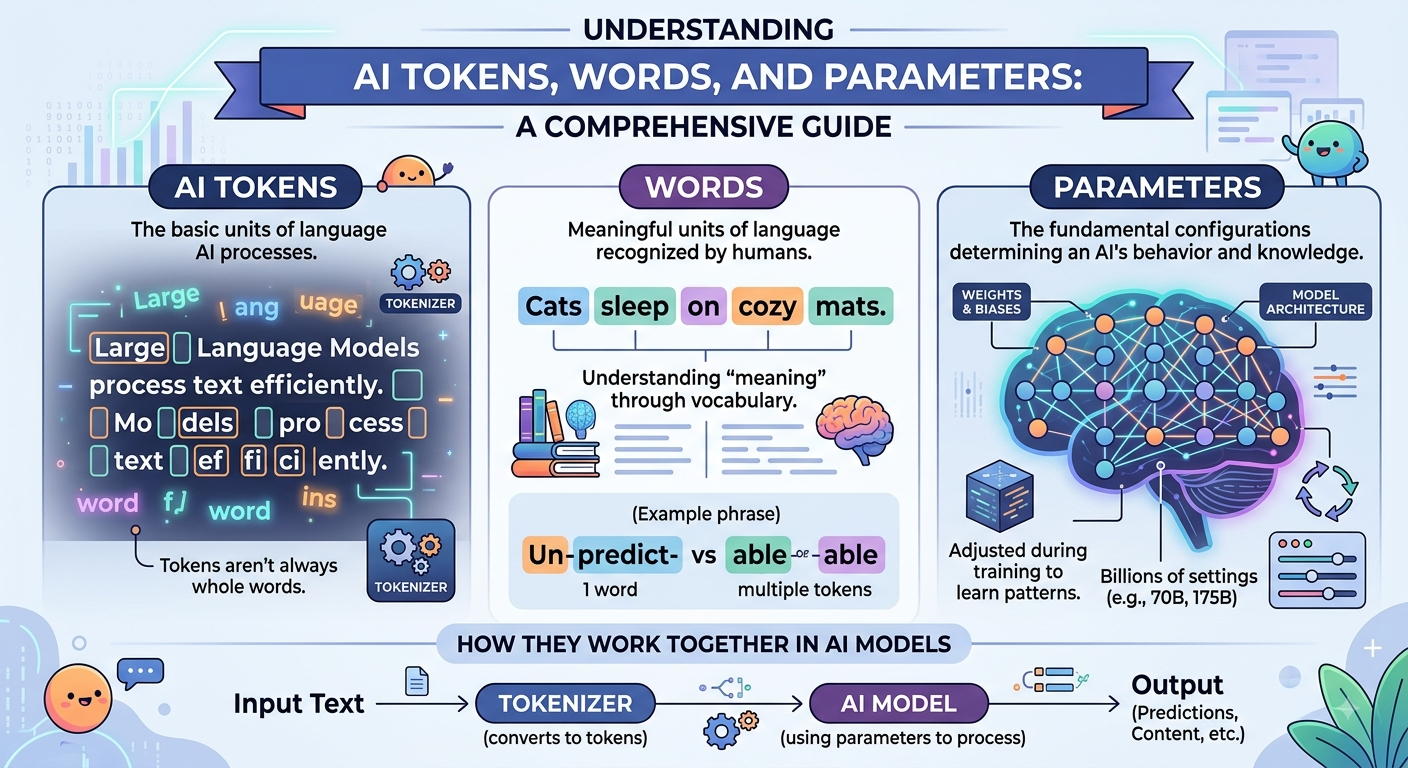
A language model does not normally process a sentence as a sequence of ordinary dictionary words. Instead, text is converted into tokens, which may represent complete words, portions of words, punctuation, spaces, or other character sequences. For English, a useful approximation is that one token corresponds to roughly four characters or about three-quarters of a word, although this varies considerably by language and text.
Tokens are then represented numerically and processed through a neural network containing potentially billions of learned parameters. Parameters are numerical values adjusted during training so that the model becomes increasingly effective at predicting and transforming patterns in its input. Thus, tokens are primarily units of data representation and processing, whereas parameters are part of the model’s learned internal machinery.
This thesis develops these concepts from first principles and connects them to tokenization, neural networks, transformers, training, inference, context windows, computational hardware, AI economics, multilingual computing, and the future of intelligent systems.
Chapter 1 — Introduction
Artificial intelligence has introduced a new vocabulary into computing.
Terms such as:
- token
- word
- parameter
- embedding
- context window
- model
- inference
- training
- attention
- transformer
- FLOPs
- GPU
- accelerator
appear frequently in discussions of ChatGPT, large language models, AI agents, and generative AI.
Yet these concepts describe different layers of the AI system.
A simplified pipeline is:
Human language → text → tokenizer → tokens → token IDs → embeddings → neural-network computation → probability distribution → next token → decoded text
Parameters operate throughout the neural-network computation.
A useful conceptual distinction is:
Words are linguistic concepts; tokens are computational representations; parameters are learned numerical components of the model.
Understanding this distinction is fundamental to understanding modern AI.
Chapter 2 — What Is a Word?
A word is primarily a linguistic unit.
For example:
artificial intelligence systems
contains three ordinary words:
- artificial
- intelligence
- systems
Humans naturally perceive these units because language has grammatical and semantic structure.
Computers, however, do not necessarily process language according to human definitions of words.
Consider:
unbelievable
A tokenizer could represent this as one token or several subword tokens, depending on the tokenizer and vocabulary.
Similarly, a word may be divided into pieces.
Therefore:
word count ≠ token count
This distinction becomes especially important in AI because many model interfaces measure input and output using tokens rather than ordinary words.
Chapter 3 — What Is an AI Token?
A token is a unit of text selected by a tokenizer.
A token can be:
- a complete word;
- part of a word;
- punctuation;
- a number;
- whitespace-related text;
- a symbol;
- or another frequently occurring sequence of characters.
OpenAI describes tokens as the building blocks processed by its models. For common English text, approximately 1 token ≈ 4 characters ≈ ¾ of a word, although this is only a rule of thumb.
For example:
The computer learns.
might conceptually become something similar to:
"The"
" computer"
" learns"
"."
The exact tokenization depends on the tokenizer.
Importantly, token boundaries are not necessarily identical to spaces between words.
Chapter 4 — Tokenization
Tokenization is the process of converting text into tokens.
A simplified pipeline is:
Human text
     ↓
Tokenizer
     ↓
Token sequence
     ↓
Token IDs
     ↓
Neural network
For example:
"Artificial intelligence"
becomes a sequence of token representations.
Those tokens are then associated with numerical identifiers.
The neural network ultimately works with numerical representations rather than the original human-readable sentence.
Chapter 5 — Why Don’t AI Models Simply Use Words?
A vocabulary consisting exclusively of complete words creates several problems.
There are enormous numbers of possible words, names, technical terms, abbreviations, misspellings, mathematical expressions and newly created words.
A word-only system might encounter:
quantumcomputingarchitecture
and fail to recognize it as a known unit.
Subword tokenization provides a more flexible solution.
The model might decompose an unfamiliar expression into smaller pieces.
This approach allows a relatively manageable vocabulary to represent an enormous range of language.
Research on tokenization describes the movement from word-based representations toward subword approaches such as Byte Pair Encoding and related techniques.
Chapter 6 — Tokens Are Not Words
This distinction deserves particular emphasis.
| Concept | Meaning |
|---|---|
| Character | Individual symbol |
| Word | Linguistic unit |
| Token | Computational text unit |
| Token ID | Numerical identifier associated with a token |
| Embedding | Numerical vector representing a token |
| Parameter | Learned numerical value inside the model |
| Model | Neural network containing learned parameters |
Therefore:
1 word can equal 1 token.
But:
1 word can also equal multiple tokens.
And:
1 token does not necessarily equal 1 word.
This is why estimating AI usage by simply counting words can be misleading.
Chapter 7 — Token IDs
Once text is tokenized, each token is associated with an identifier.
Conceptually:
"The"       → token ID A
" computer" → token ID B
" learns"   → token ID C
"."         → token ID D
The actual IDs are numerical values determined by the vocabulary of the particular tokenizer.
The model therefore receives something closer to:
[A, B, C, D]
rather than the raw sentence.
The important point is that token IDs are representations, not meanings.
A token ID is essentially an index into the model’s vocabulary.
Chapter 8 — From Token IDs to Embeddings
Token IDs are not yet the rich numerical representations used by the neural network.
The model converts them into vectors called embeddings.
Conceptually:
Token ID
   ↓
Embedding lookup
   ↓
Vector
   ↓
Transformer layers
A token might therefore become a vector such as:
[0.21, -0.74, 0.13, 0.58, ...]
Real models use vectors with many dimensions.
The embedding provides a numerical representation that can participate in the mathematical operations performed by the neural network.
Chapter 9 — What Is a Parameter?
A parameter is a learned numerical value within the neural network.
Parameters are sometimes called:
- weights;
- learned weights;
- model parameters.
During training, optimization algorithms repeatedly adjust these values.
A simplified learning process is:
Training data
      ↓
Tokens
      ↓
Neural network
      ↓
Prediction
      ↓
Error measurement
      ↓
Parameter adjustment
      ↓
Improved prediction
Millions, billions, or potentially even larger numbers of parameters may participate in the computation of modern AI systems.
Parameters therefore represent part of the model’s learned computational structure.
Chapter 10 — Tokens Versus Parameters
This is one of the most important distinctions in AI.
Tokens
Tokens describe what information is being processed.
Parameters
Parameters describe the learned mathematical system processing that information.
An analogy is a calculator:
- numbers entered into the calculator resemble input data;
- the calculator’s internal circuitry resembles the computational machinery;
- the resulting answer resembles the output.
For an LLM:
Input text
   ↓
Tokens
   ↓
Embeddings
   ↓
Neural network
   ↓
Parameters influence computation
   ↓
Output probabilities
   ↓
Generated tokens
   ↓
Text
Chapter 11 — How Parameters Are Learned
Parameters begin from initial numerical values.
During training, the model processes enormous quantities of training examples.
A simplified training cycle is:
- provide training data;
- tokenize it;
- predict a target token;
- compare prediction with the target;
- calculate an error or loss;
- calculate gradients;
- update parameters;
- repeat.
Conceptually:
Data
 ↓
Prediction
 ↓
Loss
 ↓
Gradient
 ↓
Parameter update
 ↓
New prediction
This process occurs repeatedly across enormous datasets.
The objective is not to manually program every linguistic rule.
Instead, the system learns statistical relationships through optimization.
Chapter 12 — The Transformer
Modern LLMs commonly use transformer-based architectures.
The transformer introduced a powerful mechanism known as attention, which allows the network to determine relationships between different elements of a sequence.
For example:
The scientist studied the planet because it was unusual.
The model needs to determine relationships between words and phrases.
Attention mechanisms allow the network to assign different levels of importance to different parts of the input while performing its computations.
A simplified transformer architecture can be represented as:
Tokens
  ↓
Embeddings
  ↓
Positional information
  ↓
Attention
  ↓
Neural transformations
  ↓
Repeated transformer layers
  ↓
Output representation
  ↓
Probability distribution
Chapter 13 — Parameters Inside a Transformer
Parameters are distributed throughout the neural network.
They can occur in:
- embedding-related components;
- attention projections;
- feed-forward networks;
- normalization-related components;
- output layers;
- other architectural components.
Thus, saying:
“This AI has X billion parameters”
does not mean it has X billion words stored inside it.
It means that the model contains approximately that number of learned numerical values, depending on how the parameter count is defined.
Chapter 14 — Parameters Are Not a Database of Facts
A common misunderstanding is:
“If an AI has 100 billion parameters, it must contain 100 billion facts.”
That is incorrect.
Parameters are not equivalent to individual facts.
The information learned during training is distributed across the network’s numerical structure.
A model does not normally store knowledge as:
Parameter 1 = fact A
Parameter 2 = fact B
Parameter 3 = fact C
Instead, knowledge and patterns are represented through complex interactions among many parameters.
Chapter 15 — What Happens During Inference?
After training, the model can be used for inference.
Inference means using the trained model to produce an output.
A simplified sequence is:
User prompt
     ↓
Tokenization
     ↓
Token IDs
     ↓
Embeddings
     ↓
Transformer computation
     ↓
Probability distribution
     ↓
Selected next token
     ↓
Repeat
     ↓
Final response
Language models generate text sequentially, with each generated token becoming part of the sequence used for subsequent prediction.
Chapter 16 — The Next-Token Principle
At a fundamental level, an autoregressive language model repeatedly predicts what token should come next.
Consider:
The capital of France is
The model calculates probabilities for possible next tokens.
Conceptually:
Paris      → high probability
London     → lower probability
Berlin     → lower probability
...
The model then selects a token according to its generation mechanism.
The selected token is appended to the sequence.
The process continues:
The capital of France is
→ Paris
→ .
→ ...
A sophisticated conversational answer can therefore emerge from repeated token-level prediction combined with deep neural-network computation.
Chapter 17 — Context Windows
A model does not have unlimited access to arbitrary text in a single computation.
The amount of tokenized information that can be processed within a particular context is described by its context window.
Conceptually:
System instructions
+
Conversation history
+
User prompt
+
Attached information
+
Generated response
=
Context
The total must fit within the model’s applicable context limits.
This explains why very long conversations, documents, codebases or datasets can eventually create context-management challenges.
Chapter 18 — Tokens and AI Costs
Tokens have major economic significance.
AI services commonly measure usage using:
- input tokens;
- output tokens;
- cached tokens;
- and, for some systems, other categories associated with reasoning or processing.
OpenAI’s documentation notes that token usage can be reflected in usage and billing information, depending on the service and model.
A simplified API cost model is:
Total cost
=
Input tokens × input price
+
Output tokens × output price
The actual pricing structure varies by provider and model.
Chapter 19 — Why Long Prompts Can Cost More
Suppose a system receives:
Short prompt → 100 tokens
versus:
Large document + instructions → 50,000 tokens
The second request requires the model to process substantially more input.
If output is also large, total token consumption increases further.
Therefore token efficiency becomes important for:
- AI applications;
- chatbots;
- search systems;
- autonomous agents;
- enterprise AI;
- software development;
- data analysis.
Chapter 20 — Tokens and Multilingual AI
Tokenization does not work identically across all languages.
Different languages can require different numbers of tokens to represent approximately the same semantic content.
Research has found substantial variation in tokenization efficiency across languages, creating important implications for AI accessibility, performance and pricing.
This is particularly important for Africa.
Languages such as:
- isiZulu;
- isiXhosa;
- Sesotho;
- Setswana;
- Sepedi;
- Tshivenda;
- Xitsonga;
- Afrikaans;
- English
can have different linguistic structures and therefore different computational characteristics.
Future AI systems need increasingly effective multilingual and African-language tokenization.
Chapter 21 — Tokenization and African Languages
African-language AI development presents an important research opportunity.
A language may be computationally disadvantaged if:
- its training data is limited;
- its vocabulary is poorly represented;
- tokenization is inefficient;
- digital text resources are scarce;
- speech datasets are limited;
- evaluation benchmarks are inadequate.
Consequently, building AI for Africa involves more than simply translating English AI systems.
It requires:
data + language resources + tokenization + models + computing + evaluation + cultural and linguistic knowledge.
Chapter 22 — Tokens, Numbers and Code
Tokens are not limited to ordinary prose.
Models can process:
- programming code;
- mathematical expressions;
- URLs;
- structured data;
- markup;
- symbols;
- tables;
- technical documentation.
Code can sometimes tokenize differently from natural language.
This matters because software-development AI systems can consume enormous quantities of tokens when processing large repositories.
Chapter 23 — Tokens and AI Agents
The emergence of AI agents has made token economics even more important.
A simple chatbot may perform:
User → Model → Answer
An agentic system can perform:
User
 ↓
Planning
 ↓
Search
 ↓
Tool call
 ↓
Observation
 ↓
Reasoning
 ↓
Another tool call
 ↓
New observation
 ↓
Final answer
Each interaction can involve additional model processing.
Therefore:
agentic AI can consume substantially more tokens than a single-turn question-and-answer interaction.
This makes efficient context management an important engineering problem.
Chapter 24 — Parameters and Model Size
Model size is often described using parameter counts:
1 million parameters
1 billion parameters
10 billion parameters
100 billion parameters
...
The suffixes commonly encountered include:
| Abbreviation | Meaning |
|---|---|
| 1K | 1 thousand |
| 1M | 1 million |
| 1B | 1 billion |
| 1T | 1 trillion |
However, parameter count alone does not determine intelligence.
Performance also depends on:
- training data;
- data quality;
- architecture;
- training methodology;
- compute;
- optimization;
- inference methods;
- context length;
- alignment;
- retrieval;
- tools;
- system design.
Chapter 25 — Dense and Mixture-of-Experts Models
Not every modern architecture necessarily activates every parameter for every token.
A Mixture-of-Experts (MoE) architecture can contain multiple expert networks while activating only a subset for a particular input.
Conceptually:
                 ┌── Expert A
Input → Router ──┼── Expert B
                 ├── Expert C
                 └── Expert D
The router determines which experts participate.
This creates an important distinction between:
total parameters
and
active parameters per token.
Consequently, comparing AI models purely by headline parameter count can be misleading.
Chapter 26 — Quantization
Parameters are numerical values.
They can be represented using different numerical precisions.
Examples include:
- FP32;
- FP16;
- BF16;
- INT8;
- lower-bit representations.
Reducing numerical precision can substantially reduce memory requirements and can sometimes improve inference efficiency, although there are trade-offs involving accuracy and computational behavior.
Conceptually:
High precision
     ↓
More memory
     ↓
More bandwidth

Lower precision
     ↓
Less memory
     ↓
Potentially faster / cheaper inference
Chapter 27 — Parameters and Memory
A model’s parameters must generally be stored somewhere during computation.
For example, a simplified calculation is:
Model parameters × bytes per parameter
=
Approximate parameter-memory requirement
If a model contains:
100 billion parameters
and each parameter uses approximately two bytes:
100 billion × 2 bytes
=
200 billion bytes
before accounting for additional memory requirements.
Real systems require additional memory for:
- activations;
- temporary computation;
- attention-related state;
- optimizer states during training;
- system overhead.
Chapter 28 — Training Versus Inference
Training and inference have fundamentally different computational requirements.
Training
Training involves:
Data
 ↓
Forward computation
 ↓
Loss
 ↓
Backpropagation
 ↓
Gradient calculation
 ↓
Parameter updates
This process is repeated many times.
Inference
Inference generally involves:
Prompt
 ↓
Forward computation
 ↓
Prediction
 ↓
Generated token
The parameters are normally not being continuously retrained during ordinary inference.
Chapter 29 — GPUs and AI Computation
Modern AI depends heavily on specialized computing hardware.
Important components include:
- GPUs;
- AI accelerators;
- high-bandwidth memory;
- CPUs;
- networking equipment;
- storage;
- power systems;
- cooling systems.
The relationship can be simplified as:
Tokens
 ↓
Neural-network mathematics
 ↓
Matrix operations
 ↓
AI accelerators
 ↓
Memory + networking
 ↓
Generated tokens
Large AI systems therefore represent not only software but an enormous physical infrastructure.
Chapter 30 — The Token-to-Compute Relationship
Tokens create computational work.
A simplified conceptual chain is:
More tokens
      ↓
More model computation
      ↓
More memory movement
      ↓
More accelerator utilization
      ↓
More energy consumption
      ↓
Potentially greater operating cost
However, actual computational cost depends strongly on:
- architecture;
- sequence length;
- model size;
- attention implementation;
- batching;
- hardware;
- quantization;
- caching;
- inference optimization.
Chapter 31 — The Three-Layer Mental Model
One of the easiest ways to understand modern LLMs is to separate three concepts.
Layer 1 — Language
Words
Sentences
Paragraphs
Documents
Layer 2 — Representation
Tokens
Token IDs
Embeddings
Vectors
Layer 3 — Learned computation
Parameters
Neural-network layers
Attention
Transformations
Therefore:
LANGUAGE
   ↓
TOKENS
   ↓
VECTORS
   ↓
PARAMETERIZED NEURAL NETWORK
   ↓
PROBABILITIES
   ↓
TOKENS
   ↓
LANGUAGE
This is perhaps the most important conceptual diagram in understanding LLMs.
Chapter 32 — Common Misconceptions
Misconception 1: One token equals one word
False.
Tokens may be complete words, parts of words, punctuation or other text sequences.
Misconception 2: Parameters are words
False.
Parameters are numerical values learned during model training.
Misconception 3: More parameters automatically means a smarter AI
False.
Architecture, training data, optimization and inference techniques also matter.
Misconception 4: Tokens contain complete human meanings
Not necessarily.
Tokens are computational units. Meaning emerges through representations and interactions across the network.
Misconception 5: A model stores one fact per parameter
False.
Knowledge is distributed across complex numerical relationships.
Chapter 33 — A Complete LLM Pipeline
A simplified modern language-model pipeline can be represented as:
                 HUMAN
                   │
                   ▼
              Text Prompt
                   │
                   ▼
              Tokenization
                   │
                   ▼
              Token IDs
                   │
                   ▼
              Embeddings
                   │
                   ▼
        ┌─────────────────────┐
        │   Transformer LLM   │
        │                     │
        │ Attention            │
        │ Neural transformations│
        │ Learned parameters   │
        └─────────────────────┘
                   │
                   ▼
          Probability scores
                   │
                   ▼
             Next token
                   │
                   ▼
        Repeat generation
                   │
                   ▼
             Output tokens
                   │
                   ▼
              Detokenization
                   │
                   ▼
             Human-readable
                response
Chapter 34 — Why Tokenization Matters for AI Design
Tokenization affects several dimensions of AI.
Performance
Poor tokenization can make sequences longer.
Cost
More tokens can increase usage.
Context
Longer token sequences consume more context capacity.
Multilingual fairness
Some languages can require more tokens for comparable content.
Computation
More tokens generally mean more processing.
User experience
Token efficiency can influence response speed and application cost.
Tokenization is therefore not merely a preprocessing detail.
It is an important part of AI architecture.
Chapter 35 — The Economics of Tokens
Tokens have effectively become a computational unit of modern AI services.
An AI company must consider:
Training tokens
       ↓
Training compute
       ↓
Model creation
       ↓
Inference tokens
       ↓
Infrastructure utilization
       ↓
Operating cost
AI businesses therefore optimize:
- tokens per request;
- model size;
- inference speed;
- memory utilization;
- caching;
- hardware efficiency;
- batching;
- context management.
The result is a new form of AI economics in which language itself becomes measurable computational workload.
Chapter 36 — Tokens as the Bridge Between Humans and Machines
Human beings communicate through language.
Computers operate through numerical computation.
Tokens provide one important bridge between these worlds.
Human language
       ↓
Tokenization
       ↓
Numerical representation
       ↓
Mathematical computation
       ↓
Numerical prediction
       ↓
Token sequence
       ↓
Human language
This transformation is one of the foundational mechanisms behind generative language AI.
Chapter 37 — Beyond Tokens
Tokens are important, but they are not the entire future of AI.
Researchers continue to investigate:
- byte-level models;
- character-level approaches;
- multimodal representations;
- speech tokens;
- image tokens;
- video representations;
- continuous representations;
- retrieval systems;
- external memory;
- agent architectures.
Research has also highlighted limitations of conventional subword tokenization, including issues involving multilingual representation and numerical reasoning.
Future systems may therefore use combinations of discrete and continuous representations.
Chapter 38 — Multimodal Tokens
Modern AI increasingly works beyond text.
Images can be represented through visual patches or learned representations.
Audio can be transformed into numerical representations.
Video contains spatial and temporal information.
Consequently, a future-oriented conceptual model is:
Text ───────┐
Images ─────┤
Audio ──────┤
Video ──────┤
Code ───────┤
Sensors ────┘
       ↓
Multimodal representation
       ↓
AI model
       ↓
Reasoning / generation
The fundamental concept is broader than traditional language tokens.
Chapter 39 — The Future of Parameters
Parameter counts are likely to remain important, but they are increasingly becoming only one metric among many.
Future AI evaluation may emphasize:
- effective compute;
- active parameters;
- reasoning efficiency;
- inference cost;
- data efficiency;
- energy efficiency;
- memory efficiency;
- multimodal capability;
- tool-use capability;
- reliability;
- factuality;
- latency.
The industry is therefore moving from:
How many parameters does the model have?
toward:
How effectively does the system transform computation into useful intelligence?
Chapter 40 — A Unified AI Formula
The relationship can be summarized conceptually as:
DATA
  ↓
TOKENIZATION
  ↓
TOKENS
  ↓
EMBEDDINGS
  ↓
PARAMETERIZED NEURAL NETWORK
  ↓
COMPUTATION
  ↓
PROBABILITIES
  ↓
OUTPUT TOKENS
  ↓
WORDS / IMAGES / CODE / OTHER OUTPUT
Training adds another feedback loop:
Prediction
   ↓
Loss
   ↓
Gradient
   ↓
Parameter update
   ↓
Prediction
This repeated optimization process is what transforms an initially untrained neural network into a useful trained model.
Chapter 41 — Practical Token Rules of Thumb
For ordinary English prose, OpenAI provides the approximate relationship:
1 token ≈ 4 characters
1 token ≈ ¾ word
100 tokens ≈ 75 words
These are approximations rather than universal conversion rules.
Therefore:
1,000 tokens ≈ 750 words
10,000 tokens ≈ 7,500 words
100,000 tokens ≈ 75,000 words
Actual token counts can differ substantially depending on the language and content.
Chapter 42 — A Simple Analogy
Imagine an enormous library.
Words
The books contain human language.
Tokens
Tokens are pieces into which the text is divided for computational processing.
Embeddings
Embeddings convert those pieces into mathematical representations.
Parameters
Parameters are the enormous collection of learned numerical settings that determine how the AI transforms those representations.
Transformer
The transformer is the computational architecture through which those transformations occur.
Inference
Inference is the process of using the trained system to produce an answer.
This analogy is imperfect, but it provides a useful conceptual foundation.
Chapter 43 — The Central Distinction
The entire subject can be reduced to three questions:
What does the human see?
Words and language.
What does the model process?
Tokens and numerical representations.
What does the model learn?
Patterns encoded through learned parameters.
That produces the following relationship:
WORDS
  │
  ▼
TOKENS
  │
  ▼
VECTORS
  │
  ▼
NEURAL NETWORK
  │
  ▼
PARAMETERS
  │
  ▼
COMPUTATION
  │
  ▼
PREDICTION
  │
  ▼
TOKENS
  │
  ▼
WORDS
Chapter 44 — Conclusion
Tokens, words and parameters represent three different levels of modern artificial intelligence.
A word is fundamentally a linguistic concept.
A token is a computational unit used to represent text to a language model.
A parameter is a learned numerical value within the neural network that contributes to the transformation of input representations into predictions.
The distinction is essential:
Tokens represent the information being processed; parameters represent learned computational relationships used to process that information.
Modern LLMs connect these concepts through a sophisticated pipeline:
language → tokenization → token IDs → embeddings → transformer computation → parameters → probability distribution → generated tokens → language.
This architecture explains why AI systems can process enormous quantities of text while operating fundamentally through numerical computation.
It also explains why tokenization affects context limits, inference cost, multilingual accessibility and AI application design. OpenAI’s documentation emphasizes that models process text as tokens rather than ordinary words, while research shows that tokenization efficiency can vary substantially across languages.
The deeper lesson is that modern AI is neither simply a database of words nor a collection of stored answers. It is a large-scale mathematical system whose learned parameters transform numerical representations of information into predictions and generated outputs.
Understanding the relationship between words, tokens, embeddings, parameters, computation and hardware therefore provides one of the clearest foundations for understanding the technological architecture of the AI revolution.
Reference Framework
- OpenAI, What are tokens and how to count them? — documentation on tokenization, token counting, context and token usage.
- OpenAI, Tokenizer — interactive explanation of tokenization and token-based language processing.
- Microsoft, Tokenization — Learn how to interact with OpenAI models — educational explanation of tokenization and next-token generation.
- Mielke et al., Between Words and Characters: A Brief History of Open-Vocabulary Modeling and Tokenization in NLP — survey of word, character and subword approaches.
- Ahia et al., Do All Languages Cost the Same? Tokenization in the Era of Commercial Language Models — research on multilingual tokenization efficiency and its economic implications.
- Thawani et al., Learn Your Tokens: Word-Pooled Tokenization for Language Modeling — research into alternative approaches to token representation.
Suggested publication title
Understanding AI Tokens, Words, and Parameters: The Mathematical Language Behind Large Language Models
Core thesis
Words are how humans organize language; tokens are how AI systems discretize language for computation; and parameters are the learned numerical structures that transform those representations into predictions. Together, they form one of the fundamental bridges between human communication and machine intelligence.


Be First to Comment