
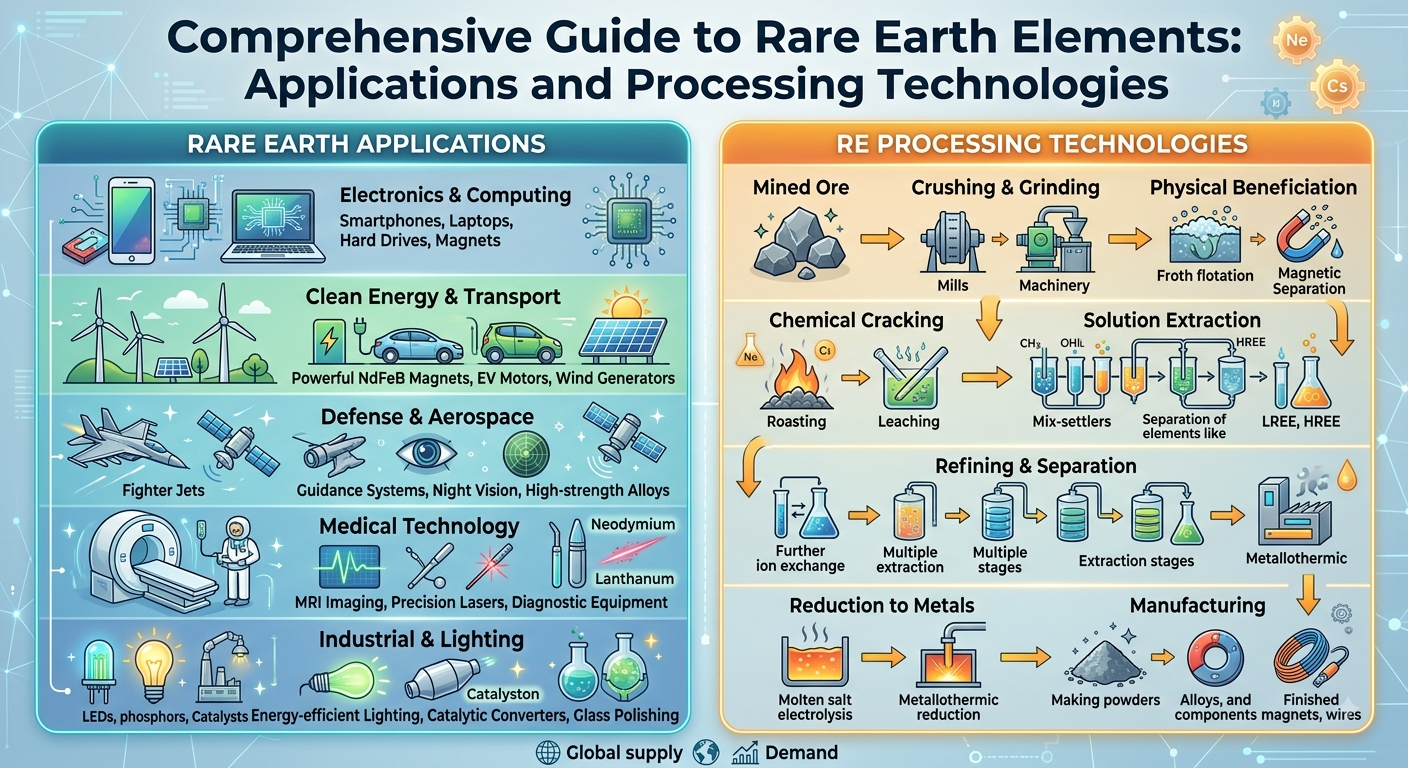
From Geological Formation and Mining to Separation, Advanced Materials, Applications, Recycling, Geopolitics and Future Technologies
Abstract
Rare Earth Elements (REEs) comprise a group of 17 chemically related elements: the 15 lanthanides, together with scandium and yttrium. Despite their name, most REEs are not exceptionally rare in the Earth’s crust. Their strategic importance arises from a different problem: economically exploitable concentrations are relatively uncommon, the elements commonly occur together, and their chemical similarities make separation technically demanding.
During the twenty-first century, REEs have evolved from specialised industrial materials into strategic foundations of modern electrification, advanced electronics, robotics, telecommunications, aerospace, medical technology, renewable-energy systems and artificial-intelligence infrastructure. Neodymium, praseodymium, dysprosium and terbium are particularly important because they enable high-performance permanent magnets used in electric motors, wind turbines, industrial automation and other high-efficiency systems.
The modern REE industry is therefore not simply a mining industry. It is a vertically integrated technological system extending from geological exploration through extraction, mineral beneficiation, chemical cracking, leaching, impurity removal, solvent extraction, individual-element separation, oxide production, metallisation, alloying and advanced-material manufacturing. At the end of the chain lies an equally important emerging sector: recycling and recovery of REEs from manufacturing scrap, permanent magnets, electronics and other products.
The strategic significance of this value chain has increased because production and processing are geographically concentrated. The International Energy Agency reported in 2026 that China accounted for approximately 60% of global mined production of magnet rare earths in 2024, around 91% of refined output and approximately 94% of sintered permanent-magnet production.
This thesis examines the complete REE technological system, including its scientific foundations, industrial processes, applications, environmental challenges, recycling opportunities, geopolitical significance, African potential and future technological pathways.
Chapter 1 — Introduction
1.1 The technological importance of rare earth elements
Modern civilisation depends upon an enormous network of materials. Iron provides structural strength, copper enables electrical conduction, silicon enables semiconductor electronics, lithium supports rechargeable batteries, and rare earth elements provide specialised magnetic, optical, catalytic and electronic properties that are difficult to reproduce economically with alternative materials.
REEs are particularly valuable because their atomic structures produce unusual magnetic, optical and chemical behaviours.
Their applications include:
- permanent magnets;
- electric motors;
- wind turbines;
- robotics;
- hard-disk technologies;
- speakers and microphones;
- telecommunications;
- lasers;
- optical equipment;
- catalysts;
- glass manufacturing;
- ceramics;
- medical imaging;
- scientific instrumentation;
- aerospace systems;
- advanced electronics;
- sensors;
- defence technologies;
- data-centre equipment; and
- emerging AI infrastructure.
The IEA identifies REEs as strategically important across energy, transport, AI, aerospace, medical and defence applications.
1.2 The central thesis
The central proposition of this thesis is:
Rare earth elements are not merely mineral commodities; they are enabling materials within a technologically interconnected industrial system whose strategic value increases as societies become more electrified, automated, digitalised and energy efficient.
This means that control of the REE industry is not determined solely by who possesses geological resources. It also depends upon who can:
- discover deposits;
- mine them economically;
- concentrate REE minerals;
- chemically process them;
- separate individual elements;
- refine them to high purity;
- manufacture metals and alloys;
- produce high-performance materials;
- manufacture finished components; and
- recycle REEs after use.
Chapter 2 — What Are Rare Earth Elements?
The 17 REEs are:
| Element | Symbol | Atomic number | Major technological relevance |
|---|---|---|---|
| Scandium | Sc | 21 | Aluminium alloys, lighting, advanced materials |
| Yttrium | Y | 39 | Ceramics, lasers, phosphors |
| Lanthanum | La | 57 | Catalysts, optical glass, batteries |
| Cerium | Ce | 58 | Catalysts, glass polishing, oxidation chemistry |
| Praseodymium | Pr | 59 | Magnets, alloys, optical materials |
| Neodymium | Nd | 60 | High-performance permanent magnets |
| Promethium | Pm | 61 | Radioisotope applications |
| Samarium | Sm | 62 | SmCo magnets, specialised applications |
| Europium | Eu | 63 | Phosphors and optical applications |
| Gadolinium | Gd | 64 | Medical and magnetic applications |
| Terbium | Tb | 65 | Magnet additives, phosphors |
| Dysprosium | Dy | 66 | High-temperature permanent magnets |
| Holmium | Ho | 67 | Lasers and magnetic applications |
| Erbium | Er | 68 | Optical fibre amplifiers and lasers |
| Thulium | Tm | 69 | Lasers and specialised applications |
| Ytterbium | Yb | 70 | Lasers and specialised materials |
| Lutetium | Lu | 71 | Medical imaging and specialised applications |
Scandium and yttrium are not lanthanides but are normally included in the REE family because of their similar chemical behaviour.
Chapter 3 — Atomic Structure and the Origin of REE Properties
The distinctive behaviour of the lanthanides originates largely from their partially filled 4f electron shells.
As atomic number increases across the lanthanide series, electrons progressively occupy the 4f orbital.
This creates:
- strong magnetic behaviour in selected ions;
- characteristic optical transitions;
- closely related chemical properties;
- gradual reduction in ionic radius;
- specialised catalytic behaviour.
This phenomenon is associated with the lanthanide contraction.
Because neighbouring lanthanides have similar ionic sizes and chemical characteristics, separating them from one another is difficult.
This is one of the defining technological problems of REE processing.
Chapter 4 — Geology of Rare Earth Elements
REE deposits form through several geological processes.
Major deposit types include:
- carbonatites;
- alkaline igneous systems;
- monazite-rich mineral sands;
- xenotime deposits;
- ion-adsorption clays;
- phosphatic deposits;
- weathered lateritic systems;
- heavy-mineral sands;
- certain iron-oxide and polymetallic systems.
The economic value of a deposit depends not simply upon total REE concentration but on:
- mineralogy;
- grade;
- distribution of individual REEs;
- recoverability;
- impurity content;
- infrastructure;
- energy requirements;
- water availability;
- environmental constraints;
- processing complexity;
- transportation;
- market prices.
Thus, a deposit with a lower total REE grade may sometimes be more economically attractive than a higher-grade deposit if its mineralogy is easier to process.
Chapter 5 — Important REE Minerals
5.1 Bastnäsite
Bastnäsite is an important source of light rare earth elements, especially:
- cerium;
- lanthanum;
- neodymium;
- praseodymium.
5.2 Monazite
Monazite is a phosphate mineral containing significant quantities of:
- cerium;
- lanthanum;
- neodymium;
- praseodymium.
Some monazite deposits also contain uranium and thorium, creating additional environmental and radiation-management considerations.
5.3 Xenotime
Xenotime is particularly important as a source of heavier REEs, including yttrium and associated heavy lanthanides.
5.4 Ion-adsorption clays
Ion-adsorption deposits are particularly significant because REEs occur adsorbed onto clay minerals rather than primarily locked into resistant crystalline mineral structures.
Their processing characteristics can therefore differ substantially from hard-rock deposits.
Chapter 6 — Exploration
Modern REE exploration combines classical geology with increasingly sophisticated technologies.
Exploration toolbox
| Technology | Function |
|---|---|
| Geological mapping | Identifies favourable formations |
| Geochemistry | Detects anomalous elements |
| Geophysics | Maps subsurface structures |
| Remote sensing | Identifies geological signatures |
| Satellite imagery | Regional exploration |
| Machine learning | Predictive exploration |
| Drilling | Confirms geological models |
| Mineralogical analysis | Determines REE-bearing minerals |
| Laboratory assays | Measures grade and distribution |
Artificial intelligence can increasingly combine geological, geochemical, geophysical and remote-sensing datasets to identify exploration targets.
However, AI does not eliminate the requirement for drilling and laboratory verification.
Chapter 7 — Mining
REE mining generally follows conventional mineral-extraction principles, but the appropriate method depends on deposit geology.
Possible approaches include:
- open-pit mining;
- underground mining;
- mineral-sands mining;
- selective extraction;
- clay extraction.
The objective is to extract sufficient REE-bearing material while minimising:
- waste rock;
- energy consumption;
- water consumption;
- environmental disturbance;
- processing costs.
Chapter 8 — Ore Preparation
Once ore reaches a processing facility, the material generally passes through several physical stages.
Simplified pathway
Run-of-mine ore
↓
Crushing
↓
Grinding
↓
Particle classification
↓
Mineral liberation
↓
Beneficiation
↓
REE concentrate
Crushing reduces particle size.
Grinding produces finer particles so that REE-bearing minerals can be liberated from surrounding rock.
Chapter 9 — Mineral Beneficiation
Beneficiation attempts to increase the concentration of REE-bearing minerals before chemical processing.
Technologies can include:
- gravity separation;
- magnetic separation;
- flotation;
- electrostatic separation;
- dense-media techniques;
- combinations of these processes.
The appropriate flowsheet depends strongly upon mineralogy.
Chapter 10 — Chemical Processing
After physical concentration, the REE-bearing mineral must generally be converted into a chemically processable form.
This can involve:
- acid treatment;
- alkaline treatment;
- roasting;
- cracking;
- leaching;
- impurity removal.
The exact chemistry varies enormously between deposits.
This is why there is no single universal “rare-earth extraction process.”
Chapter 11 — Leaching
Leaching transfers REEs from a solid mineral phase into a liquid solution.
Depending upon the feed material, chemical systems may use acidic or alkaline conditions.
The simplified principle is:
REE-bearing solid + chemical reagent → dissolved REE species + residual solids
The resulting solution contains REEs together with unwanted elements.
Consequently, leaching is only the beginning of chemical purification.
Chapter 12 — Impurity Removal
REE-bearing solutions may contain:
- iron;
- aluminium;
- calcium;
- magnesium;
- manganese;
- phosphate;
- uranium;
- thorium;
- other metals.
Selective removal is therefore essential.
The objective is to create a solution suitable for efficient REE separation.
Chapter 13 — Solvent Extraction
Solvent extraction is one of the most important industrial technologies for separating individual REEs.
The fundamental principle is selective distribution of chemical species between:
- an aqueous phase; and
- an organic phase.
Repeated extraction and stripping stages progressively separate REEs according to differences in their chemical behaviour.
A large industrial separation circuit may contain many sequential stages.
Conceptual process
Mixed REE solution
↓
Extraction
↓
Selective transfer
↓
Scrubbing
↓
Stripping
↓
Purified REE stream
↓
Precipitation
↓
REE oxide
The chemical similarity of neighbouring REEs explains why numerous separation stages may be required.
Chapter 14 — Alternative Separation Technologies
Research continues into alternatives and improvements to conventional solvent extraction.
Potential technologies include:
- ion exchange;
- membrane separation;
- adsorption;
- supported liquid membranes;
- molecular recognition;
- advanced ligands;
- ionic liquids;
- deep-eutectic solvents;
- electrochemical separation;
- selective precipitation;
- advanced chromatography.
The objective is to increase:
- selectivity;
- recovery;
- energy efficiency;
- water efficiency;
- chemical efficiency;
- environmental performance.
Chapter 15 — Production of Rare-Earth Oxides
After separation, individual REEs may be precipitated as compounds such as:
- hydroxides;
- carbonates;
- oxalates;
- oxides.
Calcination can convert selected precursor compounds into high-purity REE oxides.
Examples include:
- Nd₂O₃;
- Pr₆O₁₁;
- Dy₂O₃;
- Tb₄O₇;
- CeO₂.
The precise chemical formula and oxidation state depend upon the element and processing route.
Chapter 16 — Rare-Earth Metals
Oxides are not always the final product.
For applications requiring metallic REEs, the oxide must be converted into metal.
This can involve specialised reduction processes.
High-purity metal is then used for:
- alloy production;
- magnet manufacturing;
- specialised electronics;
- advanced materials.
Chapter 17 — Permanent Magnets
Permanent magnets represent the most strategically important REE application by economic value.
The IEA estimates that permanent magnets account for approximately 95% of rare-earth consumption by value.
Two major REE permanent-magnet families are:
NdFeB
Neodymium–iron–boron
Advantages include:
- very high magnetic energy density;
- compact size;
- high efficiency;
- excellent power-to-weight characteristics.
SmCo
Samarium–cobalt
SmCo magnets have excellent high-temperature and corrosion-resistant characteristics.
Chapter 18 — Why Dysprosium and Terbium Matter
NdFeB magnets can lose performance as temperature increases.
Small quantities of heavy REEs such as dysprosium and terbium can improve high-temperature magnetic performance.
This creates a strategic problem:
A relatively small quantity of a heavy rare earth can determine the performance of a much larger high-value technological system.
Consequently, dysprosium and terbium have strategic importance disproportionate to their volumes.
Chapter 19 — Electric Vehicles
Electric vehicles can use permanent-magnet motors because these motors provide:
- high torque;
- high power density;
- compact dimensions;
- high efficiency.
The REE value chain therefore intersects directly with the global transition toward electric mobility.
Demand for magnet REEs has already increased substantially. The IEA reports that demand for Nd, Pr, Dy and Tb doubled between 2015 and 2024 and is projected to increase further under current policy settings.
Chapter 20 — Wind Turbines
Permanent magnets can be used in certain wind-turbine generator architectures.
Their advantages can include:
- reduced mechanical complexity;
- high efficiency;
- high power density;
- reduced gearbox requirements in selected designs.
This makes REEs part of the technological infrastructure supporting renewable electricity.
Chapter 21 — Robotics and Automation
Industrial robots require compact, efficient motors.
Permanent magnets enable:
- precision movement;
- rapid acceleration;
- high torque density;
- compact actuators;
- efficient servo systems.
As industrial automation expands, demand for high-performance magnetic materials can therefore grow.
Chapter 22 — Artificial Intelligence and Data Centres
AI infrastructure is primarily associated with semiconductors, accelerators, memory and electricity.
However, REEs also enter the physical infrastructure supporting computing.
Applications can include:
- high-performance motors;
- cooling systems;
- precision actuators;
- storage technologies;
- robotics used in manufacturing;
- power-management equipment;
- data-centre mechanical systems.
The IEA explicitly identifies AI data centres among applications exposed to rare-earth supply-chain vulnerabilities.
Chapter 23 — Telecommunications and Electronics
REE-containing materials contribute to specialised:
- optical systems;
- lasers;
- displays;
- phosphors;
- sensors;
- fibre-optic technologies;
- electronic components.
Erbium is particularly important in optical-fibre amplification because of its useful optical transitions.
Chapter 24 — Ceramics and Glass
REE compounds can modify:
- optical properties;
- colour;
- thermal behaviour;
- strength;
- chemical durability.
Cerium oxide is particularly important for glass polishing and related applications.
Chapter 25 — Catalysts
Cerium and other REEs can participate in oxidation-reduction chemistry.
Catalytic applications include:
- automotive emissions control;
- petroleum refining;
- chemical processing.
Cerium’s ability to shift between oxidation states is especially useful in oxygen-storage chemistry.
Chapter 26 — Medical Applications
REEs have specialised medical uses.
Examples include:
- contrast agents involving gadolinium;
- scintillation and imaging materials;
- specialised lasers;
- radiopharmaceutical research;
- medical detector technologies.
Medical use requires particularly strict control of material chemistry, purity, toxicity and biological behaviour.
Chapter 27 — Aerospace and Advanced Engineering
REE-containing materials can support:
- high-performance magnets;
- sensors;
- lasers;
- advanced alloys;
- optical systems;
- precision actuators.
Their importance is amplified in aerospace because reducing component mass while maintaining performance can provide major system-level benefits.
Chapter 28 — Defence and Strategic Technology
Rare-earth-enabled materials occur in various advanced technological systems, including specialised:
- sensors;
- motors;
- guidance-related components;
- optical equipment;
- communications equipment;
- aerospace systems.
The important strategic point is not that REEs themselves constitute a finished technology, but that they can become essential inputs embedded within high-value systems.
Chapter 29 — The Global Rare-Earth Supply Chain
The REE supply chain can be represented as:
Geology
↓
Exploration
↓
Mining
↓
Beneficiation
↓
Chemical cracking/leaching
↓
Separation
↓
Oxides
↓
Metals
↓
Alloys
↓
Magnets/materials
↓
Components
↓
Finished technologies
↓
End-of-life products
↓
Recycling
This is fundamentally different from a simple mining industry.
The strategic value increasingly resides in the midstream and downstream stages.
Chapter 30 — China and Global Supply Concentration
China occupies a dominant position across multiple stages of the REE value chain.
In 2024, according to the IEA:
- China produced approximately 60% of mined magnet REEs;
- approximately 91% of refined magnet REEs;
- approximately 94% of sintered permanent magnets.
This concentration has enormous strategic implications.
The IEA’s 2026 analysis concludes that existing and announced capacity outside China would cover only about half of projected mining requirements, roughly one-quarter of refining requirements and less than one-fifth of magnet demand outside China by 2035.
Chapter 31 — Geopolitics
Rare earths have become part of the broader competition surrounding:
- industrial policy;
- energy security;
- technological sovereignty;
- national security;
- trade;
- manufacturing;
- supply-chain resilience.
The geopolitical issue is therefore not simply:
“Who has the rare earth?”
It is:
“Who controls the complete technological pathway from mineral to manufactured component?”
Chapter 32 — Export Controls and Strategic Vulnerability
The vulnerability of concentrated supply chains became especially visible in 2025.
The IEA reports that China introduced export controls affecting several heavy REEs in April 2025, causing significant short-term disruptions to international magnet supply. Later measures expanded the scope of controls, while some broader measures were subsequently suspended.
These events demonstrated that a disruption at a relatively small upstream stage can propagate through global manufacturing.
Chapter 33 — Economic Multiplier Effect
Rare-earth minerals may represent a relatively small physical quantity compared with the products they enable.
For example:
Small quantity of REE
→
High-performance magnet
→
Electric motor
→
Electric vehicle
→
Global automotive supply chain
A similar chain occurs in:
REE
→
Magnet
→
Wind generator
→
Wind turbine
→
Electricity infrastructure
This creates a large economic multiplier.
Chapter 34 — Environmental Challenges
REE mining and processing can produce environmental pressures involving:
- land disturbance;
- waste rock;
- tailings;
- water consumption;
- chemical reagents;
- acidic or alkaline process streams;
- potentially radioactive residues in some mineral systems;
- energy consumption;
- greenhouse-gas emissions.
Environmental performance depends heavily upon the deposit and process route.
Chapter 35 — Radioactive By-products
Some REE minerals occur alongside uranium and thorium.
Monazite processing, for example, can create streams containing naturally occurring radioactive materials.
Responsible operations therefore require:
- radiological characterisation;
- controlled handling;
- secure storage;
- monitoring;
- appropriate waste management;
- regulatory compliance.
Chapter 36 — Water Management
Water can be required throughout:
- mineral processing;
- flotation;
- leaching;
- chemical separation;
- washing;
- tailings management.
Future REE facilities will increasingly need closed-loop water systems.
The technological goal is:
Fresh water input ↓
Water recycling ↑
Wastewater discharge ↓
Chapter 37 — Energy and Carbon Footprint
REE processing can be energy intensive because it involves:
- crushing;
- grinding;
- heating;
- roasting;
- chemical processing;
- separation;
- metallisation;
- alloy production.
Decarbonisation strategies include:
- renewable electricity;
- energy-efficient grinding;
- heat recovery;
- electrification;
- process optimisation;
- low-carbon hydrogen where appropriate;
- improved recycling.
Chapter 38 — Recycling
Recycling represents one of the most promising ways to reduce dependence on primary extraction.
Potential secondary sources include:
- permanent magnets;
- electric motors;
- wind turbines;
- hard drives;
- electronic equipment;
- manufacturing scrap.
The IEA estimates that recycling could reduce primary rare-earth supply requirements by up to 35% by 2050 under favourable conditions.
Chapter 39 — Magnet Recycling
Permanent magnets are particularly attractive recycling targets because they contain relatively valuable REEs.
A simplified pathway is:
Used magnet
↓
Collection
↓
Demagnetisation
↓
Mechanical processing
↓
Chemical extraction
↓
REE separation
↓
Oxide/metal
↓
New magnet
Another approach seeks to reuse magnet material more directly, reducing the need to completely break it down into individual elements.
Chapter 40 — Urban Mining
The concept of urban mining treats cities as secondary mineral deposits.
Instead of extracting material exclusively from geological deposits, society can recover valuable elements from:
- computers;
- motors;
- electronics;
- industrial machinery;
- renewable-energy equipment;
- discarded consumer products.
The future mineral resource base is therefore:
Natural mines + urban mines + industrial waste + manufacturing scrap
Chapter 41 — Circular Economy
A circular REE economy can be represented as:
Mining
→
Processing
→
Manufacturing
→
Product
→
Use
→
Collection
→
Disassembly
→
Recovery
→
Refining
→
New material
→
New product
This reduces dependence on continuously increasing primary extraction.
Chapter 42 — Substitution
An important component of supply security is developing technologies that use less REE material or eliminate REEs.
Research areas include:
- ferrite magnets;
- improved induction motors;
- switched-reluctance motors;
- alternative magnetic materials;
- reduced-heavy-REE NdFeB designs;
- material-efficient motor architectures.
However, substitution involves trade-offs.
An alternative may reduce REE dependence while increasing:
- weight;
- size;
- energy consumption;
- manufacturing complexity;
- cost.
Therefore, substitution must be evaluated at the complete-system level.
Chapter 43 — Artificial Intelligence and REE Technology
AI can contribute throughout the value chain.
Exploration
Machine learning can analyse geological datasets.
Mining
AI can optimise:
- extraction;
- ore sorting;
- equipment utilisation;
- maintenance.
Processing
AI can optimise:
- grinding;
- flotation;
- chemical conditions;
- solvent extraction;
- recovery.
Manufacturing
AI can control:
- alloy composition;
- magnet microstructure;
- manufacturing parameters;
- quality inspection.
Recycling
AI-assisted sorting can identify components containing valuable materials.
The emerging model is therefore:
AI + geology + chemistry + robotics + materials science + process engineering
Chapter 44 — Digital Twins
A future REE processing plant can be represented by a digital twin.
The digital model can integrate:
- geological information;
- ore characteristics;
- sensor data;
- chemical conditions;
- equipment performance;
- production rates;
- energy consumption;
- water consumption;
- environmental measurements.
This allows engineers to simulate changes before physically modifying the plant.
Chapter 45 — Advanced Separation
One of the greatest opportunities for future REE technology is improving separation.
The ideal process would achieve:
High selectivity + high recovery + low chemical consumption + low energy consumption + low water consumption + low waste
Emerging approaches include:
- advanced molecular ligands;
- selective adsorption;
- membrane systems;
- electrochemical methods;
- ionic-liquid systems;
- deep-eutectic solvents;
- improved solvent-extraction chemistry;
- biotechnology-inspired separation.
Chapter 46 — Biotechnology
Research into microorganisms and biomolecules may eventually contribute to selective metal recovery.
Potential mechanisms include:
- biosorption;
- bioaccumulation;
- organic-acid production;
- selective binding.
Biological approaches remain an emerging research field rather than a universal replacement for established industrial separation.
Chapter 47 — Advanced Materials
The future of REE technology is not limited to mining more material.
A second pathway is:
Extract more performance from every gram of REE.
This involves:
- nanostructured materials;
- grain-boundary engineering;
- advanced magnet microstructures;
- high-performance alloys;
- improved coatings;
- computational materials design.
Materials engineering can therefore reduce the quantity of REE required per unit of technological performance.
Chapter 48 — African Potential
Africa possesses substantial geological diversity and opportunities for critical-mineral development.
The opportunity extends beyond mining.
An African REE strategy could potentially include:
- geological exploration;
- mining;
- beneficiation;
- chemical processing;
- separation;
- oxide production;
- alloy production;
- magnet manufacturing;
- component manufacturing;
- recycling;
- scientific research;
- technical education.
This would convert Africa from a raw-material supplier into a participant in the higher-value sections of the technology chain.
Chapter 49 — South Africa
South Africa’s 2025 Critical Minerals and Metals Strategy explicitly identifies rare earth elements among minerals important to the country’s future critical-minerals position. The strategy emphasises exploration, value addition, research and development, skills, infrastructure, energy security, regulatory coordination, circular economy principles and regional integration.
The South African opportunity therefore extends beyond extraction.
A potential national framework is:
Geological survey
↓
Exploration
↓
Resource development
↓
Beneficiation
↓
Chemical processing
↓
Advanced materials
↓
Manufacturing
↓
Recycling
The South African government has specifically highlighted exploration and beneficiation, investment, localisation, innovation, skills, infrastructure and regional collaboration as important elements of its critical-minerals strategy.
Chapter 50 — Infrastructure Requirements
A successful REE industry requires more than mineral deposits.
It requires:
- electricity;
- water;
- roads;
- rail;
- ports;
- laboratories;
- chemical supply chains;
- skilled engineers;
- metallurgists;
- geologists;
- environmental specialists;
- financing;
- research institutions;
- manufacturing facilities.
This illustrates the relationship between mineral policy and national infrastructure development.
Chapter 51 — The Mine-to-Magnet Industrial Architecture
The complete industrial architecture can be represented as follows:
                    RARE-EARTH INDUSTRIAL SYSTEM

                         GEOLOGY
                            │
                            ▼
                      EXPLORATION
                            │
                            ▼
                         MINING
                            │
                            ▼
                 CRUSHING / GRINDING
                            │
                            ▼
                      BENEFICIATION
                            │
                            ▼
                    REE CONCENTRATE
                            │
                            ▼
                CRACKING / LEACHING
                            │
                            ▼
                  IMPURITY REMOVAL
                            │
                            ▼
                  SOLVENT EXTRACTION
                            │
                            ▼
                INDIVIDUAL REE OXIDES
                            │
                            ▼
                    METAL REFINING
                            │
                            ▼
                   ALLOY PRODUCTION
                            │
                            ▼
                PERMANENT MAGNETS
                            │
                            ▼
           MOTORS / GENERATORS / DEVICES
                            │
                            ▼
                     END PRODUCTS
                            │
                            ▼
                    PRODUCT USE
                            │
                            ▼
                     COLLECTION
                            │
                            ▼
                      RECYCLING
                            │
                            └──────────► SECONDARY REE SUPPLY
Chapter 52 — The Technology Stack
The REE economy can also be understood as a technological stack.
| Layer | Technology |
|---|---|
| 1 | Geology |
| 2 | Exploration |
| 3 | Mining |
| 4 | Mineral processing |
| 5 | Hydrometallurgy |
| 6 | Separation chemistry |
| 7 | Refining |
| 8 | Metallurgy |
| 9 | Materials science |
| 10 | Magnet manufacturing |
| 11 | Component engineering |
| 12 | Electronics and machines |
| 13 | AI/automation |
| 14 | Recycling |
| 15 | Circular economy |
This demonstrates why REEs are simultaneously a geological, chemical, metallurgical, engineering, economic and geopolitical subject.
Chapter 53 — Supply-Diversification Challenge
The IEA’s 2026 assessment indicates that diversification requires substantial new investment, particularly in refining and magnet manufacturing. It estimates roughly USD 60 billion of investment over the coming decade to establish diversified magnet-REE supply chains outside the dominant supplier under the scenario examined.
This leads to an important strategic conclusion:
Building another mine alone does not create supply-chain independence.
A country may possess a mine but remain dependent upon foreign facilities for:
- separation;
- refining;
- metal production;
- alloying;
- magnets.
True supply-chain resilience therefore requires development across multiple stages.
Chapter 54 — Future Demand
The IEA’s 2025 outlook projected total REE demand rising from approximately 91 kt in 2024 to 123 kt in 2030 and 150 kt in 2040 under its Stated Policies Scenario, while secondary supply and reuse also increase.
The most important growth drivers include:
- electric vehicles;
- wind power;
- industrial automation;
- robotics;
- advanced electronics;
- digital infrastructure;
- AI-related technologies.
Chapter 55 — 2030–2050 Technology Outlook
The REE industry is likely to evolve in several directions.
1. More diversified mining
New projects are expected in multiple countries.
2. More refining outside China
Separation capacity is likely to become a strategic priority.
3. Expansion of magnet manufacturing
This is one of the most important bottlenecks.
4. More recycling
End-of-life magnets will increasingly become secondary resources.
5. Lower REE intensity
Engineers will seek to reduce material requirements.
6. Greater substitution
Alternative motor and magnetic technologies will continue to develop.
7. AI-enabled processing
Digital optimisation will improve resource recovery.
8. Cleaner chemistry
Industry will seek lower-water, lower-energy and lower-waste processes.
9. Regional supply chains
Countries will increasingly seek local or allied mine-to-magnet capabilities.
10. Materials innovation
New magnetic materials could eventually alter the current REE dependency structure.
Chapter 56 — Eight Strategic Principles for a Resilient REE Industry
A resilient national or regional strategy should pursue:
- Resource knowledge — know the geological resource base.
- Mining capacity — develop economically viable deposits.
- Processing capability — avoid exporting only raw ore.
- Separation expertise — develop chemical-processing knowledge.
- Manufacturing — produce higher-value materials and components.
- Recycling — establish secondary supply.
- Substitution — reduce dependence where technically practical.
- International cooperation — build diversified supply networks.
Chapter 57 — Scientific Research Priorities
Future research should focus on:
- improved REE-selective chemistry;
- low-impact mineral processing;
- low-energy separation;
- membrane technologies;
- advanced solvent systems;
- direct magnet recycling;
- high-performance REE-efficient magnets;
- REE-free motors;
- computational materials science;
- AI-driven mineral exploration;
- process digital twins;
- automated mineral sorting;
- environmentally safer waste treatment.
Chapter 58 — Economic Significance
The economic value of REEs arises from their position within high-value products.
A kilogram of refined material can become part of a component worth many times the value of the raw mineral.
The economic hierarchy can be visualised as:
Ore
↓
Concentrate
↓
Oxide
↓
Metal
↓
Alloy
↓
Magnet
↓
Motor
↓
Vehicle / turbine / robot
Value generally increases as technical complexity and manufacturing capability increase.
This provides a powerful argument for mineral-producing countries to pursue beneficiation and downstream industrialisation.
Chapter 59 — Environmental-Economic Balance
The future industry must solve a three-dimensional problem:
Economic
Produce materials competitively.
Technological
Meet increasingly demanding performance requirements.
Environmental
Reduce:
- waste;
- emissions;
- water use;
- chemical consumption;
- ecosystem disturbance.
The ideal REE industry therefore follows:
Maximum material value + maximum recovery + minimum environmental footprint.
Chapter 60 — Final Conclusions
Rare Earth Elements represent one of the most important material systems of the modern technological civilisation.
Their importance does not arise simply because they are “rare.” Their strategic value derives from the combination of:
- specialised atomic properties;
- difficult chemical separation;
- critical magnetic behaviour;
- optical characteristics;
- catalytic properties;
- high-performance material applications;
- concentrated global processing capacity;
- rapidly expanding technological demand.
The REE industry begins deep within geological systems but ends inside some of humanity’s most advanced technologies.
A single technological chain can therefore be expressed as:
Ancient geological processes
→
mineral deposit
→
modern exploration
→
mine
→
processing plant
→
chemical separation
→
refined element
→
advanced material
→
permanent magnet
→
electric motor
→
vehicle / robot / wind turbine / industrial machine
→
digital economy
→
recycling
→
next generation of materials
The central lesson is that resource ownership and technological sovereignty are not the same thing.
A country may possess REE deposits but remain technologically dependent if it lacks separation, refining, metallurgy, magnet production and advanced manufacturing. Conversely, a country with limited geological resources can maintain considerable strategic influence through processing technology, materials science, manufacturing and recycling.
The IEA’s 2026 analysis makes this distinction especially clear: the greatest global bottleneck is not simply extracting more ore, but developing sufficiently diversified refining and magnet-manufacturing capacity.
For Africa, and particularly South Africa, this creates a significant industrial opportunity. South Africa’s 2025 Critical Minerals and Metals Strategy already places emphasis on exploration, value addition, research and development, skills, infrastructure, circular economy and regional integration.
The ultimate objective should therefore not be:
“Mine rare earths.”
It should be:
“Build a complete rare-earth knowledge, processing, materials and manufacturing ecosystem.”
Such an ecosystem would connect geology with chemistry, chemistry with metallurgy, metallurgy with materials science, materials science with engineering, engineering with digital technologies, and manufacturing with recycling.
That integrated system represents the deeper significance of rare earth elements in the twenty-first century: they are enabling materials at the intersection of natural resources, advanced science, industrial manufacturing, electrification, artificial intelligence and geopolitical power.
Selected References and Further Reading
- International Energy Agency (IEA), Rare Earth Elements: Pathways to Secure and Diversified Supply Chains, 2026.
- International Energy Agency (IEA), Global Critical Minerals Outlook 2026, 2026.
- International Energy Agency (IEA), Rare Earth Elements 2025, 2025.
- International Energy Agency, Global Critical Minerals Outlook 2025.
- International Energy Agency, Renewables 2025.
- Government of South Africa, Critical Minerals and Metals Strategy South Africa 2025.
- Government of South Africa, Cabinet statement on the Critical Minerals Strategy, May 2025.
Suggested publication title
Rare Earth Elements: The Complete Scientific and Technological Journey — From Geological Formation and Mining to Separation, Advanced Materials, AI, Renewable Energy, Recycling and Global Geopolitics
Central research question
How can humanity develop a secure, economically competitive and environmentally sustainable rare-earth ecosystem capable of supporting electrification, advanced manufacturing, robotics, renewable energy and artificial intelligence while reducing dependence on highly concentrated supply chains?
Central technological equation
Geological Resources + Mining + Beneficiation + Separation Chemistry + Refining + Metallurgy + Materials Science + Manufacturing + Recycling + AI = Strategic Rare-Earth Technology Ecosystem






Be First to Comment