
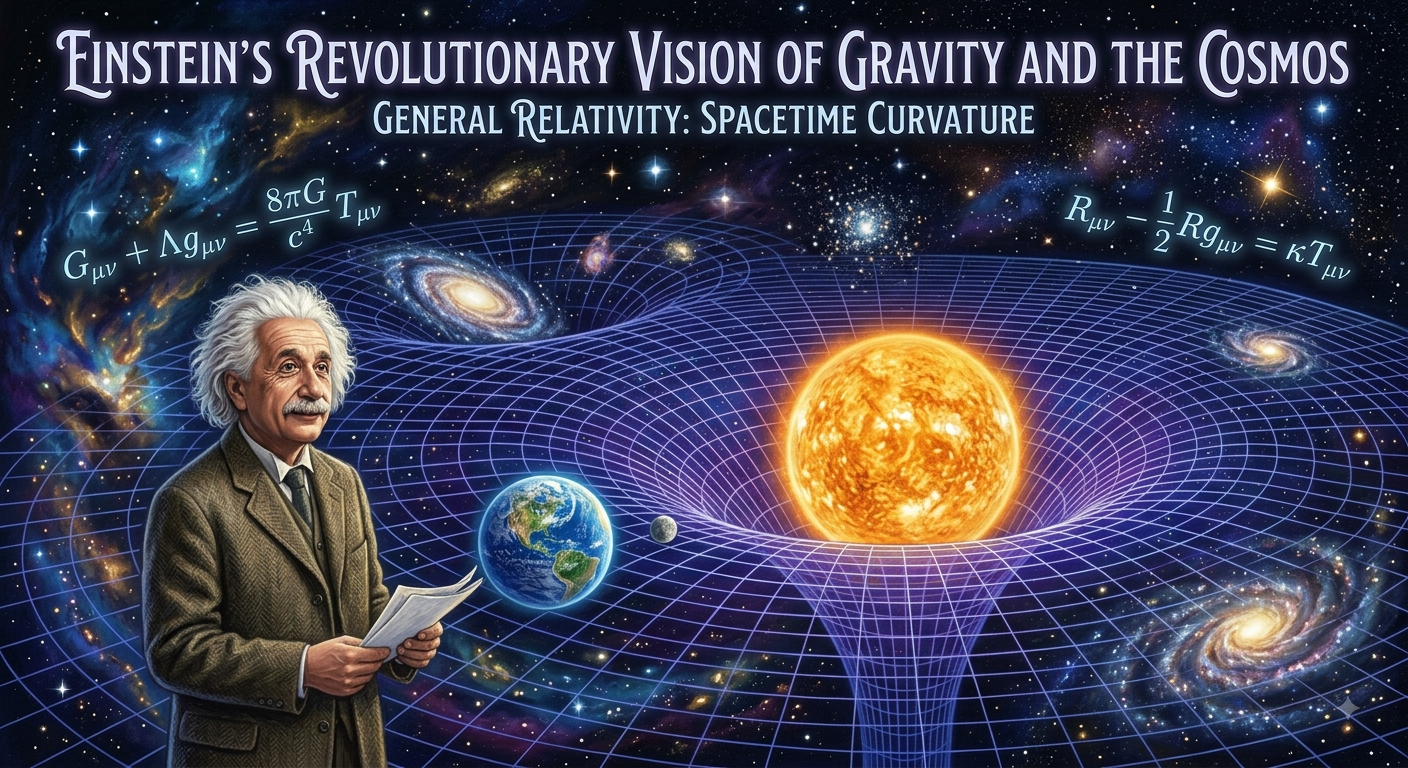
A Comprehensive Scientific and Technological Thesis
Abstract
The General Theory of Relativity, developed by Albert Einstein in 1915 and formally published in 1916, represents one of the most profound transformations in the history of physics. It replaced Newton’s conception of gravity as an instantaneous force acting between masses with a geometric description in which matter, energy, space, and time participate in a dynamic structure called spacetime.
At the heart of General Relativity is the Einstein field equation:
[
G_{\mu\nu}+\Lambda g_{\mu\nu}
\frac{8\pi G}{c^4}T_{\mu\nu}
]
In simplified language, the equation expresses a revolutionary relationship: matter and energy determine the geometry of spacetime, while that geometry determines how matter and light move.
General Relativity transformed our understanding of planetary motion, stars, black holes, gravitational lensing, cosmology, time, space and the evolution of the Universe. Its predictions have been repeatedly tested, from Mercury’s anomalous perihelion precession and the deflection of starlight to gravitational redshift, binary pulsars, frame-dragging and gravitational waves. The direct detection of gravitational waves in 2015 provided another landmark confirmation of Einstein’s theory.
The theory has also become technologically significant. Relativistic corrections are required in satellite navigation systems such as GPS, while relativistic physics underpins modern astrophysics, precision timekeeping, gravitational-wave astronomy and observations of extreme cosmic environments.
Yet General Relativity is not regarded as the final theory of nature. Its lack of a complete quantum foundation creates one of modern physics’ deepest unresolved problems: how to reconcile gravity and curved spacetime with quantum mechanics.
This thesis examines General Relativity from its historical foundations through its mathematical architecture, physical predictions, experimental verification, technological consequences, astrophysical applications and continuing search for a deeper theory of gravity.
Chapter 1 — Introduction: The Revolution in Our Understanding of Gravity
For more than two centuries, Newtonian mechanics provided an extraordinarily successful description of gravity.
Newton’s law states:
[
F=G\frac{m_1m_2}{r^2}
]
The equation describes gravity as a force between masses. It successfully explains falling objects, planetary orbits, tides, comets and much of classical astronomy.
However, Newton’s framework contained a conceptual difficulty.
If the Sun suddenly changed its gravitational influence, Newtonian gravity appeared to imply an instantaneous change throughout space. This was incompatible with the emerging relativistic understanding that information cannot propagate faster than light.
Einstein’s solution was radical.
Gravity was not fundamentally a conventional force transmitted through space.
Instead:
Gravity is manifested through the geometry of spacetime.
NASA describes Einstein’s achievement as a transformation from Newton’s instantaneous gravitational conception toward a theory in which mass and energy distort space and time.
This changed the fundamental question.
Newton asked:
What force causes an object to accelerate?
Einstein asked:
What is the geometry of spacetime through which the object is moving?
Chapter 2 — Historical Foundations
2.1 Galileo and the study of motion
The road toward General Relativity began long before Einstein.
Galileo Galilei established important principles concerning motion and observation. His work helped establish the idea that physical laws should be expressed independently of the observer’s state of uniform motion.
2.2 Newton
Isaac Newton unified terrestrial and celestial mechanics.
His theory demonstrated that the same gravitational law governs:
- falling objects;
- the Moon;
- planets;
- comets;
- tides;
- astronomical systems.
Newton’s achievement established the mathematical foundation of classical physics.
2.3 Maxwell and electromagnetic waves
James Clerk Maxwell’s theory of electromagnetism introduced another crucial development.
Electromagnetic waves propagate at a finite speed:
[
c\approx299,792,458;m/s
]
This created a fundamental question:
Why should the speed of light be the same for observers in different states of motion?
Einstein’s Special Theory of Relativity answered that question in 1905.
2.4 Special Relativity
Special Relativity established that space and time are not independent absolute quantities.
Instead, they form a unified four-dimensional structure:
[
x,;y,;z,;ct
]
The spacetime interval is:
[
ds^2=-c^2dt^2+dx^2+dy^2+dz^2
]
for flat spacetime under one common sign convention.
Special Relativity successfully described inertial motion, but it did not incorporate gravity.
Einstein therefore faced a deeper challenge:
How can gravity be reconciled with relativity?
Chapter 3 — The Equivalence Principle
The conceptual bridge to General Relativity was Einstein’s equivalence principle.
Consider an observer inside a closed elevator.
If the elevator is accelerating upward in empty space, objects released inside appear to fall toward the floor.
Now imagine the elevator stationary in a gravitational field.
The local observation can be indistinguishable.
This led Einstein to the profound insight that, locally,
gravity and acceleration can be equivalent.
The equivalence principle became one of the conceptual foundations of General Relativity.
Chapter 4 — From Gravity as Force to Gravity as Geometry
The central conceptual transformation can be summarized as follows.
| Newtonian view | Einsteinian view |
|---|---|
| Gravity is a force | Gravity is spacetime geometry |
| Space is absolute | Space participates in dynamical geometry |
| Time is universal | Time depends on gravitational and relative motion conditions |
| Gravity acts between masses | Matter-energy influences spacetime curvature |
| Planetary trajectories are force-driven | Free bodies follow geodesics |
| Light follows straight paths in flat space | Light follows null geodesics through spacetime |
A useful conceptual analogy is a heavy object placed on a flexible surface.
The object changes the geometry of the surface, and other objects moving across it respond to that geometry.
The analogy is useful but incomplete because actual spacetime curvature does not require an external two-dimensional surface.
Chapter 5 — Spacetime
General Relativity describes the Universe through a four-dimensional spacetime.
Three dimensions describe spatial position:
[
x,y,z
]
while time provides the fourth coordinate:
[
t
]
The fundamental mathematical object is the metric tensor:
[
g_{\mu\nu}
]
It determines distances, times, angles and causal relationships within spacetime.
The spacetime interval can be written generally as:
[
ds^2=g_{\mu\nu}dx^\mu dx^\nu
]
The metric is therefore not merely a coordinate system.
It encodes the physical geometry of spacetime.
Chapter 6 — Curvature
Curvature is central to Einstein’s theory.
In ordinary Euclidean geometry, parallel lines remain parallel.
On curved geometries, this need not be true.
General Relativity extends this idea to four-dimensional spacetime.
The mathematical description of curvature involves objects such as:
- Christoffel symbols;
- Riemann curvature tensor;
- Ricci tensor;
- Ricci scalar;
- Einstein tensor.
The Riemann curvature tensor is represented as:
[
R^\rho_{\ \sigma\mu\nu}
]
The Ricci tensor is obtained by contraction:
[
R_{\mu\nu}
]
and the Ricci scalar is:
[
R=g^{\mu\nu}R_{\mu\nu}
]
The Einstein tensor is:
[
G_{\mu\nu}=R_{\mu\nu}-\frac12Rg_{\mu\nu}
]
This construction provides the geometric side of Einstein’s field equation.
Chapter 7 — The Einstein Field Equations
The central equation of General Relativity is:
[
\boxed{
G_{\mu\nu}+\Lambda g_{\mu\nu}
\frac{8\pi G}{c^4}T_{\mu\nu}
}
]
where:
- (G_{\mu\nu}) = Einstein curvature tensor;
- (\Lambda) = cosmological constant;
- (g_{\mu\nu}) = metric tensor;
- (G) = gravitational constant;
- (c) = speed of light;
- (T_{\mu\nu}) = stress-energy tensor.
The stress-energy tensor contains information about:
- energy density;
- momentum density;
- pressure;
- stresses;
- energy flow.
The equation therefore connects geometry and physical content.
A useful conceptual statement is:
[
\boxed{\text{Matter-energy} \rightarrow \text{spacetime geometry}}
]
and:
[
\boxed{\text{spacetime geometry} \rightarrow \text{motion of matter and light}}
]
This relationship is the foundation of relativistic gravity.
Chapter 8 — The Stress-Energy Tensor
The quantity (T_{\mu\nu}) is much richer than ordinary mass density.
In relativistic physics, energy and momentum are deeply connected.
The stress-energy tensor describes how physical energy and momentum are distributed and transported.
Its components can represent:
| Component | Physical meaning |
|---|---|
| (T_{00}) | Energy density |
| (T_{0i}) | Energy/momentum flow |
| (T_{i0}) | Momentum density |
| (T_{ij}) | Pressure and stresses |
This means that gravity responds not only to rest mass.
It responds to the broader physical distribution of energy, momentum and stress.
Chapter 9 — Geodesics: The Natural Motion of Free Objects
In General Relativity, a freely falling object follows a geodesic.
The geodesic equation is:
[
\frac{d^2x^\mu}{d\tau^2}
+
\Gamma^\mu_{\alpha\beta}
\frac{dx^\alpha}{d\tau}
\frac{dx^\beta}{d\tau}
=0
]
where:
- (x^\mu) represents spacetime coordinates;
- (\tau) is proper time;
- (\Gamma^\mu_{\alpha\beta}) are Christoffel symbols.
A planet orbiting a star can therefore be understood not simply as being “pulled” by a gravitational force but as following a natural trajectory through curved spacetime.
This geometric interpretation is one of the theory’s greatest conceptual achievements.
Chapter 10 — Time in a Gravitational Field
One of General Relativity’s most important predictions is gravitational time dilation.
Clocks at different gravitational potentials do not necessarily measure the same elapsed time.
For a non-rotating spherical mass, the Schwarzschild metric is:
[
ds^2=
-\left(1-\frac{2GM}{rc^2}\right)c^2dt^2
+
\left(1-\frac{2GM}{rc^2}\right)^{-1}dr^2
+r^2d\Omega^2
]
For a stationary clock outside the mass:
[
d\tau
dt\sqrt{1-\frac{2GM}{rc^2}}
]
A clock deeper within a gravitational field generally accumulates less proper time relative to a distant reference clock.
This is not merely an abstract prediction.
Relativistic time corrections are important to satellite navigation. NASA notes that GPS must account for relativistic effects to maintain accurate positioning.
Chapter 11 — Gravitational Redshift
If light escapes from a strong gravitational field, its observed frequency changes.
This phenomenon is called gravitational redshift.
Conceptually:
[
\text{stronger gravitational potential difference}
\rightarrow
\text{greater frequency shift}
]
Gravitational redshift has been measured experimentally and observed astrophysically.
This establishes an important principle:
Gravity affects not only trajectories but also the measurement of time and frequency.
Chapter 12 — Mercury’s Perihelion Precession
One of the historical problems confronting Newtonian astronomy was Mercury’s orbital precession.
Mercury’s elliptical orbit slowly rotates.
Newtonian planetary perturbations explain most of this motion, but a residual component remained.
General Relativity naturally predicts an additional relativistic contribution:
[
\Delta\phi
\frac{6\pi GM}
{a(1-e^2)c^2}
]
per orbital revolution.
For Mercury, the predicted relativistic contribution corresponds to approximately:
[
43” \text{ per century}
]
This became one of the early successes of Einstein’s theory.
Chapter 13 — The Bending of Light
Newtonian intuition suggests that light, having no rest mass, should not behave like an ordinary massive projectile.
General Relativity predicts that light follows spacetime geodesics.
Near a massive object, spacetime curvature changes the light’s trajectory.
For a ray passing near a spherical mass:
[
\delta\theta
\approx
\frac{4GM}{bc^2}
]
where (b) is the impact parameter.
For light grazing the Sun, this produces an observable deflection.
The 1919 solar-eclipse observations led by Arthur Eddington became historically famous as an early observational test of Einstein’s theory.
Chapter 14 — Gravitational Lensing
The bending of light produces one of modern astronomy’s most powerful natural phenomena:
gravitational lensing.
A foreground galaxy or cluster can distort the apparent image of a background object.
Depending on the geometry, lensing can produce:
- arcs;
- multiple images;
- magnification;
- Einstein rings;
- distorted galaxy shapes.
Gravitational lensing has become an astronomical instrument for studying:
- galaxies;
- galaxy clusters;
- dark matter;
- distant quasars;
- cosmic structure.
NASA identifies strong, weak and microlensing among major observational consequences of General Relativity.
Chapter 15 — Black Holes
Perhaps the most dramatic prediction of General Relativity is the black hole.
For a non-rotating mass, the characteristic Schwarzschild radius is:
[
r_s=\frac{2GM}{c^2}
]
If sufficient mass becomes compressed within this radius, an event horizon can form.
The event horizon is not a solid surface.
It is a causal boundary beyond which signals cannot escape to distant observers under classical General Relativity.
The theory predicts that black-hole formation can occur under appropriate conditions. The Nobel Prize in Physics in 2020 recognized Roger Penrose for demonstrating that black-hole formation is a robust prediction of General Relativity.
Chapter 16 — Rotating Black Holes
Real astrophysical black holes are expected generally to possess angular momentum.
The corresponding solution is the Kerr metric.
Rotation produces an extraordinary phenomenon called frame dragging.
The rotating gravitational field can influence the orientation of nearby inertial frames.
This illustrates that spacetime is not simply curved.
It can also be dynamically dragged by rotating mass-energy.
Chapter 17 — Neutron Stars
Neutron stars provide another extreme laboratory for General Relativity.
They can contain roughly stellar masses within dimensions of only a few tens of kilometres.
Their compactness produces gravitational fields vastly stronger than those encountered on Earth.
Binary neutron-star systems are especially valuable because their orbital evolution can reveal relativistic effects.
The Hulse-Taylor binary pulsar provided a landmark indirect confirmation of gravitational radiation through the observed decrease in its orbital period.
Chapter 18 — Gravitational Waves
General Relativity predicts that accelerating asymmetric distributions of mass-energy can generate gravitational radiation.
In the weak-field approximation, spacetime can be written:
[
g_{\mu\nu}
\eta_{\mu\nu}+h_{\mu\nu}
]
where (h_{\mu\nu}) represents a small perturbation.
These perturbations propagate as gravitational waves.
The first direct detection occurred on 14 September 2015, when LIGO observed gravitational waves from the merger of two black holes.
The discovery opened a new observational window on the Universe.
Instead of observing only electromagnetic radiation, scientists could directly study disturbances in spacetime.
Chapter 19 — Gravitational-Wave Detectors
LIGO uses laser interferometry.
A laser beam is divided into two perpendicular paths.
The beams travel along long vacuum arms, reflect from mirrors and return.
A passing gravitational wave changes the relative lengths of the paths by an extraordinarily small amount.
The resulting interference pattern provides information about the wave.
The LIGO arms are approximately four kilometres long, and the required measurements involve distortions extraordinarily smaller than everyday scales.
This required an extraordinary technological combination of:
- lasers;
- precision optics;
- vacuum engineering;
- vibration isolation;
- mirrors;
- photodetectors;
- digital signal processing;
- statistical analysis;
- large-scale scientific collaboration.
Thus General Relativity has directly stimulated advanced measurement technology.
Chapter 20 — Binary Pulsars as Natural Relativity Laboratories
The discovery of binary pulsars transformed relativistic astrophysics.
A pulsar is a rapidly rotating neutron star whose radiation can be detected with remarkable timing precision.
A binary pulsar system provides an almost cosmic-scale laboratory.
Scientists can measure:
- orbital period;
- orbital eccentricity;
- periastron advance;
- gravitational time dilation;
- orbital decay;
- relativistic timing effects.
The Hulse-Taylor system showed orbital decay consistent with energy loss through gravitational radiation.
Chapter 21 — The Cosmological Constant
Einstein introduced the cosmological constant:
[
\Lambda
]
into his field equations.
The equation becomes:
[
G_{\mu\nu}+\Lambda g_{\mu\nu}
\frac{8\pi G}{c^4}T_{\mu\nu}
]
The cosmological constant has acquired renewed significance in modern cosmology.
It can be associated with a form of energy intrinsic to spacetime and is commonly incorporated into models describing the Universe’s accelerated expansion.
The relationship between (\Lambda), dark energy and the ultimate evolution of the Universe remains an active area of cosmological research.
Chapter 22 — General Relativity and the Expanding Universe
Einstein’s equations permit dynamic cosmological solutions.
Alexander Friedmann demonstrated that General Relativity naturally allows expanding or contracting universes.
The resulting Friedmann equations form the mathematical foundation of modern relativistic cosmology.
One simplified form is:
[
H^2
\frac{8\pi G}{3}\rho
-\frac{kc^2}{a^2}
+
\frac{\Lambda c^2}{3}
]
where:
- (H) = Hubble parameter;
- (\rho) = energy density;
- (a) = cosmic scale factor;
- (k) = spatial curvature parameter;
- (\Lambda) = cosmological constant.
General Relativity therefore transformed gravity from a theory of planets and stars into a framework for describing the Universe itself.
Chapter 23 — The Big Bang
General Relativity does not by itself provide a complete theory of the earliest Universe.
Nevertheless, its cosmological solutions lead naturally to an expanding spacetime.
Running an expanding solution backward in time leads toward increasingly dense and hot conditions.
Modern cosmology combines General Relativity with particle physics, thermodynamics, quantum theory and astronomical observations to study the early Universe.
At sufficiently extreme conditions, however, classical General Relativity is expected to become inadequate.
Chapter 24 — Singularities
A singularity is not simply a point where “gravity becomes infinitely strong” in an everyday sense.
In modern mathematical treatments, singularities are associated with geodesic incompleteness and breakdowns in the classical description.
Penrose’s work demonstrated that singularity formation is not merely an artifact of perfectly symmetrical models.
This became one of the major achievements in mathematical relativity and helped establish the physical importance of black-hole singularities.
Chapter 25 — The Solar System as a Relativity Laboratory
General Relativity can be tested through numerous solar-system observations.
Important effects include:
- Mercury’s perihelion precession.
- Deflection of light by the Sun.
- Gravitational redshift.
- Shapiro time delay.
- Planetary orbital dynamics.
- Lunar laser ranging.
- Satellite-clock comparisons.
- Tests of the equivalence principle.
These experiments transformed General Relativity from an extraordinary theoretical proposal into an experimentally tested physical theory.
Chapter 26 — Shapiro Time Delay
Signals travelling near a massive object experience an additional gravitational time delay.
For a simplified configuration, the effect can be represented schematically by:
[
\Delta t
\sim
\frac{2GM}{c^3}
\ln(\text{geometrical factor})
]
This is known as the Shapiro delay.
Radar and spacecraft communication experiments have been used to test this relativistic prediction.
The result illustrates another central principle:
Gravity affects the propagation of information and light.
Chapter 27 — Frame Dragging
General Relativity predicts that rotating mass-energy can influence nearby spacetime.
This phenomenon is called frame dragging or the Lense-Thirring effect.
Earth itself rotates, so precision experiments can search for tiny relativistic changes in gyroscopic or orbital motion.
Space-based experiments such as Gravity Probe B were designed to investigate relativistic spacetime effects.
The technological challenge is considerable because the predicted effects are extremely small.
Chapter 28 — General Relativity and GPS
One of the clearest technological consequences of relativity is satellite navigation.
GPS depends on precise clocks aboard satellites.
Two major relativistic effects must be considered:
Special-relativistic effect
Satellite motion causes moving clocks to run differently relative to Earth-based clocks.
General-relativistic effect
The weaker gravitational field experienced by satellites causes their clocks to run differently from clocks deeper in Earth’s gravitational field.
The combined corrections are essential for accurate navigation.
Without relativistic corrections, positioning errors would accumulate rapidly.
NASA specifically identifies GPS as a practical system in which Einstein’s relativistic predictions matter.
Chapter 29 — Relativity and Precision Timekeeping
Modern civilization increasingly depends on extremely precise time.
Applications include:
- telecommunications;
- satellite navigation;
- scientific experiments;
- astronomy;
- financial networks;
- electrical-grid synchronization;
- distributed computer systems.
As clocks become more precise, relativistic effects become easier to measure.
This creates an interesting technological feedback loop:
[
\text{Better clocks}
\rightarrow
\text{better tests of relativity}
\rightarrow
\text{better navigation and measurement}
]
Atomic clocks have therefore become both technological instruments and experimental laboratories for fundamental physics.
Chapter 30 — Relativistic Astrophysics
General Relativity is indispensable for studying objects where gravitational fields are extreme.
These include:
- black holes;
- neutron stars;
- pulsars;
- relativistic jets;
- binary compact objects;
- supermassive black holes;
- galaxy clusters;
- the early Universe.
NASA emphasizes that the strongest tests of General Relativity occur under extreme conditions near black holes and during compact-object interactions.
Chapter 31 — The Galactic Centre
At the centre of the Milky Way lies Sagittarius A*, a supermassive compact object.
Stars orbiting this region provide a natural laboratory for strong-field gravity.
One especially important star is S2.
Its orbit allows astronomers to measure relativistic effects such as:
- gravitational redshift;
- relativistic orbital precession.
Observations of stars near Sagittarius A* have provided increasingly precise tests of relativistic predictions.
Chapter 32 — General Relativity and Black-Hole Astronomy
Black holes have evolved from theoretical solutions into observational astrophysical objects.
Astronomers now investigate black holes through:
- stellar orbits;
- X-ray emission;
- accretion disks;
- relativistic jets;
- gravitational lensing;
- gravitational waves;
- radio interferometry.
General Relativity provides the theoretical framework for interpreting these observations.
Chapter 33 — Gravitational Waves as a New Astronomy
Traditional astronomy relies heavily on electromagnetic radiation.
Gravitational-wave astronomy adds a fundamentally different observational channel.
A gravitational-wave signal contains information about:
- masses;
- spins;
- orbital dynamics;
- distances;
- merger physics;
- properties of compact objects;
- strong-field gravity.
The 2015 detection therefore represented not merely another confirmation of Einstein’s theory but the creation of a new astronomical method. The 2017 Nobel Prize recognized the decisive contributions to LIGO and the observation of gravitational waves.
Chapter 34 — Scientific Instrumentation Inspired by Relativity
The experimental study of General Relativity has pushed technology toward extraordinary precision.
Major technological domains include:
34.1 Atomic clocks
Enable extremely precise measurements of time and frequency.
34.2 Laser interferometry
Allows tiny changes in distance to be detected.
34.3 Precision orbit determination
Enables sensitive tests of relativistic dynamics.
34.4 Radio astronomy
Allows precise timing of pulsars and spacecraft signals.
34.5 Optical interferometry
Provides high-resolution observations of astronomical systems.
34.6 High-performance computing
Relativistic simulations require numerical solutions of nonlinear differential equations.
Chapter 35 — Numerical Relativity
Einstein’s equations are nonlinear.
That makes many realistic astrophysical situations mathematically difficult.
Analytical solutions exist for important idealized systems, including:
- Schwarzschild spacetime;
- Kerr spacetime;
- Friedmann-Lemaître-Robertson-Walker cosmologies.
But complex systems often require numerical methods.
Numerical relativity solves discretized forms of Einstein’s equations using powerful computers.
This has become particularly important for:
- black-hole mergers;
- neutron-star mergers;
- gravitational-wave prediction;
- relativistic stellar dynamics.
Chapter 36 — Einstein’s Theory as a Field Theory
General Relativity can be viewed as a field theory whose fundamental field is the spacetime metric:
[
g_{\mu\nu}(x)
]
The metric determines the gravitational structure of spacetime.
The Einstein-Hilbert action is:
[
S=
\frac{c^3}{16\pi G}
\int
(R-2\Lambda)
\sqrt{-g},d^4x
+
S_{\text{matter}}
]
Varying this action with respect to the metric produces Einstein’s field equations.
This formulation connects General Relativity with the broader language of modern theoretical physics.
Chapter 37 — Why General Relativity Is Nonlinear
The field equation is nonlinear because the gravitational field itself contributes to the geometry.
In simplified terms:
gravity gravitates.
This differs fundamentally from many simple linear field theories.
The nonlinear structure produces phenomena such as:
- black-hole dynamics;
- gravitational-wave interactions;
- complex cosmological evolution;
- nonlinear spacetime geometries.
This is one reason General Relativity becomes mathematically challenging in extreme environments.
Chapter 38 — The Relationship Between Matter and Geometry
The deepest conceptual structure of General Relativity can be expressed as a feedback system:
[
\boxed{
T_{\mu\nu}
\rightarrow
g_{\mu\nu}
\rightarrow
\text{geodesics}
\rightarrow
T_{\mu\nu}
}
]
Matter and energy influence geometry.
Geometry influences motion.
Motion redistributes matter and energy.
The entire Universe therefore becomes a dynamic gravitational system rather than a collection of objects moving through an immutable stage.
Chapter 39 — General Relativity and the Arrow of Scientific Progress
General Relativity demonstrates a recurring pattern in scientific development:
[
\text{Observation}
\rightarrow
\text{anomaly}
\rightarrow
\text{new theory}
\rightarrow
\text{prediction}
\rightarrow
\text{experiment}
\rightarrow
\text{technology}
]
Mercury’s orbit represented an anomaly.
Einstein developed a new theoretical framework.
The theory produced predictions.
Astronomers and physicists tested them.
Technological advances subsequently enabled increasingly precise tests.
The result was a continuous interaction between theoretical physics, observation and engineering.
Chapter 40 — General Relativity vs. Newtonian Gravity
| Property | Newtonian gravity | General Relativity |
|---|---|---|
| Gravity | Force | Spacetime geometry |
| Space | Absolute background | Dynamical geometry |
| Time | Universal | Relativistic |
| Propagation | Instantaneous in classical formulation | Limited by causal structure |
| Light | Requires separate treatment | Naturally follows null geodesics |
| Strong gravity | Limited | Fundamental framework |
| Black holes | Not naturally predicted | Natural solutions |
| Gravitational waves | Not part of theory | Fundamental prediction |
| Cosmology | Limited | Built into theory |
| GPS corrections | Inadequate alone | Essential |
| Quantum foundation | Classical | Still incomplete |
Newtonian gravity remains an extremely useful approximation when gravitational fields are weak and velocities are much smaller than (c).
General Relativity does not simply “destroy” Newtonian physics.
Instead:
[
\boxed{\text{General Relativity} \rightarrow \text{Newtonian Gravity in the appropriate limit}}
]
Chapter 41 — The Weak-Field Limit
For weak gravitational fields:
[
g_{\mu\nu}
\eta_{\mu\nu}
+h_{\mu\nu}
]
where:
[
|h_{\mu\nu}|\ll1
]
Under appropriate approximations, Einstein’s equations reduce to equations closely related to Newtonian gravity.
This is scientifically important.
A successful new theory must explain why the old theory worked so well where it was experimentally successful.
Chapter 42 — The Quantum Problem
Despite its extraordinary success, General Relativity has a major unresolved weakness.
Quantum mechanics successfully describes microscopic phenomena.
General Relativity describes gravitation and spacetime on macroscopic and astrophysical scales.
But the two frameworks are conceptually and mathematically difficult to combine.
NASA notes that General Relativity is widely expected to be incomplete because it lacks a quantum foundation.
This creates one of modern physics’ central questions:
[
\boxed{
\text{What is the quantum theory of gravity?}
}
]
Chapter 43 — The Planck Scale
The natural scale at which quantum gravitational effects are expected to become important is associated with the Planck quantities.
The Planck length is:
[
\ell_P
\sqrt{\frac{\hbar G}{c^3}}
]
approximately:
[
1.6\times10^{-35};m
]
The Planck time is:
[
t_P
\sqrt{\frac{\hbar G}{c^5}}
]
approximately:
[
5.4\times10^{-44};s
]
At such scales, our classical description of spacetime may cease to be adequate.
Chapter 44 — Candidate Theories Beyond General Relativity
Several research programs attempt to understand quantum gravity or modify gravitational theory.
These include:
- string theory;
- loop quantum gravity;
- causal dynamical triangulations;
- asymptotic safety;
- emergent-gravity approaches;
- effective quantum gravity;
- modified-gravity theories.
None has yet replaced General Relativity as the experimentally established theory of gravity.
The scientific challenge is not merely producing a mathematically interesting alternative.
A successful theory must reproduce General Relativity where it has been tested while making experimentally distinguishable predictions in unexplored regimes.
Chapter 45 — Dark Matter and General Relativity
Modern cosmology contains another major conceptual problem.
Astronomical observations indicate gravitational effects that cannot be explained by visible matter alone under conventional cosmological models.
The standard interpretation introduces dark matter.
General Relativity provides the gravitational framework used to model its effects.
However, another possibility is that gravity itself might require modification under certain conditions.
Thus dark matter and modified gravity remain important research areas.
Chapter 46 — Dark Energy
The accelerated expansion of the Universe is commonly represented using dark energy, often modeled through a cosmological constant.
In the simplest cosmological model:
[
\Lambda\text{CDM}
]
contains:
- ordinary matter;
- dark matter;
- radiation;
- dark energy represented by (\Lambda).
General Relativity provides the mathematical foundation for this cosmological model.
The physical nature of dark energy, however, remains unresolved.
Chapter 47 — General Relativity and the Information Problem
Black holes generate another profound theoretical problem.
Quantum mechanics suggests that information should obey fundamental conservation principles associated with unitary evolution.
Classical General Relativity describes event horizons and black-hole interiors.
Hawking’s semiclassical analysis showed that black holes can be associated with thermal radiation.
This creates the famous black-hole information problem.
Resolving it may require understanding the quantum structure of spacetime itself.
Chapter 48 — Experimental Frontiers
The future testing of General Relativity increasingly moves toward stronger gravitational fields.
Important targets include:
- black-hole environments;
- neutron-star mergers;
- binary black-hole mergers;
- pulsar systems;
- gravitational-wave backgrounds;
- precision clocks;
- satellite experiments;
- galactic-centre stars;
- cosmological observations.
NASA identifies strong-field environments around black holes and compact-object interactions as especially important for future tests.
Chapter 49 — A Scientific Timeline
| Year | Development |
|---|---|
| 1687 | Newton publishes Principia |
| 1860s | Maxwell develops electromagnetic theory |
| 1905 | Einstein publishes Special Relativity |
| 1907 | Equivalence principle becomes central to Einstein’s thinking |
| 1915 | Einstein presents the completed General Theory |
| 1916 | General Relativity formally published |
| 1916 | Schwarzschild solution obtained |
| 1919 | Eclipse observations test light deflection |
| 1960 | Pound-Rebka gravitational redshift experiment |
| 1960s | Modern experimental gravitational physics expands |
| 1974 | Hulse-Taylor binary pulsar discovered |
| 1978 | Orbital decay provides strong evidence for gravitational radiation |
| 1993 | Hulse and Taylor receive Nobel Prize |
| 2015 | LIGO directly detects gravitational waves |
| 2017 | Nobel Prize recognizes LIGO gravitational-wave discovery |
| 2020 | Nobel Prize recognizes black-hole theory and observations |
| 2020s | Increasing precision in strong-field tests |
The historical progression illustrates how General Relativity evolved from a theoretical revolution into an experimentally rich scientific discipline.
Chapter 50 — The Technological Architecture of Relativistic Science
Modern relativistic research depends upon an interconnected technological ecosystem:
                    GENERAL RELATIVITY
                           │
        ┌──────────────────┼──────────────────┐
        │                  │                  │
   THEORY & MATH       OBSERVATION       EXPERIMENT
        │                  │                  │
        ▼                  ▼                  ▼
 Differential          Telescopes          Atomic clocks
 geometry              Radio arrays       Lasers
 Numerical relativity  Spacecraft         Interferometers
 Supercomputing        Pulsars             Precision sensors
        │                  │                  │
        └──────────────────┼──────────────────┘
                           ▼
                    DATA PROCESSING
                           │
                           ▼
                  RELATIVISTIC MODELS
                           │
                           ▼
                  TESTS OF GRAVITY
The modern study of gravity is therefore not exclusively theoretical.
It is a technological enterprise involving physics, mathematics, astronomy, computer science, optics, aerospace engineering and precision metrology.
Chapter 51 — The Conceptual Architecture of General Relativity
The theory can be summarized as a hierarchy:
ENERGY + MOMENTUM + PRESSURE
              │
              ▼
      STRESS-ENERGY TENSOR
              │
              ▼
      EINSTEIN FIELD EQUATIONS
              │
              ▼
      SPACETIME GEOMETRY
              │
              ▼
       METRIC / CURVATURE
              │
       ┌──────┴──────┐
       ▼             ▼
    MATTER          LIGHT
       │             │
       ▼             ▼
   GEODESICS     NULL GEODESICS
       │             │
       └──────┬──────┘
              ▼
        OBSERVABLE EFFECTS
              │
       ┌──────┼────────┐
       ▼      ▼        ▼
     Orbits  Lensing  Time
                       │
             ┌─────────┼─────────┐
             ▼         ▼         ▼
           GPS      Redshift   Clocks
This architecture demonstrates why General Relativity is simultaneously a theory of:
- gravity;
- geometry;
- motion;
- time;
- astronomy;
- cosmology.
Chapter 52 — Why General Relativity Matters to Civilization
The importance of General Relativity extends far beyond academic physics.
It changed humanity’s conceptual understanding of:
Space
Space is not simply an empty container.
Time
Time is not universal.
Gravity
Gravity is connected to geometry.
Light
Light responds to spacetime curvature.
Stars
Extreme stellar objects become laboratories for fundamental physics.
Black holes
Collapsed objects can create causal horizons.
Universe
Cosmology becomes an application of gravitational theory.
Technology
Precision navigation and timing require relativistic corrections.
Chapter 53 — The Philosophical Significance
General Relativity is also a transformation in scientific philosophy.
Newtonian physics encouraged the image of:
[
\text{Objects} + \text{absolute space} + \text{absolute time}
]
Einstein replaced this with:
[
\text{Matter-energy} + \text{dynamic spacetime}
]
The distinction is profound.
Space and time are no longer merely passive containers.
They possess physical structure.
Spacetime can:
- curve;
- expand;
- contract;
- support gravitational waves;
- interact dynamically with matter-energy.
The Universe therefore possesses a geometry that is itself part of physical reality.
Chapter 54 — The Limits of the Theory
A scientific theory becomes stronger, not weaker, when its limitations are understood.
General Relativity faces several major open questions:
- How does gravity behave quantum mechanically?
- What is the true physical nature of spacetime at the Planck scale?
- What happens inside black-hole singularities?
- How should quantum information behave in black-hole evaporation?
- What is dark energy?
- Is dark matter a new form of matter or evidence for modified gravity?
- What occurred at the earliest physically meaningful stage of cosmic evolution?
- Can gravity emerge from deeper microscopic principles?
These questions do not invalidate General Relativity.
Instead, they identify the boundaries where new physics may emerge.
Chapter 55 — General Relativity as an Ongoing Scientific Program
More than a century after Einstein’s breakthrough, General Relativity remains central to gravitational physics.
Its predictions have survived increasingly sophisticated tests involving:
- planetary dynamics;
- precision clocks;
- gravitational redshift;
- pulsars;
- black holes;
- gravitational lensing;
- gravitational waves;
- relativistic stellar orbits.
The binary pulsar provided a powerful natural laboratory, while direct gravitational-wave detection opened a completely new observational field.
The theory therefore occupies a remarkable position:
It is both extraordinarily successful and demonstrably incomplete as a fundamental description of nature.
Chapter 56 — Conclusion
General Relativity represents one of humanity’s greatest intellectual achievements.
Einstein did not merely modify Newton’s gravitational equation.
He changed the conceptual foundations upon which gravity was understood.
The central insight can be summarized:
[
\boxed{
\text{Energy and momentum shape spacetime}
}
]
and:
[
\boxed{
\text{Spacetime geometry governs motion}
}
]
From this principle emerges an extraordinary physical universe.
Planets follow relativistic trajectories.
Clocks experience gravitational time dilation.
Light bends around massive objects.
Stars can collapse into black holes.
Binary neutron stars radiate gravitational waves.
Black-hole mergers generate measurable disturbances in spacetime.
The Universe itself can expand dynamically.
And technologies such as satellite navigation depend upon corrections derived from relativistic physics.
The theory’s greatest triumph may therefore be its ability to connect phenomena separated by enormous scales.
The same mathematical framework describes:
[
\text{Earth}
\rightarrow
\text{Solar System}
\rightarrow
\text{Stars}
\rightarrow
\text{Black Holes}
\rightarrow
\text{Galaxies}
\rightarrow
\text{Cosmology}
]
Yet the scientific story does not end with General Relativity.
At the interface between curved spacetime and quantum mechanics lies one of the greatest unanswered questions in physics.
The next revolution in gravitational physics may therefore come from discovering what lies beneath spacetime itself.
Appendix A — Essential Equations
Newtonian gravity
[
F=G\frac{m_1m_2}{r^2}
]
Einstein field equation
[
G_{\mu\nu}+\Lambda g_{\mu\nu}
\frac{8\pi G}{c^4}T_{\mu\nu}
]
Einstein tensor
[
G_{\mu\nu}
R_{\mu\nu}
-\frac12Rg_{\mu\nu}
]
Spacetime interval
[
ds^2=g_{\mu\nu}dx^\mu dx^\nu
]
Geodesic equation
[
\frac{d^2x^\mu}{d\tau^2}
+
\Gamma^\mu_{\alpha\beta}
\frac{dx^\alpha}{d\tau}
\frac{dx^\beta}{d\tau}
=0
]
Schwarzschild radius
[
r_s=\frac{2GM}{c^2}
]
Gravitational redshift/time dilation
[
d\tau
dt
\sqrt{1-\frac{2GM}{rc^2}}
]
Light deflection
[
\delta\theta
\approx
\frac{4GM}{bc^2}
]
Mercury perihelion advance
[
\Delta\phi
\frac{6\pi GM}
{a(1-e^2)c^2}
]
Planck length
[
\ell_P=
\sqrt{\frac{\hbar G}{c^3}}
]
Appendix B — Key Terminology
| Term | Meaning |
|---|---|
| Spacetime | Four-dimensional structure combining space and time |
| Metric tensor | Mathematical object describing spacetime geometry |
| Curvature | Geometric deviation from flat spacetime |
| Geodesic | Natural path of a freely moving object |
| Proper time | Time measured by a clock following its worldline |
| Stress-energy tensor | Distribution of energy, momentum and stresses |
| Event horizon | Causal boundary associated with a black hole |
| Gravitational lensing | Deflection of light by spacetime curvature |
| Gravitational redshift | Frequency shift caused by gravitational potential differences |
| Frame dragging | Influence of rotating mass-energy on spacetime |
| Gravitational wave | Propagating disturbance in spacetime geometry |
| Singularity | Breakdown associated with geodesic incompleteness in classical GR |
| Cosmological constant | Constant term (\Lambda) in Einstein’s equations |
| Numerical relativity | Computational solution of relativistic gravitational systems |
| Quantum gravity | Proposed framework combining gravity with quantum physics |
Appendix C — Selected Scientific References
- Einstein, A. — On the Electrodynamics of Moving Bodies (1905).
- Einstein, A. — The Foundation of the General Theory of Relativity (1916).
- Einstein, A. — Cosmological Considerations in the General Theory of Relativity (1917).
- Schwarzschild, K. — On the Gravitational Field of a Point Mass According to Einstein’s Theory (1916).
- Friedmann, A. — foundational papers on relativistic cosmology.
- Kerr, R. P. — Gravitational Field of a Spinning Mass as an Example of Algebraically Special Metrics (1963).
- Hulse, R. A. & Taylor, J. H. — work on the binary pulsar PSR B1913+16.
- Penrose, R. — foundational work on gravitational collapse and spacetime singularities.
- NASA — resources on General Relativity, spacetime and relativistic astrophysics.
- Nobel Prize — historical and experimental documentation concerning binary pulsars, gravitational waves and black holes.
Final Perspective
General Relativity began as Einstein’s attempt to understand gravity consistently with relativity.
It became much more.
It became a mathematical framework for understanding space, time, gravity, stars, black holes, gravitational waves and the evolution of the Universe.
Its deepest lesson is that the Universe is not merely a collection of objects moving through a fixed stage.
The stage itself is physical.
Matter and energy participate in shaping spacetime, and spacetime participates in determining the motion of matter and the propagation of light.
That insight transformed twentieth-century physics and continues to define one of the central frontiers of twenty-first-century science.



Be First to Comment