
Abstract
The Society for Worldwide Interbank Financial Telecommunication, universally known as SWIFT, is one of the most important pieces of infrastructure in the modern international financial system. Although commonly described as an “international payment system,” SWIFT is more accurately understood as a global financial-messaging network and cooperative infrastructure connecting banks, financial institutions, market infrastructures and corporations.
Its importance arises from a deceptively simple function: transmitting trusted, standardized financial messages between institutions. Behind this function lies a sophisticated technological, organizational and governance architecture involving messaging standards, identity systems, cybersecurity, telecommunications networks, operational resilience, financial institutions, central banks and international regulatory cooperation.
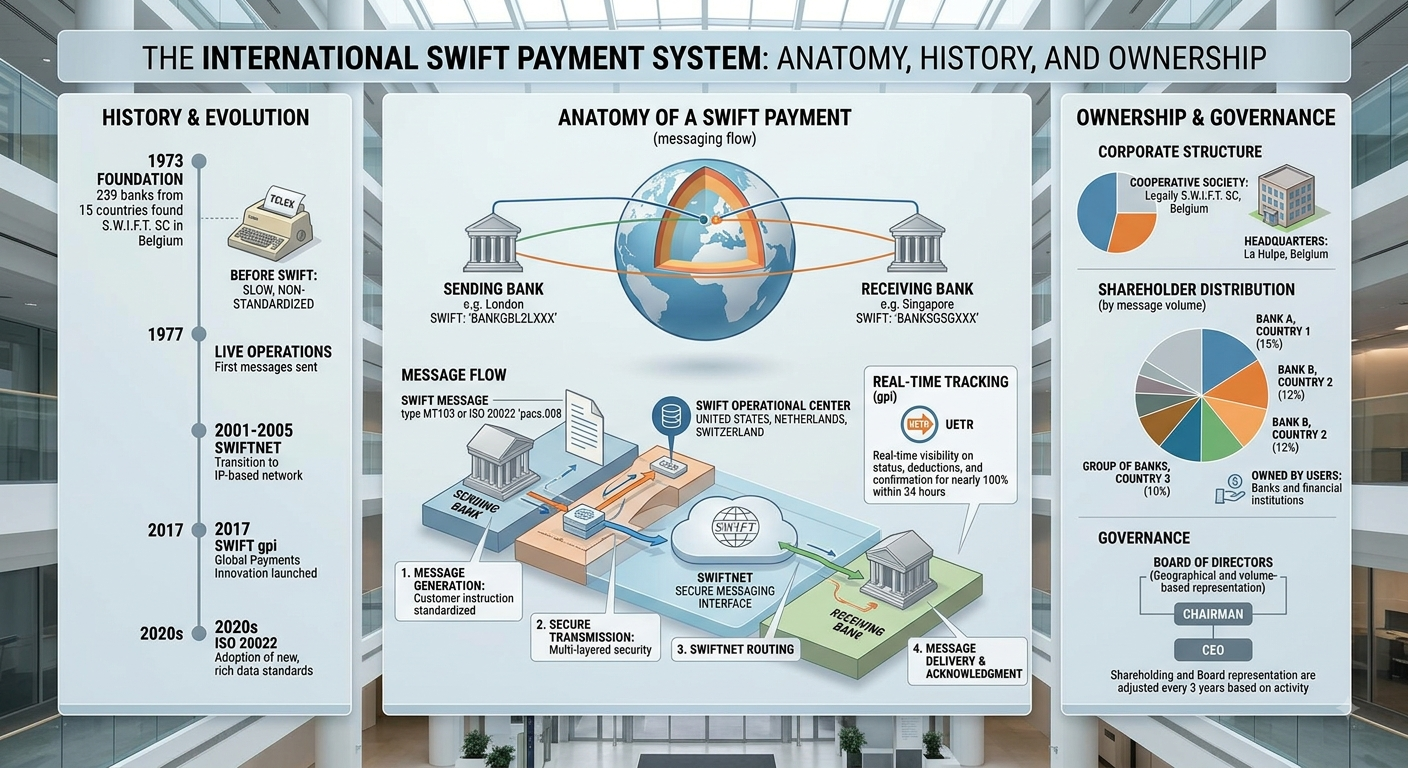
SWIFT was established in 1973 by 239 banks from 15 countries and became operational in 1977 with 518 institutions from 22 countries. It was created partly to replace inefficient and fragmented communication methods such as telex with standardized, automated and secure financial messaging.
Today, SWIFT connects more than 11,500 members and provides connectivity across more than 200 countries and territories. Its network supports more than 40,000 possible payment routes. In 2024, more than 53 million payment messages were sent across the network, while the network maintained 99.999% availability.
This thesis examines the anatomy of SWIFT from its historical origins to its modern technological architecture, ownership structure, governance, cybersecurity, relationship with banks and central banks, role in cross-border payments, geopolitical significance, sanctions, ISO 20022 modernization, SWIFT gpi, digital assets, blockchain experimentation and the future evolution of international financial infrastructure.
Chapter 1 — Introduction
1.1 The Problem of Moving Money Across Borders
International commerce requires enormous numbers of financial transactions between institutions operating under different:
- currencies;
- legal systems;
- banking regulations;
- time zones;
- payment infrastructures;
- accounting systems;
- languages;
- identification standards; and
- technological architectures.
A bank in South Africa sending a payment instruction to a bank in Germany, for example, cannot simply transfer money directly across the global banking system without coordination.
The financial system therefore requires multiple layers of infrastructure.
A simplified model is:
Customer → Bank → Payment Message → Correspondent/Intermediary Banks → Clearing → Settlement → Beneficiary Bank → Customer
SWIFT operates primarily within the messaging and communication layer.
Chapter 2 — What SWIFT Actually Is
2.1 The Meaning of SWIFT
SWIFT originally stood for:
Society for Worldwide Interbank Financial Telecommunication.
It is headquartered in Belgium and operates as a cooperative owned and controlled by its shareholders. Its shareholders elect its governing board.
SWIFT describes itself as a global member-owned cooperative and a leading provider of secure financial messaging services.
2.2 What SWIFT Is Not
A fundamental distinction must be made.
SWIFT does not normally:
- hold customers’ bank deposits;
- maintain ordinary customer accounts;
- physically move money between bank accounts;
- operate as a conventional commercial bank;
- independently determine whether a customer’s payment should be made;
- perform the final settlement of funds.
Instead, SWIFT transmits standardized messages between financial institutions.
A useful analogy is:
SWIFT is the communications infrastructure of international finance rather than the money itself.
The distinction is fundamental to understanding the system.
Chapter 3 — Why SWIFT Was Created
3.1 The Pre-SWIFT Era
Before modern electronic financial messaging, international banking communications relied heavily on:
- correspondence;
- telephone;
- telex;
- paper documentation;
- proprietary bank-to-bank systems.
These approaches created problems involving:
- inconsistent formats;
- manual processing;
- delays;
- transcription errors;
- limited automation;
- increased operating costs.
The international banking community therefore needed a common technological language.
3.2 The Founding of SWIFT
In 1973, 239 banks from 15 countries formed the cooperative that became SWIFT.
The objective was to create a standardized system for financial communication.
The concept was revolutionary because banks did not need to create thousands of individual communication arrangements.
Instead:
One global messaging framework → many participating institutions.
3.3 SWIFT Goes Live
SWIFT began live operations in 1977.
At launch:
- 518 institutions were connected;
- 22 countries participated;
- standardized electronic financial messaging became operational.
This represented a major transformation from manually intensive international banking communication.
Chapter 4 — Historical Timeline
| Period | Development |
|---|---|
| Before 1970s | International banking relies heavily on correspondence, telex and other communication systems |
| 1973 | SWIFT cooperative founded |
| 1977 | SWIFT network goes live |
| 1978 | First Sibos conference |
| 1980s | Rapid international expansion |
| 1983 | First central banks connect |
| 1987 | Expansion into securities-related services |
| 1990s | Rapid growth in financial messaging |
| 1991 | SWIFT receives Computerworld Smithsonian recognition |
| 2000s | Expansion of security and messaging infrastructure |
| 2010s | SWIFT gpi and improved payment tracking emerge |
| 2020s | ISO 20022 modernization accelerates |
| 2025 | SWIFT reports continued double-digit traffic growth |
| 2026 | SWIFT develops new infrastructure involving blockchain-based and tokenized financial technologies |
The historical transformation can therefore be represented as:
TELEX → ELECTRONIC MESSAGING → SWIFT NETWORK → GLOBAL FINANCIAL STANDARDS → REAL-TIME TRACKING → ISO 20022 → DIGITAL/TOKENIZED FINANCE
Chapter 5 — Anatomy of a Cross-Border SWIFT Payment
A simplified international payment may follow this architecture:
┌───────────────────────┐
│ Customer / Corporation│
└───────────┬───────────┘
            │
            ▼
┌───────────────────────┐
│ Originating Bank      │
└───────────┬───────────┘
            │
            ▼
┌───────────────────────┐
│ SWIFT Messaging Layer │
│ Identity + Standards  │
└───────────┬───────────┘
            │
            ▼
┌───────────────────────┐
│ Correspondent Bank(s) │
└───────────┬───────────┘
            │
            ▼
┌───────────────────────┐
│ Clearing / Settlement │
│ Infrastructure        │
└───────────┬───────────┘
            │
            ▼
┌───────────────────────┐
│ Beneficiary Bank      │
└───────────┬───────────┘
            │
            ▼
┌───────────────────────┐
│ Beneficiary           │
└───────────────────────┘
The actual path depends on currencies, jurisdictions, correspondent relationships and payment infrastructures.
Chapter 6 — SWIFT Messaging Architecture
6.1 Financial Messages
SWIFT provides standardized communication mechanisms that allow financial institutions to exchange structured information.
Historically, SWIFT’s FIN messaging environment became one of the most important mechanisms for international financial communication.
The architecture can be conceptualized as:
Institution A → Secure Connectivity → SWIFT Network → Secure Connectivity → Institution B
6.2 Message Standardization
Standardization is one of SWIFT’s greatest achievements.
A standardized message allows financial institutions in different countries to interpret the same structured information.
The principle is similar to creating a universal language for banking.
Chapter 7 — BIC and Financial Institution Identity
One of the most recognizable concepts associated with SWIFT is the BIC — Business Identifier Code.
BICs provide standardized identification of financial institutions.
A typical BIC contains:
- institution identifier;
- country identifier;
- location identifier;
- optional branch identifier.
The general architecture is:
Institution + Country + Location + Branch
This allows financial systems to identify the intended institution with much greater precision than ordinary names and addresses.
Chapter 8 — SWIFT and Correspondent Banking
SWIFT must be understood together with correspondent banking.
A bank may not have a direct banking relationship with every institution in every country.
Instead, banks establish correspondent relationships.
For example:
Bank A
  │
  ▼
Correspondent Bank B
  │
  ▼
Correspondent Bank C
  │
  ▼
Beneficiary Bank D
SWIFT messages can coordinate instructions across these relationships.
The financial value itself, however, is ultimately handled through banking, clearing and settlement arrangements.
Chapter 9 — SWIFT and Settlement
9.1 Messaging Versus Settlement
This is perhaps the most important conceptual distinction in the entire thesis.
SWIFT = messaging
Settlement = movement and final discharge of financial obligations through appropriate financial infrastructures.
SWIFT itself states that it does not hold funds or manage accounts for customers.
Thus:
SWIFT MESSAGE
      │
      ▼
Payment instruction
      │
      ▼
Banking / clearing infrastructure
      │
      ▼
Settlement
This explains why describing SWIFT simply as “the system that transfers international money” is incomplete.
Chapter 10 — Ownership of SWIFT
10.1 Is SWIFT Owned by the United States?
No.
SWIFT is not a U.S.-owned corporation.
It is a Belgian cooperative owned and controlled by its shareholders.
10.2 Who Owns It?
Its ownership is distributed among eligible financial institutions.
According to SWIFT’s published shareholding information, more than 2,000 shareholders existed in the cited governance documentation, with no individual shareholder holding more than 5% of the issued shares. The shares are not publicly traded on securities exchanges.
This means SWIFT has a fundamentally different ownership structure from a publicly traded technology corporation.
Its structure can be represented as:
              SWIFT SHAREHOLDERS
                      │
                      ▼
             GENERAL MEETING
                      │
                      ▼
              BOARD / GOVERNANCE
                      │
                      ▼
                 MANAGEMENT
                      │
                      ▼
             SWIFT INFRASTRUCTURE
Chapter 11 — Governance
SWIFT’s governance is designed around its cooperative character.
The shareholders elect the Board.
SWIFT’s governance documentation states that its Board consists of 25 directors, with representation structured around national shareholder participation and usage of SWIFT services.
The system is therefore neither simply:
“owned by one country”
nor:
“controlled by one commercial bank.”
Instead, it is a multinational cooperative structure.
Chapter 12 — International Oversight
Because SWIFT is deeply embedded in international financial infrastructure, its operations have systemic importance.
The National Bank of Belgium has a leading role in SWIFT oversight because SWIFT is incorporated in Belgium, while central banks cooperate in oversight arrangements.
This creates an important governance triangle:
             SWIFT
            /     \
           /       \
   Shareholders   Oversight
       │              │
       ▼              ▼
Financial          Central
Institutions       Banks
The purpose is to protect:
- operational resilience;
- security;
- continuity;
- governance;
- financial-system stability.
Chapter 13 — Cybersecurity
SWIFT is part of the critical technological infrastructure of global finance.
A disruption could potentially affect international financial communications.
Consequently, SWIFT emphasizes:
- confidentiality;
- integrity;
- availability;
- authentication;
- operational resilience;
- cybersecurity;
- independent assurance.
SWIFT reports that its 2025 messaging-security controls underwent an independent ISAE 3000 Type 2 review, with Deloitte providing an unqualified opinion for the relevant controls.
Chapter 14 — SWIFT’s Security Model
A simplified conceptual model is:
              SECURITY
                 │
     ┌───────────┼───────────┐
     ▼           ▼           ▼
 Confidentiality Integrity Availability
     │           │           │
     └───────────┼───────────┘
                 ▼
       Trusted Financial
          Communication
The objective is not merely to make messages private.
The system must also ensure that:
- the message came from an authorized participant;
- the message was not improperly altered;
- the network remains available;
- participating institutions maintain secure interfaces.
Chapter 15 — The Customer Security Dimension
SWIFT security is not exclusively a property of SWIFT’s central infrastructure.
Financial institutions connect their own environments to the network.
Therefore:
SWIFT security + bank security + authentication + operational controls + employee security + endpoint security
collectively determine the resilience of the ecosystem.
This became particularly important following major cyber incidents involving financial institutions.
Chapter 16 — The Bangladesh Bank Cyber Incident
The 2016 Bangladesh Bank incident demonstrated that secure messaging infrastructure cannot compensate for weaknesses in an institution’s own environment.
Attackers compromised systems associated with Bangladesh Bank and attempted fraudulent payment instructions.
The incident became one of the world’s most important case studies in financial cybersecurity.
Its major lesson was:
A secure global network still depends upon the security of the institutions connected to it.
SWIFT subsequently emphasized the responsibility of individual institutions to secure their own environments and interfaces.
Chapter 17 — SWIFT gpi
One of the major developments in SWIFT’s evolution was SWIFT Global Payments Innovation (gpi).
The objective was to improve:
- payment speed;
- transparency;
- tracking;
- predictability;
- end-to-end visibility.
Traditional cross-border payments could involve multiple intermediaries, creating uncertainty about where a payment was located.
gpi introduced improved tracking capabilities.
The conceptual transformation was:
Old model:
Send → Wait → Ask bank → Investigate
Modern model:
Send → Track → Trace → Confirm
Chapter 18 — ISO 20022
ISO 20022 represents one of the most important technological changes in global financial messaging.
It provides a richer and more structured messaging standard than many legacy formats.
The transformation can be summarized:
LEGACY MESSAGE
     ↓
Limited structured information
     ↓
ISO 20022
     ↓
Richer structured data
     ↓
Better automation
     ↓
Better compliance
     ↓
Better analytics
     ↓
Improved interoperability
SWIFT’s 2025 annual review reported that more than 97% of messages on its network had moved to ISO 20022 following the end of the coexistence period for cross-border payments.
Chapter 19 — Why ISO 20022 Matters
Better data can improve:
- fraud detection;
- sanctions screening;
- transaction monitoring;
- reconciliation;
- automated processing;
- liquidity management;
- payment tracking;
- corporate treasury;
- financial analytics.
In this sense, ISO 20022 is not merely a formatting upgrade.
It represents a transition toward a more data-rich financial infrastructure.
Chapter 20 — SWIFT’s Scale
SWIFT has become one of the largest financial communication ecosystems in history.
Its network connects more than:
11,500 members
across more than:
200 countries and territories.
SWIFT reports more than 40,000 possible payment routes, while 86% of messages are either direct or involve only one intermediary.
The network therefore acts as an enormous global communications fabric.
Chapter 21 — SWIFT and the Global Economy
The significance of SWIFT extends far beyond banks.
Its infrastructure supports:
- international trade;
- corporate treasury;
- securities markets;
- foreign exchange;
- correspondent banking;
- investment flows;
- supply chains;
- multinational corporations;
- financial-market infrastructure.
SWIFT therefore sits near the center of the global financial information architecture.
A simplified economic chain is:
Trade → Invoice → Bank → Payment Instruction → Financial Messaging → Clearing → Settlement → Beneficiary
Chapter 22 — SWIFT and International Trade
Modern global trade requires enormous coordination.
Consider:
South African exporter → European buyer
The transaction may involve:
- purchase agreement;
- invoice;
- foreign currency;
- bank account;
- correspondent relationship;
- payment message;
- sanctions screening;
- compliance checks;
- clearing;
- settlement;
- reconciliation.
SWIFT can provide the messaging infrastructure supporting several of these communication requirements.
Chapter 23 — SWIFT and Sanctions
SWIFT’s geopolitical importance became especially visible when certain financial institutions were disconnected from the network as part of international sanctions regimes.
This illustrates an important distinction:
SWIFT does not independently create international sanctions policy.
Rather, its operations exist within the legal and regulatory environments applicable to the organization and its members.
The political consequences of network access, however, can be enormous.
Chapter 24 — Why SWIFT Has Geopolitical Importance
Financial messaging is infrastructure.
Infrastructure creates power because access determines connectivity.
A country’s financial institutions that lose access to important international messaging channels may face greater difficulty communicating payment instructions internationally.
Thus:
Financial Connectivity
        ↓
International Payments
        ↓
Trade
        ↓
Investment
        ↓
Economic Integration
Disruption at the connectivity layer can therefore have economic consequences.
Chapter 25 — SWIFT and the United States
A frequent misconception is that the United States owns SWIFT.
It does not.
However, the United States possesses enormous influence in the international financial system because of:
- the importance of the U.S. dollar;
- U.S. financial markets;
- correspondent banking;
- international sanctions;
- regulatory reach;
- the role of U.S. financial institutions.
Consequently, SWIFT’s geopolitical environment cannot be understood without considering the United States, even though SWIFT itself is a Belgian cooperative.
Chapter 26 — SWIFT and Europe
SWIFT’s European identity is particularly important because:
- its headquarters are in Belgium;
- it is incorporated under Belgian law;
- it operates within a European legal environment;
- European institutions are major participants in the international banking system.
This contributes to SWIFT’s positioning as a multinational rather than national infrastructure.
Chapter 27 — SWIFT and Africa
Africa is an important component of the global cross-border payments ecosystem.
African financial institutions use international messaging infrastructure for:
- imports;
- exports;
- remittances;
- foreign investment;
- development finance;
- multinational corporate transactions;
- correspondent banking;
- international trade.
For South Africa, international financial connectivity is especially significant because the country has one of Africa’s most developed banking and capital-market systems.
Chapter 28 — SWIFT and South Africa
South African banks participate in international financial networks to support:
- international trade;
- foreign exchange;
- multinational corporations;
- investment;
- imports and exports;
- cross-border corporate payments.
The broader challenge for Africa is that cross-border payments can remain expensive and complicated because of:
- multiple currencies;
- fragmented payment systems;
- correspondent banking relationships;
- compliance requirements;
- regulatory differences.
This has encouraged African initiatives aimed at improving regional payment interoperability.
Chapter 29 — SWIFT Versus Domestic Payment Systems
SWIFT should not be confused with domestic payment systems.
For example:
Domestic system
Bank A → National Payment Infrastructure → Bank B
International transaction
Bank A
 ↓
International Messaging
 ↓
Correspondent Network
 ↓
Clearing / Settlement
 ↓
Bank B
Different countries operate different domestic infrastructures.
SWIFT provides an international communication layer that helps connect institutions across jurisdictions.
Chapter 30 — SWIFT Versus Card Networks
SWIFT is also fundamentally different from systems such as consumer card networks.
A card network is primarily designed around:
- merchant transactions;
- cardholders;
- authorization;
- payment acceptance;
- consumer commerce.
SWIFT is primarily designed around:
- financial institutions;
- institutional messaging;
- cross-border financial communication;
- standardized financial instructions.
Thus:
Card network ≠ SWIFT
and
SWIFT ≠ bank account settlement system.
Chapter 31 — SWIFT Versus Blockchain
Blockchain systems introduce a different architectural model.
Traditional SWIFT architecture is broadly:
trusted institutions + centralized cooperative infrastructure + standardized messaging
Blockchain architectures may involve:
distributed ledgers + cryptographic consensus + programmable transactions
These models are not necessarily mutually exclusive.
The financial infrastructure of the future could combine:
SWIFT
  +
ISO 20022
  +
Cloud Infrastructure
  +
AI
  +
Blockchain / DLT
  +
Tokenized Assets
  +
Digital Currencies
Chapter 32 — SWIFT’s Digital Future
SWIFT’s future strategy increasingly involves experimentation with technologies capable of supporting tokenized and digitally native financial assets.
In 2025, SWIFT described a strategy involving a parallel approach: improving today’s fiat cross-border payments while developing infrastructure for emerging digital financial ecosystems.
In 2026, SWIFT also reported progress toward a blockchain-based ledger intended to support future financial infrastructure.
This suggests that SWIFT’s future may not be simply:
SWIFT versus blockchain.
It may increasingly become:
SWIFT + blockchain + tokenization + conventional banking infrastructure.
Chapter 33 — Artificial Intelligence and SWIFT
Artificial intelligence could increasingly influence international financial messaging through:
- anomaly detection;
- fraud detection;
- payment risk analysis;
- sanctions screening;
- transaction classification;
- data-quality improvement;
- operational monitoring;
- predictive analytics;
- cybersecurity.
A future architecture might resemble:
Financial Transaction
        ↓
Structured Data
        ↓
ISO 20022
        ↓
AI Analysis
   ↙         ↘
Risk        Fraud
Analysis    Detection
   \         /
    \       /
     SWIFT
       ↓
Financial Institution
AI could therefore transform financial messaging from simple communication toward intelligent transaction infrastructure.
Chapter 34 — Cloud Computing
Modern financial infrastructure increasingly depends upon sophisticated computing architectures.
Cloud technology can provide:
- elastic computing;
- distributed storage;
- automated recovery;
- monitoring;
- analytics;
- security tooling;
- geographic redundancy.
However, financial infrastructure cannot simply maximize convenience.
It must balance:
performance + security + resilience + regulatory compliance + sovereignty.
Chapter 35 — Operational Resilience
A financial messaging network must remain available even when:
- data centers fail;
- telecommunications fail;
- cyberattacks occur;
- natural disasters occur;
- software fails;
- hardware fails;
- geopolitical disruptions occur.
SWIFT reported 99.999% network availability in 2024.
This demonstrates the extraordinary reliability requirements of global financial infrastructure.
Chapter 36 — The Mathematics of Availability
A useful way of understanding infrastructure reliability is:
[
Availability =
\frac{Uptime}{Uptime + Downtime}
]
For 99.999% availability:
[
Downtime \approx 0.001%
]
Over a year:
[
365 \times 24 \times 60
525,600 \text{ minutes}
]
A system operating at 99.999% availability permits approximately:
[
525,600 \times 0.00001
5.256 \text{ minutes}
]
of downtime per year.
This illustrates why financial infrastructure requires extraordinary engineering discipline.
Chapter 37 — The SWIFT Network as Global Infrastructure
SWIFT can be conceptualized as a layer within the global financial technology stack:
┌──────────────────────────────────┐
│ GLOBAL ECONOMY                   │
├──────────────────────────────────┤
│ Corporations / Governments       │
├──────────────────────────────────┤
│ Banks / Financial Institutions   │
├──────────────────────────────────┤
│ Payment & Financial Systems      │
├──────────────────────────────────┤
│ Clearing & Settlement            │
├──────────────────────────────────┤
│ SWIFT Messaging & Standards      │
├──────────────────────────────────┤
│ Telecommunications               │
├──────────────────────────────────┤
│ Data Centres / Computing         │
├──────────────────────────────────┤
│ Cybersecurity                    │
└──────────────────────────────────┘
SWIFT therefore cannot be studied in isolation.
It exists within a much larger technological ecosystem.
Chapter 38 — Economic Significance
SWIFT creates economic value primarily through standardization and coordination.
Without common standards, banks would need thousands of individual communication arrangements.
With standardized infrastructure:
one common language → thousands of institutions → millions of transactions
The network effect becomes extremely powerful.
The more institutions participate, the more valuable global interoperability becomes.
Chapter 39 — Network Effects
SWIFT exhibits characteristics of a network-effect infrastructure.
Conceptually:
[
Network\ Value \propto f(N)
]
where (N) represents participating institutions.
As participation increases:
- more institutions can communicate;
- more payment routes become possible;
- fewer bespoke interfaces are required;
- international interoperability improves.
This creates substantial barriers to replacing the network.
Chapter 40 — Why Replacing SWIFT Is Difficult
A competing system would have to reproduce:
- global institutional membership;
- trust;
- standards;
- regulatory compatibility;
- cybersecurity;
- uptime;
- identity infrastructure;
- operational resilience;
- correspondent relationships;
- governance;
- interoperability.
Therefore, creating a technically functional messaging network is considerably easier than creating a globally trusted financial network.
Chapter 41 — Major Challenges
SWIFT faces several strategic challenges.
41.1 Faster Payments
Customers increasingly expect near-instantaneous transactions.
41.2 Cost Reduction
Cross-border payments remain more complex than domestic payments.
41.3 Digital Assets
Tokenized assets may change the structure of financial markets.
41.4 Blockchain
Distributed ledger systems introduce alternative infrastructures.
41.5 Central Bank Digital Currencies
CBDCs could change cross-border payment architectures.
41.6 Artificial Intelligence
AI may transform compliance, fraud detection and transaction processing.
41.7 Geopolitical Fragmentation
Financial systems could become increasingly divided between geopolitical blocs.
Chapter 42 — The Future Architecture of International Payments
The future may not involve one technology replacing another.
Instead, a layered architecture may emerge:
                    GLOBAL FINANCE
                         │
          ┌──────────────┼──────────────┐
          ▼              ▼              ▼
       Banks          Fintechs        Corporates
          │              │              │
          └──────────────┼──────────────┘
                         ▼
                 ISO 20022 DATA
                         │
            ┌────────────┼────────────┐
            ▼            ▼            ▼
          SWIFT       Blockchain     CBDCs
            │            │            │
            └────────────┼────────────┘
                         ▼
                 GLOBAL SETTLEMENT
This architecture could combine traditional and emerging technologies.
Chapter 43 — SWIFT in the Era of Tokenization
Tokenization may transform assets such as:
- securities;
- deposits;
- bonds;
- currencies;
- funds;
- commodities.
The fundamental question becomes:
How can traditional financial institutions communicate and transact with tokenized assets while preserving security, compliance and interoperability?
This is an area in which SWIFT’s existing global connectivity and standards could become strategically important.
Chapter 44 — SWIFT and Digital Currencies
Central bank digital currencies could introduce new payment infrastructures.
Potential architectures include:
CBDC → Domestic Ledger → Cross-Border Bridge
or:
CBDC → Financial Institution → International Messaging → Settlement Network
SWIFT’s future relevance may therefore depend partly on its ability to connect conventional financial institutions with emerging digital monetary systems.
Chapter 45 — The Strategic Question
The central strategic question is not:
“Will SWIFT survive blockchain?”
A more useful question is:
Can SWIFT evolve from being primarily a financial messaging network into an interoperability platform connecting traditional, digital and tokenized financial systems?
The answer will depend upon technology, regulation, economics and international cooperation.
Chapter 46 — SWIFT’s Core Competitive Advantage
SWIFT’s greatest asset is not simply its software.
It is its global trust network.
Its competitive advantages include:
- enormous institutional membership;
- global reach;
- standardized financial messaging;
- operational resilience;
- cybersecurity;
- established governance;
- regulatory integration;
- decades of institutional trust;
- interoperability;
- network effects.
Chapter 47 — SWIFT as a Global Financial Nervous System
A useful scientific analogy is to compare SWIFT with the nervous system.
The analogy is not literal, but conceptually useful.
Human Body              Global Finance

Brain                    Financial institutions
Nerves                   Communication networks
Signals                  Financial messages
Organs                   Banks / markets
Blood circulation       Movement of money
Immune system            Cybersecurity / compliance
SWIFT                    Financial communication layer
Money is therefore analogous to the physical substance being transported, while financial messaging resembles the information coordinating the movement.
Chapter 48 — Ownership Versus Influence
One of the most important conclusions is the difference between:
ownership
and
influence.
SWIFT is owned through its cooperative shareholder structure rather than by a single national government.
Nevertheless, governments and major financial powers can possess considerable influence through:
- regulation;
- sanctions;
- currency dominance;
- banking relationships;
- financial markets;
- geopolitical power.
Therefore:
[
Ownership \neq Influence
]
This distinction is essential when analyzing SWIFT geopolitically.
Chapter 49 — SWIFT and Financial Sovereignty
The existence of a globally interconnected financial messaging network raises questions about national sovereignty.
Countries increasingly seek:
- domestic payment independence;
- regional payment systems;
- alternative messaging systems;
- local currencies;
- digital currencies;
- financial resilience.
However, complete financial isolation can also create economic costs.
The strategic challenge is therefore:
national sovereignty + global interoperability.
Chapter 50 — The African Strategic Opportunity
Africa’s future payment infrastructure could benefit from greater interoperability among:
- national payment systems;
- regional payment networks;
- commercial banks;
- mobile-money platforms;
- fintech companies;
- international messaging systems.
The objective should not necessarily be to choose between global and African infrastructure.
A more powerful strategy may be:
African infrastructure + international interoperability.
Chapter 51 — Lessons from SWIFT
SWIFT provides several lessons for technological development.
Lesson 1 — Standards create scale
A common language can connect thousands of organizations.
Lesson 2 — Trust is infrastructure
Technical functionality alone does not create a global financial network.
Lesson 3 — Security must be continuous
Cybersecurity is not a one-time project.
Lesson 4 — Interoperability is strategic
Systems become more valuable when they can communicate.
Lesson 5 — Governance matters
Global infrastructure requires international legitimacy.
Lesson 6 — Infrastructure must evolve
SWIFT’s transition from legacy messaging toward ISO 20022 and emerging digital technologies illustrates the importance of continuous modernization.
Chapter 52 — Comprehensive SWOT Analysis
| Strengths | Weaknesses |
|---|---|
| Global reach | Complex financial ecosystem |
| Massive network effects | Dependence on participating institutions |
| Strong trust | Legacy infrastructure transition |
| Standardization | Cross-border payment complexity |
| High resilience | Governance complexity |
| Opportunities | Threats |
|---|---|
| ISO 20022 | Blockchain alternatives |
| AI | Geopolitical fragmentation |
| Tokenization | CBDC interoperability challenges |
| Digital assets | Cybersecurity threats |
| African payment integration | Alternative regional systems |
Chapter 53 — The Evolutionary Path
The history of SWIFT can be summarized as five major technological generations:
Generation 1
Telex replacement
Generation 2
Standardized electronic messaging
Generation 3
Global financial connectivity
Generation 4
Real-time tracking and enriched data
Generation 5
Interoperable digital financial infrastructure
The emerging fifth generation could combine:
SWIFT + ISO 20022 + AI + blockchain + tokenization + digital currencies + advanced cybersecurity.
Chapter 54 — Conclusion
SWIFT represents one of the most consequential technological achievements in the history of international finance.
Its achievement was not the invention of money.
Its achievement was the creation of a standardized, secure and globally trusted mechanism through which financial institutions could communicate.
From its founding in 1973 by 239 banks from 15 countries to its present network of more than 11,500 members across more than 200 countries and territories, SWIFT has evolved from a communications experiment into critical global financial infrastructure.
Its ownership structure is equally important. SWIFT is a Belgian cooperative rather than a company owned by a single government. Its shareholders are eligible participating financial institutions, and governance is exercised through a cooperative structure.
Its greatest technological achievement is therefore not simply speed.
It is interoperability.
The modern global economy depends upon thousands of institutions being able to communicate reliably across national boundaries. SWIFT provides an important part of that communication architecture.
Yet SWIFT is entering a new technological era.
ISO 20022 is making financial information richer and more structured. Artificial intelligence is opening new possibilities for financial intelligence and security. Blockchain and distributed ledgers are challenging traditional assumptions about financial infrastructure. Tokenization may redefine how financial assets are represented. Central bank digital currencies could create new forms of cross-border settlement.
The future of SWIFT will therefore depend on its ability to evolve.
The likely future is not necessarily the disappearance of SWIFT.
Instead, the more plausible transformation is from:
financial messaging network
toward:
global financial interoperability infrastructure.
That distinction could determine its importance during the next generation of international finance.
Selected References
- SWIFT — What is Swift?
- SWIFT — Our Story: 1973–2020s.
- SWIFT — Swift Governance.
- SWIFT — Swift Shareholding.
- SWIFT — 2025 Annual Review.
- SWIFT — Understanding Swift.
- SWIFT — 2025 ISAE 3000 Type 2 Reports.
- SWIFT — SWIFT and International Oversight.
- SWIFT — SWIFT Standardises Payments End-to-End.
- SWIFT — SWIFT By-laws and Corporate Governance Documentation.
Final Perspective
SWIFT is best understood not as “the world’s bank” and not as the institution that physically owns or transfers the world’s money.
It is better understood as one of the world’s most important communication and interoperability infrastructures for international finance.
Its extraordinary significance arises from the combination of:
standardization + identity + connectivity + security + governance + trust + network effects.
Those characteristics transformed SWIFT from a 1970s banking communications project into a foundational component of twenty-first-century global finance.






Be First to Comment