
A Comprehensive Scientific Guide to Its Chemistry, Biology, Climate Role, Carbon Cycle, Technology and Future
Abstract
Carbon dioxide (CO₂) is one of the simplest molecules in Earth’s atmosphere, yet it is one of the most consequential molecules in the entire Earth system. It consists of one carbon atom chemically bonded to two oxygen atoms and is naturally produced and consumed through respiration, photosynthesis, decomposition, ocean-atmosphere exchange, volcanic activity and other geological processes. Human activities, particularly fossil-fuel combustion, cement production and land-use change, have substantially altered the atmospheric carbon balance.
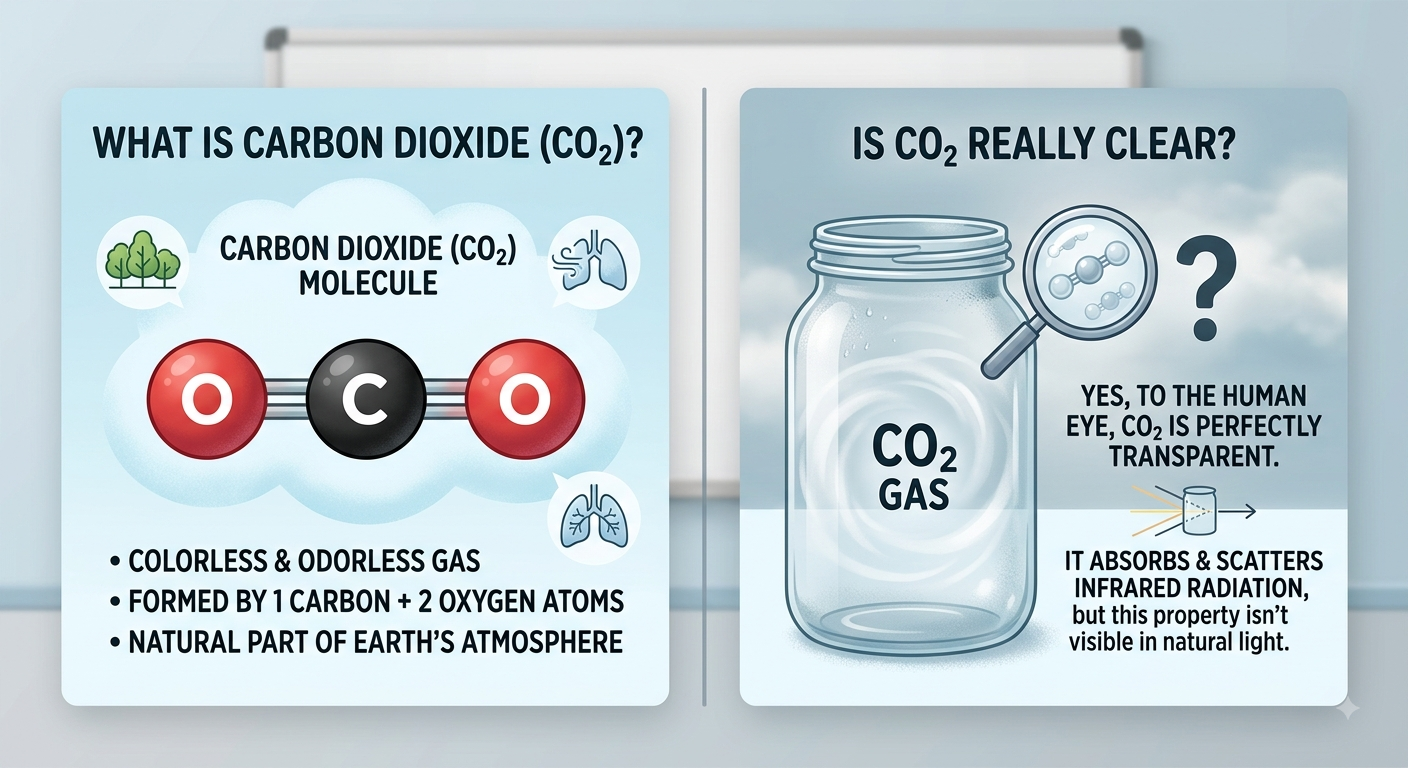
CO₂ is colourless and generally odourless at ordinary atmospheric concentrations. Therefore, it can appear to be “clear” in the everyday sense. Scientifically, however, CO₂ is far from insignificant. Its molecular structure allows it to absorb infrared radiation, making it a major long-lived greenhouse gas. It is also an essential raw material for photosynthesis, a critical component of the global carbon cycle, an important chemical species in seawater, and a feedstock for numerous industrial technologies.
This thesis examines carbon dioxide from the molecular scale to the planetary scale. It explains its atomic structure, chemical properties, physical behaviour, biological importance, photosynthesis, respiration, carbon cycle, greenhouse effect, ocean chemistry, industrial emissions, measurement technologies, carbon capture, utilisation and storage, direct air capture, geological storage, synthetic fuels, mineralisation, policy, African implications and emerging technologies.
The central conclusion is that CO₂ should not be described simply as either “good” or “bad.” It is an essential molecule for life, but the rate and magnitude at which humans are adding additional CO₂ to the atmosphere are altering Earth’s energy balance and carbon cycle. NOAA describes CO₂ as Earth’s most important long-lived greenhouse gas and identifies human activities as the dominant reason atmospheric concentrations have risen.
1. Introduction: What Is Carbon Dioxide?
Carbon dioxide is a chemical compound represented by the formula:
CO₂
The formula means that each molecule contains:
- 1 carbon atom (C)
- 2 oxygen atoms (O)
The molecule is therefore a simple triatomic molecule with a linear structure:
O = C = O
Despite its simplicity, CO₂ participates in an enormous number of physical, chemical, biological and geological processes.
It exists naturally in Earth’s atmosphere, oceans, soils, rocks and living organisms. Carbon continuously moves between these reservoirs through the carbon cycle.
2. Is Carbon Dioxide Really “Clear”?
Yes—but the word clear needs careful interpretation.
CO₂ is:
- colourless;
- generally odourless;
- transparent to visible light;
- invisible to the human eye at atmospheric concentrations.
Therefore, if a container contains CO₂ mixed with ordinary air, a person cannot normally see the gas.
However, “invisible” does not mean “inactive.”
CO₂ interacts strongly with particular wavelengths of electromagnetic radiation, especially infrared radiation. This property is fundamental to the greenhouse effect.
This produces an important scientific distinction:
CO₂ is optically transparent to much visible light but not transparent to all electromagnetic radiation.
That is why the gas can be invisible while still influencing Earth’s temperature.
3. The Atomic Architecture of CO₂
To understand CO₂, it is useful to begin with the atom.
Carbon has atomic number 6, meaning a neutral carbon atom contains six protons and six electrons.
Oxygen has atomic number 8, meaning a neutral oxygen atom contains eight protons and eight electrons.
The carbon atom forms chemical bonds with two oxygen atoms.
The resulting molecule is approximately linear:
O=C=O
The molecular geometry is important because molecular geometry determines how the molecule interacts with electromagnetic radiation.
4. Why CO₂ Absorbs Infrared Radiation
Earth receives energy from the Sun primarily as relatively short-wavelength radiation.
The surface absorbs some of this energy and subsequently emits energy outward as infrared radiation.
CO₂ molecules can interact with particular infrared wavelengths through molecular vibrations.
These include different vibrational modes such as:
- stretching;
- bending;
- asymmetric stretching.
The molecule does not absorb all wavelengths equally. Instead, it has characteristic absorption bands.
This is the molecular foundation of the greenhouse effect.
NOAA explains that greenhouse gases absorb infrared radiation emitted by Earth’s surface and re-emit energy in different directions, including back toward the surface.
5. The Natural Greenhouse Effect
The greenhouse effect is not inherently harmful.
It is an essential natural process.
Without Earth’s natural greenhouse effect, the planet would be dramatically colder. NASA estimates that removing the natural greenhouse effect would reduce Earth’s average surface temperature by approximately 33°C.
The natural greenhouse system involves several gases, including:
- water vapour;
- carbon dioxide;
- methane;
- nitrous oxide;
- ozone;
- several human-made gases.
The important distinction is therefore:
Natural greenhouse effect
Essential for maintaining Earth’s habitable climate.
Enhanced greenhouse effect
The additional warming produced when human activities increase concentrations of greenhouse gases beyond natural background levels.
6. CO₂ Is Not the Same as “Pollution”
The word pollution can create confusion.
CO₂ is naturally occurring.
Animals release CO₂ through respiration.
Plants release CO₂ through respiration.
Microorganisms release CO₂ during decomposition.
Oceans exchange CO₂ with the atmosphere.
Volcanoes release CO₂.
Plants consume CO₂ through photosynthesis.
Consequently, the existence of CO₂ in the atmosphere is not itself evidence of pollution.
The scientific issue is primarily the additional accumulation of carbon dioxide resulting from human activity.
NOAA identifies fossil-fuel combustion, biomass burning, land-use changes and industrial processes such as cement production among important anthropogenic sources.
7. CO₂ and Photosynthesis
CO₂ is indispensable to plants.
Photosynthesis can be simplified as:
CO₂ + H₂O + sunlight → carbohydrates + O₂
Plants use carbon dioxide, water and light energy to manufacture organic compounds.
The carbon becomes incorporated into biological molecules.
This means atmospheric CO₂ becomes part of:
- leaves;
- stems;
- roots;
- fruits;
- seeds;
- wood;
- soil organic matter;
- food chains.
NASA describes plants and phytoplankton as major components of the fast carbon cycle because they remove atmospheric CO₂ through photosynthesis.
8. CO₂ and Respiration
Photosynthesis and respiration operate as complementary processes.
A simplified respiration equation is:
Organic matter + O₂ → CO₂ + H₂O + energy
Animals, plants and microorganisms perform cellular respiration.
Consequently, carbon that entered biological systems through photosynthesis can eventually return to the atmosphere as CO₂.
This creates a continuous biological carbon exchange.
9. The Global Carbon Cycle
The carbon cycle is one of Earth’s fundamental planetary systems.
Carbon moves among major reservoirs:
- atmosphere;
- terrestrial vegetation;
- soils;
- oceans;
- sediments;
- rocks;
- fossil-carbon deposits.
The cycle operates on different timescales.
Fast carbon cycle
Processes include:
- photosynthesis;
- respiration;
- decomposition;
- fires;
- ocean-atmosphere exchange.
These processes can occur over seconds, days, seasons or years.
Slow carbon cycle
Processes include:
- rock weathering;
- sedimentation;
- carbonate formation;
- tectonic movement;
- volcanic activity.
Some geological processes operate over thousands to millions of years. NASA notes that portions of the slow carbon cycle can take approximately 100–200 million years to complete.
10. Carbon Reservoirs
Earth contains enormous quantities of carbon.
The largest long-term reservoirs are geological.
Carbon is also stored in:
- oceans;
- forests;
- grasslands;
- soils;
- wetlands;
- sediments;
- atmosphere;
- fossil fuels.
NASA estimates that approximately 65,500 billion metric tons of carbon are stored in rocks, illustrating how small the atmospheric reservoir is compared with Earth’s geological carbon inventory.
11. Fossil Carbon and the Industrial Revolution
Coal, oil and natural gas contain carbon that was removed from atmospheric circulation and stored over geological timescales.
When humans extract and burn these fuels:
Fossil carbon + O₂ → CO₂ + energy
The energy powers:
- electricity generation;
- transportation;
- industrial machinery;
- heating;
- manufacturing;
- construction;
- agriculture.
The problem is that geological carbon is transferred into the atmosphere much faster than many natural geological processes can return it to long-term storage.
12. Why Atmospheric CO₂ Has Increased
The modern increase in atmospheric CO₂ is primarily associated with human activities, especially:
Fossil fuels
- coal;
- petroleum;
- natural gas.
Industrial processes
Especially cement production and other processes involving carbonate minerals.
Land-use change
Deforestation and ecosystem degradation can reduce carbon storage and release previously stored carbon.
Biomass burning
Fires can rapidly transfer carbon from vegetation to the atmosphere.
NOAA identifies fossil-fuel burning as the dominant driver of the modern atmospheric CO₂ increase.
13. Why CO₂ Concentration Is Measured in ppm
Atmospheric CO₂ is commonly expressed in parts per million (ppm).
For example:
400 ppm
means approximately 400 CO₂ molecules per million molecules of dry air.
This may appear numerically small, but concentration alone does not determine whether a gas is climatically important.
A trace gas can have a substantial physical effect if its molecules interact strongly with infrared radiation.
NASA’s June 2026 Earth indicator reported atmospheric CO₂ at approximately 431 ppm.
14. The Keeling Curve
One of the most important scientific records in atmospheric science is the long-term CO₂ record associated with measurements begun by Charles David Keeling at Mauna Loa.
The record shows:
- seasonal fluctuations;
- a long-term upward trend;
- the influence of vegetation cycles;
- the accumulation of atmospheric CO₂.
NOAA notes that continuous measurements of atmospheric CO₂ began at Mauna Loa in 1958 and have become a cornerstone of modern greenhouse-gas monitoring.
15. Why CO₂ Does Not Simply “Disappear”
When CO₂ is released, some is absorbed by:
- forests;
- grasslands;
- soils;
- oceans.
These systems function as carbon sinks.
NASA estimates that land ecosystems and oceans have absorbed a substantial portion of the additional carbon released by human activity, while a significant fraction remains in the atmosphere.
This is extremely important.
Nature does not immediately absorb all additional CO₂.
The excess therefore accumulates.
16. The Ocean and CO₂
The ocean is one of Earth’s largest carbon reservoirs.
CO₂ dissolves into seawater.
Simplified:
CO₂ + H₂O ⇌ H₂CO₃
Carbonic acid can subsequently participate in chemical equilibria involving:
- bicarbonate;
- carbonate;
- hydrogen ions.
These chemical reactions are fundamental to ocean chemistry.
NOAA notes that the ocean contains vastly more carbon than the atmosphere and plays a critical role in long-term carbon storage.
17. Ocean Acidification
When additional atmospheric CO₂ enters seawater, ocean chemistry changes.
The increase in dissolved CO₂ contributes to increased hydrogen-ion concentration and therefore lower pH.
This process is commonly called:
ocean acidification
It does not mean that the entire ocean becomes an acidic liquid in the ordinary sense.
Rather, seawater becomes less alkaline.
This distinction is scientifically important.
Changes in carbonate chemistry can affect organisms that build calcium-carbonate structures, including many corals and shell-forming organisms.
18. CO₂ and Climate
CO₂ affects climate through radiative physics.
The simplified sequence is:
Sun → Earth absorbs energy → Earth emits infrared radiation → CO₂ absorbs some infrared radiation → energy is re-emitted → Earth’s energy balance changes
Increasing atmospheric CO₂ therefore changes the rate at which Earth loses energy to space.
The climate system responds until a new energy balance develops.
This involves interactions among:
- atmosphere;
- oceans;
- ice;
- land;
- vegetation;
- clouds;
- water vapour.
19. Water Vapour and CO₂
A common misunderstanding is that water vapour makes CO₂ irrelevant.
That is incorrect.
Water vapour is the most abundant greenhouse gas, but its atmospheric concentration is strongly controlled by temperature.
CO₂ can provide a persistent forcing that changes temperature, while water vapour responds as a feedback.
NASA describes water vapour as an important feedback that amplifies warming initiated by changes in other climate forcings.
Therefore:
CO₂ → warming → more atmospheric water vapour → additional greenhouse warming
This is one reason CO₂ is so important to climate-system stability.
20. CO₂ and Human Biology
Humans continuously participate in the carbon cycle.
We obtain carbon through food.
Carbon-containing molecules are metabolised within cells.
Cellular respiration produces CO₂.
The CO₂ enters the bloodstream, is transported to the lungs and is exhaled.
Thus, every breath contributes a tiny amount of biologically recycled carbon to the atmosphere.
The carbon atoms in human bodies have participated in Earth’s carbon cycle for enormous periods of time.
21. CO₂ and Agriculture
CO₂ is a raw material for photosynthesis.
Increasing CO₂ can increase photosynthetic rates for many plants under suitable conditions.
However, plant growth is not controlled by CO₂ alone.
Growth also depends on:
- water;
- nitrogen;
- phosphorus;
- temperature;
- sunlight;
- soil conditions;
- pests;
- disease;
- genetics.
Therefore, “more CO₂ means unlimited plant growth” is scientifically incorrect.
22. CO₂ and Forests
Forests function as major carbon reservoirs.
Trees absorb atmospheric CO₂ through photosynthesis and store carbon in:
- wood;
- roots;
- leaves;
- soils.
However, forests also release CO₂ through:
- respiration;
- decomposition;
- fires;
- harvesting;
- land-use change.
A forest is therefore not simply a permanent carbon vault.
It is part of a dynamic carbon system.
23. CO₂ and Volcanoes
Volcanoes naturally release CO₂.
This sometimes leads to the argument that volcanic emissions explain modern atmospheric CO₂ increases.
However, natural geological emissions are part of the natural carbon cycle, while human fossil-carbon emissions are much larger in the modern period.
NASA estimates present-day human CO₂ emissions from fossil fuels at roughly 30 billion tonnes per year, compared with approximately 130–380 million tonnes of CO₂ per year from volcanoes in the source cited.
24. CO₂ and Cement
Cement manufacturing is an important industrial source of CO₂.
Limestone is primarily calcium carbonate:
CaCO₃
During cement production, limestone is heated.
A simplified reaction is:
CaCO₃ → CaO + CO₂
Therefore, cement production can release CO₂ through both:
- energy consumption;
- chemical decomposition of limestone.
This makes cement decarbonisation an important engineering challenge.
25. Measuring CO₂
Modern science uses many technologies to measure atmospheric CO₂.
These include:
- ground-based monitoring stations;
- atmospheric sampling;
- infrared spectroscopy;
- satellite instruments;
- aircraft measurements;
- ocean measurements;
- isotopic analysis;
- ice-core analysis.
Scientists can therefore study both present-day concentrations and historical changes.
Carbon isotopes provide additional evidence about the sources of atmospheric carbon.
NOAA describes the use of atmospheric measurements, ice cores and carbon isotopes in reconstructing changes in greenhouse-gas concentrations.
26. Satellites and CO₂
Modern Earth-observation satellites can measure atmospheric carbon dioxide across large geographical regions.
Satellite observations help scientists investigate:
- regional emissions;
- carbon sinks;
- atmospheric transport;
- seasonal changes;
- wildfire emissions;
- ecosystem carbon exchange.
This represents the convergence of:
chemistry + physics + atmospheric science + remote sensing + computing + artificial intelligence.
27. Carbon Capture, Utilisation and Storage
A major technological response to rising CO₂ is:
CCUS — Carbon Capture, Utilisation and Storage
The basic architecture is:
CO₂ source → capture → purification → compression → transport → utilisation or storage
Capture technologies include:
- post-combustion capture;
- pre-combustion capture;
- oxy-fuel systems;
- chemical absorption;
- physical separation;
- membrane technologies;
- adsorption;
- mineralisation.
28. Direct Air Capture
Direct Air Capture, or DAC, attempts to remove CO₂ directly from ambient air.
The challenge is concentration.
CO₂ is only a small fraction of atmospheric air, so enormous quantities of air must be processed to remove substantial quantities of CO₂.
A DAC system generally involves:
air contact → CO₂ separation → regeneration → CO₂ concentration → storage/use
The technology could eventually become important for removing residual emissions, although energy requirements, cost, materials, infrastructure and permanent storage remain major engineering considerations.
29. Carbon Mineralisation
Another technological approach is converting CO₂ into stable minerals.
For example, CO₂ can react with certain minerals containing calcium or magnesium.
The resulting carbonate minerals can provide long-duration carbon storage.
This approach attempts to imitate geological processes that naturally store carbon in rocks.
30. Geological Carbon Storage
Captured CO₂ can potentially be injected into suitable geological formations.
Potential storage environments include:
- deep saline formations;
- depleted oil and gas reservoirs;
- certain basalt formations.
The engineering challenge is not merely injecting CO₂.
A successful system requires:
- suitable geology;
- containment;
- monitoring;
- pressure management;
- well integrity;
- long-term verification.
31. Carbon Capture Is Not the Same as Carbon Removal
These concepts should not be confused.
Carbon capture
Prevents CO₂ from reaching the atmosphere from a source.
Carbon removal
Removes CO₂ that is already present in the atmosphere.
Examples of removal approaches include:
- direct air capture;
- enhanced weathering;
- afforestation;
- reforestation;
- biochar;
- some forms of bioenergy with carbon capture and storage.
32. CO₂ Utilisation
Captured CO₂ can potentially become a feedstock.
Possible applications include:
- synthetic fuels;
- chemicals;
- polymers;
- building materials;
- carbonates;
- selected industrial products.
However, utilisation is not automatically equivalent to permanent carbon removal.
If CO₂ is converted into a product and later released back into the atmosphere, the carbon may only have been temporarily recycled.
33. CO₂ as a Chemical Feedstock
CO₂ is sometimes described as a waste product.
A more sophisticated technological view is:
CO₂ can be both an emission and a carbon feedstock.
The difficulty is energy.
CO₂ is already a highly oxidised carbon molecule. Turning it into energy-rich compounds generally requires substantial energy and, in many pathways, hydrogen.
Therefore, the ultimate sustainability depends heavily on the energy source.
34. The Role of Renewable Energy
Low-carbon electricity can support:
- CO₂ capture;
- direct air capture;
- electrochemical CO₂ conversion;
- hydrogen production;
- synthetic-fuel production;
- mineralisation;
- carbon monitoring.
This creates an emerging technological chain:
Renewable electricity → hydrogen/electrochemistry → CO₂ conversion → useful products
35. Artificial Intelligence and CO₂ Management
AI is becoming increasingly relevant to carbon management.
Machine-learning systems can assist with:
- emissions forecasting;
- satellite-image analysis;
- carbon-source detection;
- weather prediction;
- forest monitoring;
- industrial optimisation;
- energy-grid management;
- carbon-storage modelling;
- materials discovery.
The future carbon-management system may therefore combine:
Sensors + satellites + IoT + cloud computing + AI + digital twins + physical infrastructure.
36. Carbon Accounting
Modern economies increasingly need accurate carbon accounting.
A carbon-accounting system attempts to determine:
How much CO₂ is emitted?
Where is it emitted?
Who or what produced it?
How much is removed?
How permanent is the removal?
This requires reliable measurement, reporting and verification.
37. CO₂ and Africa
Africa occupies an important position in the global carbon system.
The continent contains:
- tropical forests;
- savannas;
- grasslands;
- wetlands;
- mangroves;
- agricultural systems;
- mineral resources;
- major renewable-energy potential.
Africa also faces significant climate-related vulnerabilities.
This creates a dual challenge:
Development
Africa needs:
- electricity;
- transport;
- industrialisation;
- manufacturing;
- housing;
- infrastructure;
- employment.
Decarbonisation
Africa also needs:
- cleaner energy;
- efficient transport;
- resilient agriculture;
- forest conservation;
- low-carbon industry;
- modern electricity systems.
The technological challenge is therefore not simply “stop using energy.”
It is:
produce more human development with progressively lower carbon intensity.
38. South Africa and CO₂
South Africa has a particularly important role because of its industrial structure and energy system.
Important sectors include:
- electricity generation;
- mining;
- heavy industry;
- transportation;
- manufacturing;
- cement;
- chemicals.
At the same time, South Africa has significant potential for:
- solar power;
- wind power;
- green hydrogen;
- energy storage;
- carbon-management technologies;
- industrial decarbonisation.
This creates an important national engineering opportunity.
39. The Future CO₂ Technology System
A mature future carbon-management system could look like:
Energy
↓
Renewable generation + nuclear + storage
↓
Industry
Low-carbon steel + cement + chemicals
↓
Carbon monitoring
Satellites + sensors + AI
↓
CO₂ capture
Industrial capture + DAC
↓
Carbon transport
Pipelines + ships + specialised infrastructure
↓
Carbon utilisation
Chemicals + fuels + construction materials
↓
Permanent storage
Geological storage + mineralisation
↓
Verification
Measurement + reporting + monitoring
This would transform CO₂ from a purely environmental problem into a major engineering-management challenge.
40. What CO₂ Is—and Is Not
CO₂ is:
- a naturally occurring gas;
- a carbon-containing molecule;
- essential for photosynthesis;
- part of the carbon cycle;
- a greenhouse gas;
- a component of ocean chemistry;
- an industrial feedstock;
- a geological carbon carrier.
CO₂ is not:
- inherently poisonous at ordinary atmospheric concentration;
- visible like smoke;
- the only greenhouse gas;
- the same thing as carbon monoxide;
- merely an industrial waste product;
- responsible for every atmospheric phenomenon.
41. CO₂ Versus Carbon Monoxide
The distinction between CO₂ and CO is essential.
Carbon dioxide
CO₂
One carbon + two oxygen atoms.
Carbon monoxide
CO
One carbon + one oxygen atom.
They have very different chemical properties and biological effects.
The names should therefore never be treated as interchangeable.
42. The Central Scientific Paradox
CO₂ represents one of the most interesting paradoxes in Earth science.
The same molecule is simultaneously:
Essential for life
and
a major driver of modern anthropogenic warming when present in increasing concentrations.
Plants require CO₂.
Earth requires a natural greenhouse effect.
But the rapid transfer of geological carbon into the atmosphere changes the balance of the climate system.
The question is therefore not:
“Is CO₂ good or bad?”
The scientifically meaningful question is:
How much CO₂ is present, where did it come from, how rapidly is it being added, how rapidly is it removed, and what consequences follow from the resulting change in Earth’s energy and carbon balance?
43. The Planetary Perspective
The carbon cycle demonstrates that Earth is not a collection of independent systems.
It is an interconnected planetary machine.
Carbon connects:
Stars → elements → planets → rocks → oceans → atmosphere → plants → animals → civilisation → industry → technology
Carbon atoms forged through stellar processes eventually became components of:
- rocks;
- oceans;
- trees;
- humans;
- fossil fuels;
- atmospheric CO₂;
- modern technologies.
The carbon cycle is therefore simultaneously a chemical, biological, geological and technological system.
44. Conclusion
Carbon dioxide is a deceptively simple molecule.
It is invisible to human eyes, relatively simple in molecular structure and present in relatively small atmospheric concentrations. Yet it is one of the most important molecules in the Earth system.
CO₂ connects atmospheric physics with plant biology, ocean chemistry, geology, agriculture, industrialisation and climate science.
Its importance comes from its combination of properties:
CO₂ + sunlight → photosynthesis
CO₂ + infrared radiation → greenhouse effect
CO₂ + seawater → carbonate chemistry
CO₂ + geological processes → long-term carbon storage
CO₂ + industrial technology → capture, utilisation and storage
The natural carbon cycle has always moved carbon among Earth’s atmosphere, oceans, biosphere and geological reservoirs. The modern technological civilisation has added a powerful new pathway: extracting geological carbon and rapidly returning it to the atmosphere.
Consequently, understanding CO₂ requires more than asking whether the gas is “clear.”
The deeper scientific answer is:
CO₂ is visually clear but scientifically powerful.
Its invisibility tells us almost nothing about its importance.
It is a fundamental ingredient of life, a regulator of Earth’s climate, a participant in ocean chemistry, a product of respiration and combustion, a geological material and increasingly a target of advanced engineering.
The future challenge is therefore not to eliminate CO₂ from Earth—an impossible and undesirable objective—but to understand and manage the rate, concentration, sources, sinks and long-term movement of carbon through the planetary system.
That challenge will require the combined capabilities of:
chemistry + physics + biology + geology + climate science + engineering + energy technology + satellite observation + artificial intelligence + economics + policy.
Carbon dioxide is therefore not merely a gas.
It is one of the central molecules connecting life, Earth, climate and human civilisation.
Selected Scientific Sources
- NASA Earth Science — Carbon Cycle and atmospheric CO₂.
- NASA — Greenhouse Effect.
- NOAA Global Monitoring Laboratory — Carbon Cycle and Greenhouse Effect.
- NOAA — Atmospheric Carbon Dioxide.
- NOAA Ocean Service — Carbon Cycle and Ocean Carbon Storage.



Be First to Comment