
A Comprehensive Essay
Abstract
Magnets are among the most important enabling technologies in human civilization. Although often overlooked, they are essential to almost every modern industrial system, from electricity generation and transportation to telecommunications, computing, healthcare, robotics, aerospace, and renewable energy. The discovery and scientific understanding of magnetism transformed humanity’s ability to generate, transmit, store, and convert energy, laying the foundation for the Industrial Revolution and today’s digital economy.
In the twenty-first century, magnets have become strategic economic resources. Nations that control magnet technology, rare earth processing, and advanced manufacturing possess major advantages in industries such as electric vehicles (EVs), wind turbines, semiconductors, artificial intelligence (AI), robotics, defense, and space exploration.
Chapter 1: Introduction
Modern civilization is fundamentally an electromagnetic civilization.
Nearly every technological device depends directly or indirectly on magnetic principles. Without magnets there would be:
- No electrical generators
- No electric motors
- No computers
- No smartphones
- No MRI scanners
- No wind turbines
- No satellites
- No electric vehicles
- No industrial automation
Magnets silently power the invisible infrastructure of the global economy.
Chapter 2: The Origin of Magnetism
Natural Magnets
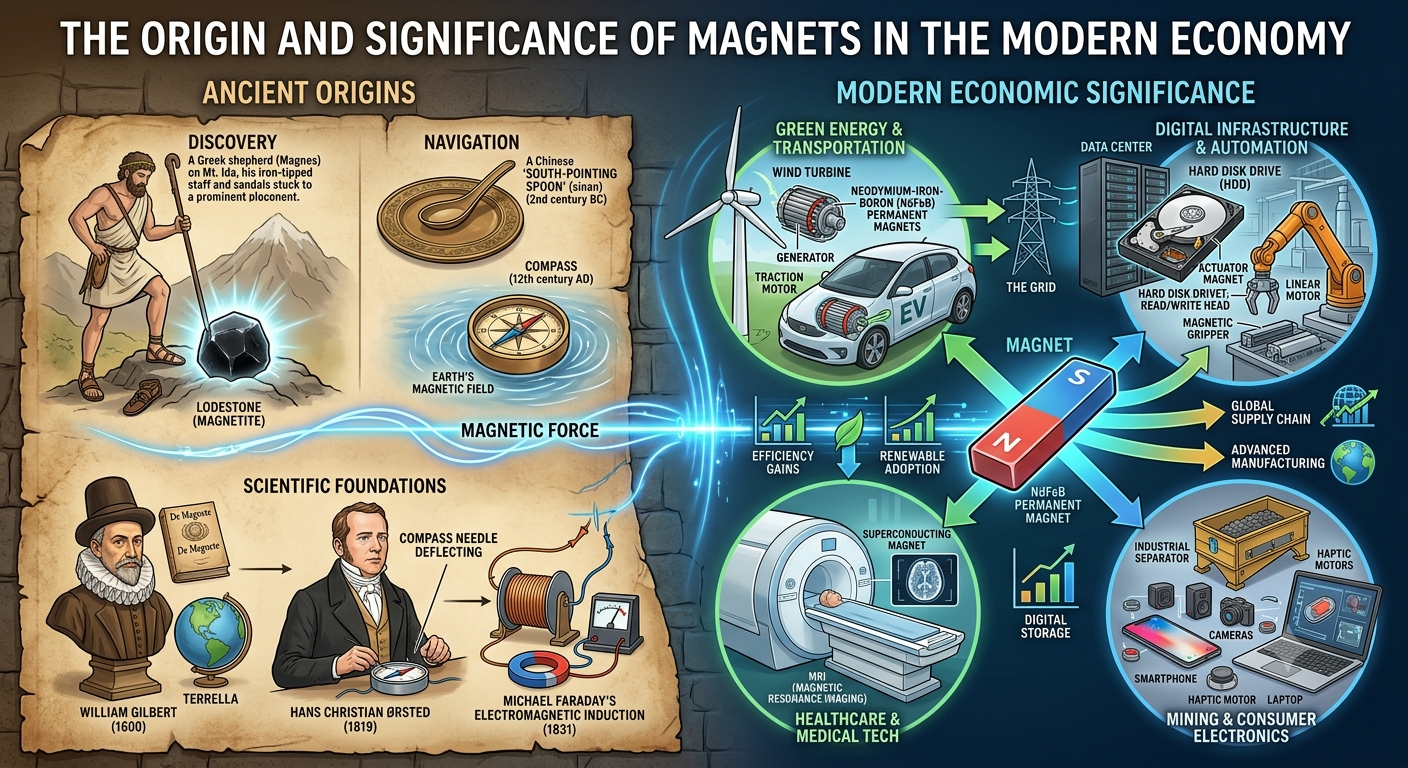
The earliest magnets were naturally occurring stones called lodestones, composed primarily of the mineral Magnetite (Fe₃O₄).
Ancient people discovered that these stones could attract iron naturally.
This remarkable property fascinated civilizations thousands of years ago.
Ancient Civilizations
Ancient Greece
Greek philosophers observed magnetic stones around 600 BCE.
The word “magnet” likely originates from the region of Magnesia, where magnetite was abundant.
Ancient China
China became one of the earliest civilizations to apply magnetism practically.
Chinese scholars discovered that magnetized needles naturally aligned north and south.
This led to the invention of the magnetic compass, revolutionizing navigation, trade, and exploration.
Medieval Europe
European sailors adopted magnetic compasses during the Middle Ages, enabling:
- Global exploration
- Maritime trade
- Colonial expansion
- International commerce
Magnetism therefore became one of the hidden drivers of globalization.
Chapter 3: Scientific Discovery
During the Renaissance and Scientific Revolution, researchers began studying magnetism systematically.
Key contributors include:
- William Gilbert, who demonstrated that Earth behaves like a giant magnet.
- Hans Christian Ørsted, who discovered the relationship between electricity and magnetism.
- Michael Faraday, who discovered electromagnetic induction, showing that moving magnets can generate electricity.
- James Clerk Maxwell, who unified electricity and magnetism through his electromagnetic equations.
These discoveries underpin nearly every electrical technology in use today.
Chapter 4: How Magnets Work
Magnets produce a magnetic field.
Every magnet has:
- North Pole
- South Pole
Opposite poles attract.
Like poles repel.
Magnetic fields influence moving electric charges, making them essential in motors, generators, transformers, and electronic devices.
Chapter 5: Types of Magnets
1. Natural Magnets
Found in nature as magnetite.
Advantages:
- Naturally magnetic
- Historically significant
Limitations:
- Weak magnetic strength
- Limited industrial applications
2. Permanent Magnets
Manufactured to retain magnetism.
Examples include:
- Ferrite magnets
- Alnico magnets
- Neodymium magnets
- Samarium–cobalt magnets
These are widely used in consumer electronics and industrial equipment.
3. Electromagnets
Electromagnets become magnetic only when electric current flows through them.
Applications include:
- MRI scanners
- Maglev trains
- Industrial cranes
- Electric relays
- Particle accelerators
Chapter 6: Magnetism and Electricity
Electricity and magnetism are inseparable.
Their interaction enables:
- Electricity generation
- Power transmission
- Electric motors
- Transformers
- Telecommunications
- Wireless charging
This relationship forms the basis of the modern electrical grid.
Chapter 7: Magnets in Power Generation
Every major power plant relies on electromagnetic induction.
Examples include:
- Hydroelectric stations
- Coal-fired plants
- Nuclear plants
- Gas turbines
- Wind turbines
Generators convert mechanical motion into electrical energy using rotating magnetic fields.
Chapter 8: Magnets in Electric Motors
Electric motors convert electrical energy into mechanical motion.
They are found in:
- Industrial machinery
- Electric vehicles
- Elevators
- Washing machines
- Refrigerators
- Pumps
- Air conditioners
- Robots
- Drones
Modern industry would not function without electric motors.
Chapter 9: Magnets and Renewable Energy
Renewable energy technologies depend heavily on high-performance magnets.
Wind Turbines
Large direct-drive wind turbines use permanent magnets to improve efficiency and reduce maintenance.
Hydroelectric Plants
Generators use magnetic fields to convert turbine rotation into electricity.
Tidal Energy
Marine turbines also rely on electromagnetic generators.
Chapter 10: Magnets in Transportation
Magnets support many transportation systems:
- Electric vehicles
- Hybrid vehicles
- Railways
- Aircraft systems
- Ships
- Electric bicycles
- Scooters
- Drones
Magnetic technologies improve efficiency and reduce emissions.
Chapter 11: Magnets in Computing and Electronics
Modern electronics depend on magnets in numerous ways:
- Hard disk drives
- Loudspeakers
- Microphones
- Electric cooling fans
- Sensors
- Wireless charging systems
- Precision actuators
Although solid-state storage has reduced reliance on magnetic storage, magnets remain critical in many components.
Chapter 12: Magnets in Healthcare
Medical applications include:
- MRI scanners
- Magnetic drug delivery research
- Hearing aids
- Surgical instruments
- Laboratory diagnostics
Magnetic resonance imaging transformed non-invasive medical diagnosis.
Chapter 13: Magnets and Artificial Intelligence
AI infrastructure relies on magnetic technologies indirectly through:
- Electric motors for robotics
- Cooling systems in data centers
- Precision manufacturing equipment
- Power systems for computing facilities
Magnets are therefore an enabling technology for AI and automation.
Chapter 14: Rare Earth Magnets
The strongest commercial magnets are made using rare earth elements such as:
- Neodymium
- Praseodymium
- Dysprosium
- Terbium
These materials enable compact, high-performance motors and generators that are central to advanced manufacturing and clean-energy technologies.
Chapter 15: Strategic Economic Importance
Magnets support major economic sectors, including:
| Sector | Role of Magnets |
|---|---|
| Energy | Generators, turbines, transformers |
| Manufacturing | Motors, automation, robotics |
| Transportation | EVs, trains, aircraft |
| Healthcare | MRI, medical devices |
| Telecommunications | Speakers, sensors, network equipment |
| Mining | Magnetic separation of ores |
| Agriculture | Pumps, irrigation, automation |
| Defense | Radar, guidance, naval systems |
| Space | Satellite actuators, spacecraft systems |
Chapter 16: Magnets in Industry 4.0
Industry 4.0 combines:
- Artificial intelligence
- Robotics
- Automation
- Smart factories
- Industrial Internet of Things (IIoT)
Magnets enable the motors, actuators, and sensors that make these systems operate with precision.
Chapter 17: Future Trends
Research aims to develop:
- Stronger magnets with reduced rare earth content
- More recyclable magnetic materials
- High-temperature superconducting magnets
- Improved magnetic materials for fusion energy
- Compact motors for advanced aerospace applications
These innovations may lower costs, strengthen supply chains, and expand the range of magnetic technologies.
Chapter 18: Challenges
Several strategic challenges affect the magnet industry:
- Dependence on critical minerals
- Concentration of rare earth mining and processing capacity
- Environmental impacts of extraction and refining
- Recycling of end-of-life magnets
- Supply-chain resilience for advanced manufacturing
Addressing these issues is increasingly important for energy security and industrial competitiveness.
Conclusion
From naturally occurring lodestones discovered in antiquity to sophisticated rare-earth magnets powering electric vehicles, wind turbines, robotics, and advanced medical equipment, magnets have become indispensable to modern civilization. Their role extends far beyond simple attraction and repulsion: they enable the generation and efficient use of electricity, support global communications, drive industrial automation, and underpin many of the technologies shaping the twenty-first century.
As economies pursue decarbonization, digitalization, and greater automation, demand for advanced magnetic materials is expected to remain strong. Continued innovation in magnet design, recycling, and sustainable supply chains will play a significant role in ensuring resilient industrial growth and supporting the transition to a more efficient, electrified global economy.

Be First to Comment