
Comprehensive Thesis
Abstract
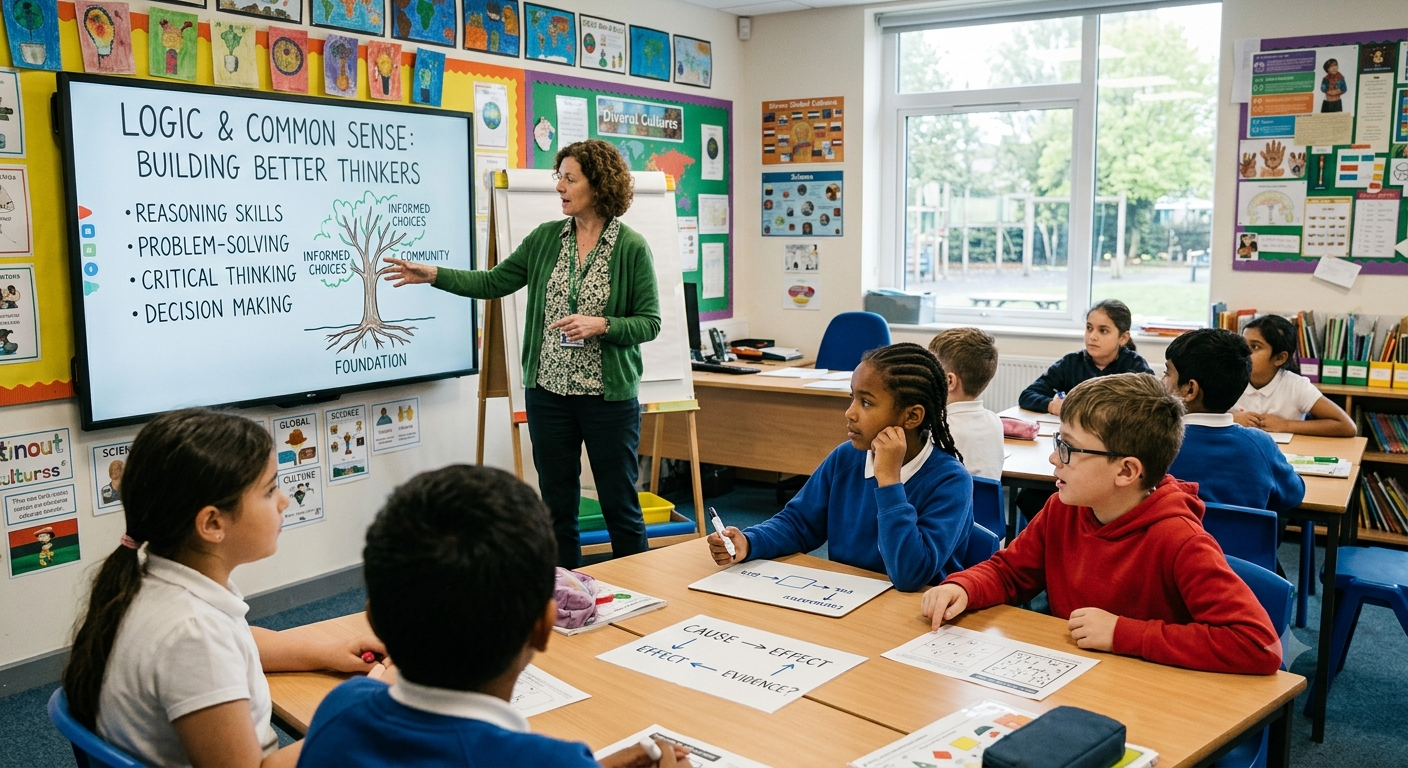
The twenty-first century is often described as the Information Age, yet it could equally be called the Age of Decision-Making. Every day, individuals face thousands of decisions involving technology, finance, health, education, ethics, communication, and citizenship. While schools traditionally emphasize literacy, mathematics, science, and languages, relatively few education systems teach formal logic, practical reasoning, and common sense as dedicated subjects from the earliest years.
This thesis argues that introducing Logic and Common Sense as compulsory primary school subjects would strengthen children’s cognitive development, improve academic performance across disciplines, enhance responsible citizenship, and better prepare societies for an era increasingly shaped by artificial intelligence, automation, misinformation, and complex global challenges.
Table of Contents
- Introduction
- Historical Background
- Understanding Logic
- Understanding Common Sense
- Relationship Between Logic and Common Sense
- Why Modern Society Needs These Subjects
- Brain Development During Childhood
- Curriculum Design from Grades 1–7
- Educational Benefits
- Economic Benefits
- Technological Benefits
- Social Benefits
- National Development
- AI and Digital Society
- Global Case Studies
- Challenges
- Recommendations
- Future Vision
- Conclusion
Chapter 1
Introduction
Education has evolved continuously throughout human history.
Early civilizations focused on:
- Survival
- Agriculture
- Hunting
- Religion
- Trade
Industrial societies later emphasized:
- Reading
- Writing
- Mathematics
- Science
The modern digital economy now requires additional skills, including:
- Critical thinking
- Decision-making
- Problem-solving
- Ethical reasoning
- Information evaluation
These skills are rooted in logic and practical judgment.
Teaching them systematically from childhood can help learners become thoughtful, capable, and resilient adults.
Chapter 2
Historical Background
Logic has ancient origins.
Major contributors include:
- Aristotle
- Confucius
- Mozi
- René Descartes
- George Boole
Their work established methods for:
- reasoning,
- evidence,
- deduction,
- structured argument,
- analytical thinking.
These ideas later became foundations for:
- mathematics,
- engineering,
- law,
- philosophy,
- computer science,
- artificial intelligence.
Chapter 3
What is Logic?
Logic is the systematic study of correct reasoning.
It teaches students how to:
- distinguish facts from opinions,
- identify valid arguments,
- recognize faulty reasoning,
- evaluate evidence,
- reach sound conclusions.
Logic is essentially the operating system of thinking.
Types of Logic
Deductive Logic
General rule → specific conclusion
Example:
All birds have feathers.
An eagle is a bird.
Therefore:
An eagle has feathers.
Inductive Logic
Specific observations → probable conclusion
Example:
Every sunrise has occurred in the east.
Therefore,
Tomorrow’s sunrise will probably occur in the east.
Abductive Logic
Finding the most likely explanation.
Example:
The road is wet.
Possible explanations:
- rain
- sprinklers
- burst water pipe
The most probable explanation is selected based on available evidence.
Chapter 4
What is Common Sense?
Common sense refers to practical judgment developed through observation, experience, and everyday reasoning.
Examples include:
- Looking both ways before crossing a road.
- Washing hands before eating.
- Saving money for future needs.
- Avoiding obvious risks.
- Verifying information before sharing it.
Common sense complements formal logic by connecting reasoning with real-life situations.
Chapter 5
Relationship Between Logic and Common Sense
Logic provides structure.
Common sense provides practical application.
Together they help people:
- solve problems,
- make better decisions,
- communicate clearly,
- avoid unnecessary mistakes,
- evaluate information critically.
Chapter 6
Why Modern Society Needs These Subjects
Today’s children face unprecedented challenges:
- Artificial intelligence
- Social media
- Deepfake technology
- Online scams
- Cybersecurity risks
- Information overload
- Financial decisions
- Climate-related issues
Without strong reasoning skills, individuals are more vulnerable to manipulation, misinformation, and poor decision-making.
Chapter 7
Brain Development in Primary School
Between approximately ages 5 and 12, children develop rapidly in areas related to:
- language,
- memory,
- attention,
- planning,
- self-control,
- reasoning.
Appropriately designed lessons in logic and practical reasoning can support these developing abilities alongside existing subjects.
Chapter 8
Suggested Curriculum (Grades 1–7)
Grades 1–2
Topics:
- Observation
- Patterns
- Simple comparisons
- Cause and effect
- Listening carefully
- Everyday safety
Activities:
- Picture puzzles
- Sorting games
- Story sequencing
- Matching exercises
Grades 3–4
Students learn:
- Simple reasoning
- Fact versus opinion
- Evidence
- Fairness
- Teamwork
- Basic decision-making
Grades 5–6
Topics:
- Logical arguments
- Problem-solving
- Planning
- Financial basics
- Digital literacy
- Responsible online behavior
Grade 7
Students explore:
- Introduction to algorithms
- Scientific reasoning
- Probability
- Ethics
- Media literacy
- Structured debates
- Critical evaluation of claims
Chapter 9
Educational Benefits
Students may become better at:
- mathematics,
- science,
- programming,
- reading comprehension,
- essay writing,
- research,
- experimentation.
They also learn to ask thoughtful questions rather than simply memorize information.
Chapter 10
Economic Benefits
A workforce trained in reasoning can contribute to:
- innovation,
- entrepreneurship,
- efficient management,
- informed financial decisions,
- higher productivity,
- better problem-solving in industry.
Chapter 11
Technological Benefits
Logic underpins:
- computer programming,
- software engineering,
- robotics,
- cybersecurity,
- data analysis,
- artificial intelligence.
Introducing logical reasoning early can make later technical education more accessible.
Chapter 12
Social Benefits
Communities benefit through:
- better communication,
- reduced conflict,
- improved cooperation,
- greater civic participation,
- informed public discussion.
Reasoning skills also encourage respectful disagreement and evidence-based dialogue.
Chapter 13
National Development
Countries that cultivate analytical thinking are often better positioned to:
- improve governance,
- strengthen innovation,
- support scientific research,
- develop competitive industries,
- adapt to technological change.
Education that emphasizes reasoning can complement investments in infrastructure, healthcare, and economic development.
Chapter 14
Logic in the Age of Artificial Intelligence
AI systems increasingly assist with:
- healthcare,
- finance,
- transportation,
- education,
- manufacturing.
People still need the ability to:
- question AI outputs,
- verify evidence,
- recognize limitations,
- make ethical judgments.
Teaching logic helps citizens use AI responsibly rather than accepting every output uncritically.
Chapter 15
International Perspectives
Many education systems incorporate elements of logical reasoning through mathematics, science, philosophy, coding, or inquiry-based learning. Some also emphasize media literacy and critical thinking as responses to digital misinformation. Expanding these skills into a dedicated primary-school subject is an idea that continues to be discussed in education policy and curriculum reform.
Chapter 16
Challenges
Potential obstacles include:
- Teacher training requirements
- Curriculum time constraints
- Development of age-appropriate materials
- Assessment methods
- Funding for implementation
- Ensuring lessons are culturally inclusive and practical
Chapter 17
Recommendations
- Introduce Logic and Common Sense gradually beginning in lower primary grades.
- Design age-appropriate, activity-based lessons rather than abstract theory.
- Train teachers in reasoning, questioning techniques, and inquiry-based instruction.
- Integrate digital literacy, media literacy, and ethical reasoning into the curriculum.
- Use games, stories, experiments, and collaborative projects to develop reasoning skills.
- Assess students through practical problem-solving, discussion, and projects instead of memorization alone.
- Review and update the curriculum regularly to reflect technological and societal changes.
Chapter 18
Vision for 2050
If children receive continuous education in logic and practical reasoning from primary school onward, future societies may benefit from:
- More innovative scientists and engineers
- More informed entrepreneurs
- More responsible AI users
- Better financial decision-makers
- Stronger democratic participation
- Improved public health choices
- Greater resilience against misinformation
- Higher levels of creativity and collaboration
Conclusion
Introducing Logic and Common Sense as dedicated subjects at the primary-school level represents a forward-looking investment in human capital. These subjects would not replace traditional disciplines such as mathematics, languages, science, or history; rather, they would strengthen students’ ability to learn from all of them by improving reasoning, judgment, and evidence-based thinking.
As societies become more interconnected and technologically advanced, the ability to evaluate information critically, solve unfamiliar problems, and make sound decisions will remain essential. A carefully designed curriculum that develops these abilities from an early age can help prepare future generations to contribute thoughtfully to their communities, economies, and scientific progress.
Such an educational reform would aim not only to increase knowledge, but also to cultivate the wisdom, judgment, and practical reasoning needed for a rapidly changing modern world.




Be First to Comment