
Abstract
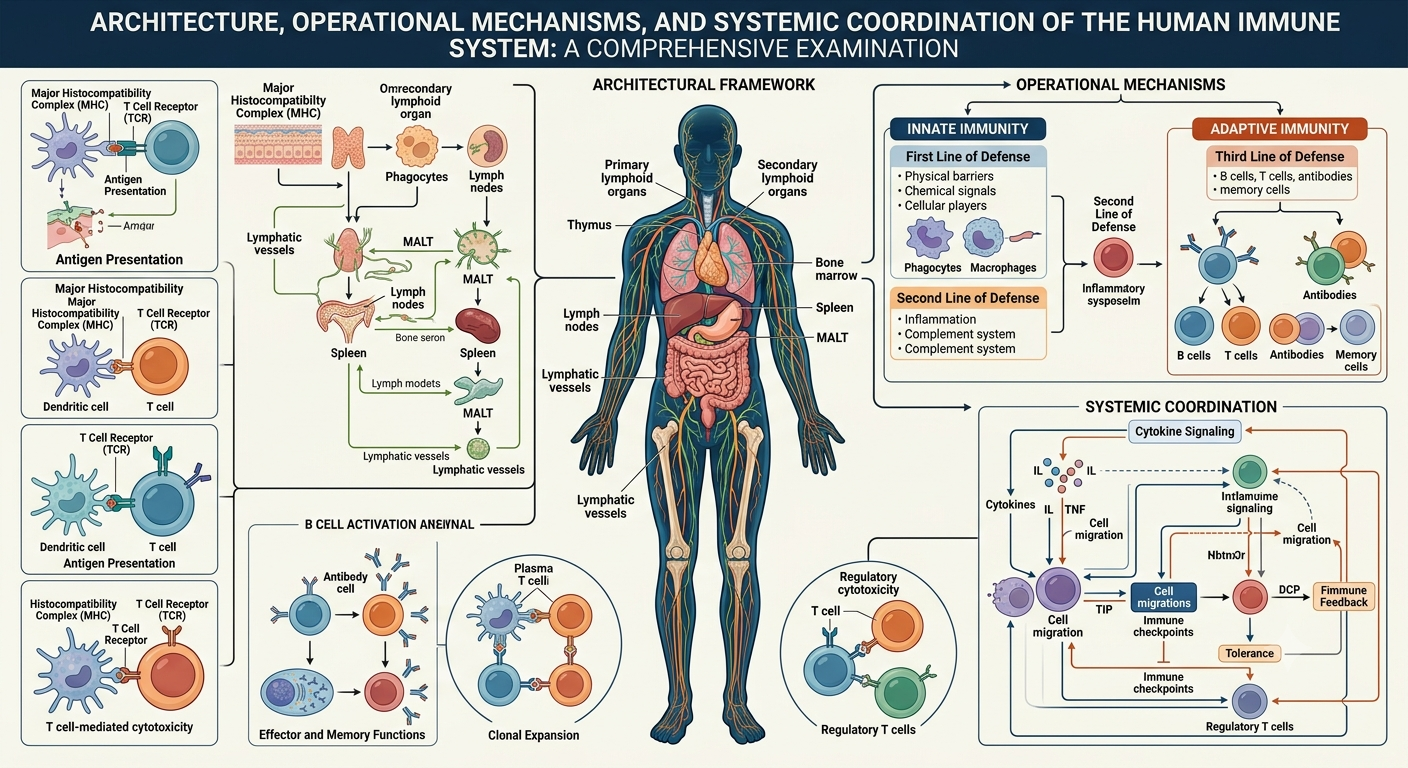
The human immune system is one of the most sophisticated biological defense networks known. Rather than being a single organ, it is a distributed, intelligent, adaptive, and self-regulating system composed of specialized cells, tissues, organs, proteins, signaling molecules, and genetic programs working together to protect the body against pathogens while maintaining tolerance toward its own tissues.
This thesis examines the immune system as an integrated biological architecture comparable to a highly coordinated national security network. It explores its structural organization, operational principles, communication systems, molecular mechanisms, memory formation, disease processes, and emerging therapeutic technologies.
Table of Contents
- Introduction
- Evolution of Immunity
- Architecture of the Human Immune System
- Major Immune Organs
- Immune Cells
- Molecular Components
- Innate Immune System
- Adaptive Immune System
- Immune Communication Networks
- Immune Response Timeline
- Immune Memory
- Coordination with Other Body Systems
- Autoimmune Diseases
- Immunodeficiency Disorders
- Allergies
- Cancer Immunology
- Vaccination
- Modern Immunotherapy
- Artificial Intelligence and Immunology
- Future Directions
- Conclusion
Chapter 1
Introduction
Every second, trillions of microorganisms attempt to colonize the human body.
These include:
- Viruses
- Bacteria
- Fungi
- Parasites
- Environmental toxins
- Cancerous cells
Without an immune system, human life would survive only a few days after birth.
The immune system performs five essential missions:
- Detect danger
- Identify the threat
- Coordinate defense
- Destroy invaders
- Remember previous infections
Chapter 2
Evolution of Immunity
The immune system evolved over more than 600 million years.
Primitive Organisms
Single-celled organisms relied on:
- Cell membranes
- Digestive enzymes
- Antimicrobial peptides
No adaptive immunity existed.
Fish
Developed:
- Antibodies
- T cells
- B cells
- Thymus
Amphibians
Added stronger antibody diversity.
Reptiles
Developed increasingly complex lymphoid tissues.
Birds
Introduced the bursa of Fabricius, where B cells mature.
Mammals
Humans possess one of the most sophisticated adaptive immune systems, capable of generating an enormous diversity of antigen receptors through genetic recombination.
Chapter 3
Architecture of the Immune System
The immune system resembles a multi-layered defense architecture.
Immune System

│
├── Physical Barriers
│
├── Chemical Barriers
│
├── Innate Immunity
│
├── Adaptive Immunity
│
├── Immune Memory
│
└── Repair & Recovery
Each layer supports the next, creating defense in depth.
Chapter 4
Immune Organs
1. Bone Marrow
Functions:
- Produces blood cells
- Generates immune stem cells
- Matures B lymphocytes
Daily production is enormous, with billions of blood cells formed each day.
2. Thymus
Located behind the sternum.
Functions:
- Matures T lymphocytes
- Eliminates self-reactive T cells (central tolerance)
- Helps prevent autoimmunity
3. Spleen
Largest lymphoid organ.
Functions:
- Filters blood
- Removes aged red blood cells
- Detects blood-borne pathogens
- Activates immune responses
4. Lymph Nodes
Approximately 600–700 lymph nodes are distributed throughout the body.
Functions:
- Filter lymphatic fluid
- Present antigens
- Activate lymphocytes
5. Tonsils
First defense against inhaled and ingested microbes.
6. Peyer’s Patches
Located in the small intestine.
Monitor gut microbes.
7. Appendix
Now recognized as contributing to gut immunity and serving as a reservoir for beneficial microbes.
Chapter 5
Immune Cells
White Blood Cells
Also called leukocytes.
Major groups include:
Neutrophils
- First responders
- Destroy bacteria
- Short lifespan
- Most abundant circulating white blood cell
Macrophages
Functions:
- Phagocytosis
- Tissue repair
- Antigen presentation
Dendritic Cells
Known as the immune system’s professional antigen-presenting cells.
Bridge innate and adaptive immunity.
Natural Killer (NK) Cells
Destroy:
- Virus-infected cells
- Tumor cells
Without prior sensitization.
B Cells
Produce antibodies.
Differentiate into:
- Plasma cells
- Memory B cells
T Cells
Include:
- Helper T cells (CD4⁺)
- Cytotoxic T cells (CD8⁺)
- Regulatory T cells
- Memory T cells
Chapter 6
Molecular Components
The immune system communicates through numerous molecules.
Important components include:
- Antibodies (immunoglobulins)
- Cytokines
- Chemokines
- Complement proteins
- Interferons
- Defensins
- Acute-phase proteins
These molecules coordinate recognition, signaling, pathogen destruction, and regulation.
Chapter 7
Innate Immunity
Innate immunity provides immediate defense.
Physical barriers
- Skin
- Mucous membranes
- Tears
- Saliva
Chemical barriers
- Stomach acid
- Lysozyme
- Antimicrobial peptides
Cellular defenders
- Neutrophils
- Macrophages
- Dendritic cells
- NK cells
Complement System
A cascade of more than 30 proteins that:
- Opsonize pathogens
- Recruit immune cells
- Form membrane attack complexes that can lyse certain microbes
Chapter 8
Adaptive Immunity
Adaptive immunity is:
- Highly specific
- Long-lasting
- Memory-based
Activation Process
Pathogen

↓

Dendritic Cell

↓

Lymph Node

↓

Helper T Cell

↓

B Cell Activation

↓

Antibody Production

↓

Memory Formation
This process can take several days during a first encounter but is much faster upon re-exposure.
Chapter 9
Immune Communication Network
The immune system is a biological communication network.
It uses:
- Cytokines
- Chemokines
- Hormones
- Cell-to-cell contact
- Antigen presentation
- Extracellular vesicles
Cells continuously exchange information to coordinate responses while limiting unnecessary damage.
Chapter 10
Immune Response Timeline
Minutes
- Physical barriers
- Complement activation
- Neutrophil recruitment
Hours
- Macrophages
- Dendritic cells
- Inflammation
Days
- T-cell activation
- B-cell activation
- Antibody production
Weeks
- Pathogen elimination
- Memory cell formation
- Tissue repair
Chapter 11
Immune Memory
One hallmark of adaptive immunity is immunological memory.
Memory B cells and memory T cells can persist for years or decades, allowing faster and stronger responses to previously encountered pathogens.
This principle underlies vaccination.
Chapter 12
Coordination with Other Systems
The immune system works closely with many body systems.
Nervous System
Neural signals influence inflammation, and immune molecules can affect brain function.
Endocrine System
Hormones such as cortisol help regulate immune activity.
Cardiovascular System
Blood transports immune cells and signaling molecules throughout the body.
Lymphatic System
Returns tissue fluid to circulation and provides pathways for immune cell trafficking.
Digestive System
The gut-associated immune system monitors trillions of microorganisms while maintaining tolerance to beneficial microbes and food antigens.
Chapter 13
Autoimmune Diseases
Autoimmunity occurs when immune tolerance fails and the immune system attacks healthy tissues.
Examples include:
- Type 1 diabetes mellitus
- Rheumatoid arthritis
- Systemic lupus erythematosus
- Multiple sclerosis
Contributing factors include genetics, environmental exposures, hormones, and immune dysregulation.
Chapter 14
Immunodeficiency
Immune deficiencies reduce the body’s ability to fight infections.
They may be:
Primary
Inherited genetic disorders.
Secondary
Acquired through factors such as infections, malnutrition, certain medications, or cancer treatments.
Chapter 15
Allergies
Allergies result from exaggerated immune responses to normally harmless substances.
Common allergens include:
- Pollen
- Dust mites
- Animal dander
- Certain foods
- Insect venom
Mast cells release histamine and other mediators that produce symptoms ranging from mild irritation to severe allergic reactions.
Chapter 16
Cancer Immunology
The immune system continuously surveys tissues for abnormal cells.
Cancer cells may:
- Reduce antigen presentation
- Suppress immune responses
- Create immunosuppressive microenvironments
- Escape immune recognition
Understanding these mechanisms has transformed cancer treatment.
Chapter 17
Vaccination
Vaccines expose the immune system to antigens or genetic instructions that safely stimulate protective immunity without causing the disease itself.
Benefits include:
- Immune memory
- Faster future responses
- Reduced disease severity
- Community (herd) protection when vaccination coverage is high
Chapter 18
Modern Immunotherapy
Modern therapies harness or modify immune responses.
Major approaches include:
- Monoclonal antibodies
- Immune checkpoint inhibitors
- CAR-T cell therapy
- Therapeutic vaccines
- Cytokine-based therapies
These have significantly improved outcomes for several cancers and immune-mediated diseases.
Chapter 19
Artificial Intelligence and Immunology
Artificial intelligence is increasingly used to:
- Analyze genomic and immune data
- Predict protein structures
- Support vaccine and drug discovery
- Identify biomarkers
- Assist personalized medicine
- Model disease progression
AI complements, rather than replaces, laboratory and clinical research.
Chapter 20
Future Directions
Emerging areas include:
- Precision immunology
- Single-cell multi-omics
- Gene editing
- Synthetic biology
- Microbiome engineering
- Nanomedicine
- Universal and broadly protective vaccines
- Digital twins for immune-system modeling
These fields aim to make prevention and treatment more personalized and effective.
Chapter 21
Systems Engineering Perspective
The immune system can be viewed as a distributed intelligent network.
| Engineering Component | Immune Equivalent |
|---|---|
| Sensors | Pattern-recognition receptors, B-cell receptors, T-cell receptors |
| Communication Network | Cytokines, chemokines, lymphatic vessels, bloodstream |
| Data Processing | Lymph nodes, spleen, antigen-presenting cells |
| Decision-Making | T cells, B cells, regulatory cells |
| Rapid Response | Innate immunity |
| Precision Strike | Cytotoxic T cells, antibodies |
| Memory Storage | Memory B cells, memory T cells |
| Maintenance | Regulatory T cells, tissue repair mechanisms |
This systems perspective highlights how distributed sensing, communication, computation, and feedback enable robust biological defense.
Conclusion
The human immune system is a dynamic, multilayered defense architecture that integrates specialized organs, diverse immune cells, molecular signaling pathways, and long-lived memory into a coordinated whole. It continuously distinguishes self from non-self, responds rapidly to infection, adapts to new threats, repairs damaged tissues, and maintains tolerance to healthy cells.
Advances in genomics, systems biology, bioengineering, and artificial intelligence are reshaping our understanding of immunity and enabling increasingly precise diagnostics and therapies. As infectious diseases evolve and chronic immune-mediated conditions remain major health challenges, continued research into immune architecture and coordination will be central to improving global health throughout the twenty-first century.




Be First to Comment