
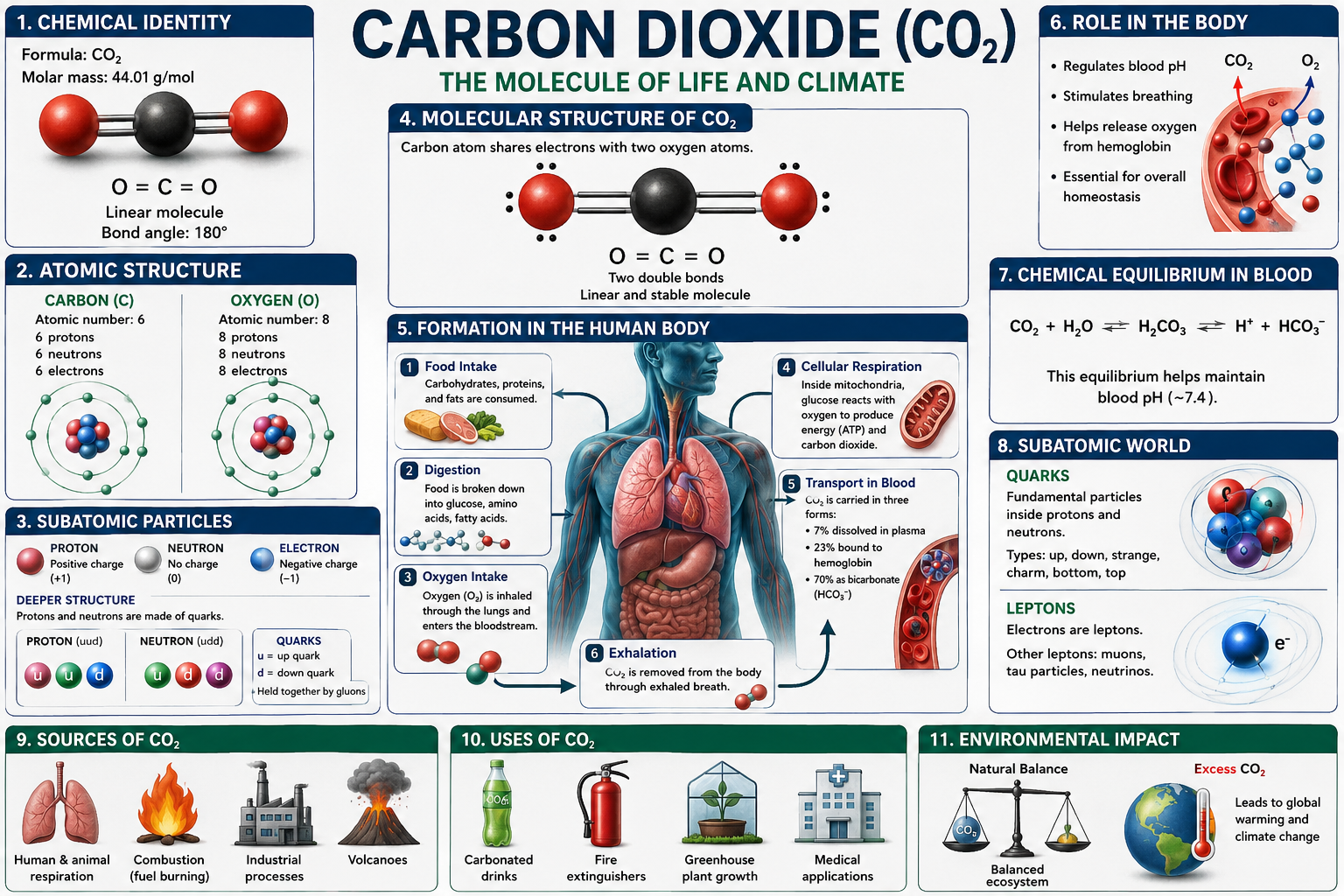
Carbon dioxide (CO₂) is one of the most important chemical compounds in human biology, Earth’s atmosphere, and modern civilization. In the human body, carbon dioxide is produced continuously during metabolism and cellular respiration. It plays a critical role in maintaining life through respiration, blood pH regulation, energy production, and communication between body systems.
Understanding carbon dioxide requires studying its complete scientific framework — from atoms and molecules to subatomic particles such as electrons, protons, quarks, and quantum interactions. Human carbon dioxide formation is deeply connected to biochemistry, physics, molecular biology, medicine, climate science, and future technologies.
This thesis article explores the characteristics, building blocks, formation processes, atomic anatomy, and subatomic structure of carbon dioxide in a comprehensive yet simple format.
1. The Scientific Nature of Carbon Dioxide
Carbon dioxide is a chemical compound made from:
- One carbon atom (C)
- Two oxygen atoms (O₂)
Chemical formula:
CO2
The molecule exists naturally in:
- Human respiration
- Animal respiration
- Combustion
- Ocean systems
- Plant photosynthesis
- Industrial systems
- Atmospheric cycles
Carbon dioxide is invisible, odorless, and colorless under normal conditions.
2. Characteristics of Carbon Dioxide
Physical Characteristics
| Property | Description |
|---|---|
| Color | Colorless |
| Odor | Odorless |
| Density | Heavier than air |
| Solubility | Dissolves in water |
| State | Gas at room temperature |
| Molecular Weight | 44.01 g/mol |
Biological Characteristics
Carbon dioxide in humans:
- Is produced during energy metabolism
- Travels through blood circulation
- Regulates blood acidity (pH)
- Stimulates breathing control in the brain
- Supports oxygen transport balance
Without proper CO₂ balance, humans can experience:
- Breathing disorders
- Acidosis
- Alkalosis
- Organ dysfunction
- Neurological instability
Atmospheric Characteristics
In Earth’s atmosphere, carbon dioxide:
- Traps heat energy
- Acts as a greenhouse gas
- Influences climate systems
- Supports plant growth
Although essential for life, excessive atmospheric CO₂ contributes to global warming and climate change.
3. Building Blocks of Carbon Dioxide
Carbon dioxide is built from atoms.
Atomic Structure
Carbon Atom
Carbon has:
- 6 protons
- 6 neutrons
- 6 electrons
Atomic number:
Z=6
Carbon is one of the most important elements in biology because it forms stable bonds with many other atoms.
Oxygen Atom
Oxygen has:
- 8 protons
- 8 neutrons
- 8 electrons
Atomic number:
Z=8
Oxygen is essential for:
- Respiration
- Oxidation reactions
- Cellular metabolism
- Water formation
4. Molecular Bonding in Carbon Dioxide
Carbon dioxide forms through covalent bonding.
The carbon atom shares electrons with two oxygen atoms.
Molecular structure:
O=C=O
This double-bond structure creates:
- Molecular stability
- Linear geometry
- Efficient gas diffusion
- Strong vibrational energy modes
5. Formation of Human Carbon Dioxide
Human carbon dioxide forms mainly through cellular respiration.
Cellular Respiration Process
Cells convert glucose and oxygen into energy.
General respiration equation:
C6H12O6+6O2→6CO2+6H2O+Energy
This process occurs inside mitochondria, known as the “powerhouses” of the cell.
Step-by-Step Formation
Step 1: Food Intake
Humans consume:
- Carbohydrates
- Proteins
- Fats
These molecules contain stored chemical energy.
Step 2: Digestion
Food is broken into:
- Glucose
- Amino acids
- Fatty acids
Step 3: Oxygen Intake
Lungs inhale oxygen.
Oxygen enters bloodstream and cells.
Step 4: Cellular Metabolism
Inside mitochondria:
- Glucose reacts with oxygen
- ATP energy is produced
- Carbon dioxide becomes a waste product
Step 5: Transport in Blood
Carbon dioxide moves through blood in three forms:
| Transport Method | Percentage |
|---|---|
| Dissolved in plasma | 7% |
| Bound to hemoglobin | 23% |
| Bicarbonate ions | 70% |
Step 6: Exhalation
The lungs remove carbon dioxide through breathing.
This maintains body chemical balance.
6. Human Respiratory Control of Carbon Dioxide
The brain monitors carbon dioxide levels continuously.
High CO₂ levels trigger:
- Faster breathing
- Deeper inhalation
- Increased oxygen intake
The medulla oblongata in the brainstem controls this system.
7. Carbon Dioxide and Blood pH
Carbon dioxide directly affects blood acidity.
Chemical relationship:
CO2+H2O↔H2CO3↔H++HCO3−
This equilibrium helps maintain normal blood pH.
Normal blood pH:
pH≈7.4
8. Subatomic Particles in Carbon Dioxide
Atoms themselves are made of smaller particles.
Protons
Protons:
- Carry positive charge
- Exist inside atomic nucleus
- Determine atomic identity
Charge:
+1
Neutrons
Neutrons:
- Have no electrical charge
- Stabilize nucleus
- Add atomic mass
Charge:
0
Electrons
Electrons:
- Carry negative charge
- Orbit atomic nucleus
- Form chemical bonds
Charge:
−1
Electrons are responsible for the covalent bonding inside CO₂ molecules.
9. Deeper Subatomic Structure
Modern physics shows that protons and neutrons are made from quarks.
Quarks
Quarks are elementary particles.
Types inside protons and neutrons:
| Particle | Quark Structure |
|---|---|
| Proton | up + up + down |
| Neutron | up + down + down |
Quarks are held together by gluons through the strong nuclear force.
Leptons
Electrons belong to a particle family called leptons.
Leptons include:
- Electrons
- Muons
- Tau particles
- Neutrinos
10. Quantum Characteristics of Carbon Dioxide
At quantum level, carbon dioxide demonstrates:
- Electron cloud behavior
- Quantum vibration
- Infrared absorption
- Electromagnetic interactions
These quantum properties explain why CO₂ absorbs infrared heat in Earth’s atmosphere.
11. Carbon Dioxide in Modern Technology
Carbon dioxide is important in many industries.
Medical Industry
Used in:
- Respiratory monitoring
- Surgical procedures
- Blood gas analysis
Food Industry
Used for:
- Carbonated drinks
- Food preservation
- Refrigeration systems
Industrial Systems
Applications include:
- Fire extinguishers
- Welding
- Chemical manufacturing
Space Science
CO₂ management is essential in:
- Spacecraft
- Space stations
- Future Mars colonization
12. Carbon Dioxide and Environmental Science
Carbon dioxide influences:
- Climate systems
- Ocean acidity
- Weather patterns
- Ecosystem stability
Major human CO₂ sources:
- Fossil fuels
- Factories
- Vehicles
- Power stations
- Deforestation
13. Future Technologies and Carbon Dioxide
Future technologies involving CO₂ include:
Carbon Capture Systems
Machines designed to remove CO₂ from atmosphere.
Artificial Photosynthesis
Scientists aim to convert CO₂ into fuel using sunlight.
Green Hydrogen Economy
CO₂ reduction supports renewable energy systems.
Smart Environmental Monitoring
AI and sensors now monitor carbon dioxide globally.
Conclusion
Carbon dioxide is far more than a simple gas. It is a central molecule connecting human biology, chemistry, physics, environmental science, medicine, and advanced technology.
Its structure begins with atoms and extends deeply into subatomic physics involving electrons, quarks, leptons, and quantum forces. In humans, carbon dioxide forms through cellular respiration and plays an essential role in life regulation, blood chemistry, and energy metabolism.
Modern civilization depends on understanding carbon dioxide for:
- Healthcare
- Environmental protection
- Climate science
- Industrial systems
- Space exploration
- Future sustainable technologies
The study of carbon dioxide therefore represents a bridge between microscopic quantum reality and the large-scale systems of life and




Be First to Comment