
Table of Contents
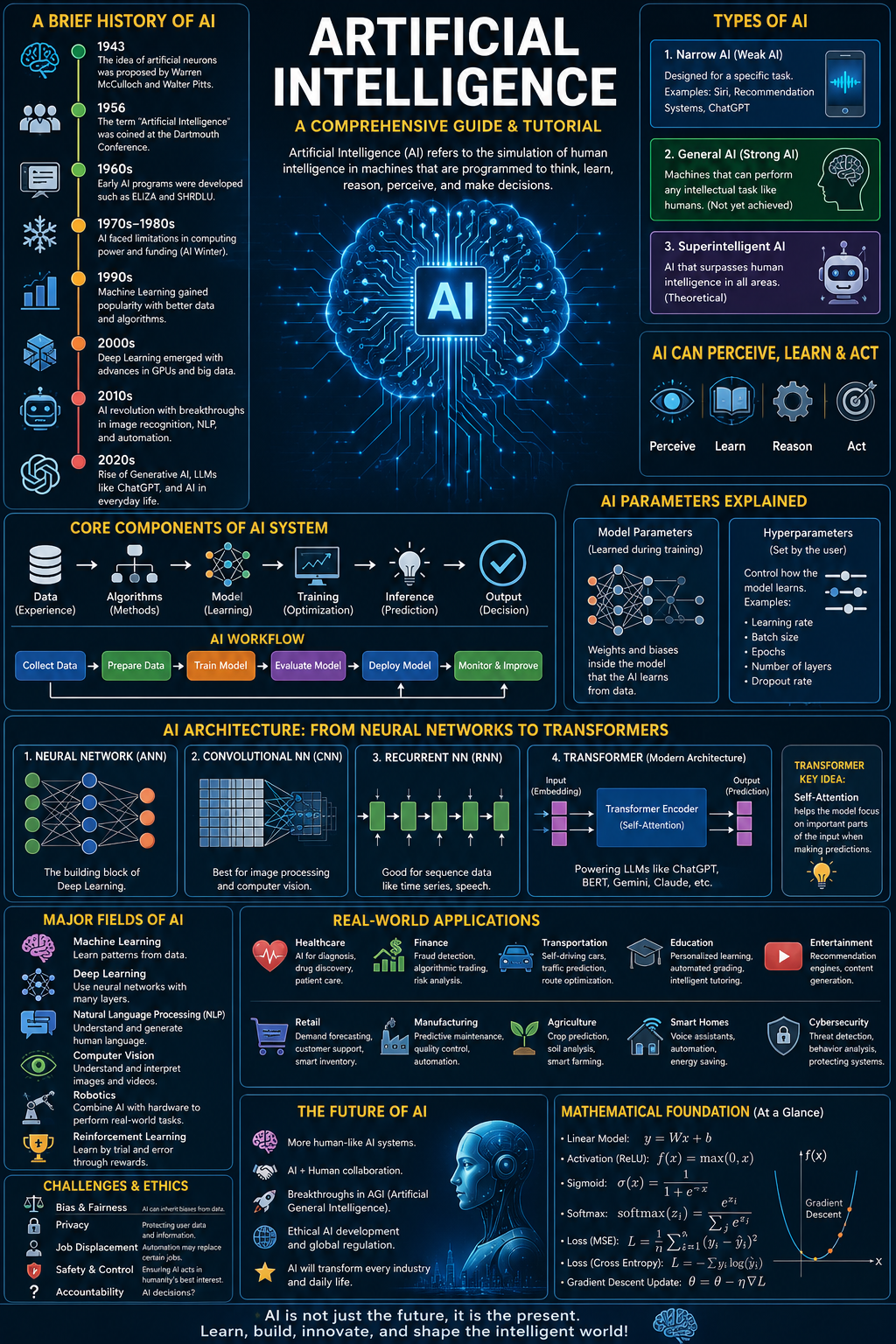
- Introduction to Artificial Intelligence
- Historical Evolution of AI
- Fundamental Concepts of AI
- Core Components of AI Systems
- AI Parameters Explained
- AI Architecture and System Design
- Machine Learning and Deep Learning
- Neural Networks and Large Language Models
- Real-World Applications of AI
- Challenges, Risks, and Ethics of AI
- Future of Artificial Intelligence
- Conclusion
1. Introduction to Artificial Intelligence
What is Artificial Intelligence?
Artificial Intelligence (AI) is a branch of computer science focused on creating machines and software systems that can perform tasks normally requiring human intelligence. These tasks include learning, reasoning, problem-solving, language understanding, decision-making, planning, creativity, and pattern recognition.
AI systems are designed to imitate aspects of human thinking and behavior. Unlike traditional software that follows fixed instructions, AI systems can learn from data, improve performance over time, and adapt to changing environments.
Examples of AI in everyday life include:
- Voice assistants such as Siri and Alexa
- Recommendation systems on YouTube and Netflix
- Self-driving vehicles
- Facial recognition systems
- Medical diagnosis systems
- Chatbots and virtual assistants
- Fraud detection in banking
- Language translation systems
AI is transforming industries such as healthcare, education, agriculture, finance, transportation, cybersecurity, robotics, manufacturing, and scientific research.
Why AI Matters
AI is important because it allows computers to process massive amounts of information much faster than humans. AI improves efficiency, reduces repetitive labor, enhances decision-making, and creates intelligent automation.
Benefits of AI include:
- Faster data analysis
- Improved productivity
- Better predictions and forecasting
- Reduced human error
- Automation of dangerous tasks
- Personalized user experiences
- Scientific innovation
AI has become one of the most influential technologies of the modern era.
2. Historical Evolution of AI
Early Foundations of AI
The idea of intelligent machines has existed for centuries in philosophy, mathematics, and science fiction. However, modern AI began developing during the 20th century.
1940s–1950s: Foundations of Computing
During the 1940s, scientists developed early electronic computers. Mathematicians and engineers began exploring whether machines could imitate human reasoning.
Important contributors included:
- Alan Turing
- John von Neumann
- Claude Shannon
Alan Turing and Intelligent Machines
entity[“people”,”Alan Turing”,”British mathematician and computer scientist”] proposed the idea that machines could think. In 1950, he introduced the famous “Turing Test,” designed to evaluate whether a machine could demonstrate intelligent conversation similar to a human.
1956: Birth of Artificial Intelligence
The term “Artificial Intelligence” was officially introduced in 1956 during the Dartmouth Conference organized by:
- John McCarthy
- Marvin Minsky
- Claude Shannon
- Nathaniel Rochester
This event marked the beginning of AI as a formal academic field.
1960s–1970s: Early Optimism
Researchers believed machines would soon solve complex human problems. Early AI systems focused on:
- Logical reasoning
- Mathematics
- Language translation
- Problem-solving
However, computers were still limited in memory and processing power.
1980s: Expert Systems
AI gained popularity through expert systems. These systems stored human expert knowledge inside rule-based software.
Examples:
- Medical diagnosis systems
- Financial decision systems
- Industrial maintenance systems
Although useful, expert systems struggled with flexibility and learning.
1990s–2000s: Machine Learning Era
The growth of the internet, faster computers, and large datasets allowed AI to evolve through machine learning.
Instead of programming every rule manually, computers learned patterns from data.
Major milestones included:
- Speech recognition
- Search engines
- Data mining
- Computer vision
In 1997, IBM Deep Blue defeated chess champion Garry Kasparov.
2010s: Deep Learning Revolution
AI advanced dramatically due to:
- Graphics Processing Units (GPUs)
- Big data
- Neural networks
- Cloud computing
Deep learning systems achieved breakthroughs in:
- Image recognition
- Natural language processing
- Autonomous driving
- Medical imaging
2020s: Generative AI and Large Models
Modern AI systems can now generate:
- Text
- Images
- Music
- Videos
- Computer code
Large Language Models (LLMs) became widely used for communication, education, programming, and research.
AI is now integrated into business, government, healthcare, finance, education, and entertainment.
3. Fundamental Concepts of AI
Intelligence
Intelligence refers to the ability to:
- Learn from experience
- Adapt to new situations
- Solve problems
- Understand language
- Recognize patterns
- Make decisions
AI attempts to reproduce these abilities using computers.
Data
Data is the foundation of AI.
AI systems learn from:
- Text
- Images
- Audio
- Videos
- Numbers
- Sensor readings
- User behavior
Without data, AI cannot learn effectively.
Algorithms
Algorithms are step-by-step procedures that guide AI systems.
AI algorithms help machines:
- Identify patterns
- Predict outcomes
- Classify information
- Learn relationships
Examples include:
- Decision trees
- Neural networks
- Linear regression
- Clustering algorithms
Training
Training is the process where AI learns from data.
During training:
- Data is provided
- Predictions are made
- Errors are measured
- Parameters are adjusted
- Performance improves gradually
Inference
Inference occurs when a trained AI model applies learned knowledge to new information.
Example:
- A trained AI recognizes a new image of a cat.
- A chatbot answers a new question.
4. Core Components of AI Systems
AI systems consist of multiple interconnected components.
1. Data Collection Layer
This layer gathers information from:
- Databases
- Sensors
- Websites
- Cameras
- Smartphones
- Internet activity
Good data quality improves AI accuracy.
2. Data Processing Layer
Raw data is cleaned and organized.
Tasks include:
- Removing errors
- Standardizing formats
- Labeling information
- Filtering noise
3. Machine Learning Models
These models learn patterns from processed data.
Examples:
- Neural networks
- Decision trees
- Random forests
- Support vector machines
4. Training Infrastructure
AI training requires:
- Powerful processors
- GPUs
- TPUs
- Cloud computing systems
Large AI models may require thousands of processors.
5. Storage Systems
AI systems need massive storage for:
- Training data
- Model parameters
- User interactions
- Generated outputs
6. Inference Engine
The inference engine applies learned intelligence to real-world tasks.
Example:
- Translating languages
- Recommending products
- Detecting fraud
7. User Interface
This allows humans to interact with AI systems.
Examples:
- Chat interfaces
- Mobile apps
- Voice assistants
- Dashboards
5. AI Parameters Explained
What Are AI Parameters?
Parameters are numerical values inside an AI model that determine how the system behaves and learns.
Parameters are adjusted during training to improve predictions.
They are the internal memory and knowledge structure of AI systems.
Simple Analogy
Imagine teaching a child to recognize dogs.
The child gradually learns:
- Shape
- Fur
- Ears
- Sounds
- Behavior
Similarly, AI parameters store learned relationships from data.
Neural Network Parameters
In neural networks, parameters mainly include:
- Weights
- Biases
Weights
Weights determine how important certain inputs are.
Example:
In image recognition:
- Eyes may receive high importance.
- Background objects may receive low importance.
Biases
Bias values help shift predictions and improve flexibility.
Together, weights and biases allow AI systems to learn complex relationships.
Hyperparameters
Hyperparameters are settings chosen before training begins.
Examples:
- Learning rate
- Batch size
- Number of layers
- Number of neurons
- Training epochs
Unlike parameters, hyperparameters are not learned automatically.
Learning Rate
The learning rate controls how fast an AI model updates its parameters.
Small learning rate:
- Slow learning
- More stable
Large learning rate:
- Faster learning
- Risk of instability
Model Size
Modern AI models can contain billions or trillions of parameters.
Larger models generally:
- Learn more complex patterns
- Require more computing power
- Need larger datasets
Why Parameters Matter
Parameters determine:
- Accuracy
- Creativity
- Prediction quality
- Generalization ability
- Memory capacity
The quality of AI depends heavily on how parameters are trained.
6. AI Architecture and System Design
What is AI Architecture?
AI architecture refers to the structure and organization of an AI system.
It defines:
- Data flow
- Processing methods
- Model organization
- Hardware interaction
- Decision mechanisms
AI architecture combines software, mathematics, and computing infrastructure.
Basic AI Architecture Structure
A typical AI system contains:
- Input Layer
- Processing Layers
- Hidden Layers
- Output Layer
- Feedback Mechanism
Input Layer
The input layer receives information.
Examples:
- Images
- Text
- Audio
- Numerical data
Hidden Layers
Hidden layers process information and identify patterns.
In deep learning, many hidden layers allow complex reasoning.
Output Layer
The output layer produces final predictions.
Examples:
- Identifying an object
- Translating text
- Predicting disease risk
Feedback Loop
Errors are measured and used to improve the model.
This process is called optimization.
Neural Network Architecture
Neural networks are inspired by the human brain.
Each artificial neuron receives inputs, processes information, and passes outputs.
Basic Neural Network Formula
genui{“math_block_widget_always_prefetch_v2”:{“content”:”y = f\left(\sum_{i=1}^{n} w_i x_i + b\right)”}}
Where:
- x = input values
- w = weights
- b = bias
- f = activation function
- y = output





Be First to Comment