
How a Material Science Researcher Can Analyze, Diagnose, and Evaluate Modern Artificial Intelligence Models
Introduction
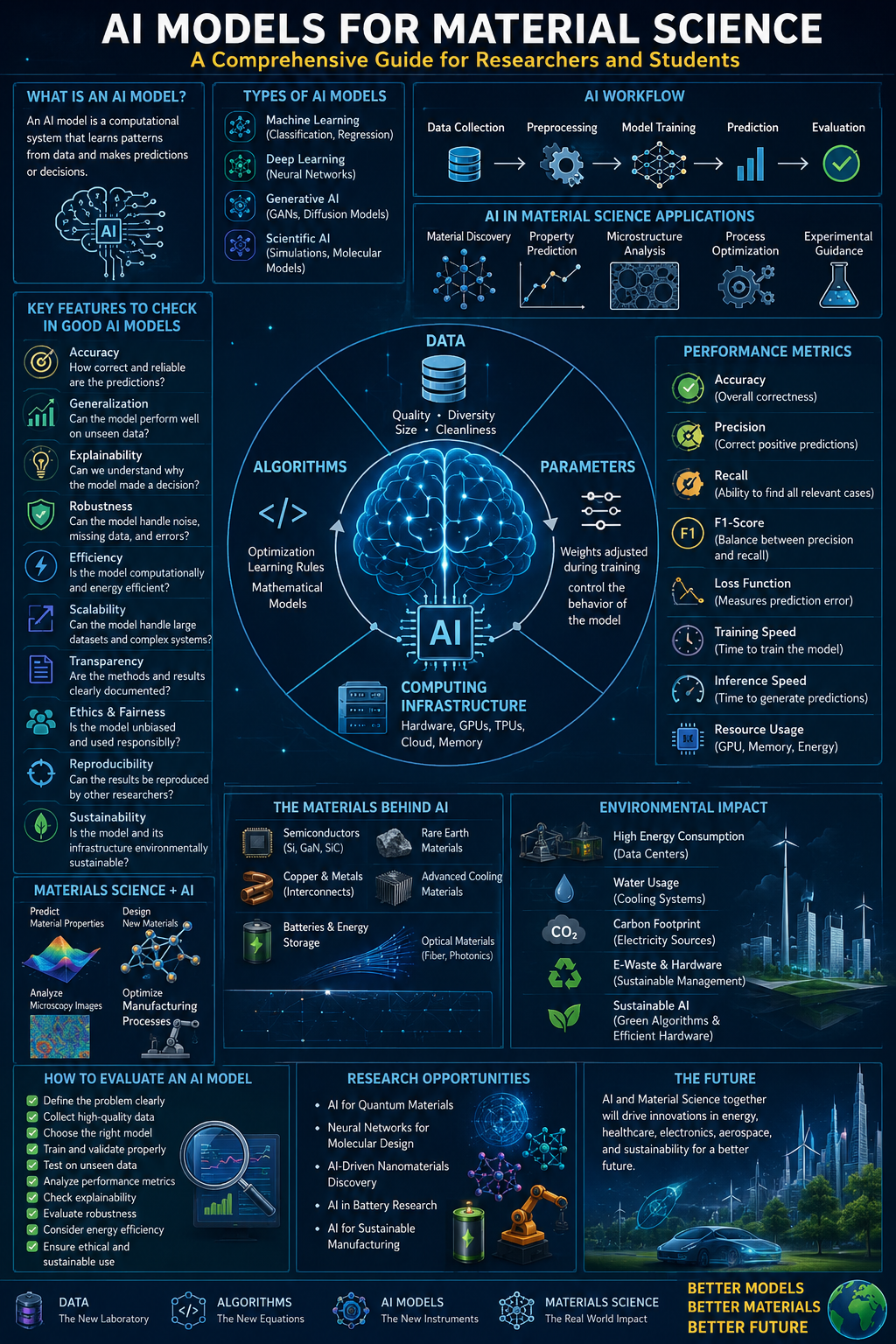
Artificial Intelligence (AI) has become one of the foundational technologies of the 21st century. Just as material science studies the structure, properties, behavior, and performance of matter, AI research studies the structure, behavior, performance, and intelligence of computational systems.
For a material science activist, researcher, or student, AI is not only a software tool. It is also:
- A scientific instrument
- A predictive engine
- A simulation framework
- A manufacturing optimizer
- A discovery accelerator
- A sustainability analysis system
Modern AI models are now helping scientists discover:
- New battery materials
- Semiconductor compounds
- Lightweight alloys
- Smart polymers
- Carbon capture materials
- Hydrogen storage systems
- Quantum materials
- Nanotechnology structures
This article provides a comprehensive beginner-to-intermediate framework for understanding:
- What AI models are
- How AI models work
- What makes a good AI model
- Which features should be analyzed deeply
- How AI can support material science research
- The ethical and industrial implications of AI
1. Understanding AI Models
An AI model is a mathematical and computational system trained to recognize patterns, solve problems, generate outputs, and make predictions from data.
AI models learn from:
- Text
- Images
- Chemical data
- Physical measurements
- Simulations
- Laboratory experiments
- Industrial sensor systems
Core Idea of AI
AI attempts to imitate certain human abilities:
- Learning
- Reasoning
- Prediction
- Pattern recognition
- Language understanding
- Decision making
2. Major Categories of AI Models
A. Machine Learning Models
These models learn patterns from data.
Examples:
- Linear regression
- Decision trees
- Random forests
- Support vector machines
Applications in material science:
- Predicting tensile strength
- Corrosion prediction
- Thermal conductivity estimation
B. Deep Learning Models
These are advanced neural-network systems inspired by the human brain.
Applications:
- Crystal structure prediction
- Microscopy image analysis
- Molecular simulations
- Defect detection in materials
C. Generative AI Models
These models create new content.
Examples:
- Text generation
- Molecular design
- Material synthesis proposals
- Research summarization
Applications:
- Designing new compounds
- Suggesting experimental pathways
- Generating laboratory reports
D. Scientific AI Models
Specialized AI designed for:
- Physics
- Chemistry
- Biology
- Material science
Examples include:
- Molecular simulation AI
- Protein-folding AI
- Quantum material prediction systems
3. AI Architecture Fundamentals
AI architecture refers to the internal structure of an AI system.
Think of it like material crystal structures:
- Atomic arrangement determines material behavior
- AI architecture determines intelligence behavior
4. Key Components of an AI Model
A. Data
Data is the raw material of AI.
Without quality data, AI becomes unreliable.
For material science:
- Spectroscopy data
- Microscopy images
- X-ray diffraction data
- Mechanical stress data
- Thermal measurements
- Chemical compositions
Important Data Properties
| Property | Meaning |
|---|---|
| Accuracy | Correct measurements |
| Diversity | Different material conditions |
| Size | Large enough datasets |
| Cleanliness | Low noise/errors |
| Relevance | Useful for the target task |
B. Algorithms
Algorithms are the rules used for learning.
Examples:
- Gradient descent
- Classification algorithms
- Optimization systems
The optimization principle is central to AI learning.
Mathematical Optimization
y=mx+b
m
b-10-8-6-4-2246810-10-5510y-interceptx-intercept
Simple mathematical relationships like this form the basis of more advanced AI optimization systems.
C. Neural Networks
Neural networks imitate interconnected brain neurons.
Structure
- Input layer
- Hidden layers
- Output layer
Applications:
- Detecting defects
- Predicting material fatigue
- Nanostructure analysis
D. Parameters
Parameters are the internal numerical weights AI adjusts during training.
Large AI models may contain:
- Millions of parameters
- Billions of parameters
- Trillions of parameters
Why Parameters Matter
More parameters can:
- Improve learning capacity
- Increase complexity understanding
- Improve reasoning
But excessive parameters can:
- Increase energy usage
- Slow computation
- Cause instability
5. What Material Science Researchers Should Diagnose in AI Models
This is one of the most important sections.
As a researcher, you should analyze AI models similarly to how you study materials.
6. Core Features to Check in Good AI Models
1. Accuracy
How correct are the predictions?
Questions:
- Does the AI predict correctly?
- Is the error rate acceptable?
- Are outputs scientifically valid?
Example
Can the AI correctly predict:
- Melting points?
- Material hardness?
- Conductivity?
2. Generalization Ability
Can the AI work on new unseen data?
This is critical.
A poor AI memorizes.
A strong AI generalizes.
Material Science Example
If trained on steel data:
- Can it analyze titanium?
- Can it predict composite behavior?
3. Explainability
Can researchers understand WHY the AI made a decision?
This is extremely important in scientific environments.
You should ask:
- Which variables influenced the prediction?
- Which atomic structures mattered?
- Which data patterns were important?
4. Robustness
Can the AI remain stable under difficult conditions?
Good AI should resist:
- Noisy data
- Missing values
- Experimental errors
5. Computational Efficiency
How much:
- Electricity?
- Memory?
- GPU power?
- Cooling systems?
does the AI require?
This matters because large AI systems consume enormous energy.
7. Energy and Environmental Diagnosis
As a material science activist, this area deserves deep investigation.
AI infrastructure requires:
- Massive datacenters
- Semiconductor chips
- Cooling water
- Rare earth minerals
- Energy grids
Environmental Questions
A. Semiconductor Materials
Investigate:
- Silicon purity
- Gallium compounds
- Graphene
- Rare earth extraction
B. Water Consumption
AI datacenters consume huge cooling water volumes.
Research:
- Water sustainability
- Cooling efficiency
- Thermal management materials
C. Carbon Footprint
Study:
- Electricity sources
- Renewable energy integration
- AI energy optimization
8. Hardware Materials Behind AI
AI depends heavily on material science.
Important Hardware Components
| Component | Material Importance |
|---|---|
| GPUs | Semiconductor physics |
| Chips | Silicon engineering |
| Batteries | Energy materials |
| Fiber optics | Glass and photonic materials |
| Cooling systems | Thermal materials |
9. Semiconductor Research Opportunities
Future AI depends on advanced semiconductors.
Areas to study deeply:
- Nanotechnology
- Quantum materials
- 2D materials
- Graphene
- Photonic chips
- Spintronics
10. AI and Nanotechnology
AI can accelerate nanotechnology discovery.
Applications:
- Molecular simulations
- Nanoparticle optimization
- Drug delivery materials
- Nanoelectronics
11. AI Ethics and Scientific Responsibility
Good AI evaluation also includes ethics.
Questions to Diagnose
A. Bias
Is the AI fair?
B. Transparency
Can results be verified?
C. Scientific Integrity
Are outputs reproducible?
D. Sustainability
Is the AI environmentally responsible?
12. Important AI Performance Metrics
A. Precision
Measures correctness of positive predictions.
B. Recall
Measures how many true cases are detected.
C. Loss Function
Measures prediction error.
Optimization Example
f(x)=x2
Optimization functions help AI reduce errors during learning.
D. Training Speed
How quickly does the model learn?
E. Inference Speed
How fast can the AI respond?
Important for:
- Robotics
- Smart manufacturing
- Industrial automation
13. AI Models Used in Scientific Research
Examples of advanced AI systems include:
- Scientific language models
- Molecular prediction models
- Protein-folding AI
- Simulation accelerators
- Robotics AI
These systems are transforming:
- Pharmaceutical research
- Battery development
- Aerospace materials
- Biomedical engineering
14. How AI Assists Material Science
A. Predictive Modeling
AI predicts:
- Mechanical strength
- Fatigue behavior
- Fracture resistance
B. Material Discovery
AI searches millions of combinations rapidly.
Applications:
- Battery chemistry
- Hydrogen storage
- Superconductors
C. Manufacturing Optimization
AI improves:
- Industrial efficiency
- Waste reduction
- Process control
D. Smart Factories
AI integrates with:
- Sensors
- Robotics
- Automated quality control
15. Deep Areas Material Science Students Should Research
Recommended Research Topics
1. AI Semiconductor Materials
2. Sustainable Datacenters
3. Quantum Computing Materials
4. AI Battery Systems
5. Graphene and AI Hardware
6. AI Cooling Technologies
7. Rare Earth Recycling
8. Photonic Computing
9. Neuromorphic Chips
10. Green AI Infrastructure
16. How to Evaluate an AI Model Professionally
Checklist Framework
| Feature | Questions to Ask |
|---|---|
| Accuracy | Is it scientifically correct? |
| Speed | Is performance efficient? |
| Robustness | Can it handle noise? |
| Explainability | Can decisions be interpreted? |
| Scalability | Can it handle large systems? |
| Sustainability | Is energy usage responsible? |
| Security | Is the model protected? |
| Adaptability | Can it learn new tasks? |
17. The Future of AI in Material Science
The future may include:
- Autonomous laboratories
- AI-designed materials
- Quantum-enhanced simulations
- Self-healing materials
- Intelligent manufacturing systems
Future researchers will combine:
- Physics
- Chemistry
- Data science
- AI engineering
- Nanotechnology
18. Challenges of AI
Major Concerns
A. High Energy Demand
B. Expensive Hardware
C. Data Privacy
D. Scientific Misinformation
E. Environmental Impact
19. Skills a Material Science AI Researcher Should Learn
Technical Skills
- Python programming
- Data analysis
- Scientific computing
- AI fundamentals
- Semiconductor basics
Scientific Skills
- Thermodynamics
- Nanotechnology
- Quantum mechanics
- Material characterization
Research Skills
- Critical analysis
- Experimental validation
- Scientific writing
20. Conclusion
AI is becoming one of the most transformative scientific systems ever created. For material science activists, students, and researchers, understanding AI is no longer optional. It is becoming a core interdisciplinary necessity.
A strong AI model should demonstrate:
- Accuracy
- Efficiency
- Explainability
- Robustness
- Sustainability
- Ethical responsibility
The future relationship between AI and material science will shape:
- Energy systems
- Semiconductor industries
- Climate technologies
- Manufacturing economies
- Medical innovation
- Space technologies
Researchers who understand both material science and AI will play a major role in designing the next generation of sustainable civilization technologies.
Summary Points
Key Things to Diagnose in AI Models
- Accuracy
- Generalization
- Explainability
- Energy consumption
- Hardware efficiency
- Sustainability
- Bias and ethics
- Robustness
- Speed
- Scalability
Best Features of Good AI Models
- Reliable predictions
- Efficient learning
- Low error rates
- Adaptability
- Strong reasoning
- Scientific transparency
- Sustainable infrastructure
- Secure architecture
Final Thought
AI itself is built upon material science:
- Semiconductors
- Rare earth minerals
- Nanostructures
- Thermal systems
- Energy materials
This means the future of AI and the future of material science are deeply interconnected.





Be First to Comment