
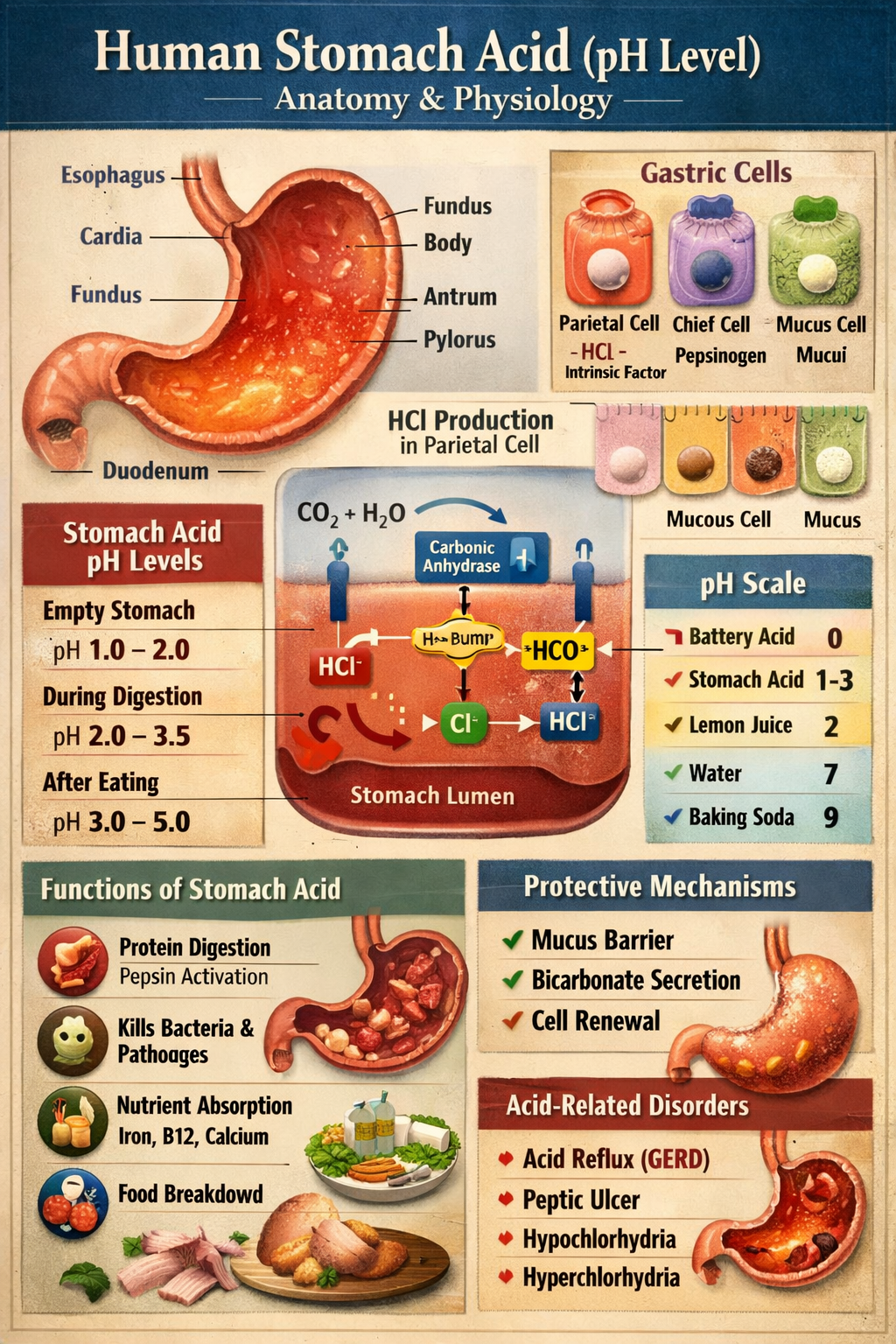
Human stomach acid is a crucial component of the digestive system. It plays a central role in food digestion, microbial defense, enzyme activation, and nutrient absorption. The acidity of the stomach is mainly due to hydrochloric acid (HCl) produced by specialized stomach cells. Understanding its anatomy, physiology, chemistry, and regulation is essential in the study of Human Physiology and Gastroenterology.
1. Anatomical Structure of the Stomach
The stomach is a muscular organ located between the esophagus and the small intestine.
Main Regions of the Stomach
- Cardia
- Entry point from the esophagus.
- Prevents acid reflux upward.
- Fundus
- Upper curved region.
- Stores food and gas.
- Body (Corpus)
- Largest portion.
- Major site of acid production.
- Antrum
- Lower grinding chamber.
- Mixes food with digestive juices.
- Pylorus
- Connects stomach to duodenum.
- Controls food release into intestine.
Layers of the Stomach Wall
- Mucosa
- Inner layer containing gastric glands.
- Submucosa
- Contains nerves and blood vessels.
- Muscularis
- Three muscle layers (longitudinal, circular, oblique) for mixing food.
- Serosa
- Outer protective covering.
2. Gastric Glands and Acid-Secreting Cells
Inside the stomach lining are gastric glands containing specialized cells:
1. Parietal Cells
- Produce hydrochloric acid (HCl)
- Secrete intrinsic factor for vitamin B12 absorption.
2. Chief Cells
- Produce pepsinogen, which becomes Pepsin when activated by acid.
3. Mucous Cells
- Produce mucus to protect the stomach lining.
4. G Cells
- Produce Gastrin which stimulates acid secretion.
3. Chemical Composition of Stomach Acid
Stomach acid is mainly composed of:
| Component | Function |
|---|---|
| Hydrochloric Acid (HCl) | Creates acidic environment |
| Potassium Chloride | Maintains ionic balance |
| Sodium Chloride | Electrolyte balance |
| Pepsin | Protein digestion |
| Gastric Lipase | Fat digestion |
| Mucus | Protects stomach lining |
4. pH Level of Human Stomach Acid
The pH scale measures acidity from 0 (very acidic) to 14 (very alkaline).
Normal Stomach pH
| Condition | pH Range |
|---|---|
| Empty stomach | 1.0 – 2.0 |
| During digestion | 2.0 – 3.5 |
| After eating | 3.0 – 5.0 |
The stomach is one of the most acidic environments in the human body.
For comparison:
| Substance | pH |
|---|---|
| Battery acid | ~0 |
| Stomach acid | 1–2 |
| Lemon juice | 2 |
| Vinegar | 2–3 |
| Water | 7 |
The acidity is necessary to activate digestive enzymes such as Pepsin.
5. Mechanism of Hydrochloric Acid Production
Hydrochloric acid is produced by parietal cells through a complex biochemical process.
Step-by-Step Acid Production
- Carbon dioxide (CO₂) combines with water in the cell.
- The enzyme Carbonic Anhydrase forms carbonic acid.
- Carbonic acid splits into:
- Hydrogen ions (H⁺)
- Bicarbonate (HCO₃⁻)
- Hydrogen ions are pumped into the stomach lumen using proton pumps.
- Chloride ions follow and combine with hydrogen ions.
- This forms hydrochloric acid (HCl).
6. Functions of Stomach Acid
1. Protein Digestion
Acid activates pepsinogen to pepsin, which breaks proteins into peptides.
2. Killing Harmful Microorganisms
Stomach acid destroys many bacteria, viruses, and parasites.
3. Nutrient Absorption
Acid helps absorb:
- Iron
- Calcium
- Vitamin B12
4. Food Breakdown
Acid helps dissolve food particles and connective tissues.
5. Enzyme Activation
Many digestive enzymes require acidic conditions to function.
7. Regulation of Stomach Acid Secretion
Acid secretion is controlled by three phases.
1. Cephalic Phase (Brain Controlled)
Triggered by:
- Smell of food
- Sight of food
- Thinking about food
Controlled by the Vagus Nerve.
Accounts for ~30% of acid secretion.
2. Gastric Phase
Triggered when food enters the stomach.
Stimulated by:
- Stomach stretching
- Protein presence
- Gastrin hormone
Accounts for ~60% of acid secretion.
3. Intestinal Phase
Occurs when food enters the small intestine.
The intestine releases hormones that reduce stomach acid.
8. Protective Mechanisms Against Acid
Despite extreme acidity, the stomach protects itself through:
1. Mucus Barrier
Thick mucus protects epithelial cells.
2. Bicarbonate Secretion
Neutralizes acid near the stomach wall.
3. Rapid Cell Renewal
Stomach cells regenerate every 3–5 days.
4. Tight Cell Junctions
Prevent acid leakage into tissues.
9. Disorders Related to Stomach Acid
1. Acid Reflux
Also known as Gastroesophageal Reflux Disease.
Occurs when acid flows back into the esophagus.
Symptoms:
- Heartburn
- Chest pain
- Regurgitation
2. Peptic Ulcers
Caused by acid damaging stomach lining.
Often associated with the bacterium Helicobacter pylori.
3. Hypochlorhydria
Low stomach acid.
Effects:
- Poor digestion
- Vitamin deficiency
- Bacterial overgrowth
4. Hyperchlorhydria
Excess stomach acid leading to irritation or ulcers.
10. Clinical Measurement of Stomach pH
Doctors measure stomach acidity using:
- Gastric pH probe
- Endoscopy
- Heidelberg capsule test
These tests help diagnose:
- GERD
- Ulcers
- Acid disorders
11. Medical Treatments for Acid Disorders
Common medications include:
- Omeprazole
- Pantoprazole
- Ranitidine
These drugs reduce acid production in the stomach.
12. Scientific Importance of Stomach Acidity
Stomach acid is essential for:
- Digestion
- Immune defense
- Nutrient bioavailability
- Enzyme activity
- Gastrointestinal homeostasis
Without sufficient stomach acid, digestion efficiency declines significantly.
✅ Key Summary
- Normal stomach pH: 1–3
- Main acid: Hydrochloric Acid (HCl)
- Produced by: Parietal cells
- Controlled by: Gastrin, vagus nerve, and digestive hormones
- Functions: digestion, enzyme activation, microbial defense




Be First to Comment