
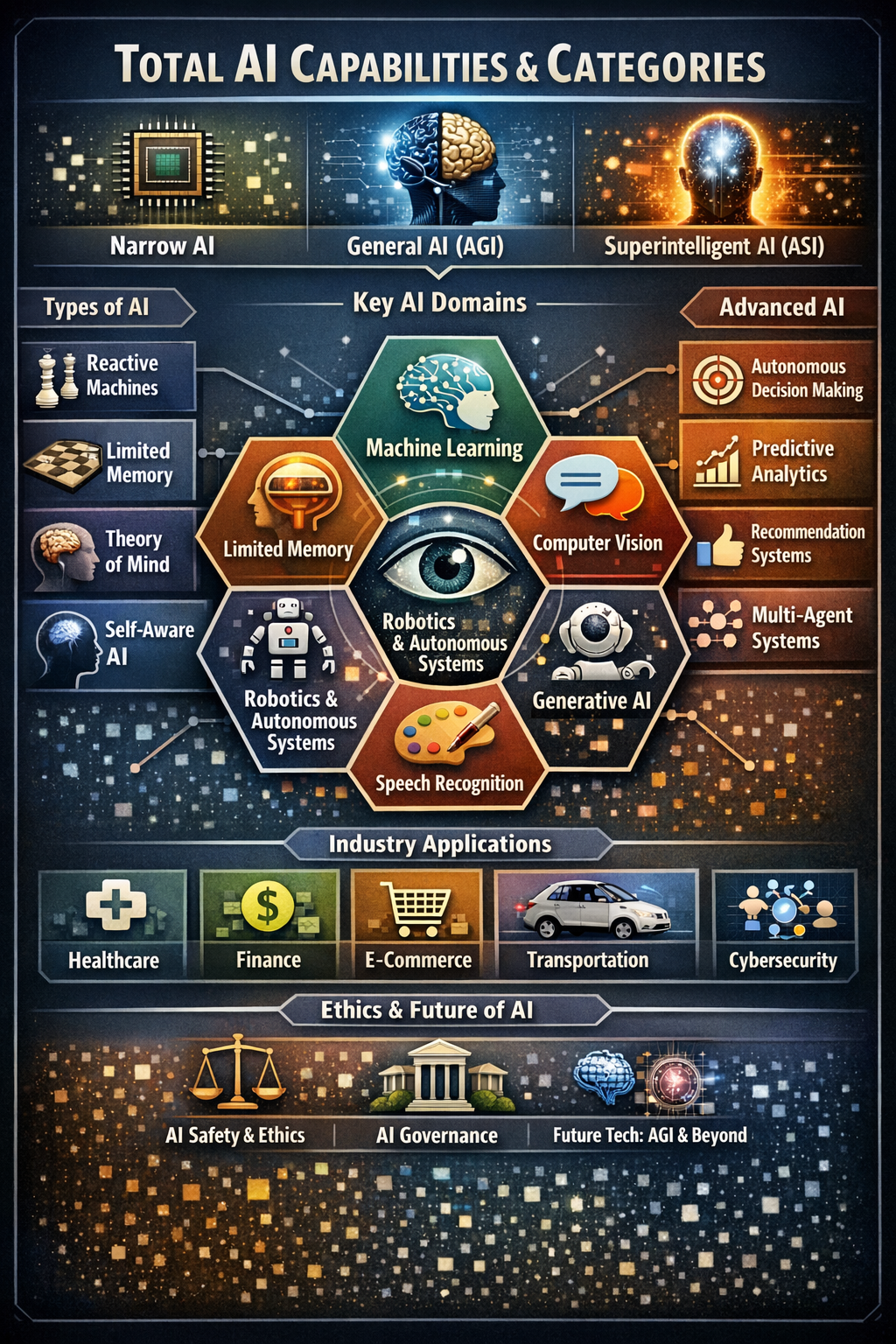
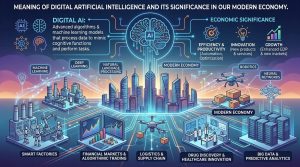
Artificial Intelligence (AI) is no longer a futuristic concept—it is a foundational technology shaping economies, governments, industries, and daily life. From generative systems like OpenAI’s ChatGPT to robotics platforms developed by Boston Dynamics, AI capabilities span cognition, perception, reasoning, creativity, and autonomous decision-making.
This article presents a comprehensive and structured framework of total AI capabilities and categories in depth.
1. Core Categories of Artificial Intelligence
AI can be categorized based on capability level, functionality, and application domain.
I. AI by Capability Level
1. Narrow AI (Weak AI)
- Designed for a specific task.
- No general intelligence outside its domain.
- Examples:
- Speech recognition
- Recommendation systems
- Fraud detection
- Self-driving modules
Almost all current AI systems are Narrow AI.
2. General AI (AGI – Artificial General Intelligence)
- Hypothetical AI capable of performing any intellectual task a human can.
- Would reason, learn, and adapt across domains.
- Not yet achieved.
3. Superintelligence (ASI)
- Theoretical AI surpassing human intelligence.
- Would exceed human reasoning, creativity, and strategy.
- Raises philosophical and ethical concerns.
2. AI by Functional Classification
1. Reactive Machines
- No memory.
- Respond only to present input.
- Example: Deep Blue (IBM’s chess system).
2. Limited Memory AI
- Uses past data for short-term decisions.
- Most modern AI systems fall here.
- Used in:
- Autonomous vehicles
- Chatbots
- Financial prediction systems
3. Theory of Mind AI (Research Stage)
- Would understand human emotions, beliefs, intentions.
- Important for social robotics.
4. Self-aware AI (Hypothetical)
- Consciousness and self-awareness.
- Purely theoretical.
3. Major AI Capability Domains
AI capabilities can be broken down into core technical competencies:
1. Machine Learning (ML)
Machine Learning enables systems to learn from data.
Subcategories:
- Supervised Learning
- Unsupervised Learning
- Semi-supervised Learning
- Reinforcement Learning
Used in:
- Medical diagnosis
- Market forecasting
- Image recognition
2. Deep Learning
A subset of ML using neural networks.
Applications:
- Face recognition
- Natural language processing
- Autonomous driving
- Medical imaging
3. Natural Language Processing (NLP)
Enables AI to understand and generate human language.
Capabilities:
- Text generation
- Translation
- Sentiment analysis
- Summarization
- Chatbots
Example systems:
- ChatGPT
- Google Translate
4. Computer Vision
AI that interprets visual data.
Capabilities:
- Object detection
- Facial recognition
- Medical image scanning
- Autonomous navigation
5. Speech Recognition & Synthesis
Capabilities:
- Voice assistants
- Call center automation
- Dictation systems
Example:
- Siri
6. Robotics & Autonomous Systems
Combines AI with mechanical systems.
Capabilities:
- Autonomous drones
- Industrial robots
- Surgical robots
- Delivery robots
Example:
- Boston Dynamics robots.
7. Expert Systems
Rule-based AI that mimics human expertise.
Used in:
- Legal systems
- Medical diagnosis
- Financial auditing
8. Generative AI
Creates new content:
- Text
- Images
- Music
- Code
- Video
Examples:
- ChatGPT
- DALL·E
4. Advanced AI Capabilities
1. Autonomous Decision-Making
- Real-time dynamic analysis
- Predictive modeling
- Self-optimization
Used in:
- Algorithmic trading
- Smart grids
- Military defense systems
2. Predictive Analytics
- Forecasting trends
- Risk modeling
- Climate analysis
3. Recommendation Systems
Used by:
- Amazon
- Netflix
4. Multi-Agent Systems
Multiple AI agents interacting and collaborating.
Applications:
- Smart cities
- Supply chain optimization
- Game theory simulations
5. Edge AI
AI operating on devices instead of cloud:
- Smartphones
- IoT devices
- Wearables
5. Industry-Specific AI Applications
1. Healthcare
- Medical imaging
- Drug discovery
- Remote diagnostics
- Robotic surgery
2. Finance
- Fraud detection
- Risk scoring
- Portfolio optimization
- High-frequency trading
3. E-commerce
- Demand forecasting
- Personalized marketing
- Automated inventory
(Highly relevant to Amazon and online sellers.)
4. Transportation
- Autonomous vehicles
- Traffic optimization
- Logistics management
5. Cybersecurity
- Threat detection
- Intrusion prevention
- Behavioral anomaly detection
6. Government & Defense
- Intelligence analysis
- Surveillance
- Strategic simulations
6. Cognitive Capabilities of AI
AI can simulate:
- Pattern recognition
- Logical reasoning
- Optimization
- Probabilistic inference
- Knowledge representation
- Planning and scheduling
- Decision theory
- Creativity (generative AI)
- Simulation modeling
7. AI Architectural Categories
1. Symbolic AI
- Rule-based reasoning
- Logic systems
2. Connectionist AI
- Neural networks
- Deep learning
3. Hybrid AI
- Combines symbolic and neural methods
4. Transformer-based Architectures
Foundation of modern large language models.
Developed in:
- Google Brain research.
8. AI System Levels of Autonomy
| Level | Description |
|---|---|
| Assistive AI | Supports human decisions |
| Augmented AI | Enhances human capability |
| Autonomous AI | Operates independently |
| Adaptive AI | Self-improves |
| Self-evolving AI | Hypothetical advanced systems |
9. Ethical & Governance Categories
AI capability must be balanced with:
- AI alignment
- Bias mitigation
- Privacy protection
- Transparency
- Accountability
- Regulation
Organizations like:
- OpenAI
- European Union (AI Act framework)
10. Future Capabilities (Emerging)
- Artificial General Intelligence (AGI)
- Neuromorphic computing
- Quantum AI
- Brain-computer interfaces
- Fully autonomous scientific discovery
Conclusion
Total AI capabilities span:
- Cognitive intelligence
- Predictive analytics
- Generative creativity
- Autonomous systems
- Industrial optimization
- Strategic decision-making
AI is evolving from tool-based automation to autonomous, adaptive intelligence systems integrated into every economic sector.

Be First to Comment