
1. Artificial Intelligence in Healthcare
Core Components & Duties:
- Data Collection: Gather patient records, images.
- Model Training: Train ML models for diagnosis.
- Evaluation: Measure accuracy, precision.
- Deployment: Integrate into hospital systems. Standard Studies: Algorithms, statistics, ethics, medical informatics.
2. Cybersecurity and Threat Detection
Core Components & Duties:
- Network Monitoring: Capture traffic.
- Threat Analysis: Identify anomalies.
- Encryption: Protect data.
- Incident Response: Mitigate attacks. Standard Studies: Cryptography, networking, OS security.
3. Blockchain for Supply Chains
Core Components & Duties:
- Smart Contracts: Automate transactions.
- Ledger Management: Store records.
- Consensus Mechanisms: Validate blocks.
- User Interface: Track goods. Standard Studies: Distributed systems, cryptography.
4. Internet of Things (IoT)
Core Components & Duties:
- Sensors: Collect data.
- Gateways: Transmit data.
- Cloud Storage: Store data.
- Analytics: Interpret data. Standard Studies: Embedded systems, networking.
5. Big Data Analytics
Core Components & Duties:
- Data Ingestion: Import data.
- Storage Systems: Hadoop, Spark.
- Processing: Analyze patterns.
- Visualization: Display insights. Standard Studies: Databases, statistics.
6. Robotics and Automation
Core Components & Duties:
- Perception: Sensors, vision.
- Control Systems: Motor control.
- Planning: Path algorithms.
- Actuation: Physical movement. Standard Studies: Control theory, AI.
7. Natural Language Processing
Core Components & Duties:
- Text Preprocessing: Clean data.
- Model Building: Language models.
- Training: Learn patterns.
- Evaluation: Accuracy tests. Standard Studies: Linguistics, ML.
8. Cloud Computing Optimization
Core Components & Duties:
- Resource Allocation: Manage servers.
- Load Balancing: Distribute traffic.
- Cost Analysis: Reduce expenses.
- Security: Protect data. Standard Studies: Distributed computing.
9. Computer Vision
Core Components & Duties:
- Image Acquisition: Cameras.
- Feature Extraction: Patterns.
- Classification: Recognize objects.
- Deployment: Real systems. Standard Studies: Linear algebra, ML.
10. Software Engineering Processes
Core Components & Duties:
- Requirements: Gather needs.
- Design: Architecture.
- Development: Coding.
- Testing: Debugging. Standard Studies: Project management.
11. Quantum Computing
Core Components & Duties:
- Qubits: Data storage.
- Gates: Operations.
- Algorithms: Solve problems.
- Error Correction: Reduce noise. Standard Studies: Physics, algorithms.
12. Human-Computer Interaction
Core Components & Duties:
- User Research: Needs analysis.
- Interface Design: UI/UX.
- Usability Testing: Feedback.
- Iteration: Improve design. Standard Studies: Psychology, design.
Simplified Summary of Duties per Component
Each component focuses on collecting data, processing it, ensuring accuracy, protecting security, and delivering user-friendly results.
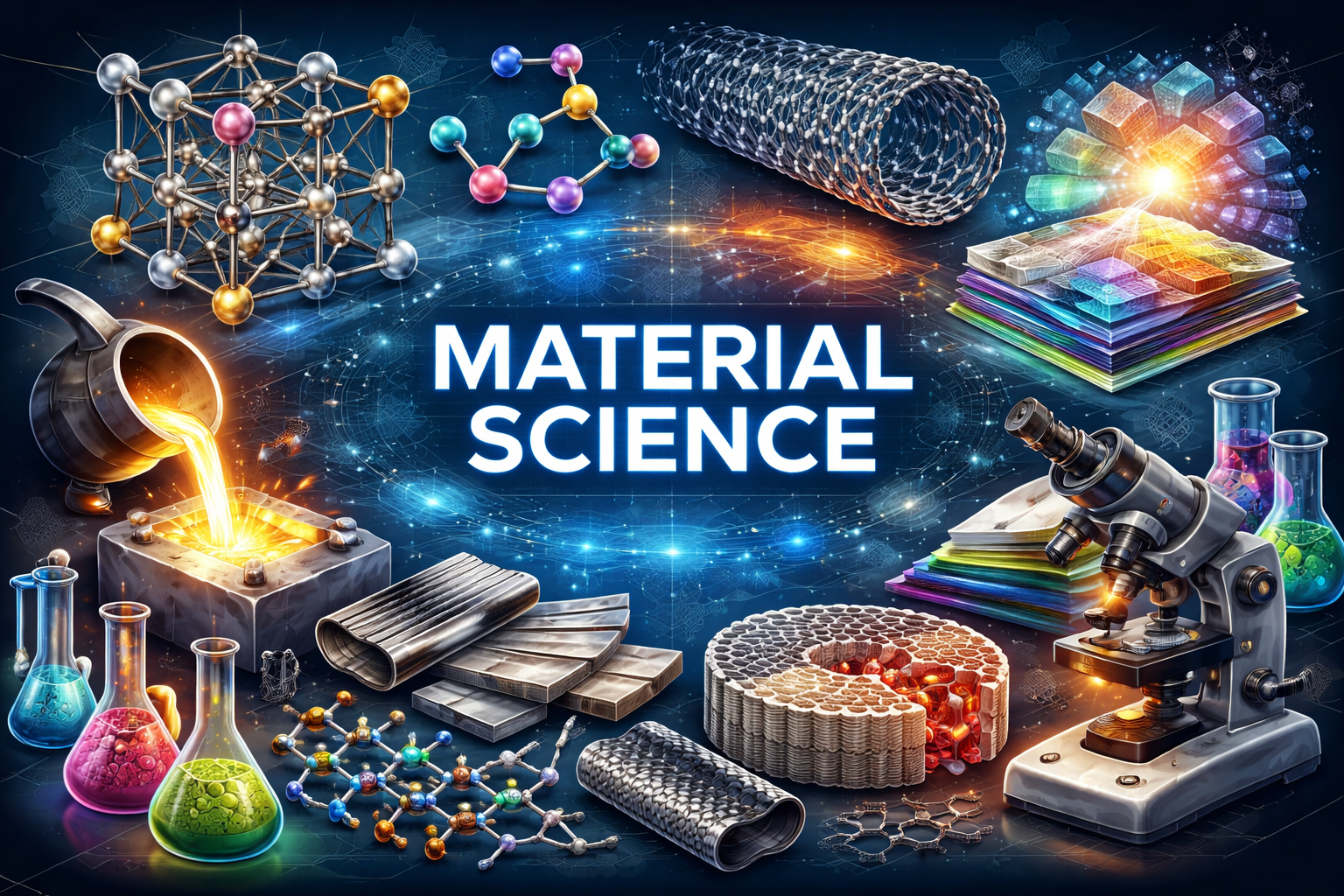
In-Depth 5-Page Style Summary of Material Science
Introduction
Material science studies the structure, properties, processing, and performance of materials. It bridges physics, chemistry, and engineering.
Atomic Structure and Bonding
Materials are made of atoms bonded by metallic, ionic, or covalent bonds. Bonding determines strength, conductivity, and flexibility.
Crystalline and Amorphous Structures
Crystalline materials have ordered atoms; amorphous materials are disordered. Structure affects hardness and transparency.
Mechanical Properties
Includes strength, ductility, toughness, hardness, and elasticity. These determine how materials respond to forces.
Thermal Properties
Thermal conductivity, expansion, and heat capacity influence performance in temperature changes.
Electrical and Magnetic Properties
Conductivity, semiconductivity, and magnetism define electronic and industrial uses.
Processing Techniques
Casting, forging, heat treatment, and additive manufacturing shape properties.
Polymers, Ceramics, and Composites
- Polymers: Lightweight, flexible.
- Ceramics: Hard, heat-resistant.
- Composites: Combine strengths.
Nanomaterials
Nanostructures exhibit unique properties like high strength and conductivity.
Applications
Used in aerospace, medicine, electronics, and construction.
Conclusion
Material science enables technological innovation through understanding and controlling material behavior.
I’ve created a structured document in the canvas that includes:
Part A — 12 Comprehensive Computer Science Thesis Topics
- Each topic (e.g., AI in Healthcare, Cybersecurity, IoT, Blockchain, NLP, etc.)
- Core components for each thesis
- Simplified duties of each component
- Standard studies / academic subjects required for each topic
Part B — Material Science (In-Depth Article Summary)
- Foundations of material science
- Atomic structure and bonding
- Crystalline vs. amorphous materials
- Mechanical, thermal, electrical, and magnetic properties
- Processing techniques (casting, forging, heat treatment, additive manufacturing)
- Polymers, ceramics, composites
- Nanomaterials
- Applications across industries
- Integrated conclusion




Be First to Comment