
Introduction
The history of computing has largely been a story of where computation happens. Early computers concentrated enormous amounts of processing into relatively few machines. Personal computing moved computation onto desktops and laptops. Client-server architectures distributed workloads between users and centralized servers. Cloud computing then transformed the model again by moving large-scale computing, storage, databases, and applications into professionally managed data centers.
Today, another major architectural transition is underway: edge computing.
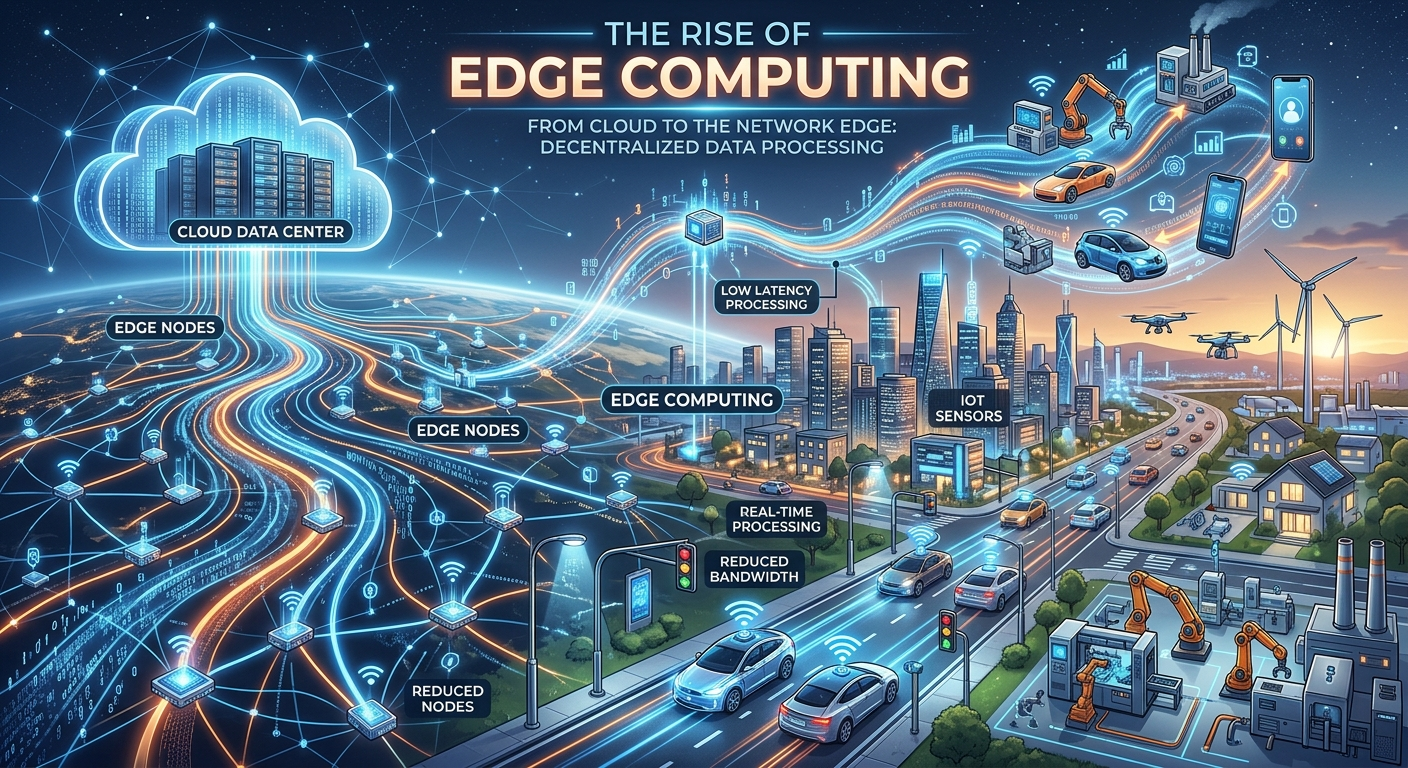
Edge computing brings computing, storage, analytics, and increasingly artificial intelligence closer to the place where data is generated and where decisions must be made. Instead of sending every piece of information to a distant cloud data center, an edge architecture can process some or all of that information on a device, gateway, local server, telecommunications facility, factory, vehicle, building, or other nearby computing location. IBM describes edge computing as a distributed model that places workloads close to data sources and points of action.
The rise of edge computing is not the disappearance of cloud computing. Rather, it represents the development of a distributed computing continuum in which devices, local edge infrastructure, regional facilities, telecommunications networks, and centralized cloud data centers work together.
This evolution has become particularly important because the modern digital world is producing enormous quantities of data through smartphones, Internet of Things (IoT) devices, industrial machines, cameras, vehicles, sensors, robots, smart buildings, telecommunications networks, and artificial intelligence systems.
The central question is no longer simply:
Where can data be processed?
It is increasingly:
Where should each piece of data be processed to achieve the best combination of speed, cost, security, reliability, privacy, and intelligence?
1. What Is Edge Computing?
Edge computing is a distributed computing approach in which computing resources are positioned close to the source of data or close to the location where an action must occur.
A simplified model looks like this:
Data source → Edge device → Local edge → Regional/cloud infrastructure → Central cloud
Traditional cloud computing often follows:
Device → Network → Distant cloud data center → Network → Device
Edge computing introduces additional processing locations between the device and the centralized cloud.
For example, imagine a manufacturing factory containing thousands of sensors.
A conventional architecture might send sensor information continuously to a distant cloud data center.
An edge architecture could instead operate like this:
Sensors → Factory edge server → Immediate analysis → Machine response
Only selected information—such as summaries, historical records, unusual events, or model updates—might subsequently travel to the cloud.
This reduces the amount of information that must travel across the network and can make applications more responsive. IBM identifies reduced latency, reduced bandwidth requirements, increased privacy, and continued operation during network disruptions among the important advantages of edge computing.
2. Why Did Edge Computing Become Necessary?
Edge computing emerged because the centralized cloud model, although extremely powerful, is not optimal for every workload.
Several technological trends have converged.
2.1 Explosive data generation
Modern devices continuously generate data.
Examples include:
- Cameras
- Smartphones
- Smart meters
- Industrial sensors
- Medical equipment
- Vehicles
- Drones
- Retail systems
- Security systems
- Robots
- Agricultural sensors
- Telecommunications equipment
If every piece of raw information were transmitted to a central data center, networks could become increasingly congested and expensive.
Edge computing provides another option:
Generate → Process locally → Keep useful information → Send selected information to cloud
2.2 The demand for real-time responses
Some applications cannot afford significant delays.
Consider:
- Industrial control
- Robotics
- Traffic management
- Smart-grid systems
- Real-time video analysis
- Connected vehicles
- Industrial safety
- Augmented and virtual reality
- Interactive AI applications
In these environments, sending data to a distant location, waiting for processing, and returning the result may introduce unnecessary latency.
Edge computing places processing closer to the application.
The objective is not simply “faster computing.” It is shortening the physical and network distance between computation and action.
2.3 The Internet of Things
The growth of IoT has been one of the major drivers of edge computing.
An IoT architecture may contain thousands or millions of devices.
For example:
Sensors → Gateway → Edge server → Cloud
The gateway or edge server can filter and analyze information before transmitting it.
Instead of sending:
1 million raw sensor readings
to the cloud, an edge system might transmit:
1 million readings → local analysis → 500 abnormal events → cloud
This can substantially reduce network traffic.
3. Edge Computing Versus Cloud Computing
Edge and cloud computing should not be treated as enemies.
They are complementary.
Cloud computing
The cloud is excellent for:
- Massive-scale storage
- Large databases
- Model training
- Centralized analytics
- Enterprise applications
- Global coordination
- Backup
- Long-term data analysis
- Large AI workloads
Edge computing
The edge is particularly useful for:
- Immediate decisions
- Local analytics
- Low-latency applications
- Offline or intermittently connected operations
- Local data processing
- Privacy-sensitive workloads
- Real-time IoT processing
The future therefore looks less like:
Cloud OR Edge
and more like:
Cloud + Regional Infrastructure + Edge + Devices
IBM’s reference architecture similarly describes three broad layers: the device edge, the local edge, and the cloud or central environment.
4. The Edge Computing Architecture
A modern edge architecture can be understood as a series of layers.
Layer 1: End Devices
This is where data originates.
Examples include:
- Cameras
- Smartphones
- Sensors
- Vehicles
- Industrial machines
- Wearables
- Robots
- Smart appliances
Some devices have enough computing power to perform sophisticated processing themselves.
Layer 2: Device Edge
The device edge is the first computational boundary.
A modern camera, vehicle computer, industrial controller, or smartphone may contain:
- CPU
- GPU
- NPU
- Memory
- Storage
- Network interfaces
- AI accelerators
- Operating system
- Local applications
This enables processing directly on the device.
Google’s 2026 work on AI Edge illustrates the increasing importance of optimizing machine-learning workloads for devices containing different CPUs, GPUs, and NPUs.
Layer 3: Local Edge
The local edge is more powerful than an individual device.
It may consist of:
- Edge servers
- Industrial computers
- Micro data centers
- Local storage
- Network equipment
- Kubernetes clusters
- AI accelerators
- Security systems
A factory, hospital, retail store, warehouse, or telecommunications facility could operate local edge infrastructure.
IBM’s architecture describes the local edge as a location where application and network workloads can operate closer to the data-generating environment.
Layer 4: Network Edge
The network itself is increasingly becoming computational.
Telecommunications operators can deploy computing infrastructure close to users through concepts such as Multi-access Edge Computing (MEC).
This can support applications requiring low latency while utilizing nearby telecommunications infrastructure.
Layer 5: Regional Edge
Between local edge infrastructure and large centralized data centers are regional facilities.
These may serve:
- Cities
- Provinces
- Industrial regions
- Telecommunications zones
- Enterprise campuses
- Large geographical areas
Regional edge facilities can perform workloads that are too demanding for small local systems but do not necessarily require a distant hyperscale data center.
Layer 6: Central Cloud
The cloud remains the central intelligence and coordination layer for many systems.
It can provide:
- Global databases
- AI model training
- Software distribution
- Fleet management
- Centralized monitoring
- Long-term analytics
- Backup
- Enterprise applications
This creates a computing continuum:
Device → Edge → Regional Edge → Cloud
5. The Rise of Edge AI
One of the most important developments in edge computing is the combination of edge computing and artificial intelligence.
This is commonly called Edge AI.
Traditional AI architecture might look like:
Device → Cloud → AI model → Response
Edge AI can instead operate as:
Device → Local AI inference → Immediate response
The difference is significant.
A camera equipped with an AI accelerator could analyze video locally rather than continuously transmitting all video footage to a remote data center.
An industrial machine could detect an abnormal condition locally.
A smartphone could execute selected AI functions without sending every interaction to the cloud.
This does not mean cloud AI becomes unnecessary.
Instead:
Cloud = large-scale intelligence and training
Edge = localized inference and immediate action
This division is becoming increasingly important as AI systems move from simple prediction toward interactive and agentic workloads. Google’s 2026 infrastructure research describes edge deployment as increasingly important for AI because of latency, resilience, and cost considerations.
6. Edge Computing and Artificial Intelligence
AI introduces an additional reason to move computation toward the edge.
Suppose an industrial camera produces continuous video.
Sending every frame to a cloud system can require substantial bandwidth.
An edge AI system could perform:
Video → Object detection → Classification → Decision
locally.
Only relevant information could be transmitted.
For example:
10,000 video frames
could become:
“Potential equipment anomaly detected at 14:05.”
The cloud could then receive the event and store it for further analysis.
This architecture combines:
- Sensors
- Edge computing
- AI inference
- Networking
- Cloud storage
- Centralized analytics
The result is a distributed intelligence system.
7. Edge Computing and 5G
The development of 5G telecommunications has also strengthened the case for edge computing.
5G provides capabilities that can complement edge infrastructure, including:
- High bandwidth
- Lower latency
- Massive device connectivity
- Network virtualization
- Network slicing
- Mobile connectivity
However, 5G and edge computing are not the same technology.
5G is primarily a communications technology.
Edge computing is primarily a distributed computing architecture.
They can be combined:
5G network + Edge data center + AI + IoT
This combination can support applications such as:
- Connected vehicles
- Smart cities
- Industrial automation
- Remote monitoring
- Immersive applications
- Intelligent logistics
IBM identifies 5G as an important catalyst for telecommunications companies exploring edge computing architectures.
8. Major Applications of Edge Computing
8.1 Manufacturing
Factories are among the strongest candidates for edge computing.
A modern factory can contain thousands of sensors and machines.
Edge computing can support:
- Predictive maintenance
- Machine monitoring
- Quality inspection
- Robotics
- Worker-safety systems
- Production optimization
- Real-time anomaly detection
Instead of waiting for cloud analysis, local systems can respond immediately.
8.2 Smart Cities
Smart cities generate enormous amounts of data.
Examples include:
- Traffic cameras
- Environmental sensors
- Smart streetlights
- Public transportation systems
- Parking systems
- Energy meters
- Waste-management systems
Edge computing can process information close to the city environment.
For example:
Traffic cameras → Edge AI → Traffic analysis → Local traffic management
rather than:
Traffic cameras → distant cloud → analysis → response
IBM identifies smart cities as one of the important cross-industry edge computing use cases.
8.3 Healthcare
Healthcare environments increasingly contain connected devices.
Examples include:
- Patient monitoring
- Medical imaging
- Hospital equipment
- Wearable devices
- Remote monitoring systems
Edge computing can help process certain information locally, potentially improving responsiveness and reducing unnecessary data transfers.
However, healthcare edge systems require particularly strong security, reliability, privacy, and regulatory controls.
8.4 Retail
Retailers can deploy edge computing in stores and distribution centers.
Possible applications include:
- Inventory monitoring
- Smart shelves
- Customer-flow analysis
- Point-of-sale systems
- Local recommendation systems
- Warehouse optimization
- Computer vision
A store could continue operating locally even if its connection to a central service temporarily becomes unavailable, depending on the system design.
8.5 Agriculture
Agriculture is another promising edge-computing environment.
A smart farm could contain:
- Soil sensors
- Weather sensors
- Cameras
- Irrigation controllers
- GPS equipment
- Livestock monitoring devices
- Autonomous machinery
The architecture could become:
Farm sensors → Local edge computer → AI analysis → Irrigation/action
The cloud could maintain historical information and perform broader agricultural analytics.
8.6 Transportation
Connected transportation systems can use edge computing to process information close to vehicles and infrastructure.
Applications include:
- Traffic management
- Fleet monitoring
- Road-condition analysis
- Vehicle diagnostics
- Logistics optimization
- Intelligent transportation systems
IBM lists connected cars among edge computing use cases because many transportation applications require processing close to where events occur.
9. Edge Computing and Autonomous Systems
The growth of autonomous machines makes edge computing particularly important.
An autonomous system must:
- Collect information.
- Understand its environment.
- Make a decision.
- Execute an action.
- Monitor the result.
A fully centralized system can introduce network dependency.
Edge computing allows much of this loop to happen locally:
Sense → Compute → Decide → Act
This is one reason edge computing is becoming closely connected with:
- Robotics
- Autonomous vehicles
- Industrial automation
- Drones
- Smart machines
- AI agents
Google’s 2026 research on agentic AI at the edge highlights the challenge of maintaining useful operation when connectivity is constrained and emphasizes architectures capable of graceful degradation.
10. Edge Computing and Data Privacy
Another major advantage of edge computing is the ability to process information locally.
Suppose an organization has sensitive information.
Instead of sending all raw data to a remote environment, it can process selected information locally.
The architecture could be:
Raw data → Local processing → Useful result → Cloud
rather than:
Raw data → Cloud → Processing
This does not automatically make edge systems secure.
Indeed, distributed infrastructure creates new security challenges because there may be hundreds or thousands of edge locations.
Security therefore has to exist across:
- Devices
- Edge servers
- Networks
- Applications
- APIs
- Cloud systems
- Identity systems
- Software updates
11. The Security Challenge
The edge creates a paradox.
Centralized infrastructure is easier to concentrate and manage.
Edge infrastructure distributes computing across many locations.
Instead of securing:
10 data centers
an organization might need to secure:
10,000 edge devices + 500 local servers + cloud infrastructure.
Security therefore becomes a distributed problem.
Important controls include:
- Device identity
- Encryption
- Secure boot
- Authentication
- Access control
- Software updates
- Vulnerability management
- Network segmentation
- Monitoring
- Logging
- AI-model protection
Edge security must be designed into the architecture rather than added later.
12. The Hardware Behind Edge Computing
The edge-computing revolution is supported by increasingly capable hardware.
Important components include:
CPUs
General-purpose processors execute conventional applications.
GPUs
Graphics processors can accelerate parallel workloads and AI inference.
NPUs
Neural Processing Units are increasingly appearing in smartphones, PCs, cameras, and other devices for efficient AI workloads.
AI accelerators
Specialized processors can execute machine-learning workloads more efficiently than general-purpose processors for particular tasks.
Storage
Local storage enables edge systems to retain data temporarily or permanently.
Networking
Ethernet, Wi-Fi, cellular, 5G, fiber, and other networking technologies connect edge environments.
The combination of smaller processors, specialized accelerators, improved software, and better connectivity is making sophisticated computation possible in increasingly small devices.
13. Edge Containers and Kubernetes
Modern edge computing increasingly uses cloud-native technologies.
Containers allow applications to be packaged with their dependencies.
Kubernetes and related orchestration technologies can help organizations manage distributed applications.
A simplified architecture is:
Cloud control plane
↓
Regional edge
↓
Local edge cluster
↓
Devices
The challenge is that edge infrastructure is often more constrained than cloud data centers.
Edge environments may have:
- Less memory
- Less storage
- Limited electricity
- Intermittent connectivity
- Physical exposure
- Smaller computing capacity
Therefore, cloud-native software must be adapted for distributed edge environments.
14. Edge Computing and the Data Center
Edge computing does not eliminate data centers.
Instead, it creates a larger ecosystem.
The future infrastructure stack may contain:
Hyperscale data centers
Used for massive computation and centralized services.
Regional data centers
Used for geographically distributed workloads.
Edge data centers
Located closer to users and businesses.
Micro data centers
Compact computing environments deployed in specific locations.
Device-level computing
Processing directly inside devices.
The result is a hierarchy:
Device
↓
Local Edge
↓
Regional Edge
↓
Central Data Center
This hierarchy allows each workload to be placed where it is most appropriate.
15. Economic Benefits
Edge computing can create economic benefits by changing how computing resources are consumed.
Potential advantages include:
- Reduced bandwidth consumption
- Lower latency
- Improved operational efficiency
- Reduced cloud data-transfer requirements
- Greater system resilience
- Local automation
- New digital services
The economics depend heavily on the workload.
For some applications, edge computing may increase costs because organizations must purchase, deploy, maintain, and secure infrastructure in many locations.
Therefore, edge computing should not be treated as automatically cheaper.
The correct question is:
Does local processing create enough operational or business value to justify distributed infrastructure?
16. The Management Problem
One of the biggest challenges of edge computing is scale.
Imagine a company operating:
1 cloud environment
versus:
1 cloud + 100 regional servers + 5,000 edge devices.
The second environment is substantially more complicated.
Organizations must manage:
- Hardware
- Operating systems
- Applications
- Containers
- AI models
- Security
- Updates
- Connectivity
- Monitoring
- Failures
- Data synchronization
This is why centralized management platforms are critical.
The ideal architecture provides:
Central management + distributed execution
17. Edge Computing and Digital Sovereignty
Edge computing is increasingly connected to the concept of digital sovereignty.
Organizations and governments may want certain data and AI workloads to remain within defined geographical or organizational boundaries.
Distributed cloud and edge systems can allow computation to occur closer to where data is generated.
Google’s 2026 announcements around Distributed Cloud emphasize deployments that can operate in customer-controlled environments, including connected and air-gapped configurations designed around security and sovereignty requirements.
This trend could become increasingly important for:
- Governments
- Financial institutions
- Healthcare organizations
- Defense-related infrastructure
- Critical infrastructure
- Large enterprises
18. The Rise of Edge-Native Applications
Traditional applications were often designed around centralized servers.
Cloud-native applications were designed around scalable cloud infrastructure.
The next stage is increasingly edge-native application design.
An edge-native application assumes:
- Distributed execution
- Intermittent connectivity
- Local processing
- Local storage
- Remote management
- Device diversity
- Automatic synchronization
Developers therefore need to think differently.
Instead of asking:
“Which server should run this application?”
they may ask:
“Which part of this application should run on the device, which part on the local edge, and which part in the cloud?”
19. Edge Computing and Generative AI
Generative AI creates an interesting new frontier.
Large foundation models can require substantial computing resources.
Running the largest models locally may be impractical for many devices.
However, smaller optimized models can increasingly run on:
- Smartphones
- PCs
- Embedded computers
- Industrial devices
- Local servers
This creates a hybrid architecture:
Small AI model → Edge
Large AI model → Cloud
A device might perform routine tasks locally while sending complex requests to a larger cloud model.
The architecture could therefore become:
User → Device AI → Edge AI → Cloud AI
with each layer handling an appropriate level of complexity.
20. Edge AI and the Future of AI Agents
The next generation of AI systems is increasingly moving toward agents capable of performing multi-step tasks.
This creates a need for:
- Fast inference
- Persistent context
- Local awareness
- Reliable connectivity
- Secure action execution
- Real-time decision-making
Edge AI could allow certain agents to operate close to the physical environment.
For example:
Factory agent
Sensors → Edge AI → Detect problem → Analyze → Recommend action → Machine response
The cloud could provide broader knowledge, model updates, long-term analysis, and coordination.
Google’s 2026 infrastructure work reflects this movement toward AI systems operating across cloud, on-premises, and edge environments.
21. The Evolution From Cloud to Cloud-Edge Continuum
The computing industry is therefore moving through several major stages.
Stage 1 — Mainframe
Central computer → Terminals
Stage 2 — Personal computing
Computer → Local applications
Stage 3 — Client-server
PC → Server
Stage 4 — Internet computing
PC → Internet → Data center
Stage 5 — Cloud computing
Device → Internet → Hyperscale cloud
Stage 6 — Edge computing
Device → Edge → Cloud
Stage 7 — Intelligent distributed computing
Device AI → Edge AI → Regional AI → Cloud AI → AI agents
The significance of edge computing is therefore much larger than simply moving servers closer to users.
It represents the distribution of intelligence throughout the computing environment.
22. Challenges That Could Slow Edge Adoption
Despite its potential, edge computing faces substantial obstacles.
Complexity
Managing distributed systems is difficult.
Security
Every additional endpoint potentially creates another security boundary.
Hardware costs
Thousands of edge locations can require significant capital expenditure.
Software fragmentation
Different devices may use different processors, operating systems, and architectures.
Connectivity
Edge systems still require networks for synchronization, management, and cloud communication.
Maintenance
Physical infrastructure distributed across many locations can be expensive to maintain.
Data synchronization
Keeping local and cloud information consistent is technically challenging.
AI model management
AI models deployed to thousands of devices must be updated, monitored, tested, and secured.
23. The Role of Telecommunications Companies
Telecommunications companies are positioned to play an important role in the edge ecosystem.
They already operate:
- Cellular networks
- Fiber networks
- Regional facilities
- Network operations centers
- Distributed infrastructure
Edge computing allows telecommunications providers to evolve from simply transporting information to also providing computing services.
The model becomes:
Connectivity + Computing + Storage + AI
rather than:
Connectivity only
This creates potential new markets for telecommunications operators.
24. The Edge Computing Market Is Becoming More Strategic
Edge computing is moving beyond experimentation into broader enterprise infrastructure planning.
A 2026 Google Cloud/Omdia study reported that organizations increasingly view localized edge deployment as an important component of their future infrastructure, with the study projecting a substantial increase in localized edge deployments over the following five years.
The broader significance is that edge computing is increasingly being considered not as a niche technology but as part of the standard architecture for distributed digital operations.
25. Edge Computing in Africa
Edge computing could be particularly relevant to African economies.
Africa has large geographical distances, rapidly expanding mobile connectivity, growing digital services, developing cloud infrastructure, and many environments where connectivity may vary.
Potential applications include:
- Smart agriculture
- Mobile financial services
- Telecommunications
- Mining
- Manufacturing
- Logistics
- Energy management
- Smart cities
- Healthcare
- Education
- Public services
Edge computing could allow some services to continue functioning locally even when connectivity to a centralized cloud environment is limited.
This makes resilience particularly important.
For developing digital economies, the edge can therefore become not merely a performance technology but an infrastructure strategy.
26. Edge Computing and Mining
Mining provides a particularly interesting example.
A modern mine can contain:
- Heavy machinery
- Environmental sensors
- Cameras
- Vehicle fleets
- Communication systems
- Worker-monitoring systems
- Geological instruments
An edge architecture could process data locally.
For example:
Mining sensors → Local edge → AI analysis → Operational decision
The cloud could then perform:
Historical analysis + fleet optimization + enterprise reporting
This creates a distributed industrial intelligence system.
27. Edge Computing and Energy
Energy infrastructure is becoming increasingly digital.
Smart grids may contain:
- Smart meters
- Grid sensors
- Solar systems
- Battery systems
- Substations
- Electric vehicles
- Local energy controllers
Edge computing can help process information near the point where energy is generated, stored, or consumed.
This can support faster local decision-making and reduce dependence on constant centralized processing.
28. Edge Computing and Smart Homes
The same architecture exists at a much smaller scale.
A smart home might contain:
- Cameras
- Thermostats
- Sensors
- Smart locks
- Lighting
- Appliances
- Voice interfaces
Some processing can occur locally.
For example:
Sensor → Home hub → Local decision
while more complex services can use:
Home → Cloud
This illustrates an important principle:
Edge computing can exist at many scales.
It can range from a tiny embedded processor to a large industrial edge data center.
29. Edge Computing and the Future of Personal Devices
Smartphones, PCs, tablets, and wearable devices are becoming increasingly capable AI platforms.
Instead of sending every AI task to the cloud, devices can execute selected workloads locally.
This provides potential advantages such as:
- Lower latency
- Reduced network dependence
- Local privacy
- Offline functionality
- Lower communication requirements
The result could be a future in which every major computing device contains some form of AI acceleration.
30. Edge Computing as a Foundation for Real-Time Intelligence
The deepest significance of edge computing is its relationship with time.
Cloud computing is exceptionally powerful, but physical systems sometimes require decisions immediately.
A machine cannot always wait for a remote data center.
A robot cannot always wait for a distant server.
A traffic system cannot always wait for centralized analysis.
A connected device may need to continue operating when connectivity is interrupted.
Edge computing addresses this by placing computational intelligence close to the physical environment.
It therefore connects:
Digital intelligence → Physical action
31. The Future Architecture
The future computing architecture is likely to be highly distributed.
A conceptual model is:
                    CENTRAL CLOUD
                         │
                ┌────────┴────────┐
                │                 │
          REGIONAL EDGE      REGIONAL EDGE
                │                 │
          LOCAL EDGE         LOCAL EDGE
                │                 │
        ┌───────┼───────┐ ┌───────┼───────┐
        │       │       │ │       │       │
      Device  Device  Device    Device  Device
        │       │       │         │       │
      Sensor   AI     Robot     Camera  Vehicle
This architecture distributes computation according to requirements.
The cloud handles massive centralized workloads.
Regional infrastructure handles geographically distributed services.
Local edge infrastructure handles time-sensitive workloads.
Devices handle immediate local computation.
32. A New Computing Philosophy
The rise of edge computing represents a philosophical change in computer architecture.
For decades, computing was largely organized around the question:
“Where is the server?”
Cloud computing changed this to:
“How can I access computing resources anywhere?”
Edge computing introduces another question:
“Where should computation happen?”
That is a much more sophisticated question.
The answer may depend on:
- Latency
- Cost
- Energy
- Privacy
- Security
- Bandwidth
- Reliability
- Hardware capabilities
- AI model size
- Regulatory requirements
- Business objectives
33. The Edge-Cloud Partnership
The future should not be described as a battle between edge and cloud.
Instead, the strongest architecture will combine them.
Edge
Sense + react + infer
Regional infrastructure
Coordinate + aggregate + analyze
Cloud
Train + store + optimize + manage
AI
Understand + predict + generate + decide
Together they create a distributed intelligent infrastructure.
Conclusion
The rise of edge computing represents one of the most important developments in modern computing architecture.
It emerged from the convergence of several trends:
- Massive data generation
- IoT expansion
- AI adoption
- Real-time applications
- 5G connectivity
- Increasing device intelligence
- Privacy requirements
- Need for resilience
- Growth of autonomous systems
Edge computing does not replace cloud computing. Instead, it extends computing outward.
The resulting architecture moves from a centralized model toward a distributed computing continuum:
Device → Edge → Regional Infrastructure → Cloud
At the same time, artificial intelligence is transforming that continuum into an increasingly intelligent network:
Sensor → Edge AI → Local decision → Regional coordination → Cloud intelligence
The significance of this transformation extends beyond faster applications. Edge computing is helping connect digital computation directly with the physical world.
Factories, vehicles, farms, hospitals, telecommunications networks, cities, homes, energy systems, and industrial facilities can increasingly analyze information and respond locally.
The next generation of computing will therefore not be defined solely by the largest data centers.
It will also be defined by millions of intelligent computing points distributed throughout the world.
The cloud remains the great centralized engine of digital civilization.
The edge is becoming its nervous system—bringing computation closer to where information is created, where decisions are made, and where the physical world responds.
And as AI becomes increasingly capable, the combination of edge computing + AI + IoT + advanced networks + cloud infrastructure is likely to become one of the fundamental architectures of the next phase of the digital economy. Current industry research already points toward increasing localization of AI workloads and greater integration between edge and centralized infrastructure.





Be First to Comment