
Introduction
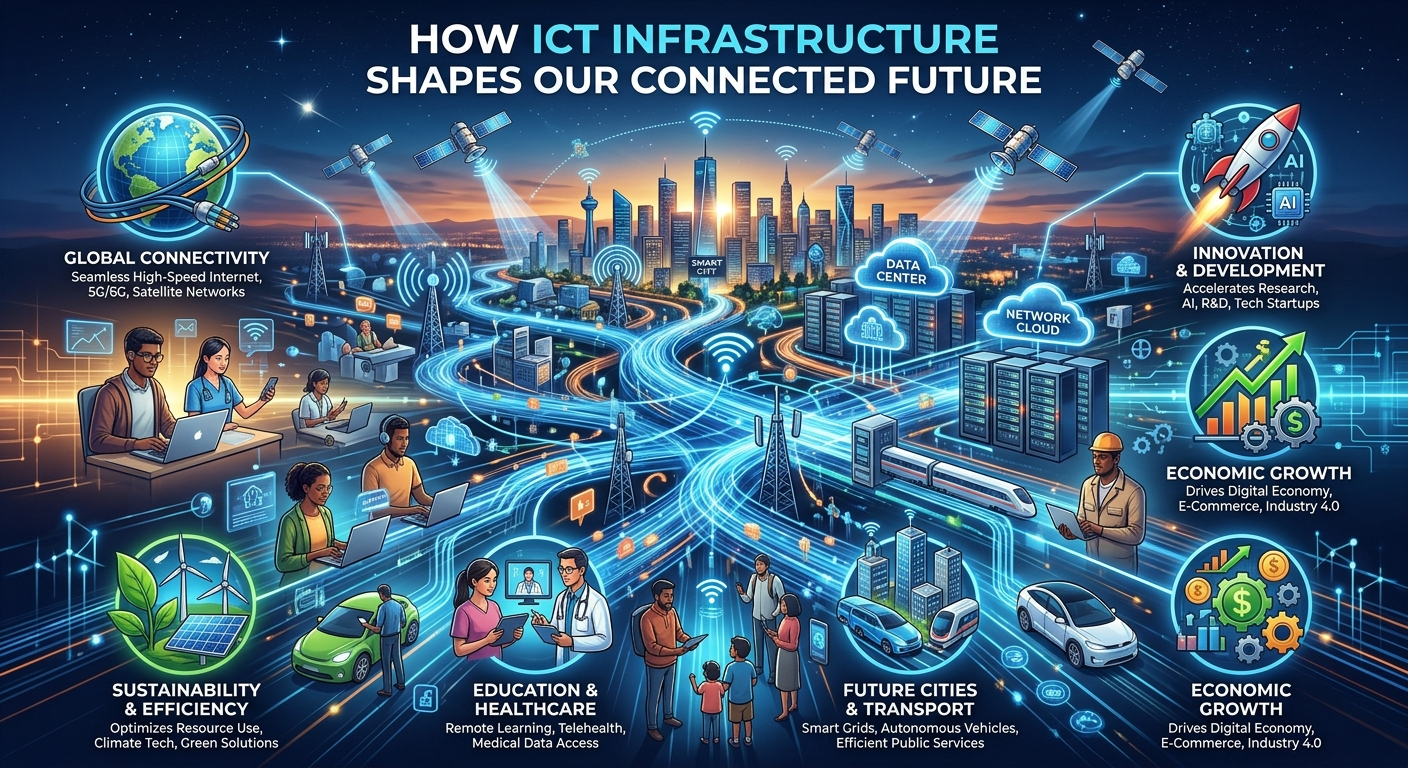
Information and Communication Technology (ICT) infrastructure is the physical and digital foundation that allows the modern world to communicate, compute, exchange information, conduct business, deliver public services, and increasingly operate through artificial intelligence.
When people think about the digital economy, they often see smartphones, applications, websites, social media, cloud platforms, artificial intelligence and connected devices. Beneath all of these visible technologies exists an enormous infrastructure ecosystem consisting of fibre-optic networks, mobile towers, satellites, submarine cables, data centres, servers, routers, switches, Internet exchange points, cloud platforms, electricity systems, software-defined networks, cybersecurity systems and digital public infrastructure.
The importance of this infrastructure is growing rapidly. The World Bank describes reliable, affordable, high-quality connectivity as essential to economic growth, education, finance, healthcare, government services, entrepreneurship and employment. Yet approximately one-third of the world’s population remained offline in 2025, demonstrating that digital connectivity remains an infrastructure and development challenge rather than a solved problem.
The International Telecommunication Union’s 2026 ICT Development Index reports continued progress toward universal and meaningful connectivity across 159 economies, while emphasizing persistent differences in affordability, Internet use and connectivity quality.
The central argument of this article is therefore simple:
The connected future will be determined not only by the applications people use, but by the infrastructure underneath those applications.
1. What Is ICT Infrastructure?
ICT infrastructure is the collection of physical facilities, networks, computing resources, software platforms and supporting systems that enable digital communication and information processing.
It can be divided into several interconnected layers:
- Energy infrastructure
- Access infrastructure
- Telecommunications networks
- Internet backbone infrastructure
- Submarine cable systems
- Satellite infrastructure
- Data centres
- Cloud computing
- Internet exchange infrastructure
- Computing and semiconductor infrastructure
- Cybersecurity infrastructure
- Digital public infrastructure
- Software and platform infrastructure
- Artificial intelligence infrastructure
- Human skills and institutional infrastructure
These layers should not be considered independent.
A smartphone requires a network.
A network requires electricity.
A network depends on fibre, radio spectrum, towers, routers and transmission equipment.
Cloud applications require data centres.
Data centres require electricity, cooling, networks and computing hardware.
AI requires all of these elements plus specialised processors, enormous datasets and skilled people.
ICT infrastructure is therefore better understood as an interdependent digital ecosystem.
2. The Basic Architecture of the Connected World
A simplified representation of the modern digital ecosystem looks like this:
Person → Device → Access Network → Local Network → Internet Backbone → Data Centre/Cloud → Application → Data → Person
For example, when someone uses an online banking application:
Smartphone
↓
Wi-Fi or mobile network
↓
Cellular tower / fibre access network
↓
Internet service provider
↓
Internet backbone
↓
Data centre
↓
Bank’s application and database
↓
Authentication and cybersecurity systems
↓
Financial transaction
This process can occur within seconds, but behind that experience may be thousands of kilometres of fibre, numerous network devices, multiple data centres and sophisticated software.
3. Electricity: The First Layer of the Digital Economy
Digital infrastructure ultimately depends upon electricity.
A mobile tower cannot operate without power.
A fibre network requires powered transmission equipment.
A data centre requires enormous quantities of electricity.
A cloud platform requires servers.
AI systems require specialised computing infrastructure.
Consequently, the relationship between energy infrastructure and ICT infrastructure is becoming increasingly important.
The digital economy is sometimes described as intangible because information travels electronically. In reality, the digital economy has a substantial physical footprint.
Data centres consume electricity.
Telecommunications networks consume electricity.
Manufacturing semiconductors requires energy and water.
Network equipment requires minerals, metals and manufacturing facilities.
The future of ICT infrastructure will therefore depend partly on whether countries can develop reliable, affordable and increasingly sustainable energy systems.
4. Fibre-Optic Networks: The High-Speed Foundation
Fibre-optic cable is one of the most important technologies underlying modern communications.
Instead of transmitting information as electrical signals through copper, optical fibre transmits information using pulses of light.
A simplified process is:
Digital data → Electrical signal → Optical transmitter → Light pulses → Fibre → Optical receiver → Electrical/digital data
Fibre offers extremely high capacity and low latency compared with many older transmission technologies.
It is therefore fundamental to:
- broadband Internet;
- cloud computing;
- financial services;
- mobile backhaul;
- data centres;
- universities;
- hospitals;
- government networks;
- businesses;
- Internet exchange points;
- 5G and future mobile networks.
Fibre is also critical because mobile networks themselves increasingly depend on fibre connections between towers and the wider Internet.
5. Submarine Cables: The Hidden Global Internet
One of the least visible components of the global Internet is the submarine cable network.
Thousands of kilometres of cables cross oceans and connect continents.
According to the ITU’s Global Connectivity Report 2025, submarine cables carry more than 99% of international data flows.
This means that international Internet connectivity is not primarily dependent on satellites.
Instead, much of the world’s international digital traffic travels through fibre-optic cables lying on the seabed.
A simplified international connection might look like:
South Africa
↓
Submarine cable
↓
Europe / Asia / Middle East / other destination
↓
International network
↓
Cloud or data centre
↓
Application
The importance of submarine cables makes them strategically significant infrastructure.
Cable redundancy is therefore important. If one route becomes unavailable, alternative routes can help maintain connectivity.
6. Mobile Networks: Bringing Connectivity to Billions
Mobile telecommunications have transformed ICT infrastructure because they allow connectivity without a fixed physical connection to every household.
Mobile infrastructure includes:
- smartphones;
- base stations;
- antennas;
- radio-access networks;
- spectrum;
- fibre backhaul;
- microwave links;
- mobile core networks;
- authentication systems;
- cloud infrastructure.
The evolution has broadly moved through:
1G → 2G → 3G → 4G → 5G → future 6G
Each generation has introduced improvements in capacity, speed, latency, reliability or functionality.
The significance of mobile infrastructure extends far beyond voice calls.
Modern mobile networks support:
- mobile banking;
- digital payments;
- education;
- healthcare;
- logistics;
- agriculture;
- e-commerce;
- entertainment;
- navigation;
- industrial monitoring;
- IoT;
- emergency communications.
7. 5G and the Evolution Toward 6G
5G represents an important shift from simply making smartphones faster toward creating networks capable of supporting large numbers of connected machines and specialised applications.
Potential 5G applications include:
- smart factories;
- connected vehicles;
- industrial IoT;
- remote monitoring;
- augmented and virtual reality;
- intelligent logistics;
- smart cities;
- advanced healthcare applications.
The emerging discussion around 6G goes further.
Future networks are expected to investigate greater integration between communications, sensing, computing, AI and distributed networks.
This suggests that the future telecommunications network may become less like a traditional telephone network and more like a distributed computing platform.
8. Satellites and the New Connectivity Frontier
Satellite communications provide another important layer of ICT infrastructure.
They are particularly valuable where terrestrial infrastructure is difficult or expensive to construct.
Satellite connectivity can potentially serve:
- remote communities;
- rural regions;
- islands;
- ships;
- aircraft;
- disaster zones;
- scientific installations;
- geographically isolated areas.
Low-Earth-orbit satellite systems have increased attention on satellite broadband because their lower orbital altitude can enable lower latency than traditional geostationary systems.
However, satellite connectivity should generally complement rather than automatically replace terrestrial infrastructure.
Fibre, mobile networks and satellites have different strengths.
The future is therefore likely to involve hybrid connectivity.
9. Data Centres: The Factories of the Digital Economy
If networks are the roads of the digital economy, data centres can be compared with its factories.
A data centre contains computing infrastructure such as:
- servers;
- storage systems;
- network switches;
- routers;
- security systems;
- backup systems;
- cooling equipment;
- power systems;
- monitoring systems.
Data centres host:
- websites;
- cloud services;
- databases;
- enterprise applications;
- streaming platforms;
- financial systems;
- government applications;
- AI models;
- digital archives.
The geographical distribution of data centres matters.
The World Bank’s 2025 research found that high-income countries accounted for about 77% of global co-location data-centre capacity, while low-income countries accounted for less than 0.1%.
This demonstrates that the digital divide increasingly concerns not only Internet access but also where computing capacity exists.
10. Cloud Computing
Cloud computing transforms physical computing infrastructure into an on-demand service.
Instead of purchasing large numbers of servers, an organisation can obtain computing resources through a cloud provider.
Major cloud services include:
- computing;
- storage;
- databases;
- networking;
- analytics;
- machine learning;
- AI services;
- cybersecurity;
- application platforms.
Cloud computing creates enormous flexibility.
A small business can access computing resources that previously required substantial capital investment.
A university can deploy applications without constructing its own large data centre.
A government can potentially scale digital services more rapidly.
However, cloud dependence also raises questions about:
- data sovereignty;
- cybersecurity;
- resilience;
- concentration of market power;
- international data flows;
- service availability;
- costs;
- strategic dependence.
The World Bank reports that cloud computing is highly concentrated geographically, illustrating the continuing importance of access to global computing infrastructure.
11. Computing Power Is Becoming Strategic Infrastructure
Historically, countries focused heavily on physical infrastructure such as roads, ports, electricity and telecommunications.
The rise of AI is expanding this concept.
Computing capacity itself is increasingly strategic.
Modern AI requires:
AI chips + servers + memory + networking + electricity + cooling + data + software + skills
The World Bank’s 2025 Digital Progress and Trends Report describes compute as foundational to AI and highlights major differences in access to AI chips, high-performance computing, data centres and cloud services.
This means that future national competitiveness may depend partly on access to:
- GPUs and other AI accelerators;
- high-performance computing;
- cloud computing;
- data centres;
- advanced networking;
- semiconductor supply chains.
12. The Four Cs of the AI Infrastructure Era
The World Bank has identified four foundational elements for effective AI participation:
1. Connectivity
People and organisations need reliable Internet and supporting energy infrastructure.
2. Compute
AI requires computing resources, including processors, servers, data centres and cloud services.
3. Context
AI requires useful data, local information, languages and content.
4. Competency
People need digital, technical and AI-related skills.
These four elements are interconnected.
A country may have excellent Internet connectivity but insufficient computing infrastructure.
Another may have data centres but insufficient skills.
Another may have skilled engineers but inadequate electricity.
Therefore:
AI readiness = Connectivity + Compute + Context + Competency
This framework illustrates why ICT infrastructure must be considered as a complete ecosystem rather than a single technology.
13. Internet Exchange Points
Internet Exchange Points, or IXPs, allow networks to exchange traffic directly.
Without efficient local interconnection, Internet traffic may travel through distant networks before returning to a nearby destination.
An IXP can allow:
Network A ↔ IXP ↔ Network B
instead of:
Network A → International transit → distant network → Network B
Local interconnection can improve:
- latency;
- resilience;
- network efficiency;
- local Internet performance;
- cost structures.
IXPs therefore form an important but largely invisible component of national digital infrastructure.
14. The Internet of Things
ICT infrastructure is evolving from connecting people to connecting objects.
The Internet of Things, or IoT, connects devices such as:
- sensors;
- vehicles;
- industrial equipment;
- agricultural systems;
- utility meters;
- environmental monitors;
- buildings;
- medical devices;
- household appliances.
A typical IoT architecture involves:
Sensor → Connectivity → Edge device → Network → Cloud → Analytics/AI → Decision → Physical action
For example, an agricultural sensor could monitor environmental conditions, transmit information through a network, send the data to an analytical system and produce information that helps farmers make decisions.
This turns ICT infrastructure into an infrastructure for real-world intelligence.
15. Edge Computing
Traditional cloud computing often sends data to centralised data centres.
Edge computing moves some processing closer to the point where data is generated.
For example:
Sensor → Edge computer → Immediate analysis
instead of:
Sensor → Internet → distant data centre → analysis → response
Edge computing can reduce:
- latency;
- bandwidth requirements;
- dependence on distant data centres.
It can be particularly useful for:
- industrial automation;
- autonomous systems;
- telecommunications;
- smart cities;
- real-time monitoring;
- healthcare;
- IoT.
The future will likely combine:
Device + Edge + Network + Cloud + AI
rather than relying exclusively on one computing location.
16. Cybersecurity Infrastructure
Connectivity creates opportunity, but it also creates dependency.
Every connected system becomes part of a broader digital environment that must be protected.
Cybersecurity infrastructure includes:
- firewalls;
- identity management;
- encryption;
- authentication;
- security monitoring;
- endpoint protection;
- intrusion detection;
- backup systems;
- incident-response systems;
- security operations centres.
As critical infrastructure becomes digitally connected, cybersecurity becomes a component of national infrastructure.
A telecommunications network, power grid, hospital system or financial platform can no longer be treated as purely physical infrastructure.
They are increasingly cyber-physical systems.
17. Digital Public Infrastructure
ICT infrastructure is also transforming government.
Digital public infrastructure can include systems for:
- digital identity;
- payments;
- data exchange;
- government authentication;
- public-service delivery;
- digital records.
When appropriately designed, these systems can make public services more accessible and efficient.
The World Bank identifies digital public infrastructure as an important component of digital transformation and highlights its potential to transform service delivery across sectors.
However, strong governance is essential.
Digital public infrastructure must address:
- privacy;
- cybersecurity;
- inclusion;
- accessibility;
- interoperability;
- transparency;
- accountability.
18. ICT and Education
Education is increasingly dependent on digital infrastructure.
A modern learner can potentially access:
- digital textbooks;
- online lectures;
- scientific databases;
- educational software;
- AI-assisted learning;
- virtual laboratories;
- global classrooms;
- collaborative tools.
But technology cannot automatically eliminate educational inequality.
If one school has:
- fibre;
- computers;
- reliable electricity;
- skilled teachers;
- digital resources;
while another has:
- unreliable electricity;
- weak connectivity;
- limited devices;
the digital transformation can actually widen educational differences.
Consequently, universal connectivity must be accompanied by affordable devices, digital literacy and teacher training.
19. ICT and Healthcare
Healthcare is becoming increasingly data-driven.
ICT infrastructure supports:
- electronic health records;
- telemedicine;
- medical imaging;
- laboratory information systems;
- hospital management;
- remote monitoring;
- health information exchange;
- AI-assisted analysis.
Connectivity can allow specialists and healthcare facilities to exchange information over long distances.
However, healthcare data is highly sensitive.
Therefore, digital healthcare requires strong:
- cybersecurity;
- privacy protection;
- identity management;
- data governance;
- reliability.
20. ICT and Agriculture
Agriculture is becoming increasingly connected.
Digital agricultural infrastructure can combine:
Sensors + satellites + weather data + connectivity + AI + farm-management software
Potential applications include:
- soil monitoring;
- weather forecasting;
- crop monitoring;
- irrigation management;
- livestock monitoring;
- logistics;
- market information;
- agricultural financial services.
This demonstrates an important transformation:
ICT infrastructure is moving from offices into fields, factories, vehicles and homes.
21. ICT and Financial Services
Financial systems are among the most infrastructure-dependent digital industries.
Modern financial infrastructure includes:
- telecommunications;
- data centres;
- cloud platforms;
- payment networks;
- banking systems;
- cybersecurity;
- digital identity;
- databases;
- mobile applications.
Digital payments can dramatically reduce the physical distance between consumers and financial institutions.
But reliable infrastructure remains essential.
A payment system cannot operate effectively when connectivity, electricity or core computing systems repeatedly fail.
22. ICT and Smart Cities
The smart city concept combines infrastructure, sensors, communications and data.
A smart-city architecture might look like:
Sensors
↓
Connectivity
↓
Data platforms
↓
Analytics / AI
↓
Decision-making
↓
Public services
Potential applications include:
- traffic management;
- public transport;
- water monitoring;
- energy management;
- waste management;
- environmental monitoring;
- emergency response.
The goal should not simply be to make cities more technologically sophisticated.
The goal should be to make them more efficient, resilient, inclusive and sustainable.
23. The Digital Divide
The digital divide is one of the most important challenges facing the connected future.
It has several dimensions.
Access divide
Some people have Internet access while others do not.
Quality divide
Two people may both be connected, but one may have high-speed fibre while another relies on weak connectivity.
Affordability divide
Connectivity may technically exist but remain too expensive.
Device divide
People may have Internet access but lack suitable computers or smartphones.
Skills divide
People may have devices but lack the skills needed to use digital technologies effectively.
Compute divide
Countries may have Internet connectivity but limited access to data centres and advanced computing.
Data divide
Some regions have extensive digital data while others have limited locally relevant datasets.
The ITU continues to identify disparities in meaningful connectivity, affordability and quality despite global improvements.
24. The Rural-Urban Infrastructure Gap
Digital infrastructure is frequently concentrated in economically dense urban areas.
Urban regions generally provide:
- larger customer bases;
- greater commercial demand;
- better electricity;
- easier fibre deployment;
- stronger business ecosystems.
Rural areas can face:
- long distances;
- lower population density;
- difficult terrain;
- lower commercial returns;
- weaker electricity infrastructure.
The ITU’s 2025 connectivity research highlighted a particularly large urban-rural gap in low-income countries, where only 14% of rural residents were online.
Closing this gap requires innovative combinations of:
- fibre;
- wireless networks;
- satellites;
- community networks;
- public investment;
- private investment;
- infrastructure sharing.
25. ICT Infrastructure and Economic Growth
ICT infrastructure influences economic growth through several channels.
Productivity
Digital systems can automate repetitive processes and improve coordination.
Entrepreneurship
Internet access allows small businesses to reach customers beyond their immediate geographical areas.
Employment
Digital infrastructure supports new industries and digitally delivered services.
Trade
Companies can provide services across borders.
Financial inclusion
Digital payments and financial platforms can extend access to financial services.
Innovation
Researchers and entrepreneurs can access global knowledge.
The World Bank describes digital technologies as important drivers of economic transformation, job creation and productivity, while emphasizing that benefits remain unevenly distributed.
26. ICT Infrastructure and National Competitiveness
Countries increasingly compete not only through natural resources and physical manufacturing capacity but also through digital infrastructure.
A digitally competitive country needs:
Reliable electricity
High-speed connectivity
Data centres
Cloud access
Skilled workforce
Cybersecurity
Innovation ecosystems
Good regulation
Access to capital
Together these components create a national digital ecosystem.
27. Digital Sovereignty
As countries become dependent on foreign digital infrastructure, the concept of digital sovereignty has become increasingly important.
Digital sovereignty does not necessarily mean that every country must build every component domestically.
Rather, it involves understanding strategic dependencies and ensuring that critical systems remain resilient.
Questions include:
- Where is important data stored?
- Who controls critical cloud infrastructure?
- Where are AI processors manufactured?
- What happens if international connectivity is interrupted?
- Are there alternative network routes?
- Does the country possess adequate cybersecurity capabilities?
- Can critical public services continue during a major external disruption?
The answer may involve a combination of domestic infrastructure, international partnerships, redundancy and diversified suppliers.
28. Infrastructure Resilience
The connected future requires systems capable of surviving failures.
Potential disruptions include:
- power outages;
- cable damage;
- equipment failures;
- cyber incidents;
- natural disasters;
- extreme weather;
- congestion;
- hardware shortages.
Resilience can be increased through:
- redundant fibre routes;
- multiple submarine cables;
- backup power;
- geographically distributed data centres;
- cloud redundancy;
- multiple telecommunications operators;
- disaster recovery systems;
- satellite connectivity;
- strong cybersecurity.
The principle is:
Do not build a single point of failure into critical digital infrastructure.
29. The Environmental Cost of ICT
Digital transformation creates environmental benefits in some areas but also creates environmental costs.
ICT infrastructure requires:
- electricity;
- minerals;
- water;
- physical buildings;
- electronic equipment;
- cooling.
Data centres are particularly important.
The ITU’s Global Connectivity Report 2025 estimates that data centres already consume approximately 1.5% of global electricity.
As AI increases demand for computing, energy efficiency will become increasingly important.
Future infrastructure must therefore consider:
Performance + Reliability + Cost + Energy efficiency + Environmental impact
rather than performance alone.
30. Green ICT Infrastructure
The future of digital infrastructure will increasingly involve:
- renewable electricity;
- energy-efficient processors;
- efficient cooling;
- advanced power management;
- server utilisation optimisation;
- longer equipment lifecycles;
- responsible electronic-waste management;
- efficient network architectures.
The objective is not to stop digital expansion.
It is to make digital expansion more sustainable.
31. Semiconductors: The Hardware Foundation
At the deepest hardware level of ICT infrastructure are semiconductor devices.
Semiconductors enable:
- processors;
- memory;
- network chips;
- sensors;
- smartphones;
- servers;
- AI accelerators;
- storage controllers;
- telecommunications equipment.
This creates a global semiconductor ecosystem involving:
Research → Chip design → EDA → Wafer fabrication → Packaging → Testing → Equipment → Distribution → Computing systems
The semiconductor supply chain is therefore part of the broader infrastructure of the digital economy.
32. Artificial Intelligence Changes the Infrastructure Equation
AI is not simply another software application.
Large-scale AI changes infrastructure requirements.
AI systems require:
- large datasets;
- specialised processors;
- high-speed networking;
- large data centres;
- cooling;
- electricity;
- storage;
- cloud infrastructure;
- software frameworks;
- specialised skills.
This is why AI infrastructure is increasingly being discussed alongside traditional telecommunications infrastructure.
The World Bank’s 2025 analysis identifies connectivity, compute, context and competency as foundational requirements for countries seeking to participate effectively in the AI economy.
33. The Convergence of ICT Technologies
One of the most important trends is the convergence of technologies that were historically separate.
Previously:
Telecommunications
Computing
Broadcasting
Cloud
Data storage
Artificial intelligence
Sensors
were often treated as different industries.
Increasingly, they are becoming one interconnected ecosystem.
For example:
5G + Edge Computing + IoT + Cloud + AI
can create an integrated intelligent infrastructure platform.
This convergence will be one of the defining characteristics of the next generation of ICT.
34. From Internet of People to Internet of Everything
The first Internet primarily connected computers.
The next phase connected people through smartphones.
The emerging phase increasingly connects:
- people;
- machines;
- vehicles;
- buildings;
- factories;
- farms;
- infrastructure;
- sensors;
- AI systems.
The transformation can therefore be described as:
Internet of Computers → Internet of People → Internet of Things → Intelligent Connected Systems
The consequence is profound.
The Internet becomes less like a separate technology and more like an underlying layer of society.
35. ICT Infrastructure and the Future of Work
Digital infrastructure is changing where and how people work.
Connectivity supports:
- remote work;
- digital freelancing;
- online businesses;
- software development;
- digital media;
- cloud collaboration;
- online education;
- AI-assisted work.
This means employment opportunities can increasingly be separated from geographical location.
However, access to these opportunities depends upon:
Connectivity + Devices + Skills + Electricity + Digital platforms
Without these foundations, the digital economy can remain inaccessible.
36. The Rise of Digital Ecosystems
The future will not be determined by isolated technologies.
Instead, value will increasingly emerge from ecosystems.
For example:
Electricity
↓
Telecommunications
↓
Cloud
↓
Data
↓
AI
↓
Applications
↓
Businesses
↓
Consumers
The strongest ecosystems will be those capable of integrating these components efficiently.
37. ICT Infrastructure in Africa
Africa presents both a major infrastructure challenge and a significant opportunity.
The continent has enormous potential for digital expansion because millions of people and businesses continue to increase their use of digital services.
Priority areas include:
- fibre networks;
- mobile connectivity;
- reliable electricity;
- data centres;
- cloud infrastructure;
- submarine cable diversity;
- Internet exchange points;
- cybersecurity;
- digital skills;
- digital public infrastructure.
Africa can potentially benefit from technological leapfrogging.
For example, communities do not necessarily need to reproduce every historical stage of fixed-line telecommunications before adopting advanced mobile and broadband technologies.
However, leapfrogging still requires strong underlying infrastructure.
38. South Africa as a Digital Infrastructure Hub
South Africa occupies an important position in Africa’s digital ecosystem because of its relatively developed telecommunications market, data-centre ecosystem, financial sector and international connectivity.
Its geographic position also makes international submarine cable connectivity strategically important.
The country’s future digital competitiveness will depend on factors including:
- reliable electricity;
- fibre expansion;
- mobile broadband;
- data-centre development;
- cloud services;
- cybersecurity;
- digital skills;
- affordable connectivity;
- innovation.
South Africa can potentially serve as a regional digital gateway, but infrastructure reliability and affordability remain fundamental to that ambition.
39. Infrastructure Investment Priorities
Countries seeking to strengthen their digital future should consider a layered investment strategy.
Priority 1: Electricity
Reliable power must underpin digital infrastructure.
Priority 2: National fibre
Expand high-capacity backbone and access networks.
Priority 3: Mobile broadband
Extend affordable high-quality mobile connectivity.
Priority 4: International connectivity
Develop diverse submarine and terrestrial international routes.
Priority 5: Local interconnection
Strengthen Internet exchange points and local hosting.
Priority 6: Data centres
Develop appropriate domestic and regional computing capacity.
Priority 7: Cloud
Ensure affordable access to scalable computing resources.
Priority 8: Cybersecurity
Build resilient security capabilities.
Priority 9: Skills
Develop the human capacity needed to operate and innovate within the infrastructure.
Priority 10: Digital public infrastructure
Create interoperable systems for public services.
40. Why Infrastructure Must Be Designed as an Ecosystem
One of the greatest mistakes in digital policy is treating infrastructure projects independently.
Building fibre without reliable electricity creates problems.
Building data centres without sufficient power creates problems.
Building mobile networks without backhaul creates problems.
Deploying digital government without cybersecurity creates problems.
Providing Internet access without digital skills limits adoption.
Building AI systems without local data can produce poor results.
Therefore, infrastructure planning should follow an ecosystem model:
Energy → Connectivity → Compute → Data → Skills → Applications → Services → Economic Value
41. The Future Architecture of ICT
The future ICT environment can be represented conceptually as:
Energy Layer
↓
Semiconductor Layer
↓
Device Layer
↓
Access Network
↓
Fibre / Wireless / Satellite Layer
↓
Internet Backbone
↓
Edge Computing
↓
Cloud & Data Centres
↓
Data Layer
↓
AI & Analytics Layer
↓
Application Layer
↓
Digital Services
↓
People, Businesses and Governments
Security and governance should operate across every layer.
42. The Next 10–20 Years
Several major trends are likely to shape ICT infrastructure through the 2030s and beyond.
42.1 More AI infrastructure
AI will increase demand for computing, storage, networking and electricity.
42.2 More edge computing
More processing will move toward users and connected devices.
42.3 More satellite connectivity
Satellites will increasingly complement terrestrial networks.
42.4 More fibre
Demand for high-capacity connectivity will continue increasing.
42.5 More data centres
Cloud, AI and digital services will continue increasing demand for data-centre capacity.
42.6 More intelligent networks
AI will increasingly be used to monitor, optimise and manage networks.
42.7 More connected machines
IoT will continue expanding beyond traditional consumer electronics.
42.8 Greater cybersecurity requirements
As dependence increases, security becomes more important.
42.9 Greater infrastructure-energy integration
Digital infrastructure and electricity planning will become increasingly interconnected.
42.10 Greater competition over digital infrastructure
Countries and companies will increasingly view connectivity and computing capacity as strategic economic assets.
43. A New Definition of Infrastructure
Historically, infrastructure meant:
roads + railways + ports + electricity + water
The digital economy adds:
fibre + mobile networks + satellites + data centres + cloud + Internet exchanges + cybersecurity + computing
The definition of infrastructure is therefore expanding.
A modern national infrastructure strategy should consider both:
physical infrastructure
and
digital infrastructure
because the two are increasingly interdependent.
44. The Ultimate Connected Future
The connected future is not simply a future in which everyone has faster Internet.
It is a future in which digital infrastructure becomes embedded throughout society.
Homes will become more connected.
Factories will become more automated.
Agriculture will become more data-driven.
Healthcare will become more digitally integrated.
Transport will become increasingly intelligent.
Government services will become more digital.
Businesses will become increasingly cloud-based.
AI will become increasingly integrated into everyday systems.
And networks themselves will increasingly become intelligent.
The ultimate transformation is therefore:
Connectivity → Data → Computing → Intelligence → Automation
45. Major Challenges Ahead
Despite enormous opportunities, several challenges remain.
Infrastructure inequality
Some countries and communities remain far better connected than others.
Affordability
Infrastructure can exist without being economically accessible.
Energy requirements
AI and data centres are increasing demand for electricity.
Cybersecurity
More connectivity creates more opportunities for digital disruption.
Privacy
Increasing data collection creates significant governance challenges.
Digital concentration
A relatively small number of companies and countries control significant portions of global digital infrastructure.
Skills shortages
Infrastructure requires engineers, technicians, cybersecurity specialists, data scientists and other professionals.
Environmental impact
Digital expansion requires energy, materials and physical infrastructure.
Resilience
Critical digital infrastructure must survive failures and disruptions.
46. Strategic Principles for the Connected Future
A successful ICT infrastructure strategy should follow several principles.
Principle 1: Universal access
Connectivity should reach urban and rural communities.
Principle 2: Affordability
Infrastructure should translate into services people can realistically afford.
Principle 3: Reliability
Networks and data centres should be designed for resilience.
Principle 4: Interoperability
Different systems should be capable of working together.
Principle 5: Security by design
Cybersecurity should be incorporated from the beginning.
Principle 6: Sustainability
Infrastructure should become more energy- and resource-efficient.
Principle 7: Local capacity
Countries should develop domestic technical skills and innovation ecosystems.
Principle 8: Competition
Healthy competition can encourage better services and innovation.
Principle 9: Inclusion
Women, rural communities, low-income households, people with disabilities and other underserved groups should not be left behind.
Principle 10: Long-term planning
Infrastructure should be designed for decades rather than only immediate demand.
47. The Infrastructure-to-Intelligence Chain
The most important conceptual lesson is that future intelligence depends upon infrastructure.
Consider the chain:
Electricity
↓
Connectivity
↓
Computing
↓
Data
↓
Artificial Intelligence
↓
Applications
↓
Automation
↓
Economic and social transformation
If the foundation is weak, everything above it becomes constrained.
This explains why the future of AI, IoT, cloud computing and digital services cannot be separated from telecommunications and physical infrastructure.
Conclusion
ICT infrastructure is the invisible architecture of the connected world.
Fibre-optic cables carry information across countries.
Submarine cables connect continents.
Mobile networks connect people and machines.
Satellites extend connectivity into difficult-to-reach regions.
Data centres provide computing and storage.
Cloud platforms transform computing into an accessible service.
Internet exchanges improve the efficiency of network interconnection.
Semiconductors provide the fundamental hardware.
Cybersecurity protects the digital ecosystem.
Digital public infrastructure supports government services.
AI increasingly transforms the entire infrastructure stack into an intelligent system.
The most important transformation is therefore not simply the invention of another application or device. It is the construction of an increasingly interconnected infrastructure capable of supporting billions of people, machines, organisations and intelligent systems.
The World Bank’s recent research emphasizes that connectivity, compute, context and competency are foundational to inclusive participation in the AI economy. Meanwhile, the ITU’s latest connectivity research demonstrates both the extraordinary scale of the global digital infrastructure and the persistent gaps in meaningful access.
The connected future will therefore depend on more than faster networks.
It will depend on reliable electricity, ubiquitous connectivity, resilient networks, abundant computing, trustworthy data, cybersecurity, skilled people, sustainable infrastructure and inclusive policy.
In the 20th century, infrastructure enabled industrialisation.
In the 21st century, ICT infrastructure is enabling digitalisation, automation and artificial intelligence.
The countries that build strong digital foundations will be better positioned to participate in the next generation of economic and technological development.
Ultimately, the future of connectivity can be expressed as:
Infrastructure → Connectivity → Data → Computing → Intelligence → Innovation → Economic Transformation
ICT infrastructure is no longer merely supporting the digital economy.
It is becoming one of the fundamental foundations of the modern economy itself.




Be First to Comment