
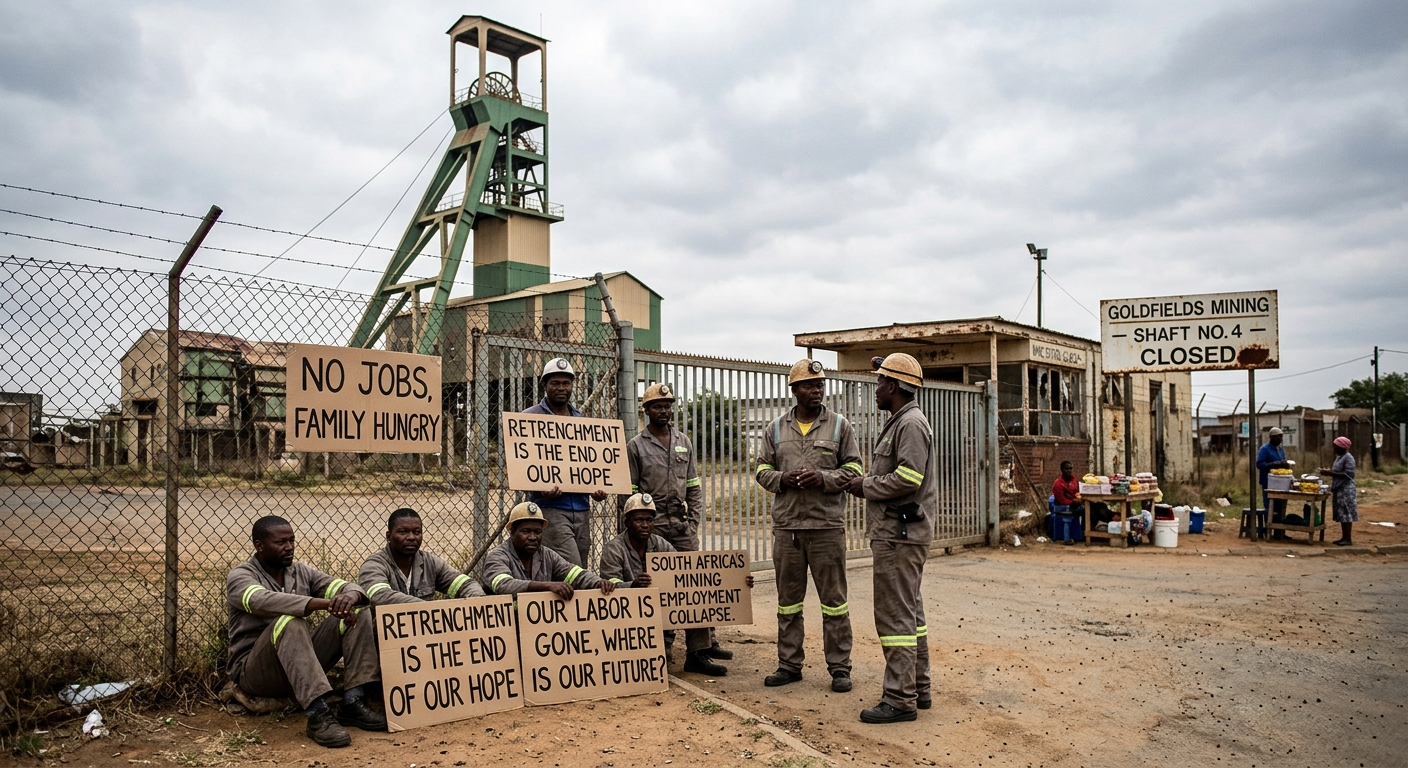
A Comprehensive Thesis
Abstract
South Africa’s mining industry has historically been one of the country’s most important sources of employment, exports, industrial activity, tax revenue and regional economic development. Yet the sector has experienced a profound long-term employment contraction. Mining employment reached more than 760,000 workers in 1987, while modern employment is closer to the 470,000 range. Statistics South Africa identifies 1987 as the historical employment peak. (Statistics South Africa)
The phrase “mining employment collapse” therefore needs an important qualification. South Africa has not experienced a simple, uninterrupted collapse in mining jobs. Rather, it has experienced a multi-decade structural decline, interrupted by periods of recovery and expansion. Mining employment increased after 2021, but retrenchments in 2024 and weaker conditions in some commodity segments subsequently reduced employment. In 2025, the industry still employed roughly 470,000 people, while preliminary 2026 data show some modest employment improvement. (Minerals Council SA)
The deeper question is why a country with enormous mineral resources has struggled to translate mining wealth into sustained employment growth. The answer involves declining ore grades, mature mines, technological change, rising costs, electricity and water constraints, rail and port bottlenecks, commodity-price cycles, regulatory uncertainty, security problems, investment constraints, labour productivity, and the changing economics of deep-level mining.
This thesis examines the history, causes, consequences and possible future of mining employment in South Africa.
1. Introduction
Mining is deeply embedded in the economic history of South Africa.
Gold, diamonds, coal, platinum-group metals, iron ore, manganese, chrome and other minerals helped create cities, railways, financial institutions, manufacturing industries and export networks. Mining also played a central role in South Africa’s industrialisation.
However, mining employment today is substantially lower than during the industry’s twentieth-century peak.
Statistics South Africa reports that mining employment peaked at more than 760,000 people in 1987. (Statistics South Africa)
By contrast, the Minerals Council’s latest industry reporting places full-year mining employment at approximately 470,457 in 2025, compared with 473,484 in 2024. (Minerals Council SA)
That represents a fundamental transformation of the industry.
The important question is therefore not simply:
Why are South African mines losing jobs?
It is:
Why has an industry with enormous mineral resources become increasingly less labour-intensive, while simultaneously facing difficulty attracting the investment required to develop new mines and maintain existing operations?
2. The Historical Importance of Mining
South Africa’s modern economy cannot be understood without mining.
The discovery of diamonds in Kimberley in the nineteenth century and gold on the Witwatersrand fundamentally transformed the country.
Mining generated:
- employment;
- foreign exchange;
- infrastructure;
- railways;
- ports;
- engineering capabilities;
- financial institutions;
- manufacturing demand;
- taxation;
- export revenues;
- urbanisation;
- technical skills.
During the twentieth century, gold mining became particularly important.
At its height, mining represented a much larger proportion of national economic production than it does today. Mining’s contribution to GDP reached approximately 21% in 1980, according to Stats SA’s historical analysis. (Statistics South Africa)
The industry subsequently became relatively smaller as the rest of the economy diversified.
3. The Employment Collapse in Historical Perspective
A useful way to understand the employment problem is to divide mining history into several periods.
Phase 1: Expansion
During much of the twentieth century:
- new mines were developed;
- gold production expanded;
- coal production increased;
- diamond mining expanded;
- mining infrastructure grew;
- large numbers of workers were recruited.
Mining was extremely labour-intensive.
Phase 2: Employment Peak
The historical employment peak occurred around 1987, when mining employed more than 760,000 people. (Statistics South Africa)
This period represents the high-water mark of mining as a mass employer.
Phase 3: Structural Decline
From the late twentieth century onward, employment began falling.
Several factors contributed:
- declining gold production;
- closure of uneconomic mines;
- increasing mining depths;
- mechanisation;
- restructuring;
- productivity improvements;
- changing commodity markets;
- rising operating costs.
Phase 4: Post-2000 Transformation
The commodity boom created substantial opportunities.
Platinum-group metals became increasingly important, while coal, iron ore, manganese and chrome also expanded.
Mining employment therefore did not simply disappear.
Instead, the composition of employment changed.
Phase 5: Post-2020 Volatility
The COVID-19 period produced major disruptions.
After 2021, employment recovered.
The Minerals Council reports that the industry created more than 14,900 jobs between 2021 and 2024, although almost 10,000 jobs were lost during 2024, particularly as some platinum-group-metal producers undertook retrenchments. (Minerals Council SA)
This demonstrates why the term “collapse” should be used carefully.
The long-term trend is strongly negative relative to the 1980s, but the short-term trend contains both job creation and job destruction.
4. Where South Africa’s Mining Jobs Are Today
Mining employment is distributed across multiple commodities.
The Minerals Council’s 2025 research indicates that in 2024:
| Commodity | Approx. employment |
|---|---|
| Coal | 98,269 |
| Platinum-group metals | 73,424 |
| Gold | 91,728 |
| Chrome | 25,824 |
| Iron ore | 22,461 |
| Manganese | 11,949 |
| Diamonds | 14,247 |
| Non-ferrous metals | 18,355 |
These figures illustrate an important structural change: employment is no longer dominated by gold alone. (Minerals Council SA)
Gold employment, in particular, has been in long-term decline.
The 2024 gold workforce was approximately 91,728, compared with 131,738 in 2013. (Minerals Council SA)
That is a reduction of approximately 30% over the period.
5. Why Mining Employment Has Declined
5.1 Mature and Depleting Mines
Many South African mines are old.
Mining companies increasingly operate deposits that have been exploited for decades.
As mines mature:
- ore bodies become harder to access;
- grades may decline;
- underground workings become deeper;
- ventilation becomes more expensive;
- rock temperatures increase;
- transportation distances increase;
- safety requirements become more complex.
The economics of extracting each additional tonne therefore become increasingly challenging.
6. The Decline of Gold Mining
Gold provides perhaps the clearest example.
South Africa was once the world’s dominant gold producer.
But the country’s gold industry has undergone a massive structural transformation.
Gold mines became increasingly:
- deep;
- expensive;
- technically complex;
- energy-intensive;
- labour-intensive.
At the same time, South Africa faced competition from countries where gold could be extracted more cheaply.
The result was mine closures, consolidation and employment reductions.
The Minerals Council’s data show gold employment falling from about 131,738 in 2013 to 91,728 in 2024. (Minerals Council SA)
7. Mechanisation and Automation
Technology has a paradoxical effect on employment.
It can:
- destroy certain jobs;
- create new jobs;
- increase productivity;
- improve safety;
- reduce operating costs.
Mechanisation can replace repetitive or dangerous manual work.
Examples include:
- automated drilling;
- remote-controlled equipment;
- autonomous haulage;
- automated ore sorting;
- digital geological modelling;
- predictive maintenance;
- remote monitoring;
- robotics;
- artificial intelligence;
- machine vision.
Consequently, a modern mine can potentially produce more minerals with fewer workers than a comparable historical operation.
This is one reason employment cannot simply be restored to 1980s levels without considering productivity and economic viability.
8. Electricity Constraints
Mining is heavily dependent on electricity.
Large mines require power for:
- ventilation;
- pumping;
- crushing;
- milling;
- refrigeration;
- hoisting;
- processing;
- communications;
- automation.
Electricity problems can therefore increase costs and reduce production reliability.
Higher electricity prices also make marginal deposits less economically attractive.
The Minerals Council has identified high input costs, including electricity and water, among the major pressures facing the industry. (Minerals Council SA)
9. Water Constraints
Water is another critical mining input.
Mining operations require water for:
- mineral processing;
- dust suppression;
- cooling;
- washing;
- tailings management;
- domestic requirements.
Water infrastructure problems can therefore become employment problems.
If a mine cannot reliably obtain water, production can be constrained and investment postponed.
10. Rail and Port Constraints
South Africa is heavily dependent on bulk commodity exports.
Mines need to transport minerals to:
- domestic processing plants;
- rail terminals;
- ports;
- international customers.
Rail and port constraints increase logistical costs.
The Minerals Council has specifically identified constrained rail and port logistics as a major operating challenge. (Minerals Council SA)
This creates an important economic chain:
Mining → rail → port → export market
If any major link becomes inefficient, the profitability of the entire mining operation can deteriorate.
11. Commodity Price Cycles
Mining companies sell commodities whose prices are determined largely by global markets.
South Africa is exposed to:
- platinum prices;
- palladium prices;
- rhodium prices;
- gold prices;
- coal prices;
- iron ore prices;
- manganese prices;
- chrome prices.
When prices fall:
Revenue ↓
→ profitability ↓
→ capital expenditure ↓
→ exploration ↓
→ marginal operations become uneconomic
→ restructuring becomes more likely
→ employment can decline.
The platinum-group-metal sector has been particularly important in recent employment pressures.
12. The Platinum-Group-Metal Problem
South Africa possesses some of the world’s most important platinum-group-metal resources.
These include:
- platinum;
- palladium;
- rhodium.
However, the economics of PGMs are complicated.
Demand is influenced by:
- automobile production;
- catalytic-converter technology;
- industrial demand;
- jewellery;
- hydrogen-related technologies;
- substitution between metals.
The transition toward electric vehicles introduces another major structural uncertainty because battery-electric vehicles do not require conventional catalytic converters.
Consequently, the future demand structure for some PGMs is uncertain.
13. Labour Costs and Productivity
Mining wages are an important component of household income and regional economies.
Mining employment can be relatively well paid compared with many other employment opportunities.
The challenge is balancing:
higher wages + worker welfare + safety
with:
international competitiveness + productivity + profitability.
The Minerals Council reports that the industry paid approximately R200.2 billion in employee earnings in its 2025 reporting period. (Minerals Council SA)
Therefore, fewer workers do not necessarily mean lower economic importance.
A smaller workforce can generate significant wages if productivity and profitability are high.
14. The Informal and Illegal Mining Economy
Another important dimension is the growth of illegal or informal mining.
Abandoned and derelict mines can become sources of informal economic activity.
The phenomenon creates complex consequences:
- lost tax revenue;
- safety risks;
- environmental damage;
- criminal exploitation;
- reduced formal employment;
- community conflict;
- difficulties for legitimate operators.
A comprehensive mining employment policy must therefore distinguish between:
formal employment
and
informal mineral extraction.
15. Investment Is Central to Employment
Mining employment ultimately depends on investment.
A new mine requires enormous capital expenditure.
Investors must evaluate:
- geological potential;
- infrastructure;
- electricity;
- water;
- rail;
- ports;
- regulatory conditions;
- taxation;
- labour;
- security;
- commodity prices;
- environmental obligations.
If investors perceive excessive uncertainty, they may redirect capital elsewhere.
The Minerals Council notes that mining investment has often been focused on sustaining existing mines rather than developing entirely new mines. (Minerals Council SA)
That distinction is extremely important.
Sustaining capital keeps an existing mine operating.
Expansion capital increases capacity.
Greenfield investment creates a new mine.
Greenfield investment is particularly important for long-term employment because eventually old mines reach the end of their economic lives.
16. Mining and South Africa’s Infrastructure Problem
Mining is unusually dependent on infrastructure.
A mining economy requires:
Energy infrastructure
Electricity generation and transmission.
Transport infrastructure
Railways and roads.
Port infrastructure
Export terminals.
Water infrastructure
Pipelines, reservoirs and treatment facilities.
Digital infrastructure
Telecommunications, sensors, cloud systems and operational technology.
Industrial infrastructure
Smelters, refineries, processing plants and manufacturing facilities.
This means mining employment cannot be separated from infrastructure policy.
17. Mining Employment and Regional Development
Mining jobs have a multiplier effect.
One formal mining position can support:
- households;
- local shops;
- transport businesses;
- accommodation;
- restaurants;
- maintenance companies;
- contractors;
- professional services.
Therefore, the closure of a mine can affect thousands of people indirectly.
Mining towns can be particularly vulnerable because they may have developed around a single major employer.
18. The Social Consequences of Job Losses
Mining retrenchments can generate:
Household income losses
Workers may become responsible for supporting families without a stable salary.
Local economic contraction
Businesses lose customers.
Municipal pressure
Reduced economic activity can weaken local tax and service-payment bases.
Migration
Workers may move to Johannesburg, Pretoria, Cape Town or other economic centres.
Youth unemployment
Young people entering the labour market may find fewer mining-related opportunities.
Skills displacement
Experienced miners may struggle to transfer specialised underground skills into other industries.
19. Mining Employment Is Not the Same as Mining Production
An important analytical distinction is:
Mining output can increase while mining employment falls.
Suppose a mine introduces automated equipment.
Production could rise from:
100 units → 150 units
while employment falls:
10,000 workers → 7,000 workers.
The mine has become more productive.
Therefore:
Employment ≠ production
and
job creation ≠ economic productivity.
This distinction is essential when evaluating the future of South African mining.
20. Evidence That the Situation Is More Complicated Than a Simple Collapse
Recent data demonstrate why the story needs nuance.
Stats SA reported that mining employment fell by 3,000 jobs in Q4 2025, or 0.6% quarter-on-quarter. (Statistics South Africa)
But in Q1 2026, mining employment increased by 2,000 jobs, or 0.4%. (Statistics South Africa)
This means the sector continues to experience volatility rather than a straight downward line.
The long-term historical decline remains severe, but recent performance contains periods of recovery.
21. Mining’s Continuing Economic Importance
Despite declining employment, mining remains strategically important.
The Minerals Council reports approximately:
- R1.1 trillion industry turnover;
- R477.1 billion direct GDP contribution;
- 6.2% contribution to GDP at current prices;
- R816.1 billion in mineral exports;
- approximately 470,457 jobs. (Minerals Council SA)
Therefore, South Africa faces an unusual economic situation:
Mining employs fewer people than it once did, but remains enormously important to the economy.
22. The Mining Employment Paradox
South Africa faces five simultaneous realities:
Reality 1
Mining employment has fallen dramatically over the long term.
Reality 2
Mining remains one of the country’s major export industries.
Reality 3
Mining continues to provide hundreds of thousands of direct jobs.
Reality 4
Technology will probably continue reducing demand for certain forms of manual labour.
Reality 5
New minerals and new technologies could create entirely new employment opportunities.
The policy challenge is therefore not simply to restore old mining jobs.
It is to create a new mining employment ecosystem.
23. Critical Minerals and the Next Mining Opportunity
The global energy transition could create new demand for minerals.
Potentially important minerals include:
- manganese;
- nickel;
- copper;
- lithium;
- graphite;
- rare earth elements;
- platinum-group metals;
- vanadium;
- chrome.
South Africa’s mineral diversity gives it an opportunity to participate in new global supply chains.
However, simply exporting raw ore would limit the economic benefits.
24. From Mining to Mineral Industrialisation
One of the most important solutions is moving from:
Mining → Export
toward:
Mining → Processing → Refining → Manufacturing → Technology
For example:
Stage 1
Extract manganese.
Stage 2
Process manganese.
Stage 3
Produce refined materials.
Stage 4
Manufacture battery-related materials.
Stage 5
Develop battery technologies and industrial products.
This can create substantially more employment than simply exporting raw minerals.
25. Mining Technology Jobs
The future mining workforce will increasingly require:
- software engineers;
- data scientists;
- robotics engineers;
- automation specialists;
- electrical engineers;
- geologists;
- metallurgists;
- environmental scientists;
- cybersecurity specialists;
- drone operators;
- AI specialists;
- equipment technicians.
This represents an important transition.
The future mine may employ fewer conventional labourers but more highly skilled technical professionals.
26. Artificial Intelligence in Mining
AI could transform mining employment.
AI can assist with:
- geological exploration;
- ore-body modelling;
- predictive maintenance;
- equipment monitoring;
- safety systems;
- production optimisation;
- energy management;
- environmental monitoring.
The challenge is that AI can eliminate some jobs while increasing demand for other occupations.
Therefore, reskilling becomes central.
27. Automation and the Future Worker
A future mining workforce may contain fewer:
- manual drill operators;
- haulage workers;
- repetitive processing workers.
But more:
- remote operators;
- robotics technicians;
- AI specialists;
- control-room personnel;
- data analysts;
- maintenance engineers.
This suggests that the central employment question is not merely:
“How many mining jobs will exist?”
It is:
“What kinds of mining jobs will exist?”
28. Education and Skills
South Africa needs stronger technical education linked directly to mining’s future.
Important areas include:
STEM
Science, technology, engineering and mathematics.
TVET
Technical and vocational education and training.
Digital skills
Programming, data analytics and automation.
Engineering
Electrical, mechanical, mining and chemical engineering.
Environmental science
Mine rehabilitation and sustainable resource management.
Geology
Exploration and mineral-resource assessment.
29. Reskilling Existing Workers
A worker displaced by mechanisation should ideally have pathways into new occupations.
For example:
Machine operator
→ digital equipment operator
→ remote-control specialist
→ automation technician.
Similarly:
Traditional geological worker
→ digital geological modeller
→ geological data analyst.
This approach can transform technological disruption into an opportunity.
30. Mine Rehabilitation as an Employment Industry
South Africa has enormous opportunities in mine rehabilitation.
Activities include:
- land restoration;
- water treatment;
- tailings management;
- soil rehabilitation;
- reforestation;
- environmental monitoring;
- infrastructure removal;
- pollution remediation.
A national mine-rehabilitation programme could therefore become an important employment generator.
31. Junior and Emerging Miners
Smaller mining enterprises can contribute to employment.
Recent Minerals Council research found that the junior and emerging mining sector is an important component of South Africa’s mining economy. It also notes that the broader industry employed approximately 475,009 people in 2024, including permanent employees and contractors. (Minerals Council SA)
Supporting legitimate junior miners could therefore increase:
- exploration;
- entrepreneurship;
- regional employment;
- mineral development;
- innovation.
32. The Importance of Exploration
A mining industry cannot survive indefinitely by exploiting old deposits.
It needs a pipeline:
Exploration
↓
Discovery
↓
Feasibility study
↓
Financing
↓
Mine development
↓
Production
↓
Processing
↓
Export/manufacturing
↓
Rehabilitation
Without exploration, today’s mines eventually become tomorrow’s closures.
33. Improving the Investment Environment
South Africa needs greater confidence among mining investors.
This requires:
- predictable regulation;
- efficient licensing;
- transparent mineral rights administration;
- reliable infrastructure;
- electricity availability;
- water security;
- transport efficiency;
- protection of mining operations;
- environmental certainty;
- clear taxation policy.
Investment follows opportunity, but also predictability.
34. Infrastructure as an Employment Strategy
Infrastructure investment could indirectly protect mining jobs.
Priorities include:
- electricity generation;
- electricity transmission;
- rail rehabilitation;
- port expansion;
- roads;
- water systems;
- telecommunications;
- digital infrastructure.
Better infrastructure reduces mining costs.
Lower costs can make marginal deposits viable.
Viable deposits can support employment.
35. Mining and Manufacturing
The greatest employment opportunity may not be underground.
It may be above ground.
Mining supports industries such as:
- mining machinery;
- chemicals;
- steel;
- engineering;
- software;
- transport;
- construction;
- financial services;
- laboratories;
- environmental services.
Developing local mining supply chains can therefore multiply employment.
36. A New South African Mining Model
A future mining strategy could be based on seven pillars:
Pillar 1 — Resource discovery
Expand exploration.
Pillar 2 — Competitive mining
Improve productivity and infrastructure.
Pillar 3 — Technology
Adopt automation, robotics and AI responsibly.
Pillar 4 — Skills
Train workers for digital mining.
Pillar 5 — Beneficiation
Process more minerals domestically.
Pillar 6 — Manufacturing
Build mineral-based industries.
Pillar 7 — Rehabilitation
Create long-term environmental employment.
37. Measuring Success Differently
South Africa should not measure mining success exclusively by the number of workers underground.
Better indicators include:
- jobs created;
- wages paid;
- productivity;
- mineral output;
- export value;
- local procurement;
- investment;
- mineral processing;
- technological capability;
- environmental performance;
- tax contribution;
- community development.
This would produce a more sophisticated understanding of mining’s economic role.
38. Can South Africa Return to 760,000 Mining Jobs?
Probably not through the traditional mining model.
Returning to the 1987 employment level would require a fundamentally different economic structure.
Modern mines are more productive and technologically sophisticated.
Therefore, attempting to recreate historical employment numbers through inefficient labour-intensive mining could make South African mining internationally uncompetitive.
The better objective is:
Create the maximum number of sustainable, productive and well-paid jobs throughout the entire mining value chain.
39. The Real Employment Opportunity
The greatest opportunity may therefore be to expand employment beyond the mine itself.
Consider the complete value chain:
Exploration
→ geology
→ drilling
→ mining
→ equipment
→ engineering
→ transportation
→ mineral processing
→ refining
→ manufacturing
→ research
→ technology
→ exports
→ recycling
→ rehabilitation.
The employment potential of this ecosystem is considerably greater than simply counting mine workers.
40. Policy Recommendations
Recommendation 1: Accelerate exploration
Create an efficient mineral exploration system.
Recommendation 2: Repair logistics
Improve rail and port performance.
Recommendation 3: Ensure energy security
Provide reliable and competitively priced electricity.
Recommendation 4: Modernise mining regulation
Make mineral-rights administration predictable and transparent.
Recommendation 5: Expand technical education
Strengthen TVET colleges and engineering education.
Recommendation 6: Establish large-scale reskilling programmes
Prepare workers for automation and digital mining.
Recommendation 7: Promote beneficiation
Increase domestic mineral processing.
Recommendation 8: Build mining technology companies
Encourage South African firms to develop:
- mining software;
- robotics;
- sensors;
- AI;
- autonomous equipment;
- safety systems.
Recommendation 9: Support junior miners
Increase opportunities for legitimate emerging companies.
Recommendation 10: Develop rehabilitation industries
Turn environmental restoration into an employment opportunity.
41. A 2030–2040 Employment Scenario
A possible future South African mining economy could look like this:
Traditional mining
Employment gradually declines in some mature commodities.
Automated mining
Productivity increases.
Critical minerals
New mining opportunities emerge.
Processing
More minerals are processed domestically.
Manufacturing
Mineral-based industries expand.
Technology
Mining software, AI and robotics become major industries.
Rehabilitation
Environmental restoration creates additional employment.
The result could be:
fewer traditional mining jobs
but
more diversified mining-related employment.
42. The Strategic Choice Before South Africa
South Africa effectively faces two paths.
Path A — Managed decline
Old mines close.
Exploration remains weak.
Infrastructure deteriorates.
Investment moves elsewhere.
Employment declines.
Minerals are increasingly extracted elsewhere.
Path B — Mining transformation
South Africa:
- attracts exploration;
- develops new mines;
- modernises infrastructure;
- adopts technology;
- trains workers;
- processes minerals;
- manufactures products;
- develops mining technology;
- rehabilitates old mines.
Path B offers a substantially stronger long-term economic opportunity.
43. Conclusion
South Africa’s mining employment crisis is real, but it is more accurately described as a long-term structural transformation of mining employment than as a simple uninterrupted collapse.
The historical evidence is striking.
Mining employment peaked at more than 760,000 workers in 1987. (Statistics South Africa)
By the modern period, employment has settled around 470,000 workers. The Minerals Council reported 470,457 average jobs in 2025, alongside substantial wages, exports and GDP contribution. (Minerals Council SA)
Recent statistics also show that the industry is not simply disappearing. Mining employment fell in late 2025 but increased by approximately 2,000 jobs in Q1 2026. (Statistics South Africa)
The central problem is therefore not that South Africa lacks minerals.
It is that the economic model surrounding those minerals is under pressure.
Mature mines, declining gold employment, commodity cycles, high input costs, electricity constraints, water challenges, logistics bottlenecks, security problems, regulatory uncertainty, technological transformation and insufficient new investment all affect employment.
The solution cannot simply be to recreate the mining industry of 1987.
South Africa needs to build the mining industry of the twenty-first century.
That means transforming the economic chain from:
Mineral extraction → raw export
into:
Exploration → modern mining → processing → refining → manufacturing → technology → exports → recycling → rehabilitation.
The ultimate objective should therefore not be the maximum number of people working underground.
It should be the creation of a globally competitive mineral economy that produces sustainable employment, high productivity, skilled workers, technological innovation, industrialisation and broad-based economic development.
South Africa’s mineral wealth remains enormous. The decisive question for the coming decades is whether that wealth will generate a new generation of productive employment—or whether the country will continue exporting increasingly valuable minerals while the employment base of traditional mining gradually contracts.
Selected current evidence
- Statistics South Africa’s historical mining analysis records the industry’s employment peak at more than 760,000 in 1987. (Statistics South Africa)
- The Minerals Council’s 2025 reporting puts average mining employment at 470,457 and employee earnings at R200.2 billion. (Minerals Council SA)
- Minerals Council research reports 475,009 mining employees in 2024 and identifies gold’s long-term employment decline. (Minerals Council SA)
- Stats SA recorded a 3,000-job mining decline in Q4 2025, followed by a 2,000-job increase in Q1 2026. (Statistics South Africa)
- The Minerals Council identifies logistics, electricity, water, security and global commodity conditions among the major pressures on mining. (Minerals Council SA)




Be First to Comment