
Introduction
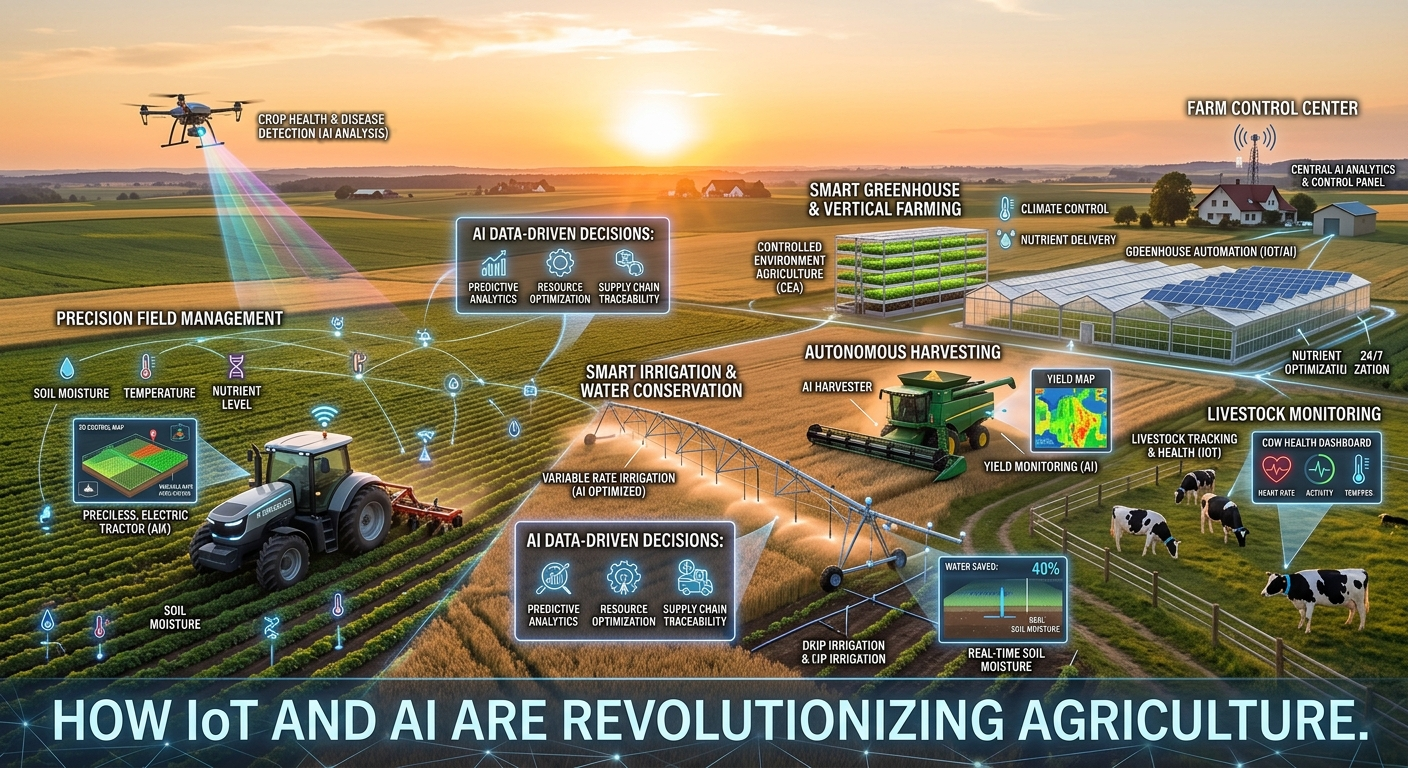
Agriculture is entering a major technological transformation. For thousands of years, farming has depended heavily on human observation, accumulated experience, seasonal patterns, and physical labor. Today, the combination of the Internet of Things (IoT), Artificial Intelligence (AI), machine learning, robotics, drones, satellite imagery, cloud computing, edge computing, and advanced sensors is creating a new model of agriculture often described as smart farming, digital agriculture, or precision agriculture.
The fundamental change is straightforward:
IoT gives agriculture the ability to sense what is happening, while AI gives agricultural systems the ability to interpret what is happening and recommend or perform an appropriate response.
IoT devices can continuously measure soil moisture, temperature, humidity, rainfall, water quality, nutrient conditions, livestock activity, equipment performance and other variables. AI and machine-learning systems can then analyze these enormous streams of information to identify patterns, predict risks, estimate yields and support decisions.
Recent research published in 2026 describes IoT and machine learning as complementary technologies: IoT provides continuous data acquisition, while machine learning converts those data into predictive and actionable information for crop monitoring, irrigation, disease detection and yield forecasting.
The result is potentially much more than simply automating individual farm tasks. It is the development of an agricultural system capable of continuous observation, prediction, optimization, automation and learning.
1. Understanding the Agricultural Revolution
Agricultural technology can broadly be viewed as a progression through several stages.
Stage 1: Traditional agriculture
Farmers primarily depend on:
- Personal experience
- Manual inspection
- Seasonal knowledge
- Human labor
- Basic tools
- Historical weather patterns
Stage 2: Mechanized agriculture
The introduction of tractors, harvesters, irrigation equipment and other machinery dramatically increased productivity.
Stage 3: Industrial agriculture
Large-scale production introduced:
- Fertilizers
- Pesticides
- Large irrigation systems
- Mechanized harvesting
- Improved crop varieties
- Agricultural chemicals
- Global supply chains
Stage 4: Precision agriculture
GPS, satellite imagery, geographic information systems, variable-rate equipment and digital mapping allowed farmers to treat different parts of a farm differently.
Stage 5: Connected agriculture
IoT sensors began connecting fields, greenhouses, livestock, machinery and irrigation systems to digital platforms.
Stage 6: Intelligent agriculture
AI adds prediction, pattern recognition and decision support.
Stage 7: Autonomous agriculture
The emerging objective is a farming environment in which machines, robots and software can perform increasing numbers of operations automatically while humans remain responsible for supervision and strategic decisions.
This evolution can therefore be summarized as:
Human observation → mechanization → precision measurement → connectivity → intelligence → automation → increasingly autonomous farming.
2. What Is IoT in Agriculture?
The Internet of Things is a network of physical objects equipped with sensors, processors, communication technologies and software that allow them to collect and exchange information.
In agriculture, IoT can connect:
- Soil sensors
- Weather stations
- Irrigation controllers
- Water pumps
- Greenhouse equipment
- Drones
- Livestock trackers
- Cameras
- Tractors
- Harvesters
- Storage facilities
- Silos
- Cold-chain equipment
- Farm vehicles
- Agricultural robots
A simplified agricultural IoT system looks like this:
Physical environment → Sensors → Connectivity → Data platform → Analytics → Decision → Actuator → Physical environment
For example:
Dry soil → moisture sensor detects declining moisture → data transmitted → software analyzes reading → irrigation recommendation generated → irrigation controller activates → water reaches crop → sensor measures new moisture level.
Modern research describes this progression as a movement from retrospective agricultural decision-making toward continuous, real-time and data-driven management.
3. What Does AI Add?
IoT can tell a farmer what is happening.
AI can help determine what it means and what may happen next.
Suppose thousands of sensors report:
- Soil moisture
- Temperature
- Humidity
- Solar radiation
- Wind
- Rainfall
- Soil nutrients
- Crop growth
A conventional system might simply display these measurements.
An AI system can analyze them collectively and estimate:
- Whether crops are experiencing water stress
- Whether disease conditions are emerging
- How much irrigation may be required
- Which areas are likely to produce higher yields
- Whether weather conditions could threaten production
- Whether machinery may require maintenance
- Whether a livestock animal’s behavior has changed
This makes AI particularly valuable because agriculture produces extremely complex and variable datasets.
4. The AIoT Agriculture Architecture
The convergence of AI and IoT is sometimes described as AIoT — Artificial Intelligence of Things.
A sophisticated agricultural AIoT architecture can contain several layers.
Layer 1: Physical environment
This includes:
- Soil
- Crops
- Animals
- Water
- Weather
- Machinery
- Buildings
Layer 2: Sensors
Sensors measure physical and biological conditions.
Examples include:
- Soil-moisture sensors
- Temperature sensors
- Humidity sensors
- pH sensors
- Electrical-conductivity sensors
- Nutrient sensors
- Water-level sensors
- Cameras
- Motion sensors
- Pressure sensors
Layer 3: Connectivity
Data can be transmitted through technologies such as:
- Wi-Fi
- Cellular networks
- LPWAN technologies
- Bluetooth
- Satellite communications
- Agricultural wireless sensor networks
Layer 4: Edge computing
Some data can be processed close to where they are generated.
This reduces the need to transmit every piece of information to a distant cloud server.
Layer 5: Cloud infrastructure
Cloud platforms can store and process large quantities of agricultural data.
Layer 6: AI and machine learning
Algorithms analyze the data.
Layer 7: Decision support
The system generates:
- Alerts
- Recommendations
- Predictions
- Reports
- Optimization decisions
Layer 8: Actuation
Physical systems respond through:
- Pumps
- Irrigation valves
- Ventilation systems
- Agricultural robots
- Machinery
- Feed systems
Layer 9: Feedback
New sensor measurements determine whether the intervention produced the desired result.
This creates a closed-loop agricultural system.
5. Smart Soil Monitoring
Soil is one of the most important components of agricultural production.
Traditional soil management often depends on periodic sampling. IoT allows continuous or frequent monitoring.
Sensors can measure variables such as:
- Moisture
- Temperature
- pH
- Electrical conductivity
- Nutrient-related indicators
- Salinity
AI can combine these measurements with:
- Historical farm data
- Weather information
- Crop type
- Plant growth stage
- Irrigation history
- Satellite imagery
The resulting system can produce a much more detailed representation of soil conditions.
Recent research has demonstrated AI-IoT frameworks combining soil-moisture and nutrient sensing with machine learning for real-time agricultural monitoring and nutrient prediction.
6. Intelligent Irrigation
Water management is one of the most important applications of agricultural IoT.
A basic irrigation system might operate according to a fixed schedule.
An intelligent irrigation system can consider:
Soil moisture + weather + crop requirements + evaporation conditions + rainfall prediction + plant growth stage
AI can estimate when irrigation is likely to be necessary.
Instead of watering an entire field uniformly, precision irrigation can potentially deliver different quantities of water to different zones.
This creates a shift from:
“Water the field.”
to:
“Water the right area, at the right time, with an appropriate amount.”
Research published in 2026 highlights IoT-enabled precision irrigation and crop monitoring as important areas where sensor networks and AI can support proactive intervention.
7. Crop Health Monitoring
Crops continuously communicate information about their condition through physical characteristics.
Cameras and sensors can observe:
- Leaf color
- Plant structure
- Growth rate
- Canopy development
- Temperature
- Vegetation patterns
AI-based computer vision can analyze images and identify patterns associated with:
- Disease
- Nutrient stress
- Water stress
- Pest damage
- Weed growth
- Abnormal development
This allows farmers to move from generalized treatment toward targeted intervention.
8. AI-Based Disease Detection
Plant disease can spread rapidly.
Traditional disease detection may depend on a farmer noticing visible symptoms.
AI-assisted computer vision can analyze photographs or continuous camera feeds.
A simplified process is:
Image → preprocessing → feature extraction → AI model → classification → probability estimate → farmer alert
Deep-learning models can recognize complex visual patterns that may be difficult to identify consistently through manual observation.
However, AI should not automatically be treated as infallible. Lighting, crop varieties, camera quality, environmental conditions and incomplete training data can affect performance.
Human agricultural expertise therefore remains important.
9. Intelligent Pest Management
IoT and AI can also support pest management.
Sensors and cameras can monitor:
- Insect activity
- Crop damage
- Environmental conditions
- Plant stress
- Pest populations
AI can analyze historical and real-time information to identify conditions associated with increased pest risk.
This can potentially support more targeted intervention rather than treating an entire field uniformly.
The broader objective is:
Detect early → identify accurately → intervene selectively → monitor results.
10. AI and Weed Detection
Weeds compete with crops for:
- Water
- Nutrients
- Light
- Space
Computer vision can distinguish between crops and weeds.
Agricultural machinery equipped with cameras can potentially identify weed locations and enable targeted operations.
This creates the possibility of site-specific weed management, reducing unnecessary treatment.
Recent reviews of IoT and machine-learning agriculture identify weed monitoring among the important application domains for intelligent farming.
11. Drones and AI
Unmanned aerial vehicles can provide an aerial perspective of agricultural land.
Drones may carry:
- RGB cameras
- Multispectral cameras
- Thermal cameras
- Other specialized sensors
They can collect information about:
- Crop growth
- Vegetation conditions
- Water stress
- Field variability
- Disease patterns
- Weed distribution
AI can then process these images.
A farmer may therefore move from manually inspecting thousands of plants to receiving a map showing areas requiring attention.
12. Satellite Agriculture
Drones are not the only source of aerial intelligence.
Satellite systems can provide large-scale information about agricultural landscapes.
Satellite imagery can contribute to:
- Crop mapping
- Vegetation monitoring
- Drought assessment
- Land-use analysis
- Weather-related assessment
- Regional agricultural planning
Combining satellite information with local IoT sensors can produce a powerful multi-scale agricultural data system.
The satellite provides the large picture.
The IoT sensors provide local detail.
AI connects the two.
13. Livestock and Animal IoT
IoT is not limited to crops.
Animals can also become part of connected agricultural systems.
Wearable or attached devices can monitor indicators associated with:
- Movement
- Location
- Feeding behavior
- Activity patterns
- Environmental conditions
AI can identify unusual patterns.
For example, a change in normal activity could generate an alert for further investigation.
This does not eliminate the need for farmers, veterinarians or animal-care professionals. Instead, it provides another source of information.
14. Smart Greenhouses
Greenhouses are particularly suitable for IoT because their environments can be controlled.
Sensors can measure:
- Temperature
- Humidity
- Light
- CO₂
- Soil moisture
- Nutrient conditions
Automated systems can control:
- Ventilation
- Irrigation
- Lighting
- Heating
- Cooling
- Shading
AI can optimize these variables according to crop requirements.
The greenhouse therefore becomes a controlled cyber-physical agricultural environment.
15. Predictive Yield Forecasting
One of AI’s most important agricultural capabilities is prediction.
Yield depends on many variables:
Yield = f(soil + weather + genetics + water + nutrients + disease + management + time)
AI models can learn relationships among these variables.
Yield prediction can help with:
- Harvest planning
- Storage planning
- Labor planning
- Transportation
- Market planning
- Financial forecasting
- Food-supply planning
A 2026 open-source research platform, AIoTU, demonstrates the integration of IoT environmental data, weather information and machine-learning-based yield prediction, including approaches intended for resource-constrained environments.
16. Predictive Maintenance for Agricultural Machinery
AI can also transform farm equipment management.
Connected machinery can generate information about:
- Engine behavior
- Temperature
- Vibration
- Fuel consumption
- Operating hours
- Component performance
AI can analyze these patterns to identify potential problems.
Instead of waiting for equipment to fail, farmers can move toward:
Monitor → detect abnormal behavior → predict potential failure → schedule maintenance.
This can reduce downtime during critical agricultural periods.
17. Autonomous Agricultural Machinery
The combination of:
- GPS
- Cameras
- Radar
- LiDAR
- IoT
- AI
- Robotics
is creating increasingly sophisticated agricultural machines.
Potential applications include:
- Autonomous navigation
- Precision planting
- Robotic harvesting
- Weed removal
- Crop monitoring
- Automated spraying
- Transport
The agricultural machine becomes more than a mechanical device.
It becomes a mobile computing and sensing platform.
18. Digital Twins for Agriculture
A particularly interesting emerging technology is the digital twin.
A digital twin is a computational representation of a physical system that is continuously updated using real-world information.
An agricultural digital twin could represent:
- A field
- A greenhouse
- A livestock facility
- Irrigation infrastructure
- A complete farm
IoT sensors continuously update the digital representation.
AI can then simulate possible scenarios.
For example:
What could happen if rainfall is lower than expected?
What happens if irrigation is increased?
Which field areas may become stressed?
How could a particular planting strategy affect expected yield?
Research on next-generation IoT-enabled agriculture increasingly combines digital twins, edge computing, federated learning and human-in-the-loop decision systems.
19. Edge AI in Agriculture
Not every agricultural decision needs to be processed in a distant cloud.
Edge AI places computation closer to the farm.
For example, a camera attached to agricultural machinery could analyze images locally rather than continuously transmitting every image to a cloud server.
Advantages can include:
- Lower latency
- Reduced bandwidth requirements
- Faster responses
- Greater operational resilience
- Reduced dependence on continuous Internet connectivity
This is particularly important in rural areas where connectivity can be limited.
20. The Importance of Connectivity
A smart farm cannot be smarter than its communications infrastructure allows.
Agricultural IoT can depend on:
- Mobile networks
- Wi-Fi
- LPWAN
- Satellite connectivity
- Local wireless networks
Connectivity challenges are particularly significant in rural areas.
Recent research continues to identify inadequate rural coverage, transmission limitations, energy constraints and system interoperability as major barriers to large-scale agricultural IoT deployment.
This means agricultural digitization is simultaneously an agricultural problem and an infrastructure problem.
21. Cloud Computing and Agricultural Big Data
A modern farm can generate enormous quantities of information.
Data may come from:
- Sensors
- Cameras
- Drones
- Satellites
- Machinery
- Weather systems
- Market systems
- Historical records
Cloud computing provides infrastructure for storing and analyzing this information.
AI models can then identify relationships across large datasets.
The agricultural data ecosystem can therefore be viewed as:
Sensors → Networks → Edge → Cloud → AI → Decision → Farm
22. AI Models Used in Agriculture
Different agricultural problems require different AI approaches.
Supervised learning
Useful for:
- Disease classification
- Yield prediction
- Crop classification
Unsupervised learning
Useful for:
- Discovering field zones
- Identifying unusual patterns
- Grouping similar agricultural conditions
Deep learning
Useful for:
- Image recognition
- Disease detection
- Remote sensing
- Complex pattern recognition
Time-series models
Useful for:
- Weather-related forecasting
- Soil moisture prediction
- Crop growth analysis
Reinforcement learning
Potentially useful for:
- Irrigation optimization
- Resource allocation
- Autonomous control
Generative AI
Emerging applications include:
- Agricultural information assistants
- Natural-language farm reports
- Knowledge retrieval
- Decision-support interfaces
- Synthetic agricultural data generation
The most appropriate model depends on the problem, available data, computing resources and consequences of incorrect decisions.
23. The Agricultural Data Pipeline
A sophisticated smart farm can be understood as a continuous data pipeline.
Step 1 — Sense
Sensors collect information.
Step 2 — Connect
The information is transmitted.
Step 3 — Store
Data are stored locally or in cloud infrastructure.
Step 4 — Clean
Poor-quality or missing data are identified.
Step 5 — Analyze
AI and statistical models process the information.
Step 6 — Predict
The system estimates future conditions.
Step 7 — Decide
Recommendations or automated decisions are generated.
Step 8 — Act
Machines or humans perform an intervention.
Step 9 — Measure
Sensors determine the outcome.
Step 10 — Learn
The system incorporates new information.
This final step is crucial because it creates a feedback loop.
24. Precision Agriculture: From Uniform to Variable Management
Traditional farming often applies inputs relatively uniformly.
Precision agriculture recognizes that a field is not necessarily homogeneous.
Different areas can have different:
- Soil properties
- Moisture levels
- Nutrient conditions
- Crop densities
- Disease risks
- Productivity
IoT and AI allow these differences to be detected and acted upon.
This creates a fundamental agricultural principle:
Measure variability, understand variability, and manage variability.
25. Resource Efficiency
One of the strongest arguments for smart agriculture is resource optimization.
Potentially affected resources include:
- Water
- Fertilizer
- Energy
- Fuel
- Labor
- Seeds
- Agricultural chemicals
The objective is not simply to use fewer resources.
It is to use them more intelligently.
Recent reviews emphasize the potential of IoT, AI and smart sensors to improve resource efficiency and agricultural sustainability, while also noting barriers such as calibration, interoperability, privacy and adoption costs.
26. Climate-Smart Agriculture
Climate variability creates enormous uncertainty for farmers.
AI and IoT can contribute to climate adaptation through:
- Weather monitoring
- Drought detection
- Irrigation optimization
- Crop stress monitoring
- Yield forecasting
- Microclimate management
Instead of simply reacting to environmental changes, farmers can increasingly receive early warnings.
This shifts agriculture toward:
Reactive farming → predictive farming.
27. Food Security
Agricultural technology has implications beyond individual farms.
At national and global scales, better agricultural data can support:
- Production forecasting
- Food-security planning
- Drought monitoring
- Supply-chain management
- Agricultural policy
- Emergency planning
AI and IoT therefore become components of a broader food system.
28. Post-Harvest Intelligence
Agriculture does not end when crops are harvested.
Significant losses can occur during:
- Storage
- Transportation
- Processing
- Distribution
IoT sensors can monitor:
- Temperature
- Humidity
- Storage conditions
- Location
- Equipment conditions
AI can analyze these data to identify risks.
This can help transform the agricultural supply chain from a disconnected series of activities into an integrated digital system.
29. Smart Cold Chains
Perishable products require appropriate temperature and environmental conditions.
Connected sensors can continuously monitor shipments.
If conditions move outside acceptable ranges, the system can issue an alert.
The concept becomes:
Farm → Storage → Transport → Distribution → Consumer
with digital monitoring throughout the journey.
30. Agricultural Robotics
Agricultural robotics represents the physical embodiment of AI.
A robot can combine:
- Cameras
- Sensors
- GPS
- AI
- Motors
- Mechanical tools
Potential agricultural robots include:
- Harvesting robots
- Weed-removal robots
- Monitoring robots
- Autonomous vehicles
- Sorting systems
The challenge is considerable because farms are unstructured environments.
Unlike factories, fields contain:
- Uneven ground
- Variable weather
- Plants at different growth stages
- Mud
- Dust
- Obstacles
- Biological variability
Agricultural robotics therefore requires sophisticated perception and control.
31. The Human Farmer Remains Central
One misconception about agricultural AI is that technology necessarily eliminates farmers.
A more realistic model is human-machine collaboration.
AI can process enormous quantities of information.
Farmers possess:
- Local knowledge
- Practical experience
- Contextual judgment
- Understanding of local conditions
- Responsibility for decisions
The strongest system combines both.
AI provides intelligence at scale.
Farmers provide judgment and accountability.
32. Challenges of IoT and AI Agriculture
The technology is powerful, but implementation is not simple.
32.1 Cost
Sensors, networks, computing infrastructure and machinery can be expensive.
32.2 Connectivity
Rural farms may have unreliable network coverage.
32.3 Sensor reliability
Sensors can drift, fail or become contaminated.
32.4 Data quality
AI is strongly dependent on the quality and representativeness of training data.
32.5 Interoperability
Equipment from different manufacturers may not communicate easily.
32.6 Cybersecurity
Connected farms create new cybersecurity risks.
32.7 Privacy
Farm data can have commercial value.
32.8 Skills
Farmers and agricultural organizations need appropriate digital skills.
32.9 Energy
Remote IoT devices may operate for long periods using limited power.
32.10 Model reliability
AI systems can produce incorrect predictions.
Recent smart-farming research specifically identifies sensor reliability, heterogeneous data, computational complexity and cybersecurity among the continuing challenges.
33. Cybersecurity of Smart Farms
A connected farm is effectively a cyber-physical system.
It contains:
Digital systems + physical machinery + biological processes.
Cybersecurity therefore becomes critical.
Security measures can include:
- Strong authentication
- Encryption
- Secure software updates
- Network segmentation
- Device monitoring
- Access control
- Backup systems
- Security auditing
A compromise of an agricultural digital system could potentially affect operations such as monitoring, irrigation, machinery management or data integrity.
Therefore:
Smart agriculture must also be secure agriculture.
34. Data Ownership
An increasingly important question is:
Who owns agricultural data?
Possible stakeholders include:
- Farmers
- Equipment manufacturers
- Technology companies
- Agricultural platforms
- Cooperatives
- Governments
- Researchers
Questions about data ownership, consent, portability and commercial use will become increasingly important as farms become more digitally connected.
35. The Digital Divide
Technology can improve agriculture, but unequal access could create another divide.
Large commercial farms may be able to afford:
- Advanced sensors
- Drones
- AI platforms
- Autonomous machinery
- High-speed connectivity
Smallholder farmers may face financial and infrastructure constraints.
Therefore, successful agricultural digitalization must consider affordability.
One promising direction is lightweight and open technology. A 2026 AIoTU platform, for example, specifically addresses resource-constrained agricultural environments and incorporates USSD access so that AI-supported information can reach users without conventional Internet access.
36. AI and Smallholder Agriculture
For developing economies, agricultural AI should not necessarily mean expensive autonomous machinery.
A useful technology stack might begin with:
- Affordable soil sensors
- Mobile phones
- SMS or USSD services
- Local weather information
- Simple AI recommendations
- Low-cost solar power
- Community agricultural networks
The principle should be:
Technology appropriate to the farm, rather than technology simply because it is technologically advanced.
37. Solar-Powered Agricultural IoT
Many agricultural IoT devices are located far from electrical infrastructure.
Solar power can therefore become an important component.
A basic architecture could be:
Solar panel → battery → sensor node → communications module → data platform
This can enable remote monitoring without requiring conventional grid electricity.
Recent research has demonstrated off-grid solar-powered AI-IoT approaches for agricultural soil monitoring.
38. AI and Agricultural Economics
Technology changes the economics of farming.
Potential economic benefits include:
- Reduced waste
- Better resource allocation
- Reduced equipment downtime
- Improved forecasting
- Improved production planning
- More precise input application
But technology also introduces costs:
- Hardware
- Software
- Connectivity
- Maintenance
- Training
- Data services
- Cybersecurity
The economic question is therefore not:
“Is AI useful?”
but:
“Does the value generated by the system justify its total cost and complexity?”
39. Measuring Return on Investment
Farmers evaluating agricultural technology should consider measurable indicators such as:
Production
- Yield per hectare
- Yield quality
- Crop survival
Resources
- Water per unit of production
- Fertilizer use
- Energy consumption
Operations
- Labor hours
- Machine downtime
- Maintenance costs
Financial performance
- Revenue
- Operating cost
- Net margin
- Technology cost
Sustainability
- Soil health
- Water efficiency
- Environmental impact
AI should ultimately produce measurable agricultural value.
40. The Emergence of Closed-Loop Agriculture
One of the most important future concepts is closed-loop intelligent agriculture.
The system continuously performs:
Sense → Analyze → Predict → Decide → Act → Measure → Learn
For example:
- Soil sensors detect declining moisture.
- AI examines weather and crop requirements.
- The system estimates irrigation demand.
- Irrigation begins.
- Sensors measure the result.
- AI evaluates whether sufficient water was applied.
- The model incorporates the new information.
This creates a continuously adapting agricultural system.
Research into plant wearable sensors is moving toward this kind of closed-loop model, combining direct plant sensing, AI, data fusion and precision management.
41. Plant Wearable Sensors
An especially interesting emerging area involves sensors that can be attached directly to plants.
These systems aim to monitor plant conditions more directly than environmental sensors alone.
Potential measurements can include physiological or biochemical indicators.
AI can then combine plant-level information with:
- Soil data
- Weather
- Imaging
- Irrigation
- Historical information
This could move agricultural intelligence from:
“What is happening around the plant?”
toward:
“What is happening to the plant?”
42. AIoT and the Future Farm
The future farm may contain several interconnected intelligence systems:
Soil intelligence
→ monitors soil.
Plant intelligence
→ monitors crop health.
Weather intelligence
→ forecasts environmental conditions.
Water intelligence
→ optimizes irrigation.
Machine intelligence
→ monitors equipment.
Livestock intelligence
→ monitors animals.
Supply-chain intelligence
→ monitors harvested products.
Business intelligence
→ supports financial and production decisions.
These systems can ultimately be integrated into a unified agricultural operating platform.
43. The Farm as a Cyber-Physical System
The modern farm increasingly resembles a cyber-physical system.
The physical world includes:
- Soil
- Plants
- Animals
- Water
- Machines
- Weather
The digital world includes:
- Sensors
- Networks
- Databases
- AI models
- Digital twins
- Software
The two worlds interact continuously.
This creates a powerful principle:
The physical farm generates data; the digital farm interprets the data; the resulting intelligence influences the physical farm.
44. From Smart Farm to Autonomous Farm
The long-term technological trajectory can be represented as:
Farm 1.0
Human-powered agriculture
Farm 2.0
Mechanized agriculture
Farm 3.0
Precision agriculture
Farm 4.0
Connected smart agriculture
Farm 5.0
AI-enabled agriculture
Farm 6.0
Increasingly autonomous agriculture
The transition will not occur uniformly.
Some farms will remain highly manual while others become heavily automated.
Agriculture will probably develop as a spectrum rather than a single universal model.
45. The Role of Industry 5.0
The emerging concept of Industry 5.0 emphasizes human-centered, resilient and sustainable technological systems.
Applied to agriculture, this means the goal should not simply be maximum automation.
The goal should be:
Technology + farmer + sustainability + resilience.
Recent research proposes combining IoT, AI, edge computing, digital twins and federated learning within a human-centered agricultural framework.
46. Federated Learning and Agricultural Data
Agricultural organizations may not want to transfer all of their raw data to a centralized platform.
Federated learning offers an alternative approach in which models can potentially learn from distributed datasets while limiting the need to centralize raw information.
This could be valuable when:
- Farms want greater data control
- Multiple farms collaborate
- Data are commercially sensitive
- Privacy requirements are significant
It represents an important research direction for distributed agricultural intelligence.
47. The Role of Blockchain
Blockchain may contribute to agricultural systems where traceability and transaction records are important.
Possible applications include:
- Product traceability
- Supply-chain records
- Certification
- Data provenance
However, blockchain should not be treated as a universal solution.
Its usefulness depends on whether the underlying agricultural problem actually benefits from a distributed ledger.
48. Building an Intelligent Farm: Conceptual Roadmap
A farm does not need to deploy every technology simultaneously.
A sensible progression can be:
Phase 1 — Digitize
Record:
- Fields
- Crops
- Inputs
- Production
- Weather
Phase 2 — Sense
Deploy essential IoT sensors.
Phase 3 — Connect
Establish reliable communications.
Phase 4 — Analyze
Introduce dashboards and agricultural analytics.
Phase 5 — Predict
Deploy machine-learning models.
Phase 6 — Automate
Connect selected systems to actuators.
Phase 7 — Optimize
Use AI to coordinate multiple farm processes.
Phase 8 — Integrate
Create a unified agricultural intelligence platform.
49. A Conceptual Smart Farm Architecture
A comprehensive architecture can be expressed as:
Physical Farm
↓
Sensors + Cameras + Machines + Drones + Livestock Devices
↓
IoT Connectivity
↓
Edge Computing
↓
Agricultural Data Platform
↓
AI / Machine Learning / Computer Vision
↓
Digital Twin + Decision Support
↓
Farmer / Manager
↓
Automated Machinery + Irrigation + Robotics
↓
Physical Farm
↓
New Sensor Data
The cycle then repeats.
50. What IoT and AI Ultimately Change
The greatest transformation is not any individual sensor or AI model.
It is the decision-making architecture of agriculture.
Traditional farming often asks:
“What should I do today?”
Data-driven farming increasingly asks:
“What is happening?”
AI-enabled farming asks:
“What is likely to happen?”
Advanced intelligent farming asks:
“What action should be taken, what result should we expect, and how should the system adapt after observing the result?”
That is a profound change.
51. Key Benefits at a Glance
| Area | Traditional Approach | IoT + AI Approach |
|---|---|---|
| Soil | Periodic sampling | Continuous monitoring |
| Irrigation | Fixed schedules | Data-driven irrigation |
| Crop health | Visual inspection | AI-assisted monitoring |
| Disease | Reactive detection | Earlier pattern detection |
| Weeds | Broad treatment | Targeted identification |
| Yield | Historical estimates | Predictive models |
| Machinery | Scheduled maintenance | Predictive maintenance |
| Livestock | Manual observation | Connected monitoring |
| Greenhouses | Manual control | Automated optimization |
| Weather | General forecasts | Farm-specific data integration |
| Management | Experience + records | Experience + real-time intelligence |
| Supply chain | Periodic tracking | Continuous monitoring |
52. The Major Risks of Over-Automation
The future of agriculture should not assume that automation is always better.
Overdependence on technology can create vulnerabilities.
Potential problems include:
- System failures
- Incorrect AI recommendations
- Cybersecurity incidents
- Sensor errors
- Connectivity failures
- Excessive vendor dependence
- Loss of local knowledge
- High maintenance costs
Therefore, robust systems should include:
Human oversight + fallback procedures + redundancy + explainable decision support.
53. The Future of Agricultural AI
Several technologies are likely to become increasingly important:
Edge AI
Processing intelligence directly on farm devices.
Multimodal AI
Combining:
- Images
- Sensor data
- Weather
- Text
- Satellite information
- Historical records
Agricultural foundation models
Large models trained or adapted for agricultural knowledge and data.
Digital twins
Simulating farms and agricultural processes.
Robotics
Physical execution of agricultural tasks.
Plant wearables
Direct measurement of plant conditions.
Autonomous machinery
Machines capable of increasingly complex agricultural operations.
Federated learning
Distributed agricultural intelligence.
AI assistants
Natural-language interfaces that allow farmers to interact with agricultural information systems.
54. Agriculture as a Data Industry
Agriculture has traditionally been viewed primarily as a biological and physical industry.
The rise of IoT and AI introduces a third dimension:
Agriculture = Biology + Engineering + Data
The farm of the future will therefore require expertise from:
- Agronomy
- Biology
- Engineering
- Computer science
- Data science
- Telecommunications
- Robotics
- Cybersecurity
- Economics
This interdisciplinary character is one of the most important features of digital agriculture.
55. Implications for Africa
Africa has a particularly important opportunity to use agricultural technology because many agricultural systems still have significant room for productivity and infrastructure improvement.
However, solutions must reflect local realities.
Important considerations include:
- Small farm sizes
- Rural connectivity
- Electricity availability
- Cost of equipment
- Local languages
- Digital literacy
- Water availability
- Climate variability
- Access to agricultural finance
Low-cost smartphones, solar-powered IoT devices, local connectivity and AI-assisted agricultural services could potentially become particularly important.
The objective should not be to copy the most expensive agricultural technology used elsewhere.
It should be to build affordable, resilient and locally appropriate agricultural intelligence systems.
56. South African Opportunity
South Africa has an especially interesting environment for agricultural AI and IoT because it combines:
- Commercial agriculture
- Smallholder agriculture
- Sophisticated telecommunications
- Large agricultural research institutions
- Diverse climatic regions
- Extensive livestock production
- Large-scale crop production
- Water-management challenges
Potential applications include:
- Precision irrigation
- Livestock monitoring
- Agricultural drones
- Smart greenhouses
- Soil monitoring
- Weather intelligence
- Crop disease detection
- Farm equipment monitoring
- Supply-chain traceability
The greatest opportunity may come from combining sophisticated technology with practical affordability.
57. From Agriculture to an Intelligent Food System
Ultimately, IoT and AI should not be considered only farm technologies.
They can connect the entire food system:
Inputs → Farm → Processing → Storage → Transportation → Distribution → Retail → Consumer
Data can move across this chain.
This could improve:
- Production planning
- Traceability
- Quality management
- Logistics
- Food-loss reduction
- Market intelligence
Agricultural intelligence can therefore become food-system intelligence.
58. Strategic Principles for Successful Adoption
Successful agricultural AI should follow several principles.
Principle 1: Solve a real agricultural problem
Technology should address a measurable need.
Principle 2: Start with reliable data
Poor data produce poor decisions.
Principle 3: Design for connectivity limitations
Systems should continue functioning when networks are unreliable.
Principle 4: Keep humans involved
AI should support agricultural expertise rather than blindly replace it.
Principle 5: Protect data
Security and privacy should be designed into the system.
Principle 6: Design for affordability
Especially for smallholder agriculture.
Principle 7: Build interoperable systems
Different devices should be able to communicate.
Principle 8: Measure outcomes
Technology should be evaluated through agricultural results, not merely technological sophistication.
59. Conclusion
The convergence of IoT and AI is transforming agriculture from a predominantly reactive activity into an increasingly connected, predictive and intelligent system.
IoT provides the sensory nervous system.
Sensors observe soil, crops, animals, machinery and environmental conditions.
Connectivity transports the information.
Edge and cloud computing provide computational infrastructure.
AI transforms raw information into predictions, classifications and recommendations.
Robotics and automation provide the physical mechanisms through which digital decisions can influence the farm.
The resulting architecture is fundamentally different from traditional agriculture:
Sense → Connect → Understand → Predict → Decide → Act → Learn.
The most important opportunity is not simply to automate farming. It is to make agricultural decisions more timely, precise, measurable, resource-efficient and resilient.
At the same time, the technology introduces significant challenges involving cost, connectivity, cybersecurity, data ownership, interoperability, sensor reliability, AI accuracy and unequal access. Recent research continues to emphasize these barriers alongside the significant potential of AI-IoT systems.
The future farm is therefore unlikely to be simply a field filled with machines.
It is more accurately understood as a living cyber-physical system in which biological processes, sensors, communications networks, artificial intelligence, farmers, machines and environmental information continuously interact.
The ultimate objective is not technology for its own sake.
It is a more intelligent agricultural system capable of producing food while using land, water, energy and other resources more effectively.
In that sense, IoT and AI represent one of the most significant technological transformations in the history of agriculture:
IoT gives the farm a nervous system. AI gives it analytical intelligence. Robotics gives it physical capability. And the farmer remains the human decision-maker at the center of the system.
Selected Research Basis
The article reflects recent research on smart agriculture, including 2026 studies covering IoT-driven precision irrigation, machine-learning-based crop monitoring, smart sensors, AI-IoT soil monitoring, AIoT platforms, agricultural robotics, cybersecurity and human-centered Industry 5.0 farming.



Be First to Comment