
Introduction
The Internet of Things (IoT) has transformed computing from a world dominated by computers and smartphones into one populated by billions of connected sensors, machines, vehicles, appliances, cameras, industrial systems, agricultural devices, medical equipment, and infrastructure assets.
For many years, the dominant IoT architecture was straightforward: devices generated data, networks transported that data, and cloud data centers stored and analyzed it. The cloud became the central brain of the connected world.
That architecture remains extremely important. However, it has an inherent limitation: the farther data must travel before intelligence is applied, the longer the feedback loop can become.
This is where edge computing and, more specifically, Edge AI become strategically important.
Edge AI places artificial-intelligence inference closer to the point where data is generated. Instead of sending every camera frame, vibration measurement, audio signal, temperature reading, machine event, or vehicle sensor observation to a remote cloud service, an edge device can analyze much of that information locally and act immediately.
Microsoft describes edge-based IoT as an architecture in which devices connect to nearby edge services that process messages before optionally forwarding information to the cloud. AWS similarly describes IoT edge computing as moving computing, storage, processing, and networking closer to devices that generate or consume data.
The emerging architecture is therefore not really “Edge versus Cloud.”
It is:
Device → Edge AI → Network → Cloud AI → Enterprise/Application
The cloud remains enormously powerful, but the edge increasingly becomes the place where immediate intelligence is created.
1. What Is Edge AI?
Edge AI is the deployment of artificial-intelligence models close to the location where data is produced or where decisions must be made.
The “edge” can exist at several levels:
- directly inside a sensor;
- inside a smart camera;
- inside a smartphone;
- inside a vehicle;
- inside an industrial machine;
- inside a local gateway;
- inside a factory server;
- inside a telecommunications network;
- at a 5G multi-access edge computing facility;
- or at another computing location geographically close to users and machines.
The fundamental principle is simple:
Move appropriate intelligence closer to the source of data.
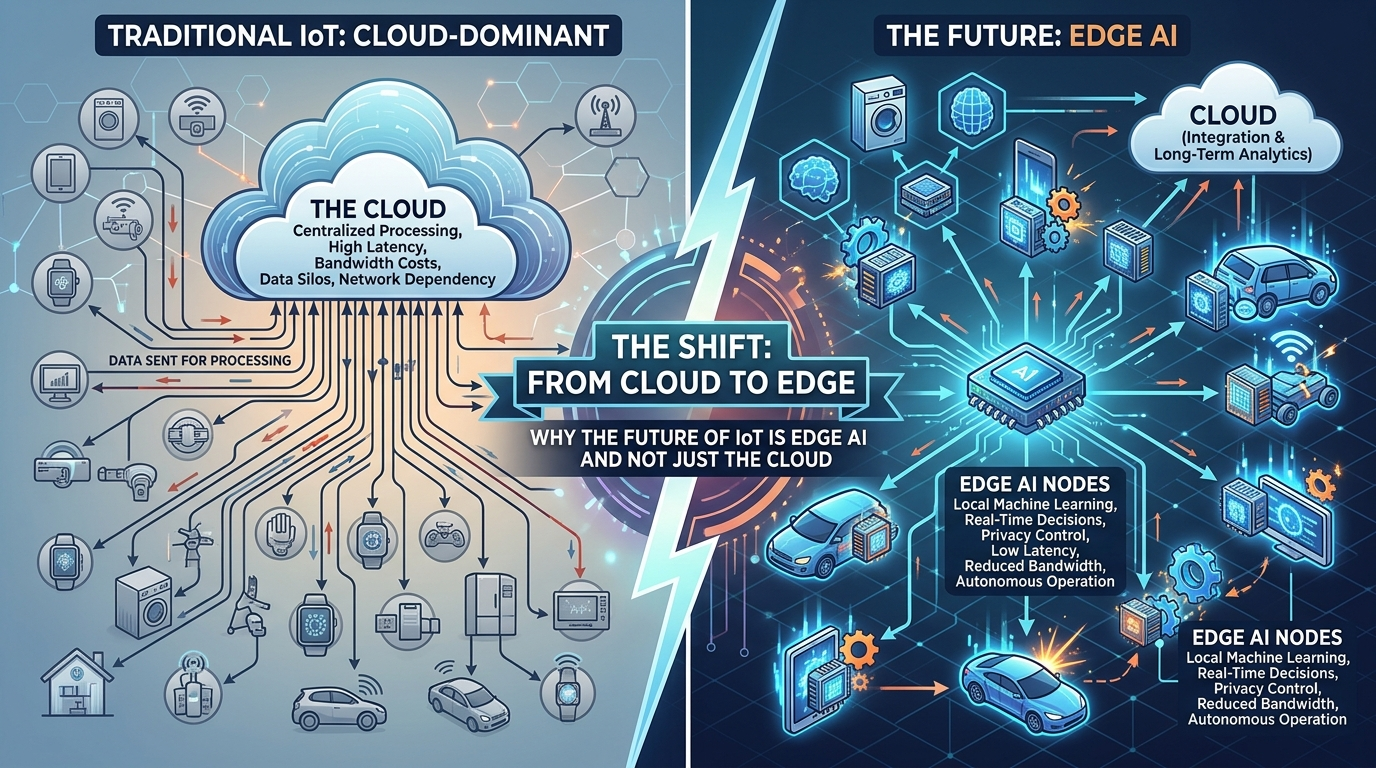
A traditional cloud architecture might operate like this:
Sensor → Internet → Cloud → AI model → Decision → Internet → Device
An Edge AI architecture can operate like this:
Sensor → Edge AI → Decision → Machine
The cloud can still receive selected information:
Sensor → Edge AI → Local decision → Relevant data → Cloud
This distinction becomes particularly important when decisions must happen in milliseconds or when connectivity is unreliable.
2. The Traditional IoT Model: Everything Goes to the Cloud
The cloud solved many of the problems associated with early IoT systems.
Cloud platforms provide:
- enormous computing capacity;
- large-scale storage;
- centralized analytics;
- machine-learning infrastructure;
- device management;
- dashboards;
- data integration;
- application development;
- security services;
- backup and disaster recovery;
- and global scalability.
A factory, for example, might have thousands of sensors producing telemetry. Instead of building a large local computing environment, the organization can transmit the data to a cloud platform.
The cloud can then:
- collect the data;
- store it;
- analyze historical trends;
- train machine-learning models;
- generate reports;
- identify anomalies;
- provide dashboards;
- coordinate operations.
This model remains highly effective for many workloads.
But it becomes less attractive when the amount of generated data becomes enormous or when decisions must be made immediately.
3. The Fundamental Problem: IoT Produces Too Much Data
One of the most important reasons for Edge AI is the data explosion.
IoT devices continuously generate information.
Consider a modern industrial environment containing:
- cameras;
- microphones;
- temperature sensors;
- vibration sensors;
- pressure sensors;
- robots;
- motors;
- electrical meters;
- machine controllers;
- environmental sensors.
A single sensor might generate manageable quantities of information.
Thousands or millions of sensors can generate enormous volumes.
The problem is that not all of this information is equally valuable.
A camera might continuously capture video, but only a tiny fraction of that video may contain an event requiring attention.
A vibration sensor might generate thousands of measurements per second, while only a small number of measurements may indicate an emerging mechanical problem.
Sending everything to the cloud can therefore be inefficient.
Edge AI provides a filtering mechanism.
Instead of transmitting everything:
Raw data → Edge AI → meaningful information → Cloud
The edge can determine:
- what matters;
- what should trigger an immediate response;
- what should be stored locally;
- what should be discarded;
- and what should be sent to the cloud.
Microsoft’s IoT Edge architecture explicitly highlights local processing as a way to reduce the amount of data sent to the cloud and support faster responses.
4. Latency: The First Major Advantage of Edge AI
Latency is the time between an event occurring and the system responding to it.
For many applications, latency matters more than raw computing power.
Imagine a machine detecting a dangerous operating condition.
A cloud-only architecture might require:
Sensor → local network → Internet → cloud → AI inference → response → machine
An edge architecture can reduce this to:
Sensor → local processor → AI inference → response
The second architecture has fewer communication steps.
This does not mean every Edge AI system automatically provides a particular millisecond response time. Actual latency depends on hardware, software, network conditions, model complexity, workload, and system architecture.
Nevertheless, processing locally can eliminate the need for a round trip to a remote cloud service.
This makes Edge AI particularly valuable for:
- industrial automation;
- robotics;
- machine monitoring;
- smart transportation;
- computer vision;
- real-time safety systems;
- interactive devices;
- telecommunications;
- and other latency-sensitive applications.
AWS identifies low latency as one of the major motivations for processing IoT workloads at the edge.
5. Offline Operation
The second major advantage is resilience when connectivity disappears.
IoT devices are frequently deployed in locations where connectivity can be:
- weak;
- intermittent;
- expensive;
- congested;
- geographically difficult;
- or completely unavailable.
Examples include:
- mines;
- farms;
- offshore facilities;
- remote industrial installations;
- ships;
- rural infrastructure;
- aircraft;
- remote energy systems;
- and field-service environments.
A cloud-dependent device can lose access to its primary intelligence when its network connection fails.
An edge-enabled device can continue performing selected tasks locally.
Microsoft specifically identifies offline operation as an important capability of edge IoT architectures, including local storage of messages that cannot immediately reach the cloud.
The resulting architecture becomes:
Connected mode
Device → Edge → Cloud
Disconnected mode
Device → Edge
Reconnected mode
Device → Edge → Cloud synchronization
This creates a much more resilient IoT system.
6. Edge AI and Bandwidth Economics
Bandwidth is another major issue.
Imagine a facility containing thousands of cameras.
Sending every video stream continuously to the cloud could require enormous network capacity.
Edge AI can analyze video locally.
Instead of transmitting continuous raw video, the system might transmit:
- detected events;
- object classifications;
- timestamps;
- selected images;
- metadata;
- alerts;
- statistical summaries.
The principle becomes:
Send intelligence rather than indiscriminately sending raw data.
This can reduce network traffic and potentially reduce cloud-storage and data-transfer costs.
Microsoft’s documentation specifically describes local processing, aggregation, and filtering as ways to reduce bandwidth requirements and avoid transferring large volumes of raw data.
7. Privacy and Data Sovereignty
Another important reason for Edge AI is data locality.
Some data is sensitive.
Examples include:
- video;
- voice;
- industrial information;
- customer information;
- location data;
- biometric information;
- proprietary manufacturing information.
A system does not necessarily need to send every raw observation to a central cloud environment.
An edge model can sometimes process sensitive information locally and transmit only the result.
For example:
Camera → local AI → “person detected” → cloud
rather than:
Camera → continuous video → cloud → AI
This does not automatically make an edge system private or secure. Edge devices themselves must be protected.
However, local processing can reduce the amount of raw information that needs to leave the environment.
8. Edge AI Changes the Architecture of IoT
Traditional IoT architecture often looked like:
                 CLOUD
        ┌─────────────────────┐
        │ Storage             │
        │ Analytics           │
        │ Machine Learning    │
        │ Applications        │
        └──────────┬──────────┘
                   │
                Internet
                   │
        ┌──────────▼──────────┐
        │ IoT Devices         │
        │ Sensors / Machines  │
        │ Cameras / Vehicles  │
        └─────────────────────┘
The emerging architecture is more distributed:
                    CLOUD
        ┌─────────────────────────┐
        │ Training                │
        │ Global Analytics        │
        │ Long-Term Storage       │
        │ Fleet Management        │
        │ Digital Twins           │
        │ Large AI Models         │
        └────────────┬────────────┘
                     │
                  NETWORK
                     │
        ┌────────────▼────────────┐
        │       EDGE             │
        │                         │
        │ AI Inference           │
        │ Data Filtering         │
        │ Local Analytics        │
        │ Event Detection        │
        │ Local Control          │
        └────────────┬────────────┘
                     │
        ┌────────────▼────────────┐
        │ IoT DEVICES             │
        │ Sensors                 │
        │ Cameras                 │
        │ Machines               │
        │ Vehicles               │
        │ Robots                 │
        └─────────────────────────┘
This is fundamentally a distributed intelligence architecture.
9. The Edge Is Not Replacing the Cloud
The phrase “Edge AI instead of the cloud” can be misleading.
The future is unlikely to be an absolute replacement of cloud computing by edge computing.
Instead, the future is increasingly hybrid.
Different workloads belong at different locations.
Device level
Best suited for:
- immediate sensing;
- simple classification;
- ultra-local control;
- tiny AI models;
- low-power inference.
Edge level
Best suited for:
- real-time inference;
- local data processing;
- computer vision;
- anomaly detection;
- local orchestration;
- gateway functions;
- operational control.
Cloud level
Best suited for:
- large-scale model training;
- enormous datasets;
- long-term storage;
- global analytics;
- fleet management;
- large AI models;
- cross-site comparisons;
- enterprise applications.
Microsoft explicitly describes IoT architectures that combine cloud and edge approaches rather than treating them as mutually exclusive.
AWS likewise describes architectures that combine device-edge processing, network-edge capabilities, and cloud AI.
The future therefore looks more like:
Cloud intelligence + Edge intelligence + Device intelligence
rather than:
Cloud versus Edge
10. Edge AI Creates a New Computing Hierarchy
The IoT computing hierarchy can increasingly be understood as a series of layers.
Layer 1 — Sensors
Sensors observe the physical world.
Examples:
- temperature;
- pressure;
- motion;
- sound;
- light;
- acceleration;
- electrical current;
- vibration;
- location.
Layer 2 — Embedded intelligence
Tiny processors perform basic processing.
Layer 3 — Edge devices
More powerful processors perform AI inference and local analytics.
Layer 4 — Network edge
Computing resources located closer to users and devices provide additional processing.
Layer 5 — Cloud
Large-scale computing provides centralized storage, training, analytics, and coordination.
Layer 6 — Enterprise applications
Business systems convert machine intelligence into operational decisions.
The architecture becomes:
Physical world → sensing → local intelligence → edge intelligence → cloud intelligence → business intelligence
This is one of the most important transformations occurring in modern computing.
11. Edge AI Hardware
The growth of Edge AI is closely connected to specialized hardware.
Traditional CPUs remain important, but AI workloads increasingly use:
- GPUs;
- NPUs;
- AI accelerators;
- neural-processing engines;
- DSPs;
- specialized inference processors;
- heterogeneous SoCs.
The goal is to perform AI computations efficiently under constraints involving:
- power;
- heat;
- memory;
- cost;
- physical size;
- and computational capacity.
A cloud data center can provide enormous computing resources and cooling.
An industrial edge device may have to operate inside a small enclosure with limited electricity.
Therefore, Edge AI hardware requires a different optimization philosophy.
The question is not simply:
“How powerful is the processor?”
It is:
“How much useful intelligence can the system produce per watt, per unit of memory, and per unit of cost?”
12. AI Model Compression Becomes Critical
Large AI models can be computationally expensive.
Edge devices therefore often require optimized models.
Important techniques include:
Quantization
Reducing numerical precision used by model parameters.
Pruning
Removing portions of a model that contribute relatively little to its performance.
Knowledge distillation
Training a smaller model to reproduce useful behavior learned by a larger model.
Model architecture optimization
Designing neural networks specifically for resource-constrained environments.
Hardware acceleration
Using specialized processors to execute AI operations efficiently.
The result is an important distinction:
Cloud AI can prioritize scale.
Edge AI must prioritize efficiency.
13. Edge AI and Computer Vision
Computer vision is one of the strongest applications for Edge AI.
A smart camera can perform local inference for tasks such as:
- object detection;
- classification;
- counting;
- movement detection;
- equipment inspection;
- quality control;
- traffic analysis;
- agricultural monitoring.
Instead of transmitting every image to a cloud service, the camera or nearby edge computer can identify relevant events locally.
Microsoft’s Edge AI architecture examples include image classification, object detection, gesture analysis, and related machine-learning inference workloads.
This transforms cameras from passive data-collection devices into intelligent sensing systems.
14. Smart Manufacturing
Manufacturing may become one of the most important Edge AI environments.
Modern factories contain:
- robots;
- programmable logic controllers;
- machine tools;
- cameras;
- motors;
- conveyors;
- sensors;
- industrial networks.
Edge AI can monitor these systems continuously.
Potential applications include:
Predictive maintenance
AI analyzes vibration, temperature, sound, electrical behavior, and other signals to identify abnormal patterns.
Quality inspection
Computer vision examines products as they move through production.
Process optimization
AI analyzes production conditions and identifies opportunities for improved efficiency.
Anomaly detection
Models identify unusual machine behavior.
Local automation
Edge systems can make operational decisions without waiting for a remote cloud response.
The factory consequently becomes a form of distributed computer.
15. Agriculture and Edge AI
Agriculture is another powerful Edge AI environment.
A smart farm can contain:
- soil sensors;
- weather stations;
- cameras;
- irrigation controllers;
- drones;
- tractors;
- livestock-monitoring systems;
- pumps;
- greenhouse systems.
Edge AI can process information locally.
For example:
Camera → Edge AI → crop condition detected → irrigation or inspection workflow
The cloud can then store long-term information and compare conditions across fields and seasons.
This is particularly important in rural environments where connectivity may be less reliable.
16. Connected Vehicles
Vehicles are essentially mobile IoT platforms.
A modern vehicle can contain large numbers of sensors monitoring:
- cameras;
- radar;
- vehicle dynamics;
- temperature;
- engine systems;
- battery systems;
- driver interaction;
- positioning;
- surrounding objects.
Some vehicle decisions cannot depend on a remote cloud round trip.
The vehicle therefore requires local computing.
The cloud remains useful for:
- fleet analytics;
- software updates;
- mapping;
- long-term data analysis;
- model development;
- fleet management.
The vehicle becomes a powerful example of the hybrid architecture:
Vehicle Edge AI + Network + Cloud AI
17. Robotics
Robots need to perceive their environment and respond to it.
A robot that must constantly send sensor information to a remote cloud before every action could become unnecessarily dependent on network conditions.
Local AI enables robots to:
- interpret sensor information;
- identify objects;
- estimate environmental conditions;
- recognize patterns;
- coordinate movements;
- respond to local changes.
Cloud computing can still provide:
- centralized fleet management;
- model training;
- historical analysis;
- software updates;
- multi-robot coordination.
Thus, Edge AI can give robots a degree of local intelligence while the cloud provides organizational intelligence.
18. Energy Systems
The energy sector increasingly relies on distributed infrastructure.
Examples include:
- solar farms;
- wind turbines;
- batteries;
- smart meters;
- substations;
- electric vehicles;
- microgrids.
Edge AI can monitor equipment locally and identify unusual behavior.
For remote installations, local inference can be especially useful because continuous high-bandwidth connectivity may not be practical.
Microsoft has highlighted edge AI scenarios involving remote environments such as wind and oil installations, where network conditions can make local inference attractive.
19. Smart Cities
A smart city can contain millions of data-producing endpoints.
Examples include:
- traffic cameras;
- parking sensors;
- environmental sensors;
- public transport systems;
- street infrastructure;
- electricity systems;
- water systems.
Centralized cloud processing remains valuable for citywide analytics.
But Edge AI can handle immediate local events.
For example:
Traffic camera → local AI → traffic condition detected → local traffic-control system
The city therefore becomes a distributed intelligence platform.
20. Telecommunications and 5G
Edge computing is closely associated with modern telecommunications.
5G networks can support computing closer to users through multi-access edge computing (MEC) architectures.
This can enable:
- lower-latency applications;
- industrial connectivity;
- intelligent video;
- connected vehicles;
- immersive applications;
- robotics;
- enterprise IoT.
AWS describes edge infrastructure as extending beyond conventional data centers into locations such as metro areas, 5G networks, on-premises environments, and ruggedized devices.
The telecommunications network therefore becomes more than a transport mechanism.
It can become a distributed computing platform.
21. Edge AI and the Evolution of Data Centers
Edge AI does not eliminate data centers.
Instead, it changes the role of data centers.
Traditional cloud data centers perform much of the intelligence centrally.
Future architectures distribute intelligence across:
Hyperscale data centers
↓
Regional data centers
↓
Telecommunications edge
↓
Enterprise edge
↓
Industrial edge
↓
Device edge
This creates a hierarchy of computing resources.
The data center becomes the center of gravity for large-scale intelligence, while the edge becomes the center of gravity for immediate intelligence.
22. The Edge Becomes an AI Inference Layer
One of the most important distinctions is between AI training and AI inference.
Training generally requires enormous computational resources and large datasets.
Inference means using a trained model to generate predictions or classifications.
This creates a natural architectural separation:
Cloud
- collect data;
- train models;
- evaluate models;
- maintain model repositories;
- manage fleets.
Edge
- deploy models;
- perform inference;
- detect events;
- make local decisions;
- filter data.
This does not mean all training must occur in the cloud, but cloud and centralized infrastructure are generally well suited to large-scale training.
23. Continuous Learning: Edge and Cloud Working Together
The most advanced systems can create a continuous feedback loop.
A simplified architecture is:
1. Edge collects observations
↓
2. Edge performs inference
↓
3. Important information goes to cloud
↓
4. Cloud analyzes large datasets
↓
5. Engineers/data scientists improve the model
↓
6. New model is validated
↓
7. Updated model is deployed to edge devices
↓
8. Edge performs improved inference
This creates a cycle:
Observe → Infer → Learn → Update → Infer
The intelligence of the IoT system can therefore improve over time.
24. Model Management Becomes a Major Challenge
Deploying one AI model onto one device is relatively straightforward.
Deploying updated models across thousands or millions of devices is much harder.
Organizations must manage:
- model versions;
- hardware compatibility;
- deployment policies;
- security;
- rollback mechanisms;
- model validation;
- update scheduling;
- bandwidth;
- device availability.
Microsoft’s IoT Edge architecture uses containerized modules and cloud-based management to deploy and monitor workloads across edge devices.
This illustrates a larger principle:
Edge AI is not merely an AI problem. It is an AI + software engineering + hardware + networking + fleet-management problem.
25. Security at the Edge
Edge computing also introduces new security challenges.
A cloud data center is physically controlled by its operator.
An edge device may be installed:
- outdoors;
- inside a factory;
- on a vehicle;
- in a farm;
- inside a shop;
- at a remote station.
Physical access can therefore be more difficult to control.
Security must address:
- device identity;
- secure boot;
- encryption;
- authentication;
- software integrity;
- hardware security;
- access control;
- secure updates;
- network segmentation;
- monitoring;
- compromised-device detection.
Edge gateways can also create security boundaries between operational technology and wider networks. Microsoft describes gateway architectures that can isolate downstream devices while providing controlled connectivity to cloud services.
26. The Edge Creates a Distributed Security Problem
Cloud security traditionally protects centralized infrastructure.
Edge security must protect potentially enormous numbers of geographically distributed devices.
The security equation therefore becomes:
Security = Cloud + Network + Edge + Device + Physical Environment
Every additional edge node becomes another computing endpoint that must be:
- identified;
- authenticated;
- updated;
- monitored;
- protected.
This makes device lifecycle management essential.
27. Reliability Becomes a Distributed-System Problem
Edge AI introduces another important engineering challenge: distributed systems.
Instead of one central computing environment, organizations may have thousands of computing nodes.
Those nodes can experience:
- power failures;
- hardware failures;
- network failures;
- software failures;
- storage failures;
- model failures;
- synchronization problems.
A robust architecture therefore needs:
- local fallback behavior;
- health monitoring;
- automatic recovery;
- redundant systems where necessary;
- secure remote management;
- data synchronization;
- staged software deployment.
The edge must be designed not merely to be intelligent, but to be operationally dependable.
28. Edge AI and Digital Twins
Digital twins create another important relationship between edge and cloud.
A digital twin represents a physical object, machine, building, process, or environment in software.
The edge can provide real-time information from the physical asset.
The cloud can maintain broader historical and analytical representations.
The architecture becomes:
Physical Asset
↕
Edge Intelligence
↕
Network
↕
Cloud Digital Twin
The edge handles immediate reality.
The cloud maintains broader organizational understanding.
29. Edge AI and Generative AI
The rise of generative AI introduces a new question:
Can generative AI move to the edge?
The answer is increasingly yes—but with important limitations.
Large generative models can require substantial:
- memory;
- compute;
- power;
- storage;
- and bandwidth.
Smaller models can be optimized for local devices.
This creates several possible architectures:
Small model on device
For simple tasks.
Medium model at the edge
For more sophisticated local reasoning.
Large model in the cloud
For complex workloads.
The architecture becomes:
Small AI → Edge AI → Cloud AI
This layered model may become increasingly important as AI moves into:
- vehicles;
- industrial machines;
- smartphones;
- robots;
- appliances;
- wearable devices;
- cameras.
30. Edge AI and the Internet of Everything
IoT originally emphasized connected devices.
Edge AI changes the concept from:
Connected things
to:
Intelligent connected things
A conventional sensor says:
“Temperature = X.”
An intelligent sensor can potentially say:
“Temperature is abnormal relative to historical operating conditions.”
A conventional camera produces images.
An AI-enabled camera can identify events.
A conventional machine produces telemetry.
An Edge AI machine can identify abnormal behavior.
This is the transition from data-generating IoT to decision-making IoT.
31. The Economic Argument for Edge AI
The business case for Edge AI usually involves several factors.
Reduced bandwidth
Less raw data needs to travel to centralized infrastructure.
Reduced cloud processing
Some inference happens locally.
Faster response
Local processing can reduce network round trips.
Improved resilience
Systems can continue functioning during connectivity interruptions.
Data locality
Some information can remain close to where it is generated.
Operational efficiency
Machines can react to local conditions more quickly.
However, Edge AI also introduces costs:
- edge hardware;
- device management;
- maintenance;
- software deployment;
- security;
- model optimization;
- physical infrastructure.
Therefore, Edge AI should not be adopted simply because it is fashionable.
It should be deployed where local intelligence provides measurable value.
32. Edge AI’s Limitations
Edge AI is not a universal solution.
Limited compute
An edge device generally cannot match the computing resources of a hyperscale data center.
Limited memory
Large models can be difficult to deploy.
Energy constraints
Battery-powered devices require highly efficient models.
Hardware diversity
Different edge devices may use different processors and operating systems.
Security complexity
Thousands of distributed devices create a larger attack surface.
Management complexity
Updating a fleet can be challenging.
Model fragmentation
Different devices may require different model versions.
Physical maintenance
Edge hardware exists in the physical world and can fail.
The best architecture therefore places each workload where it is technically and economically appropriate.
33. The Future Is a Three-Layer AI Architecture
The long-term architecture of IoT may increasingly consist of three major intelligence layers.
1. Device AI
The smallest and fastest layer.
Purpose:
- immediate perception;
- simple classification;
- local control.
2. Edge AI
The intermediate intelligence layer.
Purpose:
- more complex inference;
- local analytics;
- orchestration;
- data filtering;
- operational decision-making.
3. Cloud AI
The largest intelligence layer.
Purpose:
- large-scale training;
- global analytics;
- complex reasoning;
- long-term knowledge;
- enterprise coordination.
This creates:
Device AI → Edge AI → Cloud AI
and information can flow in both directions.
34. Why the Future of IoT Is Becoming Edge-Centric
Several major technology trends reinforce the shift toward edge intelligence.
AI is becoming smaller
Model optimization makes increasingly sophisticated AI possible on constrained hardware.
Hardware is becoming more capable
Specialized AI accelerators are appearing across embedded and edge platforms.
Sensors are becoming smarter
Sensors increasingly include local processing capabilities.
Networks are becoming faster
5G and advanced networking reduce the friction between devices and edge infrastructure.
Cloud-edge management is improving
Cloud platforms increasingly provide tools for deploying and managing edge workloads.
Data volumes are increasing
More data makes indiscriminate transmission increasingly inefficient.
Real-time applications are expanding
Robotics, industrial automation, transportation, and other systems increasingly require immediate decisions.
Together, these trends create favorable conditions for Edge AI.
35. A New Philosophy: Compute Where the Data Is
The traditional computing philosophy was:
Move data to compute.
Cloud computing accelerated this model.
The emerging edge philosophy is:
Move compute toward the data.
This is a fundamental architectural change.
Instead of asking:
“How do we send all this data to the cloud?”
engineers increasingly ask:
“Which intelligence should happen where the data originates?”
That question is at the heart of Edge AI.
36. The Future IoT Architecture
A mature future IoT system could look like this:
                         GLOBAL CLOUD
              ┌────────────────────────────┐
              │ Foundation / Large AI      │
              │ Model Training             │
              │ Global Analytics            │
              │ Long-Term Storage          │
              │ Digital Twins              │
              │ Enterprise Systems         │
              └──────────────┬─────────────┘
                             │
                       Regional Edge
              ┌──────────────▼─────────────┐
              │ Regional AI                │
              │ Data Processing             │
              │ Model Distribution          │
              │ Network Services            │
              └──────────────┬─────────────┘
                             │
                        Local Edge
              ┌──────────────▼─────────────┐
              │ Edge AI                    │
              │ Computer Vision             │
              │ Anomaly Detection           │
              │ Local Analytics             │
              │ Local Control               │
              └──────────────┬─────────────┘
                             │
                         DEVICE AI
              ┌──────────────▼─────────────┐
              │ Sensors                     │
              │ Cameras                     │
              │ Robots                      │
              │ Vehicles                    │
              │ Machines                    │
              └────────────────────────────┘
This is not simply an IoT network.
It is a distributed AI ecosystem.
37. Edge AI as the Nervous System of Machines
A useful analogy is the human nervous system.
The brain performs complex reasoning, but not every physical response requires conscious processing by the brain.
Local nervous-system mechanisms allow rapid responses.
Similarly, future machines may have:
- device-level reflexes;
- edge-level intelligence;
- cloud-level intelligence.
The cloud becomes something like a global knowledge and coordination center.
The edge becomes local intelligence.
The device becomes perception and immediate interaction with the physical world.
This analogy helps explain why centralized cloud computing alone is unlikely to represent the complete future of IoT.
38. Strategic Implications for Businesses
Organizations planning IoT strategies should stop asking only:
“Which cloud platform should we use?”
They should also ask:
- Which decisions require real-time responses?
- Which data should remain local?
- Which information should be transmitted to the cloud?
- What happens when connectivity fails?
- Which AI models can run locally?
- What edge hardware is appropriate?
- How will models be updated?
- How will devices be secured?
- How will thousands of devices be managed?
- What workloads genuinely require cloud-scale computing?
The correct architecture is likely to be a combination of cloud, edge, network, and device computing.
39. The Role of Major Technology Platforms
The major cloud ecosystems are increasingly building technologies around this hybrid model.
Microsoft’s Azure IoT architecture supports both cloud-connected and edge-connected approaches, including local processing and edge applications.
AWS similarly provides edge technologies designed for IoT, industrial environments, 5G, and machine learning.
The significance of these developments is larger than individual products.
They indicate that the architecture of computing itself is becoming distributed.
Cloud providers are no longer concerned only with computing inside their own data centers.
They increasingly need to provide infrastructure that extends:
from the hyperscale data center
to the network
to the enterprise
to the factory
to the vehicle
to the individual device.
40. The Ultimate Transformation: From IoT to Intelligent Edge
The first generation of IoT was largely about connectivity.
The second generation became increasingly about data.
The next generation is increasingly about intelligence.
The progression can be summarized as:
IoT 1.0
Connect things.
↓
IoT 2.0
Collect data from things.
↓
IoT 3.0
Analyze connected data.
↓
IoT 4.0
Put AI into connected things.
↓
Intelligent Edge
Enable connected things to perceive, understand, decide, and act locally.
This is the deeper significance of Edge AI.
Conclusion
The future of IoT will not be defined by a simple migration from cloud computing to edge computing.
Instead, it will be defined by the distribution of intelligence.
The cloud will continue to perform tasks that benefit from enormous computational resources, centralized data, large-scale model training, historical analysis, enterprise integration, and global coordination.
But the edge will increasingly perform tasks where time, locality, resilience, bandwidth, privacy, and immediate decision-making matter.
The most important transformation is therefore not:
Cloud → Edge
It is:
Cloud + Edge + Device → Distributed AI
IoT devices are evolving from passive sensors into intelligent machines. Cameras can interpret what they see. Industrial systems can identify anomalies. Vehicles can process their environments. Agricultural equipment can respond to field conditions. Robots can interpret local surroundings. Energy infrastructure can analyze its own behavior.
The cloud remains the enormous intelligence center.
But the edge becomes the local intelligence layer that connects digital intelligence to the physical world.
The long-term architecture of computing is consequently likely to look less like one giant centralized brain and more like a distributed nervous system: millions or billions of intelligent endpoints, connected through increasingly capable networks, coordinated by edge infrastructure, and supported by enormous cloud data centers.
That is why the future of IoT is not simply about putting more devices into the cloud.
It is about putting intelligence where the action happens.
Key takeaway
The cloud will remain the center of large-scale AI, but the edge is becoming the center of real-time AI. The future IoT ecosystem will be strongest when cloud intelligence, edge intelligence, and device intelligence work together.
Selected technical references
- Microsoft Azure IoT documentation — Overview of cloud-connected and edge-connected IoT architectures.
- Microsoft Azure IoT Edge documentation — Local processing, offline operation, and edge deployment.
- Microsoft Edge AI inference architecture — Examples of machine-learning inference at the edge.
- AWS IoT Edge Computing guidance — Edge computing architecture and use cases.
- AWS Edge Computing — Edge infrastructure across IoT, 5G, enterprise, and rugged environments.




Be First to Comment