
Abstract
Modern civilization depends on an extraordinary communications infrastructure that is largely invisible to the public: the global network of submarine telecommunications cables lying across the floors of the world’s oceans. These cables form the physical foundation of international digital connectivity, linking continents, countries, data centers, financial markets, cloud platforms, governments, businesses, universities, and billions of Internet users.
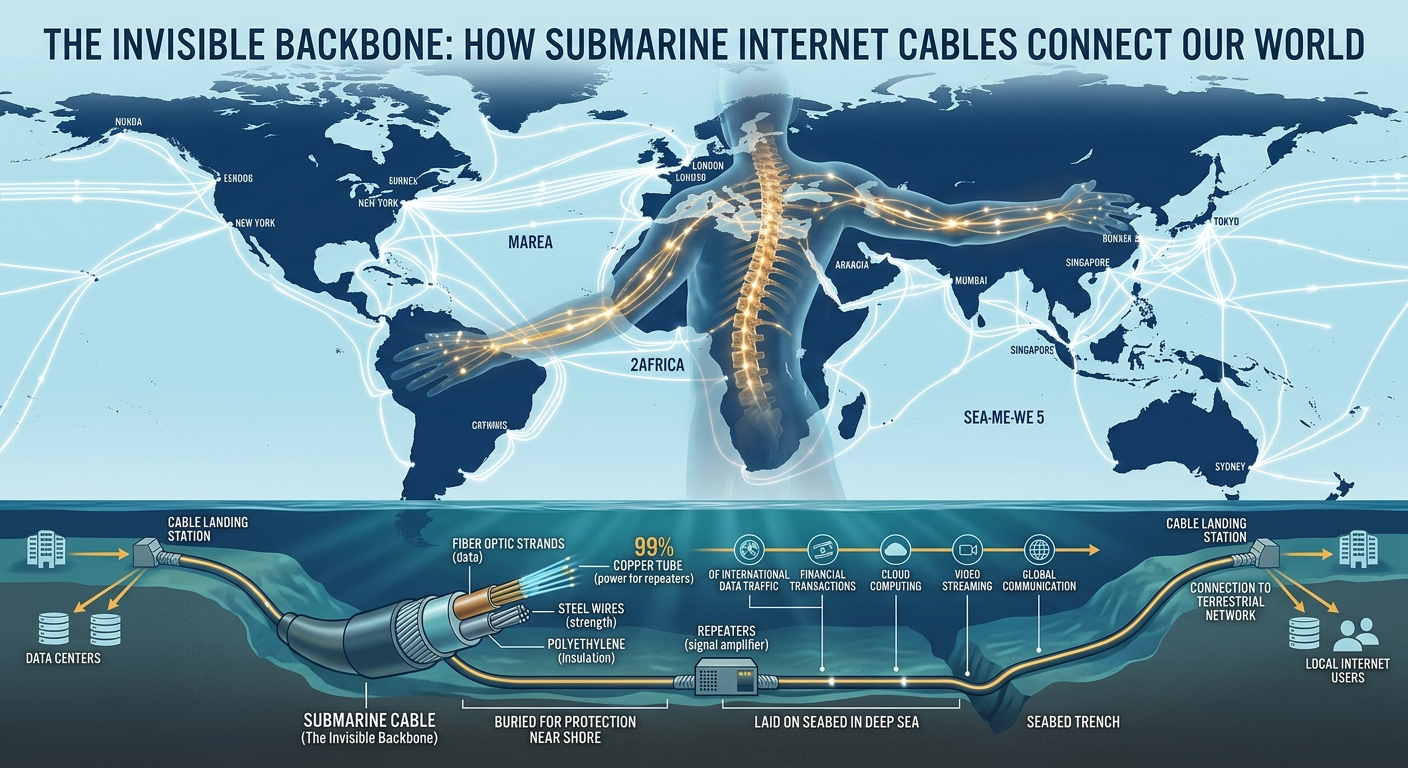
Contrary to the common perception that the Internet is primarily powered by satellites, wireless networks, or data centers, the overwhelming majority of international Internet traffic travels through optical-fibre submarine cables. The International Telecommunication Union (ITU) states that submarine cables carry more than 99% of international data flows. Its 2025 Global Connectivity Report describes submarine cables as the “hidden backbone” of global data.
The scale of this infrastructure continues to expand. TeleGeography’s 2026 Submarine Cable Map identifies 694 cable systems and 1,893 landing stations across active and planned networks. Meanwhile, the International Cable Protection Committee (ICPC) reports that the global length of submarine telecommunications cables reached approximately 1.7 million kilometres in 2025.
This thesis examines the anatomy, history, engineering, economics, geography, ownership, operation, risks, security implications, environmental considerations, and future evolution of submarine Internet cables. It argues that these cables should be understood not merely as telecommunications infrastructure, but as strategic infrastructure comparable in importance to electricity grids, transportation networks, ports, and other foundations of the global economy.
1. Introduction
The Internet appears almost weightless.
A person in Johannesburg can send a message to someone in London within seconds. A student can access a university resource hosted on another continent. A business can communicate with customers thousands of kilometres away. A bank can process an international transaction almost instantaneously. A cloud application can retrieve information from a distant data centre without the user knowing where the underlying computers are located.
This apparent immateriality is deceptive.
Behind almost every international digital interaction is a physical infrastructure consisting of fibre-optic cables, terrestrial networks, routers, switches, landing stations, data centres, exchange points, power systems and satellites.
Among these components, submarine cables are particularly important.
They cross oceans and seas, connecting continents through optical fibres. They are manufactured on land, loaded onto specialized cable ships, transported across oceans, carefully laid on the seabed and connected to terrestrial telecommunications networks at landing stations.
The result is an enormous planetary communications system.
The ITU identifies submarine cables as the backbone of global communications and notes that disruptions can affect finance, cloud computing, government communications, healthcare, education and other critical services.
The fundamental research question of this thesis is therefore:
How do submarine Internet cables connect the world, and why have they become one of the most strategically important components of modern civilization?
2. The Central Thesis
The central argument is that the Internet is simultaneously:
- a digital system,
- a computational system,
- an electrical system,
- a terrestrial communications system,
- a wireless system,
- a satellite system, and
- an ocean-spanning physical infrastructure.
Submarine cables connect the seventh component to the others.
Without them, the global Internet would become fragmented into geographically separated networks with much greater dependence on alternative communications routes.
The modern Internet therefore has a physical geography.
Data does not simply “go to the cloud.” It travels through infrastructure.
A typical international communication may involve:
User device → Wi-Fi/mobile network → local ISP → terrestrial fibre → cable landing station → submarine cable → international landing station → terrestrial fibre → data centre/cloud network → destination
This physical chain explains why geography, oceans, coastlines, ports, landing stations and political jurisdictions remain important even in an increasingly digital world.
3. What Is a Submarine Internet Cable?
A submarine Internet cable is a telecommunications cable installed beneath the surface of a body of water to carry digital information between geographically separated locations.
Modern systems primarily use optical fibre.
Instead of transmitting Internet information as conventional electrical signals over copper for thousands of kilometres, optical-fibre systems transmit information as pulses or patterns of light through extremely thin glass fibres.
A simplified architecture is:
Digital data
↓
Electrical/optical conversion
↓
Laser transmitter
↓
Optical fibre
↓
Undersea cable
↓
Optical amplification
↓
Optical fibre
↓
Receiver
↓
Electrical/digital processing
↓
Destination network
The cable itself is therefore much more than a simple wire. It is a highly engineered system designed to maintain optical transmission across enormous distances while protecting delicate fibre from the marine environment.
4. The Anatomy of a Submarine Cable
A submarine telecommunications cable contains several functional layers.
4.1 Optical fibres
At the centre are optical fibres made primarily from extremely pure glass.
These fibres carry information using light.
A single cable may contain multiple fibre pairs, with each pair consisting of fibres used for transmission in opposite directions or through carefully engineered configurations.
The extraordinary information-carrying capability of fibre comes from the enormous frequency range available in optical communication.
4.2 Fibre coating
The glass fibre is surrounded by protective coatings.
These layers protect the optical fibre from mechanical stress and environmental exposure during manufacturing, installation and operation.
4.3 Strength members
Cables require mechanical reinforcement because they must withstand significant forces during deployment.
Strength members help the cable tolerate tension, bending and handling.
4.4 Electrical conductor
Although information is transmitted optically, submarine systems also require electrical power.
The cable contains a conductor that supplies power to undersea repeaters and related equipment.
This illustrates an important principle:
Modern submarine communications combine optical information transmission with electrical power delivery.
4.5 Insulation and protective layers
Insulating materials separate the electrical conductor from surrounding components.
Additional protective layers provide resistance against the underwater environment.
4.6 Armour
Cables operating in shallow waters may receive additional armour.
Near coastlines, seabeds can be exposed to:
- fishing equipment,
- anchors,
- ship activity,
- seabed construction,
- geological movement.
Armoured cables are therefore substantially different from lightweight deep-ocean cable designs.
In very deep ocean environments, the cable may require less mechanical protection because human activity is much less common there.
The design philosophy is consequently:
more environmental protection where risk is high; less weight where risk is low.
5. How Data Travels Through the Ocean
The fundamental technology is optical communications.
Suppose a user sends a digital message internationally.
The original information exists as digital bits.
Network equipment processes those bits and ultimately converts the information into optical signals.
A laser generates the optical transmission.
The signal enters an optical fibre.
The light then travels through the fibre inside the submarine cable.
Because optical fibre has very low transmission loss compared with many conventional communication media, information can travel enormous distances.
However, the signal still loses strength and experiences optical impairments over very long distances.
This is where repeaters become essential.
6. Submarine Repeaters
Submarine repeaters are specialized optical amplification systems installed at intervals along long-distance cables.
Their function is to compensate for transmission losses and maintain signal quality.
A simplified chain is:
Transmitter → Fibre → Repeater → Fibre → Repeater → Fibre → Repeater → Receiver
The repeater does not simply act like an ordinary household signal booster.
It is part of an extremely sophisticated optical transmission architecture designed to operate reliably under deep-ocean conditions for many years.
Modern systems can therefore transport extraordinary quantities of information across oceans without requiring a computer to physically regenerate every individual Internet packet at every stage.
7. From Telegraph Cables to the Internet
Submarine telecommunications are not a recent invention.
Their history reaches back to the age of the electric telegraph.
During the nineteenth century, engineers began developing submarine telegraph cables capable of connecting countries separated by oceans.
The transatlantic telegraph cable represented a major transformation in global communication.
Before such systems existed, international communication could take days or weeks.
Submarine telegraphy dramatically reduced communication time.
The basic technological idea evolved through several stages:
Telegraph
↓
Submarine telegraph cables
↓
Telephone cables
↓
Coaxial submarine systems
↓
Optical-fibre submarine cables
↓
Modern high-capacity Internet cables
The underlying principle remained constant:
Build a physical communications path across the ocean.
The information carried by that path changed dramatically.
8. The Transition to Optical Fibre
The development of optical fibre transformed submarine telecommunications.
Copper-based systems had significant limitations in bandwidth and signal transmission.
Optical fibre offered enormous improvements.
The technology enabled:
- much higher bandwidth,
- lower transmission loss,
- longer distances,
- wavelength-division multiplexing,
- greater scalability,
- improved economics per transmitted bit.
The development of dense wavelength-division multiplexing was particularly important.
Instead of treating one optical fibre as a single information channel, engineers could transmit multiple wavelengths of light simultaneously.
Conceptually:
λ1 + λ2 + λ3 + λ4 + … + λn
can travel through the same fibre.
Each wavelength can carry its own high-speed data stream.
This dramatically increases the capacity of the physical fibre.
9. The Global Cable Network
The global submarine cable system resembles a planetary transportation network.
There are major corridors across:
- the Atlantic Ocean,
- Pacific Ocean,
- Indian Ocean,
- Mediterranean Sea,
- Red Sea,
- Arabian Sea,
- South China Sea,
- Southeast Asian waters,
- African coastal waters,
- Latin American waters.
TeleGeography’s 2026 map records 694 cable systems and 1,893 landing stations for active and planned systems.
The network is therefore not one giant cable.
It is an interconnected collection of systems.
This distinction is crucial.
A country may have several submarine cables connecting it to different regions.
This creates route diversity.
If one system becomes unavailable, traffic may potentially be redirected through another system.
10. Cable Landing Stations
The submarine cable does not simply emerge from the sea and connect directly to a user’s computer.
It terminates at a specialized facility called a cable landing station.
A simplified structure is:
Ocean
↓
Submarine cable
↓
Beach/manhole or coastal infrastructure
↓
Cable landing station
↓
Optical transmission equipment
↓
Terrestrial fibre
↓
Internet exchange/carrier network
↓
Data centre
↓
Internet
Landing stations are therefore strategic transition points between maritime and terrestrial communications.
They are among the most important pieces of infrastructure in the global Internet.
11. Why Cable Geography Matters
The geography of submarine cables influences the geography of digital economies.
A country located close to major cable routes may have an advantage in:
- international bandwidth,
- cloud connectivity,
- data-centre development,
- financial services,
- telecommunications,
- content delivery,
- digital commerce.
This is one reason cable landing locations can become strategic technology hubs.
The relationship between cables and data centres is increasingly important.
TeleGeography notes that submarine cable routing decisions are connected with cloud-region expansion because cable routes influence locations where large amounts of inter-data-centre bandwidth can be developed.
12. The Rise of Hyperscale Technology Companies
Historically, submarine cables were strongly associated with telecommunications operators and international carriers.
The economics have changed.
Large technology companies now have enormous requirements for international bandwidth.
Companies operating:
- search engines,
- video platforms,
- cloud computing,
- social networks,
- AI services,
- content delivery networks,
can generate extraordinary quantities of international data traffic.
As a result, major technology companies increasingly participate in submarine cable investment.
TeleGeography reported that Google and Meta had invested in numerous submarine cable systems by 2024, reflecting the growing role of large content providers in international infrastructure.
This represents a fundamental change in Internet infrastructure.
The companies providing digital services are increasingly involved in building the physical infrastructure needed to deliver those services.
13. Submarine Cables and Cloud Computing
Cloud computing depends heavily on network connectivity.
Consider a cloud service.
A user’s application may communicate with:
- a data centre,
- an authentication service,
- a storage system,
- a database,
- an AI inference platform,
- a content delivery network.
If these systems are distributed internationally, large quantities of information may cross national and continental boundaries.
Submarine cables provide the underlying international transport.
Thus:
Cloud computing + data centres + terrestrial networks + submarine cables
form an integrated digital infrastructure.
A cloud without connectivity is not a useful global cloud.
14. Submarine Cables and Artificial Intelligence
The rise of artificial intelligence adds another dimension.
Modern AI ecosystems require enormous data flows among:
- data centres,
- cloud platforms,
- model-training infrastructure,
- inference systems,
- research laboratories,
- users,
- enterprise applications.
AI models may be trained in one geographic location and accessed by users around the world.
The resulting traffic must travel through networks.
Consequently, the AI economy is increasingly dependent not only on:
GPUs + electricity + data centres + models
but also on:
high-capacity global connectivity.
Submarine cables therefore form part of the physical infrastructure underlying the worldwide AI economy.
15. Why Satellites Cannot Simply Replace Submarine Cables
Satellites are extremely important for connectivity.
They provide valuable services for:
- remote regions,
- maritime communications,
- emergency connectivity,
- aviation,
- disaster recovery,
- areas without terrestrial infrastructure.
However, submarine fibre remains dominant for massive international data transmission.
The reason is capacity and economics.
Fibre-optic cables can carry enormous quantities of data simultaneously across major routes.
Satellites operate under different physical and economic constraints.
The future is therefore not necessarily:
cables versus satellites.
It is:
cables + terrestrial fibre + wireless + satellites.
These systems are complementary.
The ITU explicitly describes submarine cables and satellites as complementary components of the global connectivity fabric.
16. The Economics of Submarine Cables
A submarine cable project is a major infrastructure investment.
Costs can include:
- system design,
- fibre and cable manufacturing,
- repeaters,
- optical equipment,
- cable ships,
- marine surveys,
- route engineering,
- landing stations,
- permitting,
- insurance,
- installation,
- testing,
- maintenance,
- terrestrial backhaul.
The economic life of a cable can extend over many years.
Investment decisions therefore require long-term analysis.
Operators must estimate:
- expected demand,
- route utilization,
- competing cables,
- geopolitical risk,
- maintenance costs,
- landing-station costs,
- financing,
- technological evolution.
17. The Business Model
Several parties may participate in a cable project.
These can include:
- telecommunications companies,
- governments,
- infrastructure investors,
- cloud companies,
- technology companies,
- international carriers,
- development institutions.
A cable can therefore operate as a consortium project or under a more concentrated ownership model.
The ownership structure matters because it determines:
- who finances construction,
- who receives capacity,
- who controls operations,
- who manages maintenance,
- how investment risk is distributed.
18. Cable Manufacturing
Submarine cables are produced in highly specialized manufacturing facilities.
The production process involves:
- preparing optical fibres,
- assembling fibre units,
- integrating strength members,
- adding electrical components,
- applying protective layers,
- applying armour where necessary,
- testing mechanical and optical performance,
- storing and loading the finished cable onto cable ships.
Quality control is essential.
A manufacturing defect can become extremely expensive if discovered after deployment in the ocean.
19. Route Planning
Before a cable is installed, engineers must understand the seabed.
They study:
- water depth,
- seabed geology,
- geological hazards,
- existing cables,
- pipelines,
- shipping routes,
- fishing activity,
- environmental conditions,
- coastal infrastructure.
The objective is to identify a route that balances:
distance + cost + safety + environmental impact + connectivity requirements.
The shortest route is not necessarily the best route.
A slightly longer route may be preferable if it avoids areas of significant hazard.
20. Cable-Laying Ships
Specialized ships install submarine cables.
A cable ship carries enormous quantities of cable in large storage tanks.
During deployment, the vessel moves along a predetermined route while carefully paying cable into the water.
The cable sinks toward the seabed.
Engineers continuously monitor:
- vessel position,
- cable tension,
- cable speed,
- water depth,
- seabed conditions,
- cable geometry.
This is a remarkable engineering operation.
A mistake during deployment can damage the cable or cause it to settle incorrectly.
21. Deep Ocean Versus Coastal Zones
One of the most important principles in cable engineering is that risk changes dramatically with depth.
Deep-ocean regions are relatively protected from many human activities.
Near coastlines, however, there may be:
- fishing,
- anchors,
- dredging,
- construction,
- pipelines,
- offshore energy infrastructure,
- intense shipping.
Therefore, cable protection tends to be greatest where human activity is greatest.
Some cables are buried beneath the seabed in vulnerable areas.
22. Cable Burial
Burial provides additional protection.
A specialized underwater plough or remotely operated equipment can place the cable beneath the seabed.
The objective is to reduce the probability that:
- fishing equipment,
- anchors,
- seabed equipment,
will directly contact the cable.
The required burial depth depends on local conditions and risk assessment.
23. The Major Causes of Cable Damage
Submarine cables are remarkably reliable considering their scale.
However, failures occur.
The ICPC reports that approximately 70–80% of cable faults are caused by accidental human activities, particularly fishing and ship anchors. It also reports that global cable length has expanded to approximately 1.7 million kilometres while annual fault numbers have remained broadly around 150–200 incidents.
Important causes include:
Human activity
- fishing equipment,
- anchors,
- seabed construction,
- dredging.
Natural hazards
- earthquakes,
- underwater landslides,
- volcanic activity,
- seabed movement.
Technical problems
- component failure,
- ageing,
- manufacturing defects.
Other risks
- complex geopolitical circumstances,
- concentrated routes,
- accidental damage during marine operations.
The key lesson is that not every cable failure is intentional.
Accidental physical damage remains the predominant category.
24. What Happens When a Cable Breaks?
A cable break can disrupt communications along the affected route.
However, the Internet is designed as a distributed network.
If alternative paths exist, network operators can reroute traffic.
The result may be:
Cable failure
↓
Network detects loss
↓
Traffic engineering identifies alternatives
↓
Traffic is rerouted
↓
Users experience limited disruption
But redundancy is not unlimited.
If a country or region depends heavily on a small number of cables, simultaneous or geographically concentrated failures can have much greater consequences.
The ITU has specifically highlighted geographical concentration and dependence on a small number of systems as important resilience concerns, particularly for vulnerable regions.
25. Repairing a Broken Cable
Repairing a submarine cable is a specialized maritime operation.
A simplified process is:
Fault detection
↓
Location estimation
↓
Repair vessel mobilization
↓
Vessel reaches repair area
↓
Cable recovery
↓
Damaged section identified
↓
Replacement/splice
↓
Testing
↓
Cable returned to service
The process can take significant time because repair ships must travel to the affected location and operate under marine conditions.
The availability of specialized repair vessels is therefore an important component of global Internet resilience.
26. Cable Fault Detection
Operators use sophisticated monitoring systems to identify problems.
The system can detect changes in:
- optical performance,
- electrical characteristics,
- transmission quality,
- latency,
- signal loss.
By comparing measurements from different ends of a cable, engineers can estimate where a fault has occurred.
The ability to identify the approximate location of a failure dramatically reduces repair time.
27. The Strategic Importance of Redundancy
A resilient network should not depend upon one route.
Imagine a country with only one international cable.
Its architecture might resemble:
Country → Cable A → International Internet
This creates a major single point of failure.
A more resilient architecture could be:
Country → Cable A → Europe
Country → Cable B → Asia
Country → Cable C → Middle East
Country → Cable D → Regional hub
Traffic can potentially use different paths.
This is called route diversity.
The ITU’s 2026 recommendations specifically identify increasing route diversity and infrastructure redundancy as important resilience measures.
28. Africa and Submarine Cables
Africa provides a particularly important example of the relationship between submarine cables and economic development.
The continent is surrounded by major bodies of water and increasingly connected to international cable systems.
Africa’s connectivity landscape includes routes linking it with:
- Europe,
- Asia,
- the Middle East,
- North America,
- other African countries.
TeleGeography’s Africa telecommunications mapping identifies dozens of cable systems connected to the continent.
For African economies, submarine cables can influence:
- Internet affordability,
- cloud computing,
- financial technology,
- e-commerce,
- education,
- digital government,
- AI development,
- data-centre investment,
- international business.
But landing a cable is only one part of the equation.
A country also requires strong terrestrial networks to distribute international capacity inland.
29. The Cable Landing Versus the Digital Economy
There is an important distinction between:
international connectivity
and
usable national connectivity.
A country may have an excellent submarine cable landing but weak inland infrastructure.
The complete chain is:
Submarine cable
↓
Landing station
↓
National backbone
↓
Metro fibre
↓
Mobile networks
↓
Fixed broadband
↓
Businesses and households
Therefore, submarine cables should be considered one layer of a broader national digital infrastructure strategy.
30. Submarine Cables and Financial Systems
Global financial systems depend heavily on reliable international communications.
Financial institutions use networks for:
- international transactions,
- market information,
- payment processing,
- banking services,
- communications,
- cloud infrastructure,
- risk management.
A major connectivity disruption can therefore have consequences beyond Internet browsing.
The ITU explicitly identifies financial transactions among the critical services supported by submarine cable infrastructure.
31. Submarine Cables and Government
Governments depend on international connectivity for:
- diplomatic communications,
- international coordination,
- cloud services,
- public administration,
- emergency response,
- research,
- education,
- communications with citizens.
This makes submarine cables part of national infrastructure.
They are not merely commercial assets.
32. Submarine Cables and Education
Universities increasingly depend on international digital resources.
Students and researchers access:
- scientific databases,
- cloud platforms,
- video lectures,
- international collaboration tools,
- research repositories,
- supercomputing resources.
International connectivity therefore contributes directly to knowledge exchange.
33. Submarine Cables and Healthcare
Modern healthcare increasingly uses digital infrastructure.
Examples include:
- electronic medical systems,
- cloud applications,
- international research collaboration,
- remote consultation,
- medical databases,
- digital diagnostics.
Connectivity failures can therefore affect healthcare operations.
The ITU identifies healthcare among the critical sectors potentially affected by major connectivity disruptions.
34. The Security Dimension
The strategic importance of submarine cables creates security concerns.
A cable can be viewed simultaneously as:
telecommunications infrastructure
economic infrastructure
national infrastructure
international infrastructure
strategic infrastructure
This creates difficult policy questions.
Governments and industry must consider:
- physical protection,
- monitoring,
- route diversity,
- supply-chain resilience,
- maintenance capability,
- regulatory coordination,
- emergency response.
At the same time, it is important to distinguish legitimate resilience planning from assumptions that every cable incident represents deliberate sabotage.
The ICPC emphasizes that accidental human damage remains the predominant cause of faults.
35. Geopolitical Geography
The location of submarine cables has geopolitical implications.
Important cable corridors may pass through regions affected by:
- geopolitical tensions,
- maritime disputes,
- narrow waterways,
- strategic chokepoints,
- regulatory boundaries.
A cable route therefore exists simultaneously in a physical ocean and a political environment.
This makes international cooperation essential.
36. The Suez and Red Sea Dimension
One particularly important geographic region is the connection between Europe, the Middle East, Africa and Asia.
The Mediterranean–Red Sea corridor provides a major pathway between European and Asian connectivity networks.
This illustrates a broader principle:
The geography of the Internet is strongly influenced by the geography of the oceans.
Certain maritime corridors become highly important because they provide efficient connections between major economic regions.
37. Resilience as a Global Policy Issue
The increasing importance of cables has led international organizations to focus more heavily on resilience.
In November 2024, the ITU and ICPC established an International Advisory Body for Submarine Cable Resilience.
In July 2026, the advisory body approved recommendations emphasizing:
- stronger government-industry coordination,
- streamlined permitting,
- improved risk identification,
- better monitoring,
- greater route diversity,
- stronger emergency preparedness,
- support for vulnerable regions,
- climate and environmental considerations.
This represents an important evolution.
Submarine cables are increasingly treated as infrastructure requiring coordinated international resilience planning.
38. Climate Change and the Cable Network
Climate change creates additional infrastructure considerations.
Potential concerns include:
- coastal flooding,
- changing seabed conditions,
- extreme weather,
- rising sea levels,
- coastal erosion,
- impacts on landing facilities.
The cable itself may operate underwater for many years, but landing stations and coastal infrastructure are physically exposed.
Therefore, future cable planning must consider both ocean conditions and changing coastal environments.
39. Environmental Considerations
Installing cables affects the marine environment.
Potential concerns include:
- seabed disturbance,
- interactions with marine habitats,
- construction activities,
- route selection,
- maintenance operations.
Environmental assessments can help reduce unnecessary ecological impact.
At the same time, submarine telecommunications cables can have a relatively narrow physical footprint compared with many other forms of large-scale infrastructure.
The objective should therefore be:
connectivity + resilience + environmental responsibility.
40. The Relationship Between Cables and Data Centres
Data centres increasingly cluster around locations with:
- abundant electricity,
- reliable networks,
- low-latency connectivity,
- cooling resources,
- land,
- regulatory advantages,
- access to submarine cable systems.
This creates a reinforcing cycle:
Submarine cable
↓
High-capacity connectivity
↓
Data-centre investment
↓
Cloud services
↓
More digital demand
↓
More cable investment
This is one reason submarine infrastructure has become increasingly important to the AI and cloud economy.
41. The Relationship Between Cables and Edge Computing
Edge computing attempts to place computing resources closer to users.
This can reduce latency.
A future network may therefore have multiple layers:
Global cloud data centres
↕
Regional data centres
↕
Edge facilities
↕
Telecommunications networks
↕
Users
Submarine cables connect these regional systems across continents.
42. Latency and Physical Distance
One fundamental limitation cannot be eliminated by software:
physical distance.
Light travels extremely quickly, but not instantaneously.
A signal travelling between continents must cover thousands of kilometres.
The fibre itself also slows the propagation of light relative to vacuum.
Therefore, network latency is partly a function of geography.
This is why financial systems, gaming platforms, cloud services and other latency-sensitive applications care about network topology.
43. Capacity Versus Latency
Two different concepts must be distinguished.
Capacity
How much data can be transported?
Latency
How long does it take for information to travel?
A cable may have enormous capacity but still have unavoidable propagation latency because of distance.
Therefore, network engineering optimizes both.
44. The Data Explosion
Global data consumption continues to grow.
Video streaming, cloud computing, social media, AI, software services, enterprise applications and connected devices all generate increasing quantities of information.
The ITU reported that international data demand is accelerating and highlighted submarine cables as a critical infrastructure layer.
As data consumption rises, cable capacity must expand.
This creates continuing demand for:
- new cables,
- additional fibre pairs,
- improved optical transmission,
- better network routing,
- additional landing stations.
45. The 2025–2026 Cable Expansion
The current cable ecosystem is undergoing significant expansion.
TeleGeography’s 2025 map documented 597 cable systems and 1,712 landings for active and under-construction systems. Its 2026 map increased the corresponding map count to 694 cable systems and 1,893 landing stations.
The exact numbers depend on the mapping methodology and whether planned systems are included, but the direction is unmistakable:
the global submarine network continues to grow.
46. The Emerging Role of AI in Cable Operations
Artificial intelligence can contribute to cable resilience.
Potential applications include:
- predictive maintenance,
- anomaly detection,
- network optimization,
- fault localization,
- capacity forecasting,
- marine risk analysis,
- route planning,
- operational monitoring.
The ITU’s 2026 resilience work specifically identifies AI, machine learning and advanced monitoring systems as emerging tools for risk detection, predictive maintenance and faster response.
This creates an interesting technological loop:
AI depends on cables
while
AI can help manage cables.
47. Digital Twins of Submarine Networks
A future direction is the creation of digital twins.
A digital twin could represent:
- cable routes,
- landing stations,
- network equipment,
- seabed conditions,
- maintenance history,
- environmental risks,
- traffic patterns.
Engineers could simulate hypothetical failures and determine how traffic might respond.
This could improve resilience planning.
48. Autonomous Monitoring
Future cable infrastructure may increasingly incorporate automated monitoring.
Sensors and intelligent systems could potentially detect:
- unusual cable conditions,
- seabed changes,
- environmental anomalies,
- equipment deterioration,
- changes in network performance.
The objective is to shift from:
repair after failure
toward:
predict → detect → prevent → repair rapidly.
49. The Importance of Repair Capacity
A resilient cable network is not defined only by the number of cables installed.
It also depends on the ability to repair them.
A country or region may have several cables but still experience prolonged disruption if repair resources are unavailable.
Therefore, resilience includes:
- spare components,
- repair vessels,
- trained crews,
- maintenance contracts,
- permitting systems,
- logistical support,
- international coordination.
The ITU’s 2026 recommendations explicitly recognize faster repair and improved preparedness as important resilience objectives.
50. Regulation and Permitting
Cable projects must interact with governments and maritime authorities.
They may require permissions related to:
- territorial waters,
- seabed use,
- environmental assessments,
- landing infrastructure,
- construction,
- marine activities.
Slow permitting can delay new connectivity.
Consequently, regulatory efficiency is becoming part of digital infrastructure strategy.
51. International Law and the Ocean
Submarine cables operate across multiple jurisdictions.
A single cable may:
- begin in one country,
- cross international waters,
- enter another country’s territorial waters,
- connect to a foreign network.
This creates complex legal and regulatory considerations.
International maritime frameworks and national regulations therefore interact.
52. The Digital Ocean
The oceans are often described as a barrier between continents.
Submarine cables reverse that interpretation.
The ocean becomes a communications highway.
A simplified global map can therefore be imagined as:
Africa ↔ Europe
Africa ↔ Middle East
Africa ↔ Asia
Europe ↔ North America
North America ↔ Asia
Asia ↔ Australia
Latin America ↔ North America
Latin America ↔ Europe
These routes create a global mesh of digital connectivity.
53. Why the Infrastructure Is “Invisible”
The term “invisible backbone” has two meanings.
First, users generally cannot see the physical infrastructure.
Second, the Internet experience hides the complexity of the underlying network.
A user sees:
Send
and receives:
Delivered
Behind those two actions may be:
- routers,
- optical systems,
- terrestrial fibre,
- submarine cables,
- landing stations,
- data centres,
- authentication servers,
- DNS infrastructure,
- content delivery networks.
The apparent simplicity of the Internet is therefore built upon enormous physical complexity.
54. A Layered Model of the Global Internet
The Internet can be understood as a hierarchy.
Layer 1 — Physical infrastructure
- submarine cables,
- terrestrial fibre,
- towers,
- satellites,
- data centres.
Layer 2 — Transmission
- optical systems,
- Ethernet,
- IP transport,
- routing.
Layer 3 — Internet services
- DNS,
- cloud platforms,
- content delivery.
Layer 4 — Applications
- websites,
- messaging,
- streaming,
- banking,
- AI.
Layer 5 — Human activity
- education,
- commerce,
- research,
- government,
- communication.
Submarine cables occupy the foundation.
55. The Cable as a Digital Highway
A useful analogy is transportation.
A modern economy requires:
roads + railways + ports + airports
A digital economy requires:
fibre + mobile networks + data centres + Internet exchanges + submarine cables.
Submarine cables are comparable to international digital highways.
They do not constitute the entire Internet, but they provide much of its long-distance international transport capacity.
56. What Would Happen Without Submarine Cables?
A complete disappearance of submarine cables would fundamentally transform global communications.
Countries would need to rely much more heavily on:
- terrestrial cross-border fibre,
- satellites,
- radio systems,
- alternative regional networks.
The result would likely be:
- substantially reduced international capacity,
- higher costs,
- increased latency on alternative routes,
- greater network congestion,
- weaker global redundancy,
- severe disruption to international cloud and communications services.
This thought experiment demonstrates how fundamental submarine cables are.
57. The Future Architecture
The future global network is likely to contain more layers and greater redundancy.
A conceptual architecture is:
Submarine fibre
Terrestrial fibre
5G/6G
Satellite networks
Cloud data centres
Edge computing
AI-driven network management
The Internet of the future will therefore be an increasingly integrated planetary infrastructure system.
58. Toward More Distributed Connectivity
A major future objective is reducing excessive dependence on individual routes.
This means creating:
- more cable systems,
- more landing stations,
- diverse geographic paths,
- multiple international gateways,
- regional interconnection hubs.
The goal is not simply to add cables.
It is to create a network of networks with meaningful redundancy.
59. Lessons for Developing Countries
For developing countries, submarine connectivity should be considered part of national development strategy.
Governments can benefit from policies that encourage:
- multiple international cable connections;
- competitive landing-station access;
- national fibre-backbone expansion;
- Internet exchange points;
- data-centre investment;
- cloud adoption;
- regional connectivity;
- resilient power infrastructure;
- efficient permitting;
- technical skills development.
A submarine cable landing alone does not guarantee affordable or universal Internet.
It must be connected to the broader national digital ecosystem.
60. Lessons for Africa
Africa’s digital future depends partly on transforming international connectivity into widespread domestic connectivity.
The strategic sequence is:
Submarine cables
↓
Landing stations
↓
National fibre
↓
Regional fibre
↓
Metropolitan networks
↓
Mobile/fixed broadband
↓
Schools + businesses + households
↓
Digital economy
This is where infrastructure policy becomes economic policy.
61. Submarine Cables and Digital Sovereignty
Digital sovereignty does not necessarily mean disconnecting from the world.
Instead, it can involve ensuring that a country has sufficient control, diversity and resilience in its digital infrastructure.
A resilient country should ideally understand:
- where its international connections terminate,
- how many independent routes exist,
- where its major landing stations are,
- which services depend upon them,
- how traffic can be rerouted,
- how repairs would be coordinated.
Infrastructure knowledge becomes strategic knowledge.
62. The New Strategic Infrastructure Race
The twentieth century saw competition around:
- oil,
- railways,
- ports,
- electricity,
- telecommunications.
The twenty-first century adds:
- cloud infrastructure,
- semiconductor manufacturing,
- data centres,
- AI compute,
- submarine cables.
These systems are increasingly interconnected.
The countries that build strong digital infrastructure can attract investment, research, technology companies and high-value services.
63. The Relationship Between Energy and Connectivity
There is another hidden dependency.
Data centres require electricity.
Networks require electricity.
Cable landing stations require electricity.
Therefore:
Energy → Computing → Connectivity → Digital services
are deeply connected.
A resilient digital economy consequently requires resilience in both energy and telecommunications.
64. The Relationship Between Semiconductors and Cables
At the opposite end of the infrastructure chain are semiconductors.
Modern submarine systems depend on sophisticated:
- optical components,
- lasers,
- processors,
- network equipment,
- switching systems,
- monitoring electronics.
Thus the complete digital infrastructure chain increasingly resembles:
Semiconductor
↓
Network equipment
↓
Data centre
↓
Terrestrial fibre
↓
Submarine cable
↓
International network
↓
Cloud/AI service
This is a global industrial ecosystem.
65. Strategic Vulnerability and Resilience
The central paradox of submarine cables is this:
They are extraordinarily reliable, yet civilization is extraordinarily dependent upon them.
The answer is not to eliminate risk.
The answer is to engineer resilience.
Resilience requires:
diversity
redundancy
monitoring
maintenance
repair capacity
international cooperation
good regulation
environmental planning
technical expertise
investment
66. The 2026 Resilience Agenda
The importance of resilience has become increasingly visible in international policy.
In July 2026, the ITU reported that its International Advisory Body had approved a landmark report addressing submarine cable resilience. Its recommendations include stronger coordination, better monitoring, route diversity, faster preparedness and response, attention to vulnerable regions, and consideration of environmental and climate issues.
This indicates a transition from viewing submarine cables as ordinary telecommunications assets toward treating them as critical global infrastructure.
67. A Systems View
The submarine cable should never be examined in isolation.
Its real function emerges from the system surrounding it.
Physical system
Cable + repeaters + landing stations.
Network system
Routers + terrestrial fibre + exchanges.
Computing system
Cloud + data centres + AI.
Economic system
Businesses + financial markets + digital commerce.
Social system
Education + healthcare + communication.
Government system
Public services + administration + international communication.
International system
Countries + operators + standards organizations + maritime institutions.
The cable is therefore one component of a much larger civilization-scale system.
68. Research Questions for the Future
Important research areas include:
Engineering
How can fibre capacity continue increasing without proportionally increasing cable deployment?
Resilience
How can networks remain operational when multiple cables fail simultaneously?
AI
How can AI improve fault prediction and network optimization?
Climate
How should landing stations and coastal infrastructure adapt to changing environmental conditions?
Economics
How should developing countries finance redundant international connectivity?
Security
How can infrastructure be monitored while maintaining appropriate privacy and legal safeguards?
Governance
How can countries coordinate more effectively across maritime boundaries?
69. Strategic Recommendations
A comprehensive global strategy should include the following.
Recommendation 1: Increase route diversity
Countries should avoid excessive dependence on a single international cable.
Recommendation 2: Develop multiple landing points
Multiple geographically separated landing locations can improve resilience.
Recommendation 3: Strengthen terrestrial networks
International capacity must reach inland communities.
Recommendation 4: Expand repair capability
Repair ships, equipment and skilled personnel should be available.
Recommendation 5: Improve monitoring
Advanced monitoring can accelerate fault detection.
Recommendation 6: Use AI for predictive maintenance
Machine-learning systems can identify abnormal patterns before failures become severe.
Recommendation 7: Improve international cooperation
Cable resilience is inherently multinational.
Recommendation 8: Protect vulnerable regions
Small island states and countries with limited alternative routes require particular attention.
Recommendation 9: Integrate climate considerations
Landing stations and coastal infrastructure should be designed for long-term environmental resilience.
Recommendation 10: Treat cables as critical infrastructure
National digital strategies should explicitly include submarine telecommunications systems.
These recommendations closely align with the resilience priorities identified by the ITU’s 2026 international advisory work.
70. Conclusion
Submarine Internet cables are among the most important technological infrastructures ever created.
They are physically hidden beneath oceans, but their influence extends into almost every part of modern life.
They enable:
- international Internet connectivity,
- cloud computing,
- financial transactions,
- digital commerce,
- international research,
- education,
- healthcare,
- government services,
- communications,
- AI applications.
The modern Internet is therefore not a purely virtual environment.
It is a physical planetary system.
At its foundation are glass fibres carrying light across oceans.
The scale of this infrastructure is enormous. The ITU states that submarine cables carry more than 99% of international data flows, while the ICPC estimates approximately 1.7 million kilometres of submarine telecommunications cable globally in 2025. TeleGeography’s 2026 mapping identifies 694 cable systems and 1,893 landing stations across active and planned infrastructure.
The most important conclusion is therefore simple:
The Internet may appear to exist in the cloud, but the global digital economy rests upon physical infrastructure beneath the sea.
The future of global connectivity will depend not only on faster processors, larger data centres, more powerful AI models, 5G and 6G networks, or satellites. It will also depend upon the continued expansion, diversification, protection and intelligent management of the world’s submarine cable network.
These cables are invisible to most people.
Yet every day, they help make the connected world possible.
They are, quite literally, the invisible backbone of global civilization’s digital nervous system.
Selected Research Sources
- International Telecommunication Union — Global Connectivity Report 2025.
- International Telecommunication Union — Submarine Cable Resilience.
- International Telecommunication Union — International Advisory Body recommendations on submarine cable resilience, 2026.
- International Cable Protection Committee — Submarine Cable Protection & Resilience factsheet.
- TeleGeography — 2026 Submarine Cable Map.
- TeleGeography — 2025 Submarine Cable Map and global cable infrastructure research.
- International Cable Protection Committee — Recommendations for submarine cable protection.
Final Perspective
The history of telecommunications can be viewed as a continuous effort to overcome distance.
The telegraph defeated the speed limitation of physical transportation.
The telephone enabled real-time voice communication.
Optical fibre transformed bandwidth.
Submarine cables connected continents.
The Internet connected networks.
Cloud computing connected computing resources.
Artificial intelligence is now connecting human activity with machine intelligence.
Through all of these transformations, one principle remains:
Digital civilization requires physical infrastructure.
And beneath the world’s oceans, millions of kilometres of optical fibre quietly provide one of its most important foundations.



Be First to Comment