
Introduction
The universe is the largest physical system humanity can study. It contains galaxies, stars, planets, moons, nebulae, black holes, interstellar gas and dust, radiation, dark matter, dark energy, and the vast fabric of space and time itself. Yet the universe is not simply a collection of objects sitting inside an empty container. Space expands, matter interacts through fundamental forces, energy changes form, stars manufacture chemical elements, galaxies assemble into enormous structures, and gravity organizes matter across immense distances.
Modern cosmology describes the observable universe as approximately 13.8 billion years old. Evidence from the cosmic microwave background, the expansion of space, the abundance of light elements, and the large-scale distribution of galaxies provides the foundation for this picture.
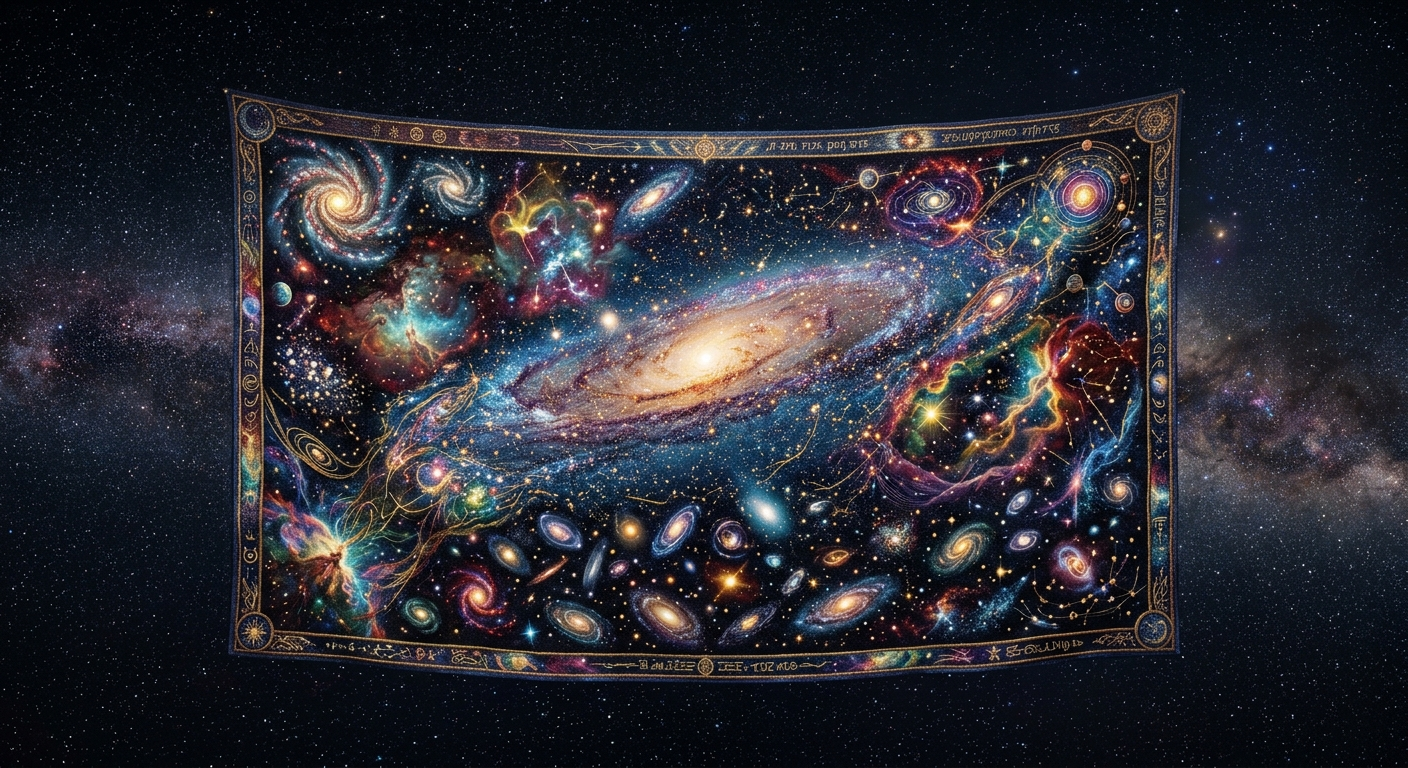
The phrase “cosmic tapestry” captures an important idea: every major structure we observe today is connected to an extraordinarily long chain of physical events. The hydrogen in a star, the carbon in a planet, the heavy elements in Earth’s rocks, and many of the atoms in living organisms emerged from different stages of cosmic evolution.
Understanding this tapestry requires studying both its history—how the universe evolved through time—and its anatomy—what the universe is made of and how its components interact.
1. What Is the Universe?
The universe can be broadly understood as the totality of known physical space, time, matter, energy, fields, radiation, and the physical laws governing their behavior.
It contains structures across an extraordinary range of scales:
Subatomic particles → atoms → molecules → stars → planetary systems → galaxies → galaxy groups → galaxy clusters → cosmic filaments → the observable universe
This hierarchy is important because the universe does not have one single level of organization.
At very small scales, quantum physics governs particles and fields. At ordinary astronomical scales, classical mechanics and electromagnetism are extremely useful. At cosmic scales, Einstein’s general theory of relativity provides the framework for understanding gravity, spacetime, black holes, and cosmic expansion.
Cosmology combines these ideas with astronomical observations to investigate the origin, structure, evolution, and ultimate fate of the universe.
2. The Cosmic Timeline
A simplified history of the universe can be represented as:
Early universe → inflation → Big Bang expansion → nucleosynthesis → recombination → cosmic dark ages → first stars → first galaxies → large-scale structure → solar systems → present universe → future evolution
NASA describes cosmic inflation as an extremely rapid expansion occurring around 13.8 billion years ago, followed by the hot early universe in which particles and radiation dominated the cosmos.
Approximate timeline
| Era | Approximate time after beginning | Major development |
|---|---|---|
| Inflation | Extremely early | Extraordinary expansion |
| Hot early universe | Fractions of a second onward | Fundamental particles and radiation |
| Nucleosynthesis | First minutes | Hydrogen, helium and small amounts of other light nuclei |
| Recombination | ~380,000 years | Neutral atoms form; universe becomes transparent |
| Dark Ages | Hundreds of millions of years | No stars yet |
| First stars | First few hundred million years | Nuclear fusion begins in stars |
| First galaxies | Early cosmic history | Stars assemble into galaxies |
| Galaxy evolution | Billions of years | Galaxies grow, merge and transform |
| Solar System | ~4.6 billion years ago | Sun, planets and smaller bodies form |
| Present | ~13.8 billion years | Expanding, structured universe |
The exact boundaries between cosmic eras are model-dependent, but this sequence provides a useful conceptual map.
3. Before the Big Bang: The Boundary of Current Knowledge
One of the most misunderstood questions in cosmology is: “What happened before the Big Bang?”
Current science does not provide a definitive answer.
The standard cosmological model describes the universe evolving from an extremely hot, dense early state. Inflation is proposed as an even earlier phase of extraordinarily rapid expansion. However, NASA emphasizes that scientists do not yet know what came before inflation or what physically powered it.
This distinction is crucial.
The Big Bang theory is not simply a claim that matter exploded from one location into pre-existing empty space. Rather, it describes the evolution of an expanding universe from a much hotter and denser early condition.
Questions concerning the ultimate origin of spacetime itself remain active areas of theoretical physics.
4. Cosmic Inflation
Inflation is a proposed period of extremely rapid expansion in the early universe.
During this phase, space expanded extraordinarily quickly. Inflation helps explain several otherwise puzzling features of the universe, including its large-scale uniformity and near-flat geometry. It also provides a mechanism through which tiny fluctuations associated with the early universe could become the seeds of later cosmic structures.
The importance of inflation is therefore profound:
Quantum-scale fluctuations → amplified by expansion → density variations → gravitational growth → galaxies and cosmic structure
Inflation remains an important theoretical framework, but the underlying physical mechanism responsible for inflation has not been established with certainty.
5. The Hot Early Universe
Following inflation, the universe existed in an extraordinarily hot and dense state.
Matter as we experience it today—stable atoms, planets, rocks and biological systems—did not yet exist in its familiar forms.
Instead, the early universe contained an energetic mixture of elementary particles and radiation.
As expansion continued, the universe cooled.
This cooling allowed increasingly complex structures to form.
The overall pattern was:
Expansion → cooling → particles → nuclei → atoms → stars → galaxies → planets → complex chemistry
This sequence illustrates one of the deepest themes in cosmology: cosmic complexity emerged from an initially much simpler physical state.
6. Cosmic Nucleosynthesis
During the first few minutes, the universe became cool enough for protons and neutrons to participate in nuclear reactions.
This period is known as Big Bang nucleosynthesis.
The earliest universe produced primarily hydrogen nuclei and helium nuclei, along with very small quantities of other light elements. NASA notes that most of the universe’s helium was produced during this early period.
However, the early universe did not manufacture all the elements found today.
Elements such as carbon, oxygen, silicon, iron and many heavier elements were subsequently produced through stellar evolution and other astrophysical processes.
This means that the periodic table is partly a cosmic historical record.
7. The Formation of Atoms
For hundreds of thousands of years, the universe remained too hot for electrons to remain permanently attached to atomic nuclei.
Light therefore interacted continuously with free electrons.
Approximately 380,000 years after the Big Bang, the universe cooled sufficiently for electrons to combine with nuclei and form neutral atoms. The universe consequently became much more transparent to light.
This transition is known as recombination.
The radiation released during this period has continued traveling through expanding space.
Today we observe it as the cosmic microwave background, or CMB.
8. The Cosmic Microwave Background
The CMB is one of the most important observational foundations of modern cosmology.
It is the cooled remnant radiation from the early universe.
Today its temperature is approximately 2.7 kelvin, because cosmic expansion has stretched its original radiation into microwave wavelengths.
The CMB is remarkably uniform, but not perfectly uniform.
Tiny temperature and density variations are extremely important because they represent early irregularities from which later cosmic structures developed.
In simplified form:
Tiny primordial fluctuations → gravitational amplification → clouds of matter → stars → galaxies → galaxy clusters
The CMB therefore acts as an extraordinary record of the early universe.
9. The Cosmic Dark Ages
After recombination, the universe contained enormous quantities of hydrogen and helium but did not yet contain the mature population of stars that illuminates today’s cosmos.
This period is called the cosmic dark ages.
Gravity gradually amplified small differences in matter density.
Regions containing slightly more matter exerted stronger gravitational attraction, drawing in additional matter.
Over time, these regions became increasingly dense.
Eventually, they collapsed sufficiently to create the first stars.
10. The First Stars
The first stars transformed the universe.
Before stars existed, the cosmos consisted largely of simple primordial material.
Inside stars, enormous pressures and temperatures allowed nuclear fusion to occur.
Stars became cosmic furnaces.
Hydrogen was transformed into helium, and in later stages of stellar evolution, heavier elements could be produced.
NASA estimates that the first stars were substantially more massive and luminous than the Sun and eventually contributed to the formation of the first galaxies.
The appearance of the first stars therefore marked the transition from a relatively simple early universe to a chemically richer and increasingly structured cosmos.
11. Stellar Nucleosynthesis: The Cosmic Factory
Stars are among the universe’s most important element-producing systems.
Their interiors can create elements through nuclear fusion.
Massive stars can progress through increasingly complex stages of nuclear burning, ultimately producing elements including carbon, oxygen, silicon and iron.
When massive stars reach the end of their lives, powerful stellar explosions and other processes can distribute newly produced elements into surrounding space.
Later generations of stars form from this enriched material.
Thus the universe experiences a kind of cosmic recycling:
Gas → stars → nuclear processing → enriched gas → new stars and planets
The material from previous generations of stars becomes the raw material for later planetary systems.
12. Galaxies: Cities of the Cosmos
A galaxy is a gravitationally bound system containing stars, gas, dust, stellar remnants, planets and substantial quantities of dark matter.
Galaxies occur in many forms, including:
- Spiral galaxies
- Elliptical galaxies
- Lenticular galaxies
- Irregular galaxies
A galaxy is not simply a collection of stars.
It is a complex ecosystem involving:
Stars + gas + dust + black holes + dark matter + gravity + magnetic fields + radiation + cosmic evolution
Galaxies grow through star formation, gas accretion and mergers with other galaxies.
Over billions of years, these processes produce the enormous variety of galaxies observed today.
13. The Milky Way
Our home galaxy is the Milky Way, a large spiral galaxy containing enormous numbers of stars.
The Solar System occupies a relatively small region within one of its spiral structures.
The Milky Way itself is part of a larger gravitational environment known as the Local Group, which contains numerous galaxies.
This provides an important perspective:
Earth is part of the Solar System.
The Solar System is part of the Milky Way.
The Milky Way is part of the Local Group.
The Local Group is embedded in the larger cosmic web.
Our planet is therefore one tiny component of an immense hierarchical structure.
14. The Cosmic Web
On the largest observable scales, galaxies are not randomly distributed.
They form an enormous structure commonly described as the cosmic web.
The cosmic web consists of:
- Filaments
- Sheets
- Voids
- Galaxy groups
- Galaxy clusters
Gravity gradually pulled matter toward denser regions.
Dark matter played a particularly important role in providing gravitational scaffolding for the development of large-scale structure.
The result is a universe resembling a gigantic three-dimensional network.
This cosmic web demonstrates how small variations in the early universe could eventually become structures extending across hundreds of millions of light-years.
15. Dark Matter
One of the greatest mysteries in modern cosmology is dark matter.
Astronomers observe gravitational effects that cannot be explained by visible matter alone.
Dark matter does not appear to interact strongly with electromagnetic radiation, making it effectively invisible to ordinary telescopes.
Its presence is inferred through gravitational effects.
According to the Planck mission’s cosmological model, ordinary matter represents only a small fraction of the universe’s total mass-energy budget, while dark matter constitutes a substantially larger component.
Dark matter is therefore central to our understanding of how galaxies and larger structures formed.
Its microscopic identity, however, remains unknown.
16. Dark Energy
An even more mysterious component is dark energy.
Observations indicate that the expansion of the universe is accelerating.
Dark energy is the name given to whatever physical phenomenon is responsible for this observed acceleration within the standard cosmological framework.
Planck-era measurements estimated dark energy to constitute roughly two-thirds of the cosmic mass-energy budget, with exact proportions depending on the cosmological model and dataset.
Unlike ordinary matter, dark energy does not appear to behave simply as a collection of particles.
Its fundamental nature remains one of the major unresolved problems in physics.
17. The Anatomy of the Universe
The universe can be studied as a hierarchy of physical structures.
Level 1: Fundamental fields and particles
At the deepest currently accessible level are quantum fields and elementary particles.
Examples include:
- Quarks
- Electrons
- Neutrinos
- Photons
- Gluons
These provide the microscopic foundations of ordinary matter and radiation.
Level 2: Atomic structure
Particles combine to form:
Protons + neutrons + electrons → atoms
Atoms form the chemical foundation of stars, planets, rocks, atmospheres and biological systems.
Level 3: Molecules
Atoms combine chemically to produce molecules.
Examples include water, carbon dioxide and countless organic molecules.
Level 4: Stars
Gravity compresses enormous clouds of gas until temperatures and pressures become sufficient for nuclear fusion.
Level 5: Planetary systems
Material surrounding young stars can form planets, moons, asteroids and comets.
Level 6: Galaxies
Stars and planetary systems become components of galaxies.
Level 7: Galaxy groups and clusters
Galaxies are gravitationally associated in groups and clusters.
Level 8: Cosmic web
Groups and clusters form part of enormous filaments and sheets separated by vast cosmic voids.
18. Gravity: The Cosmic Architect
Gravity is one of the central forces shaping cosmic structure.
In Einstein’s general theory of relativity, gravity is understood not simply as an invisible pulling force but as a manifestation of the curvature of spacetime produced by mass-energy.
Gravity governs or influences:
- Planetary orbits
- Star formation
- Galaxy formation
- Galaxy clusters
- Gravitational lensing
- Black holes
- Large-scale cosmic structure
At cosmic scales, gravity competes with the expansion of space.
Matter tends to pull structures together gravitationally, while cosmic expansion increases distances between sufficiently separated structures.
This competition helps determine the architecture of the universe.
19. Black Holes
Black holes are among the most extreme structures predicted by general relativity.
They form when matter becomes compressed into an extraordinarily compact region of spacetime.
A black hole is characterized by an event horizon, beyond which information cannot escape to distant observers through ordinary outward travel.
Black holes can have vastly different masses, from stellar-mass black holes to supermassive black holes containing millions or billions of solar masses.
Supermassive black holes are found at the centers of many galaxies and appear to be deeply connected with galaxy evolution.
Black holes are therefore not merely cosmic “vacuum cleaners.” Their gravitational influence is important, but at ordinary distances it behaves according to gravity just as it does around other objects of comparable mass.
20. The Birth of Planetary Systems
Stars are often born within collapsing clouds of gas and dust.
As a young star forms, surrounding material can flatten into a rotating disk.
Within these disks, dust grains collide and aggregate.
Over long periods, these processes can produce:
Dust → pebbles → planetesimals → protoplanets → planets
Some planetary systems contain rocky planets close to their stars and gas or ice giants farther away.
Others may have architectures dramatically different from our Solar System.
Thousands of planets outside our Solar System—exoplanets—have now been identified, revealing that planetary systems are diverse.
21. The Solar System
The Solar System formed approximately 4.6 billion years ago from a cloud of gas and dust enriched by earlier generations of stars.
At its center is the Sun.
Orbiting the Sun are:
- Eight major planets
- Dwarf planets
- Moons
- Asteroids
- Comets
- Meteoroids
- Dust and other small bodies
The Solar System represents one local example of how cosmic evolution produces planetary environments.
Earth is particularly significant because it supports known life.
22. Earth and the Cosmic Connection
Earth may appear isolated, but its materials have cosmic origins.
The oxygen we breathe, carbon in living organisms, calcium in bones, iron in Earth’s interior and many other elements were produced through astrophysical processes.
The early universe produced mostly the lightest elements.
Stars subsequently enriched cosmic matter with heavier elements.
New stars and planets formed from this enriched material.
Therefore, Earth’s chemical composition is inseparable from cosmic history.
The story of the universe is also, in part, the story of the material from which planets and living systems eventually emerged.
23. The Universe Is Expanding
One of the most fundamental discoveries of modern astronomy is that the universe is expanding.
This does not mean that galaxies are simply flying outward from a single central point into an already existing empty space.
Instead, on large scales, the distances between gravitationally unbound regions increase as space itself expands.
Light traveling through expanding space is stretched toward longer wavelengths.
This phenomenon is called cosmological redshift.
The expansion provides one of the strongest observational foundations for modern cosmology.
24. Measuring Cosmic Expansion
Astronomers use several observational methods to study expansion.
Among the important tools are:
- Galaxy redshifts
- Cepheid variable stars
- Type Ia supernovae
- Baryon acoustic oscillations
- Cosmic microwave background observations
- Gravitational lensing
Different methods provide complementary information.
However, modern cosmology also faces an important unresolved issue known as the Hubble tension, in which some measurements of the current expansion rate disagree more than expected.
This tension may eventually reveal systematic measurement problems, new physics, or limitations in the standard cosmological model.
25. The Observable Universe
The observable universe is the region from which information has had enough time to reach us since the early universe.
It is important to distinguish the observable universe from the entire universe.
The total universe could be substantially larger than the observable region.
It may even be spatially infinite; current observations do not establish a definitive answer.
Thus:
Observable universe ≠ necessarily entire universe
This distinction is fundamental when discussing cosmic size.
26. Cosmic Horizons
Because the universe has a finite age and space is expanding, there are limits to what information can reach us.
These limits are described through cosmological horizons.
They determine regions that may be observable now and regions whose information may never reach us.
Cosmic horizons demonstrate that observation is not simply a matter of building a sufficiently powerful telescope.
The geometry and expansion history of spacetime itself impose fundamental limits.
27. Time as Part of the Cosmic Tapestry
In everyday life, we often think of space and time as separate.
Einstein’s relativity combines them into spacetime.
An event has both a location and a time.
The geometry of spacetime is influenced by mass-energy, while the geometry determines how matter and light move.
This concept revolutionized our understanding of:
- Gravity
- Time
- Space
- Motion
- Black holes
- Cosmology
The universe is therefore not simply evolving inside space and time.
Space and time themselves participate in the cosmic story.
28. Light as a Cosmic Time Machine
Because light travels at a finite speed, looking farther into space means looking farther into the past.
When astronomers observe a galaxy millions or billions of light-years away, they see it as it existed when that light began its journey.
This makes astronomy a form of historical observation.
Telescopes do not merely show distant places.
They show different periods of cosmic history.
The cosmic microwave background takes this principle to an extraordinary limit: it allows scientists to observe radiation originating from the universe’s very early transparent phase.
29. How We Know the Cosmic History
Modern cosmology does not depend on a single observation.
It is supported by multiple independent lines of evidence.
29.1 Cosmic expansion
Galaxies generally show redshifts consistent with large-scale expansion.
29.2 Cosmic microwave background
The CMB provides a detailed record of the early universe.
29.3 Light-element abundances
The observed abundance of hydrogen and helium broadly agrees with predictions from early-universe nuclear physics.
29.4 Large-scale structure
The distribution of galaxies is consistent with growth from primordial density fluctuations.
29.5 Stellar evolution
The ages and properties of ancient stars provide independent constraints on cosmic history.
The convergence of these observations makes the modern cosmological model extraordinarily powerful.
30. The Standard Cosmological Model
The prevailing framework is commonly known as ΛCDM.
The symbol Λ represents the cosmological constant associated with dark energy in the simplest version of the model.
CDM means cold dark matter.
The model combines:
- General relativity
- Cosmic expansion
- Ordinary matter
- Dark matter
- Dark energy
- Primordial fluctuations
- Structure formation
It successfully explains a wide range of observations.
Nevertheless, ΛCDM is not necessarily the final theory of the universe.
Important questions remain unresolved.
31. The Great Unknowns
Cosmology has achieved extraordinary success, but some of its deepest questions remain unanswered.
What is dark matter?
We observe its gravitational influence but do not yet know its fundamental identity.
What is dark energy?
We observe accelerated expansion but do not know the physical nature of the underlying phenomenon.
What caused inflation?
Inflation is theoretically powerful, but its physical mechanism remains uncertain.
What happened before inflation?
Current observations do not provide a definitive answer.
How does gravity behave quantum mechanically?
General relativity and quantum theory are both extraordinarily successful, but a complete theory unifying them remains unfinished.
What happens inside black holes?
The deepest interior raises questions involving gravity, quantum mechanics and spacetime.
Is the universe finite or infinite?
Observations constrain its geometry but do not establish the complete global structure.
32. The Future of the Universe
The future depends on the properties of dark energy, cosmic expansion and the large-scale contents of the universe.
If dark energy behaves approximately like a cosmological constant, the universe is expected to continue expanding.
Over extremely long periods:
- Galaxies outside gravitationally bound systems will become increasingly distant.
- Star formation will gradually decline.
- Existing stars will evolve and die.
- Stellar remnants will dominate many regions.
- Black holes may eventually become important long-term structures.
- The universe will become increasingly dilute and cold.
This broad scenario is often associated with heat death or a state approaching thermodynamic equilibrium.
However, the ultimate fate of the universe remains dependent on physics that is not completely understood.
33. The Universe as a System of Transformation
One of the most useful ways to understand cosmic history is to view it as a sequence of transformations.
Matter transformation
Particles → nuclei → atoms → molecules → stars → planets → complex structures
Energy transformation
Early high-energy state → radiation → matter structures → stellar energy → radiation and gravitational processes
Structural transformation
Small fluctuations → clouds → stars → galaxies → clusters → cosmic web
Chemical transformation
Hydrogen and helium → stellar nuclear reactions → heavier elements → planets → chemistry → life-supporting environments
The universe therefore possesses a remarkable history of increasing structural and chemical complexity, even though its overall thermodynamic evolution follows fundamental physical laws.
34. The Cosmic Tapestry and Humanity
Human beings occupy an extremely small physical location within the universe.
Yet our species has developed the ability to investigate cosmic history using mathematics, telescopes, spacecraft, detectors and theoretical physics.
We can reconstruct events that occurred billions of years before humans existed.
This is one of science’s most remarkable achievements.
The same universe that produced stars eventually produced observers capable of studying those stars.
35. A Unified Picture
The cosmic tapestry can be summarized through a single chain:
Quantum fluctuations
↓
Inflation
↓
Hot early universe
↓
Particles
↓
Atomic nuclei
↓
Atoms
↓
Cosmic dark ages
↓
First stars
↓
Heavy elements
↓
Galaxies
↓
Galaxy clusters
↓
Cosmic web
↓
Planetary systems
↓
Earth
↓
Life
↓
Human civilization
↓
Scientific understanding
Each stage depends upon earlier stages.
Without the early universe’s initial conditions, there would be no galaxies.
Without galaxies, there would be no stars like the Sun.
Without stars, there would be no natural production of many heavy elements.
Without heavy elements, rocky planets and complex chemistry would be dramatically different.
The cosmic tapestry is therefore a connected historical system rather than a collection of unrelated events.
36. The Deepest Meaning of Cosmic Anatomy
Studying the anatomy of the universe reveals several fundamental principles.
1. The universe is dynamic
It evolves continuously.
2. Structure emerges from physical laws
Gravity and other interactions transform relatively simple initial conditions into enormous complexity.
3. Matter is recycled
Stars transform and return material to interstellar space.
4. Information travels through light
Astronomy allows humanity to reconstruct the past because electromagnetic radiation carries information across cosmic distances.
5. Most of the cosmic budget remains mysterious
Ordinary matter represents only a small portion of the universe’s inferred mass-energy content.
6. The universe has a history
Galaxies, stars and planets have formation histories.
7. The universe has structure at every scale
From quantum fields to the cosmic web, nature is organized hierarchically.
Conclusion
The Cosmic Tapestry: History and Anatomy of Our Universe is ultimately the story of how an extraordinarily hot and dense early cosmos evolved into the vast, structured universe observed today.
Approximately 13.8 billion years of cosmic evolution separate the early universe from the present. During that immense interval, expansion and cooling allowed particles to form nuclei, nuclei to form atoms, gravity to amplify density variations, stars to ignite, galaxies to assemble, heavier elements to be produced, planetary systems to emerge and increasingly complex environments to develop.
The cosmic microwave background provides an extraordinary observational window into the young universe, while galaxies, stars, supernovae, gravitational lensing and planetary systems allow scientists to reconstruct later stages of cosmic development.
Yet the tapestry remains incomplete.
We do not know the fundamental nature of dark matter. We do not understand dark energy at a fundamental level. We do not yet possess a complete quantum theory of gravity. We do not know with certainty what preceded inflation or whether the observable universe represents only a small part of a much larger cosmic reality.
That combination of knowledge and mystery is what makes cosmology so compelling.
The universe is simultaneously a physical system, a historical record, a laboratory, a mathematical structure and an unfinished scientific question.
From the smallest known particles to the largest cosmic structures, everything participates in one interconnected story.
The cosmic tapestry is the history of space, time, matter, energy and structure—and humanity’s attempt to understand how all of them became the universe we observe today.




Be First to Comment