
Abstract
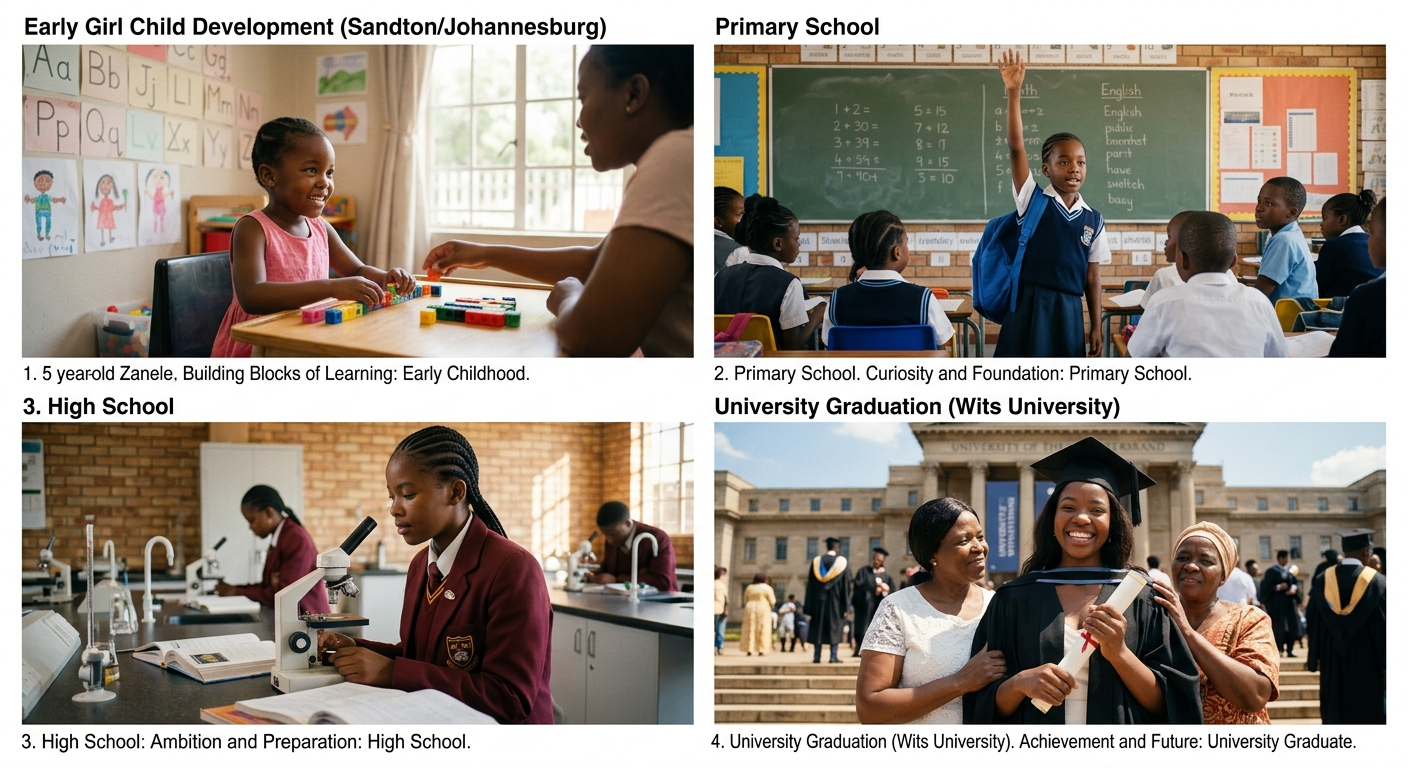
The development of a girl from early childhood to university is not simply a sequence of school grades. It is a long-term process involving physical development, cognitive growth, language, emotional well-being, social relationships, identity, education, skills, confidence, career preparation, and access to opportunities.
A strong educational pathway begins before formal schooling. UNICEF and UNESCO emphasize that early childhood care and education provide an important foundation for later learning, well-being and development. As a girl progresses through primary and secondary education, the objective should gradually expand from basic literacy and numeracy toward scientific reasoning, creativity, digital competence, leadership, career awareness and preparation for higher education.
Although substantial progress has been made globally, major inequalities remain. UNICEF currently estimates that about 119 million girls are out of school worldwide, while nearly four in ten adolescent girls and young women do not complete upper-secondary education. The challenge is particularly significant in parts of sub-Saharan Africa, where poverty, rural location, inadequate infrastructure and other barriers can disproportionately affect girls’ educational progression.
This article presents a comprehensive framework for supporting girls from early childhood through university and into adulthood.
1. Introduction
Education is one of the most powerful institutions through which a society develops its human capabilities.
For a girl, education can provide much more than academic knowledge. It can help her develop:
- language and communication;
- mathematical reasoning;
- scientific understanding;
- creativity;
- problem-solving;
- self-confidence;
- social skills;
- digital literacy;
- financial awareness;
- leadership ability;
- career aspirations;
- civic responsibility; and
- lifelong learning habits.
The objective should therefore not be merely to get a girl into school. The objective should be to create a continuous development pathway in which every stage prepares her for the next.
The pathway can be represented as:
Early childhood → Preschool → Primary education → Lower secondary → Upper secondary → University/college → Professional life → Lifelong learning
Each stage has different developmental priorities.
2. Why the Early Years Matter
The foundation of education begins before a child enters primary school.
Early childhood is a period of rapid cognitive, language, social and emotional development. UNICEF describes the early years as foundational to later health, development, well-being, relationships and productivity.
The child therefore needs an environment in which she can:
- feel safe;
- communicate freely;
- explore her surroundings;
- play;
- ask questions;
- develop language;
- develop motor skills;
- interact with other children;
- develop curiosity; and
- begin developing independence.
Early education should not be treated as a smaller version of university education. Young children learn differently.
Play, conversation, storytelling, exploration, music, drawing, movement and practical activities can all contribute to development.
3. Stage One: Birth to Approximately Age Three
The earliest stage is primarily concerned with healthy development and secure relationships.
Parents, caregivers and communities have an important role.
Key developmental areas
Language: talking, listening, naming objects and introducing stories.
Physical development: opportunities for safe movement, coordination and exploration.
Social development: learning relationships, cooperation and emotional expression.
Cognitive development: exploring objects, patterns, sounds, quantities and cause-and-effect relationships.
Emotional development: learning that adults can provide safety, care and encouragement.
The goal is not to accelerate academic pressure but to establish the foundations on which later learning can grow.
UNICEF’s early-childhood monitoring framework includes domains such as literacy-numeracy, physical development, social-emotional development and learning.
4. Stage Two: Preschool and Early Childhood Education
Preschool introduces the child to a more structured learning environment.
However, preschool should remain developmentally appropriate.
Important preschool capabilities
A girl should gradually develop:
- vocabulary;
- listening;
- storytelling;
- basic counting;
- recognition of shapes and patterns;
- fine-motor coordination;
- drawing;
- early writing movements;
- cooperation;
- sharing;
- problem-solving;
- curiosity;
- confidence;
- independence.
Gender equality begins early
Gender expectations can be absorbed during childhood.
Children may receive subtle messages about which subjects, occupations, behaviours or ambitions are supposedly appropriate for girls or boys.
UNICEF research emphasizes that gender stereotypes can be reproduced through classroom interactions, play, curricula and learning materials.
A strong early-learning environment should therefore communicate a simple principle:
Girls can learn, investigate, build, calculate, invent, lead, create and discover.
5. Stage Three: Primary Education
Primary school transforms early curiosity into structured knowledge.
The central educational pillars should include:
5.1 Literacy
The child learns to:
- read;
- write;
- understand vocabulary;
- interpret information;
- summarize;
- communicate ideas;
- develop a love of reading.
Reading is particularly important because it becomes a gateway to almost every other subject.
5.2 Mathematics
Mathematics should progress from:
counting → arithmetic → measurement → geometry → fractions → patterns → problem-solving → mathematical reasoning
The objective should not be memorization alone.
A girl should learn to ask:
Why is this answer correct?
5.3 Science
Primary science should encourage observation and experimentation.
Students can learn about:
- plants;
- animals;
- the human body;
- Earth;
- weather;
- energy;
- materials;
- water;
- simple machines;
- environmental systems.
Science education should cultivate curiosity rather than fear of difficult subjects.
5.4 Technology
Digital literacy should increasingly become part of education.
Girls should learn that technology is not merely something to consume.
They can become:
- users;
- creators;
- programmers;
- designers;
- researchers;
- engineers;
- entrepreneurs.
6. Stage Four: Building Confidence and Identity
Academic achievement alone is insufficient.
A girl also needs opportunities to develop a healthy sense of identity.
Important capabilities include:
- communication;
- cooperation;
- decision-making;
- resilience;
- responsibility;
- critical thinking;
- creativity;
- self-management;
- respect for others.
UNICEF identifies life skills such as self-management, communication, negotiation and critical thinking as important components of gender-equitable education.
The objective is not to create a child who never experiences difficulty.
The objective is to help her learn how to respond constructively to difficulty.
7. Stage Five: Lower Secondary Education
Lower secondary education represents an important transition.
Academic subjects become more specialized.
A student may encounter:
- algebra;
- geometry;
- biology;
- chemistry;
- physics;
- geography;
- history;
- economics;
- computer science;
- literature;
- additional languages.
At this stage, educational systems should actively prevent gender stereotypes from determining subject choices.
Girls should be encouraged to investigate STEM fields alongside humanities, business, arts and social sciences.
UNESCO’s global education monitoring evidence shows that girls often perform strongly in reading and can perform strongly in mathematics and science, while social expectations and stereotypes can influence later educational and career choices.
8. Stage Six: Adolescence
Adolescence is a major developmental transition.
Education during this period needs to address the whole student.
Important areas include:
Academic development
The student should increasingly learn how to:
- study independently;
- organize information;
- conduct research;
- write structured assignments;
- analyze evidence;
- solve complex problems;
- prepare for examinations.
Social development
Students need opportunities to develop:
- teamwork;
- communication;
- respectful relationships;
- conflict resolution;
- leadership;
- responsibility.
Future planning
The girl should begin asking:
- What subjects do I enjoy?
- What problems do I want to solve?
- What careers interest me?
- What qualifications are required?
- What skills will I need?
- What kind of contribution do I want to make?
Career exploration should not be postponed until the final year of school.
9. Protecting Educational Continuity
One of the most important principles in girls’ education is continuity.
A girl may successfully enter primary school but later leave education because of poverty, unsafe environments, discrimination, family responsibilities, child marriage, pregnancy, conflict or other barriers.
UNICEF identifies poverty, child marriage, gender-based violence, inadequate sanitation and other factors among the barriers affecting girls’ education.
Consequently, education policy needs to focus not merely on enrolment, but also on:
enrolment + attendance + learning + completion + transition + higher education.
10. Stage Seven: Upper Secondary Education
Upper secondary education is the bridge between general education and adulthood.
At this stage, students should increasingly develop advanced academic and practical capabilities.
Core areas
Mathematics: advanced quantitative reasoning.
Science: deeper understanding of scientific principles.
Languages: advanced communication and academic writing.
Technology: digital tools, information literacy and potentially programming.
Social sciences: society, economics, history, politics and human behaviour.
Business: entrepreneurship, accounting and economic reasoning.
Arts: creativity, design, music, literature and visual communication.
The student should also learn how to conduct independent research.
11. Preparing Girls for University
University preparation should begin years before university applications.
A comprehensive preparation model includes five dimensions.
Academic preparation
The student should understand:
- admission requirements;
- subject prerequisites;
- examination standards;
- application processes;
- academic writing;
- research methods.
Career preparation
Students should investigate different professions and understand the education required for each.
Financial preparation
Families and schools should explore:
- scholarships;
- bursaries;
- grants;
- financial-aid programmes;
- accommodation costs;
- transportation;
- textbooks and technology requirements.
Digital preparation
A prospective university student increasingly needs:
- computer literacy;
- online research skills;
- document creation;
- presentation skills;
- cybersecurity awareness;
- information evaluation.
Personal preparation
University requires increasing independence.
Students should gradually learn:
- time management;
- organization;
- communication;
- responsible decision-making;
- self-directed study.
12. University as the Next Developmental Platform
University is not simply the final examination of childhood education.
It represents a transition into advanced knowledge production.
A university student can move from:
learning established knowledge → analyzing knowledge → questioning knowledge → producing new knowledge.
This is the beginning of advanced intellectual independence.
University education can include:
- undergraduate degrees;
- diplomas;
- professional qualifications;
- research programmes;
- internships;
- laboratory work;
- entrepreneurship;
- innovation;
- postgraduate study.
13. Supporting Women in STEM
Science, technology, engineering and mathematics deserve particular attention.
The goal should not be to force every girl into STEM.
Instead, girls should have genuine access to STEM opportunities and should not be discouraged by stereotypes.
Possible pathways include:
Mathematics → Engineering → Computer Science → Artificial Intelligence → Data Science → Robotics → Biotechnology → Environmental Science → Advanced Research
Girls should also be exposed to female scientists, engineers, programmers, doctors, mathematicians and entrepreneurs as examples of possible careers.
14. Digital Education
The modern educational pathway increasingly exists partly in the digital environment.
A girl’s education should therefore progressively develop:
Digital literacy
Understanding computers, smartphones, networks and digital information.
Information literacy
Learning how to distinguish reliable information from misinformation.
Computational thinking
Learning decomposition, patterns, algorithms and logical problem-solving.
Programming
Where appropriate, students can progress from visual programming to text-based programming.
Artificial intelligence literacy
Students should understand basic concepts such as:
- data;
- algorithms;
- models;
- machine learning;
- generative AI;
- responsible AI use.
Technology should become an educational instrument rather than merely an entertainment device.
15. The Role of Parents
Parents and caregivers remain important throughout the educational journey.
They can support girls by:
- encouraging reading;
- asking about school;
- attending school meetings;
- creating a suitable study environment;
- encouraging curiosity;
- celebrating effort and learning;
- supporting healthy routines;
- discussing future careers;
- helping with educational planning.
Parents should avoid communicating the idea that some subjects are naturally “for boys” and others “for girls.”
A child needs permission to explore.
16. The Role of Teachers
Teachers are among the most important influences in a girl’s educational development.
A strong teacher can:
- identify talent;
- encourage curiosity;
- recognize learning difficulties;
- provide feedback;
- challenge stereotypes;
- encourage participation;
- introduce career possibilities;
- support students through difficult transitions.
Teacher training should include awareness of gender stereotypes and inclusive teaching practices.
UNICEF’s research on gender-transformative early education emphasizes curriculum, workforce development, family engagement, planning and quality assurance as interconnected areas of action.
17. The Role of Schools
A school should function as more than a classroom building.
A high-quality school ecosystem should provide:
Classrooms + laboratories + libraries + technology + sports + arts + counseling/support + safe sanitation + qualified teachers + leadership + community engagement
The school environment should allow girls to participate fully.
Safety is particularly important because students cannot learn effectively when they feel threatened or excluded.
18. The Role of Government
Government has responsibility for creating the conditions under which girls can access quality education.
This includes:
- adequate education budgets;
- school infrastructure;
- teacher recruitment;
- teacher training;
- curriculum development;
- transportation where necessary;
- sanitation;
- digital connectivity;
- financial assistance;
- child protection;
- inclusive education;
- higher-education opportunities.
UNESCO’s education monitoring framework identifies equal access to all levels of education and vocational training as a central objective of SDG 4.
19. Rural and Low-Income Communities
Educational opportunity is strongly affected by geography and household economic circumstances.
The latest UNESCO analysis of gender equity in Africa emphasizes that the greatest inequalities often affect the poorest and most rural girls and that gender interacts with wealth and location.
Solutions may include:
- nearby schools;
- safe transportation;
- financial support;
- internet connectivity;
- community libraries;
- digital learning centres;
- teacher incentives;
- school feeding programmes where appropriate;
- sanitation facilities;
- flexible educational pathways.
The objective should be to ensure that a girl’s birthplace does not determine the limits of her intellectual potential.
20. The African Context
Africa has made significant progress in girls’ education, but major inequalities remain.
UNESCO reports that sub-Saharan Africa remains the region furthest from gender parity in some stages of education, particularly at secondary level.
This makes girls’ education particularly important for African development.
A highly educated generation of African women can contribute to:
- medicine;
- engineering;
- agriculture;
- science;
- education;
- technology;
- finance;
- manufacturing;
- government;
- entrepreneurship;
- research;
- environmental management.
Education is therefore both a human right and an investment in national capacity.
21. From Student to Professional
The university years should connect education with real-world experience.
Students can benefit from:
- internships;
- research projects;
- laboratory experience;
- entrepreneurship programmes;
- professional mentorship;
- community projects;
- international collaboration;
- technology projects;
- academic conferences.
The transition can be understood as:
Student → Graduate → Professional → Specialist → Researcher/Leader/Entrepreneur
However, not every graduate needs to follow the same path.
A successful educational system should support multiple futures.
22. The Importance of Mentorship
Mentorship can provide guidance that textbooks cannot.
A mentor can help a young woman understand:
- university life;
- career choices;
- professional expectations;
- research;
- leadership;
- entrepreneurship;
- workplace challenges.
Mentorship is particularly valuable when a student does not have professionals in her immediate family or community who work in the field she is considering.
23. Financial Literacy
Financial education should begin before university.
A girl can gradually learn:
- saving;
- budgeting;
- banking;
- responsible spending;
- interest;
- investment concepts;
- entrepreneurship;
- taxes;
- household economics.
At university, financial literacy becomes increasingly important because students may have to manage education costs, accommodation, transportation and living expenses.
24. Health, Well-Being and Education
Education cannot be separated completely from well-being.
Students need environments that support:
- adequate rest;
- nutrition;
- physical activity;
- emotional well-being;
- personal safety;
- healthy relationships;
- access to appropriate support services.
Schools and universities should have clear safeguarding systems and pathways for students who need assistance.
The objective is not to medicalize education but to recognize that learning occurs within a human life.
25. Measuring Progress
A serious education system needs measurable indicators.
Progress can be assessed through:
Early childhood
- developmental readiness;
- language;
- numeracy;
- physical development;
- social-emotional development.
Primary
- reading;
- writing;
- mathematics;
- science;
- attendance.
Secondary
- learning outcomes;
- completion;
- subject selection;
- digital skills;
- transition rates.
University
- admission;
- retention;
- completion;
- graduate employment;
- postgraduate progression;
- research participation.
UNICEF emphasizes the importance of ECD data for identifying children at risk of being left behind and improving interventions.
26. A Development Ladder
A comprehensive girl-child development model can be summarized as follows:
| Stage | Approximate Focus | Major Development |
|---|---|---|
| Early childhood | Foundation | Language, play, relationships |
| Preschool | Exploration | Early literacy, numeracy, social skills |
| Primary | Knowledge | Reading, mathematics, science |
| Lower secondary | Expansion | Critical thinking and subject breadth |
| Upper secondary | Specialization | Advanced academic and career preparation |
| University | Expertise | Professional and research knowledge |
| Postgraduate | Innovation | Advanced research and specialization |
| Professional life | Application | Leadership, innovation and contribution |
| Lifelong learning | Continuous growth | Adaptation to changing knowledge |
The exact ages and grade structures vary between countries, so this should be treated as a developmental framework rather than a universal timetable.
27. What a Complete Educational Ecosystem Looks Like
The strongest model connects multiple institutions.
Family
↓
Early childhood development
↓
Preschool
↓
Primary school
↓
Secondary school
↓
Career guidance
↓
University/college/technical education
↓
Internship/research
↓
Employment or entrepreneurship
↓
Lifelong learning
The connections between these stages are as important as the stages themselves.
A child should not be expected to suddenly become university-ready during the final year of secondary school.
Preparation should accumulate gradually.
28. The Central Principle: Do Not Waste Potential
Every child possesses developmental potential, but potential requires opportunity.
A girl may possess exceptional mathematical ability but never discover it without exposure to mathematics.
She may have scientific talent but never enter a laboratory.
She may be capable of becoming an engineer but never meet an engineer.
She may become an entrepreneur but never receive financial education.
She may become a researcher but never encounter research methodology.
Education therefore functions partly as a discovery system.
It helps society discover what individual children are capable of becoming.
29. Major Barriers That Must Be Addressed
A comprehensive strategy should address barriers at multiple levels.
Household barriers
- poverty;
- lack of educational resources;
- family responsibilities;
- limited parental educational support.
School barriers
- inadequate facilities;
- teacher shortages;
- unsafe environments;
- weak learning outcomes;
- gender stereotypes.
Community barriers
- harmful social expectations;
- discrimination;
- distance from schools;
- inadequate transportation.
National barriers
- insufficient funding;
- inequality;
- conflict;
- weak infrastructure;
- limited higher-education capacity.
These barriers are interconnected.
A scholarship alone cannot solve an unsafe school.
A school alone cannot solve household poverty.
A university place alone cannot solve inadequate primary education.
The solution must therefore be systemic.
30. A 20-Year Educational Investment Model
Society should think about girls’ education as a long-term investment.
Years 0–5
Foundation
Language, relationships, play, physical development and early learning.
Years 6–10
Core knowledge
Reading, writing, mathematics, science and social development.
Years 11–14
Exploration
Advanced subjects, critical thinking, technology and identity development.
Years 15–18
Specialization
Senior secondary education, career planning and university preparation.
Years 18–22+
Higher education
Professional education, research, innovation and advanced skills.
Beyond university
Contribution
Employment, entrepreneurship, research, leadership and community development.
This long-term perspective changes the question from:
“How do we educate girls?”
to:
“How do we develop human capability from childhood through adulthood?”
31. Policy Priorities
Governments and educational institutions seeking to improve girls’ education can prioritize:
- universal access to quality early childhood education;
- strong foundational literacy and numeracy;
- gender-responsive curricula;
- safe schools;
- qualified teachers;
- adequate sanitation and infrastructure;
- digital access;
- STEM opportunities;
- career guidance;
- financial support for disadvantaged students;
- pathways for students who temporarily leave education;
- strong secondary-school completion;
- university access;
- mentorship;
- research opportunities;
- protection from discrimination and violence;
- reliable education data;
- rural education investment;
- family and community engagement; and
- lifelong learning.
32. The University Goal
The ultimate objective of the girl-child educational journey should not simply be a university admission letter.
The deeper objective is to produce a young woman who can:
- think independently;
- communicate effectively;
- evaluate evidence;
- solve problems;
- use technology responsibly;
- understand mathematics and science;
- participate in society;
- make informed decisions;
- pursue meaningful work;
- continue learning;
- contribute to her community.
University is therefore a major milestone, not the end of development.
33. Conclusion
The development of a girl from early childhood to university should be understood as a continuous human-development system.
The foundation begins with secure relationships, language, play, exploration and early learning. Primary education develops literacy, numeracy and scientific curiosity. Secondary education expands knowledge, critical thinking, digital competence and career awareness. Upper secondary education prepares students for specialization. University transforms learners into professionals, researchers, innovators and potential leaders.
Global progress demonstrates that major advances are possible, but significant inequalities remain. UNICEF reports that millions of girls are still outside school, while UNESCO continues to identify persistent gender and regional disparities, particularly in parts of sub-Saharan Africa.
The most important lesson is that girls’ education cannot be treated as a single intervention.
It is a continuum.
Early development creates the foundation.
Primary education builds knowledge.
Secondary education develops capability.
Higher education creates expertise.
Professional life converts knowledge into contribution.
And throughout the entire journey, families, teachers, schools, communities, governments and universities share responsibility for ensuring that girls have the opportunity to develop their abilities.
A society that invests seriously in girls from the earliest years is not merely educating individual students. It is developing its future scientists, engineers, doctors, teachers, entrepreneurs, researchers, artists, leaders, parents and citizens.
The ultimate goal is therefore simple:
Every girl should have the opportunity to begin life with a strong foundation, progress through quality education, reach the highest level of learning appropriate to her ambitions, and use her knowledge and abilities to build a better future for herself and society.
Selected Evidence Base
- UNICEF, Global Report on Early Childhood Care and Education: The Right to a Strong Foundation.
- UNICEF, Girls’ Education.
- UNICEF, Gender Equality: Education and Skills.
- UNESCO Global Education Monitoring Report, Education and Gender Equality.
- UNESCO, Gender Equity in Access to Education in Africa, 2026.
- UNICEF Innocenti, Tackling Gender Inequality From the Early Years.


Be First to Comment