
Abstract
Materials science and technology form one of the fundamental foundations of modern civilization. Almost every technological system depends on materials that possess particular combinations of mechanical, electrical, thermal, optical, magnetic, chemical, and biological properties. Buildings, bridges, aircraft, automobiles, computers, telecommunications networks, medical devices, energy systems, manufacturing equipment, batteries, satellites, and semiconductor chips are all products of materials engineering.
Materials science is concerned with understanding the relationship between a material’s composition, structure, processing, properties, and performance. Materials technology extends this scientific understanding into practical manufacturing, engineering, product development, quality control, recycling, and technological innovation.
The discipline brings together physics, chemistry, mathematics, engineering, geology, biology, computer science, and increasingly artificial intelligence. Historically, humanity progressed through periods characterized by dominant materials—the Stone Age, Bronze Age, and Iron Age—while the modern world is increasingly defined by advanced steels, aluminum alloys, polymers, ceramics, composites, semiconductors, nanomaterials, biomaterials, and functional materials.
This thesis presents a comprehensive introduction to the fundamentals of materials science and technology, examining atomic structure, bonding, crystal structures, defects, phase transformations, mechanical behavior, thermal and electrical properties, major material classes, manufacturing processes, characterization, degradation, sustainability, emerging materials, and the future direction of the field.
1. Introduction
Materials are the physical substances from which the human technological environment is constructed. Although materials often appear to be passive components of technology, their internal structure determines how they behave under different conditions.
A bridge requires materials capable of carrying enormous loads. An aircraft requires materials that combine low mass with high strength and resistance to fatigue and corrosion. A smartphone requires semiconductors, glass, metals, polymers, ceramics, adhesives, and battery materials. A data center requires electrical conductors, structural materials, cooling materials, semiconductor materials, optical fibers, and numerous specialized components.
Consequently, technological progress cannot be separated from materials development.
A central principle of materials science is that:
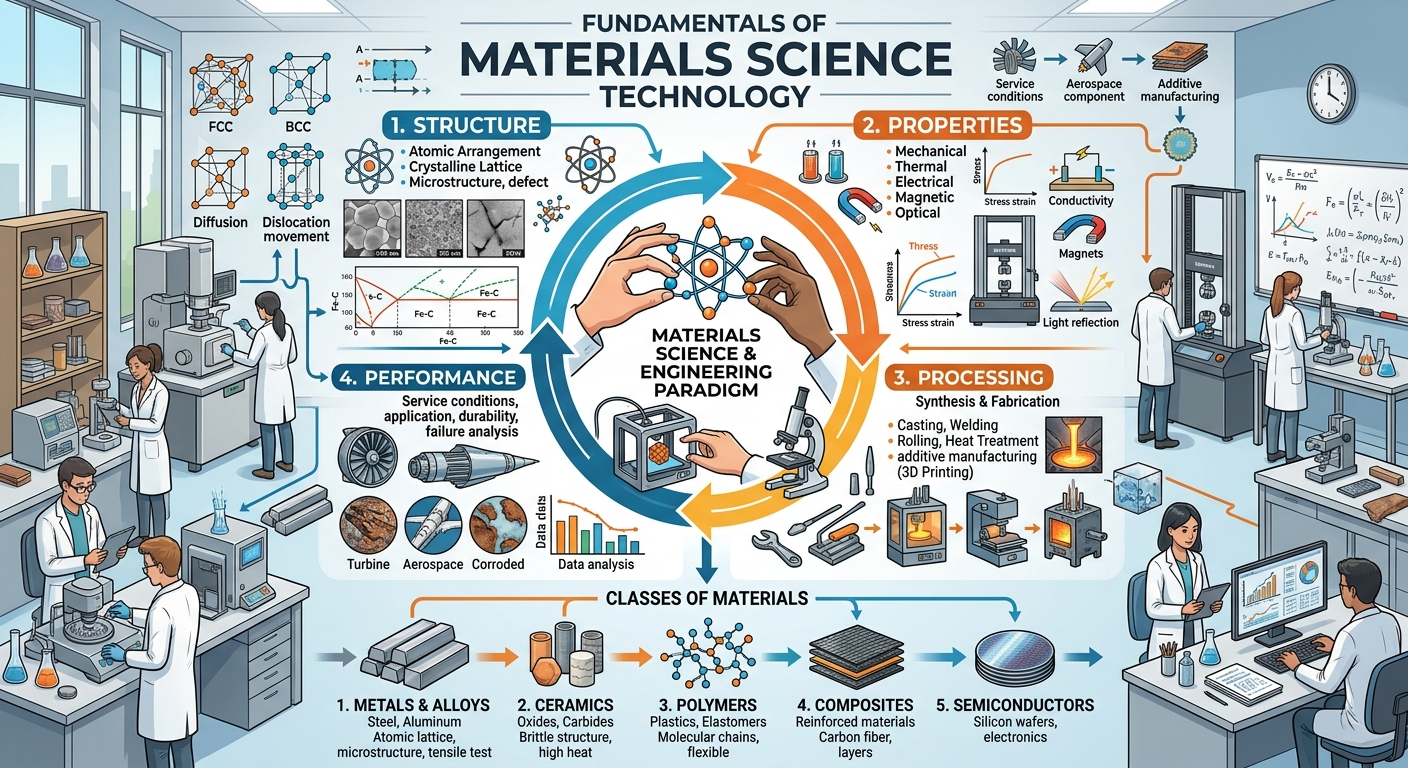
Processing → Structure → Properties → Performance
Processing determines structure; structure determines properties; and properties determine how a material performs in a particular application.
For example, two pieces of steel may have nearly identical chemical compositions but radically different mechanical properties because they were cooled, heated, rolled, forged, or treated differently.
Materials science therefore asks fundamental questions:
- What are materials made of?
- How are atoms arranged?
- How do atoms interact?
- How does processing change structure?
- Why are some materials strong while others are flexible?
- Why do some materials conduct electricity?
- Why do some materials resist heat?
- Why do materials fracture, corrode, wear, or fatigue?
- How can materials be manufactured with predictable properties?
- How can materials be designed for future technologies?
Materials technology converts answers to these questions into useful products and industrial systems.
2. Historical Development of Materials Science
Materials science is both an ancient practice and a modern scientific discipline.
2.1 The Stone Age
Early humans relied on naturally occurring materials such as stone, wood, bone, clay, and fibers.
The selection and shaping of stone represented an early form of materials engineering. Humans learned that different rocks possessed different characteristics and that fracture could be controlled through appropriate striking techniques.
Although prehistoric societies did not possess atomic theory, they developed empirical knowledge of material behavior.
2.2 The Bronze Age
The development of copper alloys represented a major technological transition.
Bronze, primarily based on copper with tin and sometimes other elements, generally provided useful combinations of hardness, strength, castability, and corrosion resistance compared with many earlier materials.
Metalworking introduced technologies such as:
- Smelting
- Casting
- Forging
- Alloying
- Heat treatment
- Metal forming
2.3 The Iron Age
Iron and steel eventually became dominant structural materials.
The ability to control carbon content and processing transformed iron into different classes of materials with widely varying properties.
Steel became essential to:
- Construction
- Railways
- Machinery
- Shipbuilding
- Automotive engineering
- Energy infrastructure
- Manufacturing
2.4 The Industrial Revolution
The Industrial Revolution dramatically increased the importance of systematic materials production.
Large-scale production of iron, steel, glass, cement, and other materials enabled railways, factories, bridges, engines, ships, and large urban structures.
Scientific understanding gradually caught up with industrial practice.
2.5 The Modern Materials Era
The twentieth and twenty-first centuries introduced extraordinary material diversity.
Important developments included:
- Aluminum alloys
- Stainless steels
- High-performance polymers
- Advanced ceramics
- Composite materials
- Silicon semiconductors
- Optical fibers
- Superalloys
- Magnetic materials
- Battery materials
- Biomaterials
- Nanomaterials
- Carbon-based advanced materials
Materials science became an interdisciplinary scientific field capable of connecting atomic-scale phenomena with macroscopic engineering performance.
3. The Central Materials Science Framework
The fundamental framework of materials science can be represented as:
Composition → Processing → Structure → Properties → Performance
3.1 Composition
Composition describes what elements or compounds make up a material.
Examples include:
- Iron-carbon steel
- Aluminum-copper alloys
- Silicon semiconductor materials
- Glass based primarily on silica
- Polyethylene polymers
- Ceramic oxides
Small changes in composition can produce major changes in properties.
3.2 Processing
Processing describes how raw materials are transformed.
Examples include:
- Casting
- Forging
- Rolling
- Extrusion
- Welding
- Sintering
- Heat treatment
- Polymerization
- Additive manufacturing
- Thin-film deposition
3.3 Structure
Structure exists at several scales.
Atomic scale
The arrangement and bonding of atoms.
Nanometer scale
Clusters, interfaces, defects, and nanoscale features.
Microscopic scale
Grains, phases, pores, inclusions, and precipitates.
Macroscopic scale
Visible components, geometries, layers, cracks, and manufacturing features.
3.4 Properties
Properties describe how materials respond to external conditions.
Major categories include:
- Mechanical
- Thermal
- Electrical
- Magnetic
- Optical
- Chemical
- Acoustic
- Biological
3.5 Performance
Performance describes how effectively a material performs its intended function under real operating conditions.
A material that has excellent strength but cannot survive corrosion may be unsuitable for a marine application.
Thus, materials selection always involves balancing multiple properties.
4. Atomic Structure
The behavior of materials begins with atoms.
An atom consists primarily of:
- Protons
- Neutrons
- Electrons
The nucleus contains protons and neutrons, while electrons occupy regions surrounding the nucleus.
The number and arrangement of electrons strongly influence chemical bonding and material behavior.
4.1 Elements
An element is defined by its atomic number, which corresponds to the number of protons in its nucleus.
Examples include:
- Hydrogen
- Carbon
- Oxygen
- Silicon
- Iron
- Copper
- Aluminum
- Titanium
The periodic table provides the organizational framework for understanding these elements.
4.2 Electron Structure
Electrons occupy energy states around atomic nuclei.
The outermost electrons are particularly important because they participate in chemical bonding.
The electronic structure of an element strongly influences whether a material becomes:
- Conductive
- Semiconductive
- Insulating
- Reactive
- Metallic
- Magnetic
5. Chemical Bonding
Atoms form bonds because bonded arrangements can provide energetically favorable states.
The principal bonding categories are:
- Ionic bonding
- Covalent bonding
- Metallic bonding
- Secondary bonding
5.1 Ionic Bonding
Ionic bonding involves electron transfer and electrostatic attraction between oppositely charged ions.
Many ceramics exhibit significant ionic bonding.
Such materials often possess:
- High melting temperatures
- High hardness
- Good chemical stability
- Low ductility
5.2 Covalent Bonding
Covalent bonding involves sharing electrons between atoms.
Covalent bonding is particularly important in:
- Diamond
- Silicon
- Silicon carbide
- Many polymers
- Various ceramics
Strong directional bonding can produce materials with high hardness and strength.
5.3 Metallic Bonding
Metallic bonding involves atoms sharing electrons through a relatively mobile electron system.
This contributes to several characteristic metallic properties:
- Electrical conductivity
- Thermal conductivity
- Ductility
- Malleability
- Reflectivity
5.4 Secondary Bonding
Secondary interactions include weaker attractions such as van der Waals forces and hydrogen bonding.
Although individually weaker than primary bonds, they can strongly influence polymers, biological materials, molecular materials, and layered structures.
6. Crystal Structures
Many solid materials possess ordered atomic arrangements.
A crystalline material contains atoms arranged in a repeating pattern.
Important crystal structures include:
- Body-centered cubic (BCC)
- Face-centered cubic (FCC)
- Hexagonal close-packed (HCP)
6.1 Body-Centered Cubic
BCC structures contain atoms positioned at the corners of a cube and an additional atom at the center.
Examples include several forms of iron and other metals.
6.2 Face-Centered Cubic
FCC structures contain atoms at the cube corners and at the centers of the six faces.
Many ductile metals have FCC structures.
Examples include:
- Aluminum
- Copper
- Nickel
6.3 Hexagonal Close-Packed
HCP materials have a different highly packed arrangement.
Examples include:
- Magnesium
- Titanium in certain phases
- Zinc
Crystal structure strongly affects deformation, diffusion, electrical behavior, and phase transformations.
7. Amorphous Materials
Not all solids possess long-range crystalline order.
Amorphous materials have atomic arrangements that lack the repeating long-range structure characteristic of crystals.
Examples include:
- Ordinary glass
- Many polymers
- Some metallic glasses
Amorphous and crystalline forms of similar chemical composition can possess very different properties.
Glass, for example, can be transparent and brittle, while a crystalline ceramic of related composition may exhibit substantially different mechanical and optical behavior.
8. Defects in Materials
Real materials are never perfectly ordered.
Defects are deviations from ideal structures.
They are not necessarily undesirable. In many technologies, defects are deliberately controlled because they determine important properties.
8.1 Point Defects
Point defects occur around individual atomic positions.
Examples include:
- Vacancies
- Interstitial atoms
- Substitutional atoms
8.2 Line Defects
Dislocations are important line defects within crystals.
They play a central role in plastic deformation.
Understanding dislocations helps explain why metals can permanently deform rather than simply fracture.
8.3 Grain Boundaries
Many engineering metals consist of numerous crystals called grains.
The boundaries between grains can influence:
- Strength
- Corrosion
- Diffusion
- Toughness
- Electrical behavior
- Creep
Controlling grain size is therefore an important engineering strategy.
9. Diffusion
Diffusion describes the movement of atoms through a material.
It becomes particularly important at elevated temperatures.
Diffusion controls or contributes to:
- Alloy formation
- Heat treatment
- Sintering
- Semiconductor processing
- Surface treatments
- Corrosion
- Phase transformations
The rate of diffusion generally increases strongly with temperature.
Diffusion is therefore fundamental to many manufacturing processes.
10. Mechanical Properties
Mechanical properties describe how a material responds to forces.
Important mechanical properties include:
- Strength
- Elasticity
- Plasticity
- Hardness
- Toughness
- Ductility
- Brittleness
- Fatigue resistance
- Creep resistance
- Fracture resistance
10.1 Stress and Strain
Stress represents force distributed over an area.
Strain represents deformation relative to the original dimensions.
The relationship between stress and strain provides fundamental information about material behavior.
10.2 Elastic Deformation
Elastic deformation is reversible.
When the load is removed, the material approximately returns to its original shape.
10.3 Plastic Deformation
Plastic deformation is permanent.
Once the applied stress exceeds a material’s relevant yield threshold, permanent deformation can occur.
10.4 Strength
Strength refers to the ability to withstand applied loads without unacceptable deformation or failure.
Different strength measures include:
- Yield strength
- Tensile strength
- Compressive strength
- Shear strength
10.5 Hardness
Hardness represents resistance to localized deformation, indentation, scratching, or wear, depending on the testing method.
10.6 Toughness
Toughness represents the ability to absorb energy before fracture.
A tough material can tolerate substantial deformation and energy absorption before failure.
10.7 Ductility
Ductility describes the capacity for significant plastic deformation before fracture.
Many metals are relatively ductile, whereas many ceramics are relatively brittle.
11. Fracture
Fracture occurs when a material separates or fails under applied conditions.
Two broad forms are:
- Ductile fracture
- Brittle fracture
Ductile failure is generally associated with significant plastic deformation, while brittle failure occurs with relatively little plastic deformation.
Fracture mechanics examines how cracks behave under applied loads.
This is crucial for:
- Aircraft
- Bridges
- Pressure vessels
- Pipelines
- Nuclear systems
- Automotive components
- Machinery
A small defect can become technologically important if stresses concentrate around it.
12. Fatigue
Fatigue occurs when repeated or cyclic loading causes progressive material damage.
A component may fail under repeated stresses that are individually below the level required to cause immediate failure.
Fatigue is particularly important for:
- Aircraft
- Vehicles
- Rotating machinery
- Bridges
- Turbines
- Engines
- Wind turbines
Materials engineering therefore considers not only maximum loads but also the number and nature of loading cycles.
13. Creep
Creep is time-dependent deformation that becomes important when materials experience sustained loads, particularly at elevated temperatures.
Creep resistance is essential in:
- Turbine engines
- Power plants
- Boilers
- High-temperature processing equipment
- Industrial furnaces
Materials for high-temperature environments must maintain structural integrity over long operating periods.
14. Thermal Properties
Materials interact with heat in different ways.
Important thermal properties include:
- Thermal conductivity
- Heat capacity
- Thermal expansion
- Melting temperature
- Thermal diffusivity
- Thermal shock resistance
14.1 Thermal Conductivity
Metals generally conduct heat efficiently.
Ceramics and polymers generally have lower thermal conductivity, although advanced materials can be engineered for specialized thermal applications.
14.2 Thermal Expansion
Materials often expand when heated and contract when cooled.
Thermal expansion must be considered in:
- Bridges
- Buildings
- Engines
- Electronics
- Pipelines
- Railways
- Semiconductor devices
Different materials expanding at different rates can generate mechanical stresses.
15. Electrical Properties
Materials can be classified according to how easily they transport electrical charge.
The principal categories include:
- Conductors
- Semiconductors
- Insulators
- Superconducting materials
15.1 Conductors
Metals such as copper and aluminum are widely used for electrical conduction.
Copper is particularly important in:
- Electrical wiring
- Motors
- Transformers
- Power systems
- Telecommunications
15.2 Semiconductors
Semiconductors have electrical properties between those of conventional conductors and insulators, and their behavior can be precisely controlled.
Silicon is the most important semiconductor material in modern electronics.
Semiconductors enable:
- CPUs
- GPUs
- Memory
- Sensors
- Power electronics
- Communication devices
- Artificial intelligence hardware
15.3 Insulators
Insulating materials restrict electrical current.
Examples include:
- Glass
- Many ceramics
- Polymers
- Specialized insulating composites
16. Magnetic Properties
Magnetic behavior is important in modern technology.
Materials may exhibit different magnetic responses, including:
- Diamagnetism
- Paramagnetism
- Ferromagnetism
- Ferrimagnetism
- Antiferromagnetism
Magnetic materials are used in:
- Electric motors
- Generators
- Transformers
- Data storage
- Sensors
- Speakers
- Medical equipment
Materials engineering allows magnetic properties to be tailored for particular applications.
17. Optical Properties
Optical properties determine how materials interact with electromagnetic radiation.
Important characteristics include:
- Transparency
- Reflection
- Absorption
- Refraction
- Transmission
- Luminescence
Glass and optical fibers are major examples.
Optical materials underpin:
- Fiber-optic telecommunications
- Cameras
- Displays
- Lasers
- Sensors
- Scientific instruments
18. Chemical Properties and Corrosion
Materials interact continuously with their surrounding environments.
Chemical stability is therefore a major engineering consideration.
Corrosion is the degradation of materials through chemical or electrochemical reactions with their environment.
Common examples include:
- Rusting of iron
- Oxidation of metals
- Chemical attack on polymers
- Degradation of ceramics
- Environmental cracking
Corrosion control strategies include:
- Alloy selection
- Protective coatings
- Cathodic protection
- Environmental control
- Surface treatment
- Appropriate maintenance
Stainless steel, for example, gains significant corrosion resistance through alloying elements that promote protective surface behavior.
19. Major Classes of Engineering Materials
Engineering materials are commonly divided into four major groups:
- Metals
- Ceramics
- Polymers
- Composites
Modern materials science also gives major attention to semiconductors, biomaterials, nanomaterials, electronic materials, and functional materials.
20. Metals and Alloys
Metals possess characteristics that make them extremely important in engineering.
Typical metallic properties include:
- Strength
- Ductility
- Electrical conductivity
- Thermal conductivity
- Toughness
- Manufacturability
Examples include:
- Iron
- Steel
- Aluminum
- Copper
- Titanium
- Nickel
- Magnesium
20.1 Ferrous Materials
Ferrous materials are primarily based on iron.
They include:
- Carbon steels
- Alloy steels
- Stainless steels
- Cast irons
20.2 Non-Ferrous Materials
Important non-ferrous materials include:
- Aluminum
- Copper
- Titanium
- Magnesium
- Nickel
- Zinc
They are often selected for characteristics such as low density, corrosion resistance, conductivity, or high-temperature performance.
21. Ceramics
Ceramics are inorganic, nonmetallic materials.
They include traditional materials such as:
- Bricks
- Cement
- Glass
- Porcelain
and advanced materials such as:
- Alumina
- Zirconia
- Silicon carbide
- Silicon nitride
Ceramics can provide:
- High-temperature resistance
- Hardness
- Chemical stability
- Wear resistance
- Electrical insulation
Their major limitation in many applications is relatively low fracture toughness compared with many metals.
22. Polymers
Polymers consist of long molecular chains formed from repeating molecular units.
Examples include:
- Polyethylene
- Polypropylene
- PVC
- Polystyrene
- Nylon
- Polycarbonate
- Epoxy materials
Polymers can be:
- Lightweight
- Corrosion resistant
- Electrically insulating
- Flexible
- Easily processed
They are widely used in packaging, construction, transportation, electronics, medicine, and consumer products.
23. Thermoplastics, Thermosets, and Elastomers
Thermoplastics
Thermoplastics can generally be softened by heating and reshaped.
Examples include polyethylene and polypropylene.
Thermosets
Thermosetting polymers form permanent crosslinked structures during curing.
Examples include epoxy and certain phenolic materials.
Elastomers
Elastomers exhibit substantial elastic deformation.
Rubber is a familiar example.
24. Composite Materials
Composites combine two or more distinct material components to obtain a combination of properties that may not be achievable with a single material.
A typical composite consists of:
- Matrix
- Reinforcement
Examples include:
- Carbon-fiber-reinforced polymer
- Glass-fiber-reinforced polymer
- Concrete
- Metal-matrix composites
- Ceramic-matrix composites
Composite engineering is particularly important in aerospace, automotive, construction, sports equipment, renewable energy, and advanced manufacturing.
25. Semiconductors and Electronic Materials
Semiconductors represent one of the most technologically important branches of materials science.
Modern integrated circuits depend on carefully controlled semiconductor materials and manufacturing processes.
Important materials include:
- Silicon
- Germanium
- Gallium nitride
- Silicon carbide
- Gallium arsenide
- Various compound semiconductors
Modern semiconductor manufacturing involves sophisticated materials technologies such as:
- Crystal growth
- Wafer preparation
- Oxidation
- Thin-film deposition
- Doping
- Lithography
- Etching
- Metallization
- Packaging
The performance of advanced computing systems is therefore deeply connected to materials science.
26. Nanomaterials
Nanomaterials possess structures or features at extremely small dimensions.
At the nanoscale, materials can exhibit properties that differ significantly from their bulk counterparts.
Examples include:
- Carbon nanotubes
- Graphene
- Nanoparticles
- Quantum dots
- Nanostructured ceramics
- Nanostructured metals
Applications include:
- Electronics
- Sensors
- Energy storage
- Medicine
- Catalysis
- Coatings
- Photonics
Nanotechnology demonstrates how controlling structure at very small scales can create new technological capabilities.
27. Biomaterials
Biomaterials are materials designed to interact with biological systems.
They are used in:
- Implants
- Prosthetics
- Dental materials
- Surgical devices
- Drug-delivery systems
- Tissue-engineering applications
Materials used in biological environments must be evaluated for properties such as:
- Biocompatibility
- Mechanical compatibility
- Chemical stability
- Surface behavior
- Wear resistance
28. Energy Materials
The transition toward new energy systems has created enormous demand for advanced materials.
Important energy-material applications include:
- Batteries
- Solar cells
- Fuel cells
- Hydrogen technologies
- Wind turbines
- Nuclear systems
- Thermal energy systems
Battery technology, for example, depends on carefully engineered combinations of electrode materials, electrolytes, separators, current collectors, and protective interfaces.
29. Materials Processing
Materials processing converts raw materials into usable forms.
Major processing methods include:
Casting
Molten material is introduced into a mold and allowed to solidify.
Forging
Material is shaped through compressive forces.
Rolling
Material passes between rotating rolls to reduce thickness or alter shape.
Extrusion
Material is forced through a shaped opening.
Machining
Material is removed to achieve a desired geometry.
Welding
Materials are joined through localized heating, pressure, or related processes.
Powder Processing
Powders are compacted and consolidated, often through sintering.
Additive Manufacturing
Components are produced by adding material layer by layer.
Each process influences the resulting microstructure and properties.
30. Heat Treatment
Heat treatment deliberately changes material properties through controlled heating and cooling.
It is especially important for metals and alloys.
Common objectives include:
- Increasing strength
- Improving toughness
- Reducing residual stresses
- Controlling hardness
- Refining microstructure
- Improving machinability
Heat treatment demonstrates the direct connection between processing, structure, and properties.
31. Materials Characterization
Scientists and engineers need to understand what is happening inside materials.
Characterization techniques include:
- Optical microscopy
- Scanning electron microscopy
- Transmission electron microscopy
- X-ray diffraction
- Spectroscopy
- Chemical analysis
- Hardness testing
- Tensile testing
- Thermal analysis
- Electrical measurements
These methods allow engineers to connect observed performance with microscopic and atomic structures.
32. Quality Control and Materials Testing
Industrial materials must meet defined specifications.
Quality control may examine:
- Chemical composition
- Dimensions
- Surface quality
- Mechanical strength
- Hardness
- Microstructure
- Electrical performance
- Thermal performance
- Defects
Non-destructive testing methods can identify internal or surface defects without destroying the component.
Examples include:
- Ultrasonic testing
- Radiographic testing
- Magnetic-particle testing
- Dye-penetrant testing
- Visual inspection
Materials quality control is essential for safety-critical infrastructure.
33. Materials Selection
Materials selection is a systematic engineering process.
A designer considers:
- Required mechanical properties
- Operating temperature
- Chemical environment
- Electrical requirements
- Manufacturing process
- Cost
- Availability
- Reliability
- Maintenance
- Environmental impact
- Expected service life
The “strongest” material is not necessarily the best material.
For example, a material may be extremely strong but too expensive, difficult to manufacture, vulnerable to corrosion, or unsuitable for the operating temperature.
Materials selection therefore involves optimization.
34. Materials in Construction
Construction depends on several fundamental materials.
Major examples include:
- Concrete
- Steel
- Cement
- Glass
- Brick
- Timber
- Aluminum
- Polymers
- Insulation materials
- Composite materials
Concrete provides compressive strength, while steel reinforcement provides tensile capacity.
The combination illustrates how different materials can complement each other.
35. Materials in Transportation
Transportation systems depend heavily on materials engineering.
Automobiles require:
- Steels
- Aluminum alloys
- Polymers
- Glass
- Rubber
- Composites
- Battery materials
- Semiconductor materials
Aircraft require advanced aluminum alloys, titanium, composites, high-temperature materials, and specialized coatings.
The principal engineering challenge is often to achieve high performance while minimizing mass.
36. Materials in Telecommunications
Modern telecommunications depend on materials at several scales.
Fiber-optic systems rely on highly controlled glass.
Electronic systems rely on:
- Semiconductors
- Copper
- Aluminum
- Dielectrics
- Magnetic materials
- Polymers
- Ceramics
Wireless communication equipment depends on materials with carefully engineered electrical and electromagnetic properties.
Thus, the global communications network is fundamentally a materials technology.
37. Materials in Data Centers and Computing
Modern data centers represent a convergence of numerous material technologies.
Servers depend on:
- Semiconductor materials
- Copper interconnects
- Aluminum and other structural materials
- Advanced polymers
- Ceramics
- Thermal interface materials
- Printed circuit board materials
- Optical materials
High-performance AI computing adds further requirements for:
- High-density semiconductor packaging
- Advanced cooling materials
- High-performance electrical conductors
- Thermal management systems
- Specialized substrates
Materials science is therefore an important foundation of artificial intelligence infrastructure.
38. Materials and Artificial Intelligence
Artificial intelligence is increasingly being applied to materials science itself.
Machine learning can assist researchers in:
- Predicting material properties
- Discovering new compositions
- Optimizing manufacturing parameters
- Detecting defects
- Designing alloys
- Searching databases
- Modeling molecular structures
- Predicting failure
- Optimizing recycling
This creates a feedback loop:
Materials Science → Advanced Computing → AI → Faster Materials Discovery → New Materials → Better Computing
The relationship between AI and materials science is consequently becoming increasingly important.
39. Corrosion, Wear, and Degradation
Materials gradually deteriorate under real operating conditions.
Major degradation mechanisms include:
- Corrosion
- Wear
- Fatigue
- Creep
- Oxidation
- Thermal degradation
- Radiation damage
- Chemical attack
Materials engineering seeks to predict these mechanisms and extend service life.
Preventive strategies include:
- Protective coatings
- Appropriate alloy selection
- Surface engineering
- Lubrication
- Environmental control
- Structural redesign
- Monitoring and maintenance
40. Surface Engineering
Sometimes only the surface of a component needs specialized properties.
Surface engineering can produce:
- Increased hardness
- Wear resistance
- Corrosion resistance
- Lower friction
- Improved chemical stability
Techniques include:
- Coatings
- Plating
- Nitriding
- Carburizing
- Thermal spraying
- Thin-film deposition
This approach can combine a relatively inexpensive structural material with a high-performance surface.
41. Sustainable Materials Science
Modern materials technology must address environmental sustainability.
The traditional linear model is:
Extract → Manufacture → Use → Dispose
A more sustainable model seeks:
Extract → Design → Manufacture → Use → Reuse → Repair → Recycle → Recover
Important goals include:
- Reducing raw-material consumption
- Reducing energy consumption
- Reducing waste
- Increasing recycling
- Designing longer-lasting products
- Reducing hazardous substances
- Using renewable resources where appropriate
Materials science therefore plays a central role in the transition toward a circular economy.
42. Recycling and the Circular Materials Economy
Recycling is not simply a waste-management problem.
It is fundamentally a materials-engineering challenge.
Products often contain mixtures of materials that are difficult to separate.
Examples include:
- Electronic devices
- Batteries
- Composite structures
- Vehicles
- Construction materials
Future product design increasingly needs to consider what happens to materials at the end of their useful lives.
Design principles may include:
- Design for repair
- Design for disassembly
- Design for reuse
- Design for recycling
- Material traceability
43. Critical Materials and Supply Chains
Modern technologies depend on globally distributed material supply chains.
Important resources include:
- Iron
- Copper
- Aluminum
- Lithium
- Nickel
- Cobalt
- Graphite
- Rare-earth elements
- Silicon
- Titanium
The availability, processing capacity, geographical concentration, transportation, energy requirements, and geopolitical conditions surrounding these resources can influence technology development.
Materials security has therefore become an important strategic consideration.
44. Materials and National Industrial Development
Materials technology is closely connected with economic development.
A country with capabilities in:
- Mining
- Refining
- Metallurgy
- Chemical processing
- Manufacturing
- Semiconductor production
- Advanced ceramics
- Composite production
- Recycling
can capture greater value from its natural resources.
Simply exporting raw materials generally provides less technological value than developing domestic processing and manufacturing capabilities.
Consequently, materials science can support industrialization, employment, technological sovereignty, and economic diversification.
45. Education and Materials Science
Materials science is inherently interdisciplinary.
A strong materials scientist may need knowledge of:
- Physics
- Chemistry
- Mathematics
- Engineering
- Thermodynamics
- Mechanics
- Electronics
- Computer science
- Manufacturing
- Environmental science
This interdisciplinary character makes materials science particularly important in modern technological education.
Students should understand not only what materials exist but also why they behave the way they do.
46. The Future of Materials Technology
The future of materials science is likely to involve increasingly precise control over matter.
Major research directions include:
Advanced semiconductor materials
Supporting increasingly powerful computing and communication technologies.
Wide-bandgap materials
Materials such as silicon carbide and gallium nitride are important for high-performance power electronics.
Two-dimensional materials
Atomically thin materials offer unusual electronic, mechanical, optical, and thermal properties.
Advanced composites
New composites may provide high strength with reduced weight.
Smart materials
These materials respond to environmental changes such as temperature, stress, electric fields, or magnetic fields.
Self-healing materials
Researchers are developing materials capable of recovering from certain forms of damage.
Biomaterials
Future medical systems may increasingly use engineered materials that interact intelligently with biological tissues.
Sustainable materials
Future materials must increasingly address energy consumption, resource availability, recycling, and environmental impact.
Materials informatics
Large databases, simulation, machine learning, and automated laboratories may dramatically accelerate materials discovery.
47. The Materials Innovation Cycle
A modern materials development cycle can be represented as:
Scientific Question
↓
Computational Modeling
↓
Candidate Material
↓
Laboratory Synthesis
↓
Characterization
↓
Performance Testing
↓
Manufacturing Development
↓
Prototype
↓
Industrial Qualification
↓
Commercial Product
↓
Service Monitoring
↓
Recycling or Recovery
This cycle demonstrates that discovering a material is only the beginning.
A laboratory material becomes technologically important only when it can be manufactured consistently, economically, safely, and sustainably.
48. Challenges Facing Materials Science
Several major challenges remain.
48.1 Resource Constraints
Some advanced technologies depend on materials whose supply may be limited or geographically concentrated.
48.2 Energy Consumption
Producing and processing materials can require substantial energy.
48.3 Environmental Impact
Mining, refining, manufacturing, and disposal can affect ecosystems.
48.4 Manufacturing Complexity
Advanced materials may be difficult to produce consistently at industrial scale.
48.5 Reliability
A material that works in a laboratory may behave differently after years of real-world operation.
48.6 Cost
High-performance materials can be prohibitively expensive for mass adoption.
48.7 Recycling
Complex material combinations can make recovery difficult.
The future of materials technology will therefore require simultaneous optimization of performance, cost, sustainability, availability, and reliability.
49. Fundamental Principles to Remember
The foundations of materials science can be summarized through several principles.
Principle 1: Structure determines behavior
Atomic and microstructural arrangements strongly influence material properties.
Principle 2: Processing changes structure
Heating, cooling, forming, alloying, deposition, and other processes can transform internal structures.
Principle 3: Properties determine application
Materials are selected according to the conditions they must survive and the functions they must perform.
Principle 4: Defects matter
Imperfections can weaken materials, but controlled defects can also create useful properties.
Principle 5: Scale matters
Material behavior can change dramatically from atomic to nanoscale, microscopic, and macroscopic dimensions.
Principle 6: Materials are part of systems
A material cannot be evaluated independently of its environment, manufacturing process, geometry, and application.
Principle 7: Sustainability matters
Modern materials engineering must consider the entire material life cycle.
50. Conclusion
Materials science and technology constitute one of the deepest foundations of human technological civilization. From prehistoric stone tools to modern semiconductor chips, aerospace composites, batteries, medical implants, optical fibers, renewable-energy systems, and artificial intelligence hardware, technological advancement has always depended upon the ability to understand, manipulate, and manufacture materials.
The central intellectual framework of the discipline is the relationship between composition, processing, structure, properties, and performance. Understanding this relationship allows scientists and engineers to explain why materials behave differently and to design materials for specific applications.
Metals provide strength and conductivity; ceramics provide hardness, thermal resistance, and chemical stability; polymers provide versatility and low density; composites combine complementary properties; semiconductors enable modern computing; biomaterials interact with biological systems; and nanomaterials provide opportunities to engineer matter at extremely small scales.
The future will increasingly depend upon materials capable of meeting simultaneous demands for performance, efficiency, sustainability, affordability, reliability, and resource security.
Materials science is therefore more than the study of substances. It is the scientific foundation for transforming matter into technology.
The next generation of technological progress—from advanced computing and artificial intelligence to clean energy, telecommunications, transportation, medicine, construction, and space exploration—will depend not only on better software and machines but also on better materials.
In the broadest sense, materials science provides humanity with a method for answering one of civilization’s most fundamental technological questions:
How can we understand matter well enough to transform it into useful, reliable, and sustainable technology?
The answer lies in connecting atoms to structures, structures to properties, properties to manufacturing, and manufacturing to real-world performance. That connection is the essence of materials science and the foundation of materials technology.




Be First to Comment