
Introduction
Everything we encounter in the physical world—from the air we breathe and the water we drink to rocks, plants, computers, buildings, planets and stars—is made from matter. At the microscopic level, matter is organized into atoms, which are the fundamental units of ordinary chemical matter.
An atom is not simply a tiny solid ball. It is a complex quantum system consisting of a compact nucleus containing protons and neutrons, surrounded by electrons occupying regions of space described by quantum mechanics. NASA describes protons, neutrons and electrons as the three major building blocks traditionally used to describe atoms.
Understanding atoms provides a foundation for chemistry, physics, materials science, electronics, biology, medicine, astronomy and modern technology.
1. What Is an Atom?
An atom is the smallest unit of an element that retains that element’s chemical identity.
For example:
- Hydrogen consists of hydrogen atoms.
- Oxygen consists of oxygen atoms.
- Carbon consists of carbon atoms.
- Silicon consists of silicon atoms.
- Iron consists of iron atoms.
The defining feature of an element is its number of protons. This quantity is called the atomic number. Hydrogen has one proton, carbon has six, oxygen has eight and iron has 26. The periodic table organizes elements according to atomic number.
This gives us a remarkably powerful principle:
The number of protons determines the identity of an element.
Changing the number of protons changes one element into another.
2. The Three Main Components of an Atom
A simplified description of an atom begins with three major particles:
| Particle | Electric charge | Location | Relative mass |
|---|---|---|---|
| Proton | Positive (+1) | Nucleus | About 1 atomic mass unit |
| Neutron | Neutral (0) | Nucleus | About 1 atomic mass unit |
| Electron | Negative (−1) | Around nucleus | Much smaller than proton |
The nucleus contains almost all of an atom’s mass, while electrons occupy the surrounding region.
Protons
A proton carries a positive electric charge.
The number of protons determines the atomic number and therefore determines the element.
For example:
6 protons → carbon
8 protons → oxygen
26 protons → iron
79 protons → gold
Thus, the proton acts like an element’s fundamental identity number.
Neutrons
Neutrons have no net electric charge and are located in the atomic nucleus.
Atoms of the same element can contain different numbers of neutrons. These variants are called isotopes.
For example, carbon commonly occurs as carbon-12 and carbon-13:
- Carbon-12: 6 protons + 6 neutrons
- Carbon-13: 6 protons + 7 neutrons
Both remain carbon because both have six protons.
Electrons
Electrons carry negative electric charge and occupy quantum states around the nucleus.
Electrons are especially important because their arrangement determines much of an atom’s chemical behavior. Atoms can interact by sharing or transferring electrons, producing chemical bonds and compounds.
3. The Atomic Nucleus
The nucleus is the extremely small central region of an atom.
It contains:
- protons;
- neutrons.
Because protons have positive charges, they would naturally repel one another electrically. Yet nuclei can remain together because of the strong nuclear interaction, which operates at extremely short distances.
The nucleus therefore represents an extraordinary concentration of mass and energy.
Although the nucleus occupies only a tiny fraction of an atom’s overall volume, it contains essentially all of its mass apart from the small contribution from electrons.
4. Atoms Are Mostly Empty Space
A useful conceptual distinction is that atoms are not miniature solid spheres packed completely with material.
The nucleus is extremely small compared with the overall scale of the atom, while electrons are described by quantum-mechanical probability distributions called orbitals.
Consequently, the familiar illustrations showing electrons travelling around a nucleus like planets around the Sun are useful introductory models, but they do not represent the complete modern quantum-mechanical description.
NASA explains that electron shells correspond to energy levels and that atoms have many possible orbital states.
5. Electron Energy Levels
Electrons cannot simply possess any arbitrary energy while bound to an atom. Quantum mechanics permits particular energy states.
An electron can:
- absorb energy;
- move into a higher-energy state;
- later return to a lower-energy state;
- release energy, often as a photon.
The differences between allowed energy levels are characteristic of each element. Consequently, the light emitted or absorbed by atoms can be used as a fingerprint for identifying elements.
This principle is extraordinarily important in astronomy.
Scientists can analyze the light from distant stars and determine which elements are present even though those stars are enormously far away.
6. Atomic Number and Mass Number
Two fundamental quantities are used to describe atomic nuclei.
Atomic number
The atomic number (Z) equals the number of protons.
For example:
- Hydrogen: Z = 1
- Carbon: Z = 6
- Oxygen: Z = 8
- Silicon: Z = 14
Mass number
The mass number (A) is the total number of protons and neutrons:
A = protons + neutrons
Therefore:
neutrons = mass number − atomic number
This relationship is particularly useful when studying isotopes.
7. Isotopes
Isotopes are atoms belonging to the same element that have the same number of protons but different numbers of neutrons.
For example:
Carbon-12
6 protons + 6 neutrons
Carbon-13
6 protons + 7 neutrons
Carbon-14
6 protons + 8 neutrons
All three are carbon because they contain six protons.
Some isotopes are stable, while others are radioactive and spontaneously transform into other nuclei. Radioactive isotopes have applications in medicine, scientific research, archaeology, industry and other fields.
8. Ions: When Atoms Gain or Lose Electrons
An electrically neutral atom normally contains equal numbers of protons and electrons.
If an atom loses an electron, it becomes positively charged.
If an atom gains an electron, it becomes negatively charged.
These charged atoms or atomic particles are called ions.
For example:
Neutral sodium: 11 protons + 11 electrons
Sodium ion: 11 protons + 10 electrons
The nucleus has not changed; the electron population has changed.
This principle is fundamental to chemistry, batteries, electrochemistry and many biological processes.
9. Chemical Bonds: Atoms Joining Together
Atoms rarely exist completely independently in ordinary materials. They frequently interact with other atoms.
The major types of chemical bonding include:
Ionic bonding
Electrons are transferred between atoms, producing oppositely charged ions that attract one another.
Covalent bonding
Atoms share electrons.
Metallic bonding
Metal atoms form structures in which electrons can move through the material, contributing to electrical and thermal conductivity.
These interactions allow atoms to form molecules, crystals, minerals, metals, biological molecules and countless other materials. NASA educational material notes that atoms can bond through electron transfer or sharing and that compounds form when different kinds of atoms chemically bind.
10. From Atoms to Molecules
A molecule consists of two or more atoms chemically connected in a defined structure.
Examples include:
H₂ — two hydrogen atoms
O₂ — two oxygen atoms
H₂O — two hydrogen atoms and one oxygen atom
CO₂ — one carbon atom and two oxygen atoms
The properties of a molecule depend not only on which atoms it contains but also on how those atoms are arranged.
This is one of the central principles of chemistry:
Atomic composition + atomic arrangement → molecular properties
11. From Atoms to Materials
Atoms can organize themselves into enormous structures.
For example:
Atoms → molecules → larger structures → materials
Carbon demonstrates this beautifully.
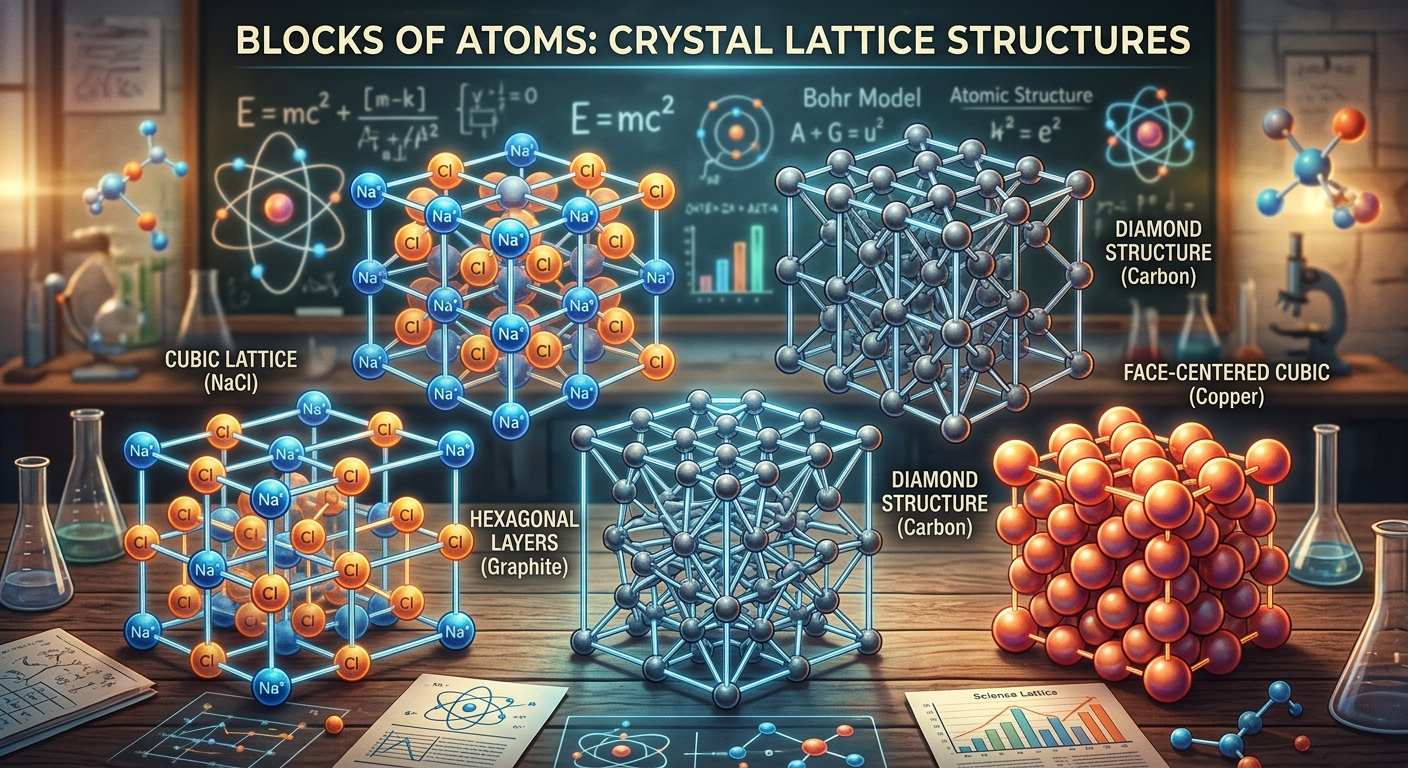
Different arrangements of carbon atoms can produce materials with dramatically different properties. Diamond and graphite are both composed of carbon, but their atomic structures are different, producing very different physical properties.
The same principle applies throughout materials science.
The properties of metals, ceramics, semiconductors, polymers and biological materials depend heavily on their atomic and molecular structures.
12. The Periodic Table: The Map of the Atoms
The periodic table is essentially a map of the known chemical elements.
Elements are arranged according to increasing atomic number. Elements with related chemical behavior appear in groups or columns because their electron configurations exhibit recurring patterns.
Important families include:
- alkali metals;
- alkaline earth metals;
- transition metals;
- metalloids;
- nonmetals;
- halogens;
- noble gases;
- lanthanides;
- actinides.
The periodic table therefore provides far more than a list of names. It is a framework for predicting chemical behavior.
13. Valence Electrons
The electrons involved most directly in chemical interactions are generally the electrons in an atom’s outermost occupied energy levels.
These are commonly called valence electrons.
Their arrangement helps explain why:
- some elements react strongly;
- some form particular numbers of chemical bonds;
- some conduct electricity;
- some are chemically inert;
- some readily form ions.
This is why the periodic table displays repeating chemical patterns. NASA notes that repeating properties reflect patterns in the outer electron states.
14. Quantum Mechanics and the Atom
The modern understanding of the atom is based on quantum mechanics.
In the quantum description, electrons are not treated simply as tiny planets moving along fixed circular paths.
Instead, an electron is represented by a quantum state, with its position described probabilistically.
Orbitals describe regions in which an electron has a significant probability of being found.
Important orbital types include:
- s orbitals;
- p orbitals;
- d orbitals;
- f orbitals.
The resulting electron configurations help determine chemical behavior and the structure of the periodic table.
15. Atoms and Light
Atoms interact strongly with electromagnetic radiation.
When electrons change between allowed energy states, atoms can absorb or emit photons with specific energies.
Because different elements have different energy-level structures, their spectra are distinctive.
This gives scientists a powerful analytical technique known as spectroscopy.
Spectroscopy can help determine:
- what elements are present;
- temperature;
- density;
- chemical composition;
- motion;
- physical conditions.
Astronomers use spectroscopy to study stars, galaxies, planets and interstellar matter.
16. Atoms and Electricity
Electricity is deeply connected to atomic structure.
In metals, some electrons can move relatively freely through the material.
In semiconductors, electron behavior can be controlled through material composition, crystal structure, temperature and deliberate introduction of impurities.
This is the foundation of modern electronics.
The development of:
- transistors;
- integrated circuits;
- memory chips;
- processors;
- sensors;
- solar cells;
- LEDs;
depends upon controlling matter at atomic and electronic scales.
17. Atoms and Semiconductors
Silicon is one of the most important elements in modern technology.
Its atomic structure allows engineers to control its electrical properties through semiconductor engineering.
Modern microchips contain enormous numbers of microscopic electronic structures manufactured in semiconductor materials.
Thus, the journey from an individual atom to a modern computer can be understood as a hierarchy:
Atoms → crystal → semiconductor → transistor → integrated circuit → processor → computer system
This illustrates one of the most important ideas in modern technology: manipulating atomic-scale properties can produce large-scale information-processing systems.
18. Atoms and Biology
Life is also constructed from atoms.
Major biological elements include:
- carbon;
- hydrogen;
- oxygen;
- nitrogen;
- phosphorus;
- sulfur.
These elements participate in molecules such as proteins, carbohydrates, lipids and nucleic acids.
Carbon is particularly important because it can form many stable chemical structures.
Thus, biological complexity ultimately depends upon the organization and interaction of atoms.
NASA notes that living systems require many of the same chemical elements and that the periodic table provides a framework for understanding these elemental relationships.
19. Atoms and the Origin of the Elements
The story of atoms extends beyond Earth.
The early universe produced primarily hydrogen, helium and small amounts of lithium. Later, stars became factories for producing many heavier elements through nuclear processes.
As stars evolved and died, material containing these elements was returned to space and incorporated into later generations of stars, planets and other objects.
This creates an extraordinary connection between cosmology and everyday matter.
The atoms in rocks, oceans, living organisms and technological devices are part of a much older cosmic history.
20. Nuclear Reactions
Chemical reactions primarily involve electrons and changes in how atoms are bonded.
Nuclear reactions are different because they involve atomic nuclei.
Two important examples are:
Nuclear fission
A heavy nucleus splits into smaller nuclei.
Nuclear fusion
Light nuclei combine to form a heavier nucleus.
Fusion powers stars. Under appropriate conditions, nuclear reactions can release vastly more energy than ordinary chemical reactions because they involve changes in nuclear binding and mass-energy relationships.
21. Beyond Protons and Neutrons
The proton and neutron are not themselves considered indivisible fundamental particles.
They belong to a larger family of particles known as hadrons and are composed primarily of quarks held together by the strong interaction.
A simplified picture is:
Matter
→ Atoms
→ Nucleus + electrons
→ Protons and neutrons + electrons
→ Quarks and other fundamental particles
The Standard Model of particle physics describes fundamental particles and their interactions, although the full structure of fundamental physics goes considerably deeper than ordinary atomic chemistry.
22. The Scale of the Atomic World
Atomic science involves an enormous range of scales.
A typical atom is roughly on the order of 10⁻¹⁰ metres across.
The nucleus is dramatically smaller.
This scale difference explains why everyday objects can contain enormous numbers of atoms.
A grain of material may contain billions upon billions of atoms, each participating in the collective structure responsible for the object’s visible properties.
23. Why Atomic Structure Matters
Atomic structure explains many everyday phenomena.
It helps us understand:
- why metals conduct electricity;
- why some materials are transparent;
- why substances have different colours;
- why salt dissolves in water;
- why combustion releases energy;
- why materials melt and freeze;
- why batteries produce electricity;
- why semiconductors work;
- why stars emit characteristic spectra;
- why radioactive materials decay;
- why biological molecules have particular structures.
The microscopic world therefore provides the foundation for the macroscopic world.
24. The Hierarchy of Matter
Matter can be viewed as a hierarchy:
Fundamental particles
↓
Protons, neutrons and electrons
↓
Atoms
↓
Molecules and crystals
↓
Materials
↓
Cells and biological structures
↓
Organisms
↓
Planets, stars and galaxies
At each level, new properties emerge from the organization of the level below.
This is why atomic science connects disciplines that might initially appear unrelated.
25. Atoms as the Foundation of Modern Civilization
Modern civilization depends extensively on the ability to understand and control matter at atomic and subatomic scales.
Consider a smartphone.
Its operation depends upon:
- semiconductor crystals;
- controlled electron movement;
- metals;
- glass;
- polymers;
- batteries;
- magnetic materials;
- optical components.
Each ultimately depends upon atomic structure.
The same principle applies to computers, telecommunications equipment, medical scanners, satellites, solar panels, electric motors and many other technologies.
26. The Deeper Scientific Lesson
One of the most important lessons from atomic science is that the properties of matter emerge from structure.
Changing the number of protons creates a different element.
Changing the number of neutrons creates an isotope.
Changing the number of electrons creates an ion.
Changing the arrangement of atoms can create a different material.
Changing how atoms bond can create completely different chemical substances.
Changing the organization of electrons in a material can dramatically change its electrical behavior.
Consequently, understanding structure is essential for understanding function.
27. From the Atom to the Universe
The atom provides a bridge between the extremely small and the extremely large.
At one end of the scale are quantum particles and atomic nuclei.
At the other are:
- planets;
- stars;
- galaxies;
- galaxy clusters;
- the observable universe.
Astronomy can determine the chemical composition of distant objects because atoms interact with light in recognizable ways. NASA emphasizes that each element can produce characteristic spectral fingerprints.
This means that studying atoms on Earth allows scientists to investigate objects billions of light-years away.
Conclusion
Atoms are among the most important concepts in science because they provide the foundation for understanding ordinary matter.
Their structure can be summarized simply:
Nucleus
→ protons
→ neutrons
Electron cloud
→ electrons occupying quantum states
But this apparently simple structure leads to an enormous scientific universe.
The number of protons determines the element. The number of neutrons determines the isotope. The number and arrangement of electrons strongly influence chemical behavior. Interactions between atoms produce molecules and materials. Collective atomic behavior produces the properties of everything from metals and semiconductors to biological organisms.
At an even deeper level, protons and neutrons themselves have internal structure involving quarks and the strong interaction.
The study of atoms therefore connects chemistry, physics, materials science, biology, medicine, electronics and astronomy.
Most remarkably, the atoms around us have a cosmic history. The lightest elements originated in the early universe, while many heavier elements were produced through stellar processes and subsequently incorporated into new generations of cosmic matter.
The atom is consequently more than a tiny unit of matter. It is a gateway to understanding how the physical universe is constructed, how matter behaves, how technology works, and how the chemical elements themselves came to exist.
Key Takeaways
- Atoms are fundamental units of ordinary chemical matter.
- Protons determine an element’s identity.
- Neutrons determine which isotope of an element is present.
- Electrons govern much of an atom’s chemical behavior.
- The nucleus contains protons and neutrons.
- Electrons occupy quantum-mechanical states around the nucleus.
- Atoms combine through chemical interactions to create molecules and materials.
- The periodic table organizes elements according to atomic number and recurring properties.
- Atomic structure is fundamental to modern electronics and semiconductor technology.
- Atomic processes connect the microscopic world to stars, planets and the evolution of the universe.
Suggested Academic Structure for Further Study
A complete study of atomic science can progress through the following sequence:
Matter → Atoms → Atomic Structure → Electrons → Quantum Mechanics → Periodic Table → Chemical Bonding → Molecules → Materials → Nuclear Physics → Particle Physics → Cosmology
This sequence demonstrates how the apparently simple idea of the atom expands into one of the deepest scientific frameworks for understanding nature.




Be First to Comment