
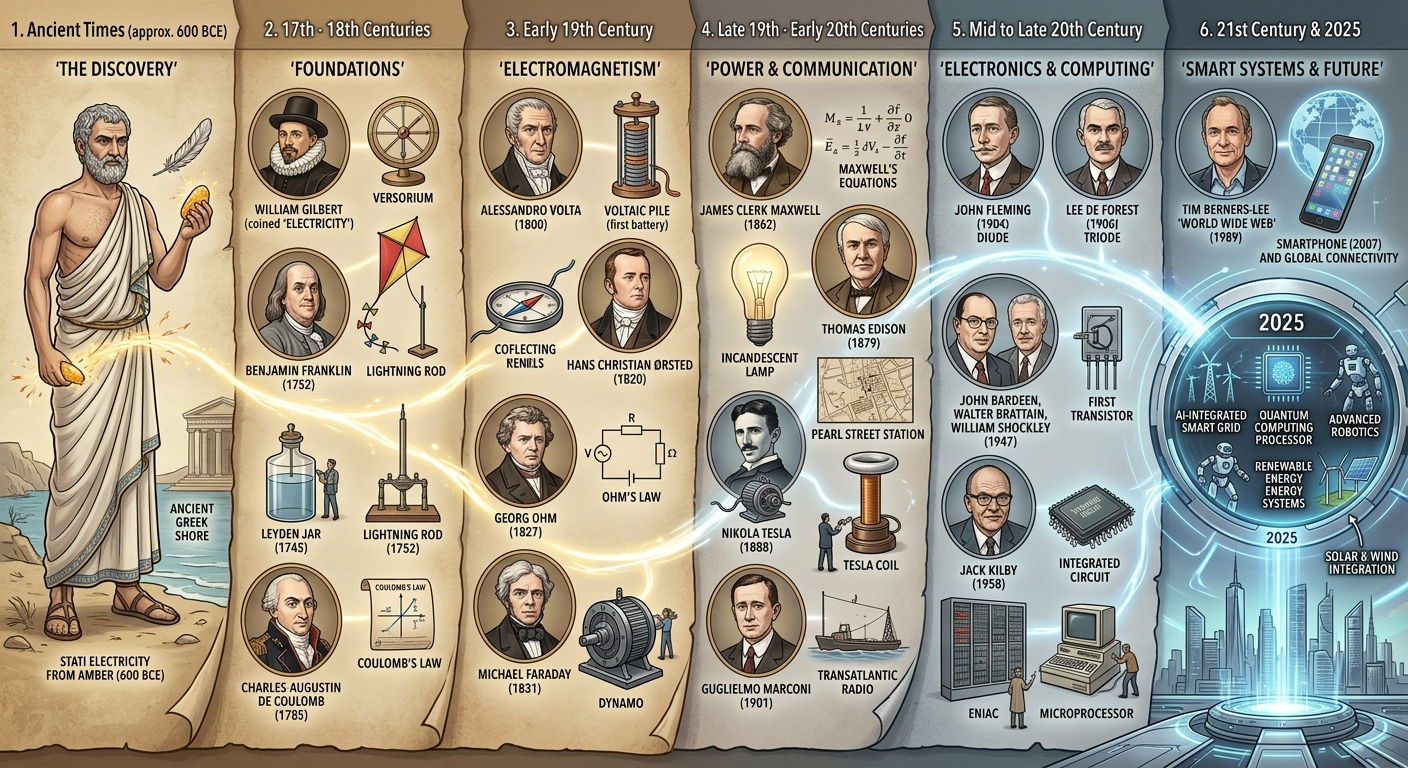
A Comprehensive Scientific and Technological Thesis
Abstract
Electrical engineering is one of humanity’s most consequential technological disciplines. Modern civilization depends on electrical engineering for electricity generation, transmission and distribution; telecommunications; radio and television; computers; semiconductors; industrial automation; medical equipment; satellites; robotics; electric transportation; data centres; renewable-energy systems; and the digital infrastructure underlying artificial intelligence.
Its history, however, extends far beyond the formal creation of the engineering profession in the nineteenth century. The intellectual journey began with ancient observations of static electricity and magnetism and gradually developed through centuries of experimentation, mathematical theory, instrumentation and engineering practice.
The decisive transformation occurred during the eighteenth and nineteenth centuries. Researchers including Charles-Augustin de Coulomb, Alessandro Volta, Hans Christian Ørsted, André-Marie Ampère, Georg Ohm, Michael Faraday, Joseph Henry, Gustav Kirchhoff and James Clerk Maxwell established the scientific foundations of electrical engineering. Their discoveries were subsequently transformed into practical technologies by engineers and inventors including Thomas Edison, Nikola Tesla, George Westinghouse, Alexander Graham Bell, Werner von Siemens, Charles Proteus Steinmetz and many others.
The twentieth century expanded electrical engineering into electronics, radio, radar, television, control systems, computers, integrated circuits and telecommunications. The invention of the transistor in 1947 and the subsequent development of integrated circuits transformed electricity from primarily an energy technology into an information technology.
By 2025, electrical engineering had become a vast ecosystem spanning power systems, electronics, semiconductor manufacturing, telecommunications, embedded systems, automation, quantum technologies, renewable energy, electric vehicles, computing infrastructure and artificial intelligence.
1. Introduction
Electrical engineering is the discipline concerned with the generation, conversion, transmission, distribution, control, measurement and application of electrical and electromagnetic energy and information.
At its deepest level, the discipline connects several fundamental physical concepts:
- electric charge;
- electric fields;
- magnetic fields;
- voltage;
- current;
- resistance;
- capacitance;
- inductance;
- electromagnetic waves;
- energy;
- information;
- materials;
- semiconductor behaviour;
- control and computation.
The modern electrical world therefore represents the accumulated work of thousands of scientists, engineers, technicians and inventors.
It is impossible to identify a single “inventor of electricity.” Electricity is a natural phenomenon. Human achievement consisted of progressively learning how to observe, measure, explain, generate, control, transmit and exploit electrical phenomena.
2. Ancient Foundations
Long before electrical engineering existed as a profession, civilizations encountered electrical and magnetic phenomena.
2.1 Static electricity
Ancient Greek observers noticed that rubbing amber with certain materials could cause it to attract lightweight objects.
The Greek word associated with amber, elektron, eventually contributed to the modern word “electricity.”
This observation was simple, but historically important: it demonstrated that matter could acquire an invisible property capable of producing measurable physical effects.
3. Ancient Magnetism
The ancient world also knew about naturally magnetic materials such as lodestone.
Magnetic stones could attract iron and could influence the direction of magnetic needles.
Over many centuries, understanding of magnetism contributed to navigation, eventually leading to the compass and later to the scientific investigation of the relationship between electricity and magnetism.
4. William Gilbert: Electricity and Magnetism Become Scientific Subjects
In 1600, William Gilbert published De Magnete.
Gilbert systematically investigated magnetic phenomena and distinguished magnetism from electrostatic attraction.
His work represented an important transition:
Observation → Experiment → Classification → Scientific theory
This methodological transition would become essential to later electrical science.
5. Benjamin Franklin and the Nature of Electrical Charge
Benjamin Franklin contributed substantially to eighteenth-century electrical science.
His experiments and theories helped establish the idea that electrical phenomena could be understood in terms of electrical charge.
The conventional terminology of positive and negative charge became embedded in scientific practice.
Franklin also investigated lightning and demonstrated the electrical character of atmospheric phenomena.
6. Charles-Augustin de Coulomb
Charles-Augustin de Coulomb quantified the force between electrical charges.
Coulomb’s law established that electrical force depends on the magnitude of the charges and decreases with the square of the distance between them.
In simplified form:
[
F = k\frac{q_1q_2}{r^2}
]
This mathematical description transformed electrostatics from qualitative observation into quantitative science.
The unit of electric charge is now the coulomb.
7. Luigi Galvani and Bioelectricity
Luigi Galvani investigated electrical effects associated with biological tissue.
His experiments contributed to the emergence of bioelectricity and stimulated debates about the relationship between electricity, chemistry and living organisms.
This eventually contributed to fields that would become important in medical engineering, neuroscience and biomedical instrumentation.
8. Alessandro Volta and the Battery
A major breakthrough came with Alessandro Volta.
Around 1800, Volta developed the voltaic pile, providing a sustained source of electrical current.
This was revolutionary because scientists no longer depended exclusively on electrostatic machines.
For the first time, researchers had a practical continuous electrical source.
The volt, the unit of electrical potential difference, honours Volta.
The battery created a new experimental platform for:
- electrochemistry;
- electromagnetism;
- electrolysis;
- electrical circuits;
- telegraphy;
- motors;
- generators.
9. Hans Christian Ørsted
In 1820, Hans Christian Ørsted demonstrated that an electric current could influence a magnetic compass needle.
This was a foundational discovery.
It revealed that electricity and magnetism were not separate phenomena.
A new scientific relationship emerged:
Electric current → Magnetic field
This discovery opened the road to electromagnetism.
10. André-Marie Ampère
André-Marie Ampère developed the mathematical study of electromagnetic forces associated with electric currents.
He investigated interactions between current-carrying conductors and established important foundations for electrodynamics.
The SI unit of electric current, the ampere, honours him.
Ampère helped transform the discovery of electromagnetism into mathematical physical science.
11. Georg Simon Ohm
Georg Ohm established one of the most important relationships in electrical engineering.
Ohm’s law is:
[
V = IR
]
where:
- (V) = voltage;
- (I) = current;
- (R) = resistance.
This equation became fundamental to circuit analysis.
It allowed engineers to calculate electrical behaviour rather than simply observe it.
The ohm, the SI unit of electrical resistance, honours Georg Ohm.
12. Michael Faraday: The Experimental Giant
Michael Faraday is one of the central figures in electrical engineering.
In 1831, Faraday discovered electromagnetic induction.
The fundamental principle can be expressed as:
[
\mathcal{E}=-\frac{d\Phi_B}{dt}
]
A changing magnetic flux can produce an electromotive force.
This principle became the foundation of:
- electrical generators;
- transformers;
- electric motors;
- alternators;
- inductors;
- power transmission technology.
Faraday’s work demonstrated how mechanical motion and magnetism could be converted into electricity.
The farad, the unit of capacitance, honours him.
Historical accounts identify Faraday’s electromagnetic-induction experiments as a fundamental turning point in the development of generators and electrical power technology.
13. Joseph Henry
Joseph Henry made important contributions to electromagnetism, electromagnets and early telegraph technology.
He independently investigated electromagnetic induction and demonstrated powerful electromagnets.
The SI unit of inductance, the henry, honours Joseph Henry.
14. Heinrich Lenz
Heinrich Lenz established the direction of induced electrical current.
Lenz’s law explains why induced current opposes the change that produced it.
This principle is fundamental to understanding:
- generators;
- transformers;
- motors;
- electromagnetic braking;
- inductive systems.
15. Gustav Kirchhoff
Gustav Kirchhoff developed two fundamental circuit laws.
Kirchhoff’s Current Law
At a circuit junction:
[
\sum I_{\text{in}}=\sum I_{\text{out}}
]
Kirchhoff’s Voltage Law
Around a closed electrical loop:
[
\sum V=0
]
Together, these laws became fundamental tools for analysing complex electrical circuits.
They remain important in modern electronics and computer-aided circuit simulation.
16. James Clerk Maxwell
James Clerk Maxwell transformed electrical science.
His greatest contribution was the mathematical unification of electricity and magnetism.
Maxwell’s equations describe how electric and magnetic fields interact.
They also predicted electromagnetic waves.
This was one of the most important theoretical achievements in the history of physics because it connected electricity, magnetism and light.
Maxwell’s electromagnetic theory subsequently became foundational to:
- radio;
- radar;
- antennas;
- microwave engineering;
- telecommunications;
- optics;
- wireless networks;
- electromagnetic compatibility.
Historical timelines identify Maxwell’s work as a major bridge between nineteenth-century electrical science and radio, television and modern electromagnetic technology.
17. Heinrich Hertz
Heinrich Hertz experimentally demonstrated electromagnetic waves predicted by Maxwell’s theory.
The frequency unit, hertz (Hz), honours him.
His experiments established that electromagnetic waves were physically real.
This created the scientific foundation for wireless communication.
18. Werner von Siemens
Werner von Siemens was an important figure in the industrial development of electrical technology.
His work contributed to generators, electrical machinery, telegraphy and industrial electrification.
The development of practical generators helped transform electricity from a laboratory phenomenon into an industrial resource.
19. Samuel Morse and Electrical Communication
Samuel Morse and collaborators developed practical electric telegraphy.
The telegraph represented a fundamental transformation:
Information could travel electrically rather than physically.
Messages could now cross long distances at speeds vastly exceeding transportation by people, ships or trains.
Electrical engineering therefore became both an energy technology and an information technology.
20. Alexander Graham Bell and the Telephone
The telephone transformed electrical communication by converting sound into electrical signals and reconstructing those signals at a distant location.
This introduced concepts that would later become fundamental to telecommunications:
- signal transmission;
- amplification;
- switching;
- modulation;
- bandwidth;
- networks;
- long-distance communication.
21. Thomas Edison
Thomas Edison played a major role in commercial electrical systems.
His achievements extended beyond the incandescent lamp itself.
His larger contribution was the development of an integrated electrical ecosystem involving:
Generator → Distribution Network → Wiring → Switches → Metering → Lighting → Customers
In 1882, Edison operated a large-scale electric supply network in New York City.
The early system used direct current.
Historical accounts describe Edison’s 1882 system as one of the first large-scale public electric supply networks.
22. Nikola Tesla
Nikola Tesla became one of the most influential figures in alternating-current electrical engineering.
His work on:
- alternating current;
- polyphase systems;
- induction motors;
- transformers;
- high-frequency electrical systems;
- wireless-energy experiments;
helped shape modern electrical technology.
Tesla’s induction motor was particularly important because it converted electrical energy into mechanical motion without requiring the mechanical commutation arrangement used in many earlier motor designs.
23. George Westinghouse
George Westinghouse played a major role in commercializing alternating-current electrical systems.
The late nineteenth-century competition between Edison’s DC approach and AC systems associated with Tesla and Westinghouse became known as the War of the Currents.
AC ultimately became highly important for large-scale electrical distribution because transformers enabled voltage to be increased for transmission and reduced again for consumers.
The historical competition between DC and AC helped accelerate the development of practical electric power networks.
24. The Transformer
The transformer became one of the critical technologies of electrical civilization.
It allows alternating electrical voltage to be increased or decreased.
A simplified relationship is:
[
\frac{V_1}{V_2}=\frac{N_1}{N_2}
]
where:
- (V_1,V_2) are the primary and secondary voltages;
- (N_1,N_2) are the corresponding winding turns.
Transformers made large-scale electrical transmission practical.
A modern grid therefore depends on a hierarchy such as:
Power plant → Step-up transformer → High-voltage transmission → Substation → Distribution transformer → Consumer
25. Charles Proteus Steinmetz
Steinmetz contributed mathematical techniques for analysing alternating-current systems.
His work helped engineers understand complex AC behaviour using mathematical representations of voltage, current, impedance and phase.
This was essential for scaling electrical engineering from individual machines into large interconnected power systems.
26. Electrical Engineering Becomes a Profession
During the nineteenth century, electrical engineering separated progressively from physics and mechanical engineering.
Formal academic programs appeared during the 1880s.
Technische Hochschule Darmstadt established a dedicated electrical-engineering faculty in 1882, while universities in the United States and United Kingdom subsequently developed electrical-engineering courses and departments.
This represented a major institutional transition:
Electrical discovery → Electrical science → Electrical engineering → Electrical industry
27. The Rise of the Electrical Grid
The twentieth century saw the expansion of electrical grids.
Power systems developed into interconnected infrastructures consisting of:
- generators;
- transformers;
- transmission lines;
- substations;
- distribution networks;
- protection systems;
- meters;
- control systems;
- consumers.
Electricity became a general-purpose infrastructure comparable in importance to transportation and water systems.
28. The Electric Motor
Electric motors converted electrical energy into mechanical work.
They became fundamental to:
- factories;
- elevators;
- pumps;
- refrigerators;
- trains;
- industrial machines;
- household appliances;
- robotics;
- electric vehicles.
Modern civilization is therefore not merely an electrically illuminated civilization; it is a civilization powered by billions of electrical motors.
29. Radio and Wireless Engineering
Maxwell’s theory and Hertz’s experiments created the scientific foundation for radio.
Later pioneers such as Guglielmo Marconi, Nikola Tesla, Reginald Fessenden, Edwin Armstrong and others contributed to practical wireless communication.
Radio engineering introduced increasingly sophisticated concepts:
- antennas;
- oscillators;
- modulation;
- receivers;
- amplifiers;
- filters;
- frequency selection;
- signal processing.
30. Vacuum Tubes and the Electronic Age
The early twentieth century introduced vacuum-tube electronics.
Vacuum tubes enabled:
- amplification;
- oscillation;
- switching;
- radio broadcasting;
- radar;
- early computers;
- electronic control systems.
Electrical engineering was now evolving from controlling large quantities of energy toward controlling extremely small electrical signals.
31. Radar
Radar combined electromagnetic waves, antennas, electronics and signal processing.
It became an important technology for detecting objects at a distance.
Radar contributed to:
- aviation;
- maritime navigation;
- meteorology;
- astronomy;
- defence;
- air-traffic management.
32. Television
Television transformed electrical signals into moving images.
Its development required the integration of:
- cameras;
- electronic scanning;
- signal processing;
- transmission systems;
- display technology;
- synchronization.
Television demonstrated how electrical engineering could transport not only voice but complex visual information.
33. The Transistor Revolution
The invention of the transistor in 1947 represented a turning point.
Compared with vacuum tubes, transistors enabled much smaller, more reliable and more energy-efficient electronic systems.
The transistor became the fundamental switching and amplification element of modern electronics.
From one transistor came an extraordinary technological chain:
Transistor → Integrated Circuit → Microprocessor → Computer → Smartphone → Cloud Computing → AI
34. Integrated Circuits
The integrated circuit placed multiple electronic components onto a single semiconductor substrate.
Instead of constructing circuits from individually wired components, engineers could manufacture increasingly complex systems directly onto silicon.
This transformed:
- computers;
- telecommunications;
- industrial control;
- consumer electronics;
- automobiles;
- medical devices.
35. The Microprocessor
The microprocessor integrated computational functions into a semiconductor device.
It enabled programmable electronic systems to become smaller, cheaper and more widespread.
Microprocessors eventually appeared in:
- personal computers;
- phones;
- vehicles;
- appliances;
- industrial machines;
- spacecraft;
- medical equipment;
- network equipment.
36. Semiconductor Engineering
Electrical engineering became inseparable from semiconductor physics.
Modern semiconductor systems rely on controlled materials and structures involving:
- silicon;
- dopants;
- p-n junctions;
- transistors;
- gates;
- interconnects;
- dielectric materials;
- lithography;
- deposition;
- etching;
- packaging.
The semiconductor industry became one of the world’s most sophisticated manufacturing ecosystems.
37. Digital Electronics
Digital electronics introduced a powerful abstraction.
Instead of continuously representing information through physical quantities, electronic systems could represent information using discrete states.
The fundamental abstraction became:
[
0 \leftrightarrow 1
]
From simple logic gates engineers constructed:
- adders;
- registers;
- counters;
- memory;
- processors;
- controllers;
- communication systems.
38. Computing
Electrical engineering and computer science became deeply interconnected.
A modern computer contains electrical-engineering systems at multiple levels:
Power → Voltage Regulation → Clock → Processor → Memory → Storage → Network Interfaces → Displays → Sensors
The computer therefore represents electrical engineering transformed into information processing.
39. Telecommunications
Electrical engineering became the foundation of global communications.
The technological progression included:
Telegraph → Telephone → Radio → Television → Satellite → Fibre Optics → Cellular Networks → Internet → 5G → Emerging 6G
Modern telecommunications combines electrical engineering, electronics, computer engineering, photonics, mathematics and software.
40. Fibre-Optic Communication
Although fibre optics primarily transport information using light, electrical engineering remains essential to the complete system.
Electrical circuits drive lasers and modulators, receive photodetector signals, amplify information, process data and power network equipment.
Modern telecommunications therefore combines:
Electricity + Electronics + Photonics + Computing
41. Power Electronics
Power electronics controls electrical energy using semiconductor devices.
Important devices include:
- diodes;
- MOSFETs;
- IGBTs;
- thyristors;
- wide-bandgap semiconductors.
Power electronics is fundamental to:
- renewable energy;
- electric vehicles;
- battery systems;
- variable-speed motors;
- data centres;
- industrial automation;
- modern power grids.
42. Renewable Energy
Electrical engineering is central to the transformation of renewable energy into useful electricity.
Solar systems require:
Solar cells → DC electricity → Power electronics → Inverter → Grid or battery
Wind systems require:
Wind turbine → Generator → Power converter → Transformer → Grid
The electrical engineer therefore connects natural energy resources to modern civilization.
43. Electric Vehicles
Electric vehicles represent a convergence of several branches of electrical engineering.
A modern electric vehicle can contain:
- battery cells;
- battery-management systems;
- inverters;
- electric motors;
- sensors;
- electronic control units;
- charging systems;
- communications networks;
- power electronics.
The automobile is increasingly becoming a sophisticated mobile electrical-computing platform.
44. Robotics and Automation
Electrical engineering provides robots with:
- motors;
- sensors;
- controllers;
- power systems;
- communication interfaces;
- feedback systems.
Control engineering allows machines to compare desired and actual conditions and automatically correct their behaviour.
A simplified control loop is:
Sensor → Controller → Actuator → Physical System → Sensor
45. Medical Electrical Engineering
Electrical engineering has transformed medicine.
Technologies include:
- electrocardiography;
- medical imaging;
- patient monitoring;
- ultrasound;
- electrical stimulation;
- diagnostic instrumentation;
- implantable electronic devices;
- laboratory automation.
The human body itself generates electrical signals, making electrical engineering particularly valuable in biomedical measurement.
46. Space Electrical Engineering
Spacecraft require extremely reliable electrical systems.
A spacecraft may contain:
Solar panels → Power management → Batteries → Computers → Communications → Sensors → Scientific instruments → Propulsion controls
Electrical engineers therefore make long-duration space missions possible.
47. The Internet
The Internet is an enormous electrical, optical and computational infrastructure.
Its physical foundation includes:
- data centres;
- routers;
- switches;
- fibre-optic cables;
- wireless networks;
- undersea cables;
- servers;
- power systems;
- semiconductor processors.
The apparently intangible digital world therefore depends on extensive physical electrical infrastructure.
48. Data Centres
Modern data centres are major electrical-engineering environments.
A large facility requires:
- utility connections;
- substations;
- transformers;
- switchgear;
- UPS systems;
- batteries;
- generators;
- power-distribution units;
- servers;
- networking equipment;
- cooling systems;
- monitoring systems;
- fire protection;
- physical security;
- sophisticated control systems.
The growth of AI has increased the importance of high-density computing power and associated electrical infrastructure.
49. Artificial Intelligence
AI is often discussed primarily as software, but modern AI depends on electrical engineering.
An AI system requires:
Electricity → Power electronics → Semiconductor chips → Memory → Networking → Cooling → Computing → Software → AI model
The physical execution of an AI model ultimately consists of electrical and electromagnetic activity inside semiconductor devices.
This creates an important technological principle:
Artificial intelligence is an information technology built upon an electrical and semiconductor foundation.
50. Modern Semiconductor Manufacturing
By 2025, electrical engineering was deeply connected with advanced semiconductor manufacturing.
A modern chip can contain billions of transistors.
Manufacturing involves highly controlled processes including:
- wafer preparation;
- oxidation;
- deposition;
- lithography;
- etching;
- ion implantation;
- metallization;
- inspection;
- packaging;
- testing.
Electrical engineers work alongside physicists, materials scientists, chemical engineers, mechanical engineers and computer scientists.
51. Control Systems
Control engineering developed from electrical engineering and became fundamental to automation.
Examples include:
- industrial plants;
- aircraft;
- spacecraft;
- power grids;
- robots;
- vehicles;
- heating systems;
- manufacturing lines.
Feedback is central.
A system measures its state, compares it with the desired state and modifies its operation.
52. The Smart Grid
The traditional electrical grid was primarily designed for one-way energy flow.
The emerging smart grid is increasingly:
- digitally monitored;
- automated;
- bidirectional;
- distributed;
- sensor-rich;
- software-controlled.
It incorporates:
- smart meters;
- distributed generation;
- batteries;
- electric vehicles;
- automated substations;
- advanced protection;
- communications networks;
- demand management.
53. Energy Storage
As electricity systems incorporate variable renewable sources, energy storage becomes increasingly important.
Electrical engineering contributes to:
- battery systems;
- battery-management systems;
- power converters;
- grid-scale storage;
- charging infrastructure;
- energy-management software.
The engineering challenge is no longer simply generating electricity but coordinating generation, storage, transmission and consumption.
54. Quantum Electrical Engineering
Electrical engineering is also entering quantum technology.
Emerging systems involve:
- superconducting circuits;
- quantum sensors;
- cryogenic electronics;
- microwave engineering;
- quantum control;
- semiconductor quantum devices.
This creates a new intersection:
Electrical Engineering + Quantum Physics + Computing
55. Materials and the Future of Electrical Engineering
Future electrical technologies will depend heavily on materials science.
Important areas include:
- silicon carbide;
- gallium nitride;
- advanced semiconductor materials;
- superconductors;
- two-dimensional materials;
- advanced dielectrics;
- nanomaterials;
- photonic materials.
Materials determine how efficiently electrical energy and information can be controlled.
56. The Pioneers and Their Conceptual Chain
The history can be represented as a technological chain:
Thales and Ancient Observers
↓
Static electricity and magnetism
↓
Gilbert
Scientific investigation of magnetism
↓
Franklin
Electrical charge and atmospheric electricity
↓
Coulomb
Quantitative electrostatics
↓
Volta
Battery
↓
Ørsted
Electricity → Magnetism
↓
Ampère
Electrodynamics
↓
Ohm
Circuit relationships
↓
Faraday
Electromagnetic induction
↓
Henry / Lenz / Kirchhoff
Electromagnetic and circuit engineering
↓
Maxwell
Electromagnetic theory
↓
Hertz
Electromagnetic waves
↓
Edison / Tesla / Westinghouse / Siemens
Industrial electrification
↓
Bell / Marconi / Armstrong and others
Telecommunications
↓
Vacuum-tube pioneers
Electronic amplification
↓
Bardeen / Brattain / Shockley
Transistor
↓
Integrated-circuit pioneers
Microelectronics
↓
Microprocessor engineers
Digital computing
↓
Telecommunications engineers
Internet and mobile networks
↓
Modern semiconductor engineers
Advanced computing
↓
2025 electrical engineers
AI infrastructure, smart grids, robotics, renewable energy and advanced electronics
57. The Most Important Pioneers
A representative list includes:
| Pioneer | Major contribution |
|---|---|
| Thales of Miletus | Early observation of static electricity |
| William Gilbert | Scientific study of electricity and magnetism |
| Benjamin Franklin | Electrical charge and lightning research |
| Charles Coulomb | Quantitative electrostatic force |
| Luigi Galvani | Bioelectricity |
| Alessandro Volta | Battery |
| Hans Christian Ørsted | Electromagnetism |
| André-Marie Ampère | Electrodynamics |
| Georg Ohm | Ohm’s law |
| Michael Faraday | Electromagnetic induction |
| Joseph Henry | Electromagnets and induction |
| Heinrich Lenz | Lenz’s law |
| Gustav Kirchhoff | Circuit laws |
| James Clerk Maxwell | Electromagnetic theory |
| Heinrich Hertz | Electromagnetic waves |
| Werner von Siemens | Industrial electrical technology |
| Samuel Morse | Telegraph |
| Alexander Graham Bell | Telephone |
| Thomas Edison | Electrical lighting and utility systems |
| Nikola Tesla | AC systems and induction motor |
| George Westinghouse | AC commercialization |
| Charles Steinmetz | AC engineering mathematics |
| Guglielmo Marconi | Wireless communication |
| Edwin Armstrong | Radio engineering |
| John Bardeen | Transistor and semiconductor physics |
| Walter Brattain | Transistor |
| William Shockley | Transistor and semiconductor development |
This list is necessarily incomplete: electrical engineering evolved through networks of contributors rather than isolated inventions.
58. Why Electrical Engineering Changed Civilization
Electrical engineering produced several fundamental transformations.
Transformation 1: Energy
It enabled controlled conversion of mechanical, chemical, nuclear, solar and other forms of energy into electricity.
Transformation 2: Distance
Telecommunications allowed information to travel enormous distances almost instantaneously.
Transformation 3: Automation
Electrical motors and control systems allowed machines to operate automatically.
Transformation 4: Computation
Electronics transformed electrical systems into machines capable of information processing.
Transformation 5: Miniaturization
Semiconductor technology reduced enormous electronic systems to microscopic components.
Transformation 6: Connectivity
Electrical and electronic networks connected individuals, organizations, machines and nations.
Transformation 7: Intelligence
Computing hardware now provides the physical platform on which AI systems operate.
59. Electrical Engineering as the Infrastructure of Civilization
Modern society can be represented as a hierarchy:
Natural Resources
↓
Energy conversion
↓
Electricity generation
↓
Transmission
↓
Distribution
↓
Power electronics
↓
Electronic devices
↓
Semiconductors
↓
Computing
↓
Communications
↓
Internet
↓
Cloud infrastructure
↓
Artificial intelligence
↓
Automated civilization
Electrical engineering therefore occupies a foundational position beneath many other technologies.
60. From the First Battery to AI
The historical distance between Volta’s battery and modern AI computing is extraordinary.
The battery provided a controllable source of electrical energy.
Faraday showed how electricity and magnetism could be converted into one another.
Maxwell established the mathematical theory governing electromagnetic phenomena.
Hertz demonstrated electromagnetic waves.
Edison, Tesla, Westinghouse and others created industrial electrical systems.
Radio engineers converted electromagnetic theory into communication.
Electronic engineers created vacuum tubes.
Semiconductor scientists created transistors.
Integrated-circuit engineers placed enormous numbers of electronic components onto tiny pieces of silicon.
Computer engineers transformed those circuits into programmable machines.
Networking engineers connected those machines.
Modern AI engineers use those connected computing systems to build models capable of processing enormous quantities of information.
The progression can therefore be summarized:
[
\text{Electricity}
\rightarrow
\text{Electromagnetism}
\rightarrow
\text{Electronics}
\rightarrow
\text{Semiconductors}
\rightarrow
\text{Computing}
\rightarrow
\text{Networks}
\rightarrow
\text{AI}
]
61. The Electrical Engineer of 2025
By 2025, the electrical engineer was no longer simply the engineer of wires and power stations.
The discipline encompassed:
- electrical power;
- electronics;
- telecommunications;
- signal processing;
- control engineering;
- embedded systems;
- semiconductor engineering;
- computer hardware;
- robotics;
- renewable energy;
- electric transportation;
- biomedical systems;
- photonics;
- quantum technologies;
- industrial automation;
- AI computing infrastructure.
The modern electrical engineer operates at the boundary between physical reality and information.
62. The Central Equation of the Electrical Age
One of the deepest lessons of electrical engineering is that electricity is not merely a source of energy.
It can simultaneously be:
Energy
Signal
Measurement
Control
Information
Computation
Communication
This versatility explains why electrical engineering became foundational to modern civilization.
63. Conclusion
The history of electrical engineering is a history of humanity learning to control one of nature’s most fundamental forces.
Ancient observers noticed static electricity and magnetism.
Early scientists began measuring and classifying these phenomena.
Volta produced sustained current.
Ørsted revealed the connection between electricity and magnetism.
Ampère developed electrodynamics.
Ohm established the relationship between voltage, current and resistance.
Faraday discovered electromagnetic induction.
Kirchhoff developed powerful circuit-analysis laws.
Maxwell unified electricity and magnetism mathematically.
Hertz demonstrated electromagnetic waves.
Edison, Tesla, Westinghouse, Siemens and many others transformed scientific principles into industrial electrical systems.
The twentieth century then produced radio, television, radar, electronics, transistors, integrated circuits, computers and telecommunications.
The twenty-first century has extended the discipline into renewable energy, smart grids, electric vehicles, robotics, advanced semiconductors, massive data centres, photonics, quantum systems and artificial intelligence.
Thus, the story of electrical engineering is not simply the story of inventors.
It is the story of a civilization progressively learning how to transform energy into useful work, physical phenomena into information, information into computation, and computation into intelligent systems.
From the ancient observation of amber attracting small objects to the semiconductor processors operating AI systems in 2025, the journey represents one of the greatest technological transformations in human history.
The pioneers did not merely invent machines.
They built the scientific and engineering foundations of the electrically powered, electronically connected and computationally intelligent civilization of the modern world.

Be First to Comment