
Abstract
Security services have evolved from traditional guarding and physical protection into integrated systems encompassing risk management, physical security, cybersecurity, surveillance, access governance, emergency response, business continuity, personnel management, intelligence, technology, and continuous improvement. A modern security methodology therefore begins not with equipment or personnel, but with a systematic understanding of assets, threats, vulnerabilities, consequences, controls, response capabilities, and organisational objectives.
A sound methodology should be risk-based, measurable, repeatable, legally compliant, and adaptable to changing threats. Contemporary approaches commonly combine principles associated with ISO 31000 risk management, ISO/IEC 27001 information-security management, physical-security practices, business continuity, and organisational governance. ISO/IEC 27001, for example, uses a risk-management approach to protect information confidentiality, integrity, and availability.
This thesis presents a comprehensive framework for designing, implementing, operating, auditing, and continuously improving security services for organisations, commercial facilities, institutions, residential environments, industrial sites, data centres, and other critical facilities.
1. Introduction
Security is fundamentally the organised management of risk.
An organisation cannot eliminate every possible threat. Instead, it must determine:
- What must be protected?
- From what?
- Why is it vulnerable?
- What could happen if protection fails?
- Which controls are appropriate?
- How effective are those controls?
- How quickly can the organisation detect and respond?
- How can operations recover afterward?
Modern security should consequently be viewed as a system rather than a collection of guards, cameras, alarms, gates, passwords, or policies.
A strong security architecture integrates:
- people;
- processes;
- technology;
- physical infrastructure;
- information;
- governance;
- intelligence;
- emergency response;
- monitoring;
- auditing; and
- continuous improvement.
A physical-security assessment, for example, should examine not merely whether controls exist but whether they actually deter, detect, delay, support response, and facilitate recovery against credible scenarios.
2. The Security Management Philosophy
The central principle is:
Security resources should be proportional to risk and directed toward the protection of people, assets, information, operations, and organisational objectives.
This produces a security chain:
Asset → Threat → Vulnerability → Risk → Control → Detection → Response → Recovery → Improvement
The methodology should avoid two common mistakes.
Mistake 1: Technology-first security
An organisation purchases cameras, biometric systems, alarms and cybersecurity products without first determining what risks require protection.
Mistake 2: Personnel-only security
An organisation relies heavily on security officers without sufficient supporting technology, procedures, supervision, intelligence or response infrastructure.
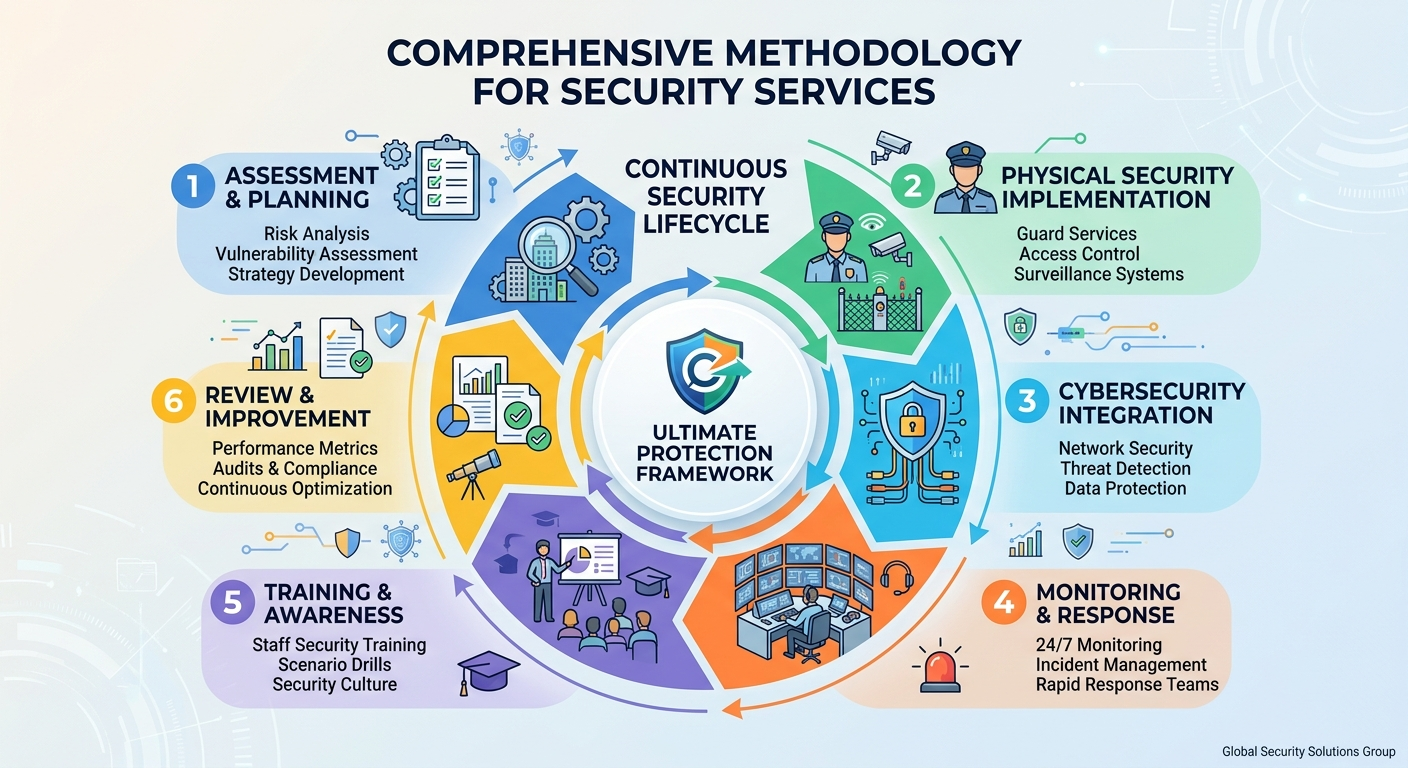
The optimal model is an integrated security system.
3. Security Governance
Security begins at the governance level.
Senior leadership should establish:
- security objectives;
- risk appetite;
- security responsibilities;
- authority structures;
- reporting requirements;
- budgets;
- compliance requirements;
- escalation procedures;
- performance indicators;
- incident-management authority.
A typical governance structure may contain:
Board / Governing Authority
↓
Chief Executive / Executive Management
↓
Security Director / Security Manager
↓
Physical Security | Cybersecurity | Risk | Business Continuity | Compliance
↓
Supervisors and Operational Teams
↓
Security Personnel and Technology Operators
Governance determines who has authority to make decisions before, during and after a security event.
4. Establishing the Security Context
Before conducting an assessment, the organisation should establish its context.
This includes:
Internal context
- organisational structure;
- facilities;
- employees;
- information systems;
- operating processes;
- valuable assets;
- suppliers;
- existing controls;
- security culture;
- previous incidents.
External context
- geographic environment;
- crime and threat environment;
- regulatory requirements;
- economic conditions;
- political and social conditions;
- neighbouring facilities;
- supply-chain dependencies;
- telecommunications infrastructure;
- environmental hazards.
Security risk assessment methodologies commonly begin by establishing context before identifying and analysing risks.
5. Asset Identification
The organisation must establish what it is protecting.
A comprehensive asset inventory may include:
5.1 Human assets
- employees;
- customers;
- visitors;
- contractors;
- executives;
- emergency personnel.
5.2 Physical assets
- buildings;
- vehicles;
- machinery;
- warehouses;
- laboratories;
- data centres;
- utilities;
- equipment.
5.3 Information assets
- databases;
- documents;
- intellectual property;
- financial information;
- customer records;
- credentials;
- research;
- strategic plans.
5.4 Digital assets
- servers;
- networks;
- applications;
- cloud infrastructure;
- endpoints;
- identity systems;
- APIs;
- databases.
5.5 Operational assets
- production systems;
- supply chains;
- logistics;
- payment systems;
- communications;
- critical services.
5.6 Reputation
Reputation itself can be an important organisational asset because major security failures can produce loss of customer confidence, regulatory consequences and commercial damage.
6. Asset Criticality
Not every asset deserves identical protection.
Each asset should therefore be classified according to:
- importance;
- replacement cost;
- operational dependency;
- legal importance;
- safety implications;
- confidentiality;
- integrity;
- availability;
- recovery requirements.
A critical server supporting an essential business process may require considerably stronger controls than an ordinary office workstation.
7. Threat Identification
A threat is a potential source of harm.
Security methodology should examine multiple threat categories.
Human threats
- unauthorised access;
- fraud;
- theft;
- sabotage;
- insider misuse;
- social engineering;
- cyber intrusion.
Environmental threats
- fire;
- flooding;
- severe weather;
- earthquakes;
- extreme temperatures;
- power disruption.
Technical threats
- equipment failure;
- network failure;
- software defects;
- telecommunications disruption;
- infrastructure failure.
Organisational threats
- poor procedures;
- inadequate training;
- weak supervision;
- excessive privileges;
- poor vendor management.
The objective is not to imagine every theoretically possible event. It is to identify credible scenarios relevant to the organisation.
8. Vulnerability Assessment
A vulnerability represents a weakness that could be exploited or contribute to an undesirable event.
Assessment should examine:
- perimeter security;
- doors and windows;
- access-control systems;
- visitor management;
- lighting;
- surveillance coverage;
- alarm systems;
- security staffing;
- procedures;
- cybersecurity;
- network architecture;
- employee practices;
- supplier access;
- emergency arrangements;
- backup systems;
- communications.
A useful principle is:
Threat + Vulnerability + Consequence = Security Risk
9. Risk Analysis
Risk analysis estimates the probability and consequences associated with identified scenarios.
A simplified model is:
Risk = Likelihood × Impact
This type of model is widely used in practical risk methodologies, although organisations may employ more sophisticated approaches depending on their needs.
Example scoring system
| Score | Likelihood | Impact |
|---|---|---|
| 1 | Rare | Negligible |
| 2 | Unlikely | Minor |
| 3 | Possible | Moderate |
| 4 | Likely | Major |
| 5 | Almost certain | Severe |
The resulting score can help prioritise treatment.
However, numerical scores should support professional judgement rather than replace it.
10. Security Risk Register
Every significant risk should be recorded.
A risk register may contain:
| Field | Description |
|---|---|
| Risk ID | Unique identifier |
| Asset | What is exposed |
| Threat | Potential source of harm |
| Vulnerability | Weakness |
| Scenario | What could happen |
| Likelihood | Probability assessment |
| Impact | Consequence |
| Risk score | Overall rating |
| Existing controls | Current protection |
| Treatment | Required action |
| Risk owner | Responsible person |
| Deadline | Target completion |
| Residual risk | Remaining exposure |
| Review date | Next assessment |
The risk register becomes the central management instrument for security governance.
11. Security Control Architecture
Security controls should operate as multiple layers.
A useful conceptual model is:
Governance
↓
Policies
↓
People
↓
Physical Controls
↓
Technology
↓
Monitoring
↓
Response
↓
Recovery
No single layer should be assumed to be sufficient.
12. Physical Security
Physical security protects people, facilities, equipment and information from unauthorised physical events.
It may include:
- boundaries;
- gates;
- doors;
- locks;
- barriers;
- reception controls;
- visitor management;
- security lighting;
- surveillance;
- intrusion detection;
- patrols;
- alarm monitoring;
- security control rooms.
Modern physical-security monitoring can combine surveillance cameras, intrusion detection, alarms, guards and patrols according to risk.
13. Security Personnel
Security officers remain an important component of many security systems, but their effectiveness depends on the wider system.
A professional security-services methodology should define:
- recruitment standards;
- screening requirements;
- training;
- uniforms and identification;
- duties;
- post orders;
- patrol responsibilities;
- reporting;
- supervision;
- incident escalation;
- fatigue management;
- performance evaluation.
The emphasis should be on professional security operations, not merely the physical presence of personnel.
14. Access Control
Access control answers a fundamental question:
Who is authorised to enter which area, under what circumstances, and for how long?
Access systems can include:
- keys;
- cards;
- PINs;
- biometric authentication;
- mobile credentials;
- visitor passes;
- vehicle identification;
- reception verification.
Access should follow the principle of least privilege:
Give each person only the access necessary for legitimate responsibilities.
Access rights should also be reviewed and removed when no longer required.
15. Surveillance and Monitoring
Surveillance transforms security from a primarily reactive system into a detection-oriented system.
A modern monitoring architecture may include:
Cameras → Network → Video Management System → Analytics → Control Room → Operator → Incident Response
The system should consider:
- coverage;
- image quality;
- lighting;
- retention;
- system availability;
- operator procedures;
- privacy;
- evidence management;
- cybersecurity of surveillance equipment.
Technology should be tested for effectiveness rather than assumed to work simply because it has been installed.
16. Alarm Management
Alarm systems can detect:
- unauthorised entry;
- intrusion;
- fire;
- equipment conditions;
- environmental events;
- technical failures.
A mature methodology establishes:
- detection;
- alarm transmission;
- verification;
- classification;
- escalation;
- response;
- documentation;
- investigation;
- corrective action.
Excessive false alarms can undermine the effectiveness of the entire system.
17. Control Room Operations
The security control room functions as the organisation’s operational coordination centre.
It may integrate:
- CCTV;
- alarms;
- access control;
- communications;
- incident-management systems;
- building-management information;
- emergency notifications.
Operators require:
- clear procedures;
- escalation matrices;
- reliable communications;
- defined authority;
- training;
- shift handover procedures;
- accurate logs.
18. Cybersecurity Integration
Modern security cannot separate physical security from cybersecurity.
A compromised digital system can affect:
- access control;
- CCTV;
- alarms;
- communications;
- building systems;
- databases;
- identity systems.
Conversely, physical compromise can affect digital systems.
Examples include:
Physical access → server room → network equipment → digital compromise
and:
Cyber compromise → access-control system → physical security consequences
This creates the concept of converged security.
19. Information Security
Information-security methodology should protect three fundamental properties:
Confidentiality
Information is available only to authorised parties.
Integrity
Information remains accurate and trustworthy.
Availability
Information and systems remain accessible when required.
ISO/IEC 27001 uses a formal information-security management system to manage information-security, cybersecurity and privacy-related risks.
20. Identity and Privilege Management
Every organisation should understand:
- who users are;
- what systems they can access;
- why they have access;
- who approved it;
- when it should expire;
- whether it remains necessary.
A complete identity lifecycle is:
Join → Provision → Use → Monitor → Modify → Disable → Review
This applies to employees, contractors, suppliers and privileged administrators.
21. Security Operations
Security operations convert policy into daily activity.
Typical activities include:
- monitoring;
- patrols;
- access verification;
- alarm response;
- incident recording;
- equipment inspection;
- shift handovers;
- security reporting;
- vulnerability monitoring.
Operational procedures should be documented and measurable.
22. Incident Management
A security incident should follow a defined lifecycle:
Detect
↓
Verify
↓
Classify
↓
Contain
↓
Escalate
↓
Respond
↓
Recover
↓
Investigate
↓
Learn
The objective is not simply to respond to incidents but to prevent recurrence.
23. Incident Classification
Incidents can be classified according to severity.
Level 1 — Minor
Limited operational effect.
Level 2 — Significant
Requires management involvement.
Level 3 — Major
Serious operational, financial or reputational impact.
Level 4 — Critical
Potentially threatens life safety, critical operations or organisational survival.
The organisation should define escalation criteria before an incident occurs.
24. Emergency Response
Security services should integrate with emergency-management structures.
Possible emergencies include:
- fire;
- medical emergencies;
- major infrastructure failures;
- severe weather;
- cyber incidents;
- physical intrusion;
- hazardous facility conditions.
Emergency procedures should define:
- who declares an emergency;
- who coordinates;
- communication channels;
- evacuation arrangements;
- accountability;
- external emergency coordination;
- recovery responsibilities.
25. Business Continuity
Security and continuity are closely related.
A security incident can interrupt:
- production;
- telecommunications;
- financial services;
- logistics;
- customer services;
- government services;
- data processing.
Business continuity planning therefore identifies critical processes, dependencies, recovery requirements and alternative operating arrangements.
26. Security Technology Architecture
A modern integrated security system may contain:
Layer 1 — Sensors
- cameras;
- access readers;
- intrusion sensors;
- environmental sensors.
Layer 2 — Communications
- wired networks;
- wireless networks;
- fibre;
- telecommunications.
Layer 3 — Processing
- servers;
- edge computing;
- analytics;
- databases.
Layer 4 — Security applications
- video management;
- access management;
- alarm management;
- incident management.
Layer 5 — Human decision-making
- operators;
- supervisors;
- security managers;
- executives.
The technology should support human decision-making rather than eliminate the need for governance and judgement.
27. Artificial Intelligence in Security
AI is increasingly capable of assisting security operations through:
- anomaly detection;
- pattern recognition;
- video analytics;
- cybersecurity monitoring;
- fraud detection;
- predictive maintenance;
- automated alert prioritisation;
- threat intelligence analysis.
However, AI introduces new risks:
- false positives;
- false negatives;
- biased models;
- privacy concerns;
- data-quality problems;
- adversarial manipulation;
- excessive automation;
- unclear accountability.
AI should therefore be treated as a decision-support capability, with appropriate human oversight.
28. Security Testing
Controls should be tested.
Testing may include:
- access-control testing;
- alarm testing;
- camera verification;
- backup testing;
- emergency exercises;
- communication testing;
- incident-response exercises;
- cybersecurity assessments;
- continuity exercises.
The central question is:
Does the security system work under realistic operating conditions?
29. Security Auditing
A security audit determines whether established requirements and controls are being followed.
An audit may examine:
- policies;
- procedures;
- records;
- personnel;
- equipment;
- access rights;
- incident logs;
- training;
- maintenance;
- compliance.
A useful distinction is that an audit asks whether controls are implemented and operated as required, whereas a risk assessment asks whether the organisation has the right controls and whether they are effective against credible risks.
30. Performance Measurement
Security must be measurable.
Possible key performance indicators include:
- incident frequency;
- response time;
- detection time;
- false-alarm rate;
- system availability;
- training completion;
- unresolved vulnerabilities;
- access-control exceptions;
- audit findings;
- corrective-action completion;
- equipment failure rates.
Example
Mean Response Time = Total Response Time ÷ Number of Incidents
Measurement enables management to identify deteriorating performance.
31. Security Service-Level Management
Where security is outsourced, contracts should define measurable service levels.
These can include:
- staffing requirements;
- patrol frequency;
- reporting requirements;
- response obligations;
- equipment availability;
- training;
- supervision;
- escalation;
- incident reporting;
- compliance;
- performance reviews.
Security contracts should therefore describe outcomes and measurable responsibilities, not simply the number of personnel supplied.
32. Personnel Training
Training should be continuous.
A programme may include:
Foundation
- security awareness;
- organisational procedures;
- ethics;
- communication;
- reporting.
Operational
- access control;
- monitoring;
- incident response;
- emergency procedures.
Management
- risk management;
- investigation management;
- leadership;
- compliance;
- crisis coordination.
Technology
- surveillance systems;
- access systems;
- alarm systems;
- security software.
33. Security Culture
Technology cannot compensate indefinitely for poor security culture.
A mature organisation encourages employees to:
- report suspicious activity;
- protect credentials;
- follow access procedures;
- challenge inappropriate access;
- protect confidential information;
- participate in training;
- report incidents promptly.
Security becomes stronger when responsibility is distributed across the organisation.
34. Supplier and Contractor Security
Third parties can create significant exposure.
Supplier assessments should consider:
- physical access;
- information access;
- cybersecurity;
- personnel screening;
- subcontractors;
- data handling;
- service continuity;
- incident notification;
- termination procedures.
Contractor access should be limited to what is required.
35. Privacy and Legal Compliance
Security systems frequently process personal information.
Examples include:
- CCTV images;
- access records;
- identity information;
- visitor records;
- employee information;
- biometric information.
Security operations must therefore consider applicable privacy, employment, surveillance, data-protection and other legal requirements.
Technology should not be deployed simply because it is technically possible.
36. Security Architecture for a Large Facility
A mature facility can be conceptualised as:
Outer Environment
↓
Perimeter
↓
Vehicle Access
↓
Pedestrian Access
↓
Reception
↓
General Building
↓
Restricted Areas
↓
Critical Infrastructure
↓
High-Value / Mission-Critical Assets
Each layer should have appropriate controls.
This creates defence in depth.
37. The Five Security Functions
A useful operational model is:
1. Deter
Make undesirable activity less attractive.
2. Detect
Identify suspicious or unauthorised activity.
3. Delay
Create barriers that provide time for response.
4. Respond
Deploy appropriate resources.
5. Recover
Restore normal operations and learn from the event.
This approach avoids designing security around prevention alone.
38. Security Maturity Model
Organisations can assess their maturity.
| Level | Characteristics |
|---|---|
| 1 — Reactive | Security responds after incidents |
| 2 — Basic | Basic policies and controls exist |
| 3 — Managed | Risk assessments and procedures are established |
| 4 — Integrated | Physical, digital and operational security are integrated |
| 5 — Adaptive | Continuous monitoring, analytics and improvement are embedded |
The objective should be progression toward risk-informed, integrated and continuously improving security.
39. Continuous Improvement
Security threats change continuously.
Therefore:
Assess → Plan → Implement → Monitor → Audit → Correct → Reassess
Risk assessments should be repeated periodically and when significant organisational, technological or threat changes occur.
Triggers may include:
- new buildings;
- acquisitions;
- new technologies;
- major incidents;
- new regulations;
- new suppliers;
- major changes in operations;
- emerging threats.
40. Complete Security Methodology
A comprehensive security-services lifecycle can therefore be expressed as:
Phase 1 — Governance
Define objectives, authority and accountability.
Phase 2 — Context
Understand the organisation and operating environment.
Phase 3 — Asset Identification
Determine what must be protected.
Phase 4 — Threat Assessment
Identify credible threats.
Phase 5 — Vulnerability Assessment
Identify weaknesses.
Phase 6 — Risk Analysis
Determine likelihood and consequence.
Phase 7 — Risk Evaluation
Prioritise risks.
Phase 8 — Security Design
Select appropriate controls.
Phase 9 — Implementation
Deploy people, processes and technology.
Phase 10 — Operations
Operate security continuously.
Phase 11 — Monitoring
Measure security performance.
Phase 12 — Incident Response
Detect, investigate, contain and recover.
Phase 13 — Audit
Evaluate compliance and effectiveness.
Phase 14 — Improvement
Correct weaknesses and reassess risk.
This produces a closed-loop security management system.
41. Master Security Architecture
The complete model can be represented as:
GOVERNANCE
↓
RISK MANAGEMENT
↓
ASSET PROTECTION
↓
PHYSICAL SECURITY + CYBERSECURITY + INFORMATION SECURITY
↓
PEOPLE + PROCESS + TECHNOLOGY
↓
MONITORING + INTELLIGENCE
↓
INCIDENT RESPONSE
↓
BUSINESS CONTINUITY
↓
RECOVERY
↓
AUDIT
↓
CONTINUOUS IMPROVEMENT
↓
NEW RISK ASSESSMENT
The cycle then repeats.
42. Conclusion
The modern security service is no longer simply a guarding function. It is a multidisciplinary management system that connects risk, people, facilities, information, technology, operations, governance and resilience.
The strongest methodology begins by understanding the organisation’s assets and objectives, identifying credible threats and vulnerabilities, evaluating consequences, selecting proportionate controls, implementing those controls, monitoring their effectiveness and continually improving the system.
The central lesson is simple:
Effective security is not measured by how much security equipment an organisation owns or how many security personnel it employs. It is measured by how effectively the entire security system reduces risk and protects people, assets, information and critical operations.
A mature security programme therefore moves from reactive protection toward risk intelligence, integrated controls, measurable performance, rapid response, resilience and continuous improvement.
This methodology can be applied to corporate facilities, government institutions, educational campuses, healthcare environments, industrial facilities, financial institutions, data centres, residential developments and other complex organisations, with the specific controls determined by the risk assessment and applicable law.




Be First to Comment