
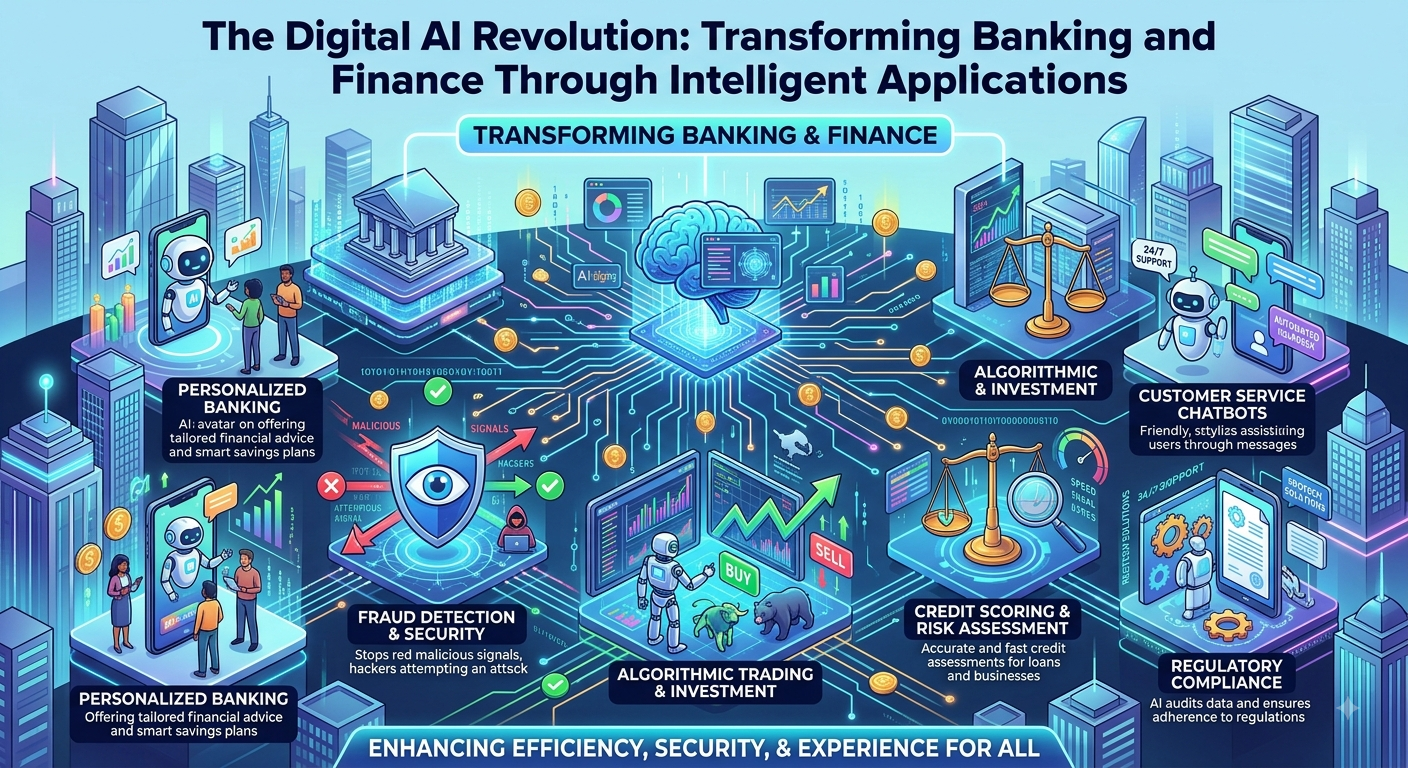
A Comprehensive Scientific, Technological, Economic and Regulatory Thesis — From Traditional Banking to AI-Native Finance
Abstract
Artificial intelligence is becoming one of the most consequential technologies in the transformation of banking and financial services. Banking has historically evolved through successive technological revolutions: paper-based accounting, mechanical calculators, electronic computers, automated teller machines, payment cards, internet banking, mobile banking, cloud computing and fintech. Artificial intelligence represents another major transition because it does not merely digitise existing processes; it can interpret information, detect patterns, generate content, predict outcomes, automate decisions and increasingly coordinate multi-step workflows.
Modern financial institutions are applying artificial intelligence to customer service, fraud detection, anti-money-laundering systems, credit assessment, risk management, cybersecurity, investment analysis, regulatory compliance, document processing, forecasting, personalised financial services and software development. Generative AI and increasingly agentic AI are extending these capabilities from prediction and classification toward natural-language interaction, reasoning assistance and workflow automation.
However, the transformation introduces a fundamental paradox. The same technologies that can make financial systems faster, more intelligent and more resilient can also create new concentrations of technological dependency, model risk, cyber risk, privacy concerns, discrimination, operational vulnerabilities and systemic financial instability. The Financial Stability Board has identified third-party dependency, market correlation, cyber risk and model risk as important areas of concern.
The International Monetary Fund has likewise highlighted the possibility that AI-enabled cyber threats could exploit common digital infrastructure at machine speed, potentially transmitting shocks across interconnected financial institutions.
South Africa is also participating in this transformation. In May 2026, South African Reserve Bank Deputy Governor and Prudential Authority CEO Fundi Tshazibana discussed the increasing adoption of AI in financial institutions, including chatbots, forecasting, claims processing, compliance and cybersecurity.
This thesis examines the technological foundations, historical development, applications, architecture, economics, risks, governance, cybersecurity, employment implications and future trajectory of AI-driven banking and finance.
Table of Contents
- Introduction
- The Evolution of Banking Technology
- From Computerisation to Artificial Intelligence
- What Artificial Intelligence Means in Finance
- The Data Foundation of Intelligent Banking
- Machine Learning in Financial Systems
- Deep Learning and Neural Networks
- Generative AI and Large Language Models
- Agentic AI and Autonomous Financial Workflows
- AI-Powered Customer Banking
- AI in Payments and Transaction Processing
- AI for Fraud Detection
- AI for Anti-Money Laundering and KYC
- AI in Credit and Lending
- AI in Risk Management
- AI in Investment and Capital Markets
- AI in Insurance and Wealth Management
- AI-Powered Cybersecurity
- AI in Accounting and Financial Administration
- AI in Regulatory Technology and SupTech
- AI Banking Architecture
- Data Centres, Cloud Computing and AI Infrastructure
- GPUs, Accelerators and Financial AI Computing
- APIs, Fintech and Open Banking
- Blockchain, Tokenisation and AI
- Human–AI Collaboration in Banking
- Economic Effects of AI on Financial Institutions
- Employment and the Future of Financial Work
- AI Bias, Fairness and Explainability
- Privacy and Financial Data Protection
- Model Risk and AI Governance
- Cybersecurity and Systemic Risk
- Third-Party and Cloud Dependency
- Central Banks and AI
- Global Regulation of Financial AI
- South Africa and AI-Driven Banking
- Africa’s Digital Financial Transformation
- Developing an AI-Native Bank
- Future Generations of Intelligent Finance
- 2030–2050 Outlook
- Strategic Recommendations
- Conclusion
- References
Chapter 1 — Introduction
Banking is fundamentally an information industry.
Money is important, but modern banking operates through information concerning customers, accounts, transactions, creditworthiness, assets, liabilities, payments, markets, risk and regulation.
For centuries, banks relied upon human judgement and physical records. The computer revolution transformed this model by making financial information machine-readable and electronically processable.
The internet then connected banks to customers.
Mobile technology placed banking in the hands of billions of people.
Cloud computing transformed the infrastructure supporting financial applications.
Artificial intelligence now introduces another transformation:
The transition from digital banking to intelligent banking.
Traditional software follows explicit instructions.
AI systems can learn patterns from data and produce predictions, classifications, recommendations or generated outputs.
This distinction is profound.
A conventional banking application may contain a rule such as:
IF transaction > threshold AND country = high-risk THEN flag transaction.
An AI system can instead analyse millions of historical transactions and identify combinations of characteristics associated with suspicious behaviour.
The future financial institution will therefore combine:
Data + Computing + Software + AI Models + Human Expertise + Governance.
Chapter 2 — The Evolution of Banking Technology
2.1 Banking Before Computers
Traditional banking depended on:
- paper ledgers;
- handwritten records;
- physical signatures;
- human calculations;
- physical branches;
- manual reconciliation;
- postal communications;
- face-to-face transactions.
The limitations were obvious:
- slow processing;
- high administrative costs;
- geographical restrictions;
- increased risk of human error;
- limited analytical capacity.
2.2 Mechanical Banking
Mechanical calculating machines introduced an intermediate stage between manual accounting and electronic computing.
Calculations became faster and more standardised.
2.3 Mainframe Banking
During the twentieth century, banks became major users of mainframe computers.
Computers allowed institutions to maintain enormous databases of:
- customer accounts;
- deposits;
- loans;
- transactions;
- interest calculations;
- financial statements.
2.4 ATMs
Automated teller machines extended banking beyond branch operating hours.
The ATM represented an important transition:
Bank employee → automated banking machine.
2.5 Internet Banking
Internet banking transformed the customer interface.
The branch became increasingly supplemented by:
Website → mobile application → digital platform.
2.6 Mobile Banking
Smartphones dramatically expanded financial accessibility.
Customers could perform:
- transfers;
- payments;
- balance enquiries;
- account management;
- digital onboarding;
- authentication.
2.7 AI Banking
The next transition is:
Digital interface → intelligent interface.
The customer increasingly interacts with systems capable of understanding natural language and analysing financial context.
Chapter 3 — From Computerisation to Artificial Intelligence
A useful technological ladder is:
| Generation | Primary capability |
|---|---|
| Manual banking | Human calculation |
| Mechanical banking | Mechanical calculation |
| Mainframe banking | Electronic processing |
| Database banking | Structured information |
| Internet banking | Networked access |
| Mobile banking | Ubiquitous digital access |
| Cloud banking | Elastic computing |
| Machine-learning banking | Predictive intelligence |
| Generative-AI banking | Language and content intelligence |
| Agentic banking | Workflow-oriented intelligent automation |
The critical difference is that AI can transform data into probabilistic predictions.
A simplified financial AI pipeline is:
Customer/Market Data
↓
Data Engineering
↓
Feature Construction
↓
AI Model
↓
Prediction / Classification / Generation
↓
Decision Support
↓
Human or Automated Action
↓
Monitoring
↓
Feedback
This creates a continuous intelligence cycle.
Chapter 4 — What Artificial Intelligence Means in Finance
Artificial intelligence is not a single technology.
It represents an ecosystem containing:
- machine learning;
- deep learning;
- natural-language processing;
- computer vision;
- reinforcement learning;
- generative AI;
- large language models;
- speech recognition;
- anomaly detection;
- predictive analytics;
- recommender systems;
- intelligent agents.
Financial AI can therefore be divided into several major categories.
Predictive AI
Forecasts:
- credit default;
- fraud probability;
- customer behaviour;
- market variables;
- liquidity requirements.
Classification AI
Determines categories such as:
- legitimate/suspicious transaction;
- low/high risk;
- approved/rejected;
- compliant/non-compliant.
Generative AI
Produces:
- text;
- reports;
- summaries;
- explanations;
- software;
- customer responses;
- analytical drafts.
Agentic AI
Can coordinate multiple steps within an authorised workflow.
For example:
Receive request → retrieve information → analyse → prepare recommendation → request approval → execute permitted action → document result.
High-risk financial actions should remain subject to appropriate controls and human oversight.
Chapter 5 — The Data Foundation of Intelligent Banking
AI depends fundamentally upon data.
Financial institutions generate enormous quantities of information:
- transaction records;
- customer profiles;
- account histories;
- credit records;
- market prices;
- economic indicators;
- financial statements;
- documents;
- communications;
- device information;
- cybersecurity events.
The quality of AI therefore depends heavily upon the quality of data.
The Financial Data Pipeline
Data Sources
↓
Data Ingestion
↓
Data Lake / Warehouse
↓
Data Cleaning
↓
Data Governance
↓
Feature Engineering
↓
Model Training
↓
Model Deployment
↓
Inference
↓
Monitoring
Bad data can produce bad decisions.
This creates the fundamental principle:
AI quality cannot sustainably exceed the quality and governance of the information environment supporting it.
Chapter 6 — Machine Learning in Financial Systems
Machine learning allows systems to identify statistical patterns from historical information.
Three major approaches are particularly important.
6.1 Supervised Learning
The model learns from labelled examples.
Example:
Historical transactions → legitimate/fraudulent label → model training → new transaction classification.
6.2 Unsupervised Learning
The system searches for patterns without predetermined labels.
Applications include:
- anomaly detection;
- customer segmentation;
- behavioural clustering.
6.3 Reinforcement Learning
The system learns through interaction with an environment and feedback.
This has potential applications in:
- optimisation;
- portfolio research;
- resource allocation;
- dynamic decision systems.
Financial applications require careful constraints because incorrect decisions can have significant consequences.
Chapter 7 — Deep Learning and Neural Networks
Deep neural networks contain multiple computational layers capable of learning complex representations.
Their applications include:
- fraud detection;
- speech recognition;
- document processing;
- financial forecasting;
- image/document verification;
- cybersecurity.
A simplified neural architecture is:
Input Data
↓
Input Layer
↓
Hidden Layer 1
↓
Hidden Layer 2
↓
Hidden Layer 3
↓
Output Layer
The network learns parameters that transform inputs into outputs.
Deep learning became especially important because modern GPUs and specialised accelerators can perform enormous numbers of mathematical operations in parallel.
Chapter 8 — Generative AI and Large Language Models
Generative AI represents a major change in financial software.
Traditional software primarily returns predetermined outputs.
Generative AI can produce new content based on learned statistical representations.
Large language models can assist with:
- financial-document analysis;
- customer communication;
- regulatory research;
- policy interpretation;
- report generation;
- coding;
- knowledge retrieval;
- summarisation;
- internal knowledge assistants.
However, generative AI can produce incorrect or fabricated information.
Consequently, financial institutions require:
- retrieval systems;
- source verification;
- access controls;
- audit trails;
- output monitoring;
- human review.
Chapter 9 — Agentic AI and Autonomous Financial Workflows
The next stage is AI that can coordinate workflows.
An AI agent can be conceptualised as:
Perception → Reasoning → Planning → Tool Use → Action → Observation → Feedback.
A financial institution could theoretically use controlled agents for:
- document processing;
- compliance investigations;
- internal research;
- customer-service workflows;
- software operations;
- financial reporting.
The critical distinction is between assistance and autonomous authority.
An AI may safely prepare a recommendation while a human or controlled system remains responsible for a consequential financial action.
Chapter 10 — AI-Powered Customer Banking
AI is transforming the customer interface.
Traditional banking:
Customer → Branch/Call Centre → Employee → System
AI-enabled banking:
Customer → Digital Interface → AI → Banking Systems
Applications include:
- intelligent chatbots;
- voice banking;
- personalised notifications;
- financial education;
- transaction explanations;
- spending analysis;
- service routing.
The ideal objective is not simply automation.
It is:
Faster + more accessible + more personalised + safer banking.
Chapter 11 — AI in Payments and Transaction Processing
Payments produce continuous streams of structured data.
AI can analyse:
- transaction frequency;
- transaction amount;
- geographical patterns;
- merchant relationships;
- account behaviour;
- device information;
- timing;
- historical patterns.
This allows systems to identify unusual activity in near real time.
The payment architecture increasingly becomes:
Payment Initiation
↓
Authentication
↓
Transaction Analysis
↓
Fraud/Risk Engine
↓
Authorisation
↓
Settlement
↓
Monitoring
Chapter 12 — AI for Fraud Detection
Fraud is a major application of financial AI.
Traditional rules remain valuable, but AI can detect complex patterns across multiple variables.
A fraud model may examine:
Transaction + Customer + Device + Location + Merchant + Timing + Historical Behaviour
rather than considering only transaction value.
AI can therefore move financial security from:
Rule-based detection
toward:
Behaviour-based detection.
Chapter 13 — AI for Anti-Money Laundering and KYC
Know Your Customer and Anti-Money Laundering systems involve enormous quantities of data.
AI can assist with:
- customer onboarding;
- identity verification;
- document analysis;
- transaction monitoring;
- network analysis;
- suspicious-activity detection;
- case prioritisation.
AI can also help investigators navigate large numbers of records.
However, regulatory decisions require careful governance because false positives and false negatives can both have serious consequences.
Chapter 14 — AI in Credit and Lending
Credit assessment has traditionally depended on:
- income;
- employment;
- credit history;
- assets;
- liabilities;
- repayment history.
AI can analyse substantially larger datasets.
Potential applications include:
- credit scoring;
- default prediction;
- loan pricing;
- affordability analysis;
- early-warning systems.
But automated lending introduces important fairness questions.
A model could unintentionally reproduce historical discrimination embedded within its training data.
Therefore:
Predictive accuracy ≠ fairness.
Chapter 15 — AI in Risk Management
Financial institutions manage multiple categories of risk:
- Credit risk
- Market risk
- Liquidity risk
- Operational risk
- Cyber risk
- Model risk
- Compliance risk
- Strategic risk
AI can assist by continuously monitoring risk indicators.
The future risk department may therefore operate increasingly as:
Human experts + statistical models + machine learning + simulation + real-time monitoring.
Chapter 16 — AI in Investment and Capital Markets
AI can process:
- financial statements;
- market data;
- economic indicators;
- news;
- research;
- alternative datasets.
Applications include:
- quantitative research;
- portfolio analysis;
- market surveillance;
- risk modelling;
- research assistance;
- algorithmic execution.
However, widespread use of similar models could create correlated behaviour.
This is one reason financial regulators are examining whether AI could amplify market-wide shocks. The FSB has specifically identified market correlations as a potential vulnerability.
Chapter 17 — AI in Insurance and Wealth Management
Insurance applications include:
- underwriting;
- claims processing;
- fraud detection;
- customer service;
- risk assessment.
Wealth-management applications include:
- portfolio analysis;
- financial planning assistance;
- customer segmentation;
- personalised communication;
- investment research.
The human adviser is therefore likely to evolve from information processor toward:
Interpreter + strategist + relationship manager + fiduciary decision-maker.
Chapter 18 — AI-Powered Cybersecurity
AI has a dual role.
It can strengthen cybersecurity through:
- anomaly detection;
- behavioural monitoring;
- automated alert prioritisation;
- malware analysis;
- threat intelligence;
- incident response.
But attackers can also use AI.
The IMF has warned that AI may accelerate vulnerability discovery and exploitation and that common digital infrastructure could amplify cyber incidents across financial institutions.
Therefore:
AI security must defend the AI system as well as use AI for defence.
Chapter 19 — AI in Accounting and Financial Administration
AI can assist with:
- invoice processing;
- reconciliation;
- expense classification;
- financial reporting;
- document extraction;
- audit preparation;
- anomaly detection.
Accounting therefore moves progressively from:
Data entry
to
Data validation
to
Financial intelligence.
Chapter 20 — AI in Regulatory Technology and SupTech
RegTech uses technology to improve regulatory compliance.
SupTech uses technology by supervisors and regulators.
AI can help regulators analyse:
- financial reports;
- transactions;
- market activity;
- risk indicators;
- regulatory submissions.
The FSB has argued that authorities should improve their monitoring of AI adoption and strengthen supervisory capabilities.
Chapter 21 — AI Banking Architecture
A modern AI-native bank can be represented as:
                 CUSTOMER
                    │
        ┌───────────┴───────────┐
        │                       │
   Mobile App               Web / Voice
        │                       │
        └───────────┬───────────┘
                    │
              API / Gateway
                    │
        ┌───────────┴───────────┐
        │                       │
   Banking Core             AI Platform
        │                       │
        │             ┌─────────┼─────────┐
        │             │         │         │
        │            ML       GenAI     Agents
        │             │         │         │
        └─────────────┼─────────┼─────────┘
                      │
                 Data Platform
                      │
          ┌───────────┼───────────┐
          │           │           │
       Database    Data Lake    External Data
          │
       Security
          │
      Governance
          │
    Human Oversight
This architecture demonstrates an important principle:
AI does not replace the banking system.
Instead, AI becomes an intelligence layer connected to the broader financial technology stack.
Chapter 22 — Data Centres, Cloud Computing and AI Infrastructure
AI banking requires substantial computing infrastructure.
The infrastructure stack includes:
Electricity
↓
Data Centre
↓
Cooling
↓
Servers
↓
CPUs + GPUs/AI Accelerators
↓
Memory
↓
Networking
↓
Storage
↓
AI Frameworks
↓
Models
↓
Applications
The financial AI revolution is therefore also an infrastructure revolution.
Chapter 23 — GPUs, Accelerators and Financial AI Computing
AI models require enormous mathematical computation.
GPUs are particularly useful because they can execute many parallel operations.
A modern AI infrastructure ecosystem contains:
- CPUs;
- GPUs;
- AI accelerators;
- high-bandwidth memory;
- networking;
- distributed computing;
- storage;
- model-serving infrastructure.
This creates a new strategic dependency:
Finance → Cloud → Compute → Semiconductor Industry.
Recent financial-sector analysis has consequently highlighted third-party and technology-provider dependency as an important emerging vulnerability.
Chapter 24 — APIs, Fintech and Open Banking
APIs allow different financial systems to communicate.
For example:
Bank API → Fintech Application → Customer
This enables financial ecosystems containing:
- banks;
- fintech companies;
- payment platforms;
- insurers;
- investment platforms;
- accounting software;
- AI companies.
AI can act as an intelligence layer across these interconnected systems.
Chapter 25 — Blockchain, Tokenisation and AI
Blockchain provides distributed transaction records.
AI provides computational intelligence.
Their combination could support:
- intelligent transaction monitoring;
- automated compliance;
- document intelligence;
- tokenised asset analysis;
- smart-contract monitoring.
The technologies should not be confused:
Blockchain = distributed record/transaction infrastructure
AI = computational intelligence
Their convergence creates another emerging architecture for digital finance.
Chapter 26 — Human–AI Collaboration
The future should not be framed simply as:
Humans versus AI.
A more useful model is:
Human Intelligence + Machine Intelligence.
Humans contribute:
- judgement;
- ethics;
- accountability;
- contextual understanding;
- institutional knowledge;
- empathy.
AI contributes:
- speed;
- scale;
- pattern recognition;
- continuous monitoring;
- computational analysis.
The strongest financial institutions are therefore likely to combine both.
Chapter 27 — Economic Effects
AI can potentially reduce:
- processing costs;
- manual administrative work;
- fraud losses;
- customer-service costs;
- analytical time.
It can potentially increase:
- productivity;
- personalisation;
- financial inclusion;
- product innovation;
- operational speed.
However, AI investment itself requires substantial expenditure on:
- computing;
- cloud services;
- cybersecurity;
- data engineering;
- model development;
- staff training;
- governance.
The economic outcome depends on whether productivity gains exceed implementation and risk-management costs.
Chapter 28 — Employment and the Future of Financial Work
AI will change financial employment.
Tasks most susceptible to automation are generally repetitive, rules-based and information-intensive.
Examples include:
- basic document processing;
- routine reporting;
- data classification;
- simple customer queries;
- repetitive reconciliation.
Human skills become increasingly important in:
- strategy;
- judgement;
- leadership;
- ethics;
- complex negotiation;
- relationship management;
- AI governance.
The central employment transformation may therefore be:
Job replacement in some tasks + job augmentation in many others + creation of new technical roles.
Chapter 29 — Bias, Fairness and Explainability
Financial AI decisions can affect:
- loans;
- insurance;
- fraud investigations;
- account access;
- customer treatment.
Consequently, fairness is essential.
Important questions include:
- Was the training data representative?
- Are protected groups treated fairly?
- Can decisions be explained?
- Can errors be challenged?
- Who is accountable?
Financial AI must therefore be designed around:
Accuracy + Fairness + Explainability + Accountability.
Chapter 30 — Privacy and Financial Data Protection
Financial data is highly sensitive.
AI systems therefore require:
- access controls;
- encryption;
- data minimisation;
- secure storage;
- retention policies;
- monitoring;
- authentication;
- privacy governance.
A bank should know:
What data enters the model?
Where is it processed?
Who can access it?
How long is it retained?
Can it be deleted or corrected?
Chapter 31 — Model Risk and AI Governance
An AI model can fail even when the underlying software is functioning correctly.
Possible causes include:
- biased data;
- data drift;
- changing economic conditions;
- model degradation;
- incorrect assumptions;
- unexpected correlations.
Model governance therefore requires:
- Model inventory
- Risk classification
- Validation
- Documentation
- Testing
- Monitoring
- Human oversight
- Incident management
- Retirement procedures
Chapter 32 — Cybersecurity and Systemic Risk
AI changes the speed of financial systems.
A human may take hours to investigate an event.
An AI system can process enormous quantities of information almost instantaneously.
This creates both resilience and vulnerability.
The IMF argues that AI-enabled cyber risks may become particularly significant because financial infrastructure is interconnected through shared software, networks and service providers.
The fundamental systemic-risk equation becomes:
More Connectivity + More Automation + More Speed = Potentially Faster Shock Transmission.
Chapter 33 — Third-Party and Cloud Dependency
Banks increasingly depend on external providers for:
- cloud computing;
- AI models;
- cybersecurity;
- data;
- software;
- infrastructure.
This creates concentration risk.
If many banks depend upon the same technology provider, a major outage could affect multiple institutions simultaneously.
The FSB has specifically highlighted third-party dependency and concentration as important areas for monitoring.
The emerging principle is therefore:
Financial resilience increasingly requires technological resilience.
Chapter 34 — Central Banks and AI
Central banks are facing a new technological environment.
AI can affect:
- economic forecasting;
- inflation analysis;
- financial supervision;
- market monitoring;
- cybersecurity;
- payment systems.
The IMF has argued that central banks need stronger oversight, better data and deeper coordination as AI becomes embedded in financial decision-making.
AI may also affect monetary policy indirectly.
The BIS has warned that the AI investment boom can complicate interpretation of inflation and productivity because AI simultaneously affects demand, investment and potential supply.
Chapter 35 — Global Regulation
AI regulation in finance is moving toward risk-based governance.
Regulators increasingly focus on:
- transparency;
- accountability;
- privacy;
- cybersecurity;
- model risk;
- third-party dependency;
- operational resilience;
- consumer protection.
The challenge is to create a regulatory environment that protects the financial system without preventing useful innovation.
The emerging philosophy is therefore:
Innovation with governance rather than innovation without limits.
Chapter 36 — South Africa and AI-Driven Banking
South Africa has a sophisticated banking and financial ecosystem and is increasingly confronting the implications of AI.
The South African Reserve Bank and Prudential Authority are examining how AI changes supervision and financial-sector risks.
In May 2026, Deputy Governor Fundi Tshazibana described applications including customer chatbots, forecasting, claims processing, compliance monitoring and cybersecurity.
South Africa’s opportunity is significant because the country combines:
- established banks;
- mobile financial services;
- fintech innovation;
- digital payments;
- sophisticated telecommunications;
- growing AI capabilities.
However, challenges include:
- inequality;
- digital exclusion;
- cybersecurity;
- data governance;
- skills shortages;
- infrastructure constraints.
AI should therefore be deployed not merely to make existing banking more profitable but also to improve accessibility and inclusion.
Chapter 37 — Africa’s Digital Financial Transformation
Africa has demonstrated the transformative power of mobile financial technology.
Mobile money showed that financial services can bypass some traditional infrastructure barriers.
The next transformation could involve:
Mobile Money → Digital Banking → AI-Enabled Financial Ecosystems.
Potential applications include:
- alternative credit assessment;
- agricultural finance;
- small-business finance;
- fraud prevention;
- financial education;
- multilingual customer service;
- digital identity;
- insurance.
AI could become particularly important for populations historically underserved by traditional financial institutions.
Chapter 38 — Developing an AI-Native Bank
An AI-native bank should not simply add a chatbot to an existing banking system.
It should redesign the institution around intelligent infrastructure.
Layer 1 — Digital Identity
Secure customer identity.
Layer 2 — Data
Unified and governed financial information.
Layer 3 — Core Banking
Accounts, payments, loans and financial products.
Layer 4 — AI
Prediction, classification, generation and intelligent workflow.
Layer 5 — Security
Cybersecurity, fraud detection and access controls.
Layer 6 — Governance
Human oversight, compliance and auditing.
Layer 7 — Customer Experience
Mobile, web, voice and conversational interfaces.
This produces:
AI + Banking + Security + Governance + Human Expertise.
Chapter 39 — Future Generations of Intelligent Finance
The evolution can be projected as:
Generation 1
Rule-based automation
Generation 2
Machine-learning prediction
Generation 3
Generative AI
Generation 4
AI copilots
Generation 5
Controlled AI agents
Generation 6
Multi-agent financial ecosystems
Generation 7
Highly autonomous financial infrastructure under human and regulatory supervision
The final stage should not mean unrestricted machine control of financial systems.
Instead, it should mean increasingly sophisticated automation surrounded by strong governance.
Chapter 40 — 2030–2050 Outlook
By 2030, AI is likely to be deeply embedded across many banking operations.
By the 2030s, banking interfaces may increasingly become conversational and context-aware.
Customers may ask:
“Explain my financial position.”
Instead of navigating multiple menus, the system could assemble a personalised financial overview.
Financial institutions may increasingly operate with:
AI employees + human employees + automated infrastructure.
By 2050, the distinction between “digital banking” and “AI banking” may largely disappear because intelligence could become an embedded component of almost every financial service.
Chapter 41 — Strategic Recommendations
Recommendation 1 — Build Strong Data Foundations
AI cannot compensate indefinitely for poor data governance.
Recommendation 2 — Adopt Risk-Based AI Governance
Not every AI application presents the same level of risk.
Customer-service summarisation and automated lending decisions should not be governed identically.
Recommendation 3 — Maintain Human Accountability
High-impact financial decisions require appropriate human responsibility.
Recommendation 4 — Strengthen Cybersecurity
AI systems must be protected against both conventional and AI-enabled attacks.
Recommendation 5 — Reduce Excessive Technology Concentration
Banks should understand their dependency on cloud, AI and infrastructure providers.
Recommendation 6 — Invest in Human Skills
Financial workers need training in:
- data;
- AI;
- cybersecurity;
- governance;
- analytical reasoning.
Recommendation 7 — Promote Financial Inclusion
AI should expand access rather than reinforce existing inequality.
Recommendation 8 — Encourage International Cooperation
Financial markets cross national borders.
AI risks therefore cannot always be managed effectively by one jurisdiction acting alone.
The IMF and international financial authorities increasingly emphasise coordination, operational resilience and common approaches to AI-related risks.
Chapter 42 — Conclusion
The digital AI revolution represents one of the most significant transformations in the history of banking.
Banking has progressed through several technological eras:
Ledger → Calculator → Mainframe → ATM → Internet → Mobile → Cloud → AI.
Artificial intelligence is different from many previous technologies because it can perform functions associated with cognitive work.
It can:
- analyse;
- predict;
- classify;
- generate;
- recommend;
- monitor;
- detect;
- communicate;
- increasingly coordinate workflows.
Its potential is enormous.
AI can make financial services faster, more personalised, more analytical and potentially more inclusive.
But intelligence without governance can create new forms of risk.
The financial system is highly interconnected. AI can therefore amplify both positive and negative effects.
The central challenge of the coming decades is not simply:
“How intelligent can financial AI become?”
The more important question is:
“How can society make financial AI sufficiently intelligent, secure, fair, transparent and accountable to deserve trust?”
The answer lies in combining technological innovation with strong institutions.
The future financial architecture will therefore not be built from AI alone.
It will be built from:
Data
Computing
AI
Cybersecurity
Financial infrastructure
Human judgement
Regulation
Ethics
Trust.
The ultimate transformation is consequently not the replacement of banking by artificial intelligence.
It is the emergence of intelligent financial infrastructure in which humans and machines cooperate to process information, manage risk, deliver services and allocate capital at unprecedented scale and speed.
Chapter 43 — Selected References and Further Reading
- Financial Stability Board, The Financial Stability Implications of Artificial Intelligence, 2024.
- Financial Stability Board, Monitoring Adoption of Artificial Intelligence and Related Vulnerabilities in the Financial Sector, 2025.
- International Monetary Fund, Artificial Intelligence and Cybersecurity in the Financial Sector, 2026.
- International Monetary Fund, How Central Banks Can Contain Financial Stability Risks as AI Accelerates Change, 2026.
- International Monetary Fund, Financial Stability Risks Mount as Artificial Intelligence Fuels Cyberattacks, 2026.
- Bank for International Settlements, The Financial Stability Implications of Artificial Intelligence and Digital Finance, 2026.
- South African Reserve Bank / BIS, Fundi Tshazibana, Regulation and Supervision of the Financial Sector in the Age of Artificial Intelligence, 2026.
Final Thesis Proposition
The history of banking can be understood as a continuous effort to increase the speed, scale, accuracy and accessibility of financial information.
The computer made financial information digital.
The internet made it connected.
The smartphone made it ubiquitous.
Cloud computing made it scalable.
Artificial intelligence is making it increasingly intelligent.
That transformation may define the next major era of global finance.



Be First to Comment