
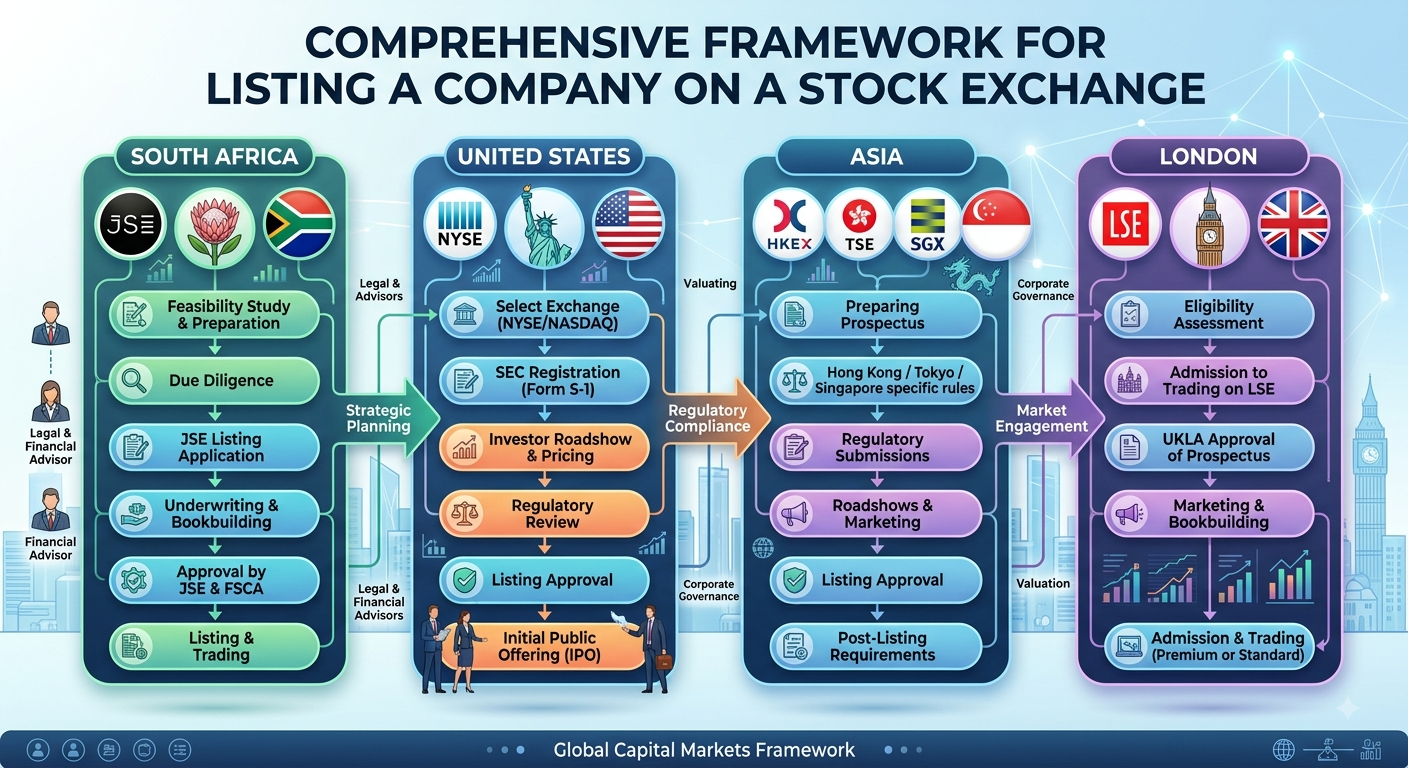
1. Introduction
Listing a company on a stock exchange is a major transition from private ownership to participation in public capital markets. It requires much more than selling shares to investors: the company must demonstrate appropriate financial reporting, governance, legal compliance, internal controls, transparency, management capability, and sufficient public-market suitability.
This framework examines the principal stages and strategic considerations for listing a company in South Africa, the United States, Asia, and London, while distinguishing between the stock exchange’s listing requirements and the securities regulator’s public-offering requirements.
2. The Fundamental IPO Architecture
A company seeking a public listing should understand the process as an interconnected system:
Private Company → Corporate Restructuring → Financial Preparation → Governance → Legal Due Diligence → Investment Bank/Advisers → Regulatory Filings → Prospectus/Offering Document → Investor Marketing → Pricing → Share Allocation → Exchange Admission → Public Trading → Continuing Compliance
The principal participants normally include:
- Company founders and shareholders
- Board of directors
- Executive management
- Investment banks/bookrunners
- Corporate and securities lawyers
- Reporting accountants and auditors
- Stock exchange
- Securities regulator
- Transfer/settlement infrastructure
- Institutional investors
- Retail investors
- Market makers or liquidity providers where applicable
- Investor-relations advisers
- Tax and corporate-structure advisers
3. Stage One — Determine Why the Company Should List
Before considering an exchange, management should establish the strategic reason for becoming public.
Primary objectives
- Raise expansion capital
- Finance acquisitions
- Build production capacity
- Enter new geographic markets
- Strengthen the balance sheet
- Improve access to future capital
- Create a market for existing shareholders’ holdings
- Increase corporate visibility
- Establish an acquisition currency through publicly traded shares
- Improve employee equity-compensation opportunities
- Create long-term institutional ownership
Critical question
A company should not list simply because an IPO is prestigious.
The central question is:
Will public-market ownership materially improve the company’s long-term ability to create sustainable economic value?
4. Stage Two — Establish IPO Readiness
Before selecting an exchange, the company should conduct an IPO-readiness assessment.
4.1 Financial readiness
The company should have:
- Reliable historical financial statements
- Appropriate accounting policies
- Audited financial information
- Predictable financial reporting processes
- Strong cash-flow controls
- Documented revenue recognition
- Proper asset and liability records
- Tax compliance
- Budgeting and forecasting systems
- Management reporting
- Internal controls
4.2 Corporate readiness
The company should establish:
- An effective board
- Appropriate independent directors
- Board committees
- Audit committee
- Risk-management framework
- Remuneration framework
- Nomination/governance processes
- Conflict-of-interest procedures
- Related-party transaction controls
4.3 Legal readiness
The company should review:
- Incorporation documents
- Shareholder agreements
- Intellectual property
- Material contracts
- Employment agreements
- Litigation
- Regulatory licences
- Tax obligations
- Environmental obligations
- Data and technology rights
- Subsidiaries
- Joint ventures
- Debt agreements
5. Stage Three — Select the Listing Jurisdiction
The four major geographic options in this framework are:
| Region | Major market examples | Strategic orientation |
|---|---|---|
| South Africa | JSE | African capital markets |
| United States | NYSE, Nasdaq | Global capital and technology markets |
| London | London Stock Exchange | International/global markets |
| Asia | Hong Kong, Singapore, Japan and other markets | Asian and international capital |
The correct exchange depends on the company’s:
- Industry
- Geographic operations
- Investor base
- Size
- Growth rate
- Profitability
- Capital requirements
- Governance capacity
- Currency exposure
- Regulatory requirements
- Desired international visibility
6. South Africa — Johannesburg Stock Exchange
The Johannesburg Stock Exchange (JSE) provides a major route to public capital markets for South African and international companies.
The JSE’s March 2026 Listings Requirements specify requirements covering areas including new listings, corporate governance, auditors, financial information and specialized sectors.
6.1 South African IPO structure
A prospective issuer should generally progress through:
Company Preparation → Sponsor/Adviser Appointment → Due Diligence → Financial Reporting → Prospectus/Pre-listing Documentation → Regulatory/Exchange Review → Investor Marketing → Pricing → Listing
6.2 Important JSE considerations
The company must address:
- Listing category
- Share structure
- Public shareholder requirements
- Financial history
- Audited financial statements
- Corporate governance
- Directors
- Sponsor requirements
- Working capital
- Related-party transactions
- Material contracts
- Shareholder approvals where required
- Continuing disclosure
- Financial reporting
The JSE requirements also provide specialized provisions for areas including dual listings, property entities, mining and oil & gas, investment entities/SPACs, BEE-related listings and depositary receipts.
7. United States — NYSE
The New York Stock Exchange (NYSE) is one of the world’s largest public equity markets.
NYSE requires companies to satisfy quantitative financial and distribution standards as well as qualitative and corporate-governance requirements.
7.1 Major NYSE readiness categories
A company must consider:
- Financial eligibility
- Public float
- Number of public shareholders
- Share price
- Market value
- Corporate governance
- Financial statements
- Regulatory filings
- Disclosure
- Exchange application
- Investor distribution
For example, NYSE’s published IPO standards include requirements such as a minimum share price and minimum publicly held shares, while financial eligibility can be assessed through alternative tests.
7.2 NYSE application architecture
NYSE describes its listing application process as involving:
Confidential eligibility review → Formal application → Exchange review → Approval → Admission to trading
8. United States — Nasdaq
Nasdaq is particularly significant for technology, growth and innovation-oriented companies.
Nasdaq’s Global Market rules, for example, establish minimum requirements relating to share price, unrestricted publicly held shares, round-lot holders and alternative financial standards.
8.1 Nasdaq market structure
Companies can potentially qualify for different Nasdaq market tiers, including:
- Nasdaq Capital Market
- Nasdaq Global Market
- Nasdaq Global Select Market
Each has its own eligibility requirements.
8.2 Example — Nasdaq Global Market
Current rules include requirements such as:
- Minimum $4 bid price
- At least 1.1 million unrestricted publicly held shares
- At least 400 round-lot holders
- Applicable financial standard
- Public-float requirements
- Market-maker requirements
The applicable financial standard can be based on income, equity, market value or assets/revenue.
9. London — London Stock Exchange
London provides a major international equity-market platform with access to UK and global investors.
A company considering London should distinguish between:
Exchange admission requirements + UK securities regulation + corporate-governance requirements + accounting/reporting requirements.
Potential listing structures should be evaluated according to the company’s size, jurisdiction, shareholder base, financial history and intended investor market.
10. Asia — A Multi-Market Strategy
Asia should not be treated as one stock exchange.
It represents multiple capital-market systems, including major financial centres such as:
- Hong Kong
- Singapore
- Japan
- South Korea
- India
- Mainland China
The appropriate market depends heavily on where the company operates and where its investors are located.
10.1 Hong Kong
Hong Kong can be strategically important for companies seeking exposure to Asian and international investors.
Key considerations include:
- Eligibility
- Financial track record
- Public float
- Corporate governance
- Disclosure
- Sponsor/adviser requirements
- Sector-specific rules
- Regulatory approval
10.2 Singapore
Singapore can be attractive for internationally oriented companies seeking an Asian financial centre.
Companies must evaluate:
- Listing route
- Financial eligibility
- Public distribution
- Governance
- Disclosure
- Continuing obligations
10.3 Japan
Japan represents a large developed capital market with its own exchange, regulatory and corporate-governance environment.
A foreign company considering Japan should evaluate:
- Investor base
- Reporting requirements
- Accounting requirements
- Corporate structure
- Japanese regulatory obligations
- Listing segment
11. Domestic Listing vs Cross-Border Listing
A company has several strategic choices.
Option A — Domestic IPO
Example:
South African company → JSE
Advantages:
- Familiar domestic market
- Local investor base
- Local currency
- Domestic visibility
Option B — Foreign IPO
Example:
South African company → NYSE/Nasdaq
Potential advantages:
- Access to larger international investor pools
- Greater visibility
- Potentially stronger sector-specific investor coverage
But the regulatory and reporting burden can be substantially greater.
Option C — Dual Listing
Example:
JSE + London
or
JSE + Nasdaq
This can broaden the investor base but creates additional compliance, disclosure, settlement and governance complexity.
12. Choosing the Correct Exchange
A useful strategic scoring system is:
| Factor | Weight |
|---|---|
| Investor access | 20% |
| Capital availability | 15% |
| Regulatory suitability | 15% |
| Industry fit | 10% |
| Liquidity | 10% |
| Valuation environment | 10% |
| Cost | 5% |
| Governance burden | 5% |
| International visibility | 5% |
| Future capital raising | 5% |
The company can assign scores from 1–10 to each exchange and calculate a weighted result.
This converts exchange selection from a prestige decision into a structured corporate-finance decision.
13. Stage Four — Corporate Restructuring
Before an IPO, the company may need to reorganize its legal structure.
Possible actions include:
- Establishing a holding company
- Consolidating subsidiaries
- Separating unrelated businesses
- Creating appropriate share classes
- Simplifying ownership
- Resolving shareholder disputes
- Cleaning up dormant subsidiaries
- Transferring intellectual property
- Restructuring debt
- Establishing employee share plans
The objective is to create a corporate structure that investors can understand.
14. Stage Five — Build the Board
A public company requires significantly stronger governance than a small private business.
The board should collectively possess expertise in:
- Finance
- Accounting
- Law
- Industry operations
- Technology
- Risk
- Strategy
- Capital markets
- Corporate governance
The company should establish clear separation between:
Board oversight → Executive management → Operational execution
15. Stage Six — Financial Reporting System
Public companies need the ability to produce accurate financial information consistently.
The IPO preparation process should therefore establish:
Financial control architecture
Transactions → Accounting System → Internal Controls → Consolidation → Audit → Regulatory Reporting → Investor Disclosure
The company should test:
- Revenue controls
- Cash controls
- Procurement controls
- Payroll controls
- Inventory controls
- Fixed-asset controls
- Tax controls
- Debt controls
- Consolidation controls
- Financial-close procedures
16. Stage Seven — Due Diligence
IPO due diligence examines the company from multiple perspectives.
Legal
- Litigation
- Contracts
- Intellectual property
- Corporate ownership
Financial
- Revenue
- Profit
- Cash flow
- Debt
- Assets
- Liabilities
Commercial
- Customers
- Suppliers
- Competition
- Market size
- Pricing
Technology
- Software
- Cybersecurity
- Data
- Intellectual property
- Infrastructure
Human resources
- Management
- Employment agreements
- Key-person dependency
- Incentive structures
17. Stage Eight — Appoint the IPO Team
A sophisticated IPO normally requires several professional advisers.
Core team
Company
↓
Board
↓
Lead investment bank/bookrunner
↓
Legal advisers
↓
Reporting accountant/auditor
↓
Exchange
↓
Securities regulator
↓
Investor-relations and communications advisers
Each participant has a different role.
18. Stage Nine — Prepare the Offering Document
The offering document must allow investors to understand the investment.
Typical subject areas include:
- Company history
- Business model
- Products
- Markets
- Competitive environment
- Strategy
- Management
- Directors
- Financial statements
- Risk factors
- Use of proceeds
- Share capital
- Major shareholders
- Material contracts
- Litigation
- Dividend policy
- Corporate governance
- Related-party transactions
19. Stage Ten — Determine the IPO Size
The company must determine how much capital to raise.
For example:
Target capital = R5 billion
The company then determines:
- Number of new shares
- Offer price
- Percentage of company sold
- Primary versus secondary shares
- Expected dilution
- Post-IPO ownership
Basic relationship
Equity Value = Share Price × Shares Outstanding
If:
- Share price = R20
- Shares outstanding = 500 million
Then:
Equity value = R10 billion
20. Primary vs Secondary Shares
This distinction is essential.
Primary issuance
New shares are issued by the company.
Investor → Company → Capital
The company receives the proceeds.
Secondary sale
Existing shareholders sell shares.
Investor → Existing Shareholder → Cash
The company generally does not receive the sale proceeds.
An IPO can contain both.
21. Stage Eleven — Investor Marketing
The investment bank and management team may conduct investor education and marketing.
The objective is to explain:
- Company strategy
- Industry
- Growth opportunity
- Financial performance
- Risks
- Capital requirements
- Competitive advantages
Management must communicate consistently and accurately.
22. Stage Twelve — Bookbuilding
Institutional investors submit indications of interest.
The bookrunner analyses:
- Demand
- Price sensitivity
- Investor quality
- Geographic demand
- Long-term versus short-term investors
The process helps establish an IPO price.
23. Stage Thirteen — Pricing
The company and its advisers determine:
Offer Price × Shares Offered = Gross IPO Proceeds
From gross proceeds, the company may need to account for:
- Underwriting fees
- Legal fees
- Accounting fees
- Exchange fees
- Regulatory costs
- Marketing expenses
- Other transaction expenses
Therefore:
Net proceeds = Gross proceeds − IPO expenses
24. Stage Fourteen — Allocation
Shares are allocated among investors according to the offering structure and applicable rules.
Possible investor categories include:
- Institutional investors
- Strategic investors
- Retail investors
- Employees
- Existing shareholders
The allocation strategy can influence the future shareholder base and trading liquidity.
25. Stage Fifteen — Listing Day
The final sequence is broadly:
Regulatory approval
↓
Exchange admission
↓
Shares allocated
↓
Settlement
↓
Ticker activated
↓
Trading begins
At this point, the company becomes a publicly traded enterprise.
26. The Company After the IPO
The IPO is not the end of the process.
It is the beginning of a new corporate operating system.
The company must maintain:
- Financial reporting
- Continuous disclosure
- Corporate governance
- Investor relations
- Regulatory compliance
- Shareholder communications
- Internal controls
- Risk management
27. Public Company Management System
A useful model is:
Strategy
↓
Capital Allocation
↓
Operations
↓
Financial Reporting
↓
Risk Management
↓
Governance
↓
Investor Communication
↓
Market Valuation
↓
Future Capital Raising
This creates a continuous public-market feedback loop.
28. Major IPO Risks
Companies should identify risks before listing.
Financial risks
- Weak cash flow
- High debt
- Unstable earnings
- Excessive valuation expectations
Operational risks
- Supply-chain disruption
- Key-person dependency
- Production failures
- Technology failures
Market risks
- Investor sentiment
- Interest rates
- Economic recession
- Sector downturn
Regulatory risks
- Disclosure failures
- Governance failures
- Accounting errors
- Regulatory non-compliance
Reputation risks
- Management misconduct
- Cyber incidents
- Customer disputes
- Environmental controversies
29. IPO Readiness Scorecard
A company can evaluate itself across ten dimensions:
| Area | Score / 10 |
|---|---|
| Financial reporting | /10 |
| Corporate governance | /10 |
| Legal readiness | /10 |
| Management | /10 |
| Internal controls | /10 |
| Market position | /10 |
| Technology | /10 |
| Investor proposition | /10 |
| Regulatory readiness | /10 |
| Capital-market readiness | /10 |
Interpretation
90–100: Highly prepared
75–89: Generally strong but requires improvement
60–74: Significant preparation required
Below 60: Company should normally strengthen its foundations before pursuing an IPO
This is an internal planning framework rather than an exchange qualification test.
30. Comparative Strategic Framework
| Dimension | South Africa | United States | London | Asia |
|---|---|---|---|---|
| Major market | JSE | NYSE/Nasdaq | LSE | Multiple |
| Primary advantage | African market access | Deep global capital | International investor base | Asian/global access |
| Key challenge | Market depth | Regulatory complexity | International compliance | Market-specific rules |
| Suitable companies | African growth businesses | Global growth/technology | International businesses | Asia-facing/global businesses |
| Currency environment | Rand | US dollar | Pound | Multiple currencies |
| Cross-border potential | High | Very high | Very high | Very high |
31. South African Company — Global Expansion Model
For a South African technology company, a possible long-term pathway could be:
Private South African Company
↓
JSE Preparation
↓
JSE Listing
↓
African Expansion
↓
International Revenue
↓
Institutional Investor Base
↓
Potential Dual Listing
↓
NYSE/Nasdaq or London
This should not be treated as an automatic progression. The company should pursue each stage only when its scale, governance, investor base and strategic needs justify it.
32. Technology Companies and IPO Readiness
Technology companies require additional preparation in areas such as:
- Intellectual property
- Software ownership
- Cloud infrastructure
- Cybersecurity
- Data governance
- Artificial intelligence
- Software licences
- Open-source software
- Customer concentration
- Recurring revenue
- Research and development
- Technology debt
For technology companies, investors increasingly examine not only current revenue but also the scalability and defensibility of the technology platform.
33. The IPO as an Economic System
An IPO can be understood as a transformation:
Private Capital
→
Public Capital
→
Liquidity
→
Price Discovery
→
Institutional Ownership
→
Capital Formation
→
Business Expansion
→
Employment
→
Tax Revenue
→
Economic Development
Therefore, a functioning stock market is not merely a place where shares are traded. It is an infrastructure system for transforming savings into productive investment.
34. The Millennium 3001 Perspective
From a long-term economic perspective, the modern stock exchange can be viewed as part of a broader financial-information network:
Human Knowledge
↓
Innovation
↓
Company Formation
↓
Capital Formation
↓
Stock Exchange
↓
Investor Capital
↓
Industrial Expansion
↓
Technology
↓
Productivity
↓
Economic Growth
↓
Higher Human Capability
The future capital market is likely to become increasingly connected to:
- Artificial intelligence
- Real-time financial data
- Automated compliance
- Digital identity
- Blockchain-based settlement
- Algorithmic market analysis
- Cloud financial infrastructure
- Global investor networks
35. Master IPO Checklist
- Define strategic reason for listing
- Evaluate IPO readiness
- Select target exchange
- Review regulatory requirements
- Restructure corporate group if necessary
- Strengthen board
- Establish governance committees
- Prepare audited financial statements
- Strengthen internal controls
- Complete legal due diligence
- Complete commercial due diligence
- Review intellectual property
- Review tax position
- Appoint investment banks
- Appoint legal advisers
- Appoint reporting accountants/auditors
- Prepare offering documentation
- Develop equity story
- Determine capital requirement
- Determine primary/secondary share structure
- Conduct investor education
- Build IPO order book
- Establish IPO price
- Allocate shares
- Complete exchange admission
- Begin public trading
- Establish investor relations
- Maintain continuing disclosure
- Monitor share-price and liquidity conditions
- Maintain governance and regulatory compliance
36. Final Strategic Principle
The most important lesson is:
A successful IPO is not simply the act of putting shares on an exchange; it is the transformation of a private company into a transparent, governed, financially disciplined and continuously accountable public institution.
For a company evaluating South Africa, the United States, London and Asia, the decision should therefore be based on a combination of capital access, investor geography, industry fit, regulatory requirements, valuation, liquidity, governance capability and long-term corporate strategy.
The exchange should be selected after the company’s strategic and financial architecture is understood—not before.






Be First to Comment