
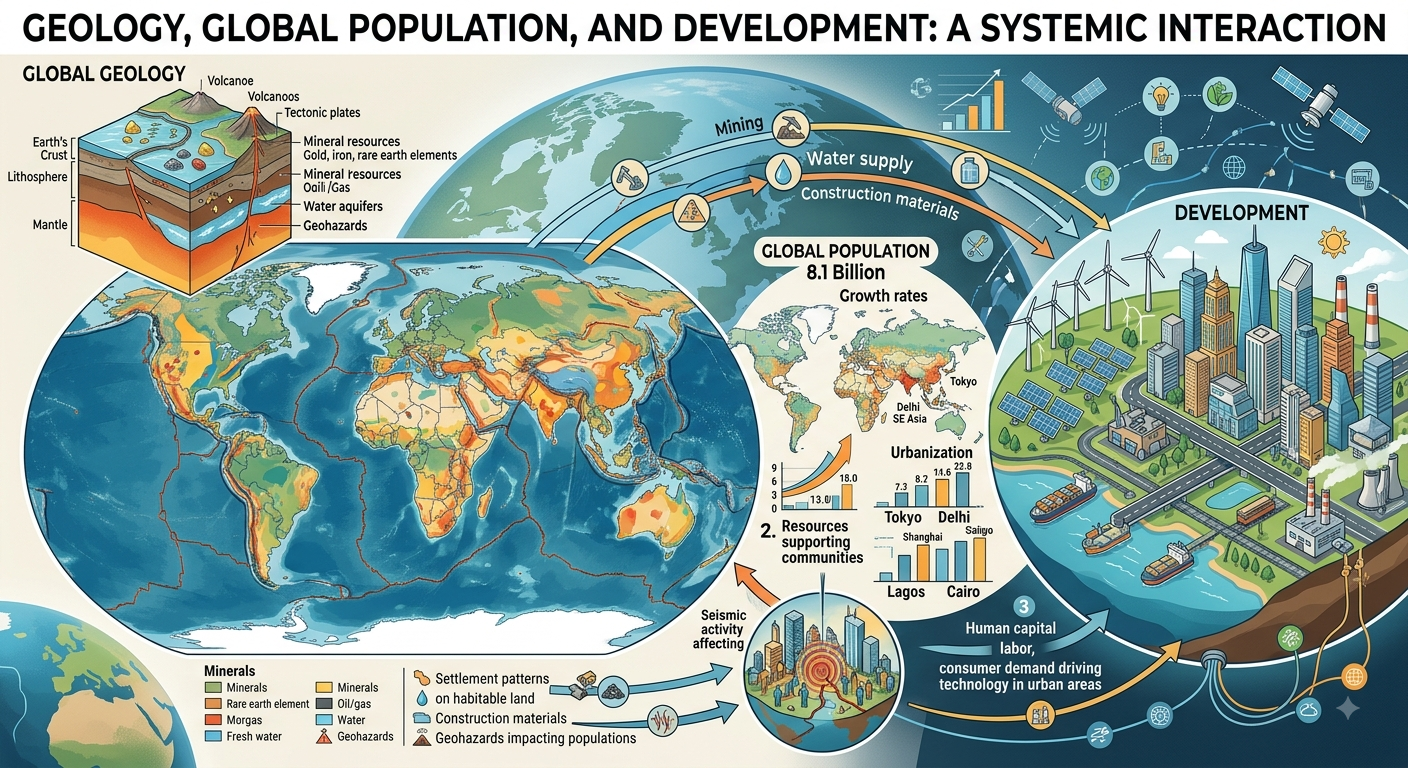
This is a strong thesis topic because it connects Earth science, human settlement, natural resources, infrastructure, economics, environmental limits, and long-term development. Your Millennium Tech Saga 3001 framework can treat geology as the physical foundation beneath human civilization.
The central idea is:
Human development takes place on a geological planet. Rocks, minerals, soils, groundwater, energy resources, landforms, and geological hazards influence where people live, what economies can produce, how cities develop, and what infrastructure societies can build.
Modern development therefore cannot be understood through economics and population statistics alone. Geology is one of the underlying physical systems.
1. The geological foundation of civilization
Geology studies Earth’s materials, structure, processes and history. It influences:
- availability of metals and industrial minerals;
- groundwater;
- agricultural soils;
- construction materials;
- fossil and geothermal energy resources;
- terrain and landscape;
- earthquake and volcanic hazards;
- coastal and river environments;
- underground infrastructure;
- waste storage and contamination;
- long-term environmental change.
The Geological Society of London similarly describes geology as fundamental to reliable supplies of energy, minerals, clean water and food, while connecting geological knowledge to sustainable development. (Geological Society of London)
2. Geology → resources → population → development
A useful conceptual chain for your thesis is:
Geological processes
↓
Rocks and mineral deposits
↓
Water, soils, energy and raw materials
↓
Agriculture + industry + infrastructure
↓
Employment and economic activity
↓
Cities and migration
↓
Population concentration
↓
Human development
This relationship is not deterministic. A country can possess enormous geological wealth and still experience poverty if institutions, infrastructure, skills, investment and governance are weak.
Conversely, countries with fewer natural resources can become highly developed through education, technology, trade, finance and efficient institutions.
3. Population is ultimately a resource-demand system
Population growth increases demand for:
Food + water + housing + energy + transport + buildings + communications + healthcare + education + manufactured goods.
That creates demand for geological materials.
USGS research has long recognized that increasing population and improving living standards increase demand for mineral resources and require long-term resource exploration and management. (USGS Publications)
The important distinction is between population size and resource consumption per person. Two countries with similar populations can have radically different environmental and material footprints because their incomes, technologies, consumption patterns and infrastructure differ.
4. The geological economy
Almost every modern economic system has a geological layer underneath it.
| Modern system | Geological foundation |
|---|---|
| Buildings | Sand, aggregates, limestone, clay, metals |
| Roads | Stone, aggregates, bitumen-related resources |
| Electricity | Copper, aluminium, steel, mineral resources and energy systems |
| Electronics | Silicon, copper, gold, rare and specialty metals |
| Batteries | Lithium, nickel, cobalt, graphite and other materials |
| Water supply | Aquifers, geological formations and watersheds |
| Agriculture | Soil, minerals, groundwater and landforms |
| Telecommunications | Metals, glass, silica and construction materials |
| Transport | Steel, aluminium, copper, mineral-derived materials |
| Renewable energy | Large quantities of metals, minerals and manufactured materials |
| Cities | Geological foundations, aggregates, cement minerals and water |
This creates a powerful thesis proposition:
The digital economy did not eliminate the material economy; it transformed the types and quantities of materials required.
5. Population geography and geological geography
Human populations are not distributed evenly across Earth.
Large populations have historically concentrated around combinations of:
- fertile soils;
- rivers;
- accessible groundwater;
- moderate climates;
- navigable waterways;
- coastlines;
- mineral resources;
- energy resources;
- transportation corridors;
- relatively stable terrain.
However, technology increasingly allows humans to overcome geographical limitations.
Desalination, pipelines, dams, refrigeration, air conditioning, high-speed transport, underground engineering and digital connectivity have expanded the range of environments that can support large populations.
6. Water is one of the most important geological connections
Hydrogeology links geology directly to human development.
Groundwater is stored and transmitted through geological formations. Aquifers can support:
- cities;
- agriculture;
- industries;
- rural communities;
- ecosystems.
But groundwater extraction can exceed natural recharge.
One important example is land subsidence, where excessive groundwater extraction causes geological materials to compact. This demonstrates that population growth, agriculture, climate, geology and infrastructure can become one interconnected system. (WIRED)
Therefore, development planning should ask not merely:
“How much water does this city need?”
but:
“What geological water system supplies the city, how quickly does it recharge, and what happens if extraction exceeds recharge?”
7. Mineral resources and industrial civilization
Modern civilization is extraordinarily mineral-intensive.
The industrial system requires materials for:
- steel;
- cement;
- glass;
- aluminium;
- copper;
- electronics;
- batteries;
- machinery;
- vehicles;
- electrical grids;
- data centres;
- telecommunications;
- renewable-energy systems.
Nature Geoscience has emphasized that supplying a growing global population requires geoscientists to think beyond conventional resource extraction toward broader resource and waste-management systems. (Nature)
This leads to an important 21st-century transition:
Extraction → processing → manufacturing → consumption → recycling → recovery
The future geological economy therefore needs to become increasingly circular.
8. Population growth is changing
A particularly important part of the thesis should avoid assuming that global population will simply continue growing exponentially.
The United Nations reports that global population growth is increasingly concentrated in poorer countries, particularly in sub-Saharan Africa, while global fertility has declined substantially in many regions. Current UN projections also indicate a high probability that global population will peak during this century. (United Nations)
This changes the development question.
The challenge becomes less:
“How do we support unlimited population growth?”
and increasingly:
“How do we provide high living standards for a large population while reducing resource intensity and environmental damage?”
9. Africa’s geological-development opportunity
Africa is particularly important for this thesis because it combines:
- rapid demographic growth;
- urbanization;
- extensive mineral resources;
- large agricultural potential;
- major infrastructure needs;
- substantial renewable-energy potential;
- significant development gaps.
The geological resource base can support industrialization, but simply exporting raw minerals does not automatically create broad-based development.
A stronger development model would move progressively through:
Geological resource
→ exploration
→ mining
→ beneficiation
→ refining
→ manufacturing
→ technology development
→ skilled employment
→ exports
→ infrastructure investment
→ higher human development
This is particularly relevant to South Africa, where geology has historically played an enormous role in mining, industrialization, energy and infrastructure.
10. Geology and cities
The modern city is effectively a gigantic geological-material system.
Consider a city of several million people.
It requires enormous quantities of:
- concrete;
- aggregates;
- steel;
- glass;
- copper;
- aluminium;
- water;
- energy;
- construction materials.
It also produces enormous quantities of:
- wastewater;
- construction waste;
- municipal waste;
- industrial waste;
- heat;
- emissions.
Urban geology therefore becomes increasingly important.
Future cities need geological information before major construction:
Geology → foundation conditions → groundwater → hazard mapping → infrastructure design → urban planning.
11. Geological hazards and development
Geology can also impose costs.
Major hazards include:
- earthquakes;
- volcanic eruptions;
- landslides;
- tsunamis;
- sinkholes;
- ground subsidence;
- expansive soils;
- coastal erosion;
- flooding influenced by terrain and geology.
Consequently, geological mapping is not merely an academic exercise.
It is part of national infrastructure protection.
A city should know the geological characteristics of its land before building:
housing + railways + bridges + hospitals + dams + pipelines + power stations + data centres.
12. Climate change adds another geological dimension
Human civilization interacts with geological carbon systems.
Coal, oil and natural gas represent geological stores of carbon accumulated over immense periods. Industrial society has transferred substantial quantities of this carbon into the atmosphere much more rapidly than natural geological processes normally cycle it.
At the same time, geological knowledge is important for:
- carbon storage;
- groundwater management;
- coastal planning;
- climate-risk assessment;
- geothermal energy;
- mineral-resource planning.
Geology therefore belongs in climate-development policy rather than being treated as a separate discipline.
13. From a linear economy to a geological circular economy
A traditional industrial model is:
Mine → manufacture → consume → discard
A future model should increasingly become:
Explore → extract responsibly → process efficiently → manufacture → use → recover → recycle → remanufacture
This reduces pressure on new geological extraction.
However, recycling cannot eliminate mining completely because growing populations and technological systems continue to require additional material stocks.
The objective is therefore not:
“Stop using geological resources.”
It is:
“Use geological resources more intelligently, efficiently and sustainably.”
14. The development equation
Your thesis could introduce a conceptual equation:
Human Development = Population × Human Capability × Infrastructure × Technology × Resource Access × Institutional Quality
with geological conditions acting as an important underlying physical constraint and opportunity.
A second equation could describe resource pressure:
Resource Pressure = Population × Consumption per Capita × Material Intensity of Technology
Technology can reduce material intensity, while recycling can reduce demand for virgin materials.
This provides a more sophisticated framework than simply blaming population growth.
15. The central paradox
The most important intellectual question is:
Can humanity increase living standards without increasing geological resource consumption at the same rate?
The answer increasingly depends on:
- advanced materials;
- renewable energy;
- energy efficiency;
- recycling;
- urban planning;
- digitalization;
- precision agriculture;
- water efficiency;
- improved mining;
- substitution;
- circular manufacturing;
- scientific education.
This is where your Millennium 3001 perspective becomes especially interesting.
The ultimate objective is not a civilization that uses no geological resources.
It is a civilization that obtains more human value from every tonne of material extracted from Earth.
16. A proposed thesis architecture
I would structure the full article into approximately 15 major chapters:
- Introduction: Earth as the Physical Foundation of Civilization
- Fundamentals of Geology
- Earth’s Geological History and Resource Formation
- Geology and the Origins of Human Settlement
- Population Growth and Resource Demand
- Water, Aquifers and Human Civilization
- Soils, Agriculture and Food Security
- Minerals and the Industrial Revolution
- Energy Resources and Economic Development
- Geology, Urbanization and Infrastructure
- Geological Hazards and Population Risk
- Africa: Geology, Population and Development
- South Africa: Mineral Wealth and Industrial Development
- Circular Economy, Technology and Next-Generation Materials
- Toward a Sustainable Civilization to 3001
17. The deeper Millennium 3001 perspective
The long-term development trajectory can be represented as:
Stone Age
↓
Agricultural Civilization
↓
Bronze Age
↓
Iron Age
↓
Industrial Civilization
↓
Petroleum Civilization
↓
Electrified Civilization
↓
Digital Civilization
↓
AI + Advanced Materials Civilization
↓
Circular Resource Civilization
Each stage represents a new relationship between human intelligence and Earth’s physical resources.
The crucial transition of the coming centuries may therefore be from a civilization primarily based on extracting increasingly large quantities of material to one based on knowledge, precision, recycling, substitution and extremely efficient use of matter and energy.
Conclusion
Geology, population and development are three parts of one planetary system.
Geology provides the physical foundation and resources. Population creates demand for food, water, housing, energy and infrastructure. Development determines how efficiently societies transform those geological resources into human well-being.
The major challenge of the 21st century is therefore not simply population growth or resource scarcity in isolation. It is the management of the entire Earth–Resource–Population–Technology–Economy system.
A comprehensive geological-development strategy should consequently integrate geoscience, demographic science, economics, engineering, environmental science, materials science, infrastructure planning, technology and education. Research on geology and the Sustainable Development Goals similarly shows that geology intersects with areas ranging from water and energy to mineral resources, hazards, climate change and agricultural systems. (Orca)
For a Millennium 3001 framework, the ultimate thesis can be stated simply:
The future of civilization depends not on escaping Earth’s geological limitations, but on developing the scientific intelligence to understand them, work within them, and use Earth’s materials with dramatically greater efficiency.

Be First to Comment