
1. Introduction
The human brain is one of the most complex biological systems known to science. It coordinates perception, movement, language, emotion, reasoning, learning, decision-making, consciousness, and memory. Memory is particularly important because it allows the nervous system to retain information from previous experiences and use that information to guide future behaviour.
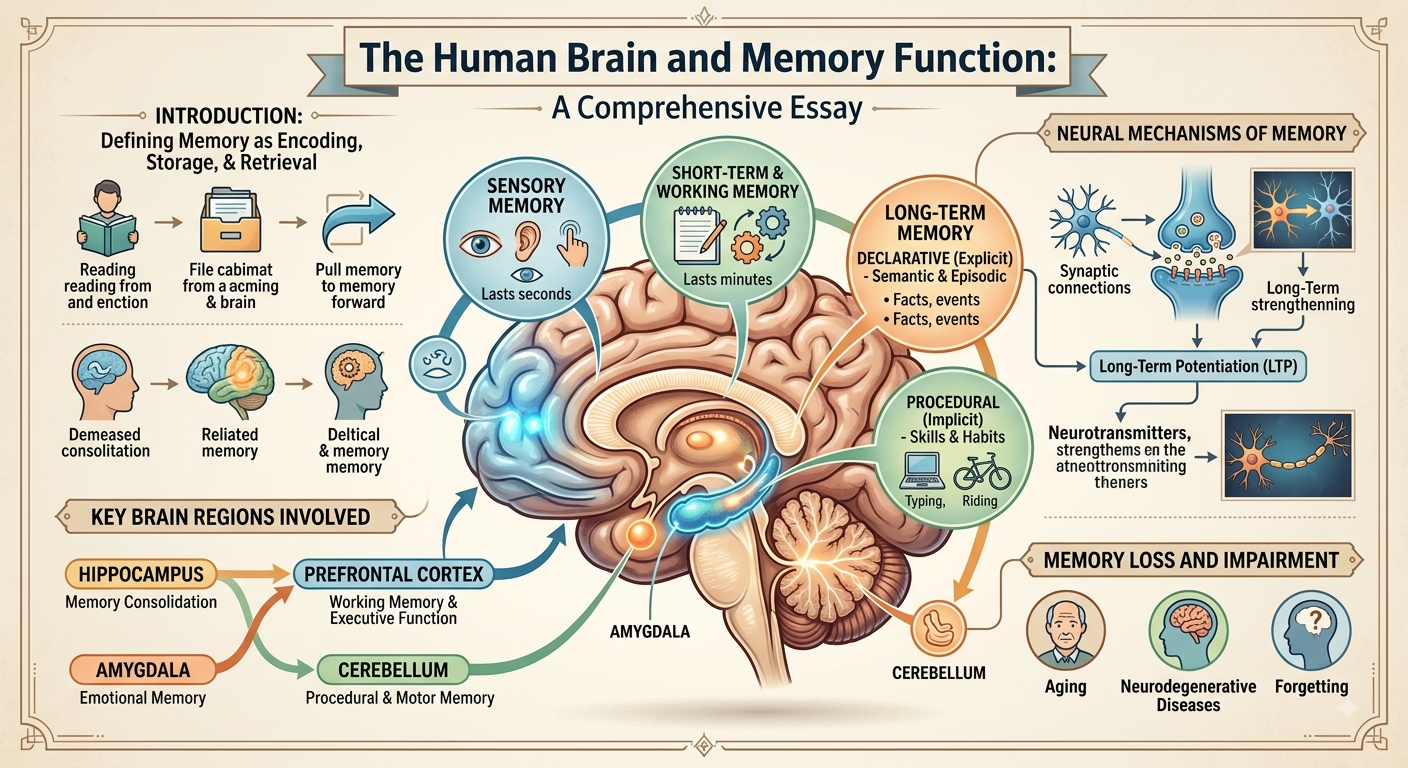
Memory should not be understood as a single storage compartment inside the brain. It is better understood as a collection of interacting biological and cognitive processes involving many brain regions and neural networks. Research has identified important contributions from the hippocampus, cerebral cortex, prefrontal cortex, amygdala, thalamus, basal ganglia, cerebellum and other interconnected structures.
A useful framework is:
Experience → Encoding → Neural representation → Consolidation → Storage/reorganization → Retrieval → Relearning or modification
This sequence is not perfectly linear. Memory can be updated when it is retrieved, and different forms of memory depend on partly different neural systems.
2. The Brain as an Information-Processing System
The brain contains billions of neurons connected through enormous networks of synapses. Neurons communicate through electrical and chemical signals, while synapses allow information to pass between cells.
The brain does not simply receive information. It continuously:
- Receives sensory information.
- Selects and processes relevant signals.
- Integrates new information with previous knowledge.
- Generates internal representations.
- Stores some information for later use.
- Retrieves information when required.
- Updates representations according to new experience.
Memory therefore emerges from interactions between neural activity, synaptic plasticity, attention, emotion, prior knowledge and broader brain networks.
3. What Is Memory?
Memory is the capacity to acquire, retain, organize and subsequently use information.
Three fundamental processes are commonly distinguished:
Encoding
Encoding is the initial processing of information so that it can become represented in the nervous system.
Consolidation
Consolidation refers to processes that stabilize newly formed memories. At the cellular level, changes in synaptic strength can stabilize information; at the systems level, memory representations can become reorganized across interacting brain regions over longer periods.
Retrieval
Retrieval occurs when previously acquired information becomes accessible for present use.
These processes interact continuously rather than functioning as completely independent stages.
4. Major Categories of Human Memory
4.1 Sensory Memory
Sensory memory briefly preserves information from sensory systems. Visual, auditory and other sensory representations can persist for a short period after the original stimulus has disappeared.
4.2 Working Memory
Working memory allows information to be temporarily maintained and manipulated during activities such as reasoning, reading, calculation and problem-solving.
The prefrontal cortex is an important component of working-memory networks, but working memory is not confined to one brain region. Distributed interactions involving cortical, thalamic and other networks contribute to maintaining information.
4.3 Long-Term Memory
Long-term memory permits information to remain available for much longer periods.
It includes several important forms:
- Episodic memory — memories of personally experienced events.
- Semantic memory — knowledge of facts, concepts and meanings.
- Procedural memory — learned skills and procedures.
- Implicit memory — influences of previous experience that do not necessarily require conscious recollection.
- Emotional memory — learned associations involving emotional significance.
Research indicates that declarative and non-declarative forms of memory depend on partly different neural systems.
5. The Hippocampus and Memory
The hippocampus is one of the most important structures in the study of human memory.
It belongs to the medial temporal-lobe memory system and interacts extensively with surrounding cortical regions. The hippocampal system is particularly important for acquiring and organizing new declarative memories, including memories involving relationships among different elements of an experience.
The hippocampus should not, however, be regarded as a simple permanent “hard drive.” Modern research describes it as part of a dynamic system that interacts with the cortex during learning, retrieval and consolidation.
6. The Cerebral Cortex
The cerebral cortex contains distributed representations associated with perception, knowledge, language, action and many other functions.
Long-term memories are therefore not necessarily stored in one isolated anatomical location. Instead, different components of an experience can involve distributed cortical networks.
The hippocampus can help bind different components of an experience and subsequently participate in their reorganization across broader cortical networks.
7. The Prefrontal Cortex
The prefrontal cortex is strongly involved in executive control, attention, planning and working memory.
It helps determine what information should receive attention, how information should be manipulated, and how retrieved memories should be used to solve current problems.
Consequently, memory is closely connected to intelligence, reasoning and decision-making rather than being an isolated cognitive function.
8. The Amygdala and Emotional Memory
The amygdala is strongly associated with emotional processing and learning.
Emotion can influence what people remember and how strongly certain experiences are encoded. Emotional significance can therefore alter the interaction between memory systems and other brain networks.
This demonstrates that memory is influenced not only by information itself but also by the biological and psychological significance assigned to that information.
9. The Thalamus and Memory Networks
The thalamus participates in extensive communication between different brain regions. Some thalamic nuclei interact with prefrontal and association-cortical networks and contribute to cognitive processing and working-memory functions.
The brain’s memory architecture should therefore be viewed as a network rather than a single structure.
10. Synapses and Neural Plasticity
One of the fundamental biological principles underlying learning and memory is neural plasticity.
When experiences repeatedly activate particular neural pathways, the effectiveness and organization of connections between neurons can change.
These changes can involve:
- Synaptic strengthening.
- Synaptic weakening.
- Changes in receptor activity.
- Changes in neuronal connectivity.
- Alterations in gene expression and protein synthesis.
- Structural changes in neurons and synapses.
The biology of memory therefore operates across multiple scales—from molecular processes to individual synapses, neurons, circuits and whole-brain networks.
11. Memory Consolidation
Consolidation is the process through which newly formed memories become more stable.
Two broad concepts are particularly important.
Cellular consolidation
Cellular consolidation involves molecular and synaptic processes that stabilize newly formed memory representations.
Systems consolidation
Systems consolidation concerns the longer-term reorganization of memory across interacting brain regions. Classical models propose that memories initially depend strongly on hippocampal mechanisms and can gradually become more represented within distributed cortical networks.
However, modern research shows that the relationship between the hippocampus and long-term memory is more complicated than a simple “hippocampus stores memories temporarily, cortex stores them permanently” model. Some remote memories can continue to involve hippocampal activity, depending on their nature and context.
12. Sleep and Memory
Sleep is closely associated with memory consolidation.
During sleep, patterns of neural activity can contribute to the reactivation and reorganization of recently acquired information. Research on hippocampal activity has identified neural events associated with both memory retrieval and consolidation.
This helps explain why learning should not be viewed simply as the moment information enters the brain. Post-learning processes can be important for stabilizing and reorganizing memories.
13. Retrieval Is an Active Process
Remembering is not necessarily equivalent to replaying a perfect recording.
Retrieval involves reconstructing information from distributed neural representations. Context, prior knowledge, expectations and subsequent experiences can influence what is remembered.
Research on memory therefore distinguishes between the original formation of a memory and later retrieval or reconstruction.
14. Memory and Existing Knowledge
New information does not enter an empty brain.
The brain already contains extensive networks of knowledge and associations. New information can therefore be integrated with previously learned material.
Research suggests that existing knowledge or “schemas” can influence how quickly and effectively new information becomes incorporated into broader memory networks.
This principle is particularly important for education: understanding a subject can provide a framework into which additional information can be integrated.
15. Forgetting
Forgetting is a normal component of memory.
Information may become difficult to retrieve because of:
- Weak initial encoding.
- Insufficient attention.
- Interference from other information.
- Changes in context.
- Incomplete consolidation.
- Competition among memories.
- Failure of effective retrieval cues.
Forgetting should therefore not automatically be interpreted as complete destruction of information.
16. Memory and Learning
Learning and memory are inseparable.
Learning changes the nervous system, while memory allows those changes to influence future behaviour.
A simplified learning cycle can be represented as:
Attention → Encoding → Practice → Consolidation → Retrieval → Feedback → Updated knowledge
Repeated retrieval can make information more accessible, while connecting new concepts to existing knowledge can create richer networks of associations.
17. Memory and Language
Language provides a powerful organizational framework for memory.
Words allow humans to label concepts, describe events, categorize knowledge and communicate experiences to other people.
Semantic memory therefore becomes closely connected to language networks and conceptual knowledge.
Reading, writing, conversation and explanation can all provide different pathways through which information is encoded and reorganized.
18. Memory and Emotion
Emotion influences attention and memory.
Events that have strong emotional significance may receive greater attention and may become especially memorable. However, emotional memories are not necessarily perfectly accurate.
Memory is influenced by both the original experience and later reconstruction.
19. Memory and Decision-Making
Memory supplies information used by the brain to interpret current circumstances and anticipate possible outcomes.
A simplified relationship is:
Past experience → Memory → Present interpretation → Decision → New experience
This means memory is not merely about the past. It contributes directly to present behaviour and future planning.
20. Memory and Imagination
The brain can use memory representations to construct scenarios that have never actually occurred.
This ability is important for:
- Planning.
- Problem-solving.
- Creativity.
- Prediction.
- Simulation.
- Future-oriented thinking.
Research on hippocampal and cortical systems has therefore connected memory processes with imagination and decision-making as well as recollection.
21. The Memory Network as an Information Ecosystem
A useful conceptual model is to think of memory as an ecosystem:
Sensory systems
↓
Attention and working memory
↓
Hippocampal and medial temporal-lobe processing
↓
Distributed cortical representations
↓
Consolidation and reorganization
↓
Retrieval
↓
Decision-making and behaviour
This model emphasizes that memory depends on communication among many parts of the nervous system.
22. Memory as a Dynamic Biological Process
Memory should not be imagined as static information stored unchanged inside the brain.
Memories can be strengthened, reorganized, associated with new information and influenced by subsequent experiences.
Research on memory consolidation increasingly emphasizes interactions among the hippocampus, neocortex and other distributed networks. Neural reactivation and replay are among the mechanisms being investigated in this process.
23. Human Memory and Artificial Intelligence
The study of biological memory has also influenced computer science and artificial intelligence.
Human memory and artificial memory systems are not equivalent, but useful conceptual comparisons can be made:
| Human Brain | Computational Analogy |
|---|---|
| Sensory processing | Input layer |
| Working memory | Temporary computational state |
| Long-term memory | Persistent information |
| Neural connections | Network parameters/connections |
| Retrieval cues | Search/query mechanisms |
| Learning | Parameter or representation updating |
| Consolidation | Stabilization/reorganization |
| Recall | Information retrieval |
The comparison must be treated carefully because biological brains and artificial neural networks operate through fundamentally different physical mechanisms.
24. Why Memory Research Matters
Understanding memory has implications for:
- Education.
- Neuroscience.
- Psychology.
- Artificial intelligence.
- Human-computer interaction.
- Rehabilitation.
- Brain research.
- Cognitive science.
- Aging research.
- Clinical medicine.
Memory research also helps explain how humans acquire knowledge and transform individual experiences into accumulated understanding.
25. A Unified Brain-Memory Framework
The overall architecture can be summarized as:
1. Stimulus
↓
2. Sensory processing
↓
3. Attention
↓
4. Working memory
↓
5. Encoding
↓
6. Hippocampal and cortical interaction
↓
7. Synaptic consolidation
↓
8. Systems-level reorganization
↓
9. Distributed long-term representation
↓
10. Retrieval
↓
11. Decision, action or communication
↓
12. New experience and memory updating
This framework demonstrates that memory is a continuous biological process rather than a single storage mechanism.
26. Major Scientific Lessons
Several major conclusions emerge from modern memory research.
First, memory is distributed across interacting neural systems rather than being confined to one location.
Second, different types of memory depend on different but interconnected brain systems.
Third, the hippocampus plays a particularly important role in forming and organizing new declarative memories.
Fourth, memory depends on plastic changes in neural circuits.
Fifth, consolidation can involve both cellular processes and longer-term reorganization across brain systems.
Sixth, sleep and neural reactivation can contribute to memory consolidation.
Seventh, retrieval is an active process rather than necessarily a perfect reproduction of the original experience.
Finally, memory is dynamic: new experiences can modify the relationships among existing representations.
27. Conclusion
The human brain’s memory function represents one of the most sophisticated information-processing capabilities in biology. Memory enables humans to transform experience into knowledge, knowledge into decisions, and decisions into future behaviour.
The hippocampus, cerebral cortex, prefrontal cortex, amygdala, thalamus and many other structures participate in interconnected memory systems. At smaller scales, changes in synapses and neural circuits provide biological mechanisms through which learning can produce lasting changes in the brain.
Modern neuroscience has moved beyond the simplistic idea that memories are stored in one particular “memory centre.” Instead, memory is understood as a dynamic process involving encoding, consolidation, distributed representation, retrieval, reorganization and interaction with existing knowledge.
The deeper lesson is that the human brain is not merely a biological storage device. It is an adaptive information-processing system that continuously interprets experience, changes its internal organization and uses previous information to understand the present and prepare for the future.
Selected Scientific References
- Squire, L. R., & Wixted, J. T. — The Cognitive Neuroscience of Human Memory Since H.M.
- Squire, L. R. — Research on the functional organization of the hippocampal memory system.
- Squire, L. R., & colleagues — Memory Consolidation.
- Sridhar, S., Khamaj, A., & Asthana, M. K. — Cognitive Neuroscience Perspective on Memory: Overview and Summary.
- Joo, H. R., & Frank, L. M. — Research on hippocampal sharp-wave ripples, memory retrieval and consolidation.
- Research literature on working memory and distributed neural networks.



Be First to Comment