
Abstract
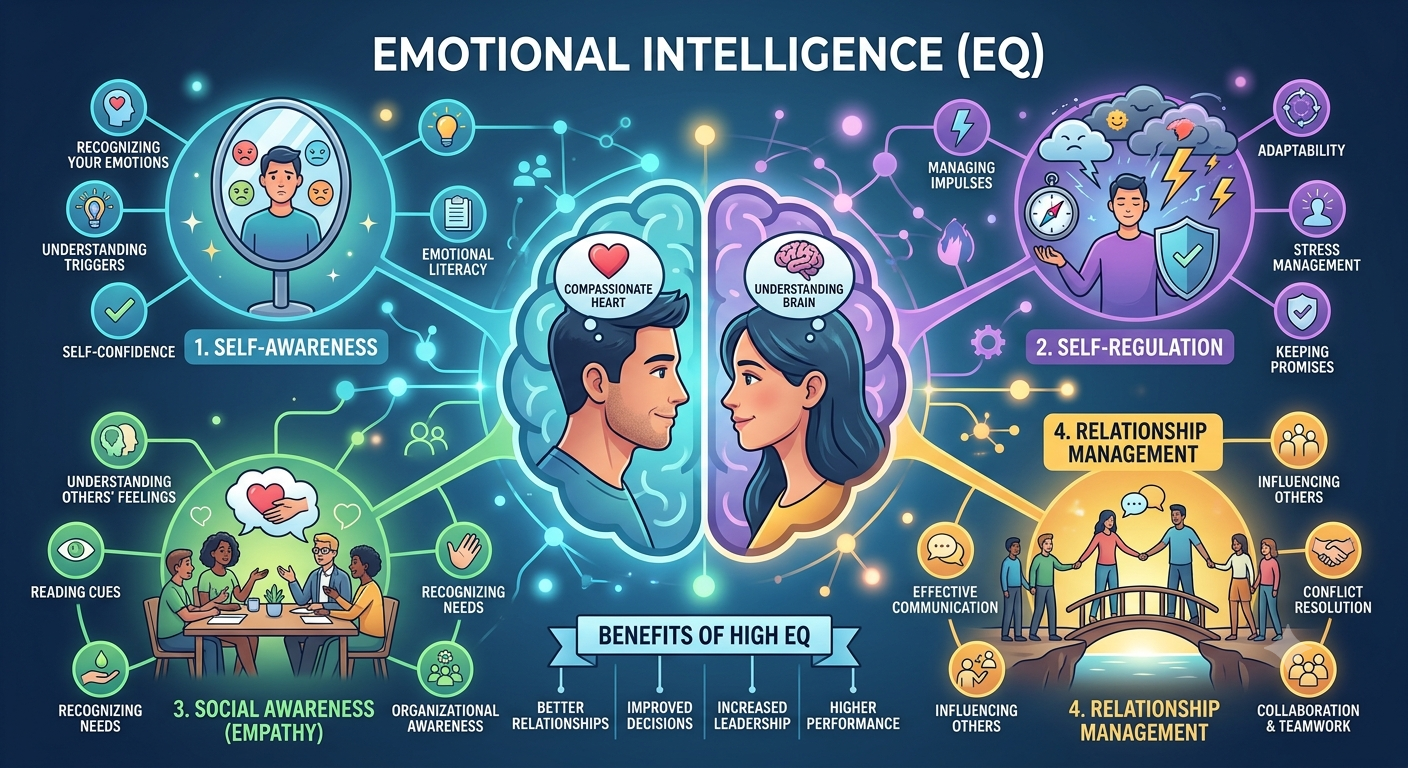
Emotional Intelligence (EQ), also known as Emotional Quotient, is the ability to recognize, understand, manage, and effectively use emotions in oneself and others. While Intelligence Quotient (IQ) measures cognitive abilities such as logical reasoning, mathematics, memory, and problem-solving, EQ determines how effectively individuals navigate relationships, make decisions under pressure, resolve conflicts, and inspire others.
In the 21st-century knowledge economy, emotional intelligence has become one of the most valuable human capabilities. Businesses, governments, educational institutions, healthcare systems, military organizations, entrepreneurs, engineers, and AI developers increasingly recognize that technical expertise alone is insufficient for long-term success. High-performing organizations require emotionally intelligent leaders who can collaborate, adapt, and communicate effectively.
Chapter 1: Introduction
Human intelligence consists of multiple interconnected dimensions:
- Cognitive Intelligence (IQ)
- Emotional Intelligence (EQ)
- Social Intelligence (SQ)
- Creative Intelligence (CQ)
- Practical Intelligence (PQ)
- Moral Intelligence (MQ)
Among these, EQ serves as the bridge connecting knowledge with action.
A brilliant scientist who cannot work with colleagues may struggle professionally despite exceptional IQ.
Likewise, an average student with outstanding emotional intelligence often becomes an excellent manager, entrepreneur, diplomat, or leader.
Chapter 2: Historical Development of Emotional Intelligence
The concept evolved gradually.
1920
Edward Thorndike introduced the idea of Social Intelligence, describing the ability to understand and manage people.
1983
Howard Gardner proposed the theory of Multiple Intelligences, including interpersonal and intrapersonal intelligence.
1990
Peter Salovey and John D. Mayer formally introduced the term “Emotional Intelligence.”
1995
Daniel Goleman popularized EQ worldwide through his influential book Emotional Intelligence, bringing the concept into business, education, and leadership.
Chapter 3: Definition of Emotional Intelligence
EQ is the capacity to
- Recognize emotions
- Understand emotional causes
- Regulate emotional responses
- Express emotions appropriately
- Understand other people’s emotions
- Build productive relationships
- Make balanced decisions despite emotional pressure
Simply stated:
EQ is the intelligent management of emotions.
Chapter 4: The Five Core Components of EQ
1. Self-Awareness
Self-awareness means understanding:
- Your emotions
- Your strengths
- Your weaknesses
- Your motivations
- Your values
Example:
Instead of saying
“I am angry.”
A self-aware person says
“I feel frustrated because my expectations were not met.”
Naming emotions accurately helps regulate them.
2. Self-Regulation
Self-regulation is controlling emotional reactions.
It includes
- Patience
- Discipline
- Emotional stability
- Calmness
- Delayed gratification
Without self-regulation
Emotion → Impulse → Mistake
With self-regulation
Emotion → Reflection → Wise Action
3. Motivation
Emotionally intelligent individuals are motivated internally rather than only by external rewards.
Intrinsic motivation includes
- Learning
- Purpose
- Personal growth
- Achievement
- Curiosity
4. Empathy
Empathy means understanding another person’s emotional experience without necessarily agreeing with them.
Empathy involves
- Active listening
- Compassion
- Perspective-taking
- Emotional understanding
Empathy differs from sympathy.
Sympathy feels sorry for someone.
Empathy understands how someone feels.
5. Social Skills
Strong EQ produces effective communication through
- Teamwork
- Negotiation
- Leadership
- Persuasion
- Conflict resolution
- Networking
- Trust-building
Chapter 5: Emotional Intelligence in the Brain
Several brain regions contribute to emotional intelligence:
- The amygdala rapidly detects emotionally significant events, especially threats.
- The prefrontal cortex supports planning, reasoning, impulse control, and thoughtful decision-making.
- The hippocampus helps connect emotions with memory and learning.
- The anterior cingulate cortex is involved in attention, error monitoring, and aspects of empathy.
- The insula contributes to awareness of internal bodily states and emotional experiences.
Healthy emotional regulation depends on effective coordination among these systems rather than any single “emotion center.”
Chapter 6: Why EQ Matters
High EQ improves
- Leadership
- Team collaboration
- Innovation
- Customer service
- Parenting
- Education
- Diplomacy
- Healthcare
- Entrepreneurship
- Politics
Research consistently shows that emotional skills contribute substantially to workplace effectiveness, although success is influenced by many factors including knowledge, opportunity, experience, and environment.
Chapter 7: EQ in Education
Schools traditionally emphasize
- Mathematics
- Science
- Languages
- History
Modern education increasingly also develops
- Communication
- Emotional regulation
- Teamwork
- Conflict resolution
- Ethical decision-making
- Resilience
Students who learn emotional skills often show improvements in classroom behavior, relationships, and overall well-being.
Chapter 8: Emotional Intelligence in Leadership
High-EQ leaders
- Listen before speaking
- Encourage teamwork
- Manage conflict constructively
- Stay calm under pressure
- Inspire trust
- Support employee development
- Accept responsibility
- Adapt to change
Low-EQ leaders often
- React impulsively
- Blame others
- Micromanage
- Ignore feedback
- Create fear
- Damage morale
Chapter 9: Emotional Intelligence in Business
Companies increasingly seek employees who can
- Collaborate across teams
- Manage customers effectively
- Negotiate successfully
- Lead diverse groups
- Adapt to change
- Resolve workplace conflicts
- Build long-term professional relationships
EQ supports productivity by improving communication, trust, and cooperation.
Chapter 10: EQ in Artificial Intelligence
Artificial intelligence can detect patterns associated with human emotions—for example, through text, speech, or facial expressions—but it does not experience emotions as humans do.
Research in affective computing aims to create systems that can respond more appropriately to human emotional cues, which can improve applications such as virtual assistants, education, and healthcare. Ethical considerations, privacy, and fairness remain important challenges.
Chapter 11: Practical Exercises to Build EQ
Daily habits include:
- Pause before reacting.
- Name the emotion you are experiencing.
- Practice active listening without interrupting.
- Ask clarifying questions before making assumptions.
- Reflect on difficult conversations.
- Keep a journal of emotional triggers and responses.
- Seek constructive feedback from trusted people.
- Practice gratitude and appreciation.
- Learn stress-management techniques such as exercise or mindfulness.
- Consider situations from another person’s perspective.
Consistent practice strengthens emotional skills over time.
Chapter 12: Common Barriers to Emotional Intelligence
EQ can be hindered by:
- Chronic stress
- Poor self-awareness
- Unmanaged anger
- Fear of feedback
- Prejudice and bias
- Inflexible thinking
- Sleep deprivation
- Poor communication habits
Recognizing these barriers is the first step toward improvement.
Chapter 13: Comparing IQ and EQ
| IQ | EQ |
|---|---|
| Logical reasoning | Emotional understanding |
| Analytical thinking | Empathy |
| Memory | Relationship skills |
| Problem-solving | Conflict resolution |
| Technical knowledge | Leadership and teamwork |
| Academic performance | Social and professional effectiveness |
IQ and EQ complement one another. Strong performance in education, work, and life often benefits from developing both.
Chapter 14: Future Importance of EQ
As automation and AI continue to perform more routine analytical tasks, uniquely human capabilities become increasingly valuable, including:
- Ethical judgment
- Creativity
- Emotional understanding
- Leadership
- Collaboration
- Cultural awareness
- Complex negotiation
These skills help people work effectively alongside intelligent technologies.
Chapter 15: Conclusion
Emotional Intelligence is not a fixed trait but a set of skills that can be learned and strengthened throughout life. It enables individuals to understand themselves, relate effectively to others, and make thoughtful decisions under pressure.
In the modern economy, success increasingly depends on combining technical expertise with emotional competence. Organizations, schools, governments, and communities benefit when people cultivate self-awareness, self-regulation, empathy, motivation, and strong social skills.
Developing EQ is therefore an investment not only in personal growth but also in healthier workplaces, stronger institutions, and more resilient societies.




Be First to Comment