
Abstract
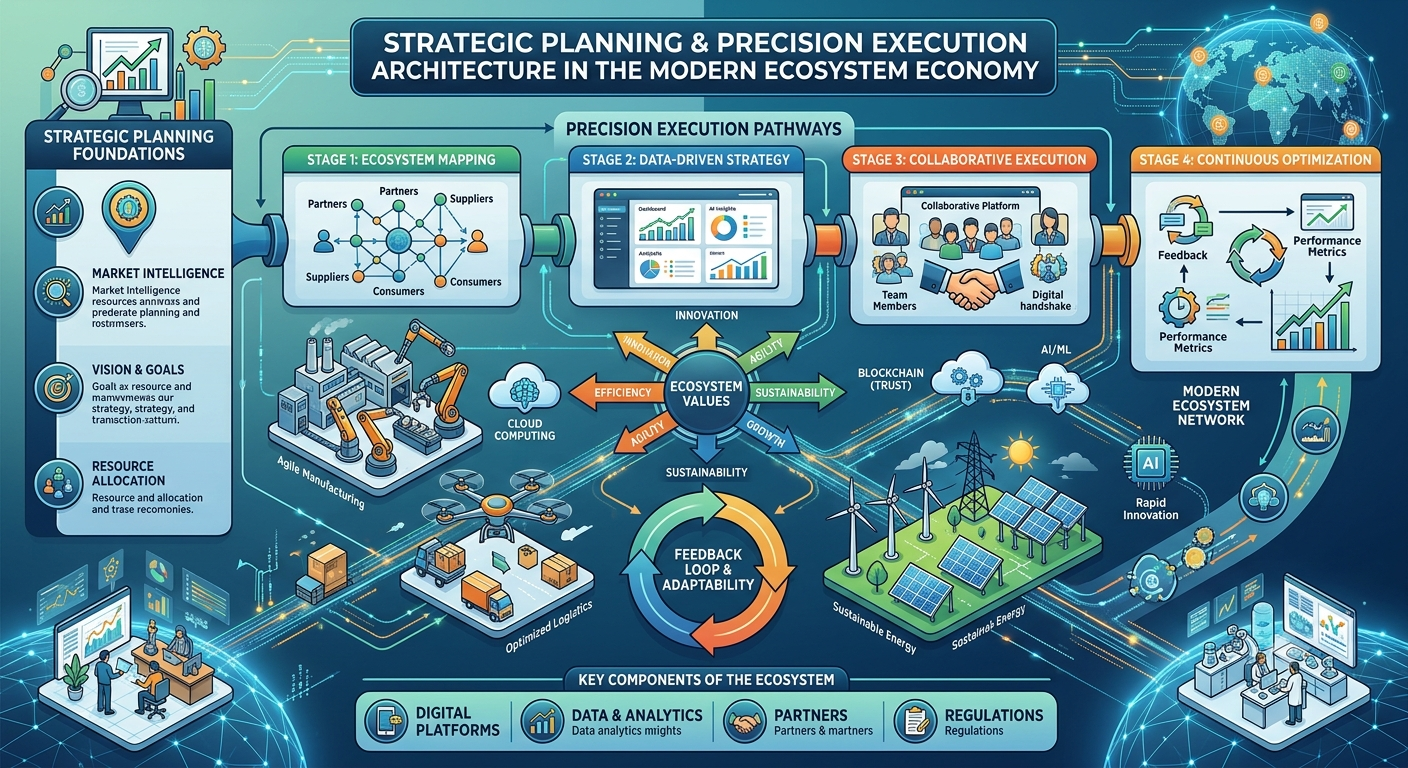
The modern economy has evolved from isolated organizations competing independently into a highly interconnected ecosystem where governments, businesses, universities, AI systems, financial institutions, suppliers, customers, and digital platforms continuously exchange information, capital, technology, and knowledge. In this ecosystem economy, success is determined not merely by having superior products or services but by an organization’s ability to develop strategic plans and execute them with precision.
Planning creates direction. Precision execution transforms vision into measurable results. Together, they form the operating system of modern civilization, enabling industries to innovate, compete, adapt, and create sustainable economic value.
Chapter 1: Understanding the Modern Ecosystem Economy
Definition
An ecosystem economy is a network of interconnected organizations, technologies, people, and institutions that collaborate while competing to create economic value.
Instead of working independently, modern organizations operate through ecosystems involving:
- Artificial Intelligence
- Cloud Computing
- Digital Platforms
- Financial Systems
- Supply Chains
- Governments
- Universities
- Research Institutions
- Investors
- Customers
- Data Networks
The ecosystem functions much like the human body’s circulatory system, where every component depends on others for continuous operation.
Chapter 2: The Architecture of Strategic Planning
Strategic planning is the process of deciding:
- Where the organization is today
- Where it wants to be
- How it will get there
- How success will be measured
The planning architecture consists of multiple layers.
Layer 1: Vision
The vision defines the desired future.
Example:
Become Africa’s leading AI-driven manufacturing company by 2040.
Vision provides long-term direction.
Layer 2: Mission
Mission explains why the organization exists.
Example:
Deliver affordable intelligent manufacturing solutions that improve quality of life.
Layer 3: Core Values
Values influence every decision.
Examples include:
- Integrity
- Innovation
- Excellence
- Accountability
- Sustainability
- Customer Focus
- Collaboration
Values remain stable while strategies evolve.
Layer 4: Strategic Objectives
Objectives translate vision into measurable targets.
Examples:
- Increase revenue
- Expand internationally
- Improve customer satisfaction
- Reduce production costs
- Accelerate innovation
- Improve employee productivity
Layer 5: Key Performance Indicators (KPIs)
KPIs quantify progress.
Examples:
Financial KPIs
- Revenue growth
- Profit margin
- Return on investment
Operational KPIs
- Production efficiency
- Equipment uptime
- Quality defects
Customer KPIs
- Satisfaction score
- Customer retention
- Net Promoter Score
Innovation KPIs
- Patents filed
- New products launched
- Research productivity
Chapter 3: Strategic Intelligence Framework
Successful planning depends on understanding the environment.
Strategic intelligence includes:
Internal Analysis
Evaluate:
- Resources
- Skills
- Financial strength
- Technology
- Culture
- Leadership
External Analysis
Study:
- Competitors
- Government policy
- Customer behavior
- Market trends
- Technology
- Environmental risks
Risk Analysis
Assess:
- Political risks
- Economic risks
- Cybersecurity threats
- Climate risks
- Supply chain disruptions
- Currency fluctuations
Chapter 4: Precision Execution Architecture
Planning alone creates no value.
Execution converts ideas into measurable outcomes.
Precision execution requires:
Clear Goals
Every department understands:
- What must be done
- Why it matters
- When it must be completed
- Who is responsible
Role Alignment
Responsibilities must be clearly defined.
Executive Leadership
Provides direction.
Middle Management
Coordinates implementation.
Technical Teams
Build systems.
Operations
Deliver products.
Sales
Generate revenue.
Customer Service
Maintain satisfaction.
Standard Operating Procedures (SOPs)
SOPs ensure consistency.
Benefits:
- Reduced errors
- Faster onboarding
- Predictable quality
- Regulatory compliance
- Improved safety
Workflow Management
Modern organizations use structured workflows.
Typical flow:
Idea
↓
Planning
↓
Design
↓
Development
↓
Testing
↓
Deployment
↓
Monitoring
↓
Continuous Improvement
Chapter 5: Data-Driven Decision Architecture
Modern execution relies on data.
Organizations monitor:
- Sales
- Production
- Inventory
- Customer behavior
- Website traffic
- Supply chains
- Employee performance
Data enables:
- Forecasting
- Optimization
- Automation
- Faster decisions
Chapter 6: Artificial Intelligence in Strategic Execution
AI has become a strategic execution engine.
Applications include:
Predictive Analytics
Forecasts:
- Demand
- Equipment failures
- Customer behavior
- Financial performance
Intelligent Automation
Automates:
- Accounting
- HR
- Customer service
- Manufacturing
- Logistics
AI Decision Support
AI assists executives by:
- Identifying trends
- Recommending actions
- Detecting anomalies
- Optimizing schedules
Chapter 7: Precision Project Management
Projects require disciplined execution.
Core components include:
- Scope
- Budget
- Timeline
- Resources
- Risks
- Quality
- Communication
Successful projects balance:
Time + Cost + Quality + Scope
Chapter 8: Operational Excellence
Operational excellence focuses on eliminating waste and improving value.
Key principles:
- Continuous improvement
- Lean thinking
- Process optimization
- Root cause analysis
- Quality management
- Employee engagement
Chapter 9: Communication Architecture
Execution fails without effective communication.
Communication flows:
Vertical
Leadership → Employees
Employees → Leadership
Horizontal
Department ↔ Department
External
Organization ↔ Customers
Organization ↔ Suppliers
Organization ↔ Investors
Organization ↔ Regulators
Chapter 10: Precision Leadership
Modern leaders serve as architects of execution.
Core competencies:
- Strategic thinking
- Emotional intelligence
- Ethical decision-making
- Systems thinking
- Adaptability
- Accountability
- Talent development
Leadership creates alignment between vision and daily execution.
Chapter 11: Digital Transformation Architecture
Digital transformation integrates technology into all business functions.
Technologies include:
- Artificial Intelligence
- Cloud Computing
- Internet of Things (IoT)
- Robotics
- Blockchain
- Digital Twins
- Big Data
- Edge Computing
Benefits:
- Lower costs
- Faster decisions
- Better customer experience
- Higher productivity
- Increased resilience
Chapter 12: Supply Chain Precision
Modern supply chains require visibility and coordination.
Critical elements:
- Supplier collaboration
- Inventory optimization
- Logistics planning
- Real-time tracking
- Demand forecasting
- Risk management
Resilient supply chains reduce disruptions and improve service levels.
Chapter 13: Innovation Strategy
Innovation is a continuous process.
Stages:
- Opportunity identification
- Research
- Concept development
- Prototype creation
- Testing
- Commercialization
- Market scaling
- Continuous improvement
Organizations that innovate consistently maintain competitive advantage.
Chapter 14: Financial Execution Architecture
Financial planning supports strategy.
Components:
- Budgeting
- Capital allocation
- Cash flow management
- Investment analysis
- Cost control
- Financial reporting
Strong financial governance enables sustainable growth.
Chapter 15: Human Capital Strategy
People execute strategy.
Organizations should invest in:
- Recruitment
- Training
- Leadership development
- Performance management
- Employee well-being
- Knowledge sharing
Continuous learning enhances adaptability and innovation.
Chapter 16: Continuous Improvement Cycle
Execution is iterative rather than one-time.
A common cycle is:
- Plan – Define objectives and resources.
- Execute – Implement with discipline.
- Measure – Track performance using KPIs.
- Analyze – Identify strengths, weaknesses, and root causes.
- Improve – Refine processes and strategies.
- Repeat – Continue the cycle to build long-term excellence.
This continuous improvement approach supports resilience in rapidly changing markets.
Chapter 17: The Integrated Strategy-to-Execution Architecture
An effective ecosystem economy aligns all organizational layers into one coordinated system:
Vision
   ↓
Mission
   ↓
Strategic Goals
   ↓
Business Strategy
   ↓
Policies & Governance
   ↓
Projects & Programs
   ↓
Operational Processes
   ↓
Technology & AI
   ↓
People & Teams
   ↓
Execution
   ↓
Performance Measurement
   ↓
Feedback & Continuous Improvement
   ↺
Each layer reinforces the others. Feedback loops ensure that lessons learned are incorporated into future planning.
Chapter 18: Challenges to Precision Execution
Common barriers include:
- Unclear strategic priorities
- Weak communication
- Poor change management
- Insufficient data quality
- Resistance to innovation
- Skill shortages
- Siloed organizational structures
- Cybersecurity threats
- Supply chain disruptions
- Inadequate governance
Addressing these challenges requires strong leadership, disciplined processes, and a culture of continuous learning.
Conclusion
In the twenty-first century, competitive advantage comes less from isolated assets and more from the ability to coordinate complex ecosystems with speed, precision, and adaptability. Strategic planning provides direction, while precision execution converts strategy into measurable outcomes. Organizations that align vision, governance, people, technology, data, finance, and continuous improvement are better positioned to respond to change, innovate responsibly, and create lasting economic value.
As artificial intelligence, automation, digital platforms, and global connectivity continue to reshape industries, the most successful organizations will be those that treat strategy and execution as an integrated, continuously evolving architecture. This capability enables resilience during uncertainty, accelerates innovation, strengthens stakeholder trust, and supports sustainable growth within the modern ecosystem economy.





Be First to Comment