
Who Owns the Internet?
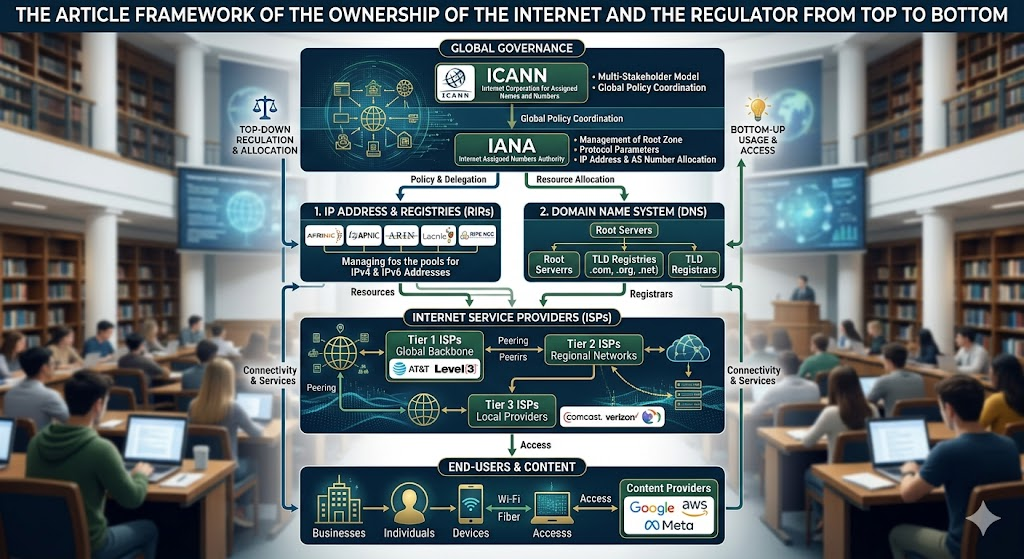
The Internet is often perceived as a single entity, but it is actually a decentralized collection of networks operated by governments, corporations, universities, and individuals. This thesis examines Internet governance from the highest global coordinating bodies to local Internet service providers. It explains the roles of key institutions such as Internet Corporation for Assigned Names and Numbers, Internet Assigned Numbers Authority, Regional Internet Registries, Internet Service Providers, and end users. The study argues that the Internet is governed through a multi-stakeholder model rather than by a single owner.
Introduction
Research Question
Who owns and regulates the Internet?
The Internet has no single owner; it is governed through a layered system of technical coordination, private ownership, and governmental regulation.
What Is the Internet?
The Internet consists of:
- Physical cables
- Routers
- Data centers
- Servers
- Domain names
- IP addresses
- Communication protocols
Internet taken as a highway system:
| Highway Element | Internet Equivalent |
|---|---|
| Roads | Fiber optic cables |
| Street addresses | IP addresses |
| Road signs | Domain names |
| Traffic rules | Internet protocols |
| Transport companies | ISPs |
Does Anyone Own the Internet?
Short Answer
No.
Different parts are owned by different entities:
- Governments own some infrastructure.
- Telecom companies own networks.
- Technology companies own servers and cloud systems.
- Universities own research networks.
- Individuals own websites.
Examples:
- Google owns its servers and infrastructure.
- Microsoft owns cloud infrastructure.
- Amazon Web Services owns data centers.
- Local ISPs own local network infrastructure.
No organization owns the whole Internet.
Top-Level Internet Governance
ICANN
Internet Corporation for Assigned Names and Numbers is the highest coordinating body for domain names.
Responsibilities:
- Domain name management
- DNS coordination
- Top-level domain administration
Examples:
- .com
- .org
- .net
- .za
ICANN does not control Internet content.
It coordinates Internet naming systems.
IANA
Internet Assigned Numbers Authority operates under ICANN.
Responsibilities:
- Global IP address allocation
- Root DNS management
- Protocol parameter assignments
Think of IANA as the Internet’s central address office.
DNS and the Root Zone
DNS
Domain Name System (DNS)
Converts:
google.com
into
142.250.xxx.xxx
Without DNS, users would need to remember numerical addresses.
DNS Hierarchy
- Root Servers
- Top-Level Domains
- Authoritative Name Servers
- Websites
Example:
↓
.com
↓
Google DNS
↓
Google Server
Regional Internet Registries
IANA distributes IP addresses to Regional Internet Registries.
Five major RIRs:
| Registry | Region |
|---|---|
| ARIN | North America |
| RIPE NCC | Europe |
| APNIC | Asia-Pacific |
| LACNIC | Latin America |
| AFRINIC | Africa |
For South Africa, AFRINIC is responsible for regional IP allocation.
Internet Service Providers (ISPs)
ISPs connect users to the Internet.
Examples include:
- Local telecom companies
- Mobile operators
- Fiber providers
Responsibilities:
- Assign customer IP addresses
- Route traffic
- Provide Internet access
Hierarchy:
Tier 1 Networks
Global backbone providers.
Examples:
- Large international carriers
Tier 2 Networks
Regional providers.
Tier 3 Networks
Local ISPs serving homes and businesses.
IP Addresses Explained
An IP address is the Internet equivalent of a home address.
Example:
192.168.1.1
Functions:
- Device identification
- Traffic routing
- Network communication
Types:
IPv4
32-bit
Example:
8.8.8.8
IPv6
128-bit
Example:
2001:4860:4860::8888
IPv6 was created because IPv4 addresses became scarce.
Governments and Internet Regulation
Governments do not own the Internet but regulate activities within their jurisdictions.
Examples:
- Privacy laws
- Cybersecurity laws
- Consumer protection
- Data protection
Governments can:
- Regulate ISPs
- Require lawful interception
- Establish cybersecurity standards
Governments generally cannot control the entire global Internet.
Technology Companies and Internet Power
Major companies influence Internet usage.
Examples:
These companies:
- Operate cloud services
- Manage platforms
- Control large amounts of Internet traffic
They influence the Internet but do not own it.
The Multi-Stakeholder Model
Internet governance includes the following:
- Technical organizations
- Governments
- Private companies
- Civil society
- Academic institutions
This is called the multi-stakeholder model.
Advantages:
- Distributed control
- Global cooperation
- Technical stability
Challenges:
- Unequal influence
- Political conflicts
- Jurisdiction issues
Future Challenges
Key issues:
- Cybersecurity
- Artificial Intelligence
- Data sovereignty
- Digital privacy
- Internet fragmentation (“Splinternet”)
Future governance will require cooperation among states, corporations, and technical organizations.
Conclusion (½ Page)
The Internet is not owned by any single person, company, or government. Instead, it operates through a layered governance structure. At the top, ICANN and IANA coordinate naming and addressing systems. Regional Internet Registries distribute IP addresses. ISPs provide access to users. Governments regulate Internet activity within national borders, while private companies own much of the infrastructure and services. Therefore, the Internet is best understood as a decentralized global network governed through cooperation rather than ownership.
Simplified “Top-to-Bottom” Internet Hierarchy
INTERNET GOVERNANCE

1. ICANN
   ↓

2. IANA
   ↓

3. Regional Internet Registries
   (AFRINIC, ARIN, RIPE, APNIC, LACNIC)
   ↓

4. National Telecom Regulators
   ↓

5. ISPs / Telecom Companies
   ↓

6. Businesses & Websites
   ↓

7. Home Users & Devices




Be First to Comment