
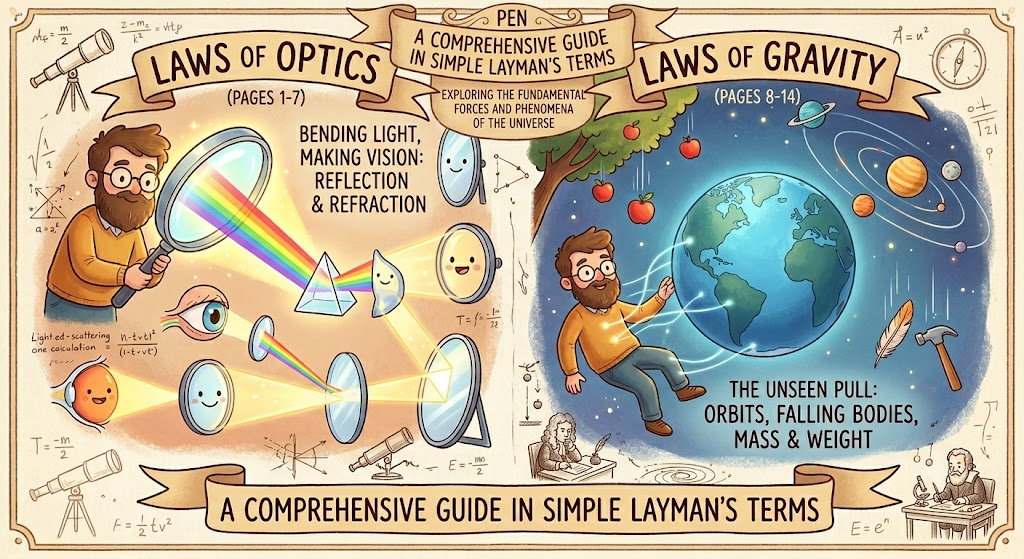
The Laws of Optics and Gravity Explained in Simple Terms
Introduction
The universe is governed by laws that help explain how everything works. Two of the most important areas of science are optics, which studies light and vision, and gravity, which studies the force that pulls objects together. Although these subjects may sound complicated, they affect our daily lives in countless ways. Every time we see a rainbow, wear glasses, use a camera, watch television, walk on the ground, or observe the Moon in the night sky, we are experiencing the effects of optics and gravity.
This article explains the basic laws of optics and gravity in simple, easy-to-understand language. The goal is to help readers without a scientific background understand these fascinating concepts and appreciate how they shape the world around us.
What Is Optics?
Optics is the branch of science that studies light and how it behaves. It examines how light travels, reflects, bends, spreads, and interacts with different materials.
Without light, we would not be able to see anything. Light allows us to observe colors, shapes, distances, and movement. Optics helps us understand how our eyes work and how devices such as glasses, microscopes, telescopes, cameras, and fiber-optic cables function.
What Is Light?
Light is a form of energy that travels in waves. It moves extremely fast—about 300,000 kilometers (186,000 miles) per second in a vacuum.
The Sun is Earth’s primary source of natural light. Artificial light comes from bulbs, candles, LEDs, and other devices.
Light can travel through empty space, unlike sound, which needs air or another medium to move.
The Straight-Line Law of Light
One of the simplest laws of optics is that light travels in straight lines when moving through a uniform medium.
For example:
Sunlight entering a room through a window travels in straight paths.
A flashlight beam appears straight.
Shadows form because light travels straight and cannot bend around large objects.
This law helps explain why objects cast shadows and why we can determine the direction of a light source.
Reflection of Light
What Is Reflection?
Reflection occurs when light bounces off a surface.
Examples include:
Looking in a mirror
Seeing your reflection in calm water
Light bouncing off a shiny car
The Law of Reflection
The law of reflection states:
The angle at which light strikes a surface equals the angle at which it bounces away.
In simple terms:
If light hits a mirror at a certain angle, it leaves at the same angle.
This law makes mirrors work effectively and allows us to see reflected images.
Types of Reflection
Regular Reflection
Occurs on smooth surfaces such as:
Mirrors
Polished metal
Still water
The reflected image is clear.
Diffuse Reflection
Occurs on rough surfaces such as:
Walls
Paper
Wood
The reflected light scatters in many directions, making images unclear.
Refraction of Light
What Is Refraction?
Refraction occurs when light changes direction as it passes from one material to another.
For example:
A straw appears bent in a glass of water.
A swimming pool appears shallower than it actually is.
This happens because light travels at different speeds in different materials.
Why Does Refraction Occur?
Light slows down when entering a denser material such as water or glass. This change in speed causes it to bend.
Refraction is essential for:
Eyeglasses
Contact lenses
Microscopes
Telescopes
Cameras
Dispersion of Light
What Is Dispersion?
Dispersion occurs when white light separates into different colors.
A rainbow is the most familiar example.
White sunlight contains many colors:
Red
Orange
Yellow
Green
Blue
Indigo
Violet
When sunlight passes through water droplets, each color bends slightly differently, creating a rainbow.
The Formation of Rainbows
Rainbows are produced through three optical processes:
Refraction
Reflection
Dispersion
Sunlight enters a raindrop, bends, reflects inside the droplet, and emerges as separate colors.
This creates the beautiful arc seen after rainfall.
Total Internal Reflection
Sometimes light becomes trapped inside a material and reflects completely instead of escaping.
This is called total internal reflection.
Applications include:
Fiber-optic communication
Medical instruments
High-speed internet systems
Fiber-optic cables carry information using pulses of light that repeatedly reflect inside the cable.
Lenses and Their Uses
What Is a Lens?
A lens is a transparent object that bends light.
There are two main types:
Convex Lens
A convex lens is thicker in the middle.
It causes light rays to come together.
Uses include:
Magnifying glasses
Cameras
Microscopes
Human eye lenses
Concave Lens
A concave lens is thinner in the middle.
It causes light rays to spread apart.
Uses include:
Correcting short-sightedness
Certain scientific instruments
How the Human Eye Uses Optics
The human eye is a remarkable optical device.
Light enters through:
Cornea
Pupil
Lens
The lens focuses light onto the retina at the back of the eye.
The retina converts light into signals sent to the brain.
The brain interprets these signals as images.
Optical Illusions
Optical illusions occur when our brains interpret visual information incorrectly.
Examples include:
Objects appearing larger or smaller than they are
Stationary pictures appearing to move
Parallel lines appearing curved
These illusions demonstrate that seeing involves both the eyes and the brain.
Importance of Optics in Everyday Life
Optics plays a major role in:
Vision
Photography
Medicine
Telecommunications
Astronomy
Entertainment
Without optics, modern technology would be impossible.
What Is Gravity?
Gravity is the force that attracts objects toward each other.
Everything that has mass creates gravity.
The larger the mass, the stronger the gravitational pull.
Gravity is responsible for:
Keeping us on Earth
Holding the Moon in orbit
Maintaining planetary motion
Forming stars and galaxies
Early Ideas About Gravity
People have observed gravity since ancient times.
Objects always fell downward, but nobody fully understood why.
Scientists eventually sought explanations for this mysterious force.
Isaac Newton and the Law of Gravity
The English scientist Isaac Newton developed the first mathematical explanation of gravity.
According to popular stories, Newton became interested in gravity after seeing an apple fall from a tree.
He realized that the same force pulling the apple down also keeps the Moon orbiting Earth.
Newton’s Universal Law of Gravitation
Newton stated:
Every object attracts every other object in the universe.
The strength of attraction depends on the following:
The masses of the objects
The distance between them
Larger masses create stronger gravitational forces.
Greater distances reduce gravitational attraction.
Why Objects Fall
When you drop a ball, gravity pulls it toward Earth.
Earth is extremely massive, creating a strong gravitational force.
This force accelerates falling objects downward.
Without air resistance, all objects fall at the same rate regardless of their weight.
Weight Versus Mass
People often confuse weight and mass.
Mass
Mass measures the amount of matter in an object.
Mass remains constant.
Weight
Weight measures the force of gravity acting on mass.
Weight changes depending on gravitational strength.
For example:
A person weighing 70 kilograms on Earth would weigh less on the Moon because the Moon’s gravity is weaker.
Gravity on Different Planets
Each planet has different gravity because of differences in mass and size.
Stronger Gravity
Jupiter
Neptune
Weaker Gravity
Mars
Mercury
Astronauts would weigh differently on each planet.
The Moon and Gravity
The Moon’s gravity is about one-sixth as strong as Earth’s.
This is why astronauts on the Moon could jump much higher than on Earth.
The Moon’s gravity also affects Earth by creating ocean tides.
Ocean Tides
Ocean tides occur because of gravitational attraction from:
The Moon
The Sun
The Moon pulls on Earth’s oceans, causing water levels to rise and fall.
High tides and low tides occur regularly because of these gravitational forces.
Gravity and Planetary Orbits
Planets do not simply fly away into space because gravity keeps them in orbit around the Sun.
Similarly:
The Moon orbits Earth.
Artificial satellites orbit Earth.
Gravity acts like an invisible tether holding celestial bodies together.
Escape Velocity
To leave Earth’s gravitational pull, an object must reach a certain speed called escape velocity.
Rockets must travel incredibly fast to overcome gravity and enter space.
Without sufficient speed, they would fall back to Earth.
Einstein’s Revolution: General Relativity
In the early twentieth century, Albert Einstein developed a new understanding of gravity.
Instead of viewing gravity as a force, Einstein described it as a curvature of space and time.
Imagine placing a heavy bowling ball on a stretched rubber sheet.
The ball creates a depression.
Smaller balls rolling nearby move toward the depression.
Similarly, massive objects such as planets and stars curve space-time around them.
Objects move along these curves, creating what we perceive as gravity.
Gravitational Time Dilation
Einstein discovered that gravity affects time.
Time passes slightly slower in stronger gravitational fields.
Although this effect is tiny on Earth, it becomes significant near extremely massive objects.
GPS satellites must account for these differences to provide accurate navigation.
Black Holes
A black hole forms when enormous amounts of matter are compressed into a tiny space.
The gravitational pull becomes so strong that not even light can escape.
Black holes represent some of the most extreme examples of gravity in the universe.
Scientists continue studying them to learn more about the nature of space and time.
Gravity and the Formation of Stars
Gravity is responsible for creating stars.
Huge clouds of gas and dust in space collapse under their own gravity.
As the material compresses:
Temperature increases
Pressure rises
Nuclear fusion begins
A new star is born.
Our Sun formed in this way billions of years ago.
Gravity and Galaxies
Gravity also shapes galaxies.
Billions of stars remain grouped together because of gravitational attraction.
Without gravity, galaxies would break apart and drift into space.
Artificial Satellites
Satellites remain in orbit because of a balance between:
Their forward motion
Earth’s gravity
Examples include:
Communication satellites
Weather satellites
Navigation satellites
These systems support modern communication, transportation, and weather forecasting.
Everyday Examples of Gravity
Gravity affects us constantly:
Walking
Running
Jumping
Falling
Pouring water
Throwing a ball
Without gravity:
We could not stay on Earth.
Oceans would float away.
The atmosphere would disappear.
Life as we know it would not exist.
Relationship Between Optics and Gravity
At first glance, optics and gravity seem unrelated.
However, modern physics shows important connections.
Einstein discovered that gravity can bend light.
This phenomenon is known as gravitational lensing.
When light passes near a massive object, such as a galaxy, its path bends.
Astronomers use this effect to study distant parts of the universe.
Thus, gravity influences optics on cosmic scales.
Applications in Modern Technology
Understanding optics and gravity has led to remarkable inventions.
Technologies Based on Optics
Cameras
Microscopes
Telescopes
Laser systems
Fiber-optic internet
Medical imaging equipment
Technologies Based on Gravity
Space exploration
Satellite communication
GPS navigation
Astronomy
Aerospace engineering
These scientific principles have transformed human civilization.
Conclusion
Optics and gravity are two of the most important pillars of our understanding of nature. Optics explains how light behaves, allowing us to see the world and develop technologies such as glasses, cameras, microscopes, telescopes, and communication systems. Gravity explains why objects fall, why planets orbit stars, why tides occur, and how galaxies, stars, and black holes form.
Although scientists have studied these subjects for centuries, they continue to reveal new mysteries about the universe. From a simple rainbow after a storm to the motion of distant galaxies, the laws of optics and gravity are constantly at work around us. By understanding these laws, we gain a deeper appreciation of both the everyday world and the vast universe beyond our planet.



Be First to Comment