
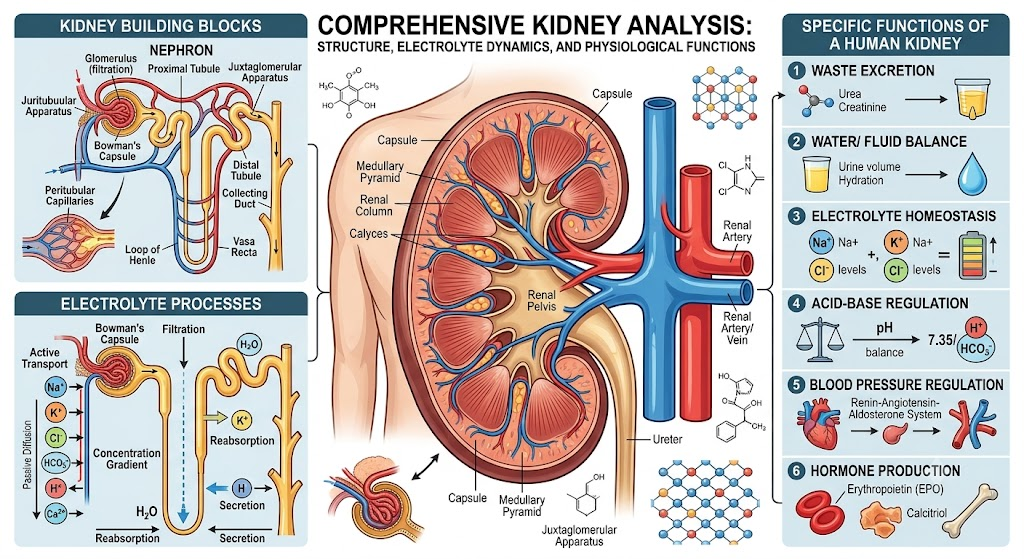
The human kidney is one of the most sophisticated organs in the body, responsible for maintaining internal homeostasis through the regulation of water, electrolytes, acid-base balance, blood pressure, and waste removal. Each kidney contains approximately one million nephrons that continuously filter blood, reabsorb essential substances, and eliminate metabolic waste products. Beyond excretion, the kidneys perform critical endocrine functions, including the production of erythropoietin, activation of vitamin D, and regulation of blood pressure through the renin-angiotensin-aldosterone system. This paper examines the anatomical structure of the kidneys, the physiological processes involved in urine formation, electrolyte regulation, endocrine activities, and the consequences of renal dysfunction.
The kidneys are paired bean-shaped organs situated retroperitoneally on either side of the vertebral column. They are essential for maintaining the body’s internal environment. Through complex filtration and regulatory mechanisms, the kidneys ensure that the composition of body fluids remains stable despite changes in diet, activity, and environmental conditions.
A healthy adult kidney filters approximately 180 liters of plasma daily while producing only 1–2 liters of urine. This remarkable efficiency results from intricate mechanisms of filtration, reabsorption, secretion, and excretion.
The kidneys contribute significantly to:
Waste elimination
Fluid balance
Electrolyte regulation
Blood pressure control
Acid-base homeostasis
Hormone production
Red blood cell formation
Gross Anatomy of the Kidney
External Anatomy
Each kidney measures approximately:
Length: 10–12 cm
Width: 5–7 cm
Thickness: 2–3 cm
Weight: 120–170 grams
The kidney consists of:
Renal Capsule
A tough fibrous covering that protects renal tissue.
Renal Cortex
The outer region contains the following:
Renal corpuscles
Proximal convoluted tubules
Distal convoluted tubules
Renal Medulla
Contains:
Renal pyramids
Loops of Henle
Collecting ducts
Renal Pelvis
A funnel-shaped cavity that collects urine before it enters the ureter.
Microscopic Structure: The Nephron
The nephron is the functional unit of the kidney.
Each kidney contains approximately the following:
1,000,000 nephrons
Components
Renal Corpuscle
Consists of:
Glomerulus
A network of capillaries where blood filtration occurs.
Bowman’s Capsule
Surrounds the glomerulus and collects filtrate.
Renal Tubule
Includes:
Proximal Convoluted Tubule (PCT)
Loop of Henle
Distal Convoluted Tubule (DCT)
Collecting Duct
Blood Supply to the Kidney
The kidneys receive approximately 20–25% of cardiac output.
Blood Flow Pathway
Aorta ↓ Renal Artery ↓ Segmental Arteries ↓ Interlobar Arteries ↓ Arcuate Arteries ↓ Interlobular Arteries ↓ Afferent Arterioles ↓ Glomerulus ↓ Efferent Arterioles ↓ Peritubular Capillaries/Vasa Recta ↓ Renal Vein
This extensive blood supply enables efficient filtration and regulation.
Formation of Urine
Urine formation occurs through three fundamental processes:
Glomerular Filtration
Tubular Reabsorption
Tubular Secretion
Glomerular Filtration
Filtration occurs within the glomerulus.
Blood pressure forces:
Water
Electrolytes
Glucose
Amino acids
Urea
through the filtration membrane.
Filtration Barrier
Consists of:
Endothelium
Allows water and small solutes.
Basement Membrane
Restricts proteins.
Podocytes
Specialized epithelial cells creating filtration slits.
Glomerular Filtration Rate (GFR)
Normal GFR:
125 mL/min
Approximately:
180 liters/day
Tubular Reabsorption
Reabsorption returns valuable substances to circulation.
Proximal Convoluted Tubule
Reabsorbs:
65% sodium
65% water
90% bicarbonate
100% glucose
Amino acids
Loop of Henle
Creates medullary osmotic gradient.
Distal Tubule
Fine-tunes electrolyte balance.
Collecting Duct
Regulates water conservation through ADH.
Tubular Secretion
Tubular secretion removes substances from blood.
Examples:
Hydrogen ions (H⁺)
Potassium (K⁺)
Ammonia
Drugs
Toxins
Functions include:
Acid-base regulation
Electrolyte balance
Drug elimination
Electrolyte Regulation by the Kidney
Electrolytes are electrically charged ions essential for cellular function.
The kidneys maintain their concentrations within narrow limits.
Sodium Regulation
Normal serum sodium:
135–145 mmol/L
Functions
Controls extracellular fluid volume
Influences blood pressure
Supports nerve conduction
Renal Control
Hormones involved:
Aldosterone
Increases sodium reabsorption.
ADH
Promotes water retention.
ANP
Enhances sodium excretion.
Potassium Regulation
Normal potassium:
3.5–5.0 mmol/L
Functions
Muscle contraction
Cardiac rhythm
Nerve impulse transmission
Kidney Role
The distal nephron secretes excess potassium.
Hormonal regulator:
Aldosterone
Failure of potassium regulation may cause:
Arrhythmias
Cardiac arrest
Calcium Regulation
Normal calcium:
8.5–10.5 mg/dL
Functions
Bone mineralization
Blood clotting
Muscle contraction
Kidneys regulate calcium through:
Vitamin D Activation
Vitamin D is converted into:
Calcitriol
which increases intestinal calcium absorption.
Parathyroid Hormone
Enhances renal calcium reabsorption.
Magnesium Regulation
Magnesium participates in:
ATP production
Enzyme activity
Neuromuscular function
Most magnesium is reabsorbed in:
Loop of Henle
Distal convoluted tubule
Phosphate Regulation
Phosphate is vital for:
ATP synthesis
Cell membranes
Bone formation
Kidneys regulate phosphate excretion according to body needs.
Parathyroid hormone increases phosphate excretion.
Water Balance and Osmoregulation
Water balance is crucial for survival.
Antidiuretic Hormone (ADH)
Produced by:
Hypothalamus
Released from:
Posterior pituitary gland
ADH increases water permeability in collecting ducts.
Result:
More concentrated urine.
Countercurrent Mechanism
The Loop of Henle generates a concentration gradient.
Descending Limb
Permeable to water.
Ascending Limb
Impermeable to water.
Actively transports:
Sodium
Potassium
Chloride
This mechanism permits urine concentration.
Acid-Base Balance
Normal blood pH:
7.35–7.45
The kidneys maintain pH by:
Reabsorbing Bicarbonate
Excreting Hydrogen Ions
Producing Ammonium
These mechanisms compensate for metabolic disturbances.
Endocrine Functions of the Kidney
The kidney functions as an endocrine organ.
Erythropoietin Production
Produced by specialized renal cells.
Stimulates:
Red blood cell production in bone marrow.
Deficiency leads to:
Anemia in chronic kidney disease.
Vitamin D Activation
Kidneys convert:
25-hydroxyvitamin D
into:
1,25-dihydroxyvitamin D (Calcitriol)
Functions:
Calcium absorption
Bone health
Renin Production
Renin initiates the:
Renin-Angiotensin-Aldosterone System (RAAS)
Renin-Angiotensin-Aldosterone System
Trigger
Reduced:
Blood pressure
Blood volume
Sodium delivery
Sequence
Renin ↓ Angiotensin I ↓ Angiotensin II ↓ Aldosterone
Effects:
Vasoconstriction
Sodium retention
Increased blood pressure
Waste Removal
The kidneys eliminate:
Nitrogenous Waste
Urea
Creatinine
Uric acid
Drug Metabolites
Environmental Toxins
Excess Electrolytes
This detoxification function is vital for survival.
Kidney and Blood Pressure Regulation
The kidneys regulate blood pressure through:
RAAS
Sodium Balance
Water Retention
Sympathetic Nervous System Interactions
Long-term blood pressure control largely depends on renal function.
Kidney Disease and Functional Impairment
Acute Kidney Injury (AKI)
Sudden decline in renal function.
Causes:
Shock
Sepsis
Dehydration
Toxic drugs
Chronic Kidney Disease (CKD)
Progressive nephron loss over months or years.
Common causes:
Diabetes mellitus
Hypertension
Glomerulonephritis
Complications:
Anemia
Electrolyte imbalance
Metabolic acidosis
Cardiovascular disease
Dialysis and Renal Replacement Therapy
When kidneys fail, dialysis replaces filtration.
Hemodialysis
Blood is filtered through an artificial membrane.
Peritoneal Dialysis
Peritoneum acts as a filtration membrane.
Kidney Transplantation
Most effective long-term treatment.
Importance of Electrolyte Homeostasis
Electrolyte balance affects:
Nervous System
Action potentials
Synaptic transmission
Muscular System
Contraction
Relaxation
Cardiovascular System
Heart rhythm
Blood pressure
Cellular Function
Enzyme activity
Metabolism
The kidneys are the principal organs responsible for maintaining these balances.
Emerging Research in Renal Physiology
Current research focuses on:
Artificial kidneys
Stem cell regeneration
Precision nephrology
Biomarkers for early CKD detection
Genetic kidney disorders
Advances may significantly improve outcomes for patients with renal disease.
Conclusion
The human kidney is an extraordinary organ whose functions extend far beyond waste elimination. Through the coordinated activities of approximately one million nephrons per kidney, it maintains fluid balance, regulates electrolytes, controls acid-base status, removes toxins, governs blood pressure, and performs critical endocrine functions. Electrolyte regulation involving sodium, potassium, calcium, phosphate, magnesium, and bicarbonate is essential for maintaining cellular integrity and systemic homeostasis. The kidneys also contribute significantly to red blood cell production and skeletal health through erythropoietin and vitamin D activation. Because virtually every physiological system depends on renal function, kidney disease can have profound multisystem consequences. Understanding the structure, physiology, and electrolyte processes of the kidney is therefore fundamental to the study of human biology, medicine, and health sciences.



Be First to Comment