
1. FOUNDATIONS: WHAT IS A TRANSISTOR?
A transistor is a semiconductor device used to:
- Switch electrical signals (ON/OFF → digital logic)
- Amplify signals (analog circuits)
Core idea:
It controls current flow using voltage.
Types:
- BJT (Bipolar Junction Transistor) – current-controlled (older tech)
- MOSFET (Metal-Oxide-Semiconductor Field-Effect Transistor) – voltage-controlled (dominant today)
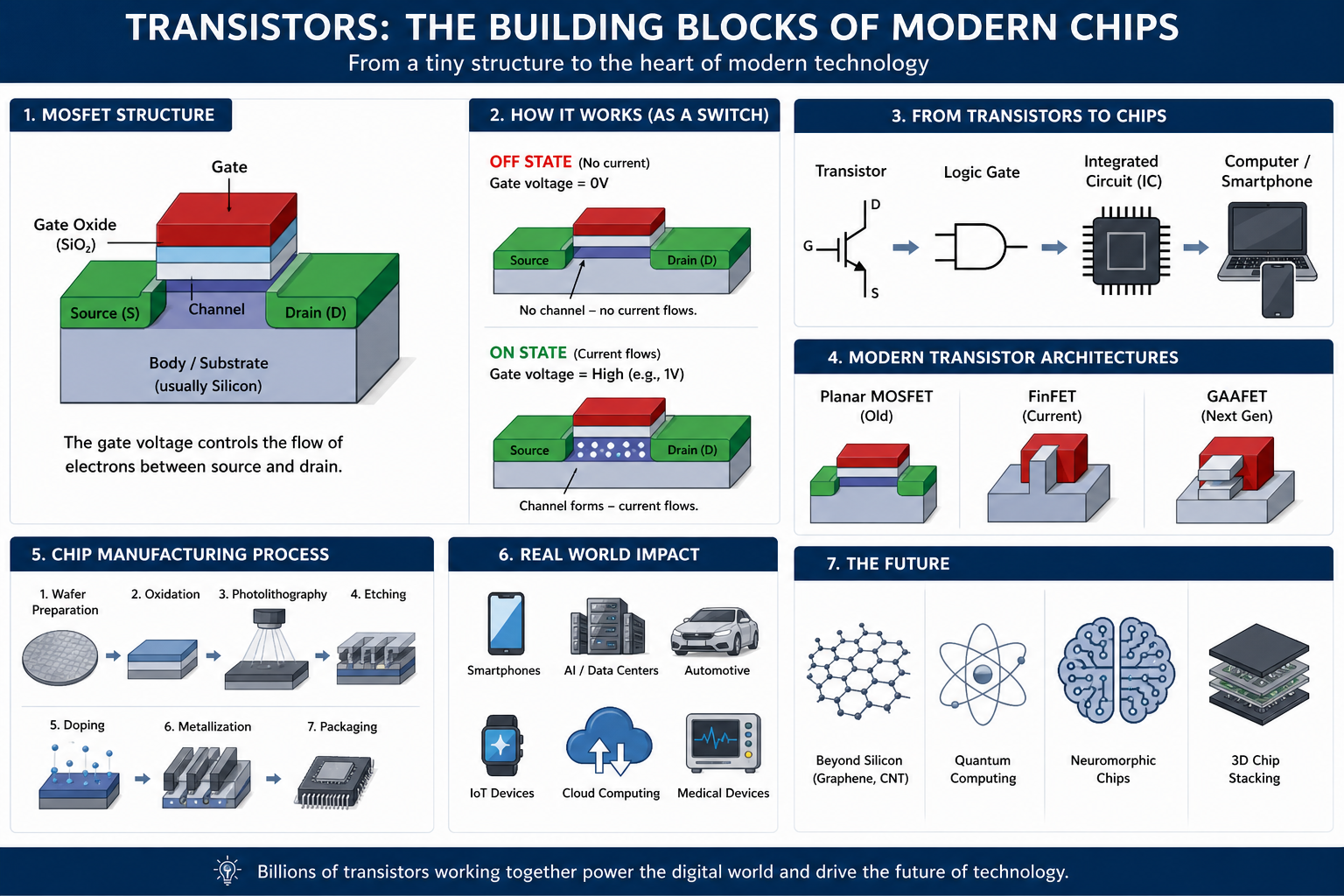
2. CORE STRUCTURE (MOSFET – MODERN STANDARD)
A MOSFET has 4 main parts:
- Gate (G) – control terminal
- Source (S) – entry point of electrons
- Drain (D) – exit point
- Substrate (Body) – base material (silicon)
Operation principle:
When voltage is applied to the gate → an electric field forms → allows current to flow between source and drain.
3. SEMICONDUCTOR PHYSICS
Transistors rely on Semiconductor physics:
Materials:
- Silicon (Si) – most common
- Gallium arsenide (GaAs)
- Silicon carbide (SiC)
Doping:
- n-type → extra electrons
- p-type → “holes” (positive carriers)
PN junction:
The boundary that controls current flow.
4. TRANSISTOR AS A SWITCH (DIGITAL LOGIC)
Binary system:
- OFF → 0
- ON → 1
Logic gates built from transistors:
- AND
- OR
- NOT
These form processors and memory.
Example:
- A CPU = billions of transistors switching billions of times per second.
5. TRANSISTOR AS AN AMPLIFIER (ANALOG)
In analog mode:
- Small input signal → larger output signal
Used in:
- Audio systems
- Radio frequency circuits
- Sensors
6. INTEGRATED CIRCUITS (ICs)
Instead of single transistors:
→ we integrate millions/billions onto one chip.
Key milestone:
Invention of the integrated circuit
Chip types:
- CPUs
- GPUs
- Memory (RAM, Flash)
- ASICs (AI chips)
7. SCALING AND MOORE’S LAW
Moore’s Law:
- Transistor count doubles ~every 2 years
Why scaling matters:
- Faster performance
- Lower power
- Smaller devices
Modern node sizes:
- 14nm → 7nm → 5nm → 3nm
8. MODERN TRANSISTOR ARCHITECTURES
1. Planar MOSFET (old)
Flat structure
2. FinFET (current mainstream)
3D “fin” structure improves control
Used by:
- Intel
- TSMC
3. GAAFET (next generation)
Gate surrounds channel completely
Used in:
- Samsung Electronics (3nm tech)
9. CHIP FABRICATION PROCESS (STEP-BY-STEP)
1. Wafer creation
- Pure silicon crystal sliced into wafers
2. Oxidation
- Silicon dioxide layer formed
3. Photolithography
- Light patterns define circuits
4. Etching
- Removes unwanted material
5. Doping (ion implantation)
- Adds electrical properties
6. Metallization
- Connects transistors
7. Packaging
- Final chip enclosed
Machines from:
- ASML (EUV technology leader)
10. PERFORMANCE METRICS
Key parameters:
- Switching speed (GHz)
- Power consumption (Watts)
- Leakage current
- Thermal output
Trade-off:
Higher speed = more heat and power usage
11. ROLE IN MODERN WORLD
1. Smartphones
Billions of transistors per chip
2. Artificial Intelligence
GPUs and TPUs process massive data
3. Cloud/Data Centers
Power services like:
- Microsoft
4. Automotive
- Electric vehicles
- Autonomous driving systems
5. Internet of Things (IoT)
Small, low-power chips in everyday devices
12. ENERGY AND ENVIRONMENTAL IMPACT
Challenges:
- High electricity use (data centers)
- Water usage in chip fabrication
- Heat dissipation
Example:
Advanced fabs consume millions of liters of water daily.
13. LIMITATIONS OF CURRENT TRANSISTORS
Physical limits:
- Quantum tunneling (leakage)
- Heat density
- Material limits of silicon
14. FUTURE TECHNOLOGIES
1. Beyond silicon:
- Graphene
- Carbon nanotubes
2. Quantum computing
Uses qubits instead of transistors
3. Neuromorphic chips
Brain-like processing
4. 3D chip stacking
Vertical transistor layers
15. COMPLETE SYSTEM VIEW (TRANSISTOR → GLOBAL IMPACT)
Hierarchy:
- Transistor
- Logic gate
- Circuit
- Chip (IC)
- Device (phone/computer)
- Network (internet/cloud)
- Economy & society
16. SIMPLE ANALOGY
Think of transistors as:
- Water taps in a massive system of pipes
- Each tap controls flow
- Billions together create intelligent systems
17. CONCLUSION
Transistors are the atomic units of the digital age. Their evolution—from simple switches to complex 3D nanoscale structures—drives:
- Computing power
- AI advancement
- Global connectivity
The future of technology depends on how far we can continue to innovate beyond current transistor limitations.


Be First to Comment