
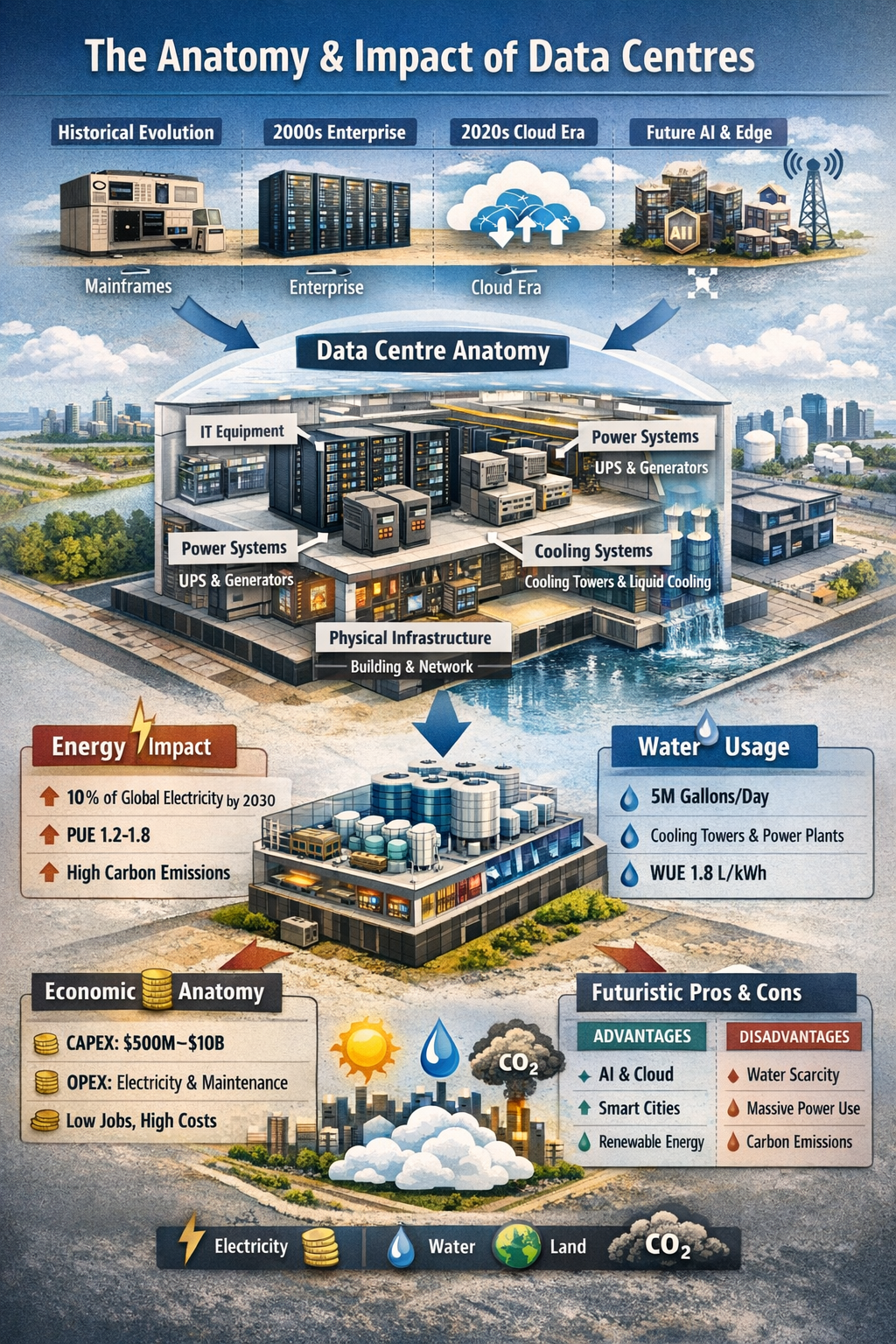
1. Historical Evolution of Data Centres
1.1 Pre-Data Centre Era (1940s–1980s)
- Early computing systems (mainframes) were centralized in government & research labs
- Examples: military computing, banking systems
- Characteristics:
- Massive size
- Extremely high energy consumption
- No optimization for cooling or efficiency
1.2 Enterprise Data Centres (1990s–2005)
- Rise of the internet → companies built internal server rooms
- Key drivers:
- E-commerce
- Enterprise IT systems (ERP, CRM)
- Problems:
- Inefficient cooling
- Fragmented infrastructure
- High operational cost
1.3 Cloud & Hyperscale Era (2006–2020)
- Led by companies like:
- Amazon (AWS)
- Microsoft
- Shift to:
- Centralized mega data centres (“hyperscale”)
- Virtualization and cloud computing
- Benefits:
- Efficiency improvements
- Global scalability
1.4 AI & Edge Computing Era (2020–Future)
- Driven by:
- AI models
- IoT devices
- Real-time analytics
- Result:
- Explosive growth in data centre demand
- Increased energy + water intensity
2. Anatomy of a Data Centre (System Architecture)
Think of a data centre as a living organism with 5 core systems:
2.1 Compute Layer (Brain)
- Servers (CPU, GPU for AI)
- Storage systems
- Networking hardware
2.2 Power Infrastructure (Heart)
- Grid connection
- Backup generators
- UPS (Uninterruptible Power Supply)
👉 Data centres are massive electricity consumers, reaching up to 4.4% of total electricity use in the U.S. (2023)
2.3 Cooling System (Thermoregulatory System)
This is where water & energy intersect critically:
Types:
- Air cooling
- Evaporative cooling (uses water)
- Liquid immersion cooling (future tech)
👉 Cooling is essential because:
- Servers generate extreme heat
- Without cooling → system failure
2.4 Network Connectivity (Nervous System)
- Fiber optics
- Internet backbone connections
- Edge distribution nodes
2.5 Physical Infrastructure (Skeleton)
- Buildings
- Security systems
- Fire suppression
3. Water Usage Anatomy (Critical Section)
3.1 Where Water is Used
Water in data centres comes from 3 layers:
(A) Direct Usage
- Cooling towers
- Evaporation systems
(B) Indirect Usage (Hidden)
- Electricity generation (power plants)
- Chip manufacturing
(C) Lifecycle Usage
- Construction
- Hardware production
3.2 Scale of Water Consumption
- Large data centres:
- Up to 5 million gallons/day
- A 100 MW facility:
- ~2 million liters/day
- Global footprint:
- ~560 billion liters annually (growing fast)
👉 Even AI prompts consume water indirectly (cooling + electricity systems)
3.3 Key Metric: WUE (Water Usage Effectiveness)
- Measured as:
liters of water per kWh of energy - Industry average:
- ~1.8–1.9 L/kWh
3.4 Water Risks
- Aquifer depletion
- Competition with communities
- Increased drought pressure
- Thermal pollution (heated water discharge)
4. Energy Consumption Anatomy
4.1 Why Data Centres Use So Much Energy
- Continuous operation (24/7)
- High-performance computing (AI, cloud)
- Cooling systems
4.2 Growth Trends
- Energy demand more than doubled (2017–2023)
- Expected to reach:
- 6.7%–12% of total electricity consumption by 2028
4.3 Energy Flow Model
Energy is used in:
- Compute (servers)
- Cooling (often 30–50%)
- Infrastructure losses
5. Economic Framework (Imaging Economics Perspective)
5.1 Value Creation Layers
(1) Digital Economy Backbone
- Enables:
- E-commerce
- Fintech
- AI services
- Streaming
(2) Capital Investment
- Billions in infrastructure development
- Land + construction + hardware
(3) Job Creation
- Construction jobs (short-term)
- Few permanent jobs (automation-heavy)
5.2 Cost Structure
| Cost Component | Description |
|---|---|
| Energy | Largest operating cost |
| Water | Increasing regulatory cost |
| Hardware | Servers, GPUs |
| Cooling | Infrastructure-heavy |
| Land | Strategic location |
5.3 Externalities (Hidden Costs)
- Environmental degradation
- Water scarcity
- Grid pressure → higher electricity prices
6. Advantages (Present & Future)
6.1 Technological Advantages
- AI acceleration
- Global connectivity
- Real-time data processing
6.2 Economic Advantages
- Enables trillion-dollar digital economy
- Attracts foreign investment
- Supports startups & innovation
6.3 Infrastructure Advantages
- Cloud reduces need for small inefficient systems
- Centralization improves efficiency
7. Disadvantages (Critical Analysis)
7.1 Water Crisis Risk
- Competes with:
- Agriculture
- Local communities
- Often located in water-stressed regions
7.2 Energy & Climate Impact
- High carbon emissions (if fossil-fuel powered)
- Strain on national power grids
7.3 Economic Imbalance
- High capital → low employment return
- Benefits large tech firms more than local communities
7.4 Geographic Inequality
- Data centres cluster in:
- Cheap energy zones
- Cool climates
- Creates uneven development
8. Future Trends (Futuristic Framework)
8.1 Water Innovation
- Closed-loop cooling systems
- Use of recycled wastewater
- Waterless cooling (air/immersion)
8.2 Energy Transformation
- Renewable-powered data centres
- Nuclear-powered data centres (emerging trend)
- AI-optimized energy usage
8.3 Decentralization
- Edge computing reduces central load
- Smaller distributed data centres
8.4 AI Efficiency Paradox
- AI improves efficiency
- But also increases total demand
9. Strategic Framework (Decision Model)
9.1 Sustainability Triangle
Balance between:
- Performance
- Energy
- Water
9.2 Policy Framework
Governments must regulate:
- Water usage caps
- Renewable energy requirements
- Location zoning
9.3 Business Strategy Framework
Companies optimize:
- PUE (Power Usage Effectiveness)
- WUE (Water Usage Effectiveness)
- Cost vs sustainability trade-offs
10. Final Insight (Critical Thinking)
Data centres are not just IT infrastructure—they are:
“Industrial-scale digital factories”
They convert:
- Electricity → computation
- Water → cooling
- Data → economic value
But the trade-off is clear:

Be First to Comment