
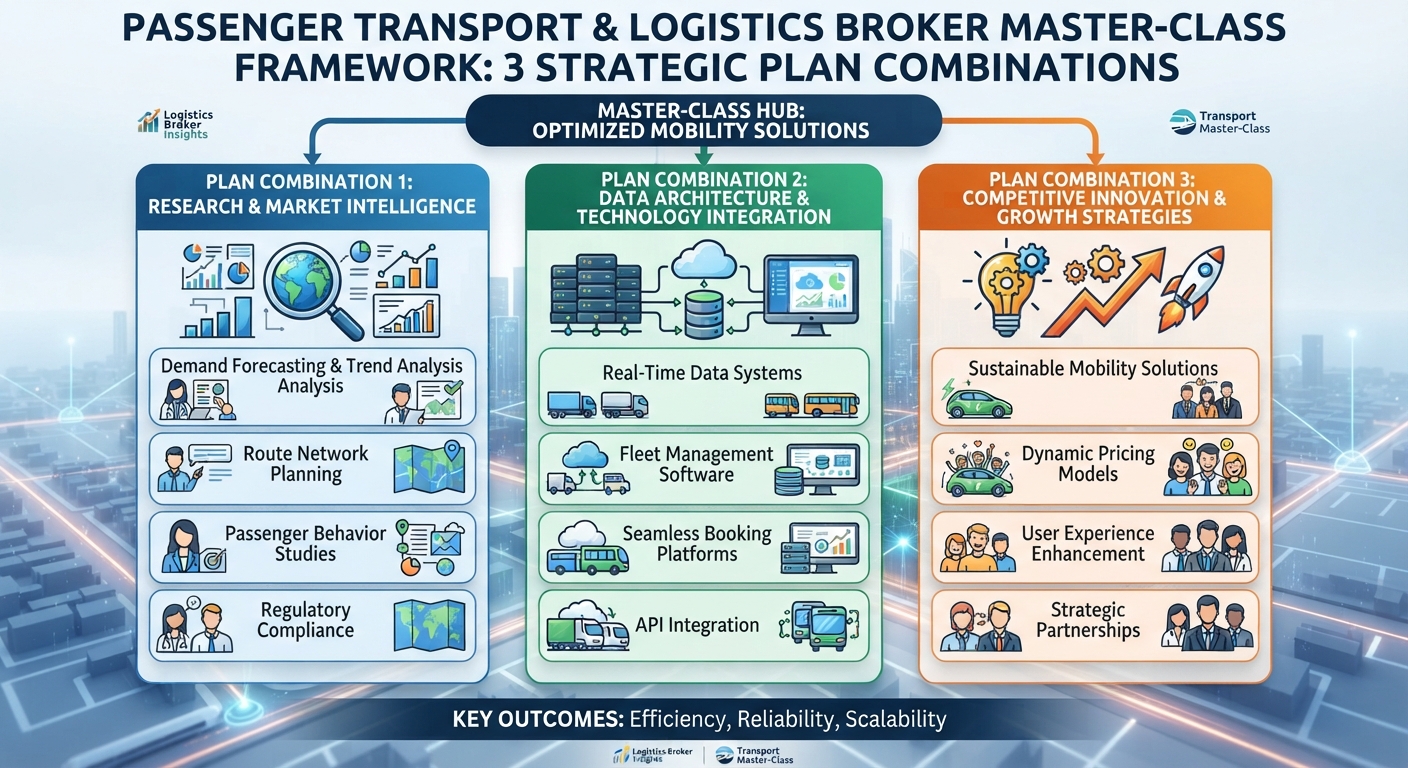
The Three Master-Class Plan Combinations — Research, Data Architecture, and Competitive Innovation
Comprehensive Thesis
A strategic framework for building an intelligent, data-driven transport brokerage ecosystem
Executive overview
Passenger transport and logistics brokerage represents a business model that connects people, businesses, transport operators, vehicles, freight, routes, destinations, and customers through a coordinated commercial and technological platform.
Instead of necessarily owning a large fleet of vehicles, a brokerage company creates value through coordination, information, trust, market access, pricing intelligence, scheduling, optimisation, and transaction management.
The central concept is to develop three master-class capabilities that operate together:
- Research Master Class — understand markets, transport demand, customers, competitors, regulations, infrastructure and economic opportunities.
- Data Architecture Master Class — construct the digital intelligence infrastructure that captures, organises, processes, analyses and distributes transport information.
- Competitive Innovation Master Class — use research and data to develop superior business models, service delivery, pricing, efficiency, customer experience and technological advantages.
The three are not independent departments. They form one continuous innovation cycle.
The Three Master-Class Combination
1. RESEARCH
Market intelligence · Demand · Geography · Customer needs · Competition
2. DATA ARCHITECTURE
Capture · Integration · Database · Analytics · Intelligence · Automation
3. COMPETITIVE INNOVATION
Better matching · Efficiency · Pricing · Reliability · New services · Growth
Continuous feedback: Performance outcomes generate new data and new research.
The objective is to create a brokerage business that understands the transport market, operates through intelligent digital systems, and continuously improves its competitiveness.
PART I — THE TRANSPORT BROKERAGE INDUSTRY
Chapter 1: Understanding the transport brokerage concept
A transport broker is an intermediary that connects a transport requirement with an available, suitable and verified transport service provider.
The broker may coordinate:
- Passenger transportation
- Corporate travel
- Airport transfers
- Tourism transportation
- Shuttle services
- School and institutional transportation, where properly authorised
- Bus and coach services
- Freight and cargo
- Distribution services
- Courier and delivery services
- Vehicle capacity
- Transport contracts
- Specialised transportation requirements
The broker’s fundamental economic function is to reduce the friction between demand and supply.
The traditional fragmented market
Imagine five groups operating independently:
| Market participant | Main requirement |
|---|---|
| Passenger/customer | Wants dependable transportation |
| Transport operator | Wants customers and utilisation |
| Vehicle owner | Wants productive vehicle usage |
| Business | Wants cost-efficient mobility or deliveries |
| Broker | Connects demand, supply and service execution |
The problem is that each group may lack the information needed to efficiently coordinate with the others.
A passenger might not know which operator is available.
An operator might have empty capacity but no customer.
A business might have transportation demand but no reliable supplier network.
A broker resolves this information and coordination gap.
Chapter 2: The brokerage value proposition
The brokerage creates value through six major mechanisms.
Market connectivity
Connecting customers to verified providers.
Information
Knowing available services, capacity and demand.
Time efficiency
Reducing search, coordination and administrative delays.
Trust
Verification, service standards and transaction transparency.
Economic optimisation
Better allocation of transport capacity and resources.
Innovation
Creating services that traditional intermediaries cannot easily provide.
The fundamental brokerage equation
A conceptual model of brokerage value:
\[ \text{Brokerage Value} = \text{Demand Matching} +\text{Coordination} +\text{Trust} +\text{Information} +\text{Service Quality} \]
The brokerage earns revenue by delivering measurable value to the customer, transport operator or both parties.
PART II — MASTER CLASS ONE: RESEARCH ARCHITECTURE
Chapter 3: Research as the foundation of transport intelligence
Research is the process of systematically discovering how the transport market works.
It should not rely only on assumptions, personal observations or anecdotal information.
The research department—or the research capability of a small brokerage—must continuously examine five major dimensions.
Research ecosystem
- Market research
- Customer research
- Transport supplier research
- Geographical and infrastructure research
- Economic, regulatory and technological research
3.1 Market research
Market research establishes the size, structure and characteristics of the market.
Questions include:
- How many customers need transportation?
- Which geographical areas have significant demand?
- What types of transportation are most frequently requested?
- Which markets are underserved?
- What are the dominant transport providers?
- What is the market’s approximate value?
- What are the seasonal variations?
- Which customer segments are growing?
Market segmentation
Passenger transport can be divided into:
| Segment | Typical customer |
|---|---|
| Individual mobility | Individuals and families |
| Corporate transport | Businesses and employees |
| Airport transfers | Travellers |
| Tourism | Tourists and travel organisations |
| Events | Event organisers |
| Institutional mobility | Organisations with recurring transport needs |
| Contract transportation | Organisations requiring scheduled services |
Logistics markets may include:
| Segment | Typical requirement |
|---|---|
| Local delivery | Goods transported within a city |
| Regional freight | Goods between towns and cities |
| Distribution | Moving products to multiple destinations |
| Business logistics | Regular supply-chain transportation |
| Specialised cargo | Specific transport requirements and handling |
The brokerage should initially select segments where it can build reliable relationships and understand customer requirements rather than attempting to serve every market simultaneously.
Chapter 4: Customer research architecture
Customers are not simply people who request transport.
They are organisations or individuals with specific problems.
Research must identify the problem behind the transaction.
Passenger customer research
Investigate:
- Reliability
- Safety and operator verification
- Price transparency
- Waiting times
- Accessibility
- Convenience
- Booking simplicity
- Communication
- Payment methods
- Cancellation policies
Business customer research
Investigate:
- Recurring transport requirements
- Monthly expenditure
- Supplier reliability
- Administrative burden
- Invoice management
- Reporting requirements
- Contract duration
- Service-level expectations
- Procurement procedures
Customer personas
Persona A — Individual traveller
Needs convenient transport, understandable pricing, dependable communication and an appropriate service.
Persona B — Corporate procurement manager
Needs reliable operators, invoices, contract management, reporting and predictable costs.
Persona C — Transport operator
Needs customer access, dependable payment, reduced idle capacity, transparent bookings and fair commercial arrangements.
Persona D — Logistics business
Needs reliable capacity, coordination, delivery visibility, documentation and supplier management.
Research should identify which customer problems are sufficiently important that customers are willing to pay for a solution.
Chapter 5: Transport supplier intelligence
A brokerage’s supplier network is one of its most important assets.
Supplier research should establish the capabilities and suitability of each operator.
Supplier information categories
| Information | Purpose |
|---|---|
| Operator identity | Business verification |
| Contact information | Communication |
| Service categories | Capability classification |
| Operating regions | Geographic coverage |
| Vehicle categories | Capacity classification |
| Availability processes | Booking coordination |
| Commercial terms | Pricing and payment |
| Documentation | Compliance verification |
| Service performance | Reliability assessment |
| Customer feedback | Quality evaluation |
For passenger transport, relevant operator credentials and requirements must be checked against applicable legislation, licensing and operating requirements.
For logistics, the broker may need to assess the carrier’s cargo capabilities, insurance, documentation, handling requirements and contractual responsibilities.
PART III — MASTER CLASS TWO: DATA ARCHITECTURE
Chapter 6: The transport brokerage digital nervous system
The data architecture is the central technological infrastructure that allows research to become operational intelligence.
A modern brokerage should not treat information as disconnected spreadsheets, telephone contacts, WhatsApp messages, invoices and manually maintained booking records.
Instead, it should establish a structured information system.
6.1 High-level architecture
DATA SOURCES
Customers · Operators · Booking enquiries · Vehicles · Locations · Contracts · Payments · Customer feedback
DATA INGESTION
Web forms · Mobile applications · API integration · Administrative systems · Approved data imports
DATA MANAGEMENT
Validation · Identity verification · Deduplication · Standardisation · Permission controls
CORE DATABASE
Customers · Suppliers · Bookings · Routes · Vehicles · Quotes · Transactions · Documents
ANALYTICS & INTELLIGENCE
Demand · Supply · Pricing · Performance · Market trends · Forecasting
BUSINESS APPLICATIONS
Booking platform · Brokerage dashboard · Operator portal · Customer portal · Reports · Notifications
This architecture creates a single operational foundation.
Chapter 7: Core data entities
A brokerage system should define its major data entities before developing complicated software.
7.1 Customer entity
A customer record may contain:
- Customer ID
- Name or business name
- Contact details
- Customer type
- Billing information
- Preferred services
- Communication preferences
- Account status
- Customer relationship history
7.2 Transport operator entity
An operator record may contain:
- Operator ID
- Legal or registered business details
- Contact person
- Service categories
- Operating locations
- Verification status
- Required documentation status
- Commercial terms
- Service performance history
7.3 Vehicle entity
A vehicle record may contain:
- Vehicle ID
- Operator ID
- Vehicle category
- Seating or cargo capacity
- Relevant operational attributes
- Documentation status
- Availability information
- Service region
7.4 Booking entity
The booking record becomes the central transaction.
| Field | Meaning |
|---|---|
| Booking ID | Unique transaction identifier |
| Customer ID | Customer requesting service |
| Service category | Passenger or logistics |
| Origin | Starting location |
| Destination | Ending location |
| Requested date/time | Service requirement |
| Capacity | Passenger or cargo requirement |
| Quote | Proposed commercial price |
| Operator ID | Assigned supplier |
| Status | Booking lifecycle |
| Payment status | Financial lifecycle |
| Completion status | Service outcome |
7.5 Booking lifecycle
Enquiry received
Requirement validated
Supplier options identified
Quotation provided
Customer confirms
Operator assignment confirmed
Service execution
Completion, payment and feedback
Every booking transition should be recorded so that the brokerage can measure where delays, cancellations or service failures occur.
PART IV — MASTER CLASS THREE: COMPETITIVE INNOVATION
Chapter 8: Innovation as the competitive engine
Innovation is the ability to use knowledge, information, technology and organisational capability to create superior services and economic value.
In transport brokerage, innovation does not necessarily mean inventing a new vehicle.
It can mean inventing a better way of:
- Finding suitable transport operators
- Managing transport requests
- Reducing administrative work
- Improving customer communication
- Increasing service reliability
- Managing business accounts
- Identifying customer demand
- Comparing service options
- Integrating transport and logistics information
- Making transport services accessible to more customers
The innovation cycle
- Identify a customer or market problem.
- Research the problem and its economic significance.
- Collect relevant information and data.
- Develop a proposed solution.
- Test the solution on a small scale.
- Measure customer and operational results.
- Improve the solution.
- Scale the successful innovation.
This makes innovation a measurable business process rather than a random activity.
Chapter 9: Competitive innovation models
9.1 Digital transport marketplace
Develop a platform where customers can submit transport requirements and suitable verified operators can be identified.
The marketplace could provide:
- Customer enquiry forms
- Transport categories
- Supplier profiles
- Quote management
- Booking confirmation
- Payment administration
- Customer feedback
- Service history
The marketplace’s competitive advantage comes from the quality and reliability of its network, not merely the existence of a website.
9.2 Corporate transport brokerage
Create specialised services for organisations that require recurring transportation.
Potential services include:
- Employee transportation coordination
- Business travel
- Airport transfers
- Conference transportation
- Visitor transportation
- Transport procurement
- Monthly reporting
- Consolidated invoicing, subject to the agreed contractual model
The key innovation is transforming fragmented transport requests into a coordinated business service.
9.3 Logistics coordination platform
A logistics brokerage can coordinate customers and transport providers across supply-chain requirements.
Potential platform functions:
- Freight request management
- Supplier discovery
- Transport quotations
- Carrier verification
- Shipment documentation
- Status updates
- Delivery confirmation
- Customer reporting
- Supplier performance analysis
9.4 Intelligent transport matching
A matching engine can evaluate a transport requirement against supplier capabilities.
Matching factors
- Service category compatibility
- Geographical coverage
- Required capacity
- Availability
- Price suitability
- Documentation and verification
- Historical service reliability
- Customer preferences
A transparent matching system can initially use rules and weighted scoring. More sophisticated predictive models should only be introduced when sufficient quality data exists.
PART V — RESEARCH METHODOLOGY
Chapter 10: The scientific methodology of brokerage research
The brokerage should adopt a disciplined research process similar to that used in scientific investigation and business intelligence.
Stage 1: Define the research question
Examples:
- Which transport categories have the greatest customer demand?
- Which routes have recurring requests?
- What causes booking cancellations?
- What prevents customers from booking?
- Which supplier characteristics correlate with reliable service?
- Which customer segments produce recurring business?
Stage 2: Establish hypotheses
Example:
Hypothesis: Customers are more likely to repeatedly use a transport broker when the service provides reliable communication, transparent quotations and verified suppliers.
Stage 3: Collect evidence
Sources can include:
- Customer interviews
- Surveys
- Booking records
- Supplier interviews
- Customer feedback
- Market reports
- Public transport information
- Relevant business statistics
- Operational observations
Stage 4: Analyse information
Methods include:
- Descriptive statistics
- Customer segmentation
- Geographic analysis
- Time-series analysis
- Comparative analysis
- Cost analysis
- Service-performance analysis
Stage 5: Develop findings
Identify patterns supported by the collected evidence.
Stage 6: Test innovations
Pilot a new service with a limited number of customers or suppliers.
Stage 7: Evaluate results
Compare the pilot against baseline measurements.
Stage 8: Implement or redesign
Retain successful innovations, improve weak ones, or discontinue unsuccessful experiments.
Chapter 11: Transport market research mathematics
Mathematics enables the brokerage to understand demand, capacity, cost, revenue and performance.
11.1 Market size
A simplified total addressable market model:
\[ TAM = N \times F \times A \]
Where:
- \(N\) = potential customers
- \(F\) = average annual number of transport transactions per customer
- \(A\) = average transaction value
Illustrative example:
Suppose a defined market contains:
- 2,000 potential customers
- 12 transactions per year per customer
- Average transaction value of R1,500
Then:
\[ TAM = 2,000 \times 12 \times 1,500 \]
\[ TAM = R36,000,000 \]
This is a hypothetical market-sizing exercise, not a real estimate for a particular South African region.
The brokerage should separately calculate:
- Total addressable market (TAM)
- Serviceable available market (SAM)
- Serviceable obtainable market (SOM)
11.2 Brokerage revenue
If the brokerage receives an agreed commission:
\[ R_b = V \times c \]
Where:
- \(R_b\) = brokerage revenue
- \(V\) = transaction value
- \(c\) = brokerage commission rate
Illustration:
A transport transaction is worth R2,000.
An agreed brokerage commission is 10%.
\[ R_b = 2,000 \times 0.10 \]
\[ R_b = R200 \]
The actual contractual arrangement could instead involve a fixed coordination fee, a service fee, a negotiated margin or a business-to-business contract.
11.3 Contribution margin
\[ CM = Revenue – Variable\ Costs \]
Variable costs may include:
- Payment processing
- Transaction communication costs
- Booking administration
- Customer acquisition attributable to a transaction
- Contractually incurred service expenses
11.4 Break-even analysis
\[ Q_{BE} = \frac{FC}{CM_u} \]
Where:
- \(Q_{BE}\) = transactions required to break even
- \(FC\) = fixed operating costs
- \(CM_u\) = contribution margin per transaction
Illustration:
- Monthly fixed costs: R30,000
- Contribution per transaction: R300
\[ Q_{BE} = \frac{30,000}{300}=100 \]
The business would require 100 transactions per month at those hypothetical values to cover the stated fixed costs.
PART VI — DATA INTELLIGENCE AND ANALYTICS
Chapter 12: Turning raw transport data into intelligence
Data alone does not automatically produce competitive advantage.
The information must be organised, analysed, interpreted and converted into operational decisions.
Data maturity levels
- Raw data: Individual bookings, quotations, suppliers and customers.
- Structured information: Clean and organised records.
- Business intelligence: Dashboards and performance measurements.
- Analytical insight: Identifying trends, patterns and causes.
- Decision intelligence: Using findings to change business operations.
- Predictive intelligence: Forecasting likely future demand or outcomes.
12.1 Demand analytics
Analyse:
- Bookings per day
- Bookings per week
- Monthly demand
- Demand by service category
- Demand by location
- Demand by customer type
- Seasonal patterns
- Recurring customers
12.2 Supplier analytics
Measure:
- Supplier response time
- Quote acceptance
- Service completion
- Customer feedback
- Cancellation frequency
- Documentation status
- Reliability over time
12.3 Financial analytics
Measure:
- Gross transaction value
- Brokerage revenue
- Operating costs
- Contribution margin
- Customer acquisition cost
- Revenue per customer
- Outstanding receivables
- Payment timing
12.4 Customer analytics
Measure:
- New customers
- Returning customers
- Customer retention
- Enquiry-to-booking conversion
- Complaint patterns
- Customer satisfaction
PART VII — THE COMPETITIVE INTELLIGENCE DASHBOARD
Chapter 13: The executive transport brokerage dashboard
A dashboard should help management understand the entire operation at a glance.
Demand
Bookings · Enquiries · GrowthHow much market activity is occurring?
Supply
Operators · Capacity · CoverageHow much suitable supply exists?
Operations
Fulfilment · Delays · CancellationsHow effectively are services delivered?
Finance
Revenue · Costs · MarginIs the business economically sustainable?
Recommended key performance indicators
| KPI | What it measures |
|---|---|
| Enquiry volume | Market interest |
| Booking conversion | Sales effectiveness |
| Fulfilment rate | Ability to satisfy demand |
| Response time | Operational speed |
| Cancellation rate | Booking stability |
| Customer retention | Repeat business |
| Supplier reliability | Network quality |
| Average transaction value | Transaction economics |
| Brokerage revenue | Income generation |
| Contribution margin | Transaction profitability |
| Customer satisfaction | Service quality |
| Complaint resolution time | Service recovery |
Example management dashboard
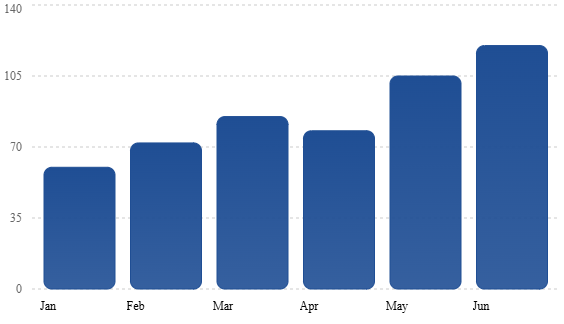
Illustrative booking volume only — not actual company performance.
The dashboard can be expanded with live data once the brokerage’s operational database exists.
PART VIII — THE THREE MASTER CLASSES WORKING TOGETHER
Chapter 14: Integrated strategic architecture
The greatest strength of this model comes from combining research, data and innovation into one integrated system.
Combination 1 — Research + Data Architecture
Purpose: Establish a reliable understanding of the transport market.
Research identifies what needs to be understood.
Data architecture establishes how information is collected, stored and analysed.
Examples:
- Research identifies increasing demand for airport transportation.
- The database records airport-related enquiries.
- Analytics measures demand by location, time, customer category and frequency.
- Management identifies a market opportunity.
Result: a research-driven market intelligence system.
Combination 2 — Data Architecture + Competitive Innovation
Purpose: Turn information into operational improvements.
Examples:
- Booking records identify delays in quotation responses.
- The system identifies the bottleneck.
- Management introduces automated enquiry acknowledgement and structured quotation workflows.
- Response performance is measured after implementation.
Result: data-driven operational innovation.
Combination 3 — Research + Competitive Innovation
Purpose: Create new products and services based on verified market needs.
Examples:
- Research discovers businesses have difficulty coordinating recurring transport.
- Innovation creates a corporate transport coordination service.
- Customer interviews test the service.
- A pilot measures reliability, customer satisfaction and commercial viability.
Result: market-led product development.
Chapter 15: The complete integrated framework
Three Master Classes — Integrated Operating Model
RESEARCH INTELLIGENCE
Market → Customers → Competitors → Operators → Geography → Economics
DATA ARCHITECTURE
Capture → Validate → Integrate → Store → Analyse → Report
COMPETITIVE INNOVATION
Products → Services → Automation → Optimisation → Differentiation
BUSINESS RESULTS
Better customer experience · Better supplier relationships · Better efficiency · Sustainable revenue · Market growth
Feedback loop: Business results create new research questions and new datasets.
This is a continuous cycle of knowledge production and economic improvement.
PART IX — COMPETITIVE ADVANTAGE
Chapter 16: Developing a sustainable competitive moat
A brokerage can be copied if its only advantage is a website or a telephone number.
Long-term competitiveness comes from a combination of difficult-to-replicate capabilities.
16.1 Supplier network quality
A strong network consists of relevant, verified, responsive and dependable transport providers.
The objective is not simply to accumulate thousands of supplier contacts.
The objective is to maintain a network capable of fulfilling real customer requirements.
16.2 Information advantage
Over time, the brokerage develops knowledge concerning:
- Customer requirements
- Service demand
- Geographic patterns
- Supplier performance
- Booking frequency
- Price behaviour
- Operational challenges
This knowledge supports better decisions.
16.3 Operational reputation
Reliability, honest communication, fair commercial relationships and effective complaint resolution create reputation.
Reputation can become an important source of customer acquisition and retention.
16.4 Technological advantage
Technology can reduce the time required to:
- Process enquiries
- Identify suitable suppliers
- Generate quotations
- Communicate booking status
- Prepare invoices
- Analyse performance
- Produce reports
16.5 Relationship advantage
Relationships with customers, suppliers, businesses, travel organisations, institutions and other legitimate partners can improve market access.
16.6 Specialisation advantage
Rather than competing across every transport market, the brokerage can become highly capable in selected segments.
Examples:
- Corporate passenger transportation
- Airport transport coordination
- Tourism mobility
- Regional logistics
- Business delivery coordination
Specialisation creates deeper knowledge and potentially stronger customer trust.
PART X — FINANCIAL AND BUSINESS MODEL ARCHITECTURE
Chapter 17: Brokerage revenue models
A transport brokerage may use several commercial structures, subject to its contracts and applicable legal requirements.
| Revenue model | Explanation |
|---|---|
| Commission | Agreed percentage of a transaction |
| Fixed booking fee | Fixed charge per booking |
| Coordination fee | Fee for arranging and managing services |
| Contract service fee | Recurring commercial agreement |
| Enterprise subscription | Fee for platform or management services |
| Procurement service | Fee for managing transport sourcing |
| Software service | Fee for access to a digital platform |
The business should be transparent about whether it acts as an intermediary, service provider, contracting party or another defined role.
This distinction affects responsibility, customer expectations, commercial agreements, insurance and compliance.
17.1 Revenue diversification
A mature brokerage could potentially have multiple revenue streams:
■ Corporate contracts
■ Logistics coordination
■ Passenger bookings
■ Platform services
Hypothetical revenue composition for strategic illustration; not a recommended fixed allocation.
Diversification reduces dependence on one customer category, but each additional service introduces operational complexity. Expansion should be based on evidence that the brokerage can manage it successfully.
PART XI — TECHNOLOGY STACK
Chapter 18: Building the digital platform
A practical technology architecture can evolve in stages.
Layer 1 — Customer interface
- Website
- Mobile-friendly booking forms
- Customer account portal
- Business account portal
Layer 2 — Brokerage operations
- Enquiry management
- Supplier directory
- Booking management
- Quote management
- Customer relationship management
- Contract management
Layer 3 — Data infrastructure
- Relational database
- Data validation
- Document management
- Reporting database
- Data integration
Layer 4 — Business intelligence
- Executive dashboard
- Booking analysis
- Customer analytics
- Supplier analytics
- Financial reporting
- Geographic analysis
Layer 5 — Automation
- Enquiry acknowledgements
- Booking notifications
- Reminders
- Status updates
- Report generation
- Workflow management
Layer 6 — Advanced intelligence
Potential future capabilities:
- Demand forecasting
- Intelligent supplier matching
- Pricing analysis
- Service-risk assessment
- Geographic demand modelling
- Recommendation systems
Advanced AI is not the starting point. Reliable operational data is.
Chapter 19: Artificial intelligence in brokerage operations
AI could assist with several functions.
Customer support
Helping categorise enquiries and prepare responses.
Research
Summarising public market information and identifying trends.
Analytics
Detecting unusual patterns in booking performance.
Forecasting
Estimating future demand from historical data.
Administration
Assisting with document categorisation and reporting.
Decision support
Comparing potential suppliers against documented requirements.
AI should support human decision-making rather than automatically making consequential decisions without suitable oversight, especially concerning safety, eligibility, financial transactions, customer disputes or operator selection.
PART XII — SOUTH AFRICAN MARKET APPLICATION
Chapter 20: Applying the architecture to South Africa
South Africa offers a broad transportation and logistics environment with urban, regional, intercity, tourism, corporate, freight and delivery markets.
The brokerage should research specific regional conditions rather than assume the entire country operates as one uniform market.
Potential research dimensions include:
Geographic research
- Johannesburg metropolitan area
- Pretoria and Tshwane
- Ekurhuleni
- Cape Town
- Durban
- Regional towns
- Industrial areas
- Tourism destinations
- Airports
- Business districts
- Freight corridors
Economic research
- Business transportation demand
- Tourism activity
- Industrial and commercial logistics
- Employment-related mobility
- SME transport requirements
- Regional distribution needs
Infrastructure research
- Roads
- Airports
- Rail connections
- Logistics facilities
- Warehousing
- Ports
- Border crossings
Regulatory and compliance research
A brokerage operating in South Africa should obtain appropriate professional guidance on its actual activities, including relevant:
- Passenger transport requirements
- Operator licensing and verification
- Road transport rules
- Contractual responsibilities
- Insurance
- Consumer protection
- Business registration and taxation
- Personal information protection under POPIA
- Electronic transactions and payment obligations
The exact compliance obligations depend on the service model, type of transport, parties involved and whether the brokerage itself assumes responsibility for transportation.
Chapter 21: Geographic transport intelligence
Geographic information systems (GIS) can help the brokerage understand the relationship between demand, suppliers and infrastructure.
A geographic intelligence database could contain:
| Geographic dataset | Business use |
|---|---|
| Customer locations | Demand distribution |
| Operator locations | Supplier coverage |
| Service destinations | Market coverage |
| Airports | Passenger transport demand |
| Business districts | Corporate demand |
| Industrial areas | Logistics demand |
| Warehouses | Distribution opportunities |
| Major transport corridors | Regional market analysis |
The system could help answer questions such as:
- Where are customers located?
- Which areas have limited supplier coverage?
- Which regions generate repeated enquiries?
- Where might a new supplier relationship be valuable?
- Which areas have recurring commercial demand?
The purpose is to identify business opportunities from geographic evidence, not merely to display a map.
PART XIII — GOVERNANCE, SECURITY AND TRUST
Chapter 22: Information governance
A transport brokerage may handle sensitive commercial and personal information.
The data architecture must therefore incorporate information governance from the beginning.
Core principles
- Collect only information necessary for the legitimate business purpose.
- Maintain accurate and up-to-date records.
- Restrict access according to responsibilities.
- Protect personal and commercial information.
- Establish appropriate retention and deletion rules.
- Maintain records of important changes.
- Protect accounts, systems and transactions.
- Establish procedures for incidents and complaints.
Cybersecurity architecture
Security control layers
- Identity and access management
- Multi-factor authentication where appropriate
- Encryption of sensitive information
- Secure backups and recovery procedures
- System monitoring
- Supplier and third-party security assessment
- Incident response procedures
- Staff security awareness
The brokerage should treat customer trust and data security as competitive advantages rather than merely administrative obligations.
PART XIV — STRATEGIC IMPLEMENTATION MASTER PLAN
Chapter 23: From research to operational business
The implementation should be divided into progressive stages.
Phase 1 — Foundation
Research and business definition
- Select initial transport market.
- Identify customer problems.
- Research potential suppliers.
- Define brokerage model.
- Establish service standards.
- Determine legal and compliance requirements.
- Develop initial business plan.
Phase 2 — Digital foundation
Data and systems
- Create customer database.
- Create supplier database.
- Establish booking records.
- Build quotation workflows.
- Develop basic website.
- Establish reporting.
- Set up security and data governance.
Phase 3 — Market pilot
Test the business model
- Work with a limited verified supplier network.
- Test the booking process.
- Measure customer satisfaction.
- Analyse transaction economics.
- Identify operational failures.
- Improve service procedures.
Phase 4 — Competitive innovation**Improve supplier matching.Automate repetitive workflows.Introduce specialised services.Improve customer reporting.Introduce analytics-driven improvements.
Phase 5 — Expansion
Scale responsibly
- Expand geographical coverage.
- Develop corporate contracts.
- Introduce additional transport categories where justified.
- Strengthen technology infrastructure.
- Develop strategic partnerships.
- Build a recognised brokerage brand.
Chapter 24: A practical 12-month development roadmap
| Period | Strategic objective | Deliverable |
|---|---|---|
| Months 1–2 | Research | Market and customer research |
| Months 3–4 | Business design | Brokerage model and supplier framework |
| Months 5–6 | Data architecture | Database and booking system |
| Months 7–8 | Pilot | Test operations and customer service |
| Months 9–10 | Analytics | KPI dashboard and performance analysis |
| Months 11–12 | Innovation and expansion | Improved services and expansion strategy |
This is an illustrative timeline. The actual duration depends on the resources, technology, market, regulatory requirements and operating complexity.
PART XV — THE MASTER-CLASS RESEARCH QUESTIONS
Chapter 25: Questions that drive continuous innovation
Research questions
- What are the most important unmet transport needs?
- Which customer segments have recurring demand?
- Which regions are underserved?
- Which transportation categories are economically viable?
- What makes customers trust a brokerage?
Data architecture questions
- What information should be collected?
- Which data is essential for a booking?
- How should suppliers be verified?
- How should information be integrated?
- How can information quality be measured?
- How can information be secured?
Innovation questions
- How can customers obtain quotations more efficiently?
- How can supplier coordination improve?
- How can administrative processes be simplified?
- How can service reliability be improved?
- Which services can be developed from customer research?
- Which technologies can create measurable competitive advantage?
Economic questions
- What is the brokerage’s revenue model?
- What are the transaction costs?
- What is the contribution margin?
- What is the break-even volume?
- Which customers generate recurring revenue?
- Which services are commercially sustainable?
PART XVI — THE MASTER-CLASS ORGANISATIONAL STRUCTURE
Chapter 26: How the three capabilities can operate within one company
A small brokerage does not initially need three separate departments. One person or a small team may perform several roles.
As the company expands, responsibilities can be separated.
Strategic management
Business strategy · Finance · Governance · Partnerships
Research
Market intelligence
Customer research
Supplier research
Data
Information systems
Analytics
Reporting
Innovation
Products
Automation
Improvement
Operations
Customers · Bookings · Suppliers · Finance · Service delivery
All three master classes must remain connected to the actual operational business.
Research without operations becomes theory.
Data without decisions becomes storage.
Innovation without evidence becomes guesswork.
Operations without research and intelligence can become inefficient and reactive.
PART XVII — THE FUTURE OF TRANSPORT BROKERAGE
Chapter 27: Evolution toward an intelligent mobility and logistics ecosystem
The transport brokerage of the future may evolve from a traditional intermediary into a digital coordination and intelligence platform.
Its development may follow five evolutionary stages:
- Traditional broker — Connecting customers and operators through manual coordination.
- Digitised broker — Using databases, online forms, digital booking and communication.
- Data-driven broker — Measuring customers, suppliers, transactions and market activity.
- Intelligent broker — Using analytics and decision-support tools to improve matching and operations.
- Connected ecosystem — Integrating customers, transport operators, businesses, systems, logistics partners and relevant information services.
The long-term opportunity is to build a platform that coordinates information and commercial relationships across multiple transportation markets while maintaining clear responsibilities and reliable service.
PART XVIII — FINAL MASTER THESIS
The Research–Data–Innovation Theory of Transport Brokerage
A passenger transport and logistics brokerage is fundamentally an information-coordination enterprise operating within the transportation economy.
Its competitiveness depends upon the ability to understand the market, organise information, coordinate fragmented supply and demand, and continuously improve its services.
The Research Master Class establishes knowledge of the market through scientific investigation, customer research, supplier intelligence, geographical analysis and economic measurement.
The Data Architecture Master Class converts fragmented information into a structured digital system capable of supporting bookings, supplier relationships, financial transactions, business intelligence and operational decisions.
The Competitive Innovation Master Class transforms knowledge and information into superior products, services, systems, relationships, processes and commercial opportunities.
The three capabilities reinforce one another:
\[ \boxed{ \text{Research} \rightarrow \text{Data} \rightarrow \text{Intelligence} \rightarrow \text{Innovation} \rightarrow \text{Competitive Advantage} } \]
And the continuous cycle becomes:
\[ \boxed{ \text{Market Knowledge} + \text{Information Architecture} + \text{Innovation} = \text{Intelligent Brokerage} } \]
The ultimate strategic objective is not simply to become another transport booking intermediary.
It is to build a dependable, intelligent and economically sustainable organisation that improves the coordination of passenger transportation and logistics through research, information technology, innovation, operational discipline and measurable customer value.
The strongest transport brokerage is one that continuously learns from its market, converts that knowledge into structured data, and uses that data to improve the next generation of services.



Be First to Comment