
Comprehensive Thesis
1. Introduction
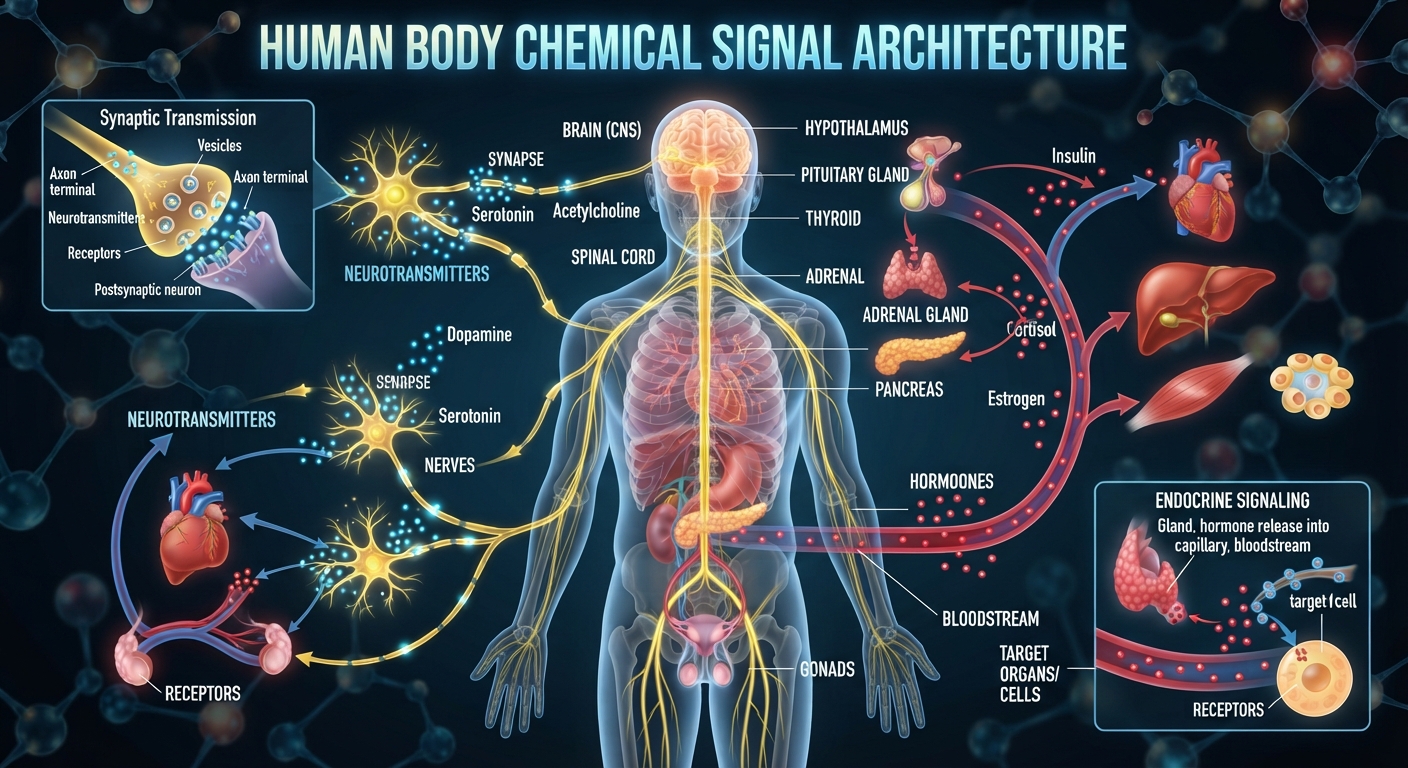
The human body is an extraordinarily complex biological communication network. Every second, billions of cells exchange information to coordinate metabolism, growth, movement, immunity, circulation, temperature regulation, digestion, reproduction, and brain activity.
Although the nervous system communicates primarily through electrical impulses and neurotransmitters, the body also depends on an extensive chemical communication architecture.
Chemical signals act like biological messages. They travel between cells, tissues, organs, and sometimes throughout the entire body. A signal may tell a cell to produce energy, release a substance, change its activity, grow, repair tissue, or adjust its response to the surrounding environment.
The human chemical communication system can be understood as a combination of:
- Signal-producing cells
- Chemical messenger molecules
- Transport pathways
- Receptors
- Signal-processing mechanisms
- Cellular response systems
- Feedback and regulation mechanisms
The architecture resembles a distributed information-processing network, with the bloodstream, extracellular fluid, nervous system, and cell membranes functioning as interconnected communication pathways.
Human Endocrine System #14 by Science Photo Library
Substance transport – Knowledge @ AMBOSS
PPT – Introduction to Anatomy and Physiology II Bio 132 PowerPoint Presentation – ID:680924
8
2. The fundamental architecture of chemical communication
Chemical communication follows a general sequence.
1. Signal generation
A cell detects a change or receives an instruction.
2. Chemical messenger production
The cell produces, releases, or activates a messenger.
3. Signal transmission
The messenger travels locally, through nerves, or through circulation.
4. Receptor recognition
A target cell detects the chemical message through a specific receptor.
5. Cellular response
The cell changes its activity, chemistry, gene expression, or behavior.
6. Signal termination and feedback
The signal is reduced, removed, broken down, or regulated.
This process is fundamental to maintaining the body’s internal stability, known as homeostasis.
3. The major classes of chemical signals
The body has several major chemical messenger categories.
A. Hormones
Hormones are chemical messengers released by endocrine cells or organs. Many hormones enter the bloodstream and travel to target tissues far from where they were produced.
Examples include:
| Hormone | Main source | Principal role |
|---|---|---|
| Insulin | Pancreatic beta cells | Regulates nutrient metabolism and glucose handling |
| Glucagon | Pancreatic alpha cells | Helps regulate blood glucose |
| Thyroid hormones | Thyroid gland | Regulate metabolic activity and development |
| Cortisol | Adrenal cortex | Helps coordinate stress responses and metabolism |
| Growth hormone | Pituitary gland | Regulates growth and metabolic processes |
| Melatonin | Pineal gland | Helps coordinate circadian timing |
| Estrogen | Several tissues, including ovaries | Reproductive, bone, and other tissue regulation |
| Testosterone | Testes and other tissues | Reproductive development and multiple physiological functions |
Hormones are not simply commands. Their effects depend on concentration, receptor availability, the target cell’s condition, and other signals arriving simultaneously.
B. Neurotransmitters
Neurotransmitters are chemical messengers used by neurons to communicate with other neurons, muscle cells, and certain glandular cells.
They are commonly released into small spaces called synapses.
Physiology Series Part 2: Neurophysiology & Action Potentials – Wasil Zafar
Overview of Neurons and Synapses — Learn With Abe
7
Major neurotransmitters include:
| Messenger | General functions |
|---|---|
| Acetylcholine | Muscle activation, attention, memory and autonomic communication |
| Glutamate | Major excitatory signaling in the brain |
| GABA | Major inhibitory signaling in the brain |
| Dopamine | Movement, learning, motivation and reward-related processing |
| Serotonin | Mood, sleep, appetite, sensory and other functions |
| Noradrenaline | Alertness, attention and autonomic responses |
| Histamine | Wakefulness, immune signaling and other functions |
Neurotransmitters can produce either excitatory or inhibitory effects, depending on which receptors and cellular mechanisms are involved.
C. Cytokines
Cytokines are signaling proteins involved in communication between immune cells and many other tissues.
They coordinate:
- Immune-cell activity
- Inflammation
- Tissue repair
- Responses to infection
- Communication between immune and nervous systems
- Changes in cellular activity during physiological stress
Examples include interleukins, interferons, and tumor necrosis factor family signals.
Cytokines form a complex communication network rather than a simple one-directional chain.
D. Chemokines
Chemokines are specialized signaling proteins that help guide the movement of cells.
They establish chemical gradients that certain cells can detect.
For example, during immune responses, chemokines help coordinate the movement of immune cells toward areas where they are needed.
The principle is similar to a navigation system in which cells detect changing chemical concentrations.
E. Growth factors
Growth factors are signaling molecules that regulate:
- Cell growth
- Cell division
- Differentiation
- Tissue development
- Repair
- Survival
Examples include:
- Epidermal growth factor (EGF)
- Fibroblast growth factors (FGFs)
- Vascular endothelial growth factor (VEGF)
- Platelet-derived growth factor (PDGF)
Different growth factors can produce different responses even in the same cell, because receptor identity and intracellular signaling pathways influence the outcome.
F. Local chemical mediators
Some signals act over very short distances.
Examples include:
- Prostaglandins
- Nitric oxide
- Leukotrienes
- Adenosine
- Local metabolites
These molecules can influence blood-vessel diameter, local inflammation, cellular activity, and tissue responses.
4. The five major communication distances
Chemical signals can operate over different distances.
Cascade for Endocrine system Flashcards | Quizlet
1. Endocrine communication
Signals travel through circulation to distant target tissues.
Endocrine and paracrine systems LO questions Flashcards | Quizlet
2. Paracrine communication
Signals influence nearby cells.
3. Autocrine communication
A cell releases a signal that acts upon itself or similar cells.
Synapse Structure. Neurotransmitter, synaptic vesicles and synaptic cleft.
4. Synaptic communication
A neuron releases a chemical messenger across a synapse to a target cell.
PPT – Chapter 45 PowerPoint Presentation, free download – ID:4753426
5. Neuroendocrine communication
Neurons release chemical signals into the bloodstream, allowing nervous-system activity to regulate distant tissues.
These modes allow the body to combine local precision with whole-body coordination.
5. The receptor architecture: How cells receive chemical messages
The receptor is one of the most important components of biological communication.
A chemical messenger may circulate through the body, but it does not automatically affect every cell it encounters. A cell must possess the appropriate receptor and the internal machinery to respond.
This is similar to a communication network where a message can be broadcast widely, but only devices programmed to recognize that message respond appropriately.
Main receptor classes
PPT – Neurotransmitter PowerPoint Presentation, free download – ID:3735781
2.6.2: Signaling Molecules and Cellular Receptors – Biology LibreTexts
7
| Receptor type | Architecture | General response |
|---|---|---|
| G-protein-coupled receptors (GPCRs) | Membrane receptor coupled to G proteins | Activates intracellular signaling networks |
| Ion-channel receptors | Receptor connected to ion-channel activity | Changes ion flow and electrical activity |
| Enzyme-linked receptors | Receptor connected to or possessing enzyme activity | Regulates biochemical reactions and cellular signaling |
| Intracellular receptors | Located inside the cell | Often regulate gene expression |
| Cytokine receptors | Surface proteins that activate signaling pathways | Coordinate immune and cellular functions |
Receptor specificity
The relationship between a messenger and its receptor is often described using a lock-and-key analogy, although actual molecular interactions are more dynamic.
The receptor recognizes chemical features of the messenger, including:
- Molecular shape
- Electrical charge
- Chemical bonding properties
- Molecular flexibility
- Binding affinity
A messenger’s effect depends partly on which receptor subtype receives it.
The same chemical messenger may have different effects in different tissues because those tissues possess different receptor types and different internal signaling systems.
6. Intracellular signal transduction: The internal communication network
When a messenger binds to a receptor, the cell must translate that external information into an internal response.
This process is called signal transduction.
The receptor acts as an interface between the extracellular environment and the intracellular biochemical machinery.
The general architecture
Make scientific figures in minutes using existing templates.
Second Messengers: AP Biology Unit 4 Guide | APScore5
7.2: Examples of Common Signaling Mechanisms – Biology LibreTexts
8
The process can involve:
- Signal reception
- Receptor activation
- Activation of intracellular proteins
- Production or release of second messengers
- Activation of enzymes
- Modification of proteins
- Changes in cellular activity
- Feedback regulation
Second messengers
Second messengers are small intracellular molecules or ions that relay signals from receptors to other components inside the cell.
| Second messenger | Function |
|---|---|
| cAMP | Regulates enzyme activity and cellular processes |
| Calcium ions (Ca²⁺) | Coordinate contraction, secretion, electrical activity and other responses |
| cGMP | Participates in signaling in vascular, sensory and other tissues |
| IP₃ | Helps mobilize calcium from intracellular stores |
| DAG | Participates in protein kinase activation |
| Nitric oxide | Acts as a signaling molecule, especially in local communication |
The messenger outside the cell is often called the first messenger. The intracellular relay molecules are called second messengers.
A small number of receptors can initiate large biochemical responses through signal amplification.
For example, one receptor activation event may activate several signaling proteins, and each of those may activate many downstream molecules.
This enables biological systems to detect and respond to relatively small changes.
7. Chemical signal architecture of the endocrine system
The endocrine system is one of the largest organized chemical communication networks in the human body.
Contact Us-Sydney Neurologist and Medical Specialists — Sydney Neurologists and Medical Specialists
sci – show position of endocrine gland in human body and write their function. – Brainly.in
6
Major endocrine organs and their communication roles
| Organ or tissue | Important signals | Main functions |
|---|---|---|
| Hypothalamus | Releasing and inhibiting hormones | Coordinates brain and endocrine functions |
| Pituitary gland | ACTH, TSH, growth hormone, prolactin | Regulates several endocrine organs and tissues |
| Thyroid | T3, T4 | Metabolic regulation and development |
| Parathyroid glands | Parathyroid hormone | Calcium regulation |
| Pancreas | Insulin, glucagon | Nutrient and glucose regulation |
| Adrenal glands | Cortisol, aldosterone, adrenaline | Stress adaptation, circulation and electrolyte regulation |
| Pineal gland | Melatonin | Circadian timing |
| Ovaries | Estrogens, progesterone | Reproductive and other physiological regulation |
| Testes | Testosterone | Reproductive and other physiological regulation |
| Kidneys | Renin, erythropoietin, active vitamin D | Blood-pressure regulation, red-cell production and mineral balance |
| Heart | Natriuretic peptides | Circulatory and fluid-balance regulation |
| Gastrointestinal tract | Gastrin, secretin, CCK, GLP-1 and others | Digestion, nutrient sensing and appetite-related regulation |
| Adipose tissue | Leptin and other signals | Energy regulation and communication with other organs |
The endocrine system is not confined to a few glands. Many organs contain cells capable of producing signals that influence the wider body.
8. The hypothalamus: A major integration centre
The hypothalamus links the nervous system with endocrine regulation.
It receives information from:
- The brain
- Sensory systems
- Internal body conditions
- Circulating hormones
- Temperature-regulation systems
- Energy and nutrient status
It coordinates responses through neural signals and hormonal control of the pituitary gland.
The hypothalamus and pituitary form an important control hierarchy.
Brain and body informationNeural inputs, temperature, stress, energy state and internal conditions
HypothalamusIntegrates information and regulates neuroendocrine output
Pituitary glandReleases regulatory signals into circulation
Peripheral endocrine organsThyroid, adrenal glands, reproductive organs and other tissues
Target organs and tissuesChange physiological activity
This system is regulated through feedback. Hormones released by peripheral organs can communicate back to the pituitary and hypothalamus, helping control subsequent hormone production.
9. Chemical communication and the nervous system
The nervous and chemical signaling systems are closely interconnected.
The nervous system provides rapid, spatially precise communication, while endocrine signaling can provide slower, broader, and longer-lasting regulation.
However, these systems overlap substantially.
Nervous-system communication
A neuron:
- Receives signals
- Integrates information
- Produces electrical activity
- Transmits electrical impulses
- Releases chemical messengers
- Communicates with its target
The chemical messenger released at a synapse is detected by receptors on another cell.
The resulting response can change the receiving cell’s electrical activity, metabolism, secretion, or other functions.
Autonomic chemical communication
The autonomic nervous system helps regulate internal organs.
It communicates with:
- Heart
- Blood vessels
- Digestive organs
- Airways
- Sweat glands
- Various other tissues
The sympathetic and parasympathetic divisions use different combinations of neural pathways and chemical messengers to regulate organ function.
These systems help coordinate body-wide changes with local tissue responses.
10. Chemical communication in the cardiovascular system
The cardiovascular system is both a transport network and a communication network.
Blood carries hormones, cytokines, nutrients, metabolites, proteins, and other signaling molecules throughout the body.
Physiological Nitric Oxide (NO) signaling pathway leading to vascular… | Download Scientific Diagram
Cardiac Endocrinology: Heart-Derived Hormones in Physiology and Disease – PMC
9
The three major communication components
1. Blood
Blood transports chemical messages between organs.
It contains:
- Plasma
- Hormones
- Nutrients
- Electrolytes
- Proteins
- Metabolic products
- Immune signaling molecules
2. Endothelium
The endothelium is the thin cellular lining inside blood vessels.
It is not simply a passive surface. Endothelial cells actively detect mechanical forces and chemical conditions and release signaling molecules that regulate vascular behavior.
Examples include nitric oxide and other vasoactive mediators.
3. Vascular smooth muscle
Smooth-muscle cells in vessel walls respond to chemical and neural signals.
Their activity helps regulate vessel diameter and therefore influences blood-flow distribution and pressure.
11. Chemical signals controlling metabolism
Metabolism is coordinated through an extensive network of chemical messengers.
Metabolism includes:
- Energy production
- Nutrient processing
- Molecule synthesis
- Molecule breakdown
- Storage
- Cellular maintenance
Important metabolic signaling molecules
| Signal | Broad metabolic role |
|---|---|
| Insulin | Coordinates nutrient storage and utilization |
| Glucagon | Helps maintain glucose availability |
| Thyroid hormones | Regulate metabolic activity in many tissues |
| Cortisol | Coordinates metabolism and physiological stress responses |
| Catecholamines | Coordinate rapid physiological responses |
| Leptin | Communicates information about energy reserves |
| Ghrelin | Participates in appetite-related signaling |
| GLP-1 | Coordinates gastrointestinal and pancreatic responses to nutrients |
| Adiponectin | Influences metabolic regulation and tissue signaling |
Metabolic signaling is a network
One hormone rarely operates alone.
The outcome depends on combinations of signals, the state of the receiving cells, the available nutrients, and the physiological circumstances.
The liver, skeletal muscle, adipose tissue, brain, pancreas, and gastrointestinal tract communicate extensively to coordinate the body’s energy economy.
12. Chemical signaling in the digestive system
The digestive system has its own highly coordinated chemical signaling architecture.
It combines:
- Hormones
- Local chemical messengers
- Neural communication
- Mechanical sensing
- Nutrient sensing
Δωδεκαδάκτυλο Φωτογραφίες Αρχείου, Royalty Free Δωδεκαδάκτυλο Εικόνες | DepositPhotos
Frontiers | Neuro-Immune Circuits Regulate Immune Responses in Tissues and Organ Homeostasis
Why You Feel Tired After Eating– Pure TheraPro Rx
9
Major digestive chemical signals
| Messenger | Source | Function |
|---|---|---|
| Gastrin | Stomach | Helps regulate gastric activity |
| Secretin | Small intestine | Coordinates digestive secretions |
| Cholecystokinin (CCK) | Small intestine | Coordinates digestive responses to nutrients |
| GLP-1 | Intestinal cells | Participates in nutrient and pancreatic signaling |
| GIP | Intestinal cells | Participates in nutrient-related hormone regulation |
| Motilin | Gastrointestinal tract | Coordinates patterns of gastrointestinal motility |
| Somatostatin | Several tissues | Regulates and inhibits selected secretory processes |
The enteric nervous system
The enteric nervous system is an extensive neural network within the gastrointestinal tract.
It communicates with gastrointestinal cells, smooth muscle, sensory cells, immune cells, and other neural pathways.
The digestive system therefore operates through a combination of local neural circuits and chemical signaling.
13. Chemical communication in the immune system
The immune system is one of the most complex chemical information networks in the body.
Immune cells exchange signals to coordinate responses, identify threats, regulate inflammation, and support tissue repair.
Thread by @drkohilathas on Thread Reader App – Thread Reader App
Spot the difference: how the immune system recognises foreign structures
11
Major chemical signal groups
Cytokines
Communication proteins that regulate immune activity.
Chemokines
Signals that help guide immune-cell movement.
Interferons
Signals involved in cellular responses to viral threats and immune coordination.
Complement system
A group of circulating proteins that interact through a regulated cascade to help defend against microbes and support immune responses.
Histamine
A messenger released by certain immune cells that participates in local inflammatory and other physiological responses.
Immune receptor signals
Immune cells also receive signals through direct cell-to-cell interactions involving receptor proteins and surface molecules.
Immune communication architecture
DetectionImmune cells and tissues detect signals associated with damage or threats
Signal releaseCytokines and other chemical mediators are released
Communication and coordinationOther immune and tissue cells receive the signals
ResponseCells alter their activity, movement, and communication
Regulation and resolutionSignals change to limit unnecessary inflammation and support recovery
The immune system must balance activation and regulation. Communication networks that are insufficient, excessive, or poorly coordinated can disrupt normal tissue function.
14. Chemical signals controlling temperature and circadian rhythms
The human body coordinates activity across the 24-hour day.
The circadian system regulates biological timing, including:
- Sleep and wake timing
- Hormone patterns
- Body-temperature rhythms
- Metabolic activity
- Daily variations in alertness
- Timing of certain cellular processes
Melatonin
Melatonin is an important signal associated with biological darkness and circadian timing.
Its secretion is regulated by the brain’s circadian system, which receives information about environmental light through specialized pathways.
Melatonin helps communicate timing information to the body.
Temperature regulation
Temperature control involves communication between:
- Sensory receptors
- Brain control centres
- Autonomic pathways
- Blood vessels
- Sweat glands
- Muscles
- Metabolic processes
Chemical signals and neural signals interact to help coordinate the body’s response to changes in temperature.
15. Chemical communication in the kidneys and fluid balance
The kidneys participate in an important signaling network controlling:
- Fluid balance
- Electrolytes
- Blood pressure
- Acid-base balance
- Red blood cell production
Major signals
| Signal | Role |
|---|---|
| Renin | Initiates a regulatory cascade affecting circulation and fluid balance |
| Angiotensin II | Participates in blood-pressure and fluid regulation |
| Aldosterone | Regulates sodium and potassium handling |
| Antidiuretic hormone (ADH) | Regulates water conservation |
| Erythropoietin (EPO) | Signals bone marrow to support red blood cell production |
| Active vitamin D | Participates in calcium and phosphate regulation |
The kidney is therefore not only a filtration organ. It is also an endocrine and regulatory organ that communicates with other systems.
16. Chemical communication and bone
Bone is a living, active tissue.
It communicates with:
- Kidney
- Intestine
- Parathyroid glands
- Bone marrow
- Muscle
- Other tissues
Bone remodeling is regulated by interactions among bone-forming cells, bone-resorbing cells, hormones, local growth factors, and mechanical conditions.
Important regulatory signals
- Parathyroid hormone
- Vitamin D
- Calcitonin
- Estrogen
- Growth factors
- Local cytokines
- Signals exchanged between osteoblasts, osteoclasts and osteocytes
Bone is both a structural organ and a participant in whole-body mineral and biological regulation.
17. Chemical communication in the reproductive system
The reproductive system is regulated by interconnected hormonal pathways.
The hypothalamus, pituitary gland, and reproductive organs communicate through hormones and feedback mechanisms.
This is often called the hypothalamic-pituitary-gonadal axis.
The communication architecture includes:
- GnRH
- LH
- FSH
- Estrogens
- Progesterone
- Testosterone
- Inhibin
These signals coordinate reproductive development and function, as well as influence other physiological processes such as bone biology and aspects of brain function.
18. Chemical communication between cells and tissues
Cells do not communicate exclusively through freely circulating molecules.
Some communication occurs through direct contact, specialized connections, and structures surrounding cells.
A. Gap junctions
Gap junctions are specialized connections between adjacent cells that allow selected small molecules and ions to pass directly between their interiors.
They are particularly important in coordinating activity in certain tissues, including cardiac muscle.
B. Cell-contact signaling
Some membrane proteins on one cell interact with receptor proteins on another cell.
This form of communication is important in:
- Tissue development
- Immune recognition
- Cell differentiation
- Tissue organization
C. Extracellular matrix communication
The extracellular matrix is a network of proteins and other molecules surrounding cells.
It provides structural support, but also influences cellular communication, movement, mechanical sensing, and tissue organization.
Cells can detect physical and chemical properties of their surroundings through specialized receptors.
19. Chemical signals and gene expression
Chemical messages can influence how genes are expressed.
A signal may cause a cell to:
- Increase production of a protein
- Reduce production of a protein
- Activate a gene-regulatory pathway
- Change its differentiation state
- Alter its metabolic activity
- Change its structure or function
Intracellular receptor signaling
Some messengers can interact with receptors inside the cell.
Examples include certain steroid hormones, thyroid hormones, and other lipid-soluble signaling molecules.
These receptor systems can influence transcription, which is the process through which DNA information is used to produce RNA.
1.3 Hormones – Blood and Guts: An OER Approach to Human Anatomy & Physiology II
The Molecular Apparatus for Transcription
Transcriptional Regulation — The Bruneau Lab
8
The process can be summarized as:
Chemical signal → receptor → regulatory machinery → gene expression changes → altered cellular activity
Not every chemical signal directly controls genes. Some signals produce rapid effects through existing proteins, while others influence slower changes involving gene expression.
20. Chemical signaling and biological time
Different chemical signals operate on different timescales.
| Communication process | Typical timescale |
|---|---|
| Ion-channel signaling | Milliseconds |
| Fast synaptic signaling | Milliseconds |
| Many local signaling processes | Seconds to minutes |
| Some hormone responses | Seconds to hours |
| Gene-expression changes | Minutes to hours or longer |
| Tissue growth and remodeling | Days to months |
| Developmental signaling | Long periods across developmental stages |
These are general ranges rather than fixed rules.
The timing depends on the messenger, receptor, target tissue, signaling pathway, and response being measured.
The body uses different signaling speeds because it must coordinate both immediate responses and long-term adaptations.
21. Signal amplification, integration and precision
Chemical communication is not a simple one-molecule-to-one-response process.
A biological signal may undergo amplification, integration, modification, and filtering.
Signal amplification
A receptor activation may initiate multiple downstream reactions.
This increases the sensitivity of a signaling system.
Signal integration
A cell may receive several signals simultaneously.
The cell integrates these signals to determine an appropriate response.
For example, a cell may receive:
- A growth signal
- A nutrient signal
- A stress signal
- A differentiation signal
Its response depends on the combination and relative strength of these inputs.
Signal filtering
Cells can regulate which messages they respond to.
This depends on receptor expression, receptor availability, intracellular proteins, and the cell’s physiological state.
Signal adaptation
Cells can adjust their responsiveness after continued stimulation.
This helps prevent responses from remaining unnecessarily strong when the surrounding conditions have changed.
22. Feedback architecture: The body’s biological control system
Feedback is one of the most important principles of chemical signaling.
Without feedback, many physiological systems would be unable to maintain stable internal conditions.
Negative feedback
Negative feedback generally reduces a change that has triggered a regulatory system.
A physiological variable changes
Sensors and regulatory centres detect the change
Chemical and neural signals coordinate a response
Target tissues change their activity
The original change is reducedRegulatory signaling adjusts as the system approaches its operating range.
Negative feedback is common in:
- Hormone regulation
- Temperature regulation
- Blood-pressure regulation
- Fluid balance
- Metabolic regulation
Positive feedback
Positive feedback reinforces an initial change.
It is used in selected biological processes where a coordinated event needs to intensify until a particular outcome occurs.
Positive feedback is not the body’s general-purpose stability mechanism; it is used in specific circumstances.
23. Signal termination: How chemical messages stop
An effective communication system needs both message transmission and message termination.
If a signal continued indefinitely, the receiving cell might remain activated when the original instruction was no longer relevant.
Signals can be terminated through:
- Enzymatic breakdown
- Reuptake into cells
- Removal through circulation
- Chemical modification
- Receptor internalization
- Receptor inactivation
- Breakdown of intracellular signaling molecules
- Changes in the signal-producing cell
The duration of a message depends on the stability of the messenger, the receptor, and the intracellular signaling machinery.
Signal termination is just as important as signal initiation.
24. An integrated example: How the body coordinates a response to changing conditions
To understand the chemical signaling architecture as a whole, consider what happens when the body detects a change in its internal or external environment.
A coordinated response may involve several systems simultaneously.
Environmental or internal change
Sensory detectionNervous system, receptors and internal sensors
Central integrationBrain, hypothalamus and neural networks
Chemical and neural signalingHormones, neurotransmitters and local mediators
Target-organ responseHeart, blood vessels, liver, muscles and other tissues
Feedback and adaptationSignals are adjusted as conditions change
This is a multi-system response rather than the action of a single hormone.
The body combines:
- Electrical signals
- Chemical signals
- Blood circulation
- Receptor recognition
- Cellular enzyme activity
- Feedback regulation
- Tissue responses
This integrated architecture is what allows different organs to function as one organism.
25. The chemical signal network at microscopic scale
At the microscopic level, the body is a vast interconnected system of cells exchanging information.
Each cell has a chemical environment consisting of:
- Water
- Ions
- Proteins
- Lipids
- Sugars
- Metabolites
- Signaling molecules
- Extracellular structures
The cell membrane is a critical interface.
It separates the intracellular environment from the extracellular environment while allowing selective communication.
Cell Membrane Structure: Detailed Image & Components | AI Art Generator | Easy-Peasy.AI
Intracellular versus Extracellular Space: There’s a Third Space? – Blogging For Your Noggin
Checking your browser – reCAPTCHA
9
The cell membrane’s communication functions
The membrane:
- Separates internal and external environments.
- Contains receptor proteins.
- Regulates the movement of ions and molecules.
- Participates in electrical signaling.
- Detects chemical messengers.
- Coordinates interactions with neighboring cells.
- Organizes signaling proteins into functional regions.
The membrane therefore acts as both a protective boundary and a sophisticated communication interface.
26. The architecture of the entire human chemical signaling network
The human body can be understood as a hierarchical yet distributed communication system.
LEVEL 1 — MolecularHormones, neurotransmitters, cytokines, ions and metabolites
LEVEL 2 — CellularReceptors, signaling proteins, second messengers and gene regulation
LEVEL 3 — TissueCoordinated interactions among specialized cells
LEVEL 4 — OrganIntegrated functions of endocrine, nervous, immune and other systems
LEVEL 5 — Whole organismRegulation of homeostasis, adaptation, survival, growth and development
Information flows both upward and downward through these levels.
- Cells communicate with tissues.
- Tissues influence organs.
- Organs communicate through blood, nerves and chemical messengers.
- The brain integrates information from many systems.
- Hormones and local signals influence cellular activity.
- Feedback returns information to regulatory centres.
This is a dynamic biological network rather than a rigid one-way hierarchy.
27. What happens when chemical communication becomes disrupted?
Normal biological function depends on correctly coordinated signals.
Disruption can occur at different points in the communication architecture.
| Component | Possible disruption |
|---|---|
| Signal production | Too little or excessive messenger production |
| Signal release | Abnormal secretion |
| Transport | Changes in circulation or messenger availability |
| Receptor | Receptor malfunction or altered sensitivity |
| Signal transduction | Disrupted intracellular signaling |
| Target response | Cells fail to respond appropriately |
| Feedback | Regulatory loops become impaired |
| Signal termination | Messages persist longer or shorter than expected |
These mechanisms are relevant to many diseases, including endocrine disorders, inflammatory diseases, metabolic disorders, and certain neurological conditions.
A disease may arise not because a single organ has failed, but because communication between several biological systems has become disrupted.
28. Chemical signaling compared with digital communication systems
The human body and modern digital communication systems have interesting conceptual similarities, although they operate through very different physical mechanisms.
| Biological communication | Digital communication analogy |
|---|---|
| Chemical messenger | Transmitted message |
| Receptor | Receiver |
| Receptor specificity | Message recognition |
| Blood circulation | Distribution network |
| Synapse | Local communication channel |
| Second messenger | Internal signal processing |
| Enzyme cascade | Amplification |
| Feedback | Control system |
| Signal degradation | Message termination |
| Homeostasis | System stability |
| Cellular integration | Distributed computing |
The analogy is useful for understanding the organization of biological systems, but living cells are not computers in a literal sense. They are biochemical systems that continuously interact with their environment.
29. Scientific framework for studying human chemical signaling
A comprehensive study of chemical communication can be divided into research disciplines.
| Research field | What it investigates |
|---|---|
| Endocrinology | Hormones and endocrine regulation |
| Neurobiology | Chemical and electrical communication in the nervous system |
| Cell biology | Receptors and cellular communication |
| Molecular biology | Genes, proteins and signaling mechanisms |
| Biochemistry | Chemical reactions and molecular processes |
| Immunology | Immune signaling and regulation |
| Physiology | Integrated functions of organs and systems |
| Pharmacology | How chemical substances interact with biological signaling |
| Systems biology | Interactions and dynamics of biological networks |
| Bioinformatics | Analysis of signaling-related biological data |
A modern research approach combines these disciplines to understand how individual chemical messages create coordinated physiological responses.
30. Key terminology
| Term | Meaning |
|---|---|
| Ligand | Molecule that binds to another molecule, commonly a receptor |
| Receptor | Protein or other molecular structure that recognizes a signal |
| Hormone | Chemical messenger involved in endocrine signaling |
| Neurotransmitter | Chemical messenger released by neurons |
| Cytokine | Signaling protein involved in immune and other biological functions |
| Chemokine | Signaling molecule involved in directing cell movement |
| Second messenger | Intracellular molecule relaying a signal |
| Signal transduction | Conversion of a received signal into cellular processes |
| Homeostasis | Regulation of internal conditions within functional ranges |
| Endocrine | Long-distance chemical signaling, often through circulation |
| Paracrine | Local signaling to nearby cells |
| Autocrine | Signaling back to the same cell or similar cells |
| Juxtacrine | Communication involving direct cell contact |
| Feedback | Regulation based on information about a system’s output |
| Amplification | Increase in the magnitude of a signal through a pathway |
| Integration | Combining information from multiple signals |
31. Conclusion: The human body as a living chemical communication network
The human body is not merely a collection of organs working independently. It is a continuously communicating biological system.
Its chemical signal architecture includes thousands of messenger types, receptor families, molecular pathways, specialized cells, and regulatory feedback mechanisms.
The nervous system provides rapid communication. The endocrine system provides broad chemical coordination. The immune system communicates through complex networks of cytokines and other mediators. Local tissues exchange signals that regulate growth, repair, metabolism, and activity.
All these systems operate together.
The central principle of human chemical communication is:
A biological signal is generated, transmitted, recognized, processed, translated into a cellular response, and then regulated through feedback and signal termination.
Understanding this architecture provides a foundation for studying human physiology, biochemistry, neuroscience, endocrinology, immunology, molecular biology, and the interconnected nature of human survival.
Selected scientific references
These resources provide a foundation for further study:
- Physiology: Cellular Messengers — NCBI Bookshelf
- Physiology: Cellular Receptors — NCBI Bookshelf
- General Principles of Cell Communication — Molecular Biology of the Cell
- OpenStax Biology: Signaling Molecules and Cellular Receptors
These explain chemical messengers, receptors, signal transduction, and the major types of cell-to-cell communication. NCBI+3


Be First to Comment