
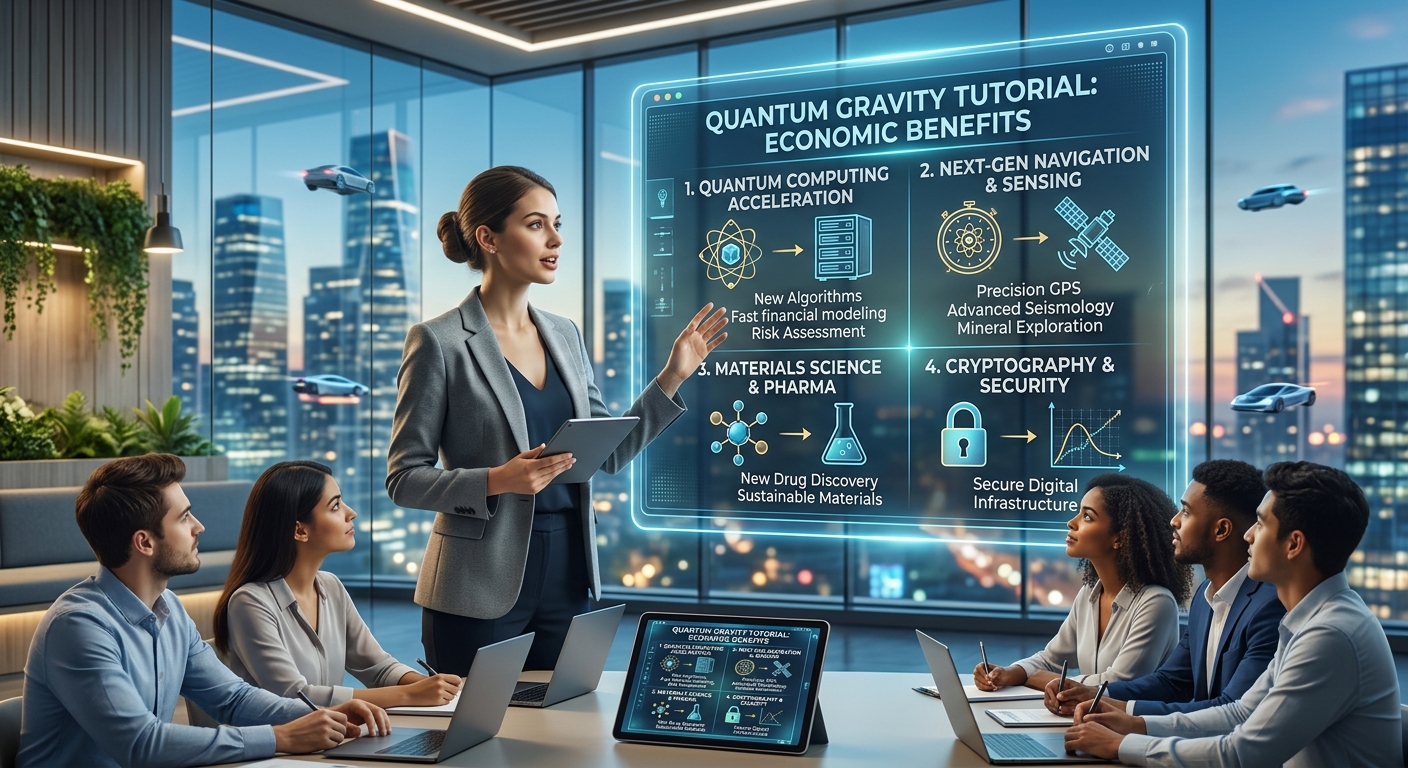
A scientific tutorial, technology analysis, and economic development framework
Abstract
Quantum gravity is one of the most ambitious research challenges in modern physics. It seeks to explain how gravity behaves at the smallest scales of nature, where the principles of quantum mechanics must work together with Einstein’s theory of general relativity.
The subject is important because our modern technological economy depends on understanding and controlling the physical world, from semiconductor chips and telecommunications to satellite navigation, advanced materials, artificial intelligence, and energy systems.
However, an essential distinction must be made: quantum gravity has not yet been established as a complete, experimentally confirmed theory. Its future economic benefits remain largely indirect and speculative. Some technologies that underpin today’s economy already rely on quantum physics, but they do not require a working theory of quantum gravity.
This thesis explains the foundations of quantum gravity, its possible technological applications, its relationship with modern industries, and how countries such as South Africa could prepare to benefit from advances in fundamental science.
Teorija Relativnosti: Einsteinov Revolucionarni Koncept
The Fundamentals of Quantum Science
Fall into a black hole in mind-bending NASA animation (video) | Space
6
Chapter 1. Understanding quantum gravity
1.1 What is gravity?
Gravity is the physical phenomenon through which objects with mass and energy influence one another.
On Earth, it keeps people on the ground, causes objects to fall, and helps retain the atmosphere. On a planetary scale, it governs orbits. On a cosmic scale, it shapes stars, galaxies, and the large-scale evolution of the universe.
Einstein’s general theory of relativity describes gravity not simply as a pulling force, but as the curvature of spacetime caused by mass and energy.
Reimagining Gravity: The TICE Equation and Trust Curvature
Imagine a flexible surface representing spacetime. A heavy object changes the geometry of that surface. Other objects move according to the resulting geometry. The analogy is useful, although real spacetime is four-dimensional and is not a physical rubber sheet.
1.2 What is quantum mechanics?
Quantum mechanics describes nature at atomic and subatomic scales.
It provides the mathematical foundations for understanding:
- Electrons and the structure of atoms.
- Photons and the behaviour of light.
- The energy levels of atoms and molecules.
- Semiconductor devices and modern computer chips.
- Lasers, quantum sensors, and quantum information processing.
At quantum scales, physical systems can exhibit superposition, quantized energy levels, and probabilistic measurement outcomes.
1.3 What is quantum gravity?
Quantum gravity is the research programme that seeks a consistent description of gravity compatible with quantum principles.
The challenge arises because general relativity and quantum mechanics were developed using different mathematical frameworks. Both are extraordinarily successful within their established domains, but a unified description is needed in extreme environments such as the earliest moments of the universe and the deep interiors of black holes.
The central question is:
How can spacetime and gravity behave when quantum effects become essential?
Researchers have not yet reached a universally accepted, experimentally confirmed answer.
Chapter 2. The scientific foundations of quantum gravity
2.1 Two major theories describing nature
| Feature | General relativity | Quantum mechanics |
|---|---|---|
| Main purpose | Describes gravity, spacetime, and cosmic structures | Describes matter and physical processes at quantum scales |
| Main applications | Planetary motion, cosmology, black holes, gravitational waves | Semiconductors, lasers, atomic clocks, chemistry |
| Mathematical framework | Curved spacetime and differential geometry | Quantum states, operators, probabilities |
| Main challenge | Does not provide a complete quantum description of gravity | Must be reconciled with gravity in extreme regimes |
Both theories have strong experimental support in their respective domains. The challenge is to develop a framework that explains situations in which both quantum effects and strong gravitational effects matter. Stanford Encyclopedia of Philosophy+1
2.2 Why unification matters
Consider three physical environments:
Black holes — Everything you need to know | Space
Black holes
General relativity predicts regions from which light cannot escape after crossing an event horizon. Quantum theory raises additional questions about the information associated with black holes and their possible radiation.
Artwork Of The Big Bang #1 by Mark Garlick / Science Photo Library
The early universe
As we trace cosmic evolution toward its earliest moments, classical equations point toward conditions where quantum gravitational effects may become important.
Scientists Achieve “Impossible” Feat in Quantum Measurement
Laboratory experiments
Researchers are testing how quantum matter behaves in gravitational fields. These experiments can investigate parts of the quantum–gravity boundary without reproducing the extreme conditions inside a black hole.
A significant development reported in September 2026 demonstrated a predicted effect of gravity on the quantum behaviour of falling atoms. This supports the consistency of the tested quantum and gravitational principles, but it does not establish a complete quantum theory of gravity. University of Oxford Department of Physics+1
2.3 The Planck scale: where the problem becomes extreme
Physicists use three fundamental constants to define the Planck length:
- \(G\): Newton’s gravitational constant.
- \(\hbar\): the reduced Planck constant.
- \(c\): the speed of light in a vacuum.
The Planck length is
\[ \ell_P=\sqrt{\frac{\hbar G}{c^3}} \]
Its approximate value is
\[ \ell_P\approx1.616\times10^{-35}\text{ metres} \]
This is extraordinarily smaller than an atom. It is the scale at which many approaches expect quantum-gravitational effects to become especially important. It is not a confirmed minimum size of the universe, nor does it mean that all quantum gravity can only be studied at this scale. Stanford Encyclopedia of Philosophy+1
Economic lesson: The distance between fundamental theory and practical technology can be enormous. An idea may require decades of research before it becomes a useful instrument, and some ideas may never produce a commercial application.
Chapter 3. The major approaches to quantum gravity
Scientists are exploring several competing or complementary approaches.
3.1 String theory
Proposes that fundamental entities can be described as tiny extended objects rather than point-like particles. Different vibrational states can correspond to different particles, including a possible quantum carrier of gravity. Its full connection to observed physics remains unresolved.
Quantengravitation: Woraus Besteht die Raumzeit? – Spektrum der Wissenschaft
3.2 Loop quantum gravity
Investigates whether spacetime geometry itself has quantum properties, using mathematical structures called spin networks. A major challenge is recovering the familiar spacetime behaviour observed at larger scales.
The causal set approach to quantum gravity | Living Reviews in Relativity | Springer Nature Link
3.3 Causal set theory
Explores the possibility that spacetime’s fundamental structure consists of discrete events connected by causal relationships.
Quantum Gravity 2023 | The Gravity Theory Trust
3.4 Effective field theory
Allows physicists to calculate certain low-energy gravitational quantum effects without claiming to possess a complete theory valid at every scale. It is useful for making controlled approximations within a defined range.
These approaches differ in their assumptions and mathematical methods. None has yet achieved universal acceptance as the final theory. Stanford Encyclopedia of Philosophy+1
Chapter 4. How quantum gravity research connects to technology
The economic significance becomes clearer when we separate two fields that are related but not identical:
- Quantum gravity research: investigates the quantum nature of spacetime and gravity.
- Quantum technology: uses established quantum principles to improve measurement, computing, communications, and other technologies.
The second field already has practical applications. It is the more immediate route to economic development.
The scientific-to-economic value chain
Fundamental physics
Discover principles and develop mathematical models
Experimental science
Build instruments, test predictions, validate results
Engineering and product development
Create sensors, software, materials, and systems
Economic and social value
Productivity, employment, research capacity, new industries
Conceptual framework: not every discovery proceeds through every stage, and commercial success is not guaranteed.
A discovery in quantum gravity might eventually inspire new ideas in mathematics, simulation, or measurement. But there is currently no demonstrated commercial technology whose operation depends on a complete theory of quantum gravity.
Chapter 5. Ten potential economic benefits of quantum gravity and related quantum science
The following analysis distinguishes benefits already associated with quantum technology from longer-term possibilities that depend on future discoveries.
Sensing gravity, the quantum way – Physics World
5.1 Precision measurement and surveying
Quantum sensors can use atomic interference to measure gravitational acceleration and tiny changes in gravitational fields. Better measurements could improve land surveying, geophysical mapping, infrastructure assessment, and scientific research.
Nearer-term opportunity: quantum sensing
This benefit comes from quantum measurement science, not from a completed quantum gravity theory. NIST+1
5.2 Water security and agriculture
Highly sensitive gravity measurements may help detect changes in underground water reserves. Combined with soil measurements, weather data, and farm sensors, these observations could support better irrigation planning and drought management.
For South Africa, where water security is economically important, improved aquifer monitoring could benefit farmers, municipalities, and mining operations. NIST+1
Геологическая съемка поиски и разведка месторождений полезных ископаемых что это за профессия
5.3 Mineral exploration and mining
Variations in measured gravity can reveal underground differences in density and geological structure. More precise instruments could help identify promising exploration areas and reduce unnecessary drilling.
The result is not a direct picture of a mineral deposit: geological interpretation and other survey methods remain essential. NIST+1
5.4 Semiconductor and computing industries
Quantum mechanics already explains semiconductor behaviour and underpins the electronics used in computers, phones, telecommunications, and AI infrastructure.
Quantum gravity does not currently provide a proven method of making chips faster or smaller. Nevertheless, supporting fundamental science develops mathematical expertise, experimental methods, and highly trained researchers who may contribute to wider technology industries.
5.5 Quantum computing and scientific simulation
Quantum computers may eventually offer advantages for selected computational problems. Improved theoretical understanding of quantum fields and spacetime could also inspire new mathematical approaches to scientific simulation.
There is no established evidence that a quantum gravity theory would automatically create a faster general-purpose computer. The near-term economic opportunity is in quantum computing research and applications where performance advantages can be demonstrated.
NASA’s Deep Space-Bound Atomic Clock Has Activated | Space
5.6 Navigation and timing
Quantum sensors and precision atomic clocks may improve navigation in environments where satellite signals are unavailable or unreliable. This could be useful in transport, scientific exploration, surveying, and space missions.
This is an application of quantum measurement technology, not a direct commercial result of quantum gravity. NIST+1
5.7 Advanced materials and industrial chemistry
Quantum physics is central to understanding chemical bonds, electronic materials, and many properties of matter. Advances in simulation and measurement could support the development of batteries, catalysts, sensors, and electronic components.
These benefits are plausible for quantum science broadly; a specific contribution from quantum gravity remains unproven.
5.8 Space science and astronomy
Research into black holes, gravitational waves, and the early universe develops expertise in advanced optics, signal processing, numerical modelling, and large scientific instruments. These capabilities can support aerospace engineering, scientific data analysis, and precision instrumentation.
Direct commercial returns are difficult to predict and may take decades.
5.9 AI, mathematics, and computational modelling
Researchers use AI and high-performance computing to analyse complex scientific data, explore mathematical relationships, and compare models with observations.
This can create transferable skills in algorithms, numerical analysis, data engineering, and scientific software. AI does not replace the need for reliable experiments or correct physical reasoning.
Génie physique – Faculté des sciences et de génie de l’Université Laval
5.10 Education, employment, and innovation
Sustained investment in fundamental physics can train researchers, engineers, technicians, and software developers. University laboratories can create opportunities for instrument manufacturing, scientific software, research partnerships, and technology transfer.
These benefits are most likely when education and research are connected to practical engineering, local industries, and measurable development goals.
Chapter 6. The relationship between quantum gravity and the modern digital economy
A useful way to understand this relationship is to examine the technology layers that operate together in today’s economy.
The modern technology ecosystem
Layer 1 — Fundamental science
Quantum mechanics, general relativity, electromagnetism, and materials physics.
Layer 2 — Physical components
Semiconductors, lasers, optical systems, sensors, and precision clocks.
Layer 3 — Digital infrastructure
Computer networks, cloud systems, AI, telecommunications, and data centres.
Layer 4 — Economic services
Banking, logistics, manufacturing, agriculture, healthcare, mining, and education.
Quantum gravity is a research frontier within Layer 1. Its influence on the other layers is not yet established; the other scientific foundations already support many working technologies.
6.1 Why this distinction matters to businesses
A company does not need to wait for quantum gravity to become a complete theory before adopting useful technologies.
For example:
- A mining company can evaluate gravity surveys and existing geophysical instruments.
- A farming business can integrate soil sensors, weather forecasts, and water monitoring.
- A technology company can develop AI-assisted scientific software.
- A university can establish training in quantum mechanics, computational physics, and precision measurement.
The commercial question is not simply whether a scientific theory is impressive. It is whether a technology produces a measurable improvement in cost, accuracy, safety, productivity, or service quality.
Chapter 7. A South African economic development strategy
South Africa has relevant capabilities in mining, astronomy, engineering, universities, and scientific research. The strategic opportunity is to strengthen these capabilities while connecting fundamental science to practical industrial needs.
South Africa’s MeerKAT telescope snaps stunning shot of Milky Way center
URU begins ground-based EM survey at South African nickel project
Admissions & Tuition | Rutgers University-Camden
9
A sensible development strategy would prioritise the following programmes.
| Programme | Practical activity | Potential economic value |
|---|---|---|
| Quantum science education | Teach mathematics, physics, programming, and experimental methods | Skilled workforce |
| Geophysical measurement | Develop expertise in gravity surveying and geological interpretation | Mining and infrastructure research |
| Water monitoring | Combine gravity measurements with hydrology and remote sensing | Water-resource planning |
| Scientific computing | Train students in simulation, numerical methods, and AI-assisted analysis | Software and research services |
| Instrument engineering | Build and maintain optical, electronic, and precision measurement equipment | Engineering capabilities |
| University–industry partnerships | Test technologies against real industrial needs | Research translation and potential new businesses |
South Africa should not initially attempt to compete with every major global laboratory in the most expensive areas of fundamental physics. A more practical approach is to develop strong specialist skills, participate in international collaborations, and identify applications relevant to local industries.
A proposed five-year development roadmap
Year 1
Build foundations
Establish training in mathematics, programming, classical mechanics, quantum mechanics, and general relativity. Map existing university and industrial capabilities.
Year 2
Develop practical projects
Create simulation exercises and pilot measurement projects involving geology, water resources, precision sensors, and scientific data.
Year 3
Connect research to industry
Partner with mining firms, agricultural organisations, universities, and instrument manufacturers to evaluate technical and economic performance.
Year 4
Develop specialist capabilities
Expand postgraduate research, precision instrument engineering, scientific software, and international collaboration.
Year 5
Evaluate and scale
Assess independently measured improvements in accuracy, cost, water monitoring, mineral exploration, employment, and research outputs. Expand only the programmes that demonstrate value.
This is a proposed planning framework, not a prediction that commercial quantum gravity technologies will exist within five years.
Chapter 8. The financial and commercial realities
Scientific importance and commercial profitability are different measures.
A theory may transform our understanding of the universe without creating a profitable product. Conversely, a measurement technique developed for basic research may later become useful in commercial equipment.
8.1 Where investment may be justified
| Investment area | Maturity | Commercial consideration |
|---|---|---|
| Established quantum sensors | Emerging to established, depending on application | Evaluate accuracy, reliability, and total operating cost |
| Scientific software and simulation | Already commercially useful | Compete through expertise, software quality, and specialised services |
| Quantum computing | Emerging | Verify performance for the specific problem before investing |
| Fundamental quantum gravity research | Primarily research-focused | Long time horizons and uncertain practical returns |
| Commercial products requiring a complete quantum gravity theory | No established market | Do not assume such products will become viable |
8.2 How to evaluate a scientific technology project
Before funding a quantum-related project, an organisation should ask five questions:
- What problem does it solve? Identify a specific industrial or scientific need.
- What evidence supports it? Require experiments, reproducible results, and independent evaluation.
- What does it cost? Include equipment, specialist labour, maintenance, power, and training.
- What improvement does it deliver? Measure accuracy, time saved, cost reduction, or other relevant outcomes.
- Can it scale? Determine whether the system can move from a laboratory demonstration to reliable field operation.
For example, suppose a new geological survey instrument costs more than a conventional instrument. It is economically attractive only if the additional accuracy or information creates enough value to justify the extra cost.
This is a general investment principle, not a claim that any particular quantum instrument will necessarily be profitable.
Chapter 9. The principal challenges facing quantum gravity
9.1 Experimental difficulty
The characteristic Planck scale is far beyond direct access using ordinary laboratory energies. Researchers must develop indirect tests, precision experiments, and observations that can distinguish between competing predictions.
9.2 Mathematical complexity
Combining the principles of quantum theory with the dynamical geometry of general relativity presents deep mathematical challenges.
9.3 Competing theories
Several research programmes offer different ideas about the fundamental structure of spacetime. A satisfactory theory must explain known physics and make predictions that can be meaningfully tested.
9.4 Funding and time horizons
Fundamental research can require sustained investment over many years without guaranteeing immediate economic returns. Public funding, international partnerships, and transparent research priorities are therefore important.
9.5 Public communication
Popular claims sometimes associate quantum gravity with unlimited energy, antigravity devices, or faster-than-light travel. These claims are not established consequences of quantum gravity research and should not be treated as investment opportunities.
The research challenge remains substantial. In 2026, experimental groups are working to test aspects of the quantum nature of gravity, but no complete theory has been experimentally confirmed. Quantum Gravity Tests Coming Soon+2
Chapter 10. A practical tutorial: learning quantum gravity step by step
You do not need to master all of modern physics at once. A structured learning sequence builds the knowledge needed to understand the subject.
Your learning pathway
Select a stage to explore its core objective.Stage 1 — Mathematics and classical physicsStage 2 — Special and general relativityStage 3 — Quantum mechanicsStage 4 — Quantum fields and spacetimeStage 5 — Quantum gravity and economic applications
Build the foundations.
Learn algebra, functions, vectors, calculus, energy, momentum, and Newton’s laws. Practise interpreting equations and graphs.
Outcome: understand the mathematical language used to describe physical systems.
A simple thought experiment
Imagine two instruments measuring a region of underground land.
- Instrument A measures the local gravitational field using an established method.
- Instrument B uses a quantum sensor to measure tiny variations in that field.
If Instrument B produces more accurate measurements under realistic operating conditions, and the improved data helps locate groundwater or geological structures more effectively, it may create economic value.
The crucial scientific question is whether Instrument B’s performance is demonstrably better. The crucial economic question is whether that improvement is worth its cost.
Notice that neither question requires a complete theory of quantum gravity. This is how a fundamental scientific idea can be connected to real engineering without exaggerating what current physics has achieved.
Chapter 11. Future scenarios: what could happen next?
More immediate
Scenario A — Improved quantum sensing
Precision measurements become more useful for geophysics, water monitoring, navigation, and scientific instrumentation. Economic benefits arise from quantum technologies that can be tested and deployed.
Longer-term research
Scenario B — Stronger experimental evidence
More sensitive experiments reveal new information about how quantum matter and gravity interact. Results help narrow the range of possible theoretical explanations.
Speculative
Scenario C — A complete quantum gravity theory
Researchers establish a mathematically consistent theory that makes distinctive, experimentally supported predictions. Its wider technological consequences would depend on what the theory reveals and whether engineers can turn those discoveries into useful applications.
These scenarios are not guaranteed stages of progress. Fundamental discoveries can take unexpected paths, and a successful theory might have no immediate commercial application.
Chapter 12. Conclusion: Why quantum gravity matters to our modern economy
Quantum gravity represents a search for a deeper understanding of nature. It asks whether the principles governing the smallest quantum systems can be reconciled with the geometry of spacetime and the gravitational behaviour of the universe.
Its long-term significance could extend beyond cosmology and theoretical physics. Fundamental research develops mathematics, experimental techniques, computational methods, and scientific expertise. These capabilities can sometimes lead to new technologies, industries, and economic opportunities.
However, a responsible economic strategy must distinguish between three things:
- Established knowledge: quantum mechanics underpins modern electronics, lasers, and many precision measurement technologies.
- Emerging opportunities: quantum sensing and related technologies may improve geological surveys, groundwater monitoring, navigation, and other specialised applications.
- Unresolved possibilities: a complete quantum theory of gravity may reveal new physical principles, but its practical and commercial consequences remain unknown.
For South Africa, the most useful strategy is to invest in mathematics education, scientific computing, physics research, precision engineering, and quantum measurement technologies that address identifiable economic needs.
The central lesson is that scientific understanding becomes economically valuable when reliable knowledge is translated into useful technology, measurable productivity, and solutions to real human problems. Quantum gravity is a promising scientific frontier, but its economic value should be pursued through evidence, patient research, and responsible investment rather than speculation.
Selected scientific references
- Stanford Encyclopedia of Philosophy — Quantum Gravity. A detailed overview of the major theoretical approaches and experimental challenges.
- American Physical Society — Quantum Gravity Tests Coming Soon (2026). Research on proposed experiments testing the quantum nature of gravity.
- National Institute of Standards and Technology — Turning Atoms Into Waves to Measure Gravity and Acceleration. Quantum sensing and potential applications in navigation, surveying, and resource monitoring.
- NASA — Quantum Technology for Earth Science. Quantum sensing research and gravity measurement applications.
- University of Oxford — Scientists observe Einstein’s gravity in the quantum world (September 2026). An experimental result concerning quantum matter in a gravitational field, with an explanation of what it does and does not establish.



Be First to Comment