
1. Introduction: Understanding the foundation of ginger production
Zingiber officinale Ginger Root Rhizomes for Home Garden Growing and C
8
Healthy soil is the biological, chemical, and physical foundation of successful ginger farming. Ginger (Zingiber officinale) is a tropical herbaceous plant whose valuable underground stems, called rhizomes, develop in the soil. The quality of the soil affects how these rhizomes grow, how well the plant absorbs water and nutrients, how roots breathe, and how effectively the crop resists soil-borne diseases.
A productive ginger field is not simply a field with dark soil. It is an environment in which mineral particles, organic matter, water, air, microorganisms, and nutrients work together.
The central objective of preparing ginger soil is therefore to establish a balanced environment that supports:
- Strong root development and healthy shoots.
- Unrestricted rhizome expansion.
- Adequate water storage without waterlogging.
- Continuous supplies of essential plant nutrients.
- Beneficial soil organisms and decomposition of organic matter.
- Reduced risk of root and rhizome diseases.
- Sustainable production without unnecessary loss of soil fertility.
This article explains the components of healthy ginger soil, the names and functions of its essential minerals and nutrients, the ideal soil conditions, and how to evaluate soil before planting.
2. The complete composition of healthy ginger soil
Soil Science Introduction: Pedology vs Edaphology | AgriDots
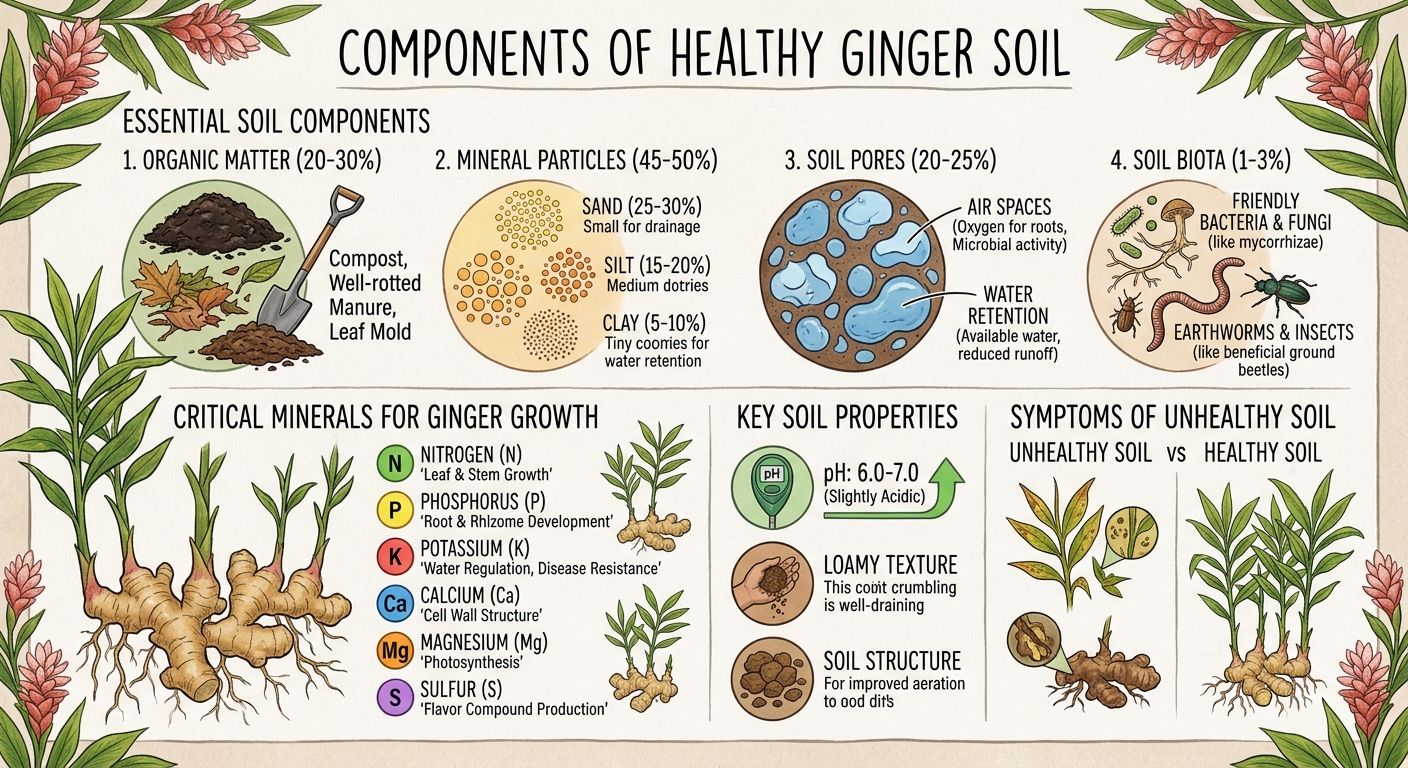
Soil is a mixture of solid materials, water, and gases. Its proportions vary according to soil type, rainfall, cultivation history, and drainage.
A useful textbook model for healthy mineral agricultural soil is:
Illustrative soil composition
Mineral particles
45%
Water
25%
Air
25%
Organic matter
5%
These are approximate illustrative proportions, not a required ginger-soil recipe. Actual proportions change with moisture, soil texture, compaction, and organic matter content.
2.1 Mineral particles
Mineral particles originate largely from the weathering of rocks. They form the physical framework of soil and influence its drainage, aeration, nutrient retention, and ability to hold water.
The three principal particle-size groups are:
- Sand: relatively large particles that promote drainage and air movement, but usually retain less water and fewer nutrients.
- Silt: medium-sized particles that can hold water and nutrients but may compact or erode easily.
- Clay: very fine particles that can retain considerable water and nutrients, but some clay-rich soils drain poorly and restrict rhizome expansion.
Best practical direction for ginger: a deep, loose, well-drained loam or sandy loam, with enough fine particles and organic matter to retain moisture without becoming waterlogged.
2.2 Organic matter
Organic matter consists of decomposing plant residues, roots, composted materials, microbial remains, and relatively stable substances called humus.
Its major functions are to:
- Improve soil structure and aggregation.
- Increase the soil’s ability to retain water and nutrients.
- Support beneficial bacteria, fungi, and other soil organisms.
- Release nutrients gradually as organic materials decompose.
- Improve the friability of soil, making it easier for rhizomes to expand.
Well-matured compost can be useful when its quality is known. Fresh, undecomposed manure is not equivalent to mature compost and may create salinity, nutrient imbalance, or food-safety problems.
2.3 Soil water
Water dissolves many plant nutrients and carries them toward the roots, where the plant can absorb them.
Ginger requires reasonably consistent moisture, especially during active vegetative growth and rhizome development. However, excessive water fills the soil’s air spaces and deprives roots of oxygen.
The goal is moist soil with adequate drainage, not permanently saturated soil.
2.4 Soil air
Healthy roots need oxygen for cellular respiration, the process that supplies energy for growth and nutrient uptake.
Air-filled pores allow oxygen to enter and carbon dioxide to escape. Compaction and prolonged waterlogging reduce this exchange, weakening roots and increasing the risk of rhizome rot.
2.5 Living organisms
Healthy soil is also a biological ecosystem. It contains bacteria, fungi, actinomycetes, earthworms, nematodes, protozoa, and many other organisms.
Some organisms decompose organic matter, release nutrients, improve soil structure, or compete with harmful organisms. Others can cause plant diseases. Therefore, more microbial activity is not automatically better; a balanced, diverse soil community is the objective.
3. The essential minerals and nutrients required by ginger
Plants require 17 essential elements for normal growth. Carbon, hydrogen, and oxygen are obtained mainly from air and water; the remaining essential mineral nutrients are absorbed predominantly through the roots.
The important distinction is that a soil may contain a mineral without making enough of its nutrient available to the plant. Soil pH, moisture, organic matter, temperature, and microbial activity all influence nutrient availability.
3.1 The three primary macronutrients: N, P, and K
1. Nitrogen — N
Primary macronutrient
Nitrogen is needed to make proteins, enzymes, chlorophyll, and genetic material. It supports leaf development and the growth of stems and shoots.
Sources: soil organic matter, compost, mineralised residues, and appropriate nitrogen fertilisers.
Imbalance: too little nitrogen can produce pale leaves and weak growth; excessive nitrogen can encourage excessive foliage, delay maturity, and increase nutrient losses.
Ingwer ernten: So wird’s gemacht – Mein schöner Garten
2. Phosphorus — P
Primary macronutrient
Phosphorus participates in energy transfer, root development, and the formation of genetic material and cell membranes. It supports the plant’s overall development.
Sources: soil phosphate minerals, decomposing organic matter, and phosphate fertilisers.
Imbalance: phosphorus deficiency can restrict growth, while excessive application may interfere with the availability of zinc and other micronutrients.
揭祕!生薑高產祕籍:老薑農的遮陽庇廕大法-imomo植物識別
3. Potassium — K
Primary macronutrient
Potassium regulates water balance, activates enzymes, and helps move sugars and other products of photosynthesis through the plant. It contributes to healthy crop development and rhizome filling.
Sources: weathered potassium-bearing minerals, exchangeable soil potassium, organic inputs, and potassium fertilisers.
Imbalance: deficiency can cause leaf-edge yellowing or scorching and reduce growth; excess potassium can disturb magnesium and calcium uptake.
The letters N, P, and K commonly appear on fertiliser labels. For example, an NPK label gives the declared nitrogen content and the phosphate and potash contents, which are conventionally expressed as \(P_2O_5\) and \(K_2O\), rather than as elemental phosphorus and potassium.
3.2 Secondary macronutrients
These nutrients are required in substantial quantities, although usually less than nitrogen, phosphorus, and potassium.
| Nutrient | Symbol | Main function in ginger |
|---|---|---|
| Calcium | Ca | Cell walls, membrane stability, growing-point development |
| Magnesium | Mg | Central atom in chlorophyll; supports photosynthesis |
| Sulfur | S | Formation of certain amino acids, proteins, and enzymes |
Calcium is important for growing tissues and cell-wall structure. It is not a reason to add lime automatically: lime is appropriate mainly when a soil test shows that acidity needs correction.
Magnesium supports chlorophyll and energy-related reactions. Deficiency can cause yellowing between leaf veins, often first on older leaves.
Sulfur contributes to protein formation and enzyme activity. Deficiency can cause pale foliage and reduced growth.
3.3 Micronutrients: the small quantities that matter
Micronutrients are required in much smaller quantities than the macronutrients, but they remain essential.
| Nutrient | Symbol | Main function |
|---|---|---|
| Iron | Fe | Chlorophyll formation and electron transfer |
| Manganese | Mn | Photosynthesis and enzyme activation |
| Zinc | Zn | Enzyme function and growth regulation |
| Copper | Cu | Enzymes and photosynthetic processes |
| Boron | B | Cell-wall development, growing points, and reproductive processes |
| Molybdenum | Mo | Enzymes involved in nitrogen metabolism |
| Chlorine | Cl | Water balance and photosynthesis |
| Nickel | Ni | Urea metabolism and nitrogen processing |
Some key points:
- Iron and manganese availability often decreases as soil becomes excessively alkaline.
- Zinc availability can fall when phosphorus is applied excessively.
- Boron has a narrow range between deficiency and toxicity.
- Molybdenum availability generally increases as soil pH rises, while some other micronutrients become less available.
- Chlorine is often supplied incidentally through soil water and fertilisers, while nickel is needed only in very small quantities.
Do not add all micronutrients simply because they are essential. Correct deficiencies identified by soil tests or credible crop-diagnostic advice.
3.4 Carbon, hydrogen, and oxygen
These three elements are the principal building materials of plant organic matter.
| Element | Symbol | Main source | Importance |
|---|---|---|---|
| Carbon | C | Carbon dioxide in the air | Sugars, carbohydrates, and plant structure |
| Hydrogen | H | Water | Organic compounds and energy-transfer processes |
| Oxygen | O | Air and water | Organic compounds and cellular respiration |
This is why healthy ginger farming needs more than fertiliser. Light, air, water, leaf health, and root-zone oxygen are also fundamental to converting nutrients into plant growth.
4. The important minerals found in soil
The nutrient elements above are not the same thing as the minerals in the geological soil material. Minerals are naturally occurring solid substances that form from geological processes and contribute to the soil’s physical and chemical properties.
Index of /Marine-beach-sediments_files/
Old Mine Park (Old Tungsten Mine), Long Hill, Trumbull, Fairfield County, Connecticut, USA
Ploughed red clay soil agriculture fields
6
| Soil mineral or mineral group | Common chemical components | Agricultural significance |
|---|---|---|
| Quartz | Silicon dioxide, \(SiO_2\) | Common in sand; helps form soil texture but supplies little plant nutrition directly |
| Feldspars | Silicate minerals containing potassium, sodium, calcium, or aluminium | Can release potassium and other elements slowly during weathering |
| Micas | Potassium-bearing aluminosilicates in some forms | Potential source of slowly released potassium |
| Smectite clays | Expanding aluminosilicate clays | Often retain considerable water and nutrient cations |
| Kaolinite | Aluminium silicate clay | Usually has lower nutrient-retention capacity than many expanding clays |
| Iron oxides | Iron and oxygen compounds | Influence red and yellow soil colours and phosphorus retention |
| Calcium carbonate | \(CaCO_3\) | Can supply calcium and neutralise acidity, but may raise pH excessively |
| Gypsum | Calcium sulfate dihydrate | Supplies calcium and sulfur; useful in specific diagnosed soil conditions |
| Apatite | Calcium phosphate minerals | Natural source of phosphorus through gradual weathering |
A healthy ginger field does not need every mineral listed above in a particular amount. Its requirements depend on the parent material, texture, soil chemistry, and nutrient test results.
For example, quartz-rich sandy soil may drain well but lose nutrients rapidly, while a heavy clay soil may retain nutrients yet remain too wet for healthy rhizome development. Adding organic matter and improving drainage can help, but management must suit the actual soil.
5. The ideal soil conditions for ginger farming
The following values are useful starting points for evaluating soil. They are not universal guarantees: local climate, ginger variety, and laboratory recommendations also matter.
Sandy Loam Top Soil – Bezzemi Logistics
Soil texture
Loam or sandy loam, with a loose, friable structure and good drainage.
Značaj mjerenja pH vrijednosti zemljišta i otopine gnojiva – Ratarstvo | Agroklub.com
Soil pH
A practical target is approximately pH 5.7–6.5, mildly acidic. resources.colead.link+1
What Is Loamy Soil and How to Improve Garden Texture — KnowTheYard
Organic matter
Sufficient mature organic matter to improve soil structure, nutrient retention, and moisture management. The required percentage depends on the existing soil.
Drainage
Excess water should leave the root zone promptly, especially during periods of heavy rain.
Moisture
Consistent moisture during active growth, without prolonged saturation. Texas A&M AgriLife Extension Service+1
Why soil pH is so important
Soil pH is a measure of acidity or alkalinity. It influences how readily plants can access phosphorus, potassium, calcium, magnesium, iron, manganese, zinc, and other nutrients.
For example:
- At excessively low pH, aluminium or manganese can reach harmful levels in some soils, while calcium and magnesium may become deficient.
- At excessively high pH, iron, zinc, and manganese can become less available.
- At a suitable pH, many nutrients are more accessible, although the actual result still depends on soil chemistry.
Do not apply lime, gypsum, wood ash, or other amendments simply because they are considered beneficial. First identify the soil’s problem and choose an amendment that addresses it.
6. The importance of beneficial soil microorganisms
How to Make Nutrient-Rich Compost in 30 Days or Less | Fast Composting Guide – Elm Dirt
Benefits of Mycorrhizae Fungi | Crop Science US
The plough, biodiversity, soil health and fresh air – Treflach Farm
8
Soil microorganisms are part of the natural nutrient-cycling system.
| Organism or group | Function in the soil |
|---|---|
| Decomposer bacteria | Break down organic residues and release nutrients |
| Decomposer fungi | Help break down complex plant materials |
| Mycorrhizal fungi | Can assist phosphorus and water acquisition in compatible plants |
| Actinomycetes | Decompose resistant organic materials and contribute to soil processes |
| Earthworms | Mix soil materials and create channels that may improve aeration |
| Beneficial microbial antagonists | Can compete with certain plant pathogens or suppress them under suitable conditions |
Organic matter, appropriate moisture, good aeration, crop rotation, and reduced soil disturbance where practical help maintain biological activity.
However, ginger can be affected by soil-borne pathogens, including organisms associated with rhizome rot. Good soil structure alone does not eliminate these risks. Clean planting material, field hygiene, suitable crop rotation, and drainage are also important. agroinvest.gov.jm+1
7. How to prepare healthy ginger soil before planting
Professional Soil Testing for Agriculture & Testing Services — Field Logic Agronomy
Step 1 — Test the soil
Collect representative samples from the intended planting area and submit them to an agricultural soil-testing laboratory. Request pH, texture, organic carbon or organic matter, electrical conductivity, and available nutrient analysis.
トマトの畑づくり – 読んで上達!やさいの育て方 | 耕うん機 | Honda公式サイト
Step 2 — Assess soil depth and drainage
Identify compacted layers, standing water, erosion risks, and areas where water collects. Loosen compacted soil where appropriate and consider raised beds or ridges if drainage is inadequate.
Incorporación De Sustancias Orgánicas: Mejora Tu Suelo
Step 3 — Incorporate mature organic matter
Use suitable, well-decomposed compost or properly treated manure. Base the quantity on soil condition, amendment quality, and local agricultural advice rather than applying a large amount automatically.
Inside UGA’s testing lab that fuels smarter farming in the Southeast and around the globe
Step 4 — Correct nutrient deficiencies
Use the laboratory report to determine whether lime, phosphorus, potassium, sulfur, or other nutrients are needed. Account for nutrients already supplied by compost and manure.
ショウガ 高温・多湿を好み菜園に向く | 家庭菜園 | JA晴れの国岡山
Step 5 — Establish the planting beds
Prepare a fine but not powdery seedbed, use healthy planting rhizomes, maintain suitable moisture, and apply mulch where appropriate. Avoid working the soil when it is excessively wet.
8. Soil health monitoring during the growing season
Soil preparation is not a once-off activity. A ginger farmer should monitor the field throughout the crop cycle.
| What to monitor | What it helps identify |
|---|---|
| Soil moisture | Drought stress or excessive irrigation |
| Drainage after rainfall | Waterlogging and potential rhizome rot |
| Leaf colour and growth | Possible nutrient deficiencies or other plant stress |
| Soil pH and salinity | Changing chemical conditions |
| Soil structure | Compaction, crusting, and poor aeration |
| Disease symptoms | Possible soil-borne pathogens |
| Organic matter and nutrient levels | Long-term changes in soil fertility |
Ginger can remove substantial quantities of nutrients during a growing season. Replenishment should therefore reflect crop requirements, soil tests, and the nutrient contribution of organic materials. Research supports integrated nutrient management rather than assuming that either organic manure or mineral fertiliser alone is always the best solution. Get Access+1
9. Common soil problems and their solutions
| Soil problem | Potential consequence | Appropriate response |
|---|---|---|
| Heavy compaction | Restricted rhizome expansion and poor aeration | Diagnose the compacted layer and improve structure |
| Waterlogging | Oxygen shortage and increased rot risk | Improve drainage and irrigation management |
| Very sandy soil | Rapid drying and nutrient leaching | Add suitable organic matter and manage water carefully |
| Excessively acidic soil | Possible nutrient imbalance or toxicity | Test pH and lime requirement before correction |
| Excessively alkaline soil | Reduced availability of certain micronutrients | Determine the cause and obtain soil-specific advice |
| Low organic matter | Poor aggregation and limited moisture retention | Use suitable compost, residues, and cover crops |
| High salinity | Water-uptake difficulties and reduced growth | Test electrical conductivity and investigate the source |
| Nutrient imbalance | Weak growth or reduced yield | Correct the specific deficiency or excess using test results |
10. A practical soil-testing checklist for a ginger farm
Use this checklist before establishing a commercial ginger field.
Pre-planting assessment
0/12Soil pH measuredSoil texture identifiedSoil depth and compaction assessedDrainage evaluatedOrganic matter or organic carbon testedNitrogen, phosphorus and potassium assessedCalcium, magnesium and sulfur assessed where relevantMicronutrients assessed where indicatedElectrical conductivity or salinity testedSoil-borne disease history reviewedQuality of compost or manure checkedFertiliser and amendment plan based on test results
Reset checklistCopy checklist
11. Conclusion: What makes soil genuinely healthy for ginger?
Healthy ginger soil is a balanced living system, not simply a mixture of minerals or a large quantity of fertiliser. Its success depends on the interaction of five essential foundations:
- Physical quality: loose structure, suitable texture, adequate depth, and good drainage.
- Chemical quality: suitable pH, balanced essential nutrients, and manageable salinity.
- Biological quality: active nutrient cycling, beneficial organisms, and responsible disease management.
- Water and air balance: enough moisture for growth, with oxygen available to the roots.
- Sustainable management: regular testing, appropriate organic matter, crop rotation, and evidence-based nutrient replacement.
For South African ginger growers, local soil conditions can vary substantially, so the correct quantities of fertiliser, lime, compost, and other amendments must be determined for the actual field rather than copied from a general farming guide.
Recommended references
- Texas A&M AgriLife Extension Service — Ginger: soil preparation, fertilising and watering.
- COLEAD — Good practice guide for ginger production.
- University of Pretoria researchers — Research on ginger growth, yield and water-use efficiency in South Africa.
The most valuable next step is to establish the actual soil profile and nutrient status of the field you intend to use. That information turns general knowledge into a precise ginger soil preparation plan.



Be First to Comment