
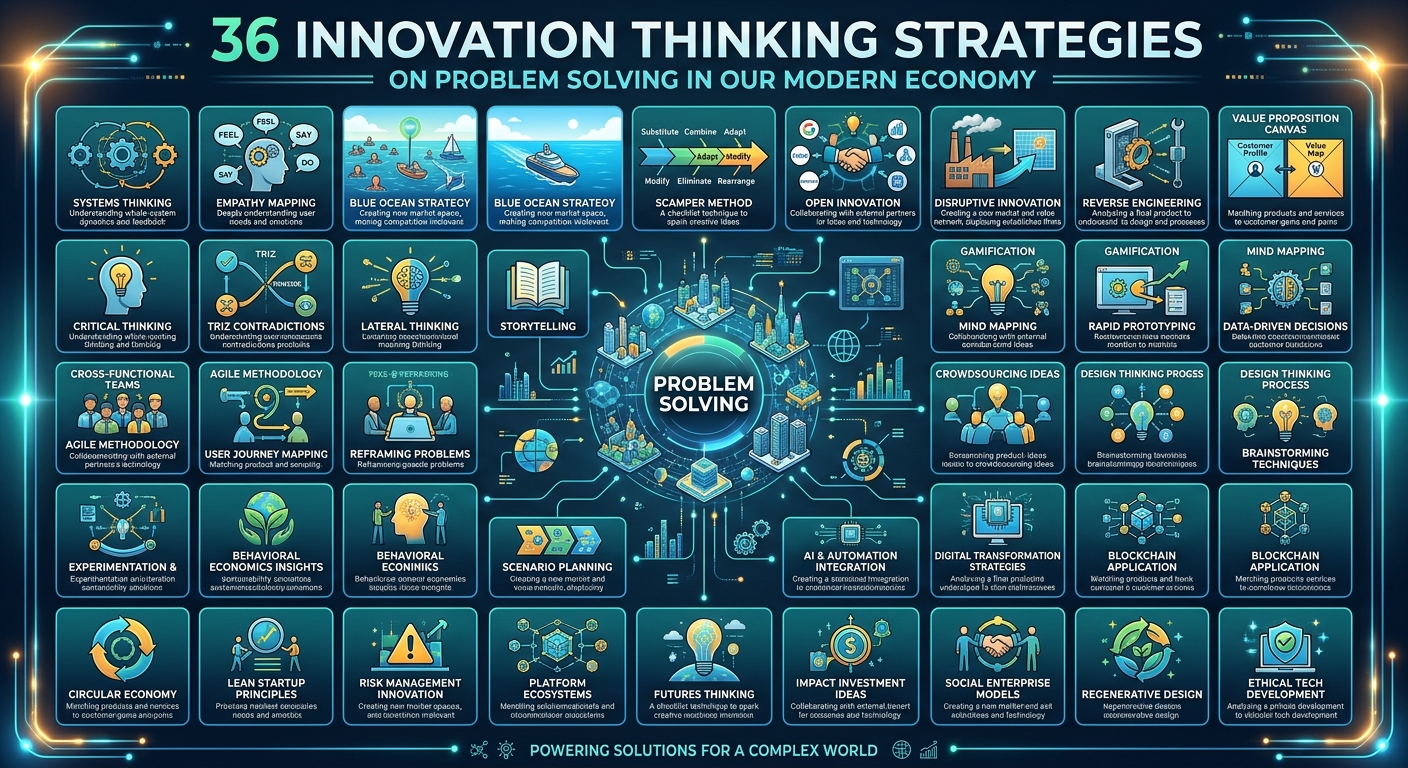
An interdisciplinary framework for intelligent problem-solving, scientific thinking, entrepreneurship, technological innovation, and sustainable economic development.
Abstract
The modern economy is increasingly shaped by artificial intelligence (AI), automation, digital finance, advanced manufacturing, agricultural technology, global supply chains, scientific research, and the continuous creation of new products and services. Yet, despite these advances, societies continue to face persistent challenges: unemployment, poverty, inefficient institutions, cybersecurity threats, resource shortages, climate risks, skills gaps, and unequal access to economic opportunities.
Solving these challenges requires more than ordinary intelligence or the accumulation of information. It requires innovation intelligence: the ability to identify important problems, understand their underlying causes, generate original ideas, test possible solutions, learn from evidence, and convert successful ideas into measurable economic and social value.
This thesis presents 36 innovation thinking strategies organized into six interconnected dimensions. Each strategy explains a way to approach problems, the method involved, its economic significance, and how it can be applied in practice.
The central argument is that innovation becomes more powerful when human reasoning, scientific knowledge, data analysis, practical experience, ethical judgment, and modern technology operate as a coordinated system.
Chapter 1: Understanding innovation intelligence
1.1 What is innovation intelligence?
Innovation intelligence is the coordinated use of knowledge, reasoning, creativity, observation, experimentation, and decision-making to develop better ways of solving problems.
It combines several intellectual capabilities:
- Analytical intelligence: understanding facts, numbers, evidence, and relationships.
- Creative intelligence: generating new ideas, designs, and possibilities.
- Critical intelligence: questioning assumptions and detecting errors.
- Systems intelligence: understanding how different parts of a problem influence one another.
- Practical intelligence: converting ideas into working solutions.
- Social intelligence: understanding people, institutions, cooperation, and human needs.
- Adaptive intelligence: learning and adjusting when conditions change.
These capabilities reinforce one another. Creativity can generate an idea, critical reasoning can test it, scientific experimentation can evaluate it, and practical intelligence can turn it into a useful product or service.
1.2 The relationship between innovation and the economy
An economy is a network through which people, businesses, governments, financial institutions, technologies, and natural resources produce and exchange goods and services.
Innovation improves this network when it helps society produce more value with available resources, develop previously unavailable products, reduce unnecessary costs, improve service quality, or solve problems that existing systems cannot adequately address.
The innovation intelligence cycle
01
Observe
Identify a real problem using evidence.
02
Understand
Investigate causes, constraints, and affected people.
03
Imagine
Generate several possible solutions.
04
Test
Use experiments, prototypes, and measurable evidence.
05
Implement
Turn the strongest solution into a working system.
06
Improve
Measure outcomes, learn, and refine continuously.
This cycle is not always linear. Testing may reveal that the original problem was misunderstood, requiring the innovator to return to the observation or analysis stage.
1.3 The difference between an idea, an invention, and an innovation
| Concept | Meaning | Example |
|---|---|---|
| Idea | A proposed possibility | Using sensors to monitor soil moisture |
| Invention | A new device, method, or technical development | Developing a new low-cost sensor |
| Innovation | Implementing an idea or invention to create useful value | Operating a sensor-based irrigation service that helps farmers manage water |
| Economic impact | The measurable result of implementation | Reduced water waste, improved reliability, or increased farm productivity |
Not every new idea becomes an innovation. An idea must be feasible, useful, adopted by its intended users, and sustainable enough to produce value.
Chapter 2: The first six strategies — intelligence, observation, and problem definition
These strategies establish the foundation of innovation. Before investing money, deploying AI, or building a product, an innovator must understand what actually needs to change.
Strategy 1: First-principles thinking
Principle: Break a complicated problem down into its most fundamental facts, then rebuild a solution from those facts.
Instead of accepting conventional practices as the only possible approach, ask what is physically, mathematically, economically, and logically necessary.
Method:
- Define the problem precisely.
- Separate verified facts from assumptions.
- Identify the fundamental constraints.
- Question practices that exist merely because they are traditional.
- Reconstruct a solution from the basic requirements.
Economic application: A small manufacturer wants to reduce production costs. Rather than immediately dismissing workers or buying expensive machinery, management examines energy consumption, material waste, machine downtime, production layout, and purchasing costs.
The resulting improvement may come from a simpler workflow rather than a major capital investment.
Key question: What must be true for this problem to be solved, regardless of how people currently approach it?
Strategy 2: Root-cause analysis
Principle: Solve the underlying cause of a problem rather than repeatedly treating its symptoms.
A business might experience declining profits. The immediate temptation is to increase prices or reduce staffing. However, the underlying cause could be defective inventory management, customer dissatisfaction, excessive borrowing costs, or poor demand forecasting.
Useful methods include the Five Whys, cause-and-effect diagrams, process mapping, and fault-tree analysis.
Economic significance: Root-cause analysis reduces repeated failures, unnecessary expenditure, and ineffective interventions.
Practical example: If a ginger farm produces inconsistent harvests, investigate drainage, soil structure, planting-material quality, disease pressure, irrigation, and nutrient availability before simply applying more fertilizer.
The objective is not to find someone to blame. It is to find the causal mechanism that can be changed.
Strategy 3: Critical thinking and assumption testing
Principle: Do not confuse a popular belief, confident statement, or historical practice with a verified fact.
Critical thinkers ask:
- What evidence supports this claim?
- What evidence could disprove it?
- Are there alternative explanations?
- What risks have been overlooked?
- Is the conclusion justified by the available data?
Economic application: Before opening a new business, test assumptions about customer demand, competitors, purchasing power, distribution costs, and the willingness of customers to pay.
An attractive business plan is not proof of a viable market.
Measurable result: Better decisions, fewer avoidable errors, and more disciplined allocation of resources.
Strategy 4: Systems thinking
Principle: Understand the relationships between the parts of a system instead of examining each part in isolation.
A modern economy consists of interconnected systems: energy, transport, education, finance, agriculture, manufacturing, communications, government, and trade.
A disruption in one area can affect many others.
Example: A supply-chain system
Raw materials and suppliers
Production and quality control
Transport and distribution
Customers and market demand
Feedback travels in both directions: customer demand affects production, while supplier reliability and production quality affect customer satisfaction.
Economic application: A business facing delayed deliveries should investigate supplier reliability, inventory policies, transport capacity, forecasting, and communication together.
Optimizing only one component may worsen the performance of the entire system.
Strategy 5: Data-driven decision-making
Principle: Use relevant, reliable data to improve judgment rather than depending exclusively on intuition.
Data can include sales figures, production rates, energy consumption, customer complaints, crop yields, inventory movements, and equipment failures.
A sound process includes:
- Collect data relevant to the problem.
- Check its accuracy and completeness.
- Identify patterns and changes.
- Compare possible explanations.
- Make a decision and measure the result.
Economic application: A retailer analyzes sales by product, season, location, and customer group to reduce excess inventory while avoiding shortages.
Important limitation: Data can be biased, incomplete, outdated, or misleading. A correlation between two variables does not automatically prove that one causes the other.
Good data-driven thinking combines measurement with critical reasoning.
Strategy 6: Problem reframing
Principle: Change the way a problem is described to uncover new solution possibilities.
Consider the difference between these two questions:
- “How can we make public transport cheaper?”
- “How can we help people reach work reliably and affordably?”
The second question opens up more possibilities: better route planning, coordinated timetables, shared transport, safer walking routes, employer transport arrangements, and digital scheduling.
Economic significance: Problem reframing prevents organizations from investing heavily in solutions that address the wrong question.
A useful rule is to define the problem from the perspective of the people experiencing it, not only from the perspective of the institution responsible for it.
Chapter 3: Six strategies for creativity and generating new ideas
Once a problem is understood, the next challenge is to generate multiple possible solutions without prematurely committing to the first idea.
Strategy 7: Divergent thinking
Principle: Generate a broad range of possibilities before evaluating them.
Divergent thinking encourages quantity and variety during the initial idea-generation stage.
For example, if a rural community experiences unreliable access to agricultural markets, possible solutions might include digital market information, shared transport, collection points, cold storage, producer cooperatives, and local processing facilities.
These options should initially be considered separately, even if some later prove impractical.
Practical exercise: Generate at least ten possible approaches to a problem, including conventional, technological, community-based, and low-cost alternatives.
The objective is to widen the search space before narrowing the options.
Strategy 8: Convergent thinking
Principle: Evaluate alternatives systematically and select the strongest candidates.
Where divergent thinking expands possibilities, convergent thinking reduces them according to evidence and constraints.
Compare options using criteria such as:
- Expected benefit.
- Total cost.
- Technical feasibility.
- Time required.
- Safety and reliability.
- Environmental and social consequences.
- Ability to scale.
Economic application: After generating several irrigation-system designs, a farmer compares water requirements, installation costs, maintenance, crop needs, and the availability of spare parts.
The most technologically advanced option is not necessarily the most suitable.
Strategy 9: Analogical thinking
Principle: Learn from how another system solves a similar problem.
Nature, engineering, logistics, biology, computing, and economics all contain useful patterns that can inspire solutions in other fields.
For example, a distribution company might study how ant colonies organize routes to understand decentralized coordination. Computer networks can also offer useful models for resilient communication and distributed information processing.
Analogies are sources of hypotheses, not automatic proof that a solution will work.
Economic application: A hospital might adapt inventory-replenishment principles from manufacturing while adjusting them for the urgency, safety, and unpredictability of medical demand.
Strategy 10: Lateral thinking
Principle: Explore unconventional approaches that escape the assumptions defining the usual solution.
A company struggling to sell a complex product might not need more advertising. It might need a simpler product, a subscription model, a demonstration service, or a partnership that makes the product easier to access.
Lateral thinking asks whether the problem can be approached from an unexpected direction.
Useful question: What alternative would become possible if our most important assumption were no longer true?
This strategy is especially useful when conventional improvements have reached diminishing returns.
Strategy 11: Design thinking
Principle: Develop solutions around the real experiences and needs of the people who will use them.
A practical design-thinking cycle consists of:
- Empathize: Understand the user’s circumstances.
- Define: Express the central problem.
- Ideate: Generate possible solutions.
- Prototype: Build a simple representation of a solution.
- Test: Observe how people use it and revise the design.
Economic application: Before developing an expensive agricultural application, interview farmers about their daily challenges, language preferences, mobile connectivity, recordkeeping, and willingness to use digital tools.
A technically impressive application that users cannot operate is not a successful innovation.
Strategy 12: Combining ideas across disciplines
Principle: Create new possibilities by connecting knowledge from different fields.
Many modern innovations arise from combinations of disciplines rather than isolated discoveries.
An interdisciplinary innovation model
Agriculture
Crop science and soil knowledge
Computing
Sensors and data processing
Economics
Costs, demand and profitability
Environmental science
Water and resource management
Intelligent precision-farming system
A combined system for monitoring crops, managing resources, and supporting decisions
The economic advantage comes from the interaction between disciplines: better information supports better decisions, while better decisions can reduce waste and improve productivity.
Chapter 4: Six strategies for scientific investigation and experimentation
Ideas are possibilities. Evidence determines which possibilities deserve further investment.
Strategy 13: The scientific method
Principle: Treat proposed solutions as hypotheses that can be investigated.
A scientific problem-solving process follows these stages:
- Observe a phenomenon.
- Define a research question.
- Form a testable hypothesis.
- Design a suitable investigation.
- Collect and analyze evidence.
- Draw a conclusion proportionate to the evidence.
- Replicate or extend the investigation where appropriate.
Example: A farm manager hypothesizes that improved drainage will reduce crop losses. The manager measures soil moisture, rainfall, plant health, and crop outcomes under appropriately comparable conditions.
The conclusion should depend on the evidence, not on the manager’s original belief.
Strategy 14: Controlled experimentation
Principle: Change a defined factor and investigate whether it produces the expected effect.
Suppose a business introduces a new customer-service procedure. A controlled evaluation compares results under the new process with a suitable comparison group or baseline, while accounting for other factors that might influence outcomes.
Useful measures include response time, customer satisfaction, error rates, and cost per completed service.
Economic significance: Controlled experimentation can prevent organizations from scaling changes that appear successful but do not actually cause improvement.
Experiments must be designed ethically and should not expose people to unreasonable risk.
Strategy 15: Rapid prototyping
Principle: Build a simple, inexpensive version of a proposed solution before developing the complete product.
A prototype might be:
- A paper sketch of an application.
- A spreadsheet that simulates a business process.
- A small irrigation test.
- A basic sensor network.
- A sample product made from inexpensive materials.
The purpose is to discover practical weaknesses early.
Economic application: A startup tests a basic inventory-management tool with a small number of consenting users before committing to a full software platform.
Early feedback can reveal confusing features, missing requirements, technical limitations, or a lack of customer demand.
Strategy 16: Minimum viable product (MVP)
Principle: Launch the simplest usable version that can test a critical business assumption.
An MVP is not necessarily an unfinished or low-quality product. It is a deliberately limited version designed to generate meaningful evidence.
For example, a proposed agricultural advisory business might begin with a small, manually supported service for a specific crop and location before building an automated national platform.
Measure whether customers use the service, whether it solves a meaningful problem, and whether a sustainable payment model exists.
Economic significance: An MVP limits unnecessary development costs and helps entrepreneurs learn before scaling.
Strategy 17: Iterative improvement
Principle: Improve a solution through repeated cycles of testing, measurement, and refinement.
A useful model is Plan–Do–Study–Act:
- Plan: Identify a specific improvement.
- Do: Test it on a manageable scale.
- Study: Compare actual results with expectations.
- Act: Adopt, modify, or abandon the change.
For example, a manufacturer might gradually adjust machine-maintenance schedules based on equipment performance and failure records.
Key principle: A failed experiment can create valuable knowledge if its assumptions, methods, and results are documented.
Strategy 18: Failure analysis and learning
Principle: Investigate failures systematically rather than concealing them or repeating the same mistakes.
A useful failure review examines:
- What was expected?
- What actually happened?
- Which assumptions proved incorrect?
- What evidence was missing?
- Which conditions contributed to the failure?
- What changes would reduce the likelihood of recurrence?
Economic application: If a digital payment service experiences repeated transaction failures, investigate network availability, software defects, system capacity, integration errors, and operational procedures.
Learning from failure does not mean tolerating preventable harm. Safety-critical systems require rigorous controls, and some experiments must never be conducted on real customers or infrastructure.
Chapter 5: Six strategies for artificial intelligence, data, and digital intelligence
AI can extend human analytical capabilities, but its economic value depends on the quality of the problem being addressed, the data available, the design of the system, and the consequences of its decisions.
Strategy 19: AI-assisted reasoning
Principle: Use AI as an analytical assistant to generate possibilities, compare explanations, organize evidence, and identify gaps in reasoning.
AI can help an entrepreneur:
- Generate alternative business models.
- Summarize large collections of documents.
- Compare competing technical designs.
- Draft research questions.
- Develop preliminary cost models.
- Identify assumptions requiring verification.
However, AI can produce false statements, flawed calculations, or plausible-sounding recommendations that lack evidence.
Best practice: Ask AI to state its assumptions, distinguish facts from estimates, provide testable predictions, and identify what additional evidence is required.
Humans remain responsible for important decisions and independent verification.
Strategy 20: Predictive analytics
Principle: Use historical and current data to estimate future events or outcomes.
Predictive models may estimate customer demand, equipment failure, inventory requirements, energy consumption, or agricultural production.
A reliable process requires relevant data, an appropriate model, validation against data not used for training, and continued monitoring after deployment.
Economic application: A retailer forecasts product demand to improve purchasing and inventory decisions.
Predictions are uncertain. A forecast should therefore be evaluated against actual results, and important decisions should account for the consequences of being wrong.
Strategy 21: Automation and intelligent workflows
Principle: Use software, sensors, robotics, and rule-based processes to reduce repetitive work and improve consistency.
Examples include:
- Automated invoice processing.
- Digital stock tracking.
- Sensor-controlled irrigation.
- Equipment-condition monitoring.
- Automated quality checks.
- Workflow notifications and reporting.
Economic significance: Automation can increase throughput, reduce certain errors, and free workers to perform higher-value tasks.
However, automation can also introduce cybersecurity risks, maintenance costs, new failure modes, and workforce-transition challenges.
The best design combines reliable automation with human oversight appropriate to the risk.
Strategy 22: Data integration and shared intelligence
Principle: Combine relevant information from separate systems to improve the quality of decisions.
A business might connect purchasing records, inventory, sales, delivery schedules, and customer feedback.
When these data sources are consistent and appropriately governed, managers can see relationships that isolated systems conceal.
Example: A supplier can compare sales forecasts with stock levels and delivery lead times to identify shortages before they disrupt production.
Effective integration requires common definitions, accurate records, access controls, privacy protection, and clear ownership of data quality.
Strategy 23: Digital twins and simulation
Principle: Create a digital representation of a real process or asset to investigate possible outcomes before changing the physical system.
Digital twins can combine engineering models, sensor readings, operational records, and simulation.
Applications include factories, electricity networks, buildings, transport systems, and some agricultural operations.
Economic application: A factory simulates production-line changes to identify potential bottlenecks before physically rearranging machinery.
A simulation is only as reliable as its assumptions and representation of reality. Model results must be compared with actual operating conditions.
Strategy 24: Cybersecurity and resilient design
Principle: Design innovation so that it remains secure, dependable, and recoverable when systems fail or face attacks.
Modern economic activity depends on digital infrastructure, including banking, telecommunications, logistics, energy, healthcare, and public services.
Innovators should incorporate:
- Appropriate authentication and access controls.
- Software updates and vulnerability management.
- Encrypted communication where appropriate.
- Reliable backups and recovery procedures.
- Monitoring and incident response.
- Protection of personal and commercially sensitive data.
Economic significance: Security is not merely a technical expense. It protects business continuity, customer confidence, intellectual property, and the integrity of transactions.
A system that performs well under normal conditions but collapses during a disruption is not a fully successful innovation.
Chapter 6: Six strategies for entrepreneurship, markets, and economic value
Innovation must ultimately connect to a real need. This chapter explains how to determine whether a technically possible solution can become an economically sustainable one.
Strategy 25: Customer-problem discovery
Principle: Investigate customers’ actual problems before designing the product.
Entrepreneurs should study customers’ existing alternatives, frustrations, budgets, decision-making processes, and willingness to change.
Interviews, observation, surveys, prototype testing, and small market experiments can all contribute evidence.
Example: Before building a sophisticated farm-management platform, discover whether farmers most urgently need irrigation advice, disease identification, purchasing information, bookkeeping, or access to buyers.
A business should not confuse interest in a demonstration with actual willingness to use or pay for a service.
Strategy 26: Value proposition design
Principle: Explain precisely how a product or service creates a meaningful benefit for a defined group of customers.
A strong value proposition identifies:
- The target customer.
- The problem being solved.
- The benefit delivered.
- The alternatives currently available.
- The reason the proposed solution may be better.
- The evidence supporting the claim.
Economic application: A low-cost digital bookkeeping service might help small businesses track cash flow, prepare records, and identify unpaid invoices.
The business must demonstrate that these benefits justify the customer’s financial and operational commitment.
Strategy 27: Business-model innovation
Principle: Improve not only the product, but also how the business creates, delivers, and captures value.
Possible business models include direct sales, subscriptions, licensing, leasing, maintenance contracts, cooperative ownership, and pay-per-use services.
For example, a farmer who cannot afford expensive equipment upfront might benefit from an equipment-hire service rather than an outright purchase.
The provider, in turn, must evaluate utilization rates, maintenance, financing, insurance, and seasonal demand.
Economic significance: Sometimes the underlying technology already exists. The innovation lies in making it accessible, affordable, and sustainable.
Strategy 28: Unit economics and financial reasoning
Principle: Understand the financial performance of one product, service, transaction, or customer before attempting to scale.
For a simple business model:
\[ \text{Contribution per unit} = \text{Selling price} – \text{Variable cost per unit} \]
If a product sells for R500 and its variable costs are R320, the contribution is R180 per unit before fixed costs and other expenses.
\[ \text{Break-even units} = \frac{\text{Fixed costs}} {\text{Contribution per unit}} \]
If monthly fixed costs are R18,000, the contribution is R180 per unit, and every unit sold contributes that amount, break-even volume is:
\[ \frac{18,000}{180}=100\text{ units} \]
This is a simplified example that assumes stable prices and costs, a single product, and no other relevant complications.
Economic significance: Unit economics help distinguish a business that generates sustainable value from one that grows sales while losing money on every transaction.
Strategy 29: Market intelligence and competitive analysis
Principle: Understand the market environment before committing significant resources.
Investigate:
- Customer segments and their needs.
- Competitors and substitute products.
- Market size and growth.
- Distribution channels.
- Regulations and entry barriers.
- Pricing and purchasing power.
- Changes in technology and customer behaviour.
Example: A new agricultural technology provider investigates whether farmers already use competing services, how much those services cost, and what prevents customers from adopting them.
Competitive analysis should identify opportunities for differentiation, not merely copy existing businesses.
Strategy 30: Resource optimization and productivity
Principle: Achieve better outcomes by improving how labour, capital, energy, materials, time, and information are used.
Useful approaches include process mapping, inventory optimization, preventive maintenance, energy monitoring, scheduling, waste reduction, and quality control.
A basic productivity measure is:
\[ \text{Labour productivity} = \frac{\text{Output produced}} {\text{Labour hours}} \]
For example, if a team produces 240 completed units in 60 labour hours, its output is four units per labour hour.
This measure alone does not establish overall performance. Quality, safety, working conditions, resource use, and the value of the output also matter.
Economic significance: Productivity improvement can strengthen competitiveness, support higher-quality employment, and increase the amount of useful output produced from scarce resources.
Chapter 7: Six strategies for leadership, collaboration, and institutional intelligence
Innovation rarely succeeds through individual intelligence alone. Complex economic problems require people with different skills, organizations with effective processes, and institutions capable of learning.
Strategy 31: Collaborative intelligence
Principle: Combine the knowledge of people with different experiences, technical skills, and perspectives.
An engineer may understand technical feasibility, an accountant may identify financial risks, a farmer may understand field conditions, and a software developer may understand automation.
Their combined knowledge can reveal problems that no individual sees independently.
Practical method:
- Define the shared problem.
- Identify the knowledge and skills required.
- Assign clear responsibilities.
- Establish a common set of facts and objectives.
- Compare proposed solutions constructively.
- Test decisions and share the results.
Economic significance: Collaboration reduces knowledge gaps and enables organizations to undertake problems that exceed the capacity of a single person or department.
Effective collaboration still requires accountability. Group agreement does not guarantee that a conclusion is correct.
Strategy 32: Knowledge management and organizational learning
Principle: Convert individual experience into knowledge that an organization can preserve, retrieve, and improve.
Businesses frequently lose valuable expertise when experienced workers leave, projects end, or decisions are not documented.
A knowledge-management system can preserve:
- Operating procedures.
- Technical specifications.
- Research findings.
- Project decisions.
- Customer feedback.
- Lessons from failures.
- Maintenance and quality records.
Economic application: An agricultural enterprise records planting dates, soil test results, irrigation schedules, pest observations, harvest quantities, and operating costs.
Over multiple seasons, these records help managers compare outcomes and make better-informed decisions.
The objective is not to collect documents indefinitely. It is to make useful knowledge accessible when a decision must be made.
Strategy 33: Strategic foresight and scenario planning
Principle: Prepare for multiple plausible futures rather than relying on a single prediction.
The modern economy can change because of AI adoption, energy prices, regulation, demographic shifts, climate events, geopolitical disruptions, and technological breakthroughs.
Scenario planning develops alternative futures and investigates what each would mean for an organization.
For example, a manufacturer might prepare for:
- A stable supply of imported components.
- Higher import costs and longer delivery times.
- Rapid adoption of a new manufacturing technology.
- A temporary disruption in electricity supply.
For each scenario, the business identifies vulnerabilities, early warning indicators, and possible responses.
Economic significance: Strategic foresight helps organizations become adaptable instead of depending on assumptions that may become obsolete.
It does not predict the future with certainty; it improves preparedness for uncertainty.
Strategy 34: Ethical intelligence and responsible innovation
Principle: Evaluate not only whether a solution works, but also whether it is safe, fair, lawful, and socially responsible.
An innovation can increase efficiency while creating other costs, such as privacy violations, unfair discrimination, environmental damage, worker displacement, or excessive dependence on a single supplier.
Responsible innovators ask:
- Who benefits from the solution?
- Who bears the risks and costs?
- Could the system discriminate or exclude people?
- What personal information is collected?
- What happens if the technology fails?
- Are there safer or fairer alternatives?
Economic significance: Ethical design protects people and helps build the trust required for the adoption of new technologies.
Responsible innovation should include appropriate human oversight, transparency, security, accessibility, and accountability.
Strategy 35: Adaptive leadership and change management
Principle: Help people and institutions move from existing practices to improved ways of working.
A technically excellent innovation may fail if workers do not understand it, customers cannot use it, management does not support it, or the organization lacks the resources to maintain it.
Successful implementation requires:
- A clear explanation of the problem and expected benefits.
- Consultation with affected people.
- Training and practical support.
- Realistic implementation stages.
- Feedback and performance monitoring.
- Adjustments when evidence reveals difficulties.
Example: Introducing AI into a small business should involve reviewing existing workflows, training staff, checking output quality, defining accountability, and measuring whether the technology improves performance.
The objective is to improve the system, not simply to purchase new technology.
Strategy 36: Continuous innovation and feedback loops
Principle: Treat innovation as an ongoing capability rather than a single event.
Markets evolve, technologies improve, competitors respond, and customers develop new expectations. A solution that works today may become less effective tomorrow.
An organization can establish a continuous-improvement cycle:
- Measure performance.
- Identify a meaningful gap.
- Prioritize the most important problem.
- Test an improvement.
- Evaluate the result.
- Standardize successful changes.
- Continue monitoring for new problems.
Economic application: A digital service reviews customer complaints, transaction failures, operating costs, security incidents, and usage patterns each month. The team then prioritizes improvements based on their likely benefit and risk.
The central lesson: Sustainable innovation depends on the ability to learn repeatedly, not on the expectation that the first solution will be perfect.
Chapter 8: Integrating the 36 strategies into one intelligent problem-solving system
The 36 strategies are most useful when they work together. No single method is sufficient for every problem.
For example, first-principles thinking helps clarify what is necessary; systems thinking reveals interdependencies; AI can assist with analysis; experimentation tests proposed solutions; financial reasoning evaluates economic viability; and ethical intelligence identifies unacceptable risks.
The following framework combines these capabilities into a practical operating model.
The 6-stage innovation operating model
Understand the problem
Stage 1
Strategies 1–6First principles, root causes, critical thinking, systems thinking, data analysis and reframing.
Generate alternatives
Stage 2
Strategies 7–12Divergent and convergent thinking, analogies, lateral thinking, design thinking and interdisciplinary ideas.
Test scientific validity
Stage 3
Strategies 13–18Scientific hypotheses, controlled experiments, prototypes, MVPs, iteration and failure analysis.
Use digital intelligence
Stage 4
Strategies 19–24AI assistance, predictive analytics, automation, integrated data, simulations and cybersecurity.
Establish economic value
Stage 5
Strategies 25–30Customer discovery, value propositions, business models, unit economics, market analysis and productivity.
Scale responsibly
Stage 6
Strategies 31–36Collaboration, knowledge management, foresight, ethics, change management and continuous improvement.
8.1 A practical example: Building an intelligent ginger-farming enterprise
Consider a hypothetical agricultural enterprise in South Africa that wants to produce ginger reliably, manage scarce resources, and build a sustainable route to market.
The objective is not simply to grow more ginger. It is to design an integrated system that connects agronomy, technology, finance, operations, and customer demand.
Ginger farm with drip irrigation.
1. Diagnose the agricultural problem
Apply first-principles thinking, root-cause analysis, and systems thinking. Examine soil structure, drainage, water quality, planting material, climate, disease risks, and cultivation practices.
Soil Testing – Residential | TruScape
2. Generate and evaluate alternatives
Compare cultivation methods, irrigation options, soil-improvement measures, crop monitoring approaches, and harvesting arrangements using evidence and local conditions.
3. Test before scaling
Run appropriately designed trials, monitor moisture and crop health, record input quantities, and compare yields and costs. Use local agronomic advice to guide safe cultivation practices.
LiDarX – Intelligent Agricultural Systems
4. Introduce digital intelligence
Use digital records, sensors where justified, weather information, and analytical tools to support irrigation, maintenance, inventory, and harvest planning.
브라질의 회사 SBG Brazil의 Whole Ginger – Find Suppliers | Tridge
5. Validate the economic model
Estimate production costs, marketable yield, labour, packaging, storage, transport, selling prices, and buyer requirements. Confirm market demand before making large investments.
The enterprise should then document what worked, train its workers, protect its digital records, and improve the production system from season to season.
The important point is that AI and automation are supporting tools. They cannot compensate for poor soil preparation, contaminated planting material, inadequate drainage, incorrect agronomic decisions, or an unviable market.
8.2 How to prioritize problems intelligently
A business may have dozens of possible improvements but limited time, money, and personnel. It therefore needs a rational method for deciding which problem to address first.
A simple preliminary priority score can be calculated as follows:
\[ P=\frac{I\times U\times F}{C} \]
Where:
- \(P\) = priority score.
- \(I\) = expected impact, rated from 1 to 5.
- \(U\) = urgency, rated from 1 to 5.
- \(F\) = confidence in the supporting evidence, rated from 1 to 5.
- \(C\) = estimated implementation cost, rated from 1 to 5.
Suppose two proposed improvements receive the following illustrative ratings:
| Factor | Improvement A | Improvement B |
|---|---|---|
| Impact | 5 | 3 |
| Urgency | 4 | 3 |
| Evidence confidence | 4 | 4 |
| Cost rating | 2 | 1 |
| Priority score | 40 | 36 |
Under this simplified model, Improvement A receives the higher score. These ratings are illustrative, not empirical findings.
The model is useful for organizing discussion, but it should not replace professional judgment. Safety-critical problems, legal obligations, and urgent threats must not be deprioritized merely because they are expensive or difficult to measure.
Chapter 9: Measuring the success of innovation
An intelligent problem-solving system must distinguish between activity and achievement. Generating ideas, holding meetings, purchasing technology, and developing prototypes are activities. Innovation succeeds when these activities produce useful, measurable outcomes.
9.1 The seven dimensions of innovation performance
| Dimension | What to measure | Example indicator |
|---|---|---|
| Productivity | How efficiently resources are used | Output per labour hour |
| Financial performance | Whether economic value is sustainable | Operating profit and cash flow |
| Quality | Whether the output meets requirements | Defect or rejection rate |
| Customer value | Whether the solution meets real needs | Retention and customer satisfaction |
| Learning | Whether the organization improves its knowledge | Time from experiment to validated decision |
| Resilience | Whether the system withstands disruption | Recovery time after a failure |
| Social and environmental impact | Whether benefits and risks are responsibly managed | Water use per unit of production |
Measures should be selected according to the problem. A healthcare service, agricultural enterprise, manufacturing plant, and software startup require different indicators.
9.2 The difference between efficiency and effectiveness
Efficiency concerns the relationship between resources used and results produced.
Effectiveness concerns whether the intended objective is actually achieved.
A business might process applications faster but still reject valid applications incorrectly. Its efficiency may have improved while its effectiveness has declined.
The best innovation improves the right outcomes, not merely the easiest metrics.
9.3 Avoiding misleading measurements
Organizations should guard against:
- Increasing sales while ignoring profitability.
- Increasing output while allowing quality to deteriorate.
- Reducing labour costs while creating unsafe working conditions.
- Increasing AI-generated content while reducing accuracy.
- Improving short-term results while damaging long-term resilience.
A balanced measurement system reduces the risk of optimizing one indicator at the expense of the overall objective.
Chapter 10: Developing a personal innovation intelligence discipline
Innovation thinking can be strengthened through deliberate practice. The purpose is not to think continuously about everything, but to develop a reliable process for approaching important problems.
Here is a practical weekly learning structure.
Weekly innovation practice
Track your weekly practice
0 of 7
Monday: Problem definition
Choose one real problem and separate facts from assumptions.
Tuesday: Root-cause investigation
Identify causal factors and draw a simple system map.
Wednesday: Creative exploration
Generate at least five possible solutions using different disciplines.
Thursday: Evidence and testing
Identify the strongest hypothesis and design a small, safe test.
Friday: Economic evaluation
Estimate costs, benefits, risks, and the resources required.
Saturday: AI-assisted analysis
Use AI to challenge your assumptions and identify alternative explanations.
Sunday: Reflection and improvement
Record lessons, unresolved questions, and the next practical step.
Reset weekly checklist
Over time, this practice develops a collection of documented problems, tested hypotheses, useful methods, and lessons learned. That collection becomes a personal knowledge system for future decisions.
Chapter 11: The wider significance for the modern economy
11.1 Innovation and employment
Innovation can create new occupations, businesses, industries, and markets. It can also automate existing tasks and disrupt established jobs.
The economic challenge is therefore not simply to adopt more technology. It is to develop the skills, institutions, infrastructure, and business models that enable people to benefit from technological change.
Education, retraining, entrepreneurship, technical competence, and effective labour-market policies are important parts of this transition.
11.2 Innovation and developing economies
For developing economies, innovation does not always require inventing an entirely new technology. It can involve adapting existing technologies to local needs, improving institutional processes, expanding access to knowledge, or making established services more affordable and reliable.
In South Africa, for example, opportunities can arise from applying innovation to:
- Agricultural productivity and food processing.
- Electricity reliability and energy management.
- Logistics and supply-chain coordination.
- Small-business financial management.
- Technical education and vocational training.
- Digital public services.
- Water management and rural infrastructure.
- Cybersecurity and digital financial inclusion.
The best opportunities depend on local demand, infrastructure, financing, skills, regulation, and the ability to deliver results.
11.3 Innovation and the responsible use of AI
AI can support research, forecasting, software development, administration, customer service, and scientific discovery. Yet its use requires sound judgment.
An intelligent AI-assisted organization should establish clear rules concerning data quality, privacy, intellectual property, accuracy, security, human oversight, and accountability.
AI should help people make better-informed decisions rather than encourage them to surrender their judgment to an automated system.
The greatest value emerges when human expertise and computational capabilities complement one another.
Conclusion: The 36 strategies as a unified intelligence framework
The 36 strategies in this thesis form a practical framework for addressing modern economic problems through disciplined reasoning and continuous learning.
Their combined purpose is to help individuals, businesses, educational institutions, governments, and communities move through six fundamental stages:
- Understand reality through observation, evidence, critical thinking, and root-cause analysis.
- Discover possibilities through creativity, interdisciplinary thinking, and problem reframing.
- Establish what works through scientific investigation, experimentation, and iterative improvement.
- Extend human capabilities through AI, data, automation, simulation, and secure digital systems.
- Create sustainable value through customer understanding, market intelligence, productivity, and financial discipline.
- Build lasting capability through collaboration, knowledge management, ethical leadership, and continuous innovation.
No strategy guarantees success on its own. Their value lies in selecting the appropriate methods, combining them intelligently, testing assumptions, and learning from actual outcomes.
The modern economy rewards more than the possession of information. It rewards the ability to interpret information, recognize meaningful problems, allocate resources wisely, develop useful solutions, and adapt as circumstances change.
The ultimate objective of innovation intelligence is to turn knowledge into sound decisions, decisions into practical solutions, and practical solutions into sustainable economic and social value.
A person, business, or nation that develops these capabilities is better equipped to confront uncertainty, improve productivity, create opportunities, and participate meaningfully in the scientific and technological transformation of the modern world.
Suggested research foundations
For further academic development of this thesis, the following established works provide useful starting points:
- Herbert A. Simon — The Sciences of the Artificial, on design, decision-making, and artificial systems.
- Peter M. Senge — The Fifth Discipline, on systems thinking and organizational learning.
- Clayton M. Christensen — The Innovator’s Dilemma, on technological disruption and established businesses.
- Eric Ries — The Lean Startup, on experimentation and iterative product development.
- Tim Brown — Change by Design, on human-centred design and innovation.
- W. Edwards Deming — Out of the Crisis, on quality management and continuous improvement.
- OECD/Eurostat — Oslo Manual 2018, on the concepts and measurement of innovation.
These works represent different approaches to innovation and management; they should be studied critically and applied according to the evidence and context of each problem.




Be First to Comment