
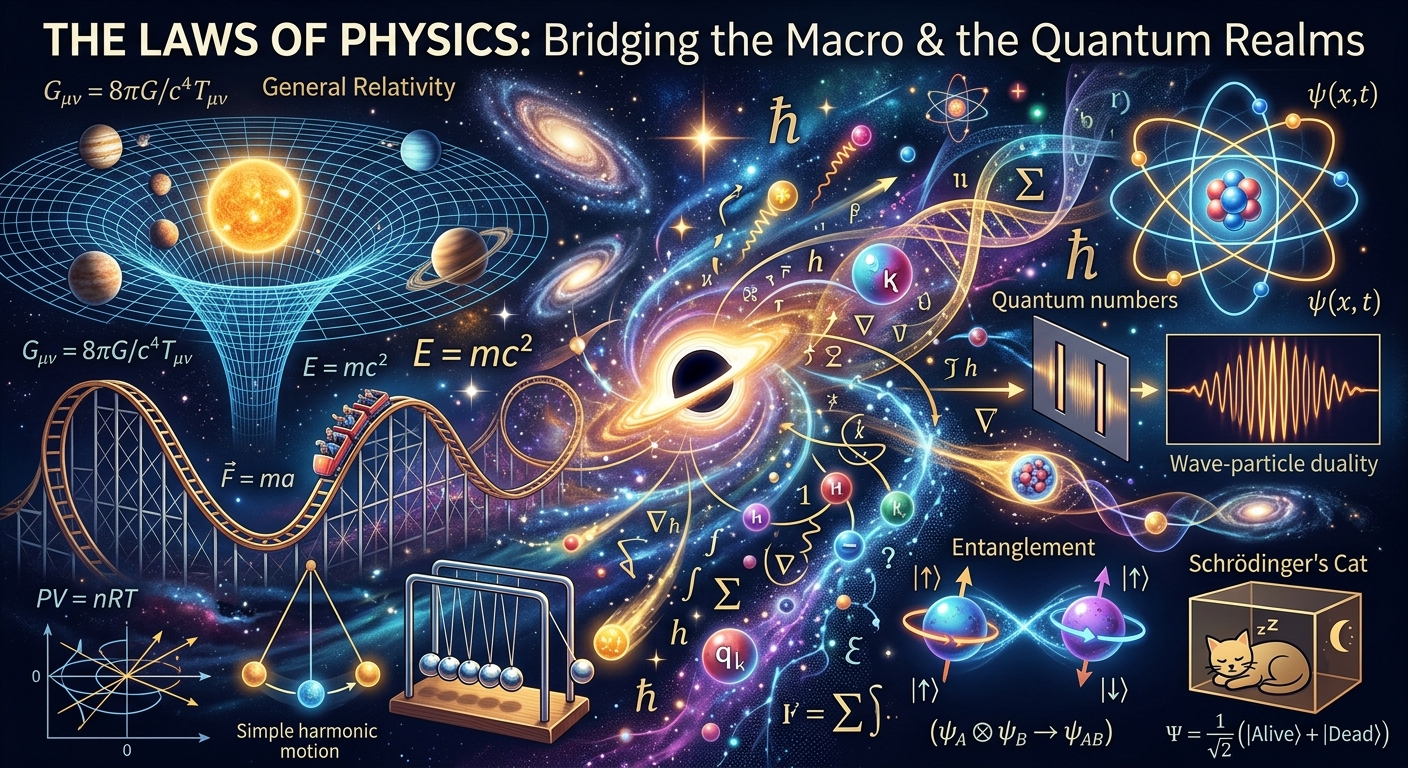
A detailed educational article on the laws governing matter, energy, motion, space, time, atoms, and the universe.
Atomic Orbitals: Definition & NEET Notes | NeetQ
11
1. Introduction: What are the laws of physics?
Physics is the branch of science that studies how the natural universe works. It investigates matter, energy, motion, forces, space, time, light, heat, electricity, magnetism, atoms, and the fundamental particles that make up the physical world.
The laws of physics are mathematical relationships and principles developed through observation, experiments, and testing. They help us explain natural phenomena and predict what may happen under particular conditions.
For example:
- Why does an object fall towards Earth?
- Why does light travel through space?
- How does electricity power computers?
- Why do planets orbit stars?
- How do atoms form molecules?
- How can a particle behave like both a wave and a particle?
- How can quantum physics enable modern computer chips and medical technologies?
To understand physics properly, it helps to distinguish between two major frameworks.
Classical physics
Explains many everyday phenomena, including motion, forces, heat, sound, electricity, and ordinary mechanical systems. Newton’s laws are a central part of this framework.
File:Hydrogen Density Plots.png – Wikimedia Commons
Quantum physics
Explains how matter and energy behave at atomic and subatomic scales, including quantized energy, quantum states, probability, and the interactions of fundamental particles.
A third essential framework is Einstein’s relativity, which explains gravity, spacetime, and the behaviour of objects at very high speeds. Quantum physics and relativity are not simply competing theories: each describes different aspects of nature, and modern physics uses both where necessary.
The central idea: physics seeks to discover reliable mathematical rules that connect what we observe with what we can predict.
2. The fundamental quantities used in physics
Before studying the laws, we need to understand the quantities that those laws describe.
| Quantity | Symbol | SI unit | Meaning |
|---|---|---|---|
| Length | \(x\) or \(L\) | metre (m) | Distance or spatial extent |
| Time | \(t\) | second (s) | Duration or interval |
| Mass | \(m\) | kilogram (kg) | Measure of inertia and a property related to gravitational interaction |
| Velocity | \(v\) | metre per second (m/s) | Speed with direction |
| Acceleration | \(a\) | metre per second squared (m/s²) | Rate of change of velocity |
| Force | \(F\) | newton (N) | Interaction that changes motion |
| Energy | \(E\) | joule (J) | Quantity transferred or transformed in physical processes |
| Power | \(P\) | watt (W) | Rate of energy transfer |
| Electric charge | \(q\) | coulomb (C) | Property governing electric interactions |
| Temperature | \(T\) | kelvin (K) | Quantity related to thermal state |
These quantities allow scientists to translate physical observations into mathematics.
For example, saying that a car travels quickly is qualitative. Saying that it travels at \(20\text{ m/s}\) is quantitative and can be used in calculations.
3. The laws of motion: Isaac Newton’s three laws
Newton’s second law of motion | PPTX
Newton’s three laws of motion form a foundation of classical mechanics. They describe how forces influence the motion of objects when classical approximations are appropriate.
Law 1: The law of inertia
An object remains at rest or continues moving at a constant velocity in a straight line unless a net external force acts on it.
In simple language, objects do not spontaneously change their motion.
Example: A football lying on the ground stays there until a force, such as a kick, changes its motion.
A moving spacecraft can continue travelling through space without continuously firing its engines, provided that external forces are sufficiently small. In reality, gravity and other forces can alter its trajectory.
Economic and technological significance: inertia is important in vehicle design, robotics, industrial machinery, transport systems, and the safe movement of goods.
Law 2: The relationship between force, mass, and acceleration
Newton’s second law is commonly written as:
\[ \boxed{F_{\text{net}}=ma} \]
Where:
- \(F_{\text{net}}\) is the total external force in newtons.
- \(m\) is the object’s mass in kilograms.
- \(a\) is its acceleration in metres per second squared.
Suppose a \(2\text{ kg}\) object experiences a net force of \(10\text{ N}\).
\[ a=\frac{F_{\text{net}}}{m} =\frac{10}{2}=5\text{ m/s}^2 \]
Its acceleration is \(5\text{ m/s}^2\).
For a given mass, a greater net force produces greater acceleration. For a given force, a greater mass produces less acceleration.
This principle is fundamental to engineering, automotive systems, industrial automation, and the control of robotic arms.
Law 3: Action and reaction
When one object exerts a force on another, the second exerts an equal-magnitude force in the opposite direction on the first.
These forces act on different objects, so they do not simply cancel each other.
Example: A rocket pushes exhaust gases backwards. The gases exert an opposing force on the rocket, helping propel it forwards.
This law helps explain rocket propulsion, walking, swimming, and the movement of machinery.
4. The laws of gravity
Reimagining Gravity: The TICE Equation and Trust Curvature
Gravity is the interaction associated with mass and energy. It governs falling objects, planetary orbits, tides, stars, and the large-scale structure of the universe.
There are two especially important descriptions of gravity.
4.1 Newton’s law of universal gravitation
Newton proposed that every object with mass attracts every other object with mass.
\[ \boxed{F=G\frac{m_1m_2}{r^2}} \]
Where:
- \(F\) is the gravitational force.
- \(G\) is the universal gravitational constant.
- \(m_1\) and \(m_2\) are the two masses.
- \(r\) is the distance between their centres.
The equation tells us that increasing either mass increases the gravitational force, while increasing the distance reduces it according to the inverse-square law.
Example: Earth’s gravity accelerates objects near its surface at approximately \(9.81\text{ m/s}^2\), ignoring air resistance and small local variations.
Gravity keeps the Moon in orbit around Earth and Earth in orbit around the Sun.
4.2 Einstein’s general theory of relativity
Einstein developed a deeper description of gravity, published in its mature form in 1915.
In general relativity:
- Space and time form a connected structure called spacetime.
- Mass and energy influence the curvature of spacetime.
- Objects and light follow paths through this curved spacetime.
- What we experience as gravity is related to this geometry.
An analogy is a map whose geometry is distorted by a heavy object. However, spacetime curvature is not literally a rubber sheet; it is a mathematical description of four-dimensional spacetime.
General relativity is especially important for understanding black holes, gravitational waves, cosmology, and precise satellite navigation.
Important distinction: Newton’s gravity remains an excellent approximation for many everyday calculations. Einstein’s theory becomes necessary when gravitational fields are strong or very high precision is required.
5. The laws of energy and work
Energy is one of the most important concepts in all of physics. It is a conserved quantity that can be transferred between systems or transformed from one form into another.
The main forms include:
- Kinetic energy — energy associated with motion.
- Potential energy — energy associated with position or configuration.
- Thermal energy — energy associated with microscopic motion and interactions.
- Chemical energy — energy associated with chemical configurations.
- Electrical energy — energy transferred or stored through electrical processes.
- Nuclear energy — energy involved in atomic nuclei.
- Electromagnetic radiation — energy carried by light and other electromagnetic waves.
5.1 Kinetic energy
The kinetic energy of a nonrelativistic object is:
\[ \boxed{E_k=\frac12 mv^2} \]
Where \(m\) is mass and \(v\) is speed.
Notice that speed is squared. If an object’s speed doubles, its kinetic energy becomes four times as large, assuming its mass stays the same.
5.2 Gravitational potential energy
Near Earth’s surface, the change in gravitational potential energy can be approximated by:
\[ \boxed{\Delta E_p=mg\Delta h} \]
An object raised higher gains gravitational potential energy relative to a chosen reference height.
This principle is used in hydroelectric power stations, where elevated water can release energy as it flows downwards.
5.3 The work–energy theorem
When a net force does work on an object, it changes the object’s kinetic energy:
\[ \boxed{W_{\text{net}}=\Delta E_k} \]
For example, an electric motor performs work to accelerate a conveyor belt. The motor transfers electrical energy into mechanical energy, with some energy also dissipated as heat and sound.
5.4 The law of conservation of energy
Energy cannot be created or destroyed in an isolated system; it can only be transferred or transformed.
Consider a solar-powered computer:
Sunlight
Radiant energy
Solar panel
Light energy → electrical energy
Computer
Electrical energy → computation, light and heat
The useful electrical energy does not appear from nowhere. It is produced through the conversion of incoming solar energy.
Einstein’s special relativity also shows that mass and energy are related:
\[ \boxed{E=mc^2} \]
This equation describes the rest energy associated with mass. It does not mean that ordinary objects spontaneously convert all their mass into usable energy.
6. The four fundamental interactions
Modern particle physics describes four fundamental interactions. Three are incorporated into the Standard Model of particle physics, while gravity is described by general relativity in our current standard framework.
Vous avez dit ‘ondes gravitationnelles’? Trois clefs pour comprendre – RTBF Actus
1. Gravity
Governs gravitational attraction and spacetime curvature. It dominates the large-scale behaviour of planets, stars, galaxies, and the universe.
2. Electromagnetic interaction
Acts on electrically charged particles. It explains electricity, magnetism, light, chemical bonding, and much of the behaviour of ordinary matter.
How many quarks are in a proton?
3. Strong interaction
Binds quarks inside protons and neutrons. A residual effect of the strong interaction helps bind atomic nuclei together.
4. Weak interaction
Responsible for processes such as beta decay and plays a role in nuclear reactions that power the Sun.
These interactions explain different aspects of the natural world. For example, gravity structures the solar system, electromagnetism governs the chemistry of materials, the strong interaction holds atomic nuclei together, and the weak interaction enables certain transformations of particles.
A major open research goal is to develop a consistent theory that unifies gravity with quantum physics.
7. The laws of thermodynamics
Thermodynamics studies heat, temperature, energy transfer, and the limits of converting energy into useful work. It is essential to engines, power stations, refrigeration, manufacturing, climate science, and computing. OpenStax+1
The zeroth law: Thermal equilibrium
If system A is in thermal equilibrium with system C, and system B is also in thermal equilibrium with system C, then A and B are in thermal equilibrium with each other.
In simpler language, systems at the same thermal equilibrium temperature can be compared using a thermometer.
This law provides the foundation for measuring temperature.
The first law: Conservation of energy
For a thermodynamic system, one common sign convention gives:
\[ \boxed{\Delta U=Q-W} \]
Where:
- \(\Delta U\) is the change in internal energy.
- \(Q\) is heat added to the system.
- \(W\) is work done by the system on its surroundings.
If a gas absorbs heat and expands, some of the transferred energy may increase its internal energy and some may be used to perform work.
The second law: Entropy and the direction of natural processes
The entropy of an isolated system cannot decrease overall.
Entropy is a thermodynamic state quantity that helps describe the number of microscopic arrangements compatible with a macroscopic state. The second law explains why many processes have a preferred direction.
Examples include:
- Heat naturally flows from a hotter object to a colder one when left to exchange heat without other effects.
- A hot drink cools in a cooler room.
- Engines cannot convert all absorbed heat into useful work in a cyclic process.
- Energy disperses into less useful forms during many real-world processes.
Why this matters for modern technology: data centres consume electrical energy and produce heat. Cooling systems transfer that heat to their surroundings but require energy themselves. Thermodynamics helps engineers design more efficient servers, cooling systems, batteries, and power plants.
The third law: Behaviour near absolute zero
For a perfect crystal, entropy approaches a minimum as temperature approaches absolute zero under the usual assumptions of the third law.
Absolute zero is \(0\text{ K}\), equivalent to \(-273.15^\circ\text{C}\).
A physical system cannot be cooled to absolute zero by a finite sequence of ordinary cooling operations. Extremely low temperatures are nevertheless achievable and useful in quantum experiments.
8. The laws of electricity and magnetism
Electricity and magnetism are two connected aspects of the electromagnetic interaction. Their relationship is described by Maxwell’s equations, which are among the most important equations in classical physics.
8.1 Coulomb’s law
Coulomb’s law describes the electric force between two stationary point charges in a vacuum:
\[ \boxed{F=k\frac{|q_1q_2|}{r^2}} \]
Like charges repel; opposite charges attract.
This principle helps explain electrical forces between particles and the behaviour of charged objects.
8.2 Ohm’s law
For a circuit element that behaves ohmically under the conditions being considered:
\[ \boxed{V=IR} \]
Where:
- \(V\) is voltage, measured in volts.
- \(I\) is electric current, measured in amperes.
- \(R\) is resistance, measured in ohms.
If a resistor has a voltage of \(12\text{ V}\) across it and a resistance of \(4\,\Omega\), then:
\[ I=\frac{V}{R}=\frac{12}{4}=3\text{ A} \]
The current is \(3\text{ A}\).
Not all electrical components obey a constant-resistance version of Ohm’s law under all conditions. Diodes, transistors, and many other devices have more complex current–voltage relationships.
8.3 Faraday’s law of electromagnetic induction
A changing magnetic flux through a circuit can induce an electromotive force:
\[ \boxed{\mathcal{E}=-\frac{d\Phi_B}{dt}} \]
For a coil of \(N\) turns, the induced electromotive force is \(\mathcal{E}=-N\,d\Phi_B/dt\).
The minus sign expresses Lenz’s law: the induced effect opposes the change in magnetic flux that produces it.
This is a foundational principle behind electrical generators, transformers, induction cooktops, and many sensors.
8.4 Maxwell’s equations
Maxwell’s equations describe how electric and magnetic fields are generated and how they interact.
In broad terms, they state that:
- Electric charges are sources of electric fields.
- Magnetic fields have no known isolated magnetic-monopole sources in classical electromagnetism.
- Changing magnetic fields generate circulating electric fields.
- Electric currents and changing electric fields generate magnetic fields.
One major consequence is that electromagnetic disturbances can propagate through space as waves.
Light is an electromagnetic wave. Radio, Wi-Fi, microwaves, infrared, visible light, ultraviolet, X-rays, and gamma rays all belong to the electromagnetic spectrum.
Modern economic significance: electromagnetic physics underpins electrical grids, mobile telecommunications, fibre-optic systems, computer hardware, medical imaging, satellite communications, and industrial automation.
9. The laws of waves and light
Waves transfer energy and information. Some require a medium, while electromagnetic waves can travel through a vacuum.
9.1 The wave equation
For a periodic wave, the relationship between wave speed, frequency, and wavelength is:
\[ \boxed{v=f\lambda} \]
Where:
- \(v\) is wave speed.
- \(f\) is frequency, measured in hertz.
- \(\lambda\) is wavelength, measured in metres.
If a wave travels at \(340\text{ m/s}\) and has a frequency of \(170\text{ Hz}\), its wavelength is:
\[ \lambda=\frac{340}{170}=2\text{ m} \]
This relationship applies to many kinds of waves, including sound and electromagnetic radiation, with the relevant wave speed.
9.2 The speed of light
In a vacuum, light travels at exactly \(299\,792\,458\text{ m/s}\), approximately \(300\,000\text{ km/s}\).
This speed is represented by \(c\).
In a vacuum, electromagnetic radiation obeys:
\[ \boxed{c=f\lambda} \]
Higher-frequency electromagnetic waves have shorter wavelengths, while lower-frequency waves have longer wavelengths.
9.3 Reflection and refraction
- Reflection: a wave changes direction when it bounces off a boundary.
- Refraction: a wave changes direction when its speed changes as it enters another medium at an angle.
These principles explain mirrors, lenses, eyeglasses, cameras, microscopes, telescopes, and optical instruments.
9.4 Interference and diffraction
Interference occurs when waves combine, producing reinforcement or cancellation depending on their relative phase.
Diffraction is the spreading and redistribution of waves when they encounter openings or obstacles.
These phenomena are important because they provide evidence of wave behaviour in light and matter.
10. The special theory of relativity
Einstein’s special relativity applies to inertial reference frames and describes physics when objects move at speeds where classical mechanics becomes inadequate.
It is built on two central principles:
- The laws of physics have the same form in all inertial reference frames.
- The speed of light in a vacuum is the same for all inertial observers.
10.1 Time dilation
A moving clock is measured to run more slowly relative to an inertial observer in a frame where that clock is moving, when the observers compare the appropriate elapsed times.
The relationship is:
\[ \Delta t=\frac{\Delta \tau}{\sqrt{1-v^2/c^2}} \]
Here, \(\Delta\tau\) is the proper time measured by the clock travelling between two events in its own rest frame, and \(\Delta t\) is the corresponding elapsed time in the specified inertial frame.
At everyday speeds, this effect is extremely small. At speeds approaching the speed of light, it becomes significant.
10.2 Mass and energy
The equation \(E=mc^2\) relates rest mass to rest energy. In the full relativistic energy–momentum relationship:
\[ E^2=(pc)^2+(mc^2)^2 \]
Here \(p\) is momentum and \(m\) is rest mass.
This broader equation applies to massive particles and, with \(m=0\), to photons.
10.3 Practical applications
Relativity is not merely an abstract theory. Satellite navigation systems must account for relativistic timing effects, including special-relativistic effects from satellite motion and general-relativistic effects from differences in gravitational potential. Without suitable corrections, navigation accuracy would deteriorate.
Relativity is also essential for particle accelerators, high-energy astrophysics, and understanding the universe at large scales.
11. Quantum physics: Understanding the microscopic universe
Supplemental Material for Phys 401
Quantum physics describes physical systems at atomic and subatomic scales. It also explains many properties of materials that cannot be understood using classical physics alone.
The word quantum refers to discrete amounts or states in contexts where certain physical quantities are quantized.
Quantum mechanics does not say that everything in nature can take only discrete values. Some quantum observables have discrete spectra, while others can have continuous ranges.
11.1 Why was quantum physics necessary?
At the end of the nineteenth century and the beginning of the twentieth century, several experiments revealed limits in classical theories.
Scientists needed to explain:
- The spectrum of light emitted by hot objects.
- The photoelectric effect.
- Atomic emission and absorption spectra.
- The stability and structure of atoms.
- The wave-like behaviour of electrons and other matter.
- The behaviour of electrons inside solids.
In 1900, Max Planck introduced the idea that energy exchange in a particular model of radiation occurred in discrete amounts. In 1905, Einstein explained the photoelectric effect using light quanta, later called photons.
Over subsequent decades, scientists including Niels Bohr, Louis de Broglie, Werner Heisenberg, Erwin Schrödinger, Max Born, and Paul Dirac helped develop modern quantum theory.
11.2 Planck’s law of energy quantization
The energy of a photon is:
\[ \boxed{E=hf} \]
Where:
- \(E\) is the photon’s energy.
- \(h\) is Planck’s constant.
- \(f\) is the frequency of the light.
Planck’s constant is approximately:
\[ h=6.62607015\times10^{-34}\text{ J·s} \]
It is small in everyday units, which is one reason quantum effects are not usually obvious in ordinary human-scale objects.
Consider two photons: one with a higher frequency and another with a lower frequency. The higher-frequency photon carries more energy.
This helps explain why ultraviolet radiation can produce certain electronic effects that visible light of lower frequency cannot produce in the same material.
11.3 Wave–particle duality
Quantum objects can show both wave-like and particle-like behaviour.
Light can produce interference patterns, a wave-like effect, while energy is exchanged with matter in discrete photon interactions.
Electrons can also produce interference patterns in appropriate experiments, even when individual detections occur at distinct locations.
This does not mean that an electron is literally a tiny classical ball that is also a water wave. Quantum objects are described by a mathematical state whose predictions do not always fit everyday categories.
11.4 The Schrödinger equation
The nonrelativistic quantum state of a system evolves according to the Schrödinger equation:
\[ \boxed{i\hbar\frac{\partial\psi}{\partial t} =\hat H\psi} \]
Where:
- \(i\) is the imaginary unit.
- \(\hbar=h/(2\pi)\) is the reduced Planck constant.
- \(\psi\) is the quantum wavefunction.
- \(\hat H\) is the Hamiltonian operator, representing the system’s energy.
In simple terms, this equation describes how the quantum state evolves over time.
The wavefunction is not usually interpreted as a physical water-like wave. Instead, its mathematical properties are used to calculate probabilities for measurement outcomes.
For a particle described by a position-space wavefunction, the probability density is given by:
\[ \boxed{P(x)=|\psi(x)|^2} \]
More precisely, \(|\psi(x)|^2\) is the probability density at position \(x\); the probability of finding the particle within a region is obtained by integrating this density over that region.
This is one of the major conceptual differences between quantum mechanics and everyday classical mechanics.
12. The Heisenberg uncertainty principle
The uncertainty principle is a fundamental feature of quantum mechanics. It limits how precisely certain pairs of physical quantities can simultaneously have definite values in a quantum state.
For position and momentum:
\[ \boxed{\Delta x\,\Delta p\geq\frac{\hbar}{2}} \]
Where:
- \(\Delta x\) represents the spread in position measurements.
- \(\Delta p\) represents the spread in momentum measurements.
- \(\hbar\) is the reduced Planck constant.
The principle does not merely describe imperfect laboratory instruments. It is a mathematical feature of quantum states.
Example: An electron confined to a very small region cannot also have an arbitrarily narrow spread of momentum.
This principle helps explain why electrons in atoms cannot be understood as tiny planets moving along precisely defined classical orbits.
It is important to understand that uncertainty is not the same as ignorance. Some uncertainty can result from missing information, but quantum uncertainty has a deeper mathematical origin.
13. Quantum superposition
Superposition means that a quantum state can be a combination of different possible states.
For a simplified two-state system, we can write:
\[ |\psi\rangle=\alpha|0\rangle+\beta|1\rangle \]
Here, \(\alpha\) and \(\beta\) are probability amplitudes. For a normalized state,
\[ |\alpha|^2+|\beta|^2=1 \]
When the corresponding measurement is performed, the probabilities of obtaining outcomes \(0\) and \(1\) are \(|\alpha|^2\) and \(|\beta|^2\), respectively.
A quantum state in superposition is not simply an ordinary object whose true classical state is unknown. Superpositions can produce interference effects that distinguish them from ordinary mixtures of possibilities.
Why superposition matters
Quantum superposition is central to quantum computing. A qubit can be prepared in a state that combines the computational basis states \(|0\rangle\) and \(|1\rangle\).
However, this does not mean that a quantum computer automatically solves every problem faster than a classical computer. Useful quantum algorithms must exploit quantum interference and other quantum properties to produce an advantage for particular tasks.
14. Quantum entanglement
Entanglement occurs when the joint quantum state of two or more systems cannot be described as a simple product of independent states.
Qubits to qudits: Using quantum mechanics to transmit information more securely | Penn Today
Imagine two particles prepared together in an entangled state. Their measurement outcomes can exhibit correlations that cannot be explained by certain models based on pre-existing local hidden properties. Experiments testing Bell inequalities support the predictions of quantum mechanics.
Entanglement has several important characteristics:
- The combined state contains relationships that cannot be reduced to independent states of the parts.
- Measurements can reveal correlations between distant systems.
- The correlations do not allow controllable faster-than-light communication.
- Entanglement can be used in quantum information protocols.
Entanglement is not a force that sends messages instantaneously between particles. It is a property of the shared quantum state.
Applications
Entanglement is important in research on:
- Quantum communication.
- Quantum cryptographic protocols.
- Quantum teleportation of quantum states.
- Certain quantum computing approaches.
- Fundamental tests of the nature of physical reality.
Quantum teleportation does not transport a person or an object from one place to another. It is a protocol for transferring a quantum state using shared entanglement and classical communication.
15. The Pauli exclusion principle
The Pauli exclusion principle states that two identical fermions cannot occupy the same complete quantum state simultaneously.
Electrons are fermions. This principle has enormous consequences for the structure of matter.
It helps explain:
- Why electrons occupy different quantum states in atoms.
- The arrangement of electrons into atomic shells and subshells.
- The structure of the periodic table.
- The electrical properties of materials.
- Important properties of dense astrophysical objects, including white dwarfs.
The periodic table is not simply a list of chemical elements. Its structure reflects the quantum rules governing electrons and their interactions with atomic nuclei.
Why this matters for modern technology
The behaviour of electrons in materials determines whether those materials act as conductors, insulators, or semiconductors. Semiconductor physics underpins transistors, integrated circuits, computer processors, memory devices, and many sensors.
Without quantum mechanics, modern electronics would be very difficult to explain correctly.
16. Quantum tunnelling
In classical physics, an object without enough energy cannot pass through a barrier if the barrier is otherwise impassable.
Quantum mechanics allows a different possibility: a particle’s quantum state may extend through a barrier, giving a nonzero probability of detecting the particle on the other side.
This is called quantum tunnelling.
It does not mean that a particle has unlimited energy or that barriers can always be crossed. The probability depends on the particle, the barrier’s height and width, and the energy involved.
Tunnelling plays a role in:
- Nuclear fusion processes in stars.
- Scanning tunnelling microscopy.
- Certain semiconductor devices.
- Some forms of radioactive decay.
- Research into superconducting and quantum electronic systems.
For example, in a scanning tunnelling microscope, a current associated with tunnelling between a sharp probe and a surface can be used to investigate surface structure at very small scales.
This is a clear example of how a quantum effect can become a practical scientific instrument.
17. Atomic physics and the structure of matter
1.2: Atomic Structure – Orbitals – Chemistry LibreTexts
Atoms contain a small, dense nucleus surrounded by electrons described by quantum states.
A simplified account of atomic structure includes:
- Protons: positively charged particles in the nucleus.
- Neutrons: electrically neutral particles in the nucleus, except for the special case of ordinary hydrogen-1, whose nucleus contains only one proton.
- Electrons: negatively charged particles whose quantum states determine much of the atom’s size and chemistry.
Protons and neutrons are themselves composed of quarks bound by the strong interaction. Electrons are elementary particles according to the Standard Model.
Why do atoms form different elements?
The number of protons in an atomic nucleus determines the chemical element. Hydrogen has one proton, helium has two, and carbon has six.
The number and arrangement of electrons in an atom strongly influence its chemical behaviour. Quantum mechanics explains the allowed electron states and energy transitions.
Why do atoms emit light?
When an atom transitions from a higher-energy state to a lower-energy state, it can emit a photon whose energy matches the energy difference:
\[ \boxed{\Delta E=hf} \]
These discrete energy differences produce characteristic spectral lines.
Scientists use atomic spectra to investigate the composition of stars, identify elements in laboratories, and develop precision measurement technologies.
18. Quantum physics and semiconductor technology
One of the most important applications of quantum physics is the semiconductor industry.
A semiconductor has electrical properties that can be controlled through its composition, structure, temperature, and applied electric fields.
Quantum theory explains its electronic energy bands, which help determine how easily electrons can move through a material.
How a transistor works in principle
A transistor controls electrical current. In a modern field-effect transistor, an applied voltage can alter the electrical behaviour of a channel, allowing the device to switch or regulate current.
Billions of transistors can be integrated into a modern processor.
A simplified relationship is:
Quantum mechanics
Electron states and material behaviour
Semiconductor physics
Energy bands, charge carriers and junctions
Transistors and integrated circuits
Logic, memory and signal processing
Modern digital economy
AI, cloud computing, telecommunications and automation
Quantum physics is therefore not separate from ordinary digital technology. It forms part of the scientific foundation of the devices used in smartphones, data centres, vehicles, banking systems, and industrial equipment.
19. Classical physics versus quantum physics
| Feature | Classical physics | Quantum physics |
|---|---|---|
| Typical domain | Everyday motion and macroscopic systems | Atoms, molecules and subatomic systems |
| State description | Often positions and velocities | Quantum states and probability amplitudes |
| Predictions | Often deterministic given a complete state and suitable equations | Measurement outcomes are generally probabilistic |
| Energy | Can vary continuously in many models | Some systems have discrete energy levels |
| Wave behaviour | Familiar mechanical and electromagnetic waves | Quantum states can produce interference |
| Measurement | Often approximated as passive | Measurement outcomes and state updates are central to the theory |
| Applications | Bridges, vehicles, machines, many electrical systems | Semiconductors, atomic clocks, lasers and quantum technologies |
These are broad distinctions rather than absolute boundaries. Classical physics emerges as a highly accurate approximation in many large-scale situations, while quantum effects can remain important in engineered macroscopic systems such as superconductors.
20. How quantum physics and relativity fit together
This is one of the deepest questions in modern science.
Quantum mechanics is extremely successful at describing microscopic systems. General relativity is extremely successful at describing gravity and spacetime on large scales.
However, the two frameworks do not yet form one universally accepted, experimentally confirmed theory of quantum gravity.
Physicists use quantum field theory to describe quantum particles and fields in a framework compatible with special relativity. The Standard Model of particle physics is built on quantum field theory.
General relativity, meanwhile, treats gravity as spacetime geometry.
Combining quantum principles with gravity in extreme conditions—such as near the centres of black holes or in the earliest moments of the universe—is an active area of research.
Researchers investigate approaches including string theory, loop quantum gravity, and other proposals. None has yet become a fully confirmed, complete theory of quantum gravity.
This distinction is important: established quantum mechanics, the Standard Model, and general relativity have strong experimental support in their tested domains, while a complete theory unifying them remains an open scientific problem.
21. The laws of physics in our modern economy
Physics is not only a theoretical science. It is one of the foundations of modern economic production, infrastructure, and technological innovation.
Critical Infrastructure Protection | Ultra I&C
Energy and electricity
Electromagnetism and thermodynamics explain power generation, transformers, electric motors, batteries, and energy efficiency.
Why MU Stock Is Trending After Micron Earnings—and What It Means for the AI Memory Market
Artificial intelligence and computing
Quantum mechanics enables the semiconductor physics behind processors, memory, sensors, and the computing infrastructure used to train and operate AI systems.
Telecommunications and navigation
Electromagnetic waves enable wireless communication, while relativity helps maintain the timing accuracy required by satellite navigation systems.
High tech MRI scanner in modern hospital environment.
Healthcare and scientific instruments
Electromagnetism, nuclear physics, quantum theory, and wave physics contribute to technologies such as MRI, lasers, spectroscopy, and advanced measurement systems.
AM Automation | Montarz instalacji elektrycznych – profesjonalne usługi | Szczecin
Agriculture and industrial automation
Mechanics, fluid dynamics, heat transfer, and sensor physics help engineers develop irrigation systems, automated machinery, environmental sensors, and precision manufacturing.
For a developing economy such as South Africa, a stronger understanding of physics can support education, technical skills, scientific research, manufacturing, energy infrastructure, and the development of locally relevant technologies.
The economic benefit does not come from scientific knowledge alone. It also requires investment, skilled people, reliable institutions, research facilities, practical engineering, and effective management.
22. A practical method for solving physics problems
Use this six-step method whenever you encounter a physics problem.
- Identify the physical system. Decide what object, particle, circuit, or process you are studying.
- Write down the known quantities. Include their numerical values and units.
- Identify the relevant law. For example, use \(F=ma\) for a suitable motion problem or \(E=hf\) for a photon’s energy.
- Choose the correct equation and rearrange it. Make sure the equation matches the conditions of the problem.
- Substitute values and calculate. Keep units throughout the calculation.
- Check whether the result makes physical sense. Check the units, the size of the answer, and the assumptions you made.
Worked example: Calculating the energy of a photon
Suppose light has a frequency of \(5\times10^{14}\text{ Hz}\). Calculate the energy of one photon.
Given:
\[ E=hf \]
\[ h=6.62607015\times10^{-34}\text{ J·s} \]
\[ f=5\times10^{14}\text{ Hz} \]
Substitute:
\[ E=(6.62607015\times10^{-34})(5\times10^{14}) \]
Therefore:
\[ \boxed{E\approx3.31\times10^{-19}\text{ J}} \]
This is the energy of one photon at that frequency.
The example illustrates an important scientific habit: use a physical law, substitute the known quantities, calculate carefully, and interpret the result.
23. Your physics learning roadmap
Learning progress
0 of 7 topics
1. Physical quantities and units
Learn mass, distance, time, velocity, acceleration and SI units.
2. Motion and Newton’s laws
Understand forces, inertia, acceleration, momentum and gravity.
3. Energy and thermodynamics
Study work, power, heat, temperature and entropy.
4. Waves, light and electromagnetism
Learn frequency, wavelength, electric fields, circuits and Maxwell’s equations.
5. Relativity
Understand spacetime, light speed, time dilation and gravitational effects.
6. Atomic and quantum physics
Study photons, wavefunctions, uncertainty, superposition and atomic structure.
7. Semiconductors and quantum technology
Connect quantum theory to transistors, sensors and quantum computers.
My recommendation is to learn classical mechanics first, followed by energy and waves, then electromagnetism, relativity, and finally quantum physics. This sequence builds the mathematical foundation needed to understand the more abstract theories.
24. Recommended free textbook
For a structured course with explanations, equations, worked examples, and exercises, use the free University Physics textbooks published by OpenStax.
- Volume 1: Mechanics, motion, waves and gravitation
- Volume 2: Thermodynamics, electricity and magnetism
- Volume 3: Optics, relativity and quantum physics
These books provide a comprehensive progression from introductory physics to modern physics. OpenStax+2
Conclusion
The laws of physics provide a systematic way to understand how the universe behaves, from the motion of a falling object to the interactions of elementary particles.
Newton’s laws explain much of everyday motion. Conservation laws explain how quantities such as energy and momentum behave. Thermodynamics explains heat and the direction of natural processes. Maxwell’s equations explain electricity, magnetism, and electromagnetic waves. Relativity explains the relationship between space, time, motion, and gravity. Quantum physics describes the microscopic world of atoms, particles, and quantized states.
Together, these theories form the scientific foundation of much of modern engineering, electronics, energy production, telecommunications, and computing.
The most important lesson is that physics is not simply a collection of formulas to memorize. It is a way of discovering the rules of nature, testing them through evidence, and applying them to solve practical problems.




Be First to Comment