
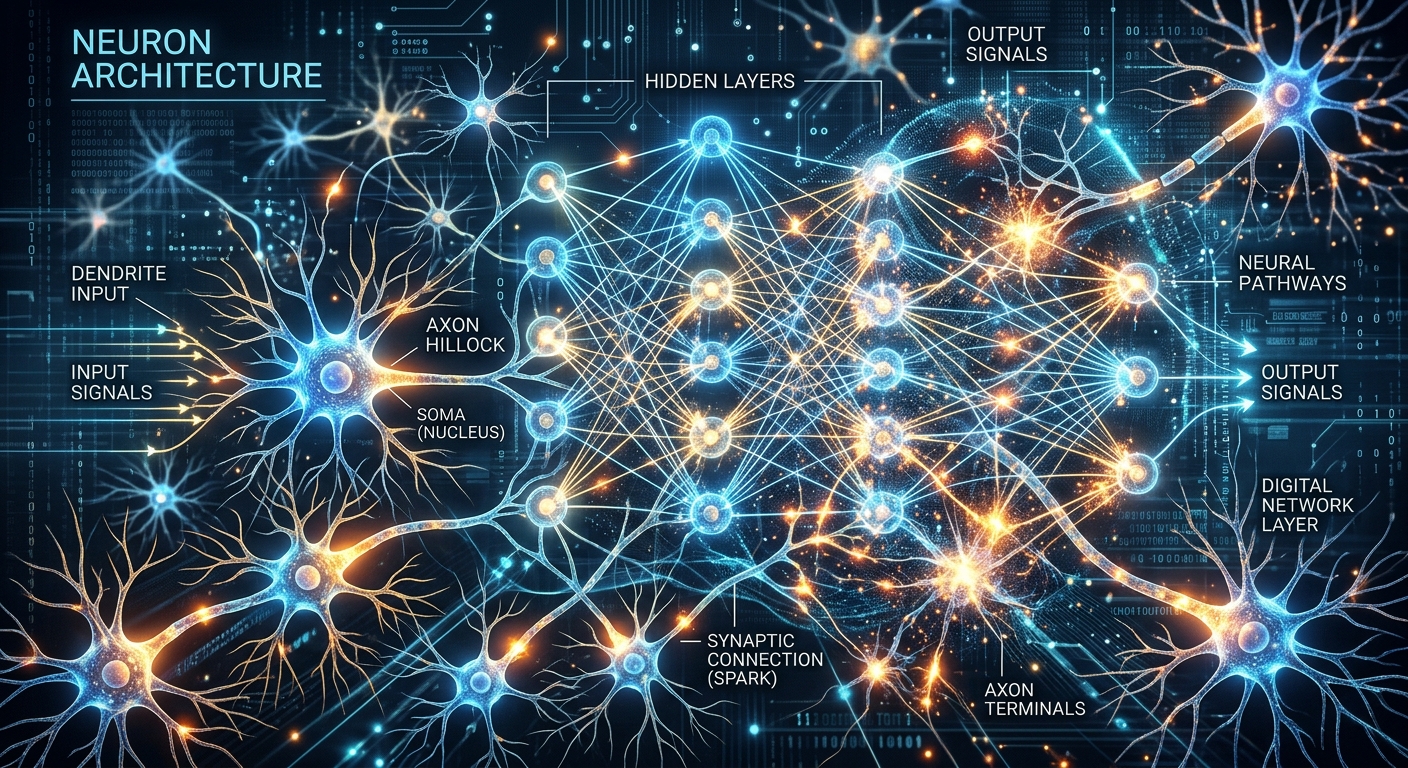
Understanding how biological brains and artificial intelligence networks process information, learn, communicate, and make decisions
Abstract
Neuron architecture is one of the most important concepts for understanding both the human nervous system and modern digital technology. Biological neurons transmit electrical and chemical signals throughout the brain and body, while artificial neurons are mathematical units used in artificial intelligence (AI) systems to process numerical information.
Although these two systems share important principles, they are not identical. A biological neuron is a living cell with complex biochemical processes, whereas an artificial neuron is a computational model implemented in software or hardware.
This thesis explores the architecture, components, communication mechanisms, network structures, learning processes, applications, limitations, and future significance of neurons in biological and digital systems. It also examines how neural networks connect to computing infrastructure, telecommunications, robotics, automation, and the modern economy.
Central thesis: Understanding how individual units connect, communicate, and adapt within a network provides a foundation for understanding intelligence, information processing, and complex technological systems.
Chapter 1: The meaning of neuron architecture
Brain Diagram Generator – Create Neuroscience Illustrations with AI – ConceptViz
1. Biological neuron architecture
A biological neuron is a specialized cell that receives signals, integrates information, and transmits signals to other cells. Networks of neurons support sensation, movement, memory, learning, and many other functions of the nervous system.
2. Artificial neuron architecture
An artificial neuron is a mathematical function that receives numerical inputs, applies weights and a bias, and transforms the result through an activation function. Many artificial neurons can be connected into a neural network.
Demystifying Distributed Systems: The Foundations of Scalable Computing | by Ivan Duhov | Medium
3. Digital network architecture
A digital network connects computers, servers, sensors, and other devices so they can exchange information. It can host or connect AI models, but a digital communication network is not itself necessarily a neural network.
These three concepts are related but different:
- Neuron: An individual biological cell or artificial computational unit.
- Neural network: A collection of connected neurons that processes information.
- Digital network: A communication system that transports information between devices or systems.
Their relationship becomes clearer when we examine their internal structures.
Chapter 2: The architecture of a biological neuron
A biological neuron has several specialized structures. Each performs a particular function, and together they allow the cell to receive, integrate, and communicate information.
2.1 The major components
| Component | Function | Significance |
|---|---|---|
| Dendrites | Receive many incoming signals | Provide input pathways |
| Cell body (soma) | Maintains the cell and integrates incoming activity | Supports cellular function |
| Nucleus | Contains most of the cell’s DNA | Helps regulate cell activity |
| Axon hillock and initial segment | Important site for initiating action potentials | Helps determine when a signal is generated |
| Axon | Conducts electrical impulses away from the cell body | Provides a transmission pathway |
| Myelin sheath | Insulates many axons | Increases conduction speed |
| Nodes of Ranvier | Gaps between myelinated segments | Support rapid impulse conduction |
| Synaptic terminals | Communicate with other cells | Enable network connections |
| Synapse | Junction between communicating cells | Transfers information to another cell |
Not every neuron has the same shape. Some have long axons, while others communicate across very short distances. Their structures reflect their roles in the nervous system.
2.2 How information moves through a neuron
A simplified sequence is:
Dendrites
Receive incoming signals
Cell body and initial segment
Integrate inputs and initiate an impulse when threshold is reached
Axon
Conducts the electrical impulse
Synaptic terminals
Release chemical messengers or communicate electrically
Next cell
Receives and responds to the signal
This sequence is a useful general model, although real neurons can receive thousands of inputs, use multiple signalling mechanisms, and participate in feedback loops.
2.3 Electrical and chemical communication
Neurons use two closely connected mechanisms.
Electrical signalling: Changes in the electrical potential across the cell membrane produce action potentials. These impulses travel along the axon through coordinated movements of ions, including sodium and potassium.
Chemical signalling: At many synapses, an arriving impulse triggers the release of neurotransmitters. These chemicals cross the synaptic gap and bind to receptors on the receiving cell, influencing its activity.
Some synapses transmit signals electrically through direct cell-to-cell connections.
The important principle is that neural communication is not simply electricity travelling through a wire. It is a coordinated biological process involving cell membranes, ion channels, chemical messengers, receptors, and cellular metabolism.
2.4 How neurons learn: synaptic plasticity
The brain does not merely transmit information. It can modify the strength and organization of connections between neurons.
This ability is called synaptic plasticity. Depending on the circuit and circumstances, connections can become more effective, less effective, or change their structure.
Two important forms are:
- Long-term potentiation (LTP): A persistent increase in the effectiveness of certain synaptic connections.
- Long-term depression (LTD): A persistent decrease in the effectiveness of certain synaptic connections.
These processes contribute to learning and memory, although memory depends on many interacting brain mechanisms rather than one process alone. NCBI Bookshelf+1
The significance is profound: a biological neural network is not a fixed wiring diagram. Its activity and experience can change how it processes future information.
Chapter 3: The architecture of an artificial neuron
Perceptron. Understanding the Perceptron: The… | by RB Fajriya Hakim | Medium
An artificial neuron is a mathematical unit designed to transform inputs into an output. It is inspired loosely by biological neural processing but does not contain a cell body, biological axon, or neurotransmitters.
3.1 The building blocks
| Component | Meaning in artificial intelligence |
|---|---|
| Input values | Numerical information entering the neuron |
| Weights | Numbers representing how strongly inputs influence the calculation |
| Bias | An adjustable parameter that shifts the calculation |
| Weighted sum | The combined input calculated using weights and bias |
| Activation function | A mathematical function that transforms the weighted sum |
| Output | The result passed to another unit or used in a prediction |
The most common simplified mathematical representation is:
\[ z=\sum_{i=1}^{n}w_i x_i+b \]
\[ y=f(z) \]
Where:
- \(x_i\) represents an input value.
- \(w_i\) represents the weight assigned to that input.
- \(b\) is the bias.
- \(z\) is the weighted sum.
- \(f\) is the activation function.
- \(y\) is the neuron’s output.
This is the foundation of a large family of artificial neural networks. IBM+1
3.2 A simple numerical example
Imagine an artificial neuron estimating the likelihood that a plant needs watering. It receives two simplified inputs:
- \(x_1\): a measure of soil dryness.
- \(x_2\): a measure of recent sunlight exposure.
Suppose the model uses these illustrative values:
| Variable | Value |
|---|---|
| Soil dryness, \(x_1\) | 0.8 |
| Sunlight, \(x_2\) | 0.6 |
| Dryness weight, \(w_1\) | 0.7 |
| Sunlight weight, \(w_2\) | 0.4 |
| Bias, \(b\) | -0.3 |
The neuron calculates:
\[ z=(0.8\times0.7)+(0.6\times0.4)-0.3 \]
\[ z=0.50 \]
If the neuron uses a sigmoid activation function,
\[ f(z)=\frac{1}{1+e^{-z}} \]
then the output is approximately \(0.622\).
This means the neuron produces a numerical output of about 0.622. It should not automatically be interpreted as a 62.2% real-world probability unless the complete model has been appropriately trained and calibrated for that interpretation.
This example illustrates the mathematics, not a validated agricultural watering system.
3.3 What makes an artificial neuron intelligent?
An individual artificial neuron generally performs a simple calculation. The more powerful behaviour emerges from the combination of:
- Many interconnected neurons.
- Multiple processing layers.
- Nonlinear activation functions.
- Large amounts of suitable training data.
- Learning algorithms that adjust model parameters.
- An architecture suited to the task.
Artificial neural networks learn statistical patterns by adjusting weights and biases to improve performance on a defined objective. IBM+1
Chapter 4: How artificial neural networks are organized
What is an AI Model? Structure, Classification, and Training of AI Models
The architecture of a neural network determines how information moves between its computational units.
4.1 The input layer
The input layer receives the data that a model will process.
Examples include:
- Numerical measurements from agricultural sensors.
- Pixel values from a photograph.
- Numerical representations of words in a language model.
- Temperature, pressure, and energy readings from machinery.
- Historical sales figures from a business.
The input layer is not necessarily where the model performs most of its reasoning. Its primary role is to make the input data available to the network.
4.2 Hidden layers
Hidden layers transform the input into increasingly useful representations.
For example, an image-recognition network might learn to represent simple edges and textures in earlier layers, then combine them into shapes and more complex visual patterns in later layers.
This is an illustrative description; actual learned representations depend on the model’s architecture and training data.
A network with multiple processing layers is commonly called a deep neural network. IEEE Technology Navigator+1
4.3 The output layer
The output layer produces the model’s result.
Depending on the task, this might be:
- A predicted numerical value.
- A category such as healthy or unhealthy.
- A set of probabilities over possible categories.
- A sequence of tokens in a language model.
- A signal for a control system.
The output does not automatically represent a correct answer. It is a model result that may require validation, interpretation, or human review.
4.4 The complete information flow
Input data
Measurements, text, images or audio
Input layer
Represent the incoming information
Hidden layers
Transform information using weights and activation functions
Output layer
Produce a prediction or generated result
Evaluation or action
Check the result and determine what should happen next
This is a simplified feed-forward architecture. Some networks include recurrent connections, attention mechanisms, external memory, or other components that change how information is processed.
Chapter 5: Major types of artificial neural networks
Different problems require different network structures.
Feed-Forward Neural Networks Explained: A Complete Tutorial | DataCamp
5.1 Feed-forward neural networks
Information moves from input toward output without recurrent cycles within the main computation. These networks are used for classification, prediction, and numerical modelling.
Convolutional Neural Networks with Reinforcement Learning
5.2 Convolutional neural networks (CNNs)
These networks use convolution operations to identify spatial patterns in data. They are useful in image recognition, visual inspection, and some medical-imaging applications.
5.3 Recurrent neural networks (RNNs)
These networks maintain internal state across a sequence of inputs. They have been used in speech, language, and time-series processing.
Transformers Explained Visually – How it works, step-by-step | Ketan Doshi Blog
5.4 Transformer networks
Transformers use attention mechanisms to process relationships between elements in a sequence or other structured input. They are central to many modern language and multimodal AI systems.
5.5 Graph neural networks (GNNs)
These networks operate on data represented as nodes and edges, making them useful for studying relationships in molecules, transport systems, knowledge graphs, and social structures.
No single architecture is best for every task. The choice depends on the data, the objective, computational resources, and the accuracy and reliability required. IEEE Technology Navigator+2
Chapter 6: How digital networks connect neurons and computers
A digital network is the communication infrastructure that allows computers to exchange data. Neural networks, by contrast, are computational models that process information. An AI system can operate across a digital network, but the network carrying its data is not the same thing as the AI model itself.
6.1 The five layers of a digital AI system
Layer 5 — Application
AI assistants, business software, agricultural automation and scientific tools.
Layer 4 — Artificial intelligence
Neural networks, model parameters, inference and learning algorithms.
Layer 3 — Computing hardware
CPUs, GPUs, AI accelerators, memory and storage.
Layer 2 — Digital communication
Network interfaces, switches, routers, communication protocols and data links.
Layer 1 — Physical infrastructure
Optical fibre, copper cables, radio signals, antennas and power systems.
These are conceptual layers, not a universal networking standard. In practice, AI software and network communication operate together across several hardware and software layers.
6.2 How information travels through the system
Consider an automated farm using soil sensors and AI.
Sensors collect soil data
Moisture, temperature and other measurements
Network transports the data
Wired or wireless communication
AI model analyses the measurements
Identifies patterns and estimates crop needs
Decision system evaluates the recommendation
Applies agricultural rules and safety limits
Approved action and feedback
Irrigation equipment operates and sensors measure the result
This illustrates how neural computation can become part of a complete digital ecosystem. The sensors provide observations, the communication network transports them, the AI model makes predictions, and the control system determines the appropriate action.
Chapter 7: How neural networks learn
Artificial neural networks usually learn through a training process that adjusts their internal parameters.
7.1 The training cycle
1. Collect and prepare data
2. Run the network and produce predictions
3. Calculate the prediction error using a loss function
4. Calculate gradients using backpropagation
5. Update weights and biases using an optimizer
6. Repeat, validate and test on appropriate data
Backpropagation calculates how the loss changes with respect to model parameters. An optimization algorithm then uses this information to update the parameters. This process repeats across many training examples. IEEE Technology Navigator+1
7.2 The difference between training and inference
| Process | What happens | Example |
|---|---|---|
| Training | Model parameters are adjusted using training data | Teaching a model to identify crop diseases from labelled images |
| Validation | Model performance is evaluated during development | Comparing alternative model settings |
| Testing | Performance is assessed on held-out data | Checking performance on previously unseen images |
| Inference | The trained model processes new inputs | Analysing a new photograph of a plant |
A deployed AI model does not necessarily learn continuously from each new input. Many models remain fixed during ordinary use unless a separate training or updating process is performed.
7.3 Biological learning versus machine learning
| Biological nervous system | Artificial neural network |
|---|---|
| Uses electrical and chemical signalling | Uses numerical computation |
| Can modify synaptic connections | Can update weights and other parameters |
| Learns through experience and biological adaptation | Learns through defined training procedures and data |
| Uses living cells and metabolism | Runs on computing hardware |
| Integrates sensory, bodily and environmental information | Processes information supplied through its designed interfaces |
The comparison is useful, but biological learning is much more complex than simply changing a set of numerical weights. Artificial neural networks borrow ideas from neuroscience without reproducing the complete human brain. NCBI Bookshelf+1
Chapter 8: The computing hardware behind digital neurons
Artificial neurons require physical computing resources. Even though the mathematical model is expressed in software, its calculations must ultimately be carried out by electronic hardware.
NVDA Stock: FLEX, COHR, AMKR, NVTS Inside Rubin’s Supply Chain
8.1 The major hardware components
- Central processing unit (CPU): Handles general computing, system control and many sequential tasks.
- Graphics processing unit (GPU): Performs large numbers of parallel mathematical operations, which are useful for many neural-network workloads.
- AI accelerators: Specialized processors designed to execute particular machine-learning calculations efficiently.
- Memory: Stores the model parameters, intermediate results and input data required during computation.
- Storage: Holds training datasets, software, model files and historical information.
- Network interfaces: Transfer data between servers, storage systems and users.
- Cooling and power infrastructure: Keep the computing equipment within suitable operating conditions.
8.2 From a single neuron to a large AI model
A single artificial neuron might require only a small number of mathematical operations. A large neural network can contain millions or billions of trainable parameters and require substantial computing capacity.
The overall processing workload depends on more than the number of neurons. It also depends on the number of connections, the architecture, the data dimensions, the numerical precision, and the training or inference procedure.
This is why modern AI infrastructure combines powerful processors, high-bandwidth memory, fast interconnects, data storage and software that coordinates the computations.
Chapter 9: Applications in the modern economy
Neural networks are useful when systems need to identify patterns, estimate outcomes, classify information or generate content.
Modern Irrigation & Water Technology — AquaLinked Media
9.1 Agriculture
Neural networks can estimate crop conditions, analyse plant images, forecast yields and support irrigation planning. Their usefulness depends on reliable local data and agricultural validation.
AI-powered Business Verification Solution | Vespia
9.2 Banking and finance
Applications include fraud detection, transaction classification, document processing and risk estimation. Financial decisions require appropriate controls, privacy safeguards and human oversight.
Hispanic woman working on computer. Female doctor analyzing medical scan result.
9.3 Healthcare and scientific research
Neural networks can assist with medical-image analysis, scientific pattern recognition and certain prediction tasks. Clinical use requires careful testing and qualified professional oversight.
Endee – AI Search and Intelligence Platform
9.4 Manufacturing and engineering
Models can identify visual defects, predict equipment maintenance needs and help analyse production data.
Enterprise Infrastructure News: NVIDIA, Dell, Juniper, HPE & Arista – network-switch.com
9.5 Telecommunications and digital services
AI can support network traffic forecasting, fault detection, resource allocation and analysis of changing communication demand.
Neural networks can improve efficiency and provide useful predictions, but they can also make mistakes, reproduce biases in their data, or perform poorly under conditions unlike those seen during training.
Chapter 10: Limitations and responsible design
A comprehensive understanding of neuron architecture must include its weaknesses as well as its capabilities.
| Challenge | Why it matters | Possible response |
|---|---|---|
| Poor-quality data | Models may learn misleading patterns | Improve data collection and validation |
| Overfitting | A model performs well on training data but poorly on new data | Use suitable validation and regularization |
| High computational costs | Training and operation may require significant energy and hardware | Optimize model size and computation |
| Limited interpretability | Some predictions are difficult to explain | Use appropriate explanation and evaluation methods |
| Bias | Model results may disadvantage particular groups or conditions | Audit datasets and test performance across relevant groups |
| Cybersecurity and privacy | Data or model systems may be exposed to misuse | Apply access controls, security testing and data protection |
| Unreliable outputs | A prediction may be wrong despite appearing convincing | Validate results and retain human oversight where needed |
A particularly important principle is that a neural network’s output is not automatically truth. Confidence, accuracy, reliability and real-world usefulness are different qualities that must be evaluated.
Chapter 11: A practical framework for designing a digital neural network project
For someone developing a technology or automation project, the following framework provides a starting point.
- Define the problem. State exactly what the system must predict, classify, detect or generate.
- Identify the inputs. Determine which data are available, their quality, and whether they can be collected lawfully and reliably.
- Choose the architecture. Select a neural-network family suited to the problem instead of assuming the largest model is best.
- Plan the computing resources. Estimate processing, memory, storage, connectivity, power and operating costs.
- Train and evaluate. Establish meaningful evaluation metrics and test the model on data it has not trained on.
- Integrate the digital network. Connect sensors, servers, databases and applications using appropriate communication protocols.
- Establish safeguards. Define access permissions, human approval requirements, failure handling and data protection measures.
- Monitor and improve. Track performance after deployment and update the system when justified by evidence.
For an agricultural project, for example, a modest model that reliably predicts a clearly defined crop condition may be more valuable than an expensive, complicated system that cannot be maintained or validated.
Chapter 12: The future of biological and digital neural networks
Several research directions are expanding how neural systems can be designed and used.
- Neuromorphic computing: Hardware inspired by aspects of neural processing, sometimes designed to support event-driven computation and energy efficiency.
- Spiking neural networks: Models that represent information using discrete events called spikes rather than relying exclusively on conventional continuous-valued activations.
- Edge AI: Running suitable models on devices near the source of the data, reducing dependence on remote servers.
- Brain–computer interfaces: Technologies that measure aspects of neural activity and translate them into signals for selected computer applications.
- Multimodal AI: Systems that process combinations of text, images, audio and other data types.
- Adaptive and continual learning: Research into systems that can incorporate new information while managing problems such as forgetting earlier knowledge.
These fields are not interchangeable, and their maturity varies. Some already support practical applications, while others remain active research areas.
The broader lesson is that future progress will depend not only on creating more artificial neurons, but also on improving architectures, data quality, hardware efficiency, evaluation, safety and integration with real-world systems.
Conclusion
Biological neurons and artificial neurons share a broad organizing idea: individual processing units can combine signals and interact with other units to produce complex network behaviour. However, their physical foundations and operating mechanisms differ substantially.
Biological neurons are living cells that communicate through electrochemical processes and adapt through complex biological mechanisms. Artificial neurons are mathematical operations implemented in computing systems, usually trained by adjusting parameters to improve performance on a defined task.
Digital communication networks provide the infrastructure that allows AI systems, sensors, databases and computers to exchange information. Computing hardware performs the underlying calculations, while software and learning algorithms determine how the model processes information.
For modern innovation, the most useful approach is to understand the complete architecture: data collection → communication → computation → learning or prediction → evaluation → responsible action.
This systems-level understanding can help guide the development of more effective technologies in agriculture, science, education, industry, finance and other parts of the digital economy.
Further reading and scientific references
- National Center for Biotechnology Information — Overview of Neuroscience Research: A Closer Look at the Neural Hierarchy. Biological neuron structure, synapses and neural circuits.
- National Institute of Child Health and Human Development — Parts of the nervous system. Neurons, nerves and nervous-system functions.
- IBM — What is a neural network?. Artificial neurons, layers, weights and model training.
- IEEE — Artificial neural networks. Network architectures and learning methods.
- Google Cloud — What is a neural network?. An introduction to neural-network components and operation.






Be First to Comment